← Pitchfork Economics with Nick Hanauer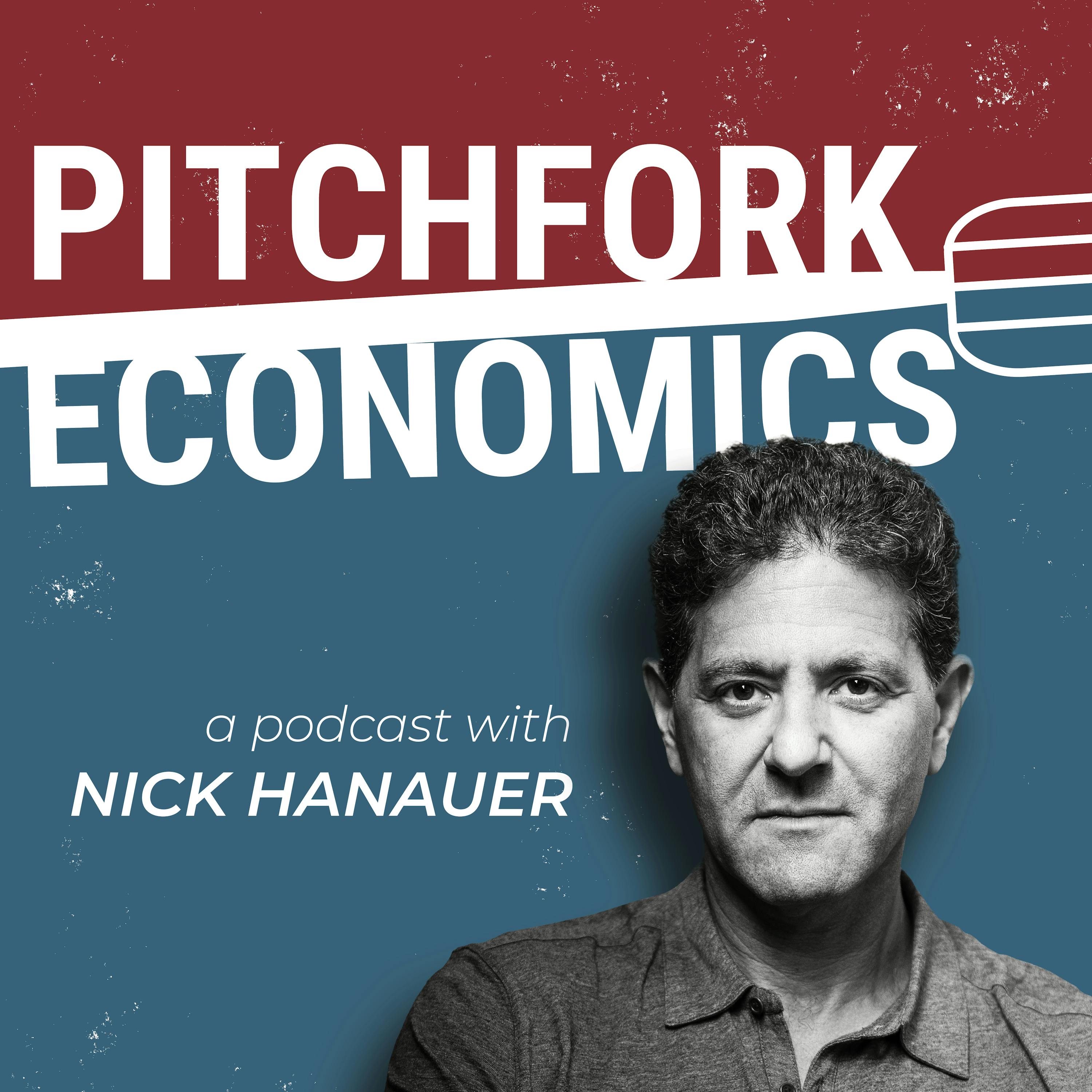
Pitchfork Economics with Nick Hanauer
Market Humanism: A New Operating System for the Economy (with Nick Hanauer)
00:56:24
Loading summary
Transcript166 lines
- [00:02]
Nick Hanauer
The rising inequality and growing political instability that we see today are the direct result of decades of bad economic theory.
- [00:11]
Paul
The last five decades of trickle down economics haven't worked. But what's the alternative?
- [00:16]
Nick Hanauer
Middle out economics is the answer.
- [00:19]
Paul
Because the middle class is the source of growth, not its consequence.
- [00:23]
Nick Hanauer
That's right. This is Pitchfork Economics with Nick Hanauer,
- [00:33]
Paul
a podcast about how to build the
- [00:35]
Nick Hanauer
economy from the middle out. Welcome to the show,
- [00:45]
Paul
Paul.
- [00:46]
Goldie
Hi.
- [00:46]
Paul
Oh, it's always fun to have you on the pod filling in for Nick or sometimes filling in for me. And today it's a really special episode of Pitchfork Economics with Nick Hanauer.
- [01:06]
Goldie
Because this for the world.
- [01:07]
Paul
Yeah, this is the first, first time we've ever done this. This is actually Pitchfork Economics with Nick Hanauer. With Nick Hanauer. Yeah, it's. So the reason why you're joining me, the two of us here is we're going to actually interview our boss today.
- [01:28]
Goldie
So which is something very fair and balanced interview.
- [01:32]
Paul
That's right. A little, you know, caveat up front. He pays us, so keep that in mind. We like to wear our bias on our sleeve and we want you to judge us in that context. But the reason why we're doing this is because, you know, longtime listeners know that we've been talking about what we've called middle out economics for a very long time. We have started using this term, market humanism, to describe the fundamental economic paradigm that informs middle out economics. Middle out economics is a pretty simple high level political and policy narrative that is meant to provide rules of thumb for how to manage the economy and how to talk about it. But it has always been informed by a much deeper scientific foundation and it's something we've been working on in the office. And more importantly, Nick and his co author, Eric Beinhocker have been working on a book forever. I think certainly the entire time you've been working here, Paul, which is almost 12 years, right? 12 years. They started going public with it. There's a little handbook which is a summary of this much bigger book which will be coming out in a year or two called Markets Built for Humans. And recently, in the past couple weeks, put their flag on the ground with a couple pieces in major publications, a piece in the Atlantic and a piece in Democracy Journal which goes into with much greater detail. So we thought it might be a good time to turn the mic on, put Nick on the other side of the mic and have a conversation about what market humanism is and why.
- [03:43]
Goldie
Now, to be clear, though, he is going to still be using this end of the mic to talk into, because if we put him on the other end of the mic, that would make for a bad podcast. I just want to clarify one thing you were saying, Goldie, because you were throwing some terms around. When we talk about neoliberalism, for instance, and we talk about trickle down economics, right. Neoliberalism is sort of the economic paradigm. It's the overarching thing that they teach in schools, that is in the textbooks and things like that.
- [04:10]
Paul
Well, and trickle down neoclassical economics is the thing they teach in textbooks. Neoliberalism is the broader economic ideology that has dominated our policy and the way we think about economics in the economy for the past 50 years. So it's all these terms. And if you don't like the term neoliberalism, some people use the term market fundamentalism, this idea that tries to reduce all of human activity to market interactions. And they teach you how to think like an economist in terms of, I don't know, dealing with your children.
- [04:51]
Goldie
And then trickle down as a term.
- [04:54]
Paul
Right.
- [04:54]
Goldie
Generally we use it when we're talking about the policy and the, the political argument around it. Things like that. Sort of the ground level. Right. So what we're talking about here is market humanism. And that kind of holds the same place in the model as, as neoliberalism or neoclassical. Both, which would you say?
- [05:14]
Paul
In a sense, it's confusing, but both. What we are talking about is not just replacing that neoliberal ideology which is dominated, but actually replacing what we teach in, in introductory economics courses, the fundamental principles of economics. The textbook that is taught is titled Principles of Economics. Market humanism argues that those principles are wrong. It's a big claim. And so, you know, since Nick, you know, earns a thousand times more than us a year, we better. Who better to go and support this claim?
- [06:01]
Goldie
Exactly. Since he's. He's clearly a thousand times better than us at explaining it.
- [06:05]
Paul
Let's see if that. Let's see if that's true. So why don't we talk today?
- [06:16]
Nick Hanauer
My name is Nick Hanauer. I am the founder of Civic Ventures and the host of Pitchfork Economics, and happy to be here on the Pitchfork
- [06:28]
Paul
Economics podcast on the other side of the mic for a change.
- [06:32]
Nick Hanauer
Yes, exactly.
- [06:34]
Goldie
So, Nick, you and Eric Benakker, you have two new pieces out making a pretty big argument. What are you trying to do with these pieces? Let's start there.
- [06:43]
Nick Hanauer
Yeah. Well, as listeners of the podcast know, we have been hard at work for a really long time on a new economic paradigm. Why? Because the Existing economic paradigm is mostly a pack of lies, and in its current form, it functions effectively as a protection racket for the rich. That if you take that paradigm seriously, what we call neoclassical economics or neoliberalism, and enact policy on the basis of it, only one thing can happen, and that is the rich will get richer and everybody else will get poor. And the people who represent that paradigm want you to believe that it is the objective truth about how economies work and that there is no alternative to it. And that also is not true, because all of the underlying assumptions of that paradigm are just objectively, measurably false. And, you know, you can start with one of the oldest of those assumptions, the idea of being utility maximizers. This is a thing that Jeremy Bentham thought up in 1787. He ran no experiments he didn't take. He had no empirical basis upon which to decide this is how the world operated. But it sounded good and it was mathematically tractable, and people grabbed onto it and just assumed it was true.
- [08:11]
Paul
And why wouldn't you? I mean, after all, this is a guy who in his will had himself mummified and is now in a glass case, like in the lunchroom at the London School of Economics. So what could be more credible than that?
- [08:25]
Nick Hanauer
Exactly.
- [08:26]
Paul
Not a weirdo at all. No, I see why he had this deep insight into human nature.
- [08:32]
Nick Hanauer
Yeah, exactly. Not a weirdo at all.
- [08:34]
Goldie
Could I ask a follow up, actually?
- [08:36]
Nick Hanauer
Yeah.
- [08:38]
Goldie
For people who are now, you know, they're going to the grocery store, their prices have been rising nonstop for like four years, things like that. Why is it important to be talking about paradigms right now?
- [08:48]
Nick Hanauer
Right?
- [08:48]
Goldie
Like why. Why is that where you've.
- [08:50]
Nick Hanauer
Why should anybody care? Why should anybody care? Yeah, so that's a great question. It is the question. Because economics, how we see economic cause and effect, which is what a paradigm is, right, is the operating system of the world. It defines for us how we see the world, what we see in it, and what we think we should do to make the world a better place. By way of example, the existing paradigm tells you that the existing distribution of income is the socially and economically optimal distribution by definition, and that anything we do to change that distribution will harm welfare for everybody, will make the economy less efficient. And as a consequence of that belief, the minimum wage, by way of example, has not been increased since 2009 and sits at $7.25 an hour or $2.13 an hour, plus tips for tipped workers. Because the consensus economic view held by both Republicans and to a great Extent Democrats is that because of all that stuff, if you raise the minimum wage, it will create a corresponding amount of job loss. Now, none of that is true. It's the farthest thing from the truth. And one of the reasons is not true is that academic economics has made a category error by insisting that the economy is this Pareto optimal equilibrium, which it is not. It is an ecology of increasing returns. So if you understand the system correctly, as our new paradigm does, as effectively an ecology, claiming that when wages rise, the number of jobs in the economy will fall would be like claiming that when plants grow, animals shrink. This is obviously not how the system works. Affordability crisis that people feel that they have isn't really affordability an affordability crisis. It's a wage crisis. If the minimum wage had tracked productivity gains for the last 50 years or something like that, as it once did.
- [11:15]
Paul
Yeah, for 30 years it did.
- [11:17]
Nick Hanauer
That's right, it did. And it stopped exactly when the neoliberal revolution took over in the mid-70s. But if the minimum wage had tracked productivity gains as it once did, instead of being $7 and 25 cents an hour, it would be in the range of $25 an hour. And if the overtime threshold, which now covers 10% of salaried workers, had tracked productivity gains or basically kept up with the economy, it would include two thirds
- [11:44]
Paul
of workers, which it once did. And.
- [11:47]
Nick Hanauer
Which it once did. And if that was true, the median income in America would be someplace between 50 and 100% higher, and we would not have an affordability crisis. And that's why people should care, is because your policymakers, whether they be Democrats or Republicans with a few small counterexamples, still believe that if they raise the minimum wage, it will be a job killer. And what the old paradigm does neoliberalism effectively is that it takes off the table any policy intervention that could actually help ordinary people, because it codes all of those things as bad for the economy, even though they're not.
- [12:35]
Paul
And by bad for the economy, they mean these. The economists mean bad for average working people. It's bad for you if you raise the minimum wage. It's bad for workers if we tax Nick Hanauer, it's bad for me and all.
- [12:50]
Nick Hanauer
Correct, correct.
- [12:51]
Paul
Which might be true because you pay us, but that's right.
- [12:54]
Goldie
Yeah, in the very particular case.
- [12:57]
Nick Hanauer
Yeah, in this very particular case. Right, but. But for sure, the reason that the vast majority of Americans have fallen farther and farther and farther and farther and farther behind every year for the last 50 years is because of the old economic paradigm. And look, let's be clear. Part of what's animating that paradigm is the intention of terrible people who just do not care about anyone but themselves, who understand perfectly clearly that raising wages doesn't kill jobs. But just say it, because it's the most effective way they've ever found to keep wages low and profits high. And those people will not be healed by better information about economics. Those people need therapy. But the broader problem has been this consensus, which is not nefarious, which just wrong. Right. We just were wrong. We were wrong about what the economy is. We were wrong about human behavior. We were wrong about the origins, prospects, prosperity and the nature of it. And while we will never get rid of the terrible people, they will always exist. Right. Incredibly rich people who do not care about anybody else and who are absolutely convinced that what is good for them is good for everybody. Right. That will never go away. But what we can do for the other 95% of people is show them that we've been understanding economic cause and effect, not just wrong, but effectively backwards. Raising wages doesn't kill jobs, it creates them, obviously. Because if nobody has any money, who will buy the stuff in the economy? That's why this is essential work, is that if we let the existing paradigm continue to dominate policymaking, all of the things that policymakers should do to improve the lives of ordinary Americans will be taken off the table as big government job killing attacks on freedom or whatever it is. And that's why it's such essential work.
- [15:03]
Paul
We've been talking about these ideas.
- [15:06]
Nick Hanauer
Yes.
- [15:06]
Paul
And just started using the term market humanism a little bit on the pod. But we've been starting talking about the ideas for years now. All of a sudden, Nick, you and Eric have two pieces simultaneously. One, this larger piece in Democracy Journal which talks directly about paradigms.
- [15:26]
Goldie
Yes.
- [15:26]
Paul
And lays out what's wrong with the old paradigm and what the new paradigm teaches us.
- [15:33]
Nick Hanauer
Yes.
- [15:33]
Paul
You also have a piece in the Atlantic.
- [15:36]
Nick Hanauer
Correct.
- [15:37]
Paul
Which focuses on the minimum wage.
- [15:39]
Nick Hanauer
Yeah. Narrows the analysis to the minimum wage.
- [15:41]
Paul
Right. And I want to talk a little bit about why focusing on the minimum wage is so important, what it does in terms of tearing down the old paradigm.
- [15:51]
Nick Hanauer
Yeah. I mean, we like the minimum wage. We call the minimum wage the gateway drug of political economy, which. Because it's the simplest thing. Right. If you can use the minimum wage as a. As a way to understand economic cause and effect in a very clear, discreet way. And again, that canonical idea that if you raise wages, it will automatically kill jobs, it's one of the Central claims of neoclassical economics and neoliberalism.
- [16:18]
Paul
It's even more central because, and for those who are watching on YouTube, I'm holding up Principles of Economics. It is Mankiew's textbook, the 10th edition. This is the textbook most widely used to teach introductory economics around the nation. It's by a Harvard professor. It's taught at Harvard. And one of the core principles of neoclassical economics, of orthodox economics, is that there is an inverse relationship between price and demand. When the price of something goes up, demand for it goes down. And that is the driving force behind this equilibrium system, that is the economy. And we all know from our own behavior it's somewhat true, depending on the things you're talking about. But the illustration, the literal textbook illustration of that inverse relationship is the minimum wage.
- [17:18]
Nick Hanauer
Yes.
- [17:18]
Paul
They use the minimum wage to demonstrate this fundamental law that when the price of something goes up, people purchase less of it. Yes.
- [17:29]
Nick Hanauer
And this is obviously may not be obvious to our listeners, it is demonstrably false. Why? Because there isn't a profound connection between how much people are paid and how much they can buy.
- [17:45]
Paul
Right. And even if you don't buy that causal relationship, nick, we have 30 years of empirical evidence showing that it's not true.
- [17:56]
Nick Hanauer
Correct. It's just so important for people, both political leaders and policymakers, but also just the ordinary citizens that go about trying to make a way in the world to understand this stuff because we have to start to push back on these terrible ideological lies.
- [18:16]
Paul
And when you say, Nick, that it's wrong about the minimum wage, what we're saying is it's wrong about the law of supply and demand. Right. That it's.
- [18:26]
Nick Hanauer
It is.
- [18:27]
Paul
It is not a fundamental law. And this is what I love about focusing on the minimum wage. You call it a gateway drug. I like to call it the wedge issue.
- [18:37]
Nick Hanauer
Yeah.
- [18:37]
Paul
If it's wrong about that, it's wrong about everything. Yeah. You got to start questioning everything, because the whole thing, if it's not a law, the whole thing unravels. None of the rest of their theory works. It has to be true. And that's why they teach it is true. Because the rest of it falls apart.
- [18:57]
Nick Hanauer
That's right. Just to your point, Goldie, the reason that we're now talking about market humanism is that Eric and I and dozens of other scholars have been at work on this stuff for a very long time. And what our contribution has been, my colleague Eric Barnach and I, what we did is we could see the hazy outlines of an alternative paradigm in the scholarship, but spread across disciplines, Right? There was all this amazing scholarship within the economics community, but also in anthropology, psychology, physics, mathematics, sociology, so on and so forth. And what we've spent the last 10 years doing is excavating all of that scholarship and organizing it into a coherent whole that you can now see as an economic paradigm that can replace the old one. You know, just to be clear, there's almost no original ideas from us in this new paradigm.
- [19:56]
Paul
You're not doing science?
- [19:58]
Nick Hanauer
No.
- [19:59]
Paul
You're doing narrative.
- [20:00]
Nick Hanauer
We're doing narrative. And what we're doing is organizing the science into a narrative that people can understand and use. And when you do that, when you organize all of the recent scholarship, you end up with this framework that is unbelievably compelling because it's rooted in actual empirical science, where people actually did scientific tests to determine if this stuff was true. Tests about human nature, tests about the origins of prosperity. You know, all this stuff, again, you know, when you. When you see it in its whole form, it totally transforms how you see economic cause and effect. And it opens up a huge amount of interesting territory for the exploration of new policies and new ways to understand how we should organize a society. And that's why it's important. And so the piece in the Atlantic, which narrowly focuses on the minimum wage, begins to explore this new paradigm. The piece in the Democracy Journal, which is longer, explains both what a paradigm is, what the old paradigm is, and explains to a certain degree what the new paradigm is. And I, you know, I hope, in fact, I insist that we also provide a link to the booklet that we call Markets Built for Humans, which is an abbreviated version, although it's quite large, it's 150 pages long, or something like that of the paradigm itself, where all of the detail is located. And. And all of this stuff is free to download. We hope that everyone downloads a copy, reads it, and then shares it with everybody that they know. Because here's the thing, we citizens are going to have to get the word out about this stuff, because the academic economics community is not likely to do it. And the forces of evil are definitely not fired up about this new way of understanding economic cause and effect. So, you know, we'll take a lot of work to get the word out.
- [22:00]
Goldie
So what does it mean to say that markets should be built for humans as opposed to the reverse, which I think is what we've been. What we've been living in for my entire life.
- [22:08]
Nick Hanauer
What neoclassical economics did, neoliberalism did, is it elevated capital efficiency, effectively returns to capital as the highest social and economic good. And anything that in any way took away from the advantages that owners of capital get by deploying capital was understood to be terrible for everybody. The word efficiency, for example, in modern parlance simply means returns to capital. And as a consequence, all the policy making that took place within this framework helped capital returns and harmed everything else. Because the word efficiency should be interrogated. Efficient for whom is it efficient for workers to be laid off? But there's all sorts of ways of looking at it. By way of example, corporate profits as a share of GDP have doubled over the last 50 years from about 5 or 6% to 12 or 13%, while labor's share of GDP has fallen by exactly that amount, more or less. It's in the range of $2 trillion a year. Now that extra $2 trillion a year in profits isn't profits because it needs to be or should be or should be or has to be. It's profits because powerful people prefer to be. That's not more efficient. That's just a different way of cutting up the value created by enterprise in the society. There's nothing more efficient about making rich people richer.
- [23:45]
Paul
It's more profitable. And you know, I think a great example.
- [23:49]
Nick Hanauer
It's more profitable, Goldie, but worse for the economy overall.
- [23:52]
Paul
I think a great example was provided by Covid and the supply chain crises. Those global supply supply chains were very capital efficient. Yes, it costs less. Rather than having manufacturing here and paying people, you know, western wages and keeping large inventories of protective equipment, we outsourced all of that to China and we had just in time delivery of these things. You didn't need to have a big inventory. And when that crisis hit and everything shut down, we had doctors wearing garbage bags for lack of protective equipment.
- [24:34]
Nick Hanauer
Right.
- [24:35]
Paul
We had this huge shortage and that was not necessary. It was not efficient in that moment. Obviously it was extremely costly to deal with that supply chain crisis both in terms of money and in human lives. People unnecessarily died.
- [24:54]
Nick Hanauer
That's right.
- [24:54]
Paul
Because they did not have masks and other protective equipment. You had that trade off between efficiency and resilience. And what we have built is an economy that is not very resilient to shocks.
- [25:11]
Nick Hanauer
Yes.
- [25:12]
Paul
Is it efficient? Sure. When it works?
- [25:15]
Nick Hanauer
Yeah. Well, I mean. But again, the word efficient. Efficient. Efficient for whom and for what?
- [25:20]
Paul
Yeah. And is that good? Yeah, I'd rather be resilient. Yes. Than efficient.
- [25:26]
Nick Hanauer
And you'd rather have a society where no one working for a large company is paid less than it takes to live in dignity without government Assistance. I consider that to be efficient. Like, it is not efficient to have these giant companies paying people so little that they all require food stamps and Medicaid and rent assistance, and they're always having to hold down three jobs and stuff like that. That is not efficient. That's capital efficient.
- [25:52]
Paul
So let me ask you something, Nick. I'm going to cosplay Fox News host here. You are a venture capitalist who became extraordinary wealthy investing in companies, creating companies, investing. What turned you into a communist.
- [26:13]
Nick Hanauer
Yeah, so I definitely don't feel like I'm a communist or socialist because even though capitalists and neoliberals and neoclassical economists misunderstand what markets are and why they're good, they are correct that they are a great social technology. So the conventional view is that markets allocate scarce resources efficiently. And that is not true. There is nothing efficient about how a market works.
- [26:43]
Paul
That is, by the way, again, going to the textbook. Literally, the definition of economics in the textbook is the study of how a society distributes scarce resources. That's what economists do. Okay, that's right. I'm just saying that. I'm not making it up. This is what they teach impressionable youth.
- [27:03]
Nick Hanauer
Yeah, that's right. And that's just not true. The reason that markets are so fundamental to creating prosperity, ennobling the human spirit to a great extent, is that they are evolving evolutionary systems. They're like an ecology where firms act like organisms, and this structure enables groups of people to cooperate to solve complex problems, which is what prosperity actually is. Prosperity isn't money or gdp. It is the accumulation of solutions to human problems, going from aspirin to antibiotics, that is economic progress. That's creating prosperity. And you do that by having groups of people come together with different ideas, putting old ideas together in new ways, and creating new technology, new innovations that can improve our circumstances. And this is what markets do better than anything else we have ever devised. And so I am a huge fan of markets, but not of capitalism, which sees markets simply as a way to extract value from the rest of society. And that is not. I mean, that's not intrinsic to markets. You can structure markets in a way so that they do serve human flourishing. Right? You can use government to ensure that businesses are solving more problems than they're creating. I mean, this is what regulation is, right? Regulation is merely the act of encouraging economic activity that improves people's lives and discouraging economic activity that harms people's lives. And when you do that, you end up. Look, you're never going to have a Utopia. And there will always be again, sociopaths who run companies who try not to do the right thing. But we can very much get change the standards by which we operate markets in ways that will both ensure that they are sort of directionally pointed at helping people, not harming them, and minimizing the damage when there's stuff that goes wrong. And again, you know, market humanism is not a utopian paradigm, but it does point towards a way to organize a society where we will all live much better lives. And I want to make one very important point. Listening to this, you may hear that it's worth making a trade off against growth for a fairer economy. I am not saying that. What I am saying is that a fairer economy will grow faster than an unfair economy. We are not trading off against growth here. By way of example, just so folks know, we used to have an economy that grew at 4, 4 and a half percent a year even. Given that GDP is a terrible measure. But just stipulate that, you know, you're using that measure. And as soon as the neoliberals took over, it fell to 2%. Why? Because all the money in the economy left the pockets of ordinary citizens who actually make the economy go and ended up in the offshore bank accounts of people like me parked in places that don't help the economy. Like putting a $200 million painting on your wall is not driving the economy forward. You know, I've said this a million times. I make a thousand times as much as the ordinary citizen, but I don't have a thousand times as many pairs of jeans. Right. Like I only get a haircut every two months. Right.
- [30:44]
Paul
Like you just rub it in that you need haircuts.
- [30:47]
Nick Hanauer
Yeah, there you go. Yeah, yeah, yeah. But anyway, so that's the core of the thesis is that our economy would grow faster if we included people more robustly in it.
- [30:59]
Paul
And this is the core middle out argument that we've been making for years when we use that term, that this idea that the middle class is a consequence of growth is backwards. That it's a large growing, robust middle class that grows the economy.
- [31:14]
Nick Hanauer
Correct.
- [31:14]
Paul
And the middle class is not a consequence of market capitalism. It was a political choice that was made in the wake of two world wars and a great recession and the rise of communist dictatorships in the Soviet Union and elsewhere. That, ah, we need to prove that our system works.
- [31:39]
Nick Hanauer
Yes.
- [31:39]
Paul
And so an actual, I mean, it was a bargain. People negotiated over this. The leaders of industry agreed to it. There was the Treaty of Detroit.
- [31:50]
Nick Hanauer
Yeah.
- [31:50]
Paul
We had both parties. We had, what was it during the Eisenhower administration when the top marginal tax rate was 94%. That's right. This was a choice that was made to build the middle class, mostly for white people. But yeah, it was, you know, you have to put it in the context of our racist past, but it was a political decision. Political and policy decisions were made and then were later unraveled from the mid-1970s onward.
- [32:23]
Nick Hanauer
That's right. I mean, I think you raised a very important point. One of the central distinctions between the neoclassical paradigm and the new economics, it's relative understandings of the underlying mathematical dynamics of these systems. And the old system assumes that the system effectively is stable. It's like if you compared it to games in the old system, we'd be playing rock, paper, scissors, where what happened before has no effect on the future. But the modern economics, market humanism acknowledges that that is not how an economy actually, how a modern economy actually works. It's called a non ergodic system, but basically means that what happened before matters a lot. That's called path dependence. And luck is also an incredibly important factor. And compounding is also an incredibly important factor. And that game is a lot like the game of Monopoly. And the thing about Monopoly is it doesn't matter if you go to Monopoly school. If five people sit down to a game of Monopoly and they play it long enough, one person will own everything and everyone else will own nothing. It's in the nature of the game. And this is how a modern market economy works.
- [33:47]
Paul
And it's not necessarily meritocratic. No, you could have no right. It's who lands on Boardwalk first and has the ability to buy Boardwalk. Right. And it compounds over time.
- [34:00]
Nick Hanauer
That's right. Four lucky roles in a row and you own the game. Right. You know, that's it. And which is exactly how it is in life. Which is not to say that talent and luck don't play a role. They do at least 50% of the role, but not all the role. And what that means is that there is no middle class in the history of middle classes that was not created without deliberate policy aimed at ameliorating these internal mathematical compounding dynamics.
- [34:33]
Paul
Right.
- [34:34]
Nick Hanauer
And that means that if you want to have a middle class, you have to deliberately create one. And that's why the idea of this laissez faire just, you know, let the free market sort it all out stuff is such utter nonsense. Unless you're the Koch brothers, in which case you don't care. You just want to get richer Right.
- [34:50]
Paul
You don't care about other people where democracy comes in, Nick, because one of the big things that's missing from the old paradigm, deliberately and ridiculously missing, is. Is power.
- [35:04]
Nick Hanauer
That's right.
- [35:04]
Paul
There is no power in the old economics.
- [35:09]
Nick Hanauer
Right.
- [35:09]
Paul
It assumes that it's everything set by prices.
- [35:13]
Nick Hanauer
Yeah. Does the word even appear in the make you textbook? I can't remember.
- [35:17]
Paul
But only in the context of market power. Like the idea that you could get some type of monopoly, you know, large share of a market and then you're able to set prices. Yeah, but it doesn't talk about like the power imbalance between me and you, Nick. Yeah, right.
- [35:37]
Goldie
So. So in the, in the menky view, this is just like three, three equal economic actors having a chat. Yeah, three, three Economic.
- [35:46]
Paul
Right.
- [35:47]
Goldie
We all have equals. Okay.
- [35:49]
Paul
And, well, and you know, it's funny you say this and we never.
- [35:53]
Nick Hanauer
You, you.
- [35:54]
Paul
One of your phrases, Nick, is that, is that employers don't pay you what you're worth. They. They pay you what you're able to negotiate. And. And we never get to negotiate with you over our raises. Exactly. Take it. You've taken yourself right out of the equation because that's what rich people do. There is a natural power imbalance and even Adam Smith talks about that in the wealth of nations that employers have more power naturally.
- [36:22]
Nick Hanauer
That's right. That's right. Yeah. I mean, one of the tricks of the neoclassical paradigm was literally taking power out of the equation. And you know, an economic theory that doesn't account for power would be like a physics that didn't account for gravity. It's just, it's absurd. It's absurd. Obviously power has a huge impact on these arrangements. One of the great examples of this trick is the principle of marginal productivity. This is the theory of economics that says that what you are paid perfectly represents the value you create in the enterprise. The history of this idea is so instructive and such a great parable about how this framework was put together. So in 18, I'm going to get these dates more or less right. In about 1879 or something like that, a guy named Henry George writes a book called Poverty in Progress, which basically says the rich are stealing from you and there's no reason for us to be poor. It's just, this is just this unfair and scandalous.
- [37:32]
Paul
Those of you the urbanists out there, it's the land tax guy. The land value tax guy.
- [37:37]
Nick Hanauer
That's right.
- [37:37]
Paul
That was his main argument.
- [37:39]
Nick Hanauer
So this book doesn't just become a bestseller, it becomes the best selling book in the history of the United States up until that time. And the powers that be freak out. So Was it Morgan? J.P. morgan, I think it was. J.P. morgan breaks out, hires an economist named John Bates Clark, brings him to the University of Chicago and says, fix this. And John Bates Clark comes up with this idea called the Theory of Marginal productivity. And basically what it says is that no matter what you're paid, that's what you're worth. But in the book that he writes, Clark, he says what he shouldn't have said out loud with the quiet part, out loud, which is, hey, you guys, we have to tell people that they earn what they deserve, because if they don't believe that they're getting paid what they're worth, they will be angry, they will revolt, and they will kill us. And we can't have that. So we have to persuade them that no matter how much you're paid, that's the reflection of the value you create. And this idea will not surprise anyone listening to this podcast that that idea sounded great to a whole bunch of rich people, and they swept it up into the economic paradigm and worked it in. And today, when you take Econ 101, they tell you that no matter how much you earn, that's all you're worth. So if you earn $12 an hour as an EMT saving people's lives, that's because 12 bucks represents the value you create. And if you rub money together to make more money on Wall street and earn $100 million a year, well, that's because that's the value you create, which is obviously nonsense. It's just nonsense.
- [39:25]
Paul
It's because you're doing God's work, according to the CEO of Goldman Sachs.
- [39:29]
Nick Hanauer
But it is a belief that is very hard to root out, because everyone has to be the hero of their own story. And I guarantee you that Ken Griffin believes that his $50 billion in net worth is absolutely a reflection of. Of the enormous amounts of value he has created in the world and has absolutely no compunction about the fact that school teachers can barely put food on the table. Like, not a problem for him. Right?
- [40:01]
Paul
Right.
- [40:01]
Nick Hanauer
But these narratives are incredibly important to people because the cognitive dissonance that would be created by having to wrestle with the fact that you're a parasite. You manipulate markets in a very particular way in a context that rewards that. That doesn't feel great.
- [40:17]
Paul
We've been talking for a while. This brings us full circle back to paradigms. What you and Eric are calling for, what we've been essentially working for, on this podcast for the past 150 years that we've been doing it, it feels like that's up to us. Feels like we're talking about a paradigm shift. Right. We're talking about going from the way they teach economics in these textbooks, the way it's been understood and taught for half a century, and the way people view their own role in the economy. Yes. And what it does, what the economy is basically what economics is. And you're talking for a complete paradigm shift.
- [40:58]
Nick Hanauer
Yes.
- [40:58]
Paul
Explain why. We'll admit it's big, but explain why that's not impossible.
- [41:06]
Nick Hanauer
Well, it's not impossible because it's happened before. Right. Like the neoliberal paradigm was created by a small group of people who were committed to the cause. And I think it's worth. As much as I hate neoliberalism today, it's worth acknowledging that the people who created it created it in a context where it made a lot more sense. So that was the context within which the sort of Soviet and Chinese style authoritarian socialism was on the rise, which was distinctly worse than what we had. Right, right. And they were, I think, appropriately worried about those paradigms taking over the world. And so, you know, not all of it was nefarious. Some of it was well meaning. Like all things, the pendulum swung too far and the worst actors got a hold of it and weaponized it to their advantage. And, you know, this is not unprecedented in human history. This is just kind of often what happens. So there's. That there's precedent for these paradigms changing. And the other thing is, is that this paradigm is good for about 99% of the people on earth.
- [42:26]
Paul
It's good for 100% too naked. It means that the people don't rise up and murder you.
- [42:31]
Nick Hanauer
Exactly. But Goldie, even then, even if I wasn't afraid of that, a world in which the median worker earned twice as much as they presently do. In other words, if the median worker had maintained their same share of GDP since about 1975, they would earn in a range of twice as much. Instead of about $60,000 a year, they would earn the range of $120,000 a year. If we had done that, our economy would be effectively twice as large, which means that all of my businesses would have twice as many customers, or if not twice as many customers, customers who could buy twice as much stuff. And the country would have effectively zero budget deficit because there would be so much more tax paid by everybody, by the way, both federally and locally. And we would have one Jillionth of the political polarization that we currently have and none of the political craziness, because everyone would feel like, well, I was kind of included in this. Right. Like, that's all people want. They just want a fair shot. They don't expect everyone to be equal. They just want to feel like it's moderately fair. Right. That if I work hard, play by the rules, I will get ahead. And I don't think that you're likely to be able to build a society on planet Earth that's much better than that.
- [43:55]
Paul
Right.
- [43:55]
Nick Hanauer
Like, I think that's all people want.
- [43:59]
Paul
There will always be haters, Nick, but it's, but it's hard to blame trans people and immigrants for all your problems when you don't really have many of that many problems. Right.
- [44:13]
Nick Hanauer
You know, yeah, you're gonna retire and your kids are doing fine and you can afford to spend. Send them to college and, you know, and all. And your healthcare is not going to bankrupt you and all the things. Right. Like, people are not unreasonable. They just want kind of the basics, and especially when they can see with their own eyes a small group of people doing nothing, which appears to be very productive, living beyond the dreams of avarice, which is the situation we find ourselves in.
- [44:43]
Paul
Right. And let's be clear, when you say that it's happened before, paradigm shift. I mean, shifts happen, and they happen pretty regularly. And 50 to 100 years. Right, right. We had that shift in the 1970s. Before that, what neoliberalism replaced was the old Keynesian consensus that came out of the Great Depression and drove us through World War, you know, guided us through World War II and beyond. Before that was the old laissez faire.
- [45:15]
Nick Hanauer
That's right. That both Roosevelts addressed. Right. Teddy and fdr. Right, right.
- [45:21]
Paul
And. Yeah. And before that, I guess mercantilism. Yeah, before, you know, and so these things. Right. So these things happen. Shifts happen, essentially. And what's important about both the, about the, the past few shifts is that they came out of intellectual movements, very concerted efforts to change people's minds about how markets worked best. And now we have all this science saying that the old paradigm is wrong and that what we're calling market humanism is directionally much more scientific. And that's right.
- [46:09]
Nick Hanauer
And. And you know, Goldie, I mean, as you know, you know, we've only been showing this paradigm to people for about 90 days or something like that. But the reaction from people has been absolutely incred, incredible. Obviously, it's pretty technical, but for people for whom these sorts of ideas are mission critical. They are flipping out, flipping out about this paradigm because it's so. It reframes everything. Right. It just makes everything clear and it makes doing the right thing seem rational rather than irrational. So again, I just really encourage folks who are listening to this podcast to download all this stuff, take a look, and then share it with everybody, because that's what it's going to take to, you know, begin to push back on this orthodoxy.
- [46:54]
Paul
Yeah.
- [46:55]
Goldie
We'll have links to the Atlantic piece, the democracy piece, and the booklet in the, in the show notes. Do you, do you have a preferred reading order in that order? Maybe the Atlantic piece and then the democracy piece and.
- [47:06]
Nick Hanauer
Yeah, I might read the democracy piece first just because it's all encompassing.
- [47:11]
Goldie
Okay.
- [47:12]
Nick Hanauer
It's a big reading list. Sorry, folks, we're weighing you down, but, you know, hey, you don't want to live in a, you know, authoritarian hellhole. It's going to take work.
- [47:24]
Goldie
A little bit of reading is all.
- [47:26]
Nick Hanauer
Yeah, yeah, yeah. It's going to take a little reading.
- [47:29]
Paul
Okay. I want to take advantage of this very special situation, Nick, to ask you the final question. Why do you do this work?
- [47:39]
Nick Hanauer
That's a good question. Yeah, I get asked that a lot, as you can imagine. And the best answer I've been able to come up with is one third is just empathy. I think I'm a reasonably empathetic person and I just. I am happy when other people are happy. I'm not happy when other people are sad. You know, I just. And living in a world where most people are struggling is not the world I want to live in. Right. There's no reason for it. You know, it's unnecessary and bad and we shouldn't do it. So there's. That a third of it is that I just find this work unbelievably interesting and stimulating. It's just a joy to work on these problems and to try to use your brain to figure them out. I can't put. I mean, Goldie, I know you agree, right? Well, you do too, right? It is such a privilege to get to work on this stuff and to think about it and to talk to people who are working on it and all that stuff. So, you know, it's just, it is fun. And the third is, you know, I think it just, just if I'm just self reflective at all, I'm pathologically ambitious. I've always been ambitious. I never saw a problem I didn't want to solve or a mountain I didn't want to climb or whatever. It is. And I just think that rewriting the. Operating the system of the world. Ambitious, yeah, crazy, like comically ambitious. But, you know, it's just the kind of stuff I love to do. I've always liked to do. I always wanted to start big companies and do crazy things. And so this is currently the outlet for my ambition.
- [49:18]
Goldie
Right.
- [49:18]
Paul
And you know, Nick, I think something you and I really share is we both like being proven right.
- [49:25]
Nick Hanauer
Yes. We love to be right.
- [49:32]
Goldie
So I really liked where Nick landed at the end there when he referred to this as the operating system of the world, because I think that's something. I don't think that we actually talked about, something we say around the office a lot is that economics is the story of who gets what and why. Right, Right. And that's, that's the whole ball game, right? That's like the explanation of why we make what we do and why Nick makes what he does. And I think, I think operating system is a. Is a, you know, relatively modern way of thinking about it. But it seems very clarifying to me in that it's, It's. It signifies both how it works, how this, this paradigm works, and also the size and scope of the. The challenge.
- [50:13]
Paul
Right. And it's, you know, one of the things, you know, we emphasize throughout that this is all of our claims are grounded in science. And one of the scientific claims, it's clearly true, is that we are storytelling creatures. This is, this is how we evolved.
- [50:28]
Nick Hanauer
We.
- [50:29]
Paul
We understand the world and our place in it through the stories we tell. And if you understand economics as a story, as you said, a story we tell ourselves to justify who gets what and why, we begin to understand that we can interact with the economy differently, we can guide it, we can change it. We can choose different outcomes.
- [50:55]
Nick Hanauer
Different.
- [50:55]
Paul
Not just different policies, different outcomes. If we tell ourselves a different story. And that's what that giant stupid textbook is. It's a story you go through and you. And he tells little stories, Maku tells little stories throughout it. It's a story supported by graphs and charts that are grounded in absolutely fucking nothing. And I want to get. And I want to get to this because this is really important. I want people to understand this because I don't think it was emphasized enough in this conversation how deeply grounded in science, market humanism is not just psychology or anthropology, evolutionary science, but all the way down to physics. How many of the most influential thinkers that have guided the new economics, whatever it ends up being called, and however its narrative is eventually formalized, how much has come out of just plain old physics. Physicists, the complexity theorists, the information theorists. It is real hard science, of which there is none in the old economics. It is this fascinating thing that the old economics, neoclassical economics, its whole equilibrium system is modeled on the first law of thermodynamics, which is the conservation of energy. When one thing goes up, another thing must go down. It's modeled on that. That is the metaphor that guides all of the old economics, orthodox economics, and yet there's no actual physics in it. It just adopts the metaphor and is totally unscientific after that. And it's ironic because at the time the old economics was formulated, the second law of thermodynamics had not been discovered yet. And that is essentially entropy. That the universe is on this path towards the cold, dark death in the universe, that to do any sort of right work, to create any sort of order, you need to use energy. And using energy, converting energy into order, always creates waste, which ends up creating more disorder in the end. And this is what life does. Organisms access energy to create order in our own bodies. And this is what the economy does, what societies do. We access information, create order, not just in our bodies to feed us, but in our physical world. None of that is in the old economics. It's not mentioned at all. It's not a part of it. And so you can't ask economics to solve the climate crisis when it doesn't acknowledge the central role of energy in extending our lives and creating high living standards, because it doesn't look to science at all. It's just not scientific. It's a bunch of theories and simplifying assumptions that have been created in order to satisfy that equilibrium model that they put together in the 1870s. And everything goes from that. If you go through and you read that Market Built for humans books, you'll see all the citations, you'll see the science in there. It is scientific.
- [54:30]
Goldie
I would inherently mistrust anyone who came down and said, I devise this system. Right. I like that. Nick led by saying, this is all out there, and we organized it. Organized is an interesting word. I might have said synthesized, but yeah, it's a tremendous amount of reading and thinking and arguing that has been going on behind the scenes for decades. And within our shop, especially within the last year, was like sort of, you know, it was building up to this. So we're. And on this podcast and we're very excited to have it out in the world and so that other people can join the conversation and argue and, and add and, and you know, keep working on it. And so it's a big moment. It's a big moment for us.
- [55:15]
Paul
And we'll be obviously talking about this a lot more on the pod in the future.
- [55:21]
Goldie
Yes. And so you can start by reading the pieces in the show Notes. We have a link to the booklet that Nick mentioned called Markets Built for Humans. And we also have links to the piece in the Atlantic titled the Economic Experiment that Upended Reality. And in the Democracy Journal, there's a piece titled Market A New Paradigm for a New Era. Pitchfork Economics is produced by Civic Ventures. If you like the show, make sure to follow, rate and review us. Wherever you get your podcasts, find us on other platforms like Twitter, Facebook, Instagram and Threads. Pitchfork Economics. Nick's on Twitter and Facebook as well.
- [56:02]
Nick Hanauer
Ickhanhauer for more content from us, you
- [56:05]
Goldie
can subscribe to our weekly newsletter, the Pitch over on Substack Tech. And for links to everything we just mentioned, plus transcripts and more, visit our website, pitchforkeconomics. Com. As always, from our team at Civic Ventures, thanks for listening.
- [56:18]
Nick Hanauer
See you next week.