← Pitchfork Economics with Nick Hanauer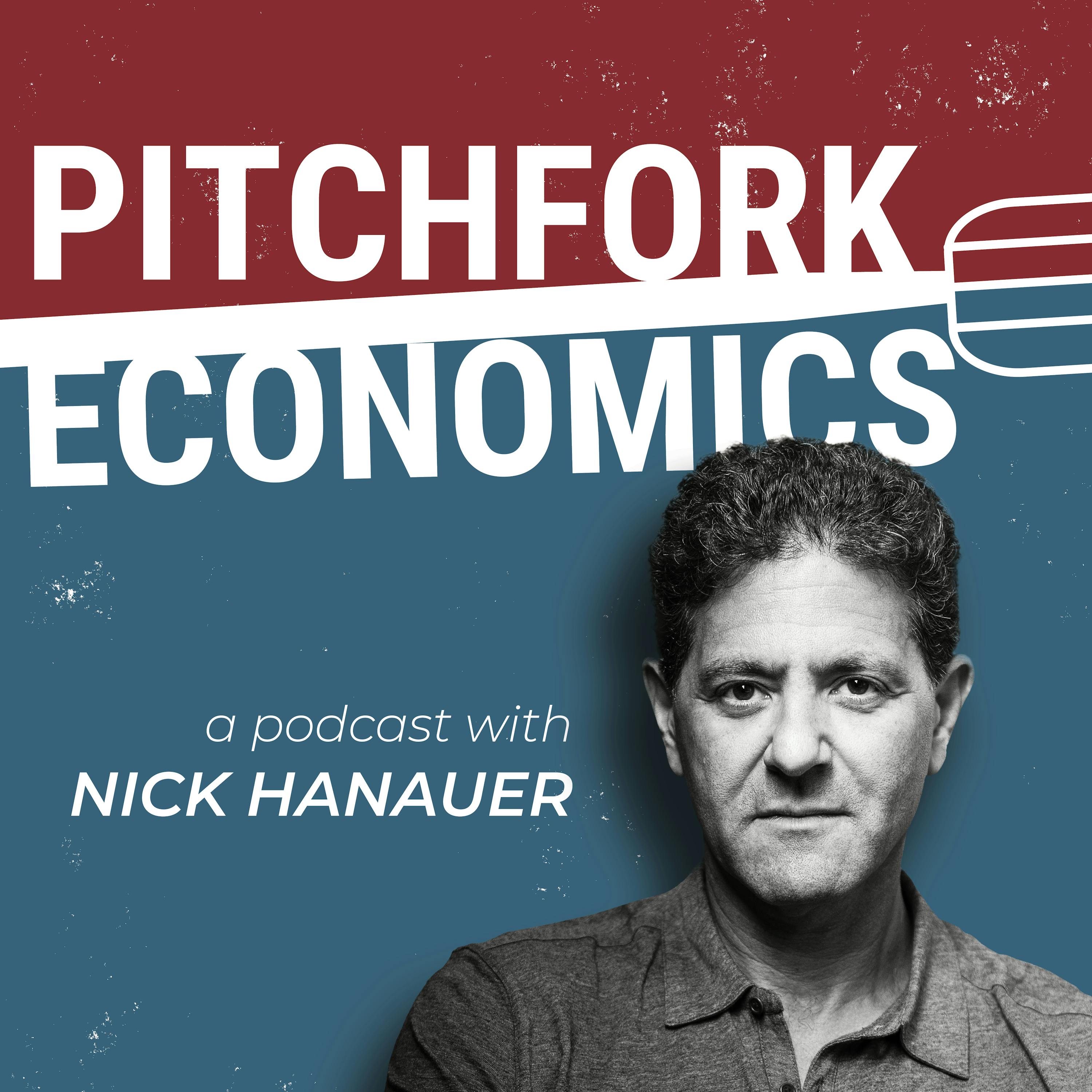
Pitchfork Economics with Nick Hanauer
Back to Basics Series: Where does economic growth really come from? (with W. Brian Arthur and Cesar Hidalgo)
00:46:51
Loading summary
Transcript104 lines
- [00:00]
David Goldstein
Hey, Pitchfork listeners. Goldy here. We've been doing this podcast for a long time now, so we thought we'd take a little break this summer, but we don't want you to miss us too much. So we thought we'd revisit some of the most central episodes from early in our history with a back to basic summer series. And what could be more basic than our conversation with W. Brian Arthur about where does economic growth really come from?
- [00:31]
W. Brian Arthur
I think we've made this mistake of politically or culturally idealizing a system that was never meant to become a cultural ideal.
- [00:44]
David Goldstein
Complexity is really where our wealth, our standard of living comes from in a modern society.
- [00:52]
W. Brian Arthur
It's rather like saying we want to look at how butterflies fly. And to do that, we'll chloroform them and nail them to a board and then figure out.
- [01:07]
Nick Hanauer
From the offices of Civic Ventures in downtown Seattle, this is Pitchfork Economics with Nick Hanauer, where we explore everything you.
- [01:16]
Cesare Hidalgo
Wished you'd learned in Econ 101.
- [01:22]
Sarah Lebovitz
Foreign.
- [01:28]
David Goldstein
I'm David Goldstein, senior fellow at Civic Ventures. So, Nick, in episode five, we ended by talking about what, a sucky measure of growth. Gdp.
- [01:41]
Nick Hanauer
Yes.
- [01:42]
David Goldstein
Yeah. And we promised in this episode we'd come up with something a little better.
- [01:48]
Nick Hanauer
Yeah.
- [01:48]
David Goldstein
So what do we have?
- [01:50]
Nick Hanauer
Well, I think that if you're going to talk about growth in any sort of meaningful way, you have to examine the question, growth of what? Like, what do we want more of money? Well, you know that indeed, thinking about money is the conventional way to think about prosperity and growth and market economies. As in, the more money you have, the more growth you have and the more prosperous you are. But there's a really easy way to see why. Money is actually not a very good way to conceptualize prosperity. And it is to imagine yourself as king or queen of the jungle and having a ton of money, all the money in your society. I don't know what it would be. Beads or shells or whatever it was.
- [02:43]
David Goldstein
Or even, let's say, gold.
- [02:44]
Nick Hanauer
Gold.
- [02:45]
David Goldstein
Lots of gold.
- [02:46]
Nick Hanauer
Exactly. But gold would not buy you air conditioning or antibiotics or a comfy bed, because in a primitive society, you pretty much have a hut and a hammock and some very, very basic foodstuffs. But even a poorest person in a modern society has access to antibiotics and air conditioning and a bus, if not their own car, bus service, and so on and so forth. Indeed, many of their most pressing problems, if not all of their most pressing problems, have been solved by society. So for this reason, I think it's best to conceptualize Prosperity in human societies as not money, but solutions to human problems. And it's the accumulation of solutions to human problems that is best understood as how an economy grows.
- [03:38]
David Goldstein
And when we talk about solutions, we are largely talking about technologies, be they like physical technologies, like we normally think of, or social technologies. These are the way we solve human problems.
- [03:53]
Nick Hanauer
That's right. And by the way, we use social technologies to create new physical technologies. Social technologies being the ways in which we arrange society in order to cooperate in groups to solve complex problems. But again, it's probably worth saying the solution to a human problem can be from the profound, like curing cancer, that's a solution to human problem, to very prosaic things like a crunchier potato chip. Both of those things are indeed solutions to different kinds of problems. You can have an argument about which of those is more important. But one of the ways of understanding the difference in prosperity between a primitive culture and an advanced society is basically the number of skus in a store. If you go to a primitive society, there are very few things to choose from. If you go to a big store in a big city in a developed world, there are 10 different kinds of ketchup to choose from. Each one of those products, in essence solving a finer and finer grain problem in human societies.
- [05:01]
David Goldstein
And so this gets to really, I think one of the big themes in this episode, which is complexity.
- [05:08]
Nick Hanauer
That's right.
- [05:08]
David Goldstein
A modern, technological, prosperous economy is incredibly complex.
- [05:15]
Nick Hanauer
That's right. And the most advanced solutions to human problems are often insanely complex. And the exemplar of that, of course, that everybody uses is the iPhone or the smartphone. This is an enormously complicated object constructed of dozens of enormously complicated technologies knit together into a solution creating product that people use every day in their lives. And I think understanding prosperity as complexity makes you think in very new ways about where growth comes from. Because if prosperity is complexity, then it's very, very clear that complexity depends on a very high level of cooperation from a bunch of people working in different ways on different things to make a complex solution to a human problem.
- [06:14]
David Goldstein
So essentially, the more complex a product generally, the more value, like an iPhone is more valuable than your old wall phone, your landline phone.
- [06:26]
Nick Hanauer
That's right. Or a hunk of iron ore. Right, right.
- [06:30]
David Goldstein
So how do we get this increasing complexity in our products and in our economy?
- [06:35]
Nick Hanauer
Yeah, well, the most magical part of market capitalism is the way in which it allows people to break tasks up into finer and finer areas of specialization, and then to re knit those specialized chunks of knowledge back together. In novel ways to create new technologies.
- [07:10]
Sebastian Simch
It will take a moment for this water to heat up, so we'll have a little moment. So this is filtered water. If you don't filter the water, then it won't taste very good. And if it doesn't taste very good, your coffee doesn't taste very good. Because after all, coffee is mostly water.
- [07:33]
Sarah Lebovitz
Hi, my name is Steve. My name is Sarah Lebovitz and I'm a producer on Pitchfork Economics.
- [07:37]
Sebastian Simch
So I'm currently making you a pour over Chemex. It's an American made filter coffee maker and I added 42 grams of coffee and I'm adding about 570 grams of water. And then it's just dripping through here into this beautiful carafe called the Chemex.
- [07:58]
Sarah Lebovitz
That's Sebastian Simch, the owner of Seattle Coffee Works, a local roastery. He's making a cup of coffee, something a lot of people do every day. But as he explains, the work it takes to make that cup goes so far beyond just pouring it out of a bag.
- [08:16]
Sebastian Simch
We buy coffee directly from farmers, and that means we have a green coffee buyer. He's actually a Guatemalan citizen. His name is Oscar Garcia. So he travels to all the countries that we source coffee from. Guatemala, Honduras, El Salvador, Nicaragua, Panama, Ecuador, Colombia, Ethiopia, in East Africa and Kenya. And he needs to talk with them about potential issues in quality or potential opportunities to improve the quality. Now at that point, he negotiates a price for the season and that price is what we pay the farmers. But now we, we need a truck to transport this coffee to a dry process export processing facility. There's a little more processing that goes on. It needs to be put in bags, it needs to be more sorted. And that usually happens in another facility, not on the farm. So that takes it to the processing facility. At that point, the coffee gets sorted. And in that process, you sort out bad beans from good beans, basically, and you lose about 10% of your harvest.
- [09:24]
Sarah Lebovitz
So you get a broker to deal with the farmer. They handpick the coffee, they sort the beans, often by hand, and pack them into bags. And that's not even mentioning the lining of those bags, which is made in the US or China, and then has to be shipped to the coffee's country of origin so that it can be packed up and then shipped back to China, at which point it's finally on its way to the US and then they just have to make it through customs.
- [09:53]
Sebastian Simch
This is such a complex process to bring coffee into the country that most of us, unless we're Very large companies. We hire what is called a customs broker. And this customs broker is in very close touch with all kinds of entities at the port. It comes into the port, the ship unloads, and at that point, it is not in the country until all kinds of government entities have signed off on this whole container entering the country. The customs broker, for a fee, will help bring that container through that barrier.
- [10:26]
Sarah Lebovitz
And after all of that, it sits here in a little roastery with Sebastian and me. Thousands of pounds of beans that need to be stored and roasted and brewed or packaged and then shipped off somewhere else where maybe, if they're lucky, someone will buy a bag. The amount of work and workers that goes into a single cup of coffee is incredible. The growers and brokers and pickers and sorters and shippers and roasters and baristas, some of whom take months or even years to fully train. And that's not even counting the filters and grinders and other equipment, let alone the vastly complex power, water and transportation systems that contribute to every cup. And at the end of the day, what you have is a cup of coffee, brown liquid, devoid of most nutrients, if we're being honest. Something simple, something small, something we all take for granted, thanks to an economy that's incredibly complex.
- [11:32]
Sebastian Simch
This is a mix between some Bali coffee from Bali and some coffee from Ethiopia. Cheers.
- [11:47]
Nick Hanauer
Our friend, the economist Brian Arthur, is one of the leading thinkers in the world about what technology is. And his core insight is that contrary to sort of popular perception, invention and technology isn't this sort of individual effort that ends in eureka and a new idea is born. In fact, all technologies are created by combining other older technologies. And that's where cooperation comes into play.
- [12:30]
W. Brian Arthur
My name is W. Brian Arthur. I go by the handle Brian. I am an economist and mostly mathematician and engineer by training. I taught for many years at Stanford University. I taught economics, and I've been associated with the Santa Fe institute for over 30 years. And I am an external professor at Santa Fe Institute these days.
- [13:00]
Nick Hanauer
So, Brian, why don't we start at the beginning, which is complexity, right? And what that is and why it is such an important concept with respect to economics.
- [13:17]
W. Brian Arthur
Well, there's a really old view in economics, goes back to Adam Smith, that people in the economy, the butchers and bakers, etcetera, are working away and working together and exchanging goods and so on. They create a trading system or even a pricing system, and in turn they react to that. So you have a kind of feedback loop. The businesses in the economy, the people in the Economy are creating a system. It's almost like a little ecology of its own. And in turn, the businesses and consumers and producers and investors are reacting to this system that they've created. Now, about 150 years ago, economics simplified all of this so they could get analytical results. And they said, okay, we're not going to look at the agents in the economy as creating an economy that keeps changing, that they keep reacting to and thereby change again. We're going to simplify things and assume that agents in the economy, whatever part of it we're looking at, produce behaviors that create some pattern in the economy that poses no incentive for those agents to change. So it's rather like saying, we want to look at how butterflies fly. And to do that, we'll chloroform them and nail them to a board. Then we'll figure out how they're going to fly. I think that a lot of baby got thrown out with this particular bathwater. Standard equilibrium economics, the result of all of this, I think, was greatly successful. It was very much mathematized since the 1870s when it was more or less invented. It became highly analytical, highly mathematical. But in a way, a lot of economists, and I'm one of them, complained that there was something deadening about it. To assume that everything was in equilibrium was a bit like assuming nothing happened, that you reach an equilibrium, that all forces are in balance, a bit like a spider's web, and nothing's really going on. And in particular, that rules out invention and structural change and rail adaptation. It rules out a lot of things that I would say belong to the formation or constant change and constant churning and new things, new upheavals in the economy. The economy was idealized in a way, and we kept looking that ideal system, and we got a lot of payoff for it. But a lot of things to do with change and formation and innovation were left out.
- [16:39]
David Goldstein
In our writing, we only make one normative assertion, which is that the purpose of economics is to broadly improve the lives of people. So I'd like to talk a little bit about how we actually improve the lives of people. And I think you would argue that a lot of that comes through technology.
- [16:57]
W. Brian Arthur
Sure. I was trained as an engineer, so I. When I went into economics, this was in grad school, I was a little bit shocked. Economics basically thought that the economy existed, kind of existed like a big container or huge, big ball. And every so often, helicopters would come along and drop new technologies into this container. I don't want to be. I don't want to Be too frivolous about this. Economists have thought seriously about invention and innovation. But it occurred to me, and it became plain when I started to look at technology, that technologies were not so much brought about by the economy. The economy was the result of its technology. Technologies are basically the way we solve human problems. They are means of fulfilling human purposes. So if we have a need like smelting iron ore, we will in due course we come up with the technology to do that. If we want to communicate among ourselves, say 100 years ago or more, we invented the telephone system and a lot of things that went with that, including repeater stations to carry the message and refresh it every 50 miles or so. So we've done an awful lot as human beings with technology. And I would certainly argue that we, if we had a choice between swapping our modern day technologies with the ones we had, say, five, 600 years ago, at the end of the middle ages, there's not much comparison, especially with medical technologies. Our grandchildren survive, our children survive, and we ourselves tend to survive into our 80s and 90s when where before we might have died within the first five years or maybe at age 35 or 40. So technology has done a huge amount for us as humans, all these different methods and procedures.
- [19:31]
Nick Hanauer
Can we take a step back and can you talk a little bit about where technology comes from? Because I think that for my own part, your book the Nature of Technology was revelatory because we certainly in the west, we have been sort of taught to think about technology as sort of the eureka metaphor, right? The light bulb going on in somebody's head, and a new technology was born. And I think what you show so persuasively is that technology is combinatorial.
- [20:10]
W. Brian Arthur
Yeah. I started to look at technologies where they actually had come from. Ancient technologies, really modern ones. The computer, radar, modern railroad, steam engine, all of these technologies. When I started to look at how these major technologies had come into being, I found it wasn't so much a eureka moment or people having genius inspiration. It was practically always that there was some practical problem to be solved. And people solved these problems, say, like the invention of radar, by putting together pieces of technology that already existed. So it's like you come along to some person who has a bunch of Lego sets and you say, I've got the following problem. And that person says, yep, I think I can see how to put together pieces that will solve your problem. So new technologies weren't something that were invented out of nothing, that sprung out of the ground like Greek soldiers or something. New technologies came into being as combinations of previous technologies.
- [21:33]
Nick Hanauer
Yeah. And there's a fancy word you use to describe this.
- [21:38]
W. Brian Arthur
Autopoiesis.
- [21:39]
Cesare Hidalgo
Yeah.
- [21:39]
Nick Hanauer
Yes.
- [21:41]
W. Brian Arthur
Okay. All right. Thanks for the prompt.
- [21:46]
Nick Hanauer
Yeah.
- [21:48]
David Goldstein
Nick didn't want to try to say it himself.
- [21:52]
W. Brian Arthur
So if you want to be fancy about it, there's a lovely word called autopoiesis, meaning self producing. If you take the whole collection of all the technologies we've ever had and you say that new ones are invented as combinations of the old. The steam engine, for example, consists of pistons and cylinders, etc. Boilers. All of these existed before the steam engine. So if new technologies are a combination of what's already gone before, then you come to the conclusion that technology is self creating. The new pieces grow out of old ones. The fancy way to say that is that it's autopoietic or self producing in Greek.
- [22:44]
Nick Hanauer
Here's the thing I think that's so profound about that insight, is that the cultural, political, and policy implications of understanding technology as this combinatorial cooperative process are profound versus seeing it as this sort of individual effort.
- [23:12]
W. Brian Arthur
Right.
- [23:13]
David Goldstein
Give some smart, innovative guy a lot of capital and we'll get new technology as opposed to that combinatorial process where there's actually the diversity of existing technologies determine what new technologies are even possible. Because it limits the design space.
- [23:31]
Nick Hanauer
Yeah. And the kind of culture and the kind of policy frameworks you end up with. Understanding technology in this modern way versus the old way, I think are super, super profound. Thank you so much.
- [23:45]
W. Brian Arthur
I want to say this to the two of you.
- [23:47]
Nick Hanauer
Yeah.
- [23:48]
W. Brian Arthur
This has been enormously enjoyable. Thanks to both of you.
- [23:53]
Nick Hanauer
Yeah, yeah, yeah. Thank you.
- [23:54]
W. Brian Arthur
Thank you again.
- [23:55]
David Goldstein
Thank you. So Brian Arthur gave us a very clear explanation of how new technologies evolve from old technologies. But to be clear, they don't evolve on their own. They evolve due to humans.
- [24:16]
Nick Hanauer
That's right.
- [24:17]
David Goldstein
Experimenting, innovating, just randomly stumbling upon.
- [24:21]
Nick Hanauer
Correct.
- [24:22]
David Goldstein
And in the end, all of this comes from the human imagination.
- [24:27]
Nick Hanauer
Yes. And the way in which societies or social technologies enable people to combine their imaginations into new. Into new and better things. And no one has better explained this process than Cesar Hidalgo in his book How Information Grows.
- [24:54]
David Goldstein
Professor Hidalgo?
- [24:56]
W. Brian Arthur
Yes.
- [24:57]
David Goldstein
This is David Goldstein at Civic Ventures. Thanks for joining us on the podcast today.
- [25:05]
Cesare Hidalgo
It's my pleasure. Hi, my name is Cesare Dalvo. I run the Collective Learning Group at the MIT Media Lab, and I try to understand how teens, cities and nations learn. My latest book is called why Information Grows.
- [25:17]
David Goldstein
You know, most people, when they think about economics, if they take their Econ 101. They think of it in terms of some very simple models of behavioral model and an equilibrium model. But that's not the way you break it down. You talk about the economy in terms of information.
- [25:37]
Cesare Hidalgo
Yes, exactly. So, like, I think economics has an original scene, as most fields do. And the original scene of economics is to have started from the study of trade. So as economics started with first Josiah Child and then with Adam Smith, you know, basically the problem that economists were asking was when it was convenient to exchange something with someone, and at what price and in which quantities. And those are preferably fine problems. But they missed another problem, which I think it was extremely important, which is where does all of this stuff that we get to exchange comes from? Okay, how do we produce it? How difficult it is to eat? What does it need to be made? And those more fundamental questions are questions about the accumulation of knowledge in society and about the manifestation of knowledge in multiple different things, in the teams that produce the things that we eventually exchange, but also in the things that we create and that carry the practical uses of that knowledge. So we live in a world in which each one of us is kind of stupid, but we're able to perform at a very high level of capacity because we're in out with all of these products that have really magical properties. The ability to talk at long distances or to fly across the world, or to watch a movie that was produced in a different decade. All of those capacities are something that we get access to because of these products. And what I really wanted to understand was not so much the laws that govern the exchange of goods among people, but those that help us understand how people can create the goods that eventually wind up exchanging. So that's how I got into understanding knowledge, learning, and of course, information.
- [27:19]
David Goldstein
Right. I think the first sentence of your book, you say that the universe is made of matter, energy and information. And it's the information that makes the universe interesting. You know, information itself, unlike matter, is weightless. But you describe knowledge and know how as heavy. Explain what you mean by that and why that has consequences on the economy.
- [27:47]
Cesare Hidalgo
Yeah. So in some way, you know, we have a world in which there are groups of people that are able to produce things that endow us with fantastic capacities. Why is also our world so uneven? Why are there some parts of the world that are so rich and some parts of the world that are so poor? And the answer must be that there's something that these parts of the world that are so rich have that other ones don't. And this something must Be hard to move. And for a long time, economists have been thinking about that question. And at the end of the 80s and the beginning of the 90s, they realized that the only quantity that could explain this is knowledge. It's the only thing that grows in per capita terms. But when people think about knowledge, they tend to assume that knowledge is something that is very easy to move, that is very light in some way. But actually it's not because you have to distinguish between knowledge, know how, and also ideas, which is what sometimes people think about when they think about knowledge. So think about a car. The idea of a car is kind of obvious. You know, every child understands very quickly that you can put four wheels on some sort of rectangle and you can make yourself some sort of car. They understand that there are cars in the street that move around, autonomous sort of move around, you know, based on the engines that they have, without any problem. But the idea of the car can move very quickly. But the knowledge on how to make a car is something that cannot move that quickly. Okay, so the moment that the cars are invented, few years after a lot of people in the world have this concept, they're ready maybe to buy a car, they have enough money to do so. But the knowledge on how to produce it is something that remains concentrated in a small group of people. So if you start looking at the world that way, ideas can fly very quickly and can move very easily. And there's no problem for communication technologies to move ideas across the world. But the world doesn't just need ideas, it needs the ability to execute the ideas. And that's knowledge, and that's know how. And that gets embodied in groups of people. Knowledge is this part of this ability of how to do that can eventually be learned through communication, like the knowledge of math or the knowledge of language that most people have. But there's also know how that requires experience. Is this tacit knowledge on how to do things like the knowledge that a basketball player has, which they cannot communicate to another person simply by talking about basketball. You know, they will need to practice and work together, you know, and learn through that experiential type of experience. So we live in a world in which, you know, there's these big differences because there's this sort of quantity that people have inside, especially in groups of people, that is knowledge. And that doesn't move as easily as the ideas, you know, that people sometimes.
- [30:36]
W. Brian Arthur
Think knowledge is right and you know.
- [30:39]
David Goldstein
By heavy, I guess. So this knowledge is embodied in people, and people are heavy. So you'd have to move the people, not just the ideas.
- [30:49]
Cesare Hidalgo
Exactly. So knowledge is, of course, metaphorically heavy. It's not literally heavy.
- [30:52]
W. Brian Arthur
Right.
- [30:53]
Cesare Hidalgo
And it's heavy because it's embodied in people. So if you think about the knowledge that you would need to, you know, run Google, well, that knowledge is embodied in the people that are running Google. The knowledge that you would need to manufacture a BMW, it's embodied on the people that manufacture those BMWs in Bayern. So you have this embodiment of knowledge in networks of people that makes it really hard to move because the knowledge gets pegged down to these networks. And it's like trying to move a jigsaw puzzle that has too many pieces. You try to move it too quickly, or you think that you're going to be able to move a few pieces and get the rest very easily. On the other side, that's relatively naive. When knowledge is very complex, it's really hard to move, and that's why it gets so geographically circumscribed.
- [31:35]
David Goldstein
And to complicate this further, as the economy becomes more complex and our products and services become more complex, these products move beyond the ability of any one person to produce them. So now it's not only having to move people, it's having to move networks of people.
- [32:00]
Cesare Hidalgo
Exactly. You know, so the other property that knowledge has is that knowledge usually comes in chunks. You know, half of the knowledge that you need to make a television is not as good as all of the knowledge that you need to make a television.
- [32:13]
W. Brian Arthur
Okay?
- [32:14]
Cesare Hidalgo
So you need the complete chunk. You need all of the knowledge that you need for the activity for the knowledge to be valuable. And sometimes, you know, especially like in our modern economy, the knowledge that you need to do an activity or to provide a service or to create a product is much larger than the knowledge that a single person can accumulate. And therefore, knowledge has to be subdivided and has to be accumulated in networks of people. These are companies or, you know, these are industrial ecosystems or clusters that accumulate that knowledge. And because of that division of knowledge, knowledge becomes even harder to move. So there's actually good evidence with different types of data sets that shows that the more complex an economic activity is, the harder it is to move that knowledge across distance. Learning how to do something easy is something that you can actually learn from afar, but learning how to do something hard is something that you really need to be there. And you need a lot of social reinforcement in that process of learning. So there's also, like, this relationship between how resistive is the knowledge to movement and how large the Knowledge is, and that's, you know, something that is partly explained because of this need to disaggregate knowledge into networks of people, because simply the chunks are too big for a.
- [33:35]
David Goldstein
Person to hold and for these networks to operate because they are made up of people in the end, which is something that neoclassical economists seem to ignore. For a network to actually operate efficiently, these people need to cooperate. And that brings in trust as an element of the economy.
- [34:01]
Cesare Hidalgo
Of course. So if knowledge is too large for a single person to have and needs to be divided among a large number of people for it to be put to work, then the question is, well, what are the mechanisms that help us reduce the cost for people to interact so they can accumulate all the knowledge that they need? And one of those mechanisms or one of those concepts is the idea of trust. If I have a society that have high levels of trust, I can have a lot of links at a relatively low cost. I trust that the person is going to do the right thing when I'm giving the right instruction, that they're not going to screw me, that they're going to follow procedure, or that they're going to be creative and finding a solution when they stumble into a problem. And therefore, I'm going to be able to create a large network that is going to accumulate lots of knowledge. In a society in which I don't have trust, I need to really be sure that I check each one of my interactions. And it's going to be very costly for me to always be checking on them to make sure that I develop the relationship to the point in which I can finally trust something to someone. And all of those extra costs that you're going to incur because of the lack of trust is going to end up in a society that is going to have much more, smaller, more fragmented networks that are not going to be able to accumulate as much knowledge. So if you think about it, this problem of trust that maybe some people talk that in the US Is taking place might affect not only politics, but also the economy. Because the people are not able to come together and form large collaborative groups, they're going to also limit their ability to learn how to produce complex economic activities. And by the same token, places like China that now, according to many surveys, have high levels of trust, people are having a relatively easy time forming those large collaborative networks that they need to accumulate the knowledge that is necessary to go into complex economic activities. So there is that interplay, too. The cost of links translates into the size of the networks that you can form and the size of the networks that you can form, condition the type of of knowledge that you can accumulate. The larger the network, the more complex the knowledge that you can accumulate.
- [36:16]
David Goldstein
Let's try to put this to some practical use, given everything you've talked about so far. How do you grow an economy?
- [36:27]
Cesare Hidalgo
So that's a very good question and actually we're working a lot on that. So once you understand that economic growth is all about the accumulation of knowledge, you know, there are some policy implications that come from that view that may be a little bit different from the ones that you get, you know, from a more traditional view. Basically what you have to always think about is what are the policies that promote learning. So for instance, you know, one of the really important policies that people know promote learning are policies that would promote the migration of highly skilled people. In some cases, that is something that can be self reinforcing. So for instance, the United States has a lot of great universities. Those universities have been attracting foreign talent for decades. And that foreign talent keeps on attracting new foreign talent that eventually produces a large amount of economic activity. So migration is one really big, big key that you want to try to focus on. And there's some countries that are a little bit smarter that are doing that, like China, you know, which has these 1000 talents program that are put in big bucks to attract foreign professors. They're trying to track at least 1,000 professors that are at the Nobel level or higher. One thing that is important to realize is that this knowledge based view on the economy that comes from complex systems and that has been growing recently is not at odds with the neoclassical view of economics. In the late 80s and the early 90s, when economists discover endogenous growth theory and they figure out that knowledge is truly what it's all about, because knowledge is the only factor of production that can grow in per capita terms, they basically provide focus to some questions that now have become central. First, how do we measure knowledge? Then what is the knowledge that you would need to enter an economic activity? How does knowledge diffuses? What are the channels and frictions that limit that diffusion? And the recent field of economic complexity and relatedness and economic geography has been looking at these questions. And the good news is that we are able now to provide very good answers. Because another thing that happened since the 90s is that now we have have access to large amounts of data of administrative records of economic activity. And those records of economic activity allow us to know what's the knowledge that each region has or that a country has or that is embodied in a firm or in a group of people, because knowledge is expressed in the things that people know how to do. So what we're doing now is basically doing the second part of that research. In the theory side, it was figured out that knowledge was what really drove economic growth. But on the empirical side, that opened many questions that were extremely nuanced because knowledge is not just an abstract thing. It's something that is extremely multifarious, that has many, many, many different types and nuances and definitions, and that has a bunch of flavors that you need to combine to create all of the things that the economists truly make. I think what's going to happen more and more in the future is that we're going to start measuring knowledge. We're going to start focusing on not gdp, but maybe something like gdk, Gross Domestic knowledge. Because at the end, the product that we create, it's an outcome of those knowledge accumulations. And if we really understand how knowledge is accumulated and how it's produced and how it diffuses, we're definitely going to have a better idea of how to do economic policy. Because ultimately, that's what it's all about. It's about accumulating the knowledge that you need to enter activities that allow you to support decent wages.
- [40:17]
David Goldstein
That's great. That's a great summation.
- [40:20]
Cesare Hidalgo
Okay, thank you.
- [40:20]
David Goldstein
Thank you.
- [40:21]
Cesare Hidalgo
Bye bye, bye.
- [40:28]
David Goldstein
Okay, Nick. So what we learned from Brian Arthur is that new technologies actually evolve from old technologies. And what we've learned from Cesar Hidalgo is that this process of evolving new technologies, new solutions, comes from distributing human knowledge and know how across complex networks of cooperative specialists. So this finally brings us, I think, to the answer we didn't get to at the end of the last episode. How do we measure growth?
- [41:06]
Nick Hanauer
Yeah, and so I think there's not a definitive answer to that question yet. But there are some very smart thinkers on the path to doing it. And one of the possible answers to this question is an idea being bandied about called fitness and fitness. And this is going to be a massive oversimplification of a very complicated idea. But basically it's variety plus complexity that if you can measure the variety an economy produces and the complexity of the products it produces, this is an infinitely better measure of prosperity and predictor of growth than just how many dollars worth of products the country produces. And, you know, variety and complexity are really, really important measures, mostly because it is impossible for a society to produce a large variety of products and a large variety of complex products without including people in a really robust way in that economy, right. You need a lot of specialists, you need highly trained people, you need a lot of infrastructure. You need people to be in super high functioning cooperative networks in order to produce this variety and complexity. And because you have that in place that predicts that your economy will continue to be prosperous in the future. Because that basic human infrastructure is what creates new, novel solutions to human problems. Just to contrast that with a high GDP economy that generates that GDP by digging up some ore out of the ground. Well, if the world loses interest in that or that country is out of business. Right. That GDP will go to zero. Not true for the place with a huge number of highly trained people working very, very capably in cooperation with one another.
- [43:11]
David Goldstein
And part of that is it turns out that fit economies, economies with a large amount of economic complexity and diversity, are a lot more resilient because of that combinatorial process. We talked about, this evolutionary process. Economies tend to evolve into adjacent product space that if you are processing vegetable oils, you can then maybe move into processing petroleum products. If you're processing petroleum products, you can move into creating plastics and so on.
- [43:48]
Nick Hanauer
And these adjacencies are where more economic opportunity comes from and where more solutions to human problems come from. And that is essentially what growth is.
- [44:05]
David Goldstein
So let's be clear. When we talk about complexity and we talk about distributing knowledge and know how across these complex networks, we're talking about people.
- [44:15]
Nick Hanauer
Yes, absolutely. The economy is people. And the more people we include, both as consumers and as innovators, the faster it grows.
- [44:27]
David Goldstein
And when we talk about including more people in the economy, we're largely talking about expanding and lifting the middle class.
- [44:35]
Nick Hanauer
Yeah. And you know, look, one of the ways to conceptualize growth is to imagine it being a product of the feedback loop between increasing amounts of innovation and increasing amounts of demand. Innovation is the thing that solves human problems and increases standards of living. Demand is the thing that both incentivizes and sustains that innovation. And this is why inclusion is what drives economic growth. Making more people both more effective consumers and more effective innovators is how you fundamentally grow the economy. And that's why growth is built from the middle out and why it doesn't trickle down from the top. That investments in in the middle class that robustly include people in the economy in every way possible as innovators, as entrepreneurs, as business people, as consumers, as citizens, as workers. That's what drives the economy. And that's why we always say that the economy grows from the middle out.
- [45:40]
David Goldstein
Right. So rather than measuring money or capital, what's really, really our most valuable resource is the knowledge know how imagination and participation of our people.
- [45:52]
Nick Hanauer
Exactly. And that's why a policy agenda focused on the middle class is the thing that both creates and sustains economic growth and why tax cuts for rich people is not what does it.
- [46:04]
David Goldstein
I'm happy to take your tax cuts with me.
- [46:06]
Nick Hanauer
Okay, thank you. Pitchfork Economics is produced by Civic Ventures. If you like the show, make sure to follow, rate and review us. Wherever you get your podcasts. Find us on other platforms like Twitter, Facebook, Instagram and threads. Itchfork Economics Nick's on Twitter and Facebook as well. Ickhanhower for more content from us, you can subscribe to our weekly newsletter the Pitch over on Substack and for link thanks to everything we just mentioned plus transcripts and more visit our website pitchfork economics.com as always from our team at Civic Ventures, thanks for listening. See you next week.