Loading summary
Transcript62 lines
- [00:01]
A
The rising inequality and growing political instability that we see today are the direct result of decades of bad economic theory.
- [00:10]
B
It's time to build our economy from the bottom up and from the middle out, not the top down.
- [00:15]
A
Middle out economics is the answer because.
- [00:18]
B
Wall street didn't build this country. Great middle class built this country.
- [00:22]
A
The more the middle class thrives, the better the economy is for, for everyone. Even rich people like me.
- [00:34]
B
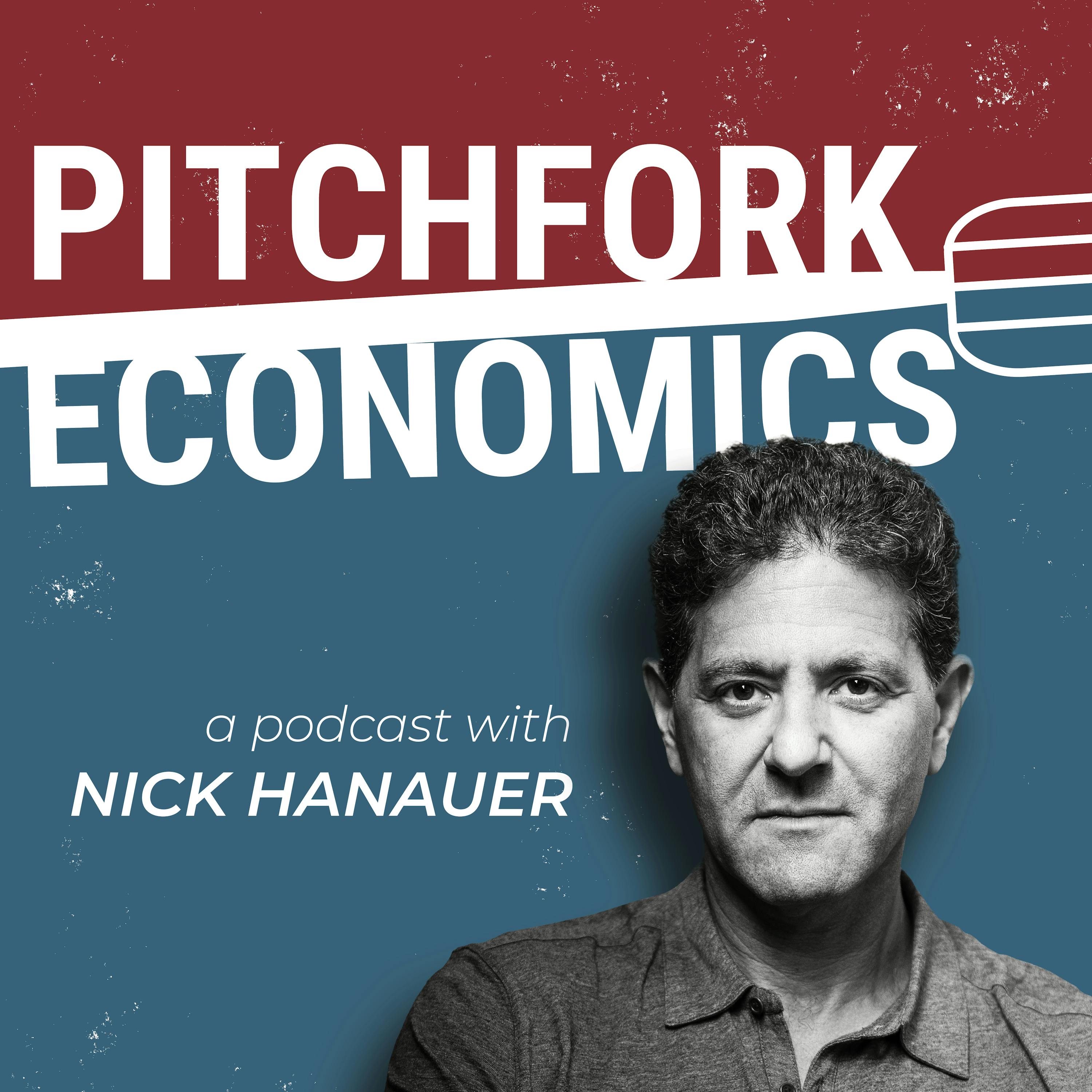
This is Pitchfork Economics with Nick Hanauer, a podcast about how to build the economy from the middle out. Welcome to the show. I don't know if you heard that, Nick, but we've got a new opening to the podcast. I know, this week in the new year. And new cover art as well. If you're looking in whatever podcast app you use, Apple or otherwise. Very different. Nice big picture of you. I'm disappointed that it isn't with this rebrand, that it's not Pitchfork Economics with Goldie. Or maybe there's you with a pitchfork and my head on top of it. Something like that might have been cool. But what's happening here, Nick?
- [01:23]
A
I'll speak to the art directors about that. Goldie, you know, we are going through what they call a rebranding, but really it's not so much a rebranding as just sort of acknowledging the moment I think, that we're in. You know, we have been at this for a few years and when we got started, you know, the ideas that we were discussing and the positions that we were taking on economics were much more outside of the mainstream. We started doing this podcast before Joe Biden took office and before really the middle out era. And here we are in it. And I think that that's just. It's a very significant phase change in how the world is thinking about economics, both policy and more generally economic cause and effect. You know, if you do this, what happens? And you know, we have been regaling our listeners with this idea of middle out economics for a very long time. And I think we can admit that it never occurred to us how far we would come in a relatively short amount of time. You know, it certainly never occurred to us that every time the President of the United States would talk about economics, he would talk about growing the economy from the bottom up and the middle out. But, you know, Goldie, you know, the whole world is shifting in terms of its consensus. You know, I met with an economist from the London School of Economics last week, and you know who's got a whole.
- [02:52]
B
A notoriously conservative.
- [02:54]
A
Absolutely.
- [02:55]
B
Histor. Yeah.
- [02:56]
A
Who's got a new department dedicated to this idea of cohesive capitalism, which is a, you know, yet another flavor of getting, you know, trying to get behind us this sort of neoliberal version, like capitalism version of what is dominated policymaking and culture in the United States for the last 50 years. And so I just think, yeah, we're at a new moment.
- [03:17]
B
Right. And to put this in, in a longer perspective, Nick, I have been working with you for almost a decade now. We started working together right around the time that original Pitchfork. That's right, Came out in Politico that, that we used to brand this. And when I first came into the office to meet with you, the. What you asked me to do was help you with your effort to redefine capitalism.
- [03:46]
A
Right.
- [03:47]
B
It wasn't, you know, nothing big. Yeah, just take, just take capitalism and redefine it. And it seemed incredibly ambitious. And I've always said my philosophy in life is I'd rather fail big than succeed small. So of course I said yes. And yeah, the progress that has been made over those 10 years, in fact, your work dates back even further. Middle out was coined in what, 2010. 2010. Yeah, you and Eric Liu in the, in the book Gardens of Democracy. And, you know, I'm sure you got quite a bit of eye rolling at the time.
- [04:28]
A
Yes.
- [04:29]
B
But we are definitely in a middle out moment. President Biden has played a big role in changing the narrative in his relentless use of that phrase and talking about when the middle class does well, everybody does well. How the economy grows best from the bottom up in the middle out, not the top down. His tearing down of the old trickle down paradigm, which has supported much of the neoliberal paradigm for the past few decades. And we also see, and you've seen this with some of the conversations we've had on our podcast recently that mainstream economists are beginning to shift on this.
- [05:11]
A
Absolutely.
- [05:11]
B
But a lot of the old neoclassical orthodoxy, you know, eventually it just has run into a wall of empirical evidence. Most specifically, and we've talked about this a lot over the years on the minimum wage, you know, you go back to that whole idea that when you raise the price of something, people buy less of it. And that applies to employment as much as it does to widget. So if you raise the minimum wage, you're just going to hurt the people you're trying to help. And what we have seen again and again in study after study is that not only does raising the minimum wage not kill jobs, and this is a core part of orthodox economic theory, it has to work that way because it's an equilibrium system. We have studies now showing that large minimum wage increases actually increase jobs. And the larger the increase, the larger the increase in jobs. And that just, you know, at some point if you're an economist and the theory you're taught, and more importantly the theory you're teaching runs into objective reality. Even an economist is. Some economists are willing to question themselves about, well, maybe this theory isn't all that accurate.
- [06:30]
A
That's right. And you know, I think it's probably worth clarifying for folks what the distinction is between middle out economics, what we think of as middle out economics, and bidenomics. So middle out economics to us is a way of understanding economic cause and effect. It's a way of understanding what prosperity is and where it comes from and how you get more of it. And bidenomics is a policy agenda that reflects that modern understanding of economic cause and effect. And the core economic insight at the heart of middle out economics is that a thriving middle class is the cause of both economic growth and political stability. And that therefore a policy agenda that seeks to increase the welfare of a place should be directly focused on increasing the welfare of, you know, effectively the median family. That that's the way that we should think, think about and manage economic policy. And if you do that, you can be quite sure that you will have faster economic progress and a high functioning democracy. And if you don't do that, you will end up in this sort of neoliberal hellscape and Trumpian world that we have managed to find ourselves in in the United States of America right now.
- [07:52]
B
To understand that clearly is that there's a contrast here. We said that bidenomics is this policy agenda and middle out is this economic narrative. You know, try a story that you tell, just try to explain the way the economy really works. And this contrasts very neatly with Reaganomics and trickle down. Reaganomics was this policy agenda, this neoliberal policy agenda, which really both parties eventually.
- [08:19]
A
Adopted, right, which was tax cuts for the rich, deregulation of the powerful, and basically suppressing the wages of everybody else for the last 50 years.
- [08:28]
B
And when we say suppress wages, we sometimes get pushback. Oh, they're not trying to suppress wages. No, no, no. Let's be clear what the Federal Reserve did when they hiked interest rates. Their proximate goal was to drive up unemployment. And the reason why they wanted to drive up unemployment was they wanted to decrease the labor demand, to decrease the power of workers to demand higher wages.
- [08:55]
A
Because.
- [08:55]
B
Because they're stuck in a 1970s thinking of economics that says, oh, inflation is a wage price spiral. That when wages go up, prices go up and you get inflation. So we need to slow wage growth to keep inflation low.
- [09:12]
A
That's right.
- [09:13]
B
That is specifically what they tried to do.
- [09:15]
A
That's right.
- [09:15]
B
I know people are giving the Fed credit today for possibly managing a soft landing. I personally don't think they deserve credit whatsoever.
- [09:24]
A
Total bullshit.
- [09:24]
B
They did not achieve their proximate goal. Unemployment never went up and yet prices went down.
- [09:30]
A
Right.
- [09:31]
B
Anything. They drove up inflation because housing costs have been high, because interest rates have been high. And that makes mortgages more expensive and that makes housing construction more expensive.
- [09:43]
A
Correct.
- [09:44]
B
So that has inflated housing costs. But let's be clear, this is a very different. We talk about cause and effect. What trickle down says, both implicitly and explicitly is that it is the investment of the wealthy people like you, Nick, that is the primary cause of growth. And that the middle class is a consequence that when we have economic growth, when we get economic growth because people like you invest your money because you're really smarter than everybody else, you invest your money, we get economic growth. And that creates jobs. Because you are a job creator, Nick. It creates jobs and that drives up wages and everybody benefits. So that the middle class is a consequence of the investment of wealthy job creators of capital. And middle out says the opposite. No, no, no. The middle class is the cause of growth. A large, vibrant, affluent middle class. That's where growth comes from. And you benefit from that. Right? Everybody benefits, Everybody does. Well, when the middle class does well, it's a reversal of that causal argument 180 degrees. And I think what we've seen over the past few decades with empirical research is that we are right and they're wrong and a lot of other folks are coming around to our way of seeing things.
- [11:15]
A
Correct. And it's not like you don't want rich people to invest. That's a fine thing. But if you have a thriving middle class, you have huge amounts of capital to invest on their behalf too. The source of capital need not be the bank accounts of a few rich people. The source of capital can be the pension funds of tens of millions of middle class people. Right.
- [11:38]
B
But they still had pensions.
- [11:39]
A
Exactly right. Like it's just nuts to think that, you know, all investment will stop if the richest people are slightly less rich. It's just not true. It's nuts. And so by dynamics, just to continue to draw the distinction, is the policy framework that fits within that middle out narrative and way of understanding cause and effect. And it is basically has Three pillars empowering workers to raise their incomes and lower their costs so they can be more robust participants in the economy, investing in both our personal and national capabilities and infrastructure. Right. So we need big investments both in our people and in the stuff that ties us all together, like the roads, bridges and technology that make the economy go. And finally promoting competition. And you know, again, one of the biggest mistakes of the neoliberal era was the idea that if you unconstrained big corporations that somehow magical things would happen and everybody would be richer and better off. It's just absolutely not true that that.
- [12:43]
B
Is pro competition to remove constraints on giant corporations, that you'll end up with a more competitive market when even Adam Smith will tell you that that's not true.
- [12:55]
A
Yeah, that on the contrary, what happened is that all this power moved from working people to the owners of capital. All of the industries in the country consolidated into effectively these, you know, they're not monopolies, but close to it. And you know, the thing is, is that when markets are concentrated, then wages where workers fall because companies don't have to compete for workers, prices for consumers rise because companies don't have to, don't have to compete really for consumers anymore either. And consumer choice and innovation fall because you have fewer market participants. Those three pillars, those three policy peers, empowering workers, investing in the country and in our people and promoting competition are the, you know, first order logical things you want to do if you really want to build the economy from the bottom up in the middle out. And so we are in this moment, dramatic transformation. The accomplishments of the administration thus far have been incredible. There's a crapload more they obviously could do if they had a slightly more rational Congress. But a lot of progress has been made.
- [14:08]
B
It's a turning point. What we are seeing is it's the Biden revolution. People have talked about the Reagan revolution in the early 80s, which is what brought on the trickle down neoliberal era. And what we're seeing is the death of trickle down as a paradigm and the death of neoliberalism as a dominant political philosophy. And a lot of that is being ushered in by Joe Biden very deliberately. And I think he's the most consequential president since Ronald Reagan. You would agree with that, Nick. He could be one of the most consequential presidents 100% in American history. Now it's not a done deal.
- [14:50]
A
Right.
- [14:51]
B
And so this gets to part of this rebranding, Pitchfork Economics. That name comes from that original piece you wrote. The pitchforks are Coming for us. Plutocrat.
- [15:01]
A
Correct.
- [15:02]
B
And your argument there was, if we don't do something about rising inequality, there's going to be a revolt, there's going to be a rebellion, and that doesn't work out well for anybody Now. I think part of what we're saying right now is, you know, the pitchforks are kind of here. We're in this moment where it's going to go one way or the other, and both metaphorically and unfortunately, literally, you can see an outcome in which the fascists take over by the Trumpists take over, and that is the end of American democracy. And if that happens, that is largely a consequence of the mistakes that were made during the neoliberal era, where we have torn this country apart through rising economic and political inequality, and it is a reaction to it, and nobody will do well from that. The alternative is that, in fact, we reverse the mistakes of the past 40 years and we build an economy and democracy based on a better understanding of how economics and, well, democracy works. And we're really hopeful. I believe. You're hopeful.
- [16:14]
A
I am.
- [16:14]
B
Well, you. Yeah, that. That we're in the moment where this could happen. And a lot of it has to do with this revolution in economics that we are on the precipice of.
- [16:25]
A
That's right.
- [16:26]
B
A wholesale shift in how we talk about, think about, and govern the economy that President Biden is a part of. But it's happening at the academic level, too, that you're seeing this revolt from younger economists. You know, people will call it heterodox economics. We have our own name for it. I don't know. Do you want to go into our naming or not, Nick?
- [16:51]
A
Well, I just want to say a little bit to your point, Goldie, that. That, you know, the rebranding of the podcast, to a certain extent, just represents a posture change. When we first started doing this, we knew very clearly what we were trying to get people to see was the what was the enemy. It was much clearer than what we were against. Today, we very much know what we are for. And so the podcast needs to reflect not just attacking what's bad, but encouraging what's good, because we are at that moment where there's a lot of good to talk about.
- [17:26]
B
Right. And so there's a lot of possibility. It's weird. People think of me as everybody who knows me will think as a cockeyed pessimist, but we wouldn't be doing this if we didn't think there was an opportunity to win and win big.
- [17:45]
A
So, to be clear, dear listeners, don't have a panic attack from your side. Nothing much is changing. We will be in the same place at the same time in the same way. But we just wanted to acknowledge in our materials and in our posture the change in circumstance that we find ourselves in, from just attacking to, in many ways, promoting a new way of thinking about economics. And, you know, I do think that if we can get through this next election cycle, there's going to be a lot in the United States of America to be incredibly optimistic about. Because the, the legislation that has been passed in the last three years will absolutely, positively transform America in some very positive ways over the next five to 10 years. And if we could get another round of that passed and in the next four or five years, you know, the country will be immeasurably better off in the future. I think that we may be in for the best years of our lives if we can get this right or if we don't. Yeah, it will be really, really terrible.
- [18:54]
B
Well, you know what, Nick? We should revisit this episode a year from now.
- [18:59]
A
That's right around.
- [19:00]
B
Around the time of the next presidential inauguration.
- [19:04]
A
That's right.
- [19:04]
B
We'll see if we still have a.
- [19:06]
A
Democracy, if it's the best of times or the worst of times.
- [19:10]
B
Right? But in the meanwhile, as a listener, you don't need to do anything differently. We're still going to give you a new podcast every Tuesday. You'll find it in the same place if you want to thank us, you know, or thank Nick, because this is a, a Nick funded production with no advertising. We never throw ads at you, right? You're not hawking mattresses or, or food plants or stuff like that. All we ask from you is leave us a positive review, auto download us, recommend us to your friends, word of mouth. This is all about achieving positive change in the world. And you know, if it wasn't for our listeners, it would just be you and I talking, Nick. And we do that a lot on our own anyway, so why bother with the podcast?
- [20:00]
A
Ex. And finally, thank you, listeners. You know, a lot of people listen to this podcast and we're deeply appreciative and we hope it's interesting, we hope it's fun, and we hope it's useful.
- [20:12]
B
Right? No greater privilege in the world than getting to talk and have people listen to you.
- [20:19]
A
Yeah, no, for sure.
- [20:25]
C
Pitchfork Economics is produced by Civic Venture. If you like the show, make sure to subscribe, rate and review us wherever you get your podcasts. Find us on Twitter and Facebook at Civic Action. And Nick Hanauer Follow our writing on Medium at CivicSkunkworks and peek behind the podcast scenes on Instagram. Itchfork Economics as always from Our team at CivicVentures, thanks for listening. See you next week.