← Pitchfork Economics with Nick Hanauer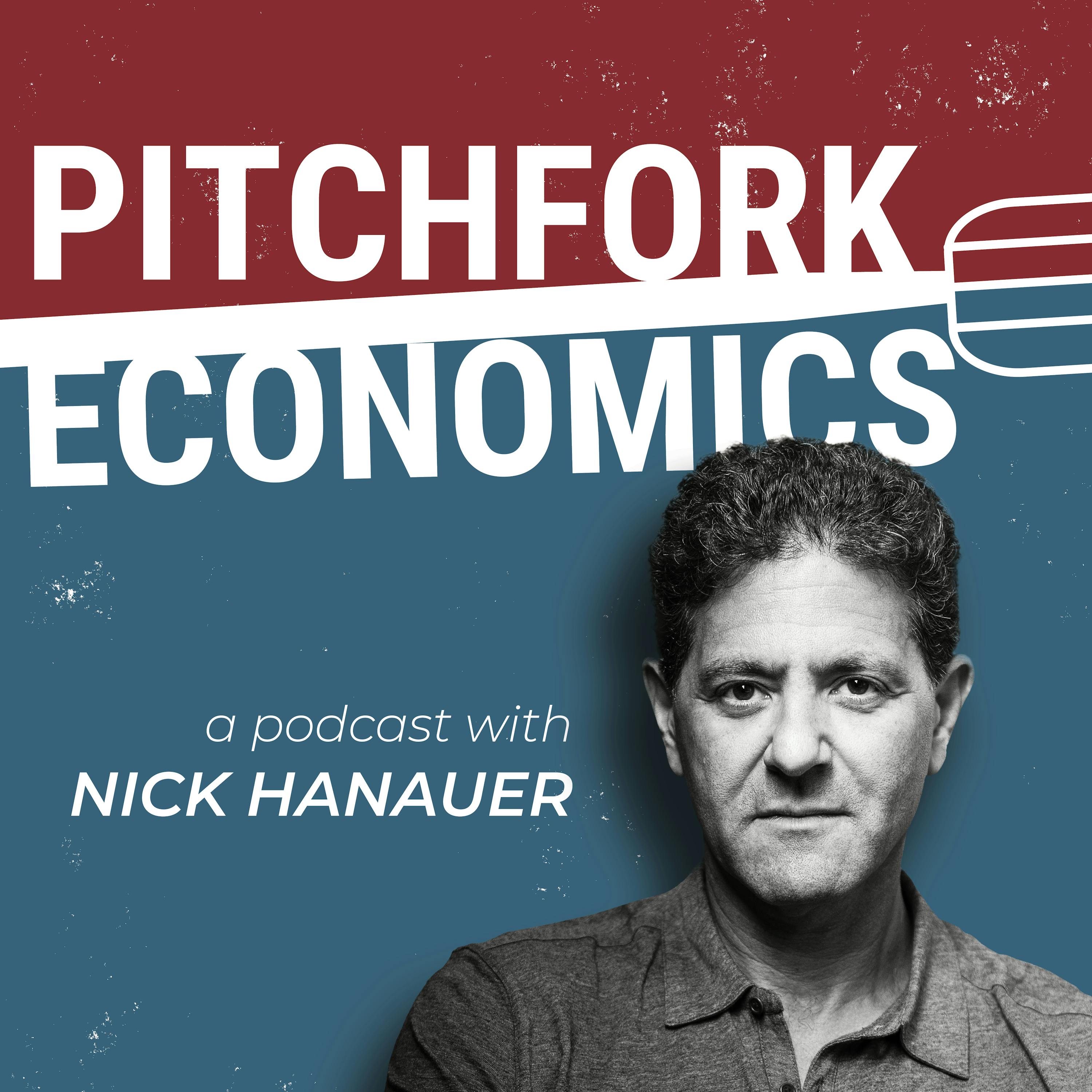
Loading summary
Transcript65 lines
- [00:02]
Nick Hanauer
The rising inequality and growing political instability that we see today are the direct result of decades of bad economic theory.
- [00:10]
Joe Biden
It's time to build our economy from the bottom up and from the middle out. Not the top down.
- [00:16]
Nick Hanauer
Middle out economics is the answer because.
- [00:18]
Joe Biden
Wall street didn't build this country. Great middle class built this country.
- [00:23]
Nick Hanauer
The more the middle class thrives, the better the economy is for everyone, even rich people like me.
- [00:35]
Joe Biden
This is Pitchfork Economics with Nick Hanauer, a podcast about how to build the economy from the middle out. Welcome to the show.
- [00:50]
David Goldstein
Nick. You know that guy we always play a clip of at the top of.
- [00:54]
Nick Hanauer
The podcast, the President of the United States.
- [00:58]
David Goldstein
Absolutely. Well, guess who we're talking to today?
- [01:01]
Nick Hanauer
Yes, today we get to talk to the actual President of the United States on our podcast, which I guess you would call a pretty big get in.
- [01:09]
David Goldstein
The podcast to talk to Joe Biden. As a former talk radio host, I would have killed for that opportunity.
- [01:19]
Nick Hanauer
Yeah, it's so fun that he's been. He's willing to chat with us for a little while about his economic legacy and middle out economics and stuff.
- [01:27]
Joe Biden
Stuff.
- [01:28]
Nick Hanauer
Obviously the man accomplished so much and was such a transformational president. Such a shame that the orange one is going to try and screw it all up, but who cares about that right now? Today we get to talk to the President of the United States about middle out economics. So let's go do that.
- [01:53]
Joe Biden
You have President Biden online. Hey, Nick. You're going to admit me.
- [01:57]
Nick Hanauer
How are you? We are, Mr. President. We are going to admit you expressly. How are you, sir?
- [02:03]
Joe Biden
I thank you. I thank you. How you doing? Good. How are things, Seattle?
- [02:07]
Nick Hanauer
They're great. Mr. President. I'm here with my colleague David Goldstein, and we are so excited to talk to you about the extraordinary economic legacy that your administration has created. And it's just such an honor to get to talk to you. Do you mind if we start peppering you with questions?
- [02:26]
Joe Biden
Pepper away. I may put some salt on it.
- [02:30]
Nick Hanauer
So what would you say is the most important part of your economic legacy?
- [02:36]
Joe Biden
I hope and think the most important part is making sure that we change the dynamic of how we think we build a strong economy. And by that I mean, and I know you use the term as well, the stronger the middle class is, the better everybody is Poor, have a way up, and the wealthy still do well. And so I've come from a background where, when I grew up in Scranton, Claymont, Delaware, Wilmington, Delaware, where a lot of hard working people, some of them pretty well educated and still struggle like hell My dad used to say that, you know Joe, they talk about trickle down economics. Wealthy do well trickle down to all of us. It doesn't ever trickle down on my kitchen table. And my dad was a well read, good hard working man. And the other thing Nick, is I drives my staff crazy, including some of my economists. One of the things that I think is important is to try to establish a principle that we can say is a principle that the United States of America has attempted to abide by, but it didn't do it very well. Which is that when a president goes and spends taxpayers money, he should spend it by buying an American product, whatever it was, and by hiring American workers to get it done. For example, if you're going to build a new aircraft carrier and a deck and an air replace the deck and an aircraft carrier, use American metal and you use American workers, you can do exceptions when you don't have them available. Now granted, as your old buddy points out who worked for me, that's not what grew. The economy that sets the principle is investing in America and Americans. We have the best workers in the world, we have the greatest opportunities in the world. And so for me it was to focus on middle class. The middle class built this country. Wall street didn't build this country, the middle class did. And unions built the middle class. I'll say it again, unions built the middle class. There would be no middle class in this country were it not for the fact unions existed and were strong. But they've really been undermined for a long time. So I focused a lot on reaching out to the union movement to get them up and running again like they never have been before. I know I'm labeled the most pro union president in American history. I'm proud of it. I think that's who we are. And all these are hardworking people who are middle class folks who have gone out and want a fair return on their, on their wage. One other thing, it drives my economic staff crazy for me saying this, but I really mean it. One of the most important things about this is that we have the best damn workers in the world. Most qualified workers in the world. That's not hyperbole. You know, I really ripped into the union movement for this privately with them. I said, you guys don't talk about how hard it is to get your license to be an electrician or to be anything. For example, the average person out there thinks, Nick, if you ask them that I want to be an electrician, okay, I go to school for six months, I get a license And I can be electrician five years. Yeah, five damn years. Apprenticeship program. You get paid how much you get paid once you become a union member. And one of the things that always was the case. You heard a lot from. I come from the corporate state of the world, Delaware. More corporations incorporated in Delaware than every other state in the union combined. And so I'm used to corporate power. The fact of the matter is that everybody said, well, all unions do is raise the cost of products. Well, that's much malarkey. But what the unions do is they in fact increase the fair way, an American debt. And it pushed everybody's salary. When I started pushing this union bit really hard as president, I've been doing it my whole life. What I did was I made sure that we went out there and made the case that it also helps everybody. For example, I had the Treasury Department do a study. When union wages increase, what happens to the rest of the wages? Well, the average person say that's going to cost me more money. Well, the truth of the matter is it raises the salaries of everybody. Everybody. So what I've tried to do, and I know it's not, I'm not talking like an economist here, but what I tried to do is start and talk to people where they live, how they think, what moves them. And what moves them is when they realize, holy mackerel, I can do this. And you have 60% of the population never went to college. These are people who are hardworking folks. Well, they have the capacity to do great things. Yeah, and I'm talking too much here. But look, and took on big corporations to increase competition, lower cost and support small business as well. For example, I've been a pain in the neck for the industry that does all the prescription drug stuff. Well, you know, I can put you in Air Force One with me tomorrow and you take a prescription from a major drug company in the United States and I can fly you to 20 cities around the world where you'll pay, receive 40, 60% less for that same prescription, for the same exact prescription. So that's why we went after. We're the only ones off limits for Medicare to negotiate with were the drug companies. And everybody said that's going to cost all my right wing and great conservative friends. That's going to cost the government a lot of money. Well, guess what? We passed the prescription drug bill and we've saving over the next 10 years $160 billion in taxpayer money. $160 billion. I'm talking more like what I was a history major and an international relations major than an economic major. But we're talking in normal terms with people. And so I guess what I'm trying to say is that the result has been 16 million jobs. Lowest unemployment of any president in 50 years. Collective bargaining is doubling. The union election petitions going on, took on big corporations, lowered costs. Lowered costs, as I said, for everything from hearing aids, prescription drugs to all the. These hidden fees that we have. Junk fees. Well, there's no rationale for that. I know you know this better than I do. Yeah, but, you know, an overdraft in a bank. They're charging 35 bucks for an overdraft. Well, guess what? It's $5 now. Ridiculous. Doesn't cost them 35 goddamn darn dollars. No, to make an overdraft. Same way with talking about, you know, credit cards. But look, got about 20 million new business applications. Doubling black business ownership. Hispanic ownership is up 40%. My dad used to have an inspection. Everybody deserves even a chance to go. Just a shot. No guarantee. Just a shot. People weren't even getting a shot before. But I'm talking too much. I'm a little excited about this.
- [09:33]
Nick Hanauer
No, it's awesome.
- [09:34]
David Goldstein
We're excited to have you talking this much. You know, obviously the economy hasn't been perfect over the past four years. We had that post Covid spike in inflation and of course interest rates continue to remain high. But you were talking about how great the economy is doing. I'm curious, how is the US Economy doing compared to the rest of the world? And how do you attribute its relatively strong performance?
- [10:04]
Joe Biden
We're doing better than any other major industrial formation in the world, period. The only advantage being an old guy in the presidency. I know more heads of state than any president ever sat in this chair. And all the time, all the time, I'm talking about us. What are we doing? I go to these international meetings. We're doing better than any other economy in the world. And look, obviously the past four years haven't been perfect, but, you know, look, the fact is that the pandemic really disrupted our supply chains and increased inflation. I was talking about, as pointed out to me by the staff. I didn't. I just thought I was just doing what everybody else was doing, using supply chains. Talking about that before I ran for office. Because what was happening is with the pandemic, it's so badly, badly handled. There were people shutting down, business shutting down. And one of the areas was. I remember sitting. I'm sitting behind the Resolute desk right now, and I got a couple Staff in front of me, I remember saying to my foreign policy staff, I want to go to South Korea. What do you want to go to South Korea? I said, because I want to talk to South Koreans about chips and science. We invented those damn computer chips. We United states reached up 40% of the market. And then what happened was as time moved on, they all went overseas. Because I come this is all the case, and I learned in Delaware for all those years as a senator, is that, you know, the corporate America started to decide what to do. What you want to do is you want to find the cheapest labor in the world, take your product there and have them build it and import it. Well, not me. I want to have. Make sure we build it here and export it. And so what happened is that we found ourselves, that we emerged of a pandemic, really stronger, but it disrupted supply chains and increased inflation. And we found ourselves in a situation where it was very, very difficult to get anything moving and all the people put out of work, you know. But what's happened is our. Since we took office, our economy has grown more than 12% more than any other economy, major economy in the world. And he advanced. And incomes are up by four grand more than prices. Inflation's fallen back to pre pandemic levels. Now we have. But we have, as I said, this whole notion about, I call it corporate greed, where you're talking about how they're charging for things that are hidden cost. And so it's no accident we did this by getting shots in people's arms and checks in their pockets. We got America back to work. We empowered them to get better jobs, hear better pay, organize more unions, and we're rebuilding our infrastructure. Remember? I think you were probably surprised, although you less than most people, because I think we. I don't want to ruin your reputation, but I think we agree more than. But all kidding aside, think about it. You know, they told me I could never get an infant. Remember the last guy and the guy coming in, the same guy, said he declared infrastructure weakness. He declared it for four years. Never built a damn thing. Well, they told me you couldn't get it done. We got $1,300,000,000,000 for infrastructure. How the hell can you be the leading nation in the world politically, economically and physically without the best infrastructure in the world? And so we got it done. And then what happened was we found ourselves with a position. When that occurred, we found out that we remember the price, the price of new cars skyrocketed. How did it skyrocket? This is 3,000 computer chips, size of the tip of your little finger to go into automobile, going to your cell phone, going to our weapon systems, going to your, I mean we weren't making anymore. There was nothing here. So I went to South Korea and sat down with Samsung and sat down with the president of South Korea and said I want you to come and invest in America your shipmaking. And guess what? Samsung came invested billions of dollars here we're not seeing the benefit of yet because it is being built. And I asked him why America? This is the God's truth. There are two reasons. The safest place in the world for me to have my money invested, number one and number two, you have the best workers in the world. And so that's grown from looking at, I don't hold me the exact number but we've got a commitment of over I think $60 billion of investment in building these new fabs and these new facilities and everywhere from Columbus, Ohio to Syracuse, New York to Alabama, all across the country. And what that does and what people don't realize you do is but when these coach fabs are big as a couple football fields put together where they're building these computers, you don't need a college degree to work there. Average salary is 102 grand. So without a college degree you can get a job for $102,000. You're in a situation as well where those same people are people who are. It takes a hell of a lot to build a building. So we significantly increase remember we well how can we be a great manufacturing country? How can we be a country that building well guess what? Whole hell lot of carpenters and cement masons and a whole lot of folks out there now having jobs. But the reason people haven't felt it yet and the reason why I'm so anxious to talk to you and you talk about it is that I know it's going to take time for this to happen.
- [15:45]
Nick Hanauer
Yeah.
- [15:46]
Joe Biden
So I think we've, we've announced, I don't know, thousands of projects around the country for the infrastructure and the CHIPS act. But guess what the fact is takes time to get them up and running.
- [16:00]
Nick Hanauer
Yeah.
- [16:00]
Joe Biden
And you may remember, no they don't know yet but they're going to know when. Guess what, as I pointed out when Samsung going to invest, I forget how many billion outside of Columbus, Ohio and I said in a thousand acres that call it a field of dreams. What's going to happen there is when this investment takes place, first of all it's going to generate a lot of Economic activity in the greater region in southern Ohio, number one. But number two, in addition to that, when this sucker is built, guess what they're going to be building? More drugstores, barbershops. Everything's going to grow. But I knew it wasn't going to happen for a while. That's why it was really, you know, it's like Biden's promising all these jobs, all this investment. Well, it hadn't come yet. Well, I guess it was, what, Time magazine or something, and I'm paraphrasing that Trump's the luckiest son of a gun in the world because Biden lives in an economy that can't fail. Basically.
- [17:00]
Nick Hanauer
Yeah.
- [17:01]
Joe Biden
Look, and what I did was, and you may remember, I got in trouble for it. We made significant investments in red states, investing more money in red states than in blue states. The reason why I did that, I'm a president for all Americans.
- [17:17]
Nick Hanauer
Yeah.
- [17:18]
Joe Biden
And the idea is, because those red states had such lousy practices and were the ultimate practitioners of trickle down. How many factories closed? I'll bet you can name for me people, you know, growing up who say, my, my grandpa used to work at this factory. My father worked, Mom, I gotta move. There's no jobs here. What we're trying to do is restore some pride as well. So I'm excited about the way things seem to be moving, and I think that going from the middle out really makes a difference.
- [17:46]
Nick Hanauer
No, absolutely. So. So you've spoken about, you know, your commitment to worker power and unions, and you are undoubtedly the most. You know, you're the only sitting president to ever join a picket line, which is quite an extraordinary thing. My question to you is slightly broader, though. Your approach to economic policymaking was such a break from what people have done for the last 50 years and certainly took lots of people, myself included, Democrats, by surprise that just how bold you were willing to be. Where did that come from? Like, was that hard? Did people yell at you on the inside for doing all that stuff like that? Courage was just amazing.
- [18:34]
Joe Biden
Well, you give me more credit about the courage than I deserve because, look, my dad used to have an expression, and I mean it sincerely, said Joey. A job is about a lot more than a paycheck. About your dignity, about respect, about your place in the community. It's about being able to look your kid in the eye and say, honey, it's going to be okay, and mean it. All about dignity, all about treating people fairly. Second piece was, I grew up in a household where my mom was one of five kids, four brothers, and my dad had three in his family where people busted their ass just to be able to get a good paying job at a time when things were pretty rough. During the 30s and going into the 40s when things began to pick up, I talked a lot about the middle class as a basis for my reason for running for office when I was a senator. People are now going back and forth. I was told last night, I don't know this to be true. I forgot my communication staff said that Lawrence o' Donnell had a piece on where I was making a speech in 2019 about what we needed to do to grow the economy and then showed the speech I made Brooklyn five years later. Five years, five years later when we did all, I was talking about the things that I wanted to do back in the team because I really believed it would work. I come from the corporate state of Delaware, the giant banking industry. And if I lived in New York and that was a major industry, I might not be able to get elected. But Delaware was small enough that I could do say what I meant. And yet I could show up in people's living rooms, I could show up in town meetings, I could show up and explain in plain English what I meant. And it was hard to distort what I meant. And so that I'm not sure I could have done it had I represented the state of California, even though it's much more liberal than my state.
- [20:27]
Nick Hanauer
Interesting.
- [20:27]
Joe Biden
So it was. I think it's just being able to talk straight with people. As I said, I drive my economic team. It was a great team I have here crazy because I say speak English, not economics, talk to people like ordinary people talk. And we still got. Well, don't get me wrong, we got a lot more work to do. But I think that, you know, like I use phrases that are sketchy but not particularly, not perfectly accurate. When I said where, where's it written we can't be the manufacturing capital of the world. People look and go, yeah, right, we're the United States. Why can't we do that? People always believe anything is possible if we set our mind to it. That's why we're viewed as the ugly Americans, because we could do anything. I'm serious, think about it. But we stopped thinking that anything was possible. But I think it's important that we focus on. And wasn't that hard because it doesn't relate to economics. In 1972, I was 29 years old and I won my Senate seat in what was a very red state at the time. I was the Only statewide. I only got elected statewide with one other got elected that year as a Democratic governor. And one of the things that mattered was I talk about what we could do and appeal to America's sense of patriotism. And there's this, their, their sense that anything is possible. And so one of the things we talked about was why. Why if we invested in ABC near D, for example, you know, when I announced, before I announced for president, you may recall there was this big event out on the South Lawn and I hadn't introduced, even though I've been ahead of most people and most of my colleagues on environmental issues going back to the first, I first major environmental bill in 78. And they said, why haven't I talked more about the environment? And I said, because I haven't talked to labor yet. Why labor? Remember, if you said, go back four years, if you said the environment, labor thought that meant they're going to lose jobs. Seriously, not a joke. Well, when I think the environment, I think jobs. Not a joke. And so I sat down with the president of the IBEW and I spent better part of three hours ago and convinced him that it's in the interest of the IBEW to have us invest billions of dollars, which 38 billion, almost 36 point, I think $4 billion we got for the, for the environment. And I said that thousands of jobs. And all of a sudden if, you know, now labor thinks that what we're doing, building jobs is good. And so it was part of. Just seems like the mindset. Now, don't get me wrong, I'm not saying that I've solved it, we got it done, but we lost this election and it's gonna be hard as hell hanging on to the practice and any rate. So back in 72 when I ran and won in the state of Dupont, Nixon, won my state by 60% of the vote. I won by 3,800, 3,200 votes and ran against a decent guy, a guy named jkill A Bogg, involved in both the Clean Air, Clean Water act, but a decent man. And everybody said, and so all the young guys and women wanted to run would come and talk to me in 73 and 74. What was the secret? I said, the biggest, most important secret for you to learn is what is worth losing over. What are you willing to lose over rather than change your view. And I said, because people reward you for that if you explain it. And I think when you asked me about was it hard, wasn't hard. There was no reason to have this damn job unless it could do something about the economy and foreign policy. Yeah. And I don't know enough to know what I wanted to do.
- [24:33]
Nick Hanauer
That's great, Mr. President. On this podcast, we always ask our guests one final question, and we're going to put it to you.
- [24:40]
Joe Biden
Okay.
- [24:41]
Nick Hanauer
Why do you do this work?
- [24:43]
Joe Biden
I guess I do it because the family I was raised in and the neighborhood I come from, it was all about everybody has an obligation to make sure the other guy next door is helped out a little bit. And I didn't start off wanting to do this. I started off because I got involved in the civil rights movement. I wasn't in great shape. I was a kid when I moved from Scrantwood, there were very few African Americans. When coal died, we had to move, find work, moved back to Delaware. My dad had gone up to junior in high school, but it was. It was all about, you know, you look out for the other guy a little bit because. And you expect them to look out for you a little bit. And, you know, as I said, my dad was one of those guys who thought everybody deserved a chance. Everybody deserved an equal chance. No guarantees, just a shot. And as it kept coming, clearer and clearer, there was no shot for a whole hell of a lot of people. And it's also selfish. The better they do, other people, better I do, the better the community does.
- [25:49]
Nick Hanauer
Yeah.
- [25:50]
Joe Biden
And I think we could have lost that notion, too. And that's why. But anyway, I got involved in the civil rights movement as a kid, moved to Delaware, where they have the eighth largest black populations, percent of population in the country for a great shame. We were a slave state. We fought on the side of the North. But I got involved in trying to reform the Democratic Party, which was much more conservative than the national Democratic party at the time. And when Dr. King was assassinated, we had a Democratic governor who insisted that they place on every corner in the city of Wilmington National Guard with drawn bayonets for 10 months. I quit the law firm I had gone to work for, and I became a public defender. And that went on from there. Wow.
- [26:32]
Nick Hanauer
Well, Mr. President, thank you so much for being with us and thank you.
- [26:37]
David Goldstein
For all your work.
- [26:38]
Joe Biden
Yeah.
- [26:38]
Nick Hanauer
Because it is an extraordinary legacy. You are the man who killed neoliberalism. We and the country will be forever in your debt for having done it so well.
- [26:51]
Joe Biden
I mean, you're dead. I'm in the debt of you guys who. Who just are. Look, one of the things that worries me most, and I'll get off the line, is that the kind of things you Hear the numbers. You know that that survey done by the Michigan survey, how people feel about this? I think it's between 65, 67% of American people think they're better off than they were before we got elected in the last four years. But when asked, what do you think? Do you have a positive view of the direction of the economy? I think it's like 30. Only 34% have a positive view. And I think that's because the press isn't the way it used to. And they're not. They're good people, don't get me wrong. But let me put it this way. After my son died because of Iraq, I wasn't going to ever run again. And one of the things I wrote, I started to write a book about another book about the inflection points in world history that changed economic growth and changed the economy overall. And I said, we're one of those inflection points. And the decisions that we make in the next four, two, four, six years are going to determine what the rest of the world looks like for the next six, seven decades. And I mean that sincerely. Think of the changes that take in the idea of global warming is doing in terms of just the pure. The pure development of the world, how we're responding and so on. And so one of the things that I found was that if we focus on things that really matter, we can make a difference. In my view, the decisions we're making now are going to set the agenda for the next. Not just I'm making, I mean the world. We're going to set the agenda for the next five, six seconds. Post World War II is over. On. Everything's changing, but the biggest change taking place is the press. Not bad. There's still good people, but where do people get their news? Thing is, don't hold me to this, but the data is correct. Something only 5, 7% of people under the age of 25 are. Read a newspaper.
- [29:06]
Nick Hanauer
Yeah.
- [29:07]
Joe Biden
We pick what we want to hear. It's a totally different deal. And we got to figure out how we deal with this significant technological change. If it wasn't. If Nixon was more accustomed to television, he wouldn't have perspired so much and he would be president when he beat Kennedy. I mean, I know that sounds silly, but think of the changes taking place and where do you go and what is true. We have no edge anymore.
- [29:34]
Nick Hanauer
Yep.
- [29:35]
Joe Biden
And so I'm not sure how that gets resolved, but I think it's a big deal. Anyway, thanks for taking the time. I'm sorry to take so much of your time.
- [29:42]
Nick Hanauer
No, well, sir, thank you. Thank you so much for being with us and we wish you the best and hopefully we'll see you soon.
- [29:50]
Joe Biden
All right, pal. Thank you.
- [29:52]
Nick Hanauer
Thank you for being with us.
- [29:54]
Joe Biden
Thank you for having me.
- [30:00]
David Goldstein
I gotta say, Nick, this isn't economics, but I just want to reiterate what the President just said about really, he was talking about at the end the failure of journalism. The reason why most people don't understand how good the economy is or how much the President has done and how well he has set up our economy for the future, I think is at least partially a failure of journalism to educate the American people. Yeah, I know a lot of other journalists won't want to hear it, and maybe the President's staff didn't want him to go there. I've got no idea. But I'm with him 100% on this.
- [30:48]
Nick Hanauer
No, I mean, it's obviously a tragedy that nine out of 10Americans couldn't name three of the economic accomplishments.
- [30:56]
Joe Biden
Probably. Right.
- [30:57]
Nick Hanauer
It's just, it's so, so, so sad. But, you know, it still was fun to talk to him. And the thing, you know, I did one hour and a half or two hour, one on one with Joe Biden before he ran for president. And the thing that really came through for me in that conversation before he ran was that his guiding sort of political philosophy, his guiding principle was that it was all about the middle class. That he just thought that if you took care of middle class people, then everybody, then the country would be fine. And I don't think that there's a better heuristic for governance than that. I think under any circumstances and for all time, you show me a political system that governs to ensure that the median family is thriving, I will show you a successful society. I don't think you could find a counterexample.
- [31:57]
David Goldstein
And that, Nick, is one of the strengths of middle out economics, both in theory and in practices. You don't have to understand why it works in order to be successful by adhering to its heuristics to that rule of thumb. When the middle class is strong, America is strong. What's good for the middle class is good for America. When you grow the economy from the middle out, everybody benefits. And he didn't just say these things. And that was really important, the leadership he provided. Obviously there were chinks in the armor of neoliberalism well before he took the White House, but that leadership that he provided, I think just people underestimate how consequential it was, how consequential it was for a president of the United States to join the picket line of striking auto workers. Never before in our history. And if you look back and you remember what happened, he did that. And a few days later, Ford folded. Right. They settled. And when Ford settled, the other automaker settled. And when the other automakers settled, the non unionized automakers in the south, they all tried to match those contracts because that's what the competition was doing. So they had to follow along. And that's leadership. And who knows what will happen over the next four years. You know me, I'm really pessimistic about the state of our democracy, whether we'll even be allowed to have real elections again. But if we do, I'm pretty confident that his legacy historians will look fondly on his legacy, particularly in terms of his economic policy and narratives.
- [33:50]
Nick Hanauer
Yes, yeah, absolutely. Joe Biden may be out of the White House, but we're definitely going to continue the fight. I think that the American people are going to get a huge serving of trickle down economics over the next couple of years. I just don't think there's any way that the Republican Party won't do, won't revert to their tax cuts for the rich, deregulation for the powerful, and wage suppression for everybody else. I just don't think they can help themselves. But we will be here reminding people that that choice was a terrible choice.
- [34:21]
Joe Biden
Yeah.
- [34:22]
Nick Hanauer
And that there's a better way.
- [34:23]
David Goldstein
What could have been and what could be, you know, again in the to paraphrase the words of Milton Friedman, you know, when the crisis comes, what takes the place of the ideas that are lying around. So for the next four years, we'll just have to continue to promote these ideas.
- [34:46]
Nick Hanauer
Pitchfork Economics is produced by Civic Ventures. If you like the show, make sure to follow, rate and review us wherever you get your podcasts. Find us on other platforms like Twitter, Facebook, Instagram and Threads. Itchforceconomics Nick's on Twitter and Facebook as well. Ickhanauer for more content from us, you can subscribe to our weekly newsletter, the Pitch over on Substack. And for links to everything we just mentioned, plus transcripts and more, visit our website, Pitchfork economics.com as always from our team at Civic Ventures, thanks for listening. See you next week.