Podcast
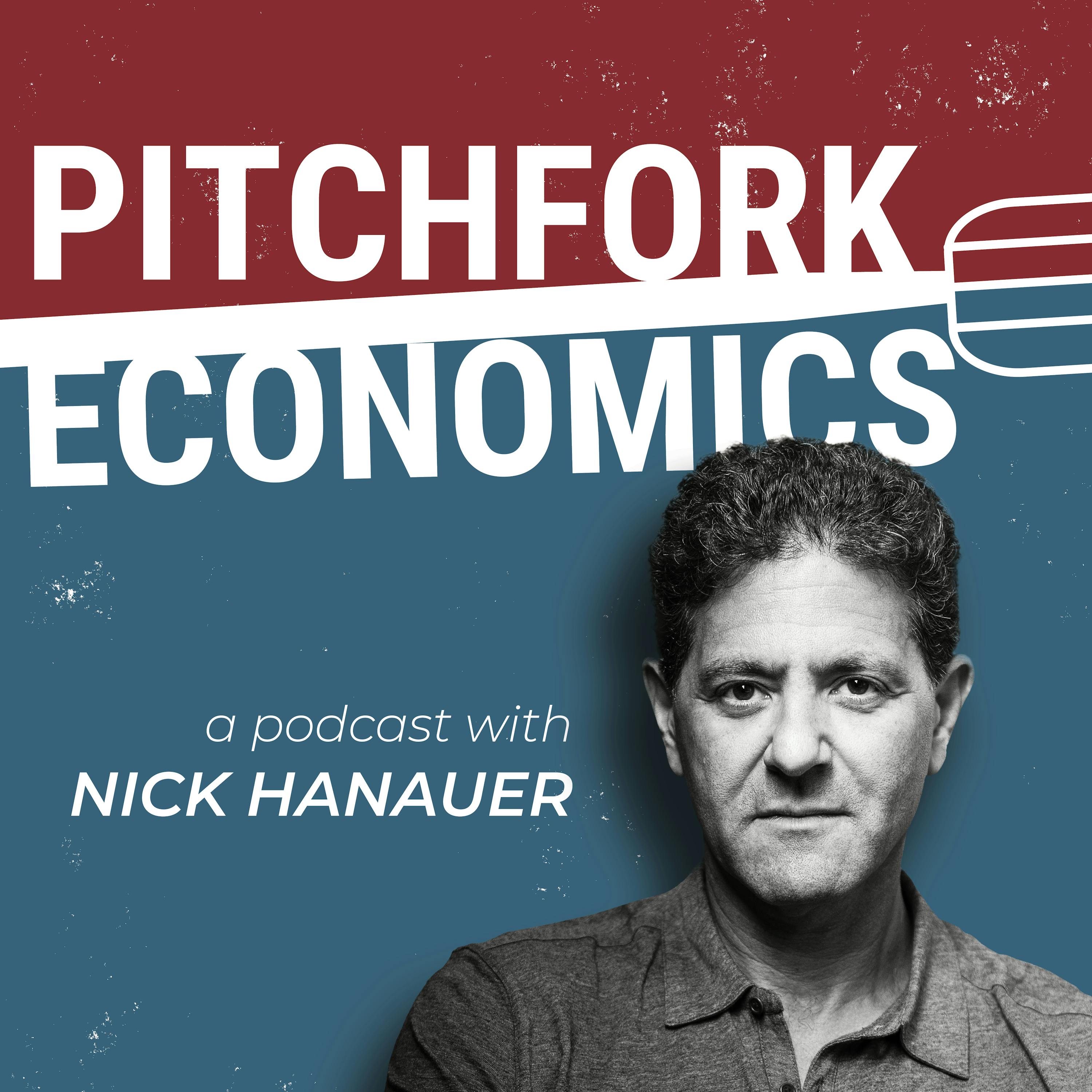
Pitchfork Economics with Nick Hanauer
Hosted by Civic Ventures · EN
We are living through a paradigm shift from trickle-down neoliberalism to middle-out economics — a new understanding of who gets what and why. Join zillionaire class-traitor Nick Hanauer and some of the world’s leading economic and political thinkers as they explore the latest thinking on how the economy actually works.
140episodes
Episodes
Newest firstAll episodes
Why Democracy Needs a New Operating System (with K. Sabeel Rahman)
May 6, 202500:44:39Tap to summarizeDecades of trickle-down thinking hollowed out our government—and now the anti-democracy crowd is finishing the job. This week, legal scholar and former Biden advisor K. Sabeel Rahman joins Nick and Goldy to talk about what happens when the rule of law becomes optional, what the Biden administration got right (and what it didn’t,) and why simply restoring the old system isn’t enough. If we want a real democracy—one that can stand up to corporate power and actually deliver for people—we need to stop playing by outdated rules and start constructing a government that's faster, fairer, and fit for the modern world. K. Sabeel Rahman is a legal scholar, policy expert, and former senior advisor in the Biden administration, where he served as Associate Administrator at the Office of Information and Regulatory Affairs. A leading voice on democracy, governance, and economic justice, he is Demos's former president and a law professor at Cornell University. Social Media: @ksabeelrahman.bsky.social @ksabeelrahman Further reading: Civic Power: Rebuilding American Democracy in an Era of Crisis Website: http://pitchforkeconomics.com Instagram: @pitchforkeconomics Threads: pitchforkeconomics Bluesky: @pitchforkeconomics.bsky.social Twitter: @PitchforkEcon, @NickHanauer, @civicaction YouTube: @pitchforkeconomics LinkedIn: Pitchfork Economics Substack: The Pitch
Transcribe →Democracy in Chains (with Nancy MacLean)
Apr 29, 202500:38:16Tap to summarizeThis week, we’re revisiting a critical conversation we had back in 2020 with author and historian Nancy MacLean, in which she exposes how today’s threats to democracy were decades in the making. Based on her groundbreaking book Democracy in Chains, MacLean traces how Nobel Prize-winning economist James Buchanan worked with billionaire donors to rig the rules of government to expand corporate power and protect extreme wealth. From public choice theory to voter suppression, this episode reveals the coordinated strategy to undermine democracy—and explains why understanding it is essential to fighting back. Nancy MacLean is an award-winning historian and the William H. Chafe Distinguished Professor of History and Public Policy at Duke University. Her book, Democracy in Chains: The Deep History of the Radical Right’s Stealth Plan for America was a National Book Award finalist and winner of the Los Angeles Times Book Prize. This episode originally aired on July 21, 2020. Social Media: @nancymaclean.bsky.social @NancyMacLean5 Further reading: Democracy in Chains Website: http://pitchforkeconomics.com Instagram: @pitchforkeconomics Threads: pitchforkeconomics Bluesky: @pitchforkeconomics.bsky.social Twitter: @PitchforkEcon, @NickHanauer, @civicaction YouTube: @pitchforkeconomics LinkedIn: Pitchfork Economics Substack: The Pitch
Transcribe →The Abundance Doctrine (with Mike Konczal)
Apr 22, 202500:40:43Tap to summarizeWhat does “abundance” actually mean—and who is it really for? In this episode, Goldy and Paul welcome back economic policy expert Mike Konczal to unpack the big new idea dominating political discourse: abundance. They dive into the buzz around Ezra Klein and Derek Thompson’s book “Abundance,” and Konczal’s sharp critique of its deregulatory leanings, missed opportunities, and neoliberal undertones. From housing policy to green energy to the myth that deregulation alone can fix America’s problems, this episode challenges the idea that more is always better, and asks what it would really take to build a future that’s abundant for everyone—not just the rich.Mike Konczal is the Senior Director of Policy and Research at the Economic Security Project, where he oversees policy development, research, and strategic analysis to advance its ideas. Previously, he served as a Special Assistant to President Biden for Economic Policy and Chief Economist for the National Economic Council. Social Media:@mtkonczal.bsky.social@mtkonczalFurther reading: Democracy Journal - The Abundance DoctrineAbundance By Ezra Klein & Derek Thompson Why Nothing Works: Who Killed Progress—and How to Bring It Back By Marc Dunkelman NBER Working Paper - Supply constraints do not explain house price and quantity growth across U.S. citiesWebsite: http://pitchforkeconomics.comInstagram: @pitchforkeconomicsThreads: pitchforkeconomicsBluesky: @pitchforkeconomics.bsky.socialTwitter: @PitchforkEcon, @NickHanauer, @civicactionYouTube: @pitchforkeconomicsLinkedIn: Pitchfork EconomicsSubstack: The Pitch
Transcribe →Why Nothing Works: Who Killed Progress—and How to Bring It Back (with Marc Dunkelman)
Apr 15, 202500:54:17Tap to summarizeWhy does it feel like we can’t build anything anymore? In this episode, Nick and Goldy talk with author Mark Dunkelman about his new book Why Nothing Works, which examines how well-intentioned progressive reforms created a “vetocracy” that makes major public projects nearly impossible. From Seattle’s decades-long waterfront rebuild to the dysfunction of Penn Station, they explore the messy trade-offs between accountability and action—and ask what it would take to make progress possible again.Marc Dunkelman is a fellow at Brown University’s Watson Institute for International and Public Affairs and a former fellow at NYU’s Marron Institute of Urban Management. During more than a decade working in politics, he worked for Democratic members of both the Senate and the House of Representatives and as a senior fellow at the Clinton Foundation.Social Media:@MarcDunkelmanFurther reading: Why Nothing Works: Who Killed Progress—and How to Bring It BackWebsite: http://pitchforkeconomics.comInstagram: @pitchforkeconomicsThreads: pitchforkeconomicsBluesky: @pitchforkeconomics.bsky.socialTwitter: @PitchforkEcon, @NickHanauer, @civicactionYouTube: @pitchforkeconomicsLinkedIn: Pitchfork EconomicsSubstack: The Pitch
Transcribe →Live From DC: Turning Middle-Out Economics into Good Politics
Apr 8, 202500:54:44Tap to summarizeTimid tweaks won’t fix a broken economy. From Nick Hanauer’s blunt critique of Democratic incrementalism to a candid conversation with Representatives Ro Khanna, Delia Ramirez, and Jim Himes on how Democrats can reclaim working-class trust by embracing economic populism and fighting for real change, this episode brings you inside the 2025 Middle Out Economics conference, where the message was clear: Go big or get out of the way.Moderator: Harold Meyerson, The American ProspectRep. Jim Himes, 4th congressional district, ConnecticutRep. Ro Khanna, 17th congressional district, CaliforniaRep. Delia Ramirez, 3rd congressional district, IllinoisFurther reading: Measuring the Income Gap from 1975 to 2023Adieu to Laissez-Faire TradeWebsite: http://pitchforkeconomics.comInstagram: @pitchforkeconomicsThreads: pitchforkeconomicsBluesky: @pitchforkeconomics.bsky.socialTwitter: @PitchforkEcon, @NickHanauer, @civicactionYouTube: @pitchforkeconomicsLinkedIn: Pitchfork EconomicsSubstack: The Pitch
Transcribe →America Needs an Economic Bill of Rights (with Mark Paul)
Apr 1, 202500:39:34Tap to summarizeTrickle-downers want you to believe that in America, freedom is a narrow idea—freedom from taxes, from regulation, from government itself. But what good is that kind of freedom if you can’t afford rent, see a doctor, or feed your family?So, this week we’re revisiting one of our favorite conversations—our interview with economist Mark Paul about his book, The Ends of Freedom: Reclaiming America's Lost Promise of Economic Rights. In it, he challenges the myth of economic freedom and offers a bold alternative: a 21st-century Economic Bill of Rights. Drawing on the unfinished work of FDR and Martin Luther King Jr., Paul argues that true freedom means more than just being left alone—it means having access to the basic goods that make life possible: housing, healthcare, education, and a decent job. From the lasting damage of neoliberalism to a vision for a fairer, more humane economy, this conversation reframes what freedom really means—and what it will take to build an economy that works for everyone.Mark Paul is an assistant professor at the Edward J. Bloustein School of Planning and Public Policy at Rutgers University and a member of the Rutgers Climate Institute. His work has been featured in publications such as The New York Times, The American Prospect, The Washington Post, and The Financial Times. In 2023, he published his first book, The Ends of Freedom: Reclaiming America’s Lost Promise of Economic Rights.This episode originally aired on May 16, 2023.Social Media:@markpaulecon.bsky.socialFurther reading: The Ends of FreedomWebsite: http://pitchforkeconomics.comInstagram: @pitchforkeconomicsThreads: pitchforkeconomicsBluesky: @pitchforkeconomics.bsky.socialTwitter: @PitchforkEcon, @NickHanauer, @civicactionYouTube: @pitchforkeconomicsLinkedIn: Pitchfork EconomicsSubstack: The Pitch
Transcribe →The Middle-Out Moment Is Still Here
Mar 25, 202500:47:06Tap to summarizeTwelve months ago, Democracy Journal announced we were entering the "Middle-Out Moment." A year later—after a brutal election and rising uncertainty—the question isn’t whether neoliberalism is over, but what comes next. In a new symposium titled “It’s Still the Post-Neoliberal Moment,” Democracy brings together leading voices to answer that question. In this episode, we hear directly from some of the smartest contemporary thinkers on how to dismantle corporate power, rebuild trust in government, center care as a public good, and make policy that actually reaches the people it's meant to serve. The stakes couldn’t be higher—and the decisions we make in this moment could mean the difference between widespread prosperity or a negative feedback loop that will be felt for generations to come.Guests include: Nidhi Hegde, Charles Davidson, Shilpa Phadke & Shayna Strom, Harry Holzer, Mary Beth Maxwell, Bilal Baydoun, and Melissa Morales. Further reading: The Middle-Out Moment Is Still Here - Nick Hanauer Anti-Monopoly Is the Path Forward - Nidhi HegdeFinancial Secrecy Is a Middle-Out Issue - Charles Davidson Do Not Abandon the Care Agenda - Shilpa Phadke & Shayna StromTaking the Spending-Inflation Problem Seriously - Harry HolzerTime for People-Centered Policy - Mary Beth Maxwell Good Political Stories Need Heroes—and Villains - Bilal BaydounOn the Need to Go Bigger - Melissa Morales Website: http://pitchforkeconomics.comInstagram: @pitchforkeconomicsThreads: pitchforkeconomicsBluesky: @pitchforkeconomics.bsky.socialTwitter: @PitchforkEcon, @NickHanauer, @civicactionYouTube: @pitchforkeconomicsLinkedIn: Pitchfork EconomicsSubstack: The Pitch
Transcribe →Why Working-Class Voters Are Turning Away from the Democratic Party (with Lainey Newman)
Mar 18, 202500:39:31Tap to summarizeFor decades, unions were more than just labor organizations—they were community anchors that shaped working-class identity and political loyalty. But what happens when an entire generation loses its economic and social foundation? The Rust Belt’s working-class voters were once a Democratic stronghold, but that’s no longer the case. Lainey Newman, co-author of Rust Belt Union Blues, joins Paul and Goldy this week to explain how the erosion of union power helped shift working-class voters away from Democrats, and why economic fixes alone won’t be enough to win them back.Lainey Newman is an author and J.D. candidate at Harvard Law School. She is a graduate of Harvard College and a native of Pittsburgh, Pennsylvania.Social Media:@laineynewman.bsky.sociallaineynewman@LaineyNewmanFurther reading: Rust Belt Union Blues: Why Working-Class Voters Are Turning Away from the Democratic PartyWebsite: http://pitchforkeconomics.comInstagram: @pitchforkeconomicsThreads: pitchforkeconomicsBluesky: @pitchforkeconomics.bsky.socialTwitter: @PitchforkEcon, @NickHanauer, @civicactionYouTube: @pitchforkeconomicsLinkedIn: Pitchfork EconomicsSubstack: The Pitch
Transcribe →Wall Street’s War on Workers (with Les Leopold)
Mar 11, 202500:36:59Tap to summarizeMass layoffs have become a routine corporate strategy—not because companies are struggling, but because Wall Street demands it. In Wall Street’s War on Workers, labor educator and author Les Leopold exposes how stock buybacks, deregulation, and financialized capitalism have made job cuts a tool for enriching CEOs and hedge funds at the expense of workers and communities. He joins Nick and Goldy this week to explain how this happened, why both political parties have failed to stop it, and what we can do to fight back.Les Leopold is a labor educator, author, and co-founder of the Labor Institute, where he has spent decades advocating for economic justice and worker rights. He is the author of several books, including Runaway Inequality and Wall Street’s War on Workers, which exposes how financial elites have rigged the economy in their favor.Social Media:@les_leopoldFurther reading: Wall Street's War on Workers: How Mass Layoffs and Greed Are Destroying the Working Class and What to Do about ItCorporate Bullsh*t: Exposing the Lies and Half-Truths That Protect Profit, Power, and Wealth in AmericaLes Leopold’s SubstackCivic Ventures Produced Comic on Stock Buybacks: Trillion Dollar HeistWebsite: http://pitchforkeconomics.comInstagram: @pitchforkeconomicsThreads: pitchforkeconomicsBluesky: @pitchforkeconomics.bsky.socialTwitter: @PitchforkEcon, @NickHanauer, @civicactionYouTube: @pitchforkeconomicsLinkedIn: Pitchfork EconomicsSubstack: The Pitch
Transcribe →Breaking Up Big Econ (with David Deming)
Mar 4, 202500:39:07Tap to summarizeA small group of elite universities holds an outsized influence over the field of economics, shaping research, policy, and the broader economic narrative. But is that concentration of power stifling innovation and reinforcing the status quo? This week, Harvard economist David Deming joins Nick and Goldy to discuss his recent Atlantic article, in which he argues that Big Econ functions like a monopoly—limiting competition, excluding diverse perspectives, and making it harder for new ideas to take hold. David Deming is the Isabelle and Scott Black Professor of Political Economy at the Harvard Kennedy School. Deming is also a research associate at the National Bureau of Economic Research and Associate Editor of the Journal of Economic Perspectives.Social Media:@ProfDavidDemingFurther reading: Break Up Big EconDOGE Is Failing on Its Own TermsDavid Deming’s Substack Forked LightningThe Trouble With MacroeconomicsWebsite: http://pitchforkeconomics.comInstagram: @pitchforkeconomicsThreads: pitchforkeconomicsBluesky: @pitchforkeconomics.bsky.socialTwitter: @PitchforkEcon, @NickHanauer, @civicactionYouTube: @pitchforkeconomicsLinkedIn: Pitchfork EconomicsSubstack: The Pitch
Transcribe →