Podcast
Podcast - SURF MASTERY
Hosted by Surf Mastery Podcast · EN
We interview the best surfers in the world and the people behind them, so surfers can learn ways to improve their own surfing. The podcast is targeted to open-minded surfers who want to improve and progress their surfing as well as enhance their surf longevity & health. Each interview will educate the listener on ways to refine and progress their surfing and/or increase their surf longevity.
25episodes
Episodes
Newest firstAll episodes

141 Stop Paddling for Waves - The Beginner Surfing Advice Nobody Gives You
3w agoTap to summarize141 Stop Paddling for Waves - The Beginner Surfing Advice Nobody Gives You Surf Mastery Podcast Download What if catching more waves as a beginner had less to do with paddling harder, and more to do with timing and wave selection?Many beginner surfers waste energy chasing every patch of whitewater, only to miss waves, struggle to stand up, and finish each session feeling frustrated. In this episode, surf coach Michael Frampton explains a simpler approach that helps you conserve energy, choose better waves, and develop skills that will support your surfing for years to come.You’ll discover:How to catch whitewater waves without paddling by using a simple, well-timed movementWhat separates strong, smooth whitewater waves from weak, turbulent onesHow timing, ocean awareness, and efficient habits can help you stand up more often and learn fasterPlay the episode to start catching better waves with less effort and build the foundational skills every confident surfer needs.To download the free PDF: "The Intelligent Beginners Guide to Surfing" click this link:https://mailchi.mp/surfmastery/the-intelligent-beginners-guide-to-surfingTranscript:Welcome back or welcome to the Surf Mastery Podcast, the podcast that helps you to be a better surfer in and out of the water. I'm your host, Michael Frampton, and today's episode is for beginner surfers. Now, I've been a surf coach for over 15 years, and I've worked with hundreds of surfers, including the absolute beginners. And I've realized recently that this podcast doesn't actually have much information for the absolute beginner, so I've got a couple of absolute gems here for you. Tip number one is to stop paddling for waves. Firstly, let me explain the drill so that you can visualize how to catch waves without paddling, and then I'll explain a bit more as to why we do this drill.So the no paddling method. All you need to do is walk out into waist-deep water, you turn yourself and your surfboard around so that you're facing the beach. And the next whitewater wave that co...
Transcribe →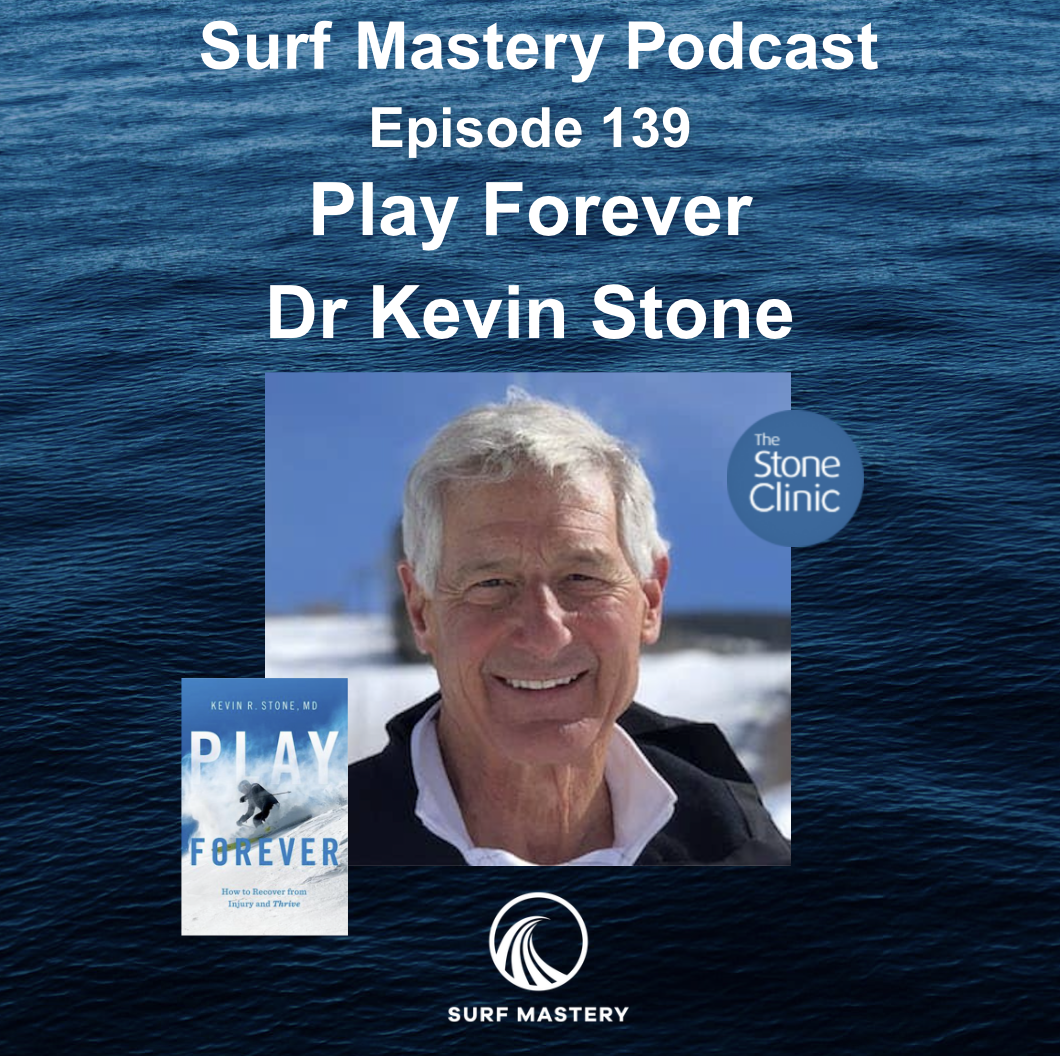
139 Play Forever with Dr. Kevin Stone: Healing, Longevity & the Future of Joint Health
May 20Tap to summarize139 Play Forever with Dr. Kevin Stone: Healing, Longevity & the Future of Joint Health Surf Mastery Podcast Download What if the key to recovering from injury and surfing well into your 80s isn’t resting more… but learning how to “play” better?Orthopedic surgeon and sports medicine pioneer Dr. Kevin Stone explains why movement, balance, community, and even fun itself may be some of the most important ingredients in healing. From biologic joint repair and stem-cell science to the psychology of staying present in the water, this conversation explores how athletes can come back stronger instead of slowly breaking down.In this episode, you’ll discover:Why turning fitness into “play” instead of “work” can dramatically improve your consistency, mindset, and long-term health.The cutting-edge advancements in biologic joint repair, PRP therapies, robotic surgery, and recovery techniques that are helping athletes avoid unnecessary surgeries and heal faster.How balance, presence, and mental focus reduce injuries, and why distraction may be one of the biggest hidden causes of wipeouts and breakdowns as we age.Press play now to learn how to recover smarter, stay active longer, and keep doing the sport you love for the rest of your life.https://www.stoneclinic.comPlay Forever Book:https://a.co/d/06sF8zYm Michael Frampton: , Dr. Kevin Stone, welcome to the Surf Mastery Podcast. Thank you so much for coming on board. You're welcome. So you have a book, and it's called Play Forever.The subtitle is How to Recover from Injury and Thrive. Now, I do want to get into the title of the book, because it plays nicely into surfing, I think, because surfing is often seen as a sport. I personally think it's a sport for very few. Most of us surfers surf recreationally and for fun, and my philosophy is surfing is far closer to music than it is a sport.So therefore, what do we do with an instrument? We play an instrument. So I'm always preaching to people, "Hey, we've got to go play surf." We don't go surfing for s- for a sport per se, unless you're a competitive athlete. So I like the title of your book for that reason, but my first question would be is what was the inspiration to write the bo...
Transcribe →
138 From Obsession to Awareness: How Great Surfers Evolve with Coach Chris of The Surf Continuum
May 1Tap to summarize138 From Obsession to Awareness: How Great Surfers Evolve with Coach Chris of The Surf Continuum Surf Mastery Podcast Download What if becoming a better surfer isn’t about catching more waves - but about thinking differently in the water?In this episode, Coach Chris from The Surf Continuum unpacks the deeper layers of surfing that often go unnoticed: the philosophy behind progression, the importance of surf culture and etiquette, and how maturity in the water can transform your entire experience. If you’ve ever felt frustrated, stuck, or disconnected from your surfing, this conversation offers a refreshing, thoughtful perspective.Gain insight into how mastering fundamentals and simplifying your approach leads to true, lasting progressionLearn how surf culture, respect in the lineup, and ethical decision-making shape not just your surfing, but your identity as a surferDiscover how breaking surfing down into simple, learnable fundamentals removes overwhelm and builds real skillHow shifting from performance-driven surfing to a more present, aware, and intentional approach can deepen your enjoyment and longevity in the sportPress play to explore a more thoughtful, grounded approach to surfing, and start evolving not just as a surfer, but as a human in the water.https://thesurfcontinuum.comhttps://www.instagram.com/thesurfcontinuum/https://podcasts.apple.com/nz/podcast/kookcast-surf-education/id1387032167To see and purchase the Surf Basis Paddle Trainer:www.surfbasis.comFor $30 off use Discount code: SURFMASTERYTranscript:Coach Chris: it's cool because our philosophy is the same. It's our unifying, kind of path. But obviously our personalities and our approaches and and delivery of of that same philosophy comes out differently.Michael Frampton:</stron...
Transcribe →
137 James Russell - Mad Surf Stories
Apr 4Tap to summarize137 James Russell - Mad Surf Stories Surf Mastery Podcast Download What would you do if one wild surf story could change how you travel, train, and survive in the ocean?Michael talks with author James Russell about the real spark behind his podcast; Mad Surf Stories - those unforgettable car park conversations where local surfers share the kind of stories that never make the mainstream. From near-death experiences and ocean rescues to fear, aging, flow state, and the lessons hidden inside heavy surf moments, this conversation speaks to anyone who loves the ocean and wants to surf smarter, safer, and longer.You’ll hear how storytelling preserves local surf lore, why surfers should take safety gear more seriously, and what happens when experience, fear, and age all collide in the lineup. James also shares insights from his own surfing life, his writing, and the deeper emotional threads that run through survival stories at sea.Discover why real surf stories are often the best source of practical wisdom and hard-earned safety lessonsYou’ll learn how fear, preparation, and mindset shape performance in the water, especially as surfers get older.You’ll get a deeper appreciation for the psychology, risk, and addictive beauty of surfing and surf culture.Press play to hear the stories, lessons, and mindset shifts that could help you surf with more awareness, confidence, and respect for the ocean.James' Podcast "Mad Surf Stories" -https://podcasts.apple.com/nz/podcast/mad-surf-stories-podcast/id1861306952https://open.spotify.com/show/4tHYvt9btBdGgB5rwKv0jv?si=e69d777c95bf46cbhttps://youtube.com/@madsurfstories?si=BH8FCHs6D_4RADApJames' website:https://dragonbrothersbooks.comTranscript:What inspired you to start the podcast?Yeah, , I guess it's those car park conversations with surfers, , where you talk to somebody and they just tell you something crazy that's happened to someone.And I thought. That's pretty cool. Like, to, to mine those stories would be awesome to be able to do that. , Yeah, I think that's kind of it really. 'cause they're, they're all local, you know, there's those legendary stories that might be, a Piha story or whatever, and everyone Piha knows it, but nobody else does.Hmm. And , when you get a bit long in the tooth, like me, you, you come across quite a few of them. Yeah. But yeah, the, the challenges to, , to get people to talk really. 'cause some of the surfers are like, , maybe they've had a shocker and they're a bit ashamed of it. Mm. So that's, that's the challenge really.But, , actually it's been really interesting 'cause a lot of the, , a lot of the kind of stories, there's been some quite good lessons come out of them, I think for, for listeners or for me or for whoever. Oh, definitely. . Good examples like Elliot Foot.And he, , suggested that if you're going to Indo and you're gonna be taking these ferries between islands, you get yourself an E and you buy that ether in your own country rather than in Indonesia. 'cause then when it pings, it goes back to your own country and you know, those people are gonna. Be on top of it and they're gonna call the into authorities.And I thought, you know, that's gold. That sort of info is, is gold, you know? Yeah, definitely. That he was swimming for two days, you know? Yeah. And, and it would've been.I've already got one of those. 'cause I do a bit of, bit of hunting, so I always have one in, in the backpack. You, you are almost, you're almost silly not to have one nowadays with given what we know. And you just gotta realize that, I mean, any sort of tourism operator in most countries, you know, there's regulations and you know that the captain of the boat will have one of those on them, and there's regular maintenance schedules of their equipment, blah, blah.None of that happens in Indonesia. So you, you kind of gotta have one of those with you just in case.Yeah, but keep in mind, Michael, you've, you are coming from the point, you know, you go, you're a hunter, so you go hunting and you bring this with you. I hadn't even considered that. Like, I think I've, I think they only came on my radar about two years ago when I was in an outdoor shop and I saw one.I was like, what's that? So I, I didn't even know what they were really, because I've never, you know, I've never done that much stuff. I've done, you know, I've done some stuff in the mountains, but I've been with other guys that, you know, they've probably got one in their pack, but they don't even think to mention it to me.So. Yeah, a lot of people wouldn't even think about it. And plus they're quite expensive. Right. How much do you pay for one? , Five, 600, something like that. Yeah, I think, I think I was 400 and it's just a basic e perb, like a signal. But , you can get, Garmin have devices that are similar but a little bit bigger that actually double as satellite phones, so.Right. You, even if you're out outside of normal signal and your iPhone's not gonna work, you've still got GPS signal. So you can immediately tell where you are and you can send a signal out, you can text message, I think you can even call on some of the more modern ones, and they're only a couple hundred bucks more and they have, you know, multiple uses.Now it's just be good to have one just in your house, you know? Yeah. No, it's good. I, um, I haven't had a, a big. A little while, but I think I might make the investment before I do, you know? Yeah, it's fu...
Transcribe →
136 Why Surfers Don’t Come Out of Barrels (And How to Fix It) - The Neurology of Tube Riding
Mar 10Tap to summarize136 Why Surfers Don’t Come Out of Barrels (And How to Fix It) - The Neurology of Tube Riding Surf Mastery Podcast Download https://surfmastery.com/barrel-mastery-academyWhat if the reason you can’t come out of the barrel has nothing to do with courage or experience, and everything to do with your brain?Many surfers believe that getting barreled is purely about skill, timing, or bravery. But if you’ve ever felt disoriented inside the tube, struggled to hold your line, or mysteriously fallen when the exit was right there, the real issue might be neurological. In this episode of the Surf Mastery Podcast, Michael Frampton reveals how vision, balance, and body awareness directly affect your ability to stay stable in the barrel, and why training your brain could transform your surfing.Discover why disorientation in the barrel is often a neurological challenge, not a lack of surfing ability.Learn practical tube riding techniques that help you stay balanced, compact, and focused on the exit.Understand how improving your vision, balance, and proprioception can elevate every aspect of your surfing. Press play to learn the surprising brain-based insights and practical tips that could finally help you ride out of the barrel. Transcript: welcome back or welcome to the Surf Mastery Podcast, the podcast that helps you to become a better surfer in and out of the water. I'm your host, Michael Frampton, and today we are talking about tube riding, getting barreled, and specifically coming out of the barrel.If you've ever struggled to come out of the barrel, then this one is for you. Tube riding. It looks like the easiest thing in surfing 'cause all you're doing is standing there. There's little movement in tube riding. However, it is the hardest thing in surfing.It's also. The pinnacle of surfing, get...
Transcribe →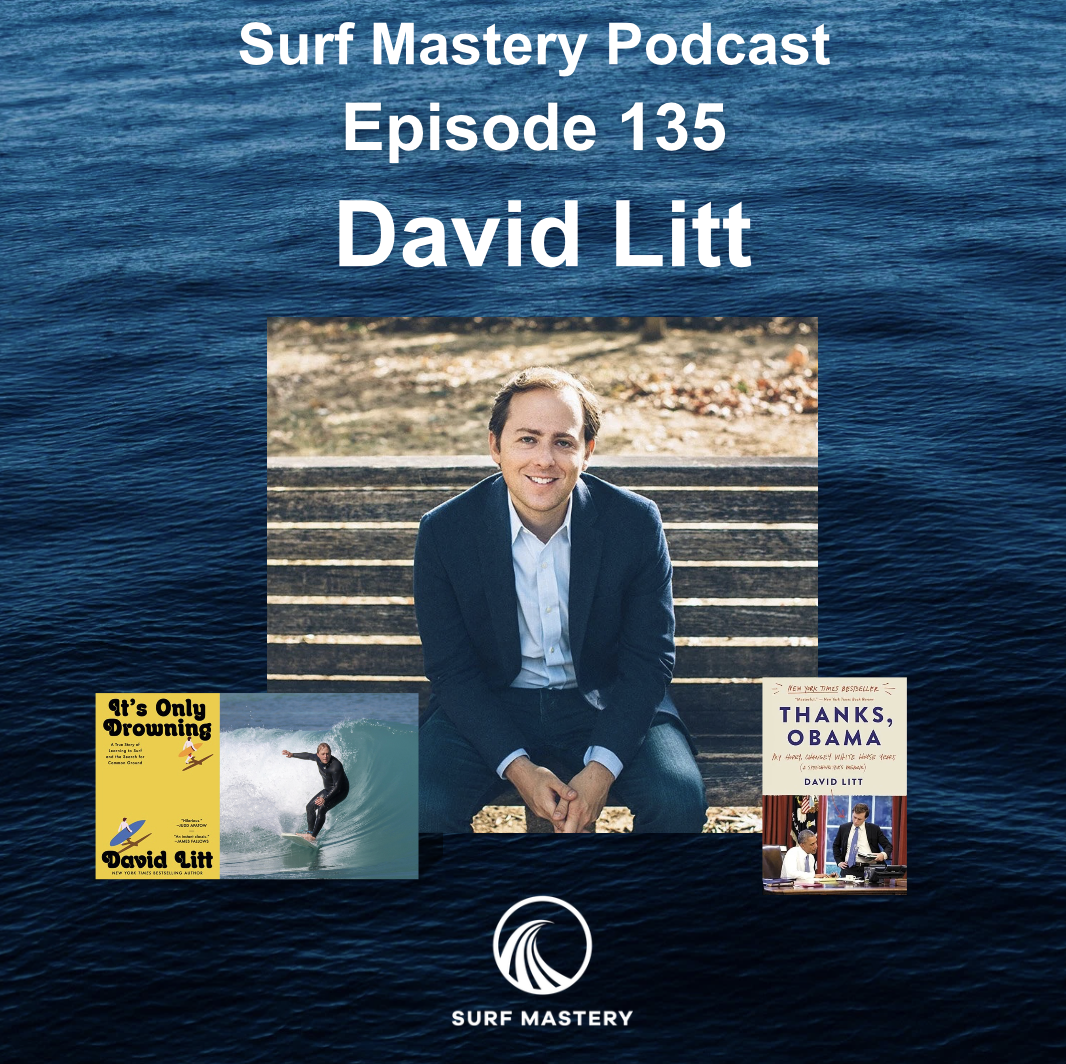
135: From Presidential Speechwriter to Surfer – David Litt
Feb 24Tap to summarize135: From Presidential Speechwriter to Surfer – David Litt Surf Mastery Podcast Download What happens when a former White House speechwriter, who’s written for presidents and packed auditoriums, decides to humble himself in a cold New Jersey lineup at 35?David Litt isn’t your typical surf author. He joined the Obama White House at just 24 and became one of the youngest senior presidential speechwriters in history, crafting remarks on healthcare, climate change, and even comedy for the Correspondents’ Dinner. After publishing Thanks, Obama and Democracy in One Book or Less, he turned his attention to something far less controllable than politics: surfing.In this episode, David brings a writer’s precision to the chaos of learning to surf as an adult, articulating the fear of hold-downs, the shame of kook moments, the obsession with progression, and the addictive pull of those brief, otherworldly flashes of flow. It’s a refreshing take for surfers: not from a prodigy, not from a lifelong local, but from someone who can actually put words to what most of us only feel.3 benefits you’ll gainA deeper understanding of why surfing feels “more than a sport,” and how chasing flow reshapes your mindset in and out of the water.Practical perspective on fear, embarrassment, and adult progression, especially if you didn’t grow up in the ocean.A renewed appreciation for the lineup as neutral ground, where politics, profession, and identity fall away, and only waves (and humility) matter.Hit play for a thoughtful, funny, and surprisingly relatable conversation that will leave you seeing your own surfing journey, and your next paddle out, in a whole new light.https://www.davidlittbooks.comMichael Frampton: are you still surfing?David Litt: Yeah, I mean, right now I'm in Washington, DC but I was in New Jersey just a couple of days ago and I was out, , actually with my brother-in-law.We, we went out and it was,, good. , It's gotten cold, but it's also gotten less crowded, so it kind of works out. Right. That's the, that's the trade off in Jersey is in the winter, the crowds go away, but , every time you get. You know, you take a set on the head, you have the worst ice cream headache of your life.Michael Frampton: Yeah. It gets cold there. All right. Like really, really cold. Yeah. Ice floating down the Hudson and , into the sea. , David Litt: I think the coldest I've surfed in is probably like 35 degrees. , So what, that's something like. Zero or one. Michael Frampton: Yeah. David Litt: Chelsea Michael Frampton: just David Litt: doesn't, doesn't get much Michael Frampton: colder.Really? David Litt: Yeah. It's basically ice cold. Although it is, it's one thing that I like about surfing on the East coast in the US is one way you can kind of prove that you belong is if you're a new surfer, you don't necessarily need. Skill, if you're willing to show up when it's really miserable out right.You get a certain kind of respect just for being there. , And you get more respect if you can actually surf. I've heard. But, , hopefully , I'll discover that firsthand one day soon. Michael Frampton: Yeah. Well, surfing is a, it's a hard sport. , David Litt: I, I think it's one of those things, if I had known how difficult.Surfing is when I started, I definitely would not have started, , especially at 35 years old. So I'm really glad that I had no idea because I, I've gotten so much out of it. But if I had known how difficult this was gonna be, I never would've signed up for it in the first place. Michael Frampton: So when was the point, like the tipping point of that?Because obviously you were motivated to start and then you got to a point where you're like, oh man, this is how you must have, there must have been times where you thought, I'm just gonna give up. David Litt: Yeah, some of it I think is the cliche, right? That first wave you catch, even if it's just you're in the whitewater and you look back on it a few years later and you're like, maybe that was all of four or five seconds.But there's something pretty remarkable about it, and I think what I really fell in love with quickly was that sense that when you are. Up on a board, you're like in a different dimension, right? I always feel like it's almost like a, like a door to Narnia opens up, right? It's just this different place.And I started surfing at a time in my life where I was pretty, I, I just kind of gotten out of, or was maybe getting out of the only real episode of true depression that I've ever gone through. And it was really, uh, it was really tough. I mean really, really tough. And so I think the idea of being somewhere else was more attractive than ever.And. That absolutely hooked me in, right? That feeling of, okay, you're up on the board, that you're in this entirely new reality. And then. The ride ends and you're like, how do I get back there? Right. That was a big part of it. And I think the other thing honestly was I was surfing with my brother-in-law.He's a good surfer. I knew I was gonna see him for the rest of my life, and I knew that if I chickened out, he would kind of judge me for it. And I was like, I cannot let that happen. And that was a very powerful motivator, right? I talked to other people who learned to surf as an adult without a family member who was always gonna kind of roll their eyes a little bit if they gave up.And I don't know how they do it. Michael Frampton: Yeah, well I think it comes back to that, that original flow state that you felt and you connected with the ocean and your mind went blank for, you know, a few seconds on that ride. And it's that feeling that we, that we chase, it's so much more than a sport. David Litt: Yeah, absolutely.I think it was one of the hardest things in the book actually, because you, you don't wanna call surfing a sport 'cause that seems to diminish it, but then you don't quite know, there's not enough other words to dis, you don't wanna say an activity or a hobby or what, weirdly. Right. Writing a book about surfing, there are lots of challenges, but one of the biggest challenges was when you're describing the category of things that surfing ...
Transcribe →
134: You’re NOT Too Old for Surfing: How Aging Can Actually Improve Your Surfing
Feb 5Tap to summarizeYou’re NOT Too Old for Surfing: How Aging Can Actually Improve Your Surfing Surf Mastery Podcast Download Are You Really Too Old to Surf - Or Just Believing the Lie?Feeling slower in the water, stiffer in the joints, or unsure if you’ve aged out of the sport you love? What if it’s not your body that’s holding you back, but your mindset?Surfing is often seen as a young person’s sport, but that belief is costing older surfers joy, progress, and freedom. If you’ve ever felt like your best surfing days are behind you, this episode shows that they might actually still be ahead. Backed by neuroscience and real-world examples, this conversation reframes what’s truly possible in your surfing life after 40, 50, and beyond.What You’ll Gain from ListeningA science-backed mindset shift that shows how the brain can get better with age, leading to smarter wave choices, emotional control, and more satisfying sessions.Real stories of aging surfers like Kelly Slater and Laird Hamilton who defy decline, plus insights from The Mature Mind, The Mindful Body, and Gnar Country that expose the myths of aging.Practical ways to thrive as an older surfer - from cognitive strategies to physical habits and creative approaches that will reignite your passion and performance.Press Play If You're Ready to Surf Smarter, Not SlowerDiscover how to keep surfing, keep learning, and keep enjoying the ocean, for life.Books:The Mature Mind by Gene CohenThe Mindful Body by Ellen Langer Gnar Country by Steven Kotler - or the podcast interview:https://jamesaltuchershow.com/episode/superpowered-aging-with-the-master-of-flow-steven-kotlerhttps://podcasts.apple.com/podcast/id794030859?i=1000679523450Transcript:Welcome back or welcome to the Surf Mastery Podcast, education and inspiration for Lifelong Surfers. Are you too old for surfing? I don't think so. I think we've been lied to about aging. I'm your host, Michael Frampton, and I hate to admit it, but I am an aging surfer and there comes a point in our surfing life where we start to think is that it?Is that as good as I'm gonna get? , Can I even continue to surf with this knee? Should I just buy long boards? Am I aged out of tropical surf trips? Now it turns out that this negativity is actually just disguised as realism. Sure we may feel less paddling power, slower popups, stiffer joints, pain, blah, blah, blah.A sense that surfing like most other sports belongs to the young. Our expectations shrink. Our wave count drops our tolerance for risk. Disappears. But it turns out not because the body has failed, it's because the story has, and once that story takes hold, it becomes self-fulfilling.We stop experimenting. We avoid challenging conditions. We stop getting up early for dawnies, we. We upsize all of our boards. We surf defensively rather than creatively. We confuse caution with wisdom and what looks like natural decline is really learned limitation. Now that is a tragedy because surfing is actually one of the rare athletic disciplines where experience perception, pattern recognition, emotional control, all of those things actually matter far more than raw athleticism or strength or youth.Your ability to read the ocean and to stay calm and be efficient is actually what makes you a good surfer.Having one toe in the surf industry, I've been lucky enough to have some conversations , with some older, amazing surfers, and whenever you ask them about aging, , they often just simply shut you down. I remember talking to Laird Hamilton in the water and I asked him about longevity and aging, and he just immediately shut me down, said, no, we don't even talk about it.We don't acknowledge it. We just carry on. And I thought that was a really, a really unique and cool perspective. But it turns out there's a lot of, a lot of truth backed by science to this way of thinking. And I've recently read a couple of books. The first one is called The Mature Mind by Gene Cohen. Now Gene looks at the science of the Aging Brain.And yes, some of our processing speeds decline as we age. And of course our bodies slow down as we age, but our brains can actually improve if we do certain things. The overarching principle of the book would be the use it or lose it principle. So if we keep doing stuff, we can actually keep getting better.Scientifically speaking, our brains begin to use both hemispheres better, and those hemispheres work together better. We become more emotionally regulated and less impulsive responses. We actually integrate our memories and perception better.We become more aware of who we are and what we want. So in surfing terms, our wave selection gets better. The way we read the ocean gets better. We can remain calm under pressure, and of course we know the types of waves, the types of boards, and the way that we wanna surf better. We become more comfortable in our own skin andmaybe we don't surf as well from a competition surfing perspective, but we actually end up enjoying surfing more.Cohen also talks about neuroplasticity. Some of the old science suggested that we actually learn. That we, some of the old science, some of the old science suggests that we lose our ability to learn as we age, but it turns out that's not true. If we continue to deliberately learn, our brain can stay plastic and we can continue to learn stuff.And Cohen gives concrete tips about how to improve our brains as we age. And one of those is to continue learning. Now, that might be a language or a skill, something that's intellectually challenging. He recommends doing crosswords and puzzles and strategy games. . Engaging in creative pursuits, writing, painting, music, dance, any form of artistic expression,and learning a new instrument or if you already play an instrument. Continuing to learn more about music and, and new songs encompasses both the learning and the creative side of things.We need to maintain and expand our social engagement. So that means maintaining our friendships and relationships and community, but also a term Coan users is to cultivate cognitive diversity. And what he means by that is meeting new people,being op...
Transcribe →
133 Why Good Surfers Think Like Stoics, and How Stoic Philosophy Can Make You a Better Surfer
Feb 2Tap to summarize133 Why Good Surfers Think Like Stoics, and How Stoic Philosophy Can Make You a Better Surfer Surf Mastery Podcast Download What if mastering the waves has less to do with technique, and more to do with ancient philosophy?Whether you're paddling out for the first time or carving your hundredth wave, frustration, fear, and unpredictability are always part of the ride. In this episode, host Michael Frampton explores how stoic philosophy offers timeless wisdom that every surfer, beginner or seasoned, can use to improve not only their performance, but their overall surfing life.Discover how living “in agreement with nature” is the foundation of both surfing and stoicism, and why resisting the ocean never works.Learn how the four stoic virtues, courage, temperance, justice, and wisdom - naturally align with the traits of truly great surfers.Understand how to shift your mindset from ego to awareness, helping you manage frustration, navigate lineup politics, and stay stoked even in challenging conditions.Tap into the mindset of resilient, wise surfers by listening to this episode and learn how to ride the waves, and life - with stoic flow.Transcript:Why good surfers think like stoics and how stoic philosophy can make you a better surfer? I recently re-read The Obstacle is The Way by Ryan Holiday.It's a very famous book. , It's a short and modern summary of the ancient stoic philosophy stoicism and I realized just how stoic we are as surfers. Certainly good and experienced surfers, if you surf, you are already a student of stoicism. And if you're a good surfer, you're actually very stoic already.And if you're completely new to surfing, I think stoic philosophy can really help you on your journey. So today I'm just gonna give a little bit of an overview of stoicism and how it relates to surfing. Now one of the core teachings of early stoicism is that a smooth flow of life comes from living in agreement with nature.Surfing is a literal embodiment of this idea. You cannot fight the ocean. You must observe it and respect it, and learn to move in harmony with the ocean. Zeno, one of the original stoics who this teaching is attributed to didn't just mean nature in terms of mother nature and its literal sense. But he also meant it in terms of human nature, other people, society, and of course our own nature, which is very important I think, to to note these nuances.In surfing. Obviously we want to live in agreement with Mother Nature, the ocean and the weather patterns, et cetera. And as a surfer, we need to read and predict these, adapt and utilize them. But nature as in human nature, other people are. Because other surfers are everywhere, so we've got lineup, politics, and ethics.They're unavoidable, especially at your local break if you want to consistently go out and surf the same place amongst the same people, we have to get on with everyone and we have to learn the unspoken rules and ethics of surfing in general and also for that particular break. And of course, self knowledge, our own nature. Our own deep desires to surf. We need to live in agreement with that. 'cause if you try and deny that part of you, you live in fomo, fear of missing out, and you don't go surfing enough to satisfy that inner surfer.And, uh, it can certainly encompass and take over one's mind. And of course, if you go the other way and you embrace that inner surfing desire too much, it can certainly lead to ruining other aspects of your life and your relationships. So we must have a balance.We must learn to live in agreement with all three aspects of nature in order to be a good surfer. A smooth flow of life comes from living in agreement with nature. It's almost like a surfer came up with that principle. Stoicism at its heart is about focusing on what we can control and accepting what we can't. And furthermore, as surfers, we need to utilize what we can't control to adapt to and play with the ocean and the crowd. And if you want to be a good surfer, you cannot get away from that principle. , What can we control the surfers, .We can control the way we move. Our bodies, we can control our minds. What we focus on our inner dialogue, and of course, we can control our equipment choices and where we surf. We cannot control the weather, the waves, the conditions, or other surfers. We must learn to accept those. We can, of course, learn to read the ocean better and understand surf culture and human psychology, but we've got to accept these things as they are and focus on what we can control.The ancient stoics talked about four virtues, courage, temperance, justice, and wisdom. Surfing is dangerous, especially if you're gonna push yourself into bigger waves or surf rougher conditions or busier crowds. Courage is incredibly important. E courage isn't just about ignoring fear, it's about feeling the fear, acknowledging it, and moving forward logically.Improving your surfing requires that you repeatedly step into danger and discomfort, not recklessly, but willingly, and over time, this builds a quiet, [00:05:00] grounded courage, the kind that the stoics admired the most. Temperance. Temperance is about self-control and moderation.Now if you surf for long enough, you'll eventually call somewhere home. You'll become a local, and temperance is going to be really important 'cause other surfers and the ocean will punish anger and impatience and entitlement.However, mother nature and the crowd will reward. Calm and measured decision making. This is stoic temperance in practice. Temperance and surfing is about choosing waves without being greedy. It's about controlling your emotions and behaving fairly.It's about the way you conduct yourself, not only in the lineup and when you're surfing a wave. But also in the car park. If you show a lack of temperance and self-control or moderation, the ocean and the crowd will humble you. Now, this segues very easily into justice. Justice , is deeply embedded in surf culture, particularly with lineup politics, the ancient stoics associated justice with fairness, kindness and reverence, fairness and kindness.They're obvious and every lineup has its informal judges and experienced surfers that will enforce the unspoken rules. Now, sometimes that enforcement can come through harsh words or passive aggressive drop-ins, but reverence, reverence is an interesting word. The stoics thought of reverence as a deep solemn respect for something greater than yourself, the ocean.Surfing demands reverence for the ocean's power. It's chaos, it's cycles. If you choose the wrong wave or push beyond your capabilities, the consequences will arrive swiftly and the ocean w...
Transcribe →
132 The Only Way to Get Better at Surfing: Obsess Over It
Dec 23Tap to summarize132 The Only Way to Get Better at Surfing: Obsess Over It Surf Mastery Podcastt Download Are you ready to transform your surfing in 2026 by going all in - completely obsessed, fully immersed, and totally committed? This is the ONLY way to truly improve.If you're feeling stuck in your surf progression or yearning to break through to the next level, this solo episode with host Michael Frampton dives deep into the one mindset shift that separates average surfers from true masters. It’s not just about passion, it’s about short-term obsession to create long-term transformation.Learn why a temporary period of full-blown surfing obsession could be the key to lasting surf progression.Discover practical ways to build your life around surfing without giving up your responsibilities.Get inspired with a clear roadmap for turning 2026 into the year you finally identify not just as someone who surfs, but as a true surfer.Press play now to find out how to make 2026 your breakthrough year of total surf immersion and mastery.Transcript:[00:00:00] Welcome back, or welcome to the Surf Mastery Podcast, education and inspiration for better surfing and a better surfing life. I am your host, Michael Frampton, and it is the end of 20, 25, 10 years this podcast has been going on, and I was just doing a little bit of reflecting back and looking at all of the episodes and interviews I've done and all of the unpublished stuff, all the work that went on behind the scenes.the inspiration that, that, that makes me want to get better at surfing and to share that journey. And if you do want to get better at surfing, to be on that path of mastery. This one essential thing that is paramount, and that is you need to be obsessed with surfing for at least a portion of your surfing life.If you're a listener to this show, you are [00:01:00] already fascinated. With surfing, it's already a passion. You already love surfing, otherwise you would not be listening. But have you been through a stage of your life when you have been completely obsessed with it? That is what it takes to get better at not just surfing, but anything.Kind of more so surfing 'cause it's so complex. It's the playground is always so different. It's also not just a sport, it's so much more than that. So you do need to obsess over surfing for a certain period of time. I remember I was living in London, focused on career working 70 hour weeks miles away from any coastline and.the desire to go surfing and the identity I had as a surfer was still there. And it just got to this point where I was like, man, I think I'm addicted to surfing. And I was ashamed of it and I wanted to deny it. Ironically, [00:02:00] that's why I became a personal trainer. It was because I wanted to learn more about health and fitness and to become a better surfer.And I found myself, just focused on the career side of that. And it ate at me and I tried to push it down and deny it for quite some time, and it was pointless. And it wasn't until a couple of years later, moved to Sydney and was just immersed in, in a rich surf culture and surrounded by good waves, and I just let go of it.I just gave in. It's okay, I, I love surfing so much. I'm just gonna focus on it every single moment outside of work and family, I was either surfing or I was learning about surfing in some way, and it is a time of my life that. I'll never regret it. it wore off a little bit in terms of the fascination [00:03:00] for surfing has never gone away, but that, that strong desire to be obsessed with it, that was eating at me for years once I gave into it and just fully immersed myself and it just faded into.Fascination and surfing passion. But that time that I spent completely obsessed with surfing, informed the rest of my surfing life, and without those, that time spent diving into it, being completely immersed with surfing, there's no way I would've got as good as I got now and I can pull up to a beach and feel confident in almost any conditions.It's such a cool place to be in one's surfing life. So here's my advice to you. As you come into the new year 2026, and you truly want to get better at surfing, make 2026 the year that you [00:04:00] obsess and totally immerse yourself in surfing. Now, that means not only are you going surfing as much as you can, you're committing to going surfing as much as you can.'cause sometimes you're not gonna feel like it. You might force yourself to put your wetsuit on, but I promise as you're taking your wetsuit off, you won't regret the surf no matter what the conditions. You also, you're gonna drop that Netflix time and you're gonna watch surfing videos and surfing documentaries and YouTube tutorials.You're gonna dive into surfboard technology. The right shape for you. The different types of surfboard designs there are. You're gonna start reading novels written about surfing, adventure and surfing culture. You're going to do breath work training, and you're gonna stop doing heavy weight training and do different training in the gym.That's mo...
Transcribe →
131 Why You’re Missing Waves (and What the Pros See That You Don’t)
Nov 25Tap to summarize131 Why You’re Missing Waves (and What the Pros See That You Don’t) Surf Mastery Podcast Download Are you truly reading the wave, or just watching water move? Discover how paying attention to the ocean’s smallest details could completely transform your surfing.If you’ve ever felt stuck in your surf progression, unsure why better technique isn’t getting better results, this episode is your wake-up call. It’s not just about turning sharper or paddling harder, it’s about changing how you see the ocean. Whether you’re an intermediate surfer or decades in, understanding how to focus and read the wave can be the game-changer you’ve been missing.Learn how world-class surfers like Tom Carroll gain a massive edge by spotting secondary swells, backwashes, and subtle refractions that most surfers miss.Discover why your technique won’t matter if you can’t focus and how mindfulness and meditation off the board can level up your performance on it.Shift your entire relationship with surfing by embracing a personal surfing philosophy rooted in joy, longevity, and self-defined progression - not surf industry hype.Press play to learn how changing your mindset and mastering wave reading can unlock deeper flow, better waves, and more fulfilling sessions in any surf condition.131Michael Frampton: [00:00:00] What helped my surfing the most was looking for the details in the wave because I think it's so easy to get lost while you're surfing. A lot of the time you spend either paddling or just sitting there waiting. If you don't have the ability to read the wave properly, technique's not gonna help you.That is the hardest part of surfing, knowing where to go. 99% of your time surfing. Is not spent surfing. It's paddling around and looking for waves and sitting there staring at the ocean. Welcome back to the Surf Mastery Podcast, education and Inspiration for Better Surfing. I am your host, Michael Frampton, and that was a quote from when I was interviewed for the surf.Basis podcast. A podcast very similar to this one. I interviewed Van who hosts and produces the podcast, uh, back in episode 1, 2, 3, and he interviewed me for his show. So today I am releasing that conversation, which originally appeared. On the Surf basis podcast. Van Vu: Alright, welcome to the Basis Surf [00:01:00] podcast.Very excited because today we got Michael Frampton of the Surf Mastery Podcast. He is one of the OGs in this space. I think you've interviewed over 120 guests at this point. You were one of the original inspirations when I started my podcast as well. 'cause there's just a, a wealth of knowledge in your podcast and in you, yourself as a coach.Um, and I know you have. Courses as well. But, uh, very excited to get into it, try to extract all the little nuggets that you've picked up over talking to all these people and yeah, so thanks for joining. Thank you so much, fan. It's, it's an honor. Cool. Well, why don't we just dive straight in. I mean, you know, there's a million angles that we could take from this, but I, I think where the place I want to start is, you know, you've interviewed over 120 guests at this point.What have been kind of the best nuggets, best pieces of wisdom, best pieces of advice that you've, you've been able to get over all these interviews Michael Frampton: at this point? Yeah. Straight into it. Okay. The thing, what helped my surfing the most was I immediately think [00:02:00] of Tom Carroll. I was lucky enough to be. When I started the podcast, I was actually training Tom Carroll as a personal trainer in the gym, and he was the second guest, number two.And one of the things he was talking about in that original interview was looking for the details in the wave, and that stuck with me back then back in 2015, as something that I'm constantly trying to improve on is looking for the details and the wave and what Tom meant by that. What I'm still learning is when you're looking at the wave, most people think that there's a wave coming in or there's a, you know, there's a, a one meter swell at 15 seconds and that when that wave hits the beach or the point and it breaks along, that's what we surf.Yes, that's the main wave. But there back washes, there are secondary and tertiary swells. There's wind chop. There's refractions coming off headlands, even [00:03:00] from miles away, that interact with that main wave. And when we start to see, when we look for, and we start to see those smaller details in the waves, then that's what allows, I mean, surf what and what, um, what fascinated me the most was Tom would've been.This is, you know, 10 years ago, so I was what, 34? And Tom, Tom would've been like 52 probably. And we went surfing and he's on a smaller surfboard than me, just on these probably waist high waves. At a soft beach break. I was struggling to paddle into the waves. I couldn't even catch these waves, and he's doing full roundhouse cutbacks, just going a hundred miles an hour.I just couldn't work it out. Like, how are you doing that? Mm-hmm. Obviously, he's a pro and he's been doing it a long time, but. We got to break it down and it was because he's looking for the [00:04:00] details. Van Vu: Yeah. Michael Frampton: He, he's looking at how the, that wind chop, that's where I'm gonna put the rail on my surfboard, right inside that wind chop or that refracted wave.And I'm gonna choose the wave that's meeting. The main swell and kind of wedging up a little bit. That's where I'm gonna chip in and paddle into the wave in the first place. And I wasn't even aware that that's what was going on in surfing until he, he pointed that out. So that was definitely a, a huge nugget and something that I'm always looking for as those real, those just minor little details.Sometimes when the, at, uh, when the sun's low on the horizon, it's really easy to see. But when the sun's straight up in the sky and the water's murky, it's so hard to see the multiple swells and the wind chops and the water, et cetera. Also, just the way the water moves, like especially in the, some of the beaches in Australia at the time, you get little, they call it a rip bowl, where there's a rip running sort of alongside the, the, the beach break.The [00:05:00] beach break, and then as the wave's coming in, there's also water drawing. Underneath the wave two. So your board speed is actually faster than the wave's actually going. It's almost acting like a, a wave moving towards the beach as well as a stand...
Transcribe →