Loading summary
Transcript234 lines
- [00:02]
Sophie Ansari
Lemonade.
- [00:06]
Anthony Perovsky
I called her Crazy Debbie because I had like three Debbies in my life. And she worked at my dad's hospital and she was always getting into trouble. And my dad had her watch me once. And I drove a car for the first time. I think I was 13 years old. Her Honda Prelude to Costco. And I bought my first DVD ever, any given Sunday, which. Where his eyeball falls out. Which is crazy that I just remembered that. And she had a weed plant in the backseat. And then she got me a bottle of apple.
- [00:34]
Penn Badgley
A weed plant.
- [00:36]
Anthony Perovsky
I can't. I just unlocked something.
- [00:38]
Penn Badgley
This sounds awesome. To be clear. To be clear.
- [00:41]
Anthony Perovsky
Yeah.
- [00:41]
Penn Badgley
She sounds like awesome Debbie, by the way.
- [00:43]
Anthony Perovsky
She's amazing. Yeah. We should change her name, actually. Yeah.
- [00:47]
Penn Badgley
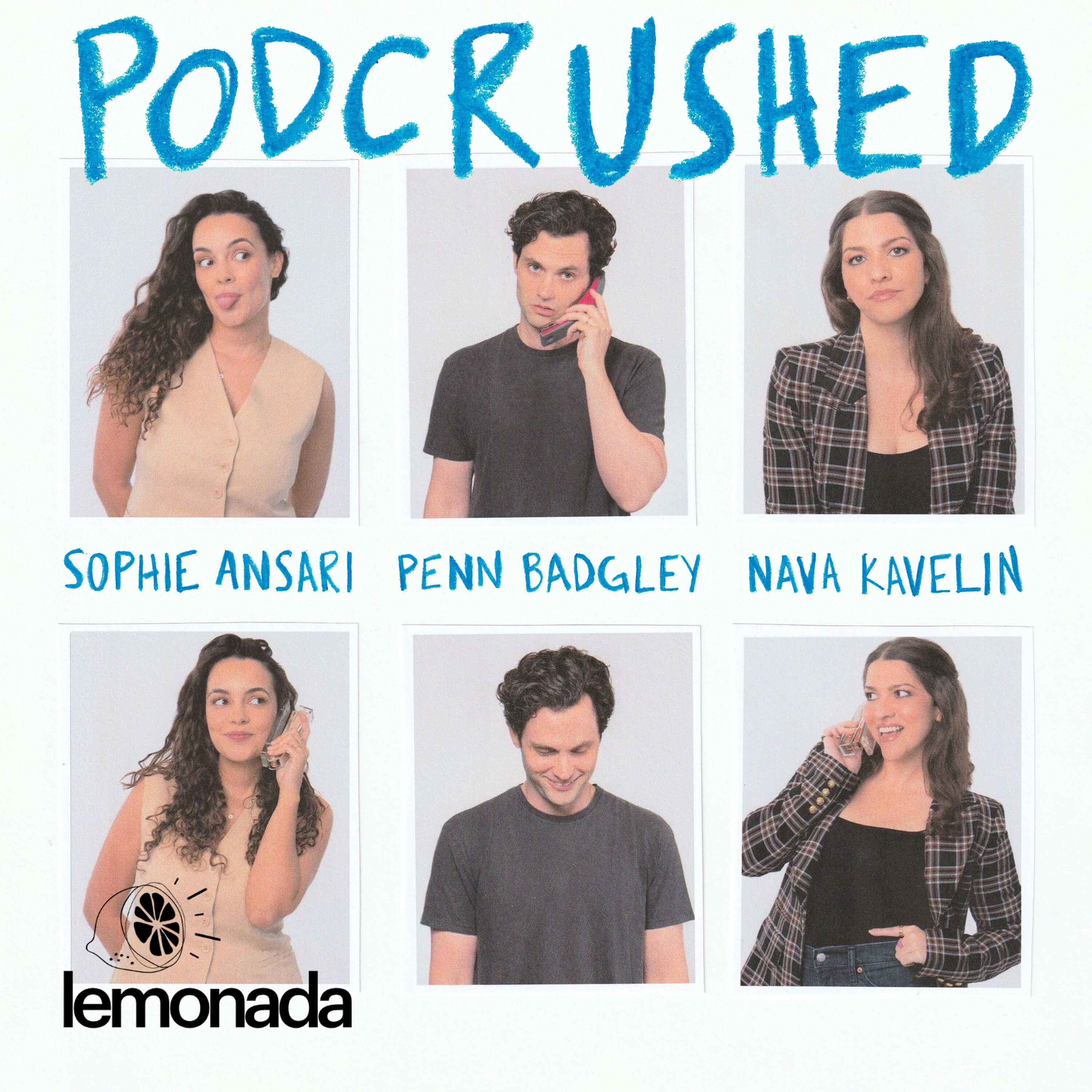
Welcome to PodCrushed. We're your hosts. I'm Penn.
- [00:50]
Sophie Ansari
I'm Sophie.
- [00:51]
Nava Kavilan
And I'm Nava. And I think we would have been your middle school besties.
- [00:54]
Sophie Ansari
Blasting the Goo Goo Dolls and watching ourselves cry in the mirror.
- [00:58]
Penn Badgley
I just want you to know who I am. Right.
- [01:03]
Sophie Ansari
Perfect.
- [01:05]
Penn Badgley
Welcome to Pod Crushed. My two co hosts are looking very partisan today.
- [01:11]
Sophie Ansari
They're wearing red and blue, actually. Yeah.
- [01:14]
Nava Kavilan
Now that I.
- [01:14]
Sophie Ansari
The last few episodes have been on the same wavelength. Like both in a gray cardigan, both in striped shirts. And today we are divided.
- [01:23]
Nava Kavilan
I'm representing the chiefs.
- [01:25]
Sophie Ansari
The last sad. Well, you should be in. You should be in a sparkly. I thought that those clips of Travis Kelce and his sparkly top walking out. So sad.
- [01:37]
Penn Badgley
I've not seen that. He was wearing what, like a sequin thing?
- [01:40]
Sophie Ansari
It was like a matching set of like sparkly.
- [01:45]
Penn Badgley
It was something he thought he was gonna win in.
- [01:47]
Nava Kavilan
It sounds like there are a few funny. I mean, I do feel badly, but there are very funny videos going around of men in sparkly tops. Like, think he could have packed a backup outfit.
- [02:00]
Penn Badgley
I love that. Speaking of a sparkly top, I think he'd like that. I think we'll have to just print it and go and see.
- [02:09]
Nava Kavilan
Just got there.
- [02:11]
Penn Badgley
Our guest today is none other than Anthony Perovsky. He's Emmy winning New York time bestselling chef who is most famously from Netflix's Queer Eye. He's on today. He's got a new show called no Taste like home which follows Anthony as he guides a cast of a list celebrities. You know, they didn't call me. Which I'm not sure who's more disappointed. But he takes his celebrity friends or acquaintances on an epic journey to explore their own personal histories through their ancestors. Food traditions, techniques and experiences, culinary experience. Culinary experiences. It's actually. It's very cool. It seems very highbrow and very interesting. It was a real joy having him on the pod today. You're gonna love this episode. Please stick around.
- [03:09]
Anthony Perovsky
I'm Hasan Minhaj, and I have been lying to you. I only pretended to be a comedian so I could trick important people into coming on my podcast. Hasan Minhaj doesn't know to ask them the tough questions real journalists are way too afraid to ask people like Senator Elizabeth Warren. Is America too dumb for democracy?
- [03:28]
Hasan Minhaj
Outrageous.
- [03:29]
Anthony Perovsky
Parenting expert Dr. Becky. How do you skip consequences without raising a psychopath? It's a good question. Listen to Hassan Minhaj doesn't know. From Lemonada Media. Wherever you get your podcasts, suffering is.
- [03:42]
Hasan Minhaj
Inevitable, and it sucks. But we're still expected to thrive. Everything Happens is a podcast for people who are tired of coffee mug platitudes and want something with a little more teeth and a lot more heart. Each week, Duke professor Kate Bowler talks with guests like Glennon Doyle, Sharon McMahan, and Coach K about grief, absurdity, and the beautiful, terrible days we actually live through. No hustle culture, no silver linings, Just real talk and good company. Listen to Everything Happens wherever you get your podcasts.
- [04:17]
Penn Badgley
So we. We do usually start at 12, but because you have a show coming out that has this really lovely, unique premise, rather than saying, who are you at 12? We'll get there, we'll get there. But we would like to ask you, what did home taste like at 12?
- [04:36]
Anthony Perovsky
Okay, we're getting poetic from the Deco. All right. What did home taste like? The food that we ate growing up was dictated by my parents trips. So we traveled a lot as well as a family, but they took a lot of trips together, either with, like, a group of friends or just as a couple. And so, like, they went to. They were in Morocco and went to, like, Charm El Sheikh, because my dad is, like a big windsurfer. And when they got back from Morocco, like, we ate tagine for a month.
- [05:03]
Nava Kavilan
Wow.
- [05:04]
Anthony Perovsky
When they. My mother would go to Poland for a month to visit her. Her mother, she would come back with, like, these, like, little yogurts and this, like, smoked cheese that you get from, like, the mountains. And so we would just be eating a shit ton of Polish food for a few weeks. So it was really. It was really dictated by that. And I think sort of like the diversity of, like, the diversity exposure to food was I was exposed to at a really young age, except I was an extremely picky eater. Like, I hated tomatoes. There were so many Things that I wouldn't eat, but then I had weird things that most kids didn't like that I really enjoyed. So it was sort of really all over the place because it was in Canada and we have nine months of winter and, like, six feet of snow. There was a shocking amount of, like, stews and soups and just stuff to put meat on your bones.
- [05:48]
Nava Kavilan
Yeah. So when you say, like, your parents went to Morocco and then you were eating tagine for a month, that sounds not that hard to imagine now. But I'm thinking of you. You and I are the same age, so you were born in 84. So I'm thinking of that as, like, in 1996. There's not YouTube. Like, how are your parents figuring out even how to make it tagine? Like, how is that possible?
- [06:12]
Anthony Perovsky
You know what? That's a really good question. My mother was an excellent home cook. She really had instinct. And when we would be at a restaurant, she would try something, and she would be able to kind of take apart all the different elements. I have a little bit of that. I'm not as good. But then she would come home and figure out how to make it healthier or easier or whatever. I just got this random memory of this halibut that we had with a pistachio crust in North Carolina again, when my dad went windsurfing. Big windsurfer. And we came back, and then she was figuring. Figuring out how to, like, roast it so that the temp would be good for, like, the fish to be fully cooked, but the crab and the pistachio mix wouldn't, like, be overdone. So she kind of, like, it was all very instinctual, and she kind of. She treated cooking the way I do as, like, painting is like, you're kind of, like, figuring it out a little bit as you go. You kind of have a plan. And that's how I approach it now. Like, if I'm. If I'm making something that I've never made before, I'm gonna go read a couple of blogs, like, maybe get on Reddit, even though I try to avoid that thing as much as I possibly can. And then I just, like, let it go. And I'm like, okay, like, what am I retaining? What are the main rules that I need to know? And I kind of go with it. So I think that's how she operated kind of. It was all very. Yeah, it was, like, all in her brain.
- [07:24]
Penn Badgley
I feel like cooking Reddit might be the safest part of Reddit. Is that not true?
- [07:28]
Anthony Perovsky
Yeah, yeah, yeah. I made the mistake once of looking up my name when someone told me that people.
- [07:33]
Penn Badgley
Oh, no, no, no, no, not on Reddit.
- [07:35]
Anthony Perovsky
No. That was a double therapy session. Yeah. Never happening again. You live, you learn, you know.
- [07:40]
Nava Kavilan
Yeah.
- [07:41]
Penn Badgley
So, you know, you do have this interesting kind of upbringing where, you know, you were moving a lot. You've, you've, you're sort of a self professed nomad, by the way. I can relate very much, but for very different reasons, or I think they might be different reasons. What, what was it that contributed to your family moving so much? For those who don't know.
- [08:04]
Anthony Perovsky
Yeah. So when I finish. I was raised in Montreal. And then right when I do you graduate elementary school. Yeah. You technically graduated. You did, yeah. Yeah. And then I, I, my father moved to West Virginia. He's, he was a physician. And when you move to the US before you get board certification, you have to work in certain states. And he chose West Virginia because it was a lot of golfing and whitewater rafting and a lot of Canadian expats were there. And so both my sister stayed in Montreal. I moved with my parents. I was there for junior high, so 7, 8, 9. And then my parents split up. So for grade 10, I went back to Canada, and then they got back together. So for grade 11, I went back to West Virginia.
- [08:49]
Nava Kavilan
Oh my gosh.
- [08:51]
Anthony Perovsky
And then I kind of had enough of being there. And I don't forget the reasons exactly. But they sent me back to Montreal. I know why. Because it was one year less of high school and you start this thing called Seijep, which is like a pre college. So I move back so that I can kind of be caught up with everyone that was my age, because if I would have stayed another year, I would have lost a year and I would have been behind. So the weird thing is, even though I have a university degree, I don't have a high school diploma, I never graduated from high school.
- [09:17]
Sophie Ansari
Anthony, you're talking like, even when you were describing your parents trips, like them going to Morocco and coming back and you having tagine and then this picture that you're painting of like your sister staying back in Montreal and then you going back and forth, the only thing I'm wondering is like, who was taking care of who at what time, like, did you have. It sounds like you would have had to have like extended family around or like more like your parents had to have had a village of some sort. Like who, who was in your community?
- [09:45]
Anthony Perovsky
You would think I was. Like, when I kind of look back, I was Alone a lot. And at the time, I thought it was the greatest thing in the world. Cause I was like the immigrant kid with the weird name who brought the weird lunches, who lived in West Virginia, whose parents were traveling a lot. And my mother was in between Canada and the U.S. taking care of my sisters in both houses. And my father worked a lot, like, 12, 14 hour shift. And so I was the one always having, like, house parties. And I lived in this, like, gated community where I kind of had, like, my. My. My friends that we always really hung out with. So it was kind of like a safe space where we could get into a lot of trouble without any consequences because there weren't any cops. It was like, security people. And this was like. It was a fancy place, but in West Virginia, it's sort of there. There really was. No, not like, a representation of, like, a middle class. It was either. There were a lot of, like, mobile homes, trailer parks, that sort of thing, or you lived in a gated community. It was really like, the extremes. So, yeah, you would think that I would have someone watching over me, but no. Although. Wow. I just remembered. It's fine. You know what? She's. I called her Crazy Debbie because I had, like, three Debbies in my life, and she worked at my dad's hospital. And she was always getting into trouble for, like, just being mischievous at work. And my dad had her watch me once when he was. He was gone for, like, three days, and my mother was gone, and I drove a car for the first time. I think I was 13 years old. Her Honda Prelude to Costco. And I bought my first DVD ever, any given Sunday, where his eyeball falls out. Which is crazy that I just remembered that. And she had a weed plant in the backseat. And then she got me a bottle.
- [11:32]
Penn Badgley
Of a weed plant.
- [11:34]
Anthony Perovsky
I kept. I just unlocked something to be clear.
- [11:38]
Penn Badgley
To be clear.
- [11:39]
Anthony Perovsky
Yeah.
- [11:39]
Penn Badgley
She sounds like awesome Debbie, by the way.
- [11:41]
Anthony Perovsky
Yeah. We should change her name, actually.
- [11:43]
Nava Kavilan
Yeah.
- [11:44]
Anthony Perovsky
No, I don't. She wasn't, like, intoxicated when she was with me. She, like, really had her together. But she was definitely, like. She had a lot of, like, side hustles and, like, stuff going on. And the weed plant had a name. I forgot what it was exactly. But she literally got me, like, a 26 ounce of absolute Mandarin, which, like, when you're a very young teenager, is delic with orange juice and grenadine.
- [12:04]
Penn Badgley
Oh, yeah.
- [12:05]
Anthony Perovsky
And I just had, like, a little house party that weekend. And she's like, tell your dad I was here the whole weekend. I was like, I want you to come back all the time.
- [12:11]
Nava Kavilan
Oh, my gosh.
- [12:12]
Anthony Perovsky
Oh, I complete. I haven't thought about this in at least 20 years. Now when I look back and in therapy and in conversations that I have with my friends, I realize, like, wow, I was, like, a really lonely. I was, like. I was alone a lot, but I don't know if I felt that lonely. Like, I kept myself busy. I swam a lot, every single day for two hours, and then tennis, and, like, I just. I was always doing something, so I never. I didn't like being at the house alone because it just felt. It was just very echoey and just, like, quiet, and there was no soul there. And growing up, I had two older sisters, and we lived in, like, a very loud, chaotic household. So I was either having friends over or I was, like, at someone's house, because you could just bike over and, like, walk into someone's house without even calling them. It was that kind of a vibe.
- [12:56]
Penn Badgley
Yeah. Right, right, right.
- [12:57]
Nava Kavilan
So wait, I want to go back to the first question we would have asked you. Who was Anthony at 12, 13, sort of transitioning from Montreal to West Virginia?
- [13:07]
Anthony Perovsky
I was super excited to move to the US Because I was obsessed with anything that was Americana, from Gap to the introduction of Abercrombie and Fitch and these, like, overpriced 90 cargo pants that I convinced my parents to get me. Like, I just wanted to feel like an American kid and just fully fit in. And I thought it was, like, the greatest thing ever. And I remember, like, going to school, and it was my first. A lot of people in, like, the lgbtqi plus, sorry, we're only allowed to say LBG these days. Like, experience this other than this, where they don't feel like they necessarily fit in. And I never felt that on that front, I think, because of my sexuality and fluidity or whatever. But I felt like, oh, my name is different. The food that I'm bringing here is different. I had my teacher in the seventh grade come up to me. I remember, like, the first week, and she was like, I heard a rumor that you speak three languages. Is that true? And I was like, well, yeah. Like, my parents are Polish, so that was my first language. And then French I learned in school, and English I learned from, like, my sisters in Sesame Street. And her question to that was, why? And it wasn't like she was trying to insult me or demean me or bring me down in any way, but she just didn't understand. And that's when I sort of realized, like, oh, we don't really have as much diversity here, slash, at all. And so that was kind of this sort of like, oh, like I'm different. I'm definitely a little weird. And then people would make comments about my name. It was Antec at the time. It was like my Polish slang name. And then Perofsky was just like mind blowing to them. They just didn't know what to do with it. So I think I kind of, I wanted to fit in desperately. So it totally makes sense that I would have house parties. But I was like, it was very sort of like the public sphere of me was the party kid who had everyone over at his house and would like cause a mess and fill up like the alcohol bottles with water afterwards. And then the private sphere side of me was sort of, I think, just kind of like sad and trying to figure myself out and just desperately trying to fit in.
- [15:17]
Sophie Ansari
Yeah, I was gonna say doing and doing research and watching interviews. You. And then of course years of watching you on Queer Eye. Like you have this very effervescent energy about you. Like you're very enthusiastic and bubbly and. But then I heard you say in another interview that you have, you feel you have this severe social anxiety. And I was, you know, of course both can be true. And I was wondering at 12, what were you like, was that, did that effervescent energy sort of develop as a mask for the social anxiety? Were you feeling that at the time?
- [15:58]
Anthony Perovsky
I think it was definitely a coping mechanism. I love to make people laugh and I can really, I was able to really turn it on when I was younger. I've, I've, I've less energy and patience for that at the ripe old age of 40 now. But I, I really knew how to like turn it on. And even when I was going back all the way to like 5 years old, my parents would have friends over and I would dance to like George Michael's Faith and like pause when the song would pause. And like I was like an entertainer. I it to be seen. It's like classic youngest child syndrome. And so, yeah, like I, I remember definitely having. I was always trying to like avoid. I learned to avoid pain from a really young age. Like when I was alone at home, it was like, okay, like what am I going to do to get out? I'm going to go to my friend Lauren's house because I know they're having dinner at like 6 and her mom always makes like bomb ass food or I'll go see the Kelly's and like we're Going to go bike around forever and like, go hit the trails or whatever and see if we find snakes. So it was, I, I, I learned to kind of. To not deal and process my feelings when I was like 12, 13. I think that's kind of when it started.
- [17:04]
Penn Badgley
That is now what every 12 and 13 year old is doing with a phone.
- [17:08]
Anthony Perovsky
Yeah, exactly. Yeah. We don't even have that, which is wild.
- [17:12]
Sophie Ansari
I know. Biking around and, and looking for snakes sounds so much worse.
- [17:16]
Penn Badgley
It's pretty healthy, right? I mean, Yeah.
- [17:18]
Anthony Perovsky
I mean, it's healthier than ordering 10 bars of Dubai chocolate on the TikTok show.
- [17:22]
Nava Kavilan
Oh, my God, Anthony. I have 50 off. I just did that. Wait, I just did that. I just ordered eight. But I served it at a party and everybody loved it, so I feel like that's okay. Okay.
- [17:33]
Anthony Perovsky
I just ordered the beef tallow that you put on your face with you know how that.
- [17:38]
Nava Kavilan
Okay, let us know how that turns out.
- [17:40]
Anthony Perovsky
So it's, it's the second thing I ever. That and the sour gushers I ordered a few months ago. Worth it. Okay.
- [17:45]
Nava Kavilan
You know, some of these things.
- [17:47]
Penn Badgley
The only thing I've ever bought through Instagram or TikTok, oddly, is my co hosts are going to laugh at me. Was natural chewing gum.
- [17:58]
Sophie Ansari
Oh, yeah, I get those ads.
- [18:00]
Penn Badgley
Yeah. I've never done it in my life. I don't think I will again. Because when I did it, I was like, why did I do that? And I always do that.
- [18:08]
Anthony Perovsky
Is there one that gives you the better jaw? There's one that they tell you that gives you, like, a more chiseled jaw.
- [18:13]
Nava Kavilan
That's why he bought it, Anthony.
- [18:14]
Penn Badgley
I don't believe I need that one.
- [18:17]
Anthony Perovsky
We're all victims to the TikTok show.
- [18:19]
Penn Badgley
Yeah.
- [18:20]
Nava Kavilan
But I am really curious about that beef tallow, so please let us know.
- [18:23]
Anthony Perovsky
I'll keep you posted. For sure. My face is going to break out and it's going to look like a pepperoni pizza within two days and then I'll stop. Okay. So I'll like, use it on my hands or my dog's paws when I take her on the walk so the salt doesn't mess it up. I don't know.
- [18:35]
Nava Kavilan
It'll work.
- [18:35]
Penn Badgley
I have heard somehow that it does not cause breakouts. How is that possible? How is it possible that beef tallow.
- [18:41]
Anthony Perovsky
Pure animal fat.
- [18:42]
Penn Badgley
Yeah.
- [18:42]
Anthony Perovsky
Right. It smells delicious. It smells like.
- [18:44]
Nava Kavilan
Does it really?
- [18:45]
Anthony Perovsky
Like, I almost wanted to try it and I was like, we don't need to be doing this right now.
- [18:50]
Penn Badgley
So. You know something that you have of course, become known for, especially through Queer Eye, is being vulnerable, being, being, being transparent, being forthcoming. And I guess I'm just curious, like, at what point do you feel this reflex, which is more automatic when you're like 12, 13, you know, into 14, 15, 16, teens, 20s, when does it become more conscious so that you're like, ah, I understand something about myself so that even if I'm doing that, I can name it and, and, or I'm interested in others, you know, I mean.
- [19:33]
Anthony Perovsky
I feel like you're sort of touching on self awareness. It was shockingly like much later in life that I was able to put a name to the feelings that I was feeling because I, I, for a really long time, sorry, 80% of my life is therapy. So Carol's just going to come up a lot. So she's basically a guest on the show. There are five of us here. Love it. She's in my brain. But I, I think that because I, I've always been a very sensitive person. Like, I remember I was 8 or 9 years old and I cried the first time I listened to Don't Look Back in Anger by Oasis. And I was at like a summer camp and they were like, what's going on? And I was like, I just, I, I remember thinking, like, it's incredible that a human being can feel so much pain about having their heart broken. And like, I don't know what that's like, but like, it's wild that humans are capable of that. So I was like a really. I had a lot of feelings. Yeah. But I didn't really know how to put a name to them. And if it was something that impacted me directly, like I could feel for, I could feel empathy for someone. Or if I'm at a party and someone's like really like going through it in a corner of a room, like, I really take that on. But when it comes to myself, I'm really good at compartmentalizing and kind of putting it aside whenever I need to. I think I was raised in a household too. It's, I, it's, for me, it's conditioning and it's, and it's nurture. That kind of like plays into like, why I think I am the way that I am. And I lived in a house where it wasn't really. I didn't always feel safe to express my feelings and to share what I was going through because there were, there were other characters that required a lot more attention and that were a lot louder. And I think being the youngest, it was sort of like, it wasn't like the classic toxic masculinity of like, you're a boy shut things down. It was just sort of like, you know, it was, it was, it was my mother. Like, it was. All the attention was kind of there. She, like, ran the show. And so I didn't really have space to kind of do that. And I was the peacekeeper, so I was the one if things, like, really got out of hand. I was the one who, like, calmed things down with either humor impersonations or just trying to, like, keep the temp low. So I learned to be really sensitive about other people. And I think sort of that, like, bedside manner and empathy I definitely get from my father. I love human connection in all its forms. There's nothing better than, like, speaking to a random ass person and getting to know a bit of their life or meeting someone, falling in love, new friends, old friends, like, all that kind of stuff. But when it comes to me, it was, it. It was very recent where I was able to be like, oh, I'm actually scared. I'm actually, oh, this actually makes me angry. Which is a very novel and kind of like. Because I thought I really had my together emotionally in terms of that connection of like, mind, body and heart. So I don't know if that answers your question, but I think it definitely came a lot later in life for me, I feel, than some people.
- [22:38]
Sophie Ansari
Stick around.
- [22:39]
Nava Kavilan
We'll be right back.
- [22:45]
F
Hey, Julia, Louis Dreyfus here. If you listen to me on my Wiser Than Me podcast, you probably already know that I'm an investor and an evangelist for the mill food recycler. There are a lot of reasons to love mill, but for me, it's all about the impact. Keeping food out of the garbage is one of the most powerful things we can do to help the planet. Planet. Every single day. We're talking banana peels, carrot tops, old takeout. When that stuff heads to the landfill, it becomes a huge driver of climate change. If you already compost, great. But of course, there's the smell, the flies, the running to the curb every day with a little leaking compost bag made of cornstarch. That's where mill comes in. It makes keeping food out of the trash as easy as dropping it in. It can handle nearly anything from a turkey carcass to, like 20 avocado pits. It works automatically while you sleep, can keep filling it for weeks, and it never, ever smells. Mill makes dry, nutrient rich grounds that you can use in your garden, add to your compost, feed to your chickens. Or mill can get them back to a small farm for you, but you kind of have to live with mill to really get it and that's why they offer a risk free trial. Go to mill.com wiser for an exclusive offer.
- [23:59]
Sophie Ansari
Whether your child is struggling with a specific subject, overwhelmed by homework, or asking questions that you as a parent are not sure how to answer, you are not alone. And if they're ahead of the curve, coasting through class without feeling challenged, that's just as important to address. Every child learns differently and personalized support can make all the difference. IXL Learning is an online learning program for kids. It covers math, language arts, science and social studies. IXL is designed to help them really understand and master topics in a fun way with positive feedback. It's powered by advanced algorithms and gives the right help to each kid, no matter the age or personality. As a former teacher myself, I know how important it can be for kids to have extra support outside of the classroom. In fact, I used IXL in my classroom as well. Like sometimes while I was helping a student with a specific thing, I needed another student to be working on a specific topic or skill and I would print out things from IXL for them to do or they would use IXL on their computer in the classroom. I also would recommend it to families when I was a teacher if they needed extra problems and things to do at home. And I'm so grateful that when my kid is school age that I will have IXL in my arsenal. If your child is struggling, this is a really smart investment that you can make. A single hour of tutoring costs more than a month of IXL and one subscription gets you access across everything pre K to 12th grade. So if you have multiple kids in your home, they can all benefit from using IXL. IXL is used in 96 of the top 100 school districts in the US. Make an impact on your child's learning. Get IXL now and PodCrush listeners can get an exclusive 20% off IXL memberships when they sign up today@ixl.com podcrushed visit ixl.com podcrush to get the most effective learning program out there at the best price. Spring is all about fresh starts and growth. What better time to start learning a new language right with Rosetta Stone? Of course you can make real progress with Rosetta Stone in a feels natural and engaging. Rosetta Stone has been the trusted leader in language learning for over 30 years. I actually remember my dad buying Rosetta Stone trying to learn. I think it was Spanish. They offer an immersive and effective approach that helps you absorb and retain a new language naturally on desktop and mobile, whenever and wherever it fits your lifestyle. One of the things I would love to do this spring and summer is to be able to travel more confidently and connect with locals in im meaningful way. I've always wanted to explore somewhere in South America. I've never been to South America and I have always wanted to go. I don't know if this spring is the time that that's going to happen, but if I want to go, I need to start preparing and brushing up on my Spanish. As I've been saying for many, many months, Rosetta Stone is helping me build the foundation that I need to actually talk to people. Not just to get by, but to actually engage in a meaningful conversation. It feels like I could be opening a door to a whole new world. Thanks to Rosetta Stone, they immerse you in your new language naturally, helping you think and communicate with confidence. There are no English translations, so you truly learn to speak, listen and think in your chosen language. With 30 years of experience, millions of users and 25 languages offered, Rosetta Stone is the Go to language learning solution. Don't wait. Unlock your language learning potential. Now. PodCrush listeners can grab Rosetta Stone's lifetime membership for that's unlimited access to 25 language courses for life. Visit Rosetta Stone.com PodCrush to get started and claim your 50% off today. Don't miss out. Go to Rosetta Stone.com PodCrust and start learning today.
- [27:58]
Penn Badgley
So we're hearing a lot about your interior and your feelings, which is great because that's, that's, that's kind of what, that's kind of what we do. I get, I'm, I'm also curious what your. Whether it was academic or like, where were your interests and where did you see yourself going at this point?
- [28:16]
Anthony Perovsky
Always wanted to be an actor, always. Since I was a little kid. I loved like, pretending I was on the Titanic and like roll down the stairs and my mother would think that I would like, hurt myself. I also had like a deep obsession with the Titanic, but that's neither here nor there. And I think as I, I just, I, I wanted to be in films and just to play characters. I loved being the bad guy and I love directing my friends of like, how they were going to walk in and like, who was going to fall and like, who's going to throw the first punch. Just like classic boy stuff. And then I think as I got older it was still there, but I think because my parents are, you know, both physicians, a lot of physicians in the family, it was kind of. I was like, gently pushed towards that way. So I ended up doing a psych degree because I felt like it was kind of like the middle ground. But, yeah, I just wanted to be in movies and, like, play characters and, like, live in a fantasy land. I think my understanding of acting when I was 12, I think subconsciously, was that I would get to kind of, like, hide behind a character. And I think then once when I moved to New York after university and started, like, went to Neighborhood Playhouse and did, like, Meisner studies, and it was like, oh, no, you're actually, like, bringing parts of your actual self. Like, there's actual real human vulnerability that's there. Kind of Opened me up towards that path. And then with Queer Eye was not part of the plan at all. I. I wanted nothing to do with unscripted television, and I certainly didn't want to cook in a professional capacity. Like, that wasn't. Wow, those were two, like. And talking about my sexuality like, hell, no. Like, Super Private Guy, which, like, landing literally on the gayest show, only lovingly hit the bingo. And then Astish asked to share about my personal life. It was sort of like, God damn. I'm like, what is happening here?
- [30:07]
Nava Kavilan
Wow.
- [30:08]
Anthony Perovsky
So I feel like I ended up doing something that was a lot more vulnerable in a way that's kind of opened me up in different ways and that's completely shifted the trajectory of. Of. Of what I feel like my. My sense of purpose is now that I kind of, like, have this platform and just using it to tell stories through food, basically.
- [30:27]
Penn Badgley
Okay. Before we. Because that's actually really, really interesting. And I would love to transition right there into. Into what you' we'll get right back to that. But I.
- [30:36]
Anthony Perovsky
But we do have a good segue. But go ahead.
- [30:38]
Penn Badgley
It would have been perfect.
- [30:39]
Nava Kavilan
We gotta ask you a couple more questions.
- [30:41]
Penn Badgley
Yeah, we do have classic. We do have classic questions that are just in the. In the. In the adolescent space. More just that coming of age formative stuff. Do you have a first crush and. Or a first heartbreak story.
- [30:59]
Anthony Perovsky
First? I had. I had two famous crushes. One of them was Aliyah, and the other one was Gwen Stefani and her in her no Doubt days, like, early.
- [31:11]
Penn Badgley
On, like, they were phenomenal.
- [31:13]
Anthony Perovsky
She was not just a girl to me.
- [31:14]
Penn Badgley
Yeah, no, no, she wasn't.
- [31:16]
Anthony Perovsky
I was in love with both of them. And then the first real. Oh, her name was Judy Karam. You didn't ask for a full name. Why am I sharing it?
- [31:28]
Sophie Ansari
People often do. It's really.
- [31:29]
Penn Badgley
They know.
- [31:30]
Anthony Perovsky
Yeah, they really.
- [31:30]
Penn Badgley
They give surnames.
- [31:31]
Nava Kavilan
Yeah.
- [31:32]
Anthony Perovsky
Because the specificity allows me to, like, kind of like tap into that, you know, it's like. And she was like the sweetest girl ever. And we dated for, I don't know how long, but it probably felt like seven years. And like, we literally spoke on the phone from 9:00pm until like 3:00 in the morning. And then, wow, like, get on the phone and be like, what the hell are you doing? And we would just stay silent because it, like, felt illegal. I don't even know what the hell we would talk about. Like, what did we have to say about it? Was that all for four hours? And she would write these letters that were like 10 pages long about. And then I would respond with, like, how much we loved each other. And like, it was. There was. I don't think there was any, ever any discussion about the future. It was just so many feelings in this, very much, like in the moment. And then, you know, Goo Goo Dolls playing on the radio and then we both lose our mind. And every single Shania Twain song still the one that was about us. Shania, she wrote that for us. And she would. Judy would quote song and it was like. And then holding hands. And then, like when the fingers got interlocked, I was telling my friend, my best friend Earl, that they did. And then the first time we made out and it was like, oh, my God. And the first time we made out in a room alone again, like, it was just like. Just these, like all these things happening. And it was all like so big and grandiose and it was just like, just my heart was like beating like so freaking hard the entire time. It was so intense.
- [33:00]
Nava Kavilan
Wow.
- [33:01]
Penn Badgley
So then. Is there a first heartbreak too? I don't hate to ask.
- [33:06]
Anthony Perovsky
There's a heartbreak. It was unrequited love. I'm still close with her.
- [33:11]
Sophie Ansari
What?
- [33:12]
Anthony Perovsky
It was her name. Her name is Lindsay Riggs. And I was. She was like. She was one of, like the cool girls. And she had like the BB top with like the little. The little embroidered like crystals and like the bell bottom jeans. She had the coolest mom. Her mom drove us to Atlanta to the up and Smoke tour with Eminem and Dre and, wow, Snoop might have been there too. And she waited in the parking lot. We were in the eighth grade and she waited in the parking lot while we went to the show and someone gave us a sucker. And we were convinced that it was a weed sucker and it was just like flavored. But like, we thought we were super high when we weren't afterwards. But anyway, I was. I remember like, I. I was just like. She was all that I could would think about and I would keep on trying to flirt with her, but I didn't know how. And I remember one time I had a sleepover at her place and she. She snuck out to go see this guy and I stayed in her room. And I remember just like sitting in her room, Anthony. It was like gray carpeting. She had this like big brown dresser posters everywhere because she was like single child allowed to do whatever the hell she wanted in her room. And like my house, everything was like, like had its place. And I was like, oh. I was like, damn, like, she doesn't want to be with me.
- [34:29]
Penn Badgley
That's so. Honestly, my heart just sort of had a little. It folded in on itself a bit. That is a terrible feeling. That, that kind of. It's like. Because it's so in your face. You're there because you want to be with her and she's like, bye. Hi.
- [34:43]
Anthony Perovsky
I'm going to see Sean.
- [34:44]
Penn Badgley
Like. Oh, Sean.
- [34:47]
Nava Kavilan
Sorry, Anthony.
- [34:49]
Anthony Perovsky
What am I doing? It's fine. Everything is fine.
- [34:54]
Penn Badgley
We can bleep that one out.
- [34:55]
Anthony Perovsky
No, no, no. And. And yeah. And I remember like when she came back, I. I imagine it's what my dog feels like every time. If I like go to the gym for an hour ago, quickly run an errand where it's like just sitting by the door, you know, and then as.
- [35:08]
Penn Badgley
Soon as imagining you with other dogs.
- [35:10]
Anthony Perovsky
Couldn't have been happier. I had no resentment. I. I pushed all those feelings down and decided not today under the carpeted rugged. And. And just like, I think we just like talked until, you know, like 2:00 in the morning and then fell asleep. Also, I'm thinking I'm like eighth grade. I'm like, why did my parents let me sleep at a girl's house?
- [35:30]
Penn Badgley
Yeah.
- [35:31]
Anthony Perovsky
And. But her mom was super chill and like, trusted her anyway.
- [35:36]
Nava Kavilan
Wow.
- [35:36]
Anthony Perovsky
Just one of the questionable things.
- [35:38]
Sophie Ansari
You. You described yourself as a big wallower, which when I heard you say that, I could really relate. I'm like, yeah. Yep. I like to wallow.
- [35:48]
Penn Badgley
Yeah, she does.
- [35:49]
Sophie Ansari
And I can think of specific examples that looking back, I'm like, that's so ridiculous. That's so like, overly dramatic. And like, for like one specific example is like, my husband and I, when we were just. When we had just gotten engaged, we had to go long distance and we weren't going to see each other for five months, and he dropped me at the airport and we played this song, mended by Vera Blue, that was so sad. And we were both crying. And then after that, I would continually be like, let's listen to that song. Like, let's just sit here and listen. He's like, no, I don't want to. And, yeah, I feel like for a wallower, there are things you can look back on and be like, that's ridiculous. Looking back, I wonder if you have any stories like that.
- [36:33]
Anthony Perovsky
Yeah, I mean, I think it's. For me, it's dialing pain. It's just like, figuring out how to just feel the. I'm. As someone who really loves to feel, whether it's joy or whether it's sadness, I have. My instinct is to hold on to it for as long as I possibly can. And I think even, like, when. Like, when Judy and I broke up, I don't remember the reason why. I remember just, like, being so blue and sad. And I would just go and reread all her letters that I had in my drawer. Every single line. Like, could I find another word somehow? Or, like, was there going to be some kind of a hidden meaning? Because it's Even at the. You know, at the. When. When. When the breakup is done, it's sort of like, I. I just go. I. I used to go and just kind of, like, relive every single moment that I could. And Earl was like my best friend. Earl Flores guy. Such a cool dude.
- [37:34]
Penn Badgley
It's an amazing name.
- [37:36]
Anthony Perovsky
And he's. He taught me to wear two because we didn't have calves and we wanted to look cool. And we had cargo shorts. And so I would have two pairs of polo sport socks on to make my legs look bigger. So we felt really cool in our visors. It was dope.
- [37:49]
Penn Badgley
Wow. Abercrombie cargo shorts and two socks.
- [37:55]
Nava Kavilan
What a time.
- [37:56]
Anthony Perovsky
And the orange parachute pants. Anyway, anyway, add's real.
- [38:00]
Penn Badgley
That's right. That's right. Orange parachute pants.
- [38:02]
Anthony Perovsky
And I would call him, and he was dealing with his heartache. No. Because he was, like, falling in love with. With one of my best friends. And so we would just, like, listen to. It was like a lot of Goo Goo Dolls. And we would just listen to songs together and talk about our feelings. And he was like my buddy who. We just, like. We just commiserated together and we kind of fueled each other. It was like a bit of a funny ado where it was like. Like, I'm just gonna, like, egg you on? I'm like, yeah, tell me more. Like, just like, let's. Let's go. You know? And so he was like, my safe space to kind of. To kind of do that with. Because there's so many. So many feelings when you're that young.
- [38:37]
Penn Badgley
That's true.
- [38:38]
Anthony Perovsky
And there's no perspective. There's no sense of impermanence. That it's like, oh, the way I feel right now, I'm not gonna feel like this forever. No. I was the only one to ever experience heartache. And no one would ever understand what it was like. And I was just walking around with my cross at school every day, you know?
- [38:55]
Nava Kavilan
Yeah.
- [38:56]
Anthony Perovsky
And seeing her in the halls. Oh, devastating.
- [38:59]
Nava Kavilan
Anthony, we have one more classic question, and then we're gonna get to your illustrious career. Do you have an embarrassing story you can share with us?
- [39:07]
Penn Badgley
Apart from all those.
- [39:09]
Anthony Perovsky
Apart from all those. Yeah, let's go more.
- [39:12]
Nava Kavilan
Dig a little deeper.
- [39:13]
Anthony Perovsky
Oh, I remember. I would say, okay, just. Cause I was like. I was envisioning kind of like being in the halls of Beckley Stratton junior high school. Mr. Kentley, the principal.
- [39:27]
Nava Kavilan
Let's go.
- [39:28]
Anthony Perovsky
Ronald Cantley. He would start every announcement with, I might not be perfect, but I think I'm the best principal in the world.
- [39:38]
Nava Kavilan
What.
- [39:38]
Anthony Perovsky
What. He led with that.
- [39:41]
Sophie Ansari
That was like, going on with that person.
- [39:43]
Nava Kavilan
Okay?
- [39:44]
Anthony Perovsky
That was his line. He drove me crazy. He was just. He's such a dick. Not at all what a principal should be. But anyway, I had. I was obsessed. Like you at that age. It's sort of like the girls would go to Bath and Body Works and, like, douse themselves with that, like, chemical spray stuff that was, like, reminiscent of what vapes taste like these days. Not that I know. And. And I was obsessed with Polo Sport by Ralph Lauren. That blue with that chrome that. I would get it.
- [40:14]
Penn Badgley
You're naming, like, the exact same things.
- [40:16]
Anthony Perovsky
Really?
- [40:17]
Penn Badgley
You're naming the exact same things. I was seeing in. On the Other side of the country at this point. Like, I mean, from the Abercrombie shorts, the visors. I mean, I never did the visors.
- [40:29]
Anthony Perovsky
That was one.
- [40:30]
Nava Kavilan
Okay.
- [40:30]
Penn Badgley
Hats off to. Hats off to you. No, no, no, no.
- [40:32]
Anthony Perovsky
I mean, look at.
- [40:32]
Nava Kavilan
You had to say it.
- [40:34]
Sophie Ansari
He had to go on the record.
- [40:35]
Penn Badgley
No, my friend. What I mean is that I was short and squat and I could not pull off a visor. I would. Look, you're being generous.
- [40:44]
Anthony Perovsky
I did not. I never said I pulled it off.
- [40:46]
Penn Badgley
I had the two, like, hot, skinny, tall guys of the group. They wore visors. I Wished I could pull it off. I wished so badly I could pull off a visor, but I couldn't. I couldn't.
- [40:55]
Anthony Perovsky
Abercrombie visor. But I. So I have this bottle of Polo sport. And naturally, you know, when you're that age, puberty and all, like, you're putting cologne on, like, five times a day. I'm not even that at home. I'm bringing you with me to school. And I took it out of my locker and it was obviously like those clangy metal lockers. And the bottle, I, like, reached for something in the back and then the bottle just fell and shattered. Oh, and Ronald Cantley, I remember now, we had a different name for him that I'm not going to use. Walked up to me and he was right there and he picked up the bottle and he looked and he was like, like. But this says it's for men. Insinuating, like, I was a boy.
- [41:40]
Sophie Ansari
Oh, my gosh, what a dick, right? No, really, something's wrong with him. Like, you.
- [41:46]
Nava Kavilan
You should not be so if you.
- [41:48]
Penn Badgley
Control yourself, like, he should not be a principal.
- [41:51]
Sophie Ansari
Something like that. You know, there's, like, people. Sometimes I feel like you get really incredible. Because I was a teacher. Nava was a former middle school principal as well. So I feel like I can speak to some type of experience of, like, faculty in school. I feel like there's, like, there's one part of the population that is just, like, service oriented there for the kids. And then there's, like, some people who work in schools who have some kind of, like, power complex or something going on. Ronald Cantley, first of all.
- [42:22]
Penn Badgley
And just to be clear, now Sophie is naming names.
- [42:25]
Anthony Perovsky
I had teachers who were amazing. Mrs. Boseman in the gifted program told me that it's beautiful that I speak French and I should embrace that. V. Browning taught me, like, that was sort of like the introduction to English lit and got me, like, reading books when I didn't feel like it. So I had a lot of amazing pictures. But no, not Ronald. I'm not giving him anything he gets.
- [42:41]
Penn Badgley
Let's not focus on them. Let's focus on Ronald, whatever his name is.
- [42:47]
Nava Kavilan
Well, Anthony, I'm so curious because you told us, you know, just a few questions ago, like, you didn't want to. You hate talking about your sort of sexuality publicly. You didn't want to do a cooking show. Like, basically all these things you didn't want to do. And all of that is what you do on Queer Eye. So how did you get there? Tell us, what was your path to Queer Eye. And I also should say we've had Bobby Burke and Karamo on the show and they both had amazing paths. So I'm now convinced that every person who's ended up on that show has had an amazing journey to get there.
- [43:18]
Anthony Perovsky
Prior to working to Queer Eye, about a year before that, I was working for Ted Allen, who was the original food and wine expert on Queer Eye. In the first iteration of the show, he lived across from me in Brooklyn and I was his personal assistant. And so I sometimes like, I made him sandwiches and like made lunches, made meals for like dinners and stuff, like a little bit of like catering stuff. And then helping develop and test recipes, writing like TED talks on like sustainability. He was actively involved in a lot of the gardens in Brooklyn as well, in the co ops. And so I was kind of like organizing his schedule and at the time he was working on still is on chopping and so kind of understanding what a production life looks like with like car pickups and flights and all that kind of stuff. And then I ended up working in, in a gallery based. I was a gallery director for post war art and French and American deco. And because I wanted to have like a 9 to 6 job, all while working at night at a sushi restaurant, Bond Street. But all of these jobs kind of allowed me to still audition. So I was going to a lot of castings. I auditioned three times for the original Gossip Girl.
- [44:31]
Penn Badgley
Did you really?
- [44:32]
Anthony Perovsky
Yeah, twice. It was for French waiter and they were like, oh, you're like French Canadian. I was like, yeah. So it didn't work out.
- [44:38]
Penn Badgley
Oh, like, yeah, they were concerned about French representation.
- [44:48]
Anthony Perovsky
But anyway, never got it. And then. And so I was doing all these different things and then a friend of mine reached out. I had kind of had, you know, my, my. I've always had like a board of directors. And those are like the, the friends who've been there for you who are gonna just like just be brutally honest with you and put you in your place where you can always rely on that. I kind of like, if I'm questioning my intentions or I feel like I'm not making a right move, they're the ones I go to. And a couple of them kept on telling me, like, aunt, like, you're so obsessed with food, you don't shut up about it. You love to cook for your friends. Like, why don't you start doing like YouTube videos or something? I was like, no, I want to be an actor. Like, no one's gonna take me seriously if I'm And I was just very, like, sort of stubborn because I had this, like, set plan of, like, this thing that I wanted to accomplish. And then finally, a friend of mine reached out who's a manager, and he was like, Queer Eyes being rebooted for Netflix, they want a diverse cast. It's very, like, storytelling based, and they want you to share about your personal life. So I immediately ran to one of my mentors. His name is Klaus. And he's just, like, filled with wisdom and speaks in very short sentences, but you, like, really listen when he speaks. And I remember asking him, and I was like. I was like, I don't know if I want to do this. And he was like, well, why don't you want to do it? So I listed all the reasons, and he was like, well, you have to go try for it at least. And I asked him to explain why, and he was like, well, if the show. If you get it and the show is a failure, it's going to be a lesson. If you get it and it's a success, your career is going to take a different path, and it's going to open up your doors to different things. But if you don't do it, whether it's a success or a failure or whatever, like, you're going to live in regret, and you can't live in regret. You have to, like, this is an opportunity to potentially have really big success or make a really big mistake, but either way, the feelings are going to be different, but it's going to be really good for your. For your. For your growth. So I was like, okay. So I went. I auditioned for it. It came down to 10 of us. They put me in a. In a casting room with the other four, with Bobby, 10 Karamo, and JVN. And for the first time in my life, after going to so many freaking auditions, I was like, oh. I'm like, this is what good chemistry feels like. Like, because the showrunner, David Collins, was running behind us, we're, like, finishing each other's sentences. We were bantering. I looked at the optics. I was like, this looks pretty good. And then they put us in two cars, and we did mock episodes, and they put me in a car with four other people that I hadn't tested with, and they put someone else in the other car. And I remember we're driving up to the house. GoPros everywhere set up, like, a real episode. And I remember one of the guys in my car was guys. I think we're like, the A team. I think it's us. And I Looked, and it's like, we were all white dudes. And I was like. In my mind, I remember, like, holding on to my seat and just, like, pressing my fingers underneath. And I was like, you're the biggest bit.
- [47:32]
Sophie Ansari
We're not the A team.
- [47:34]
Anthony Perovsky
We're not the A. Something ain't right. And we did the thing, and I did a little food demo, and we did a little mock episode. I came back to New York, I got a call from a. From. From Ally, who's in casting, who's so communicative without. With me throughout the whole process, which I'd never experienced before, because when you don't book a role, they don't tell you, like, it's your nose or it's your performance. You just kind of, like, move on to the next thing. And she was like, you didn't get it, and you did not get it. They're still considering, like, you. But they were confused with the fact that I had gone to acting school, that I worked as a gallery director, that I had these, like, other things. And they were worried that I was, like, an actor trying to be, like, a food person, when my narrative was basically like, no. Like, two things can exist at the same time. I'm, like, passionate about a lot of things and, you know, and food is just one of them. So they invited me to go back to la. I had to compete against four more people and my partner at the time, I didn't want to go because I was like, they don't see me. I don't feel seen. Why should I go fight for this? And he was like, why don't you stop seeing it that way and kind of, like, shift your perspective and just see it as, like, they haven't had an opportunity to see you yet. Yet. So go show them who they are, who you are. And so I went pathological. Competitiveness kicked in. They had the best pasta carbonara ever, using cold eggs, which is really challenging because you don't want them to curdle. And then about a week later, I was sitting in the gallery about to make a really big sale on this beautiful deco piece from, like, a ship that used to be part of Andy Warhol's, like, collection. And we, like, found it in the catalog and we were so excited and. And I got the call and it was Rob Eric from Scout. And he was like, are you sitting down? And I was like, yeah, I am now. And they were all on the phone and they were like, we just want you to know across the board between, like, Netflix, ITV and Scout, like, we all want you in the family, and, like, we'd love to have you join us. I cried. I took the subway home. My ex partner now picked me up from work. He came from his office, and we just, like, stood on the subway, and I just, like, kept on giggling, like, holding on to the railing, just, like, shaking with, like, excitement, because I was like, oh, I think this is, like, gonna be a thing.
- [49:37]
Nava Kavilan
Wow.
- [49:37]
Sophie Ansari
Huge moment.
- [49:38]
Penn Badgley
Yeah.
- [49:39]
Anthony Perovsky
Yeah, the F train.
- [49:40]
Penn Badgley
It's interesting to hear how your background wasn't already so zeroed in on. On. On. On food and just everything that it can be and everything that it means. I guess I'm curious how you have embraced that, you know, and how you are enjoying that journey.
- [49:59]
Anthony Perovsky
I compartmentalized a lot. Like, bear with me. But even with, like, sexuality, I think a part of me knew that eventually I would end up with a guy. But it wasn't anything that I felt the need to, like, lean into until it was gonna happen with the right person. And so I kind of, like, set that block to the side, and I kept that part a little, like, separate from me. And I've kind of been like that with a lot of things. And as I've grown older, it's just become exhausting. And I'm just like. Like, I'm just gonna be me in, like, what? Go in? Because it's like, this is way too much energy, and I'm getting older. And I think with food, it was that. It was just this personal thing. It was like. It was how I showed my love to my ex's family on a Sunday when I would make, like, meatloaf and. And. And, like, a root veg mash situation or. It was how my parents showed me love when we were growing up, and it was, you know, the, like, those were the happiest memories. So on Queer Eye, suddenly it was like, oh, that's kind of, like bleeding into, like, what I thought my work life was going to be like, like. And from then, you know, became, like, public speaking. That came from it with a lot of, like, mental health awareness stuff and writing hook books and doing a competition show, and then with. With no taste like home. It's. I think it's a. In. In many ways, it's an evolution of that. It's a, you know, epic National Geographic show where you get, like, incredible vistas of, like, the Borneo jungle and all that kind of stuff. But. And yes, I'm taking, like, celebrities to their country of origin, but I'm taking these individuals and I'm asking them like, what's a dish that you remember from child? Like, what smells like home to you? Like, your first question. And we do a deep dive and we go to their country of origin and. And we explore sort of what was going on sociocultural, politically at the time. We break it down and through that it's like, yes, it's about the food, but it's so much more than that because a thing that we realize like three or four episodes in like, I love talking about generational trauma, especially being Polish, having two grandfathers as Catholics who are in concentration camps of like all my Polish friends and cousins. It's like, like instilled in us since we were little kids. And I feel like I don't often talk about or think about generational gifts. It's like, why are we the way that we are? Why are we very passionate about certain things? Why am I so obsessed with food? And we found this through line with, with every single person that we did where they kind of had this idea of sort of like, Issa said it in Senegal and it was like a beautiful quote. And she was like, I'm literally like, I'm standing on the shoulders of giants. And like, I'm here because of those who came before me. And learning from her that she had an ancestor who, in a male dominated fishing village in St. Louis in Senegal, was the first woman to import peanuts from Mali and started like a really like, flourishing, successful business. And I mean, there are so many stories like that as well. Like with Florence Pugh. I asked her why she wanted to do the show, because if I didn't know them ahead of time, I wanted to talk and be like, manage expectations, let them know, like, there are no gotcha moments here. I want this to feel like a gift for you. Something can pass on to friends and family and kids. One day I was like, why do you want to do this? And she's like, I'm obsessed with organic growing practices, sustainability. I've been cooking since I was like a little kid. Everyone's obsessed with it in my family. My dad has restaurants. It's like generation after generation. And then to go back and look and realize that they're. They're not characters or people in her, in her family lineage who, who came from like extreme poverty, who were jailed for stealing food for petty theft, which is often what happened at the time when they couldn't provide for their families, learning that then used food as a tool to cook, to create businesses, to be able to sustain their families, and then had to pivot when Crazy things happen and they lost their businesses. So it's like it all kind of goes back to just like being able to kind of like take that look back. And I think with food being the focal point of it, we're able to like, uncover so much.
- [53:58]
Sophie Ansari
And we'll be right back.
- [54:02]
Nava Kavilan
I don't know about you all, but the minute it gets warm, I convince myself that I need a whole new wardrobe. And then I end up with a pile of clothes that I might never wear. Quince is the one brand that actually helps me break that habit. Their pieces are timeless, lightweight. Somehow they make my closet feel pulled together. Quince has 100% European linen shorts and dresses from just $30 Luxe Swimwear, Italian leather platform sandals, and so much more. And the best part? Part everything with Quint is priced 50 to 80% less than what you'd find at similar brands. By working directly with top artisans and cutting out the middlemen, Quint gives you luxury without the markup. And Quint only works with factories that use safe, ethical and responsible manufacturing practices and premium fabrics and finishes. I have always had a hard time figuring out how to be offic when the weather starts to warm up. You guys might know this about me, but I'm a blazer girly and that gets a little tricky when it's pretty hot out. So that's why I'm really excited about Quince's 100% European linen. The pants, the combos, they're so breathable, they're super comfortable, and they're pulled together enough to wear to work. It's definitely going to become a summer staple. Treat your closet to a little summer glow up with quince. Go to quince.com podcrush for free shipping on your order and 365 day returns. That's Q-U-I-N-C-E.com podcrush to get free shipping and 365 day returns. Quince.com podcrushed I wish I had known.
- [55:42]
Sophie Ansari
About Rakuten sooner because it's actually an incredible tool. I am already doing regular shopping at places like Sephora for skincare or Adidas for workout gear. Urban Outfitters for, you know, the trendiest stuff. All of those stores are on Rakuten, so the fact that I could earn cash back just by clicking through their site before I shop. Total game changer. Rakuten really is one of the smartest ways to save money because you earn cash back at over 3,500 stores. Everything from fashion and beauty to electronics, home essentials and even concert tables tickets. Stores like Nike, Bloomingdale's, Levi's. They pay Rakuten to send them shoppers and Rakuten turns around and gives part of that payment back to you. It's like getting rewarded for buying things that you were already gonna get anyway. Cash back is deposited directly into your PayPal account or Rakuten can send you a check. You can even maximize your savings by stacking cash back on top of other deals like store sales and coupons. You're already shopping at your favorite stores. Why not save a little while you're doing it? It's honestly a no brainer. Membership is free and it's easy to sign up. Get the Rakuten app now and join the 17 million members who are already saving. Cashback rates change daily. See rakuten.com for details. That's R A K u T N Your cash back really adds up.
- [57:07]
Hasan Minhaj
This is an ad by BetterHelp. Mental health awareness is growing, but there's still work to be done 26% of Americans recently surveyed have avoided seeking mental health support due to fear of judgment. When people hesitate to seek support, it doesn't just affect them, it impacts families, workplaces and entire communities. This Mental Health Awareness month, let's encourage everyone to take care of their well being and to help break the stigma. Because the world is better with emotionally healthy people at BetterHelp, they have over 10 years of experience matching you with the right therapist so you can access support from the privacy of home and on your schedule. Give online therapy a try or share it with a loved one. Whether it's for regular maintenance, help with grieving a loss, or to work through your anxiety, it's a great tool for your wellness. We're all better with help. Visit betterhelp.com today for 10% off your first month. That's betterhelph. E l-p.com.
- [58:10]
Sophie Ansari
When I was watching the trailer for no Tastes Like Home, I was really moved by the connections that it seemed like you had with each of your guests. Particularly with Awkwafina, I felt really moved by just the few moments that I saw. And then also on Queer Eye, I've always been really impressed with how the Fab Five has these, what looks like really personal connections to the heroes that are in each episode. And I was wondering, like, of course sometimes that is that happens very naturally and maybe it's something intangible. But then I wondered if you have any tips for how to form a connection with someone who's a stranger at.
- [58:52]
Anthony Perovsky
First yeah, that's a very good question. And I, I've never heard that one before. I really like it.
- [59:00]
Penn Badgley
We all worked on it together.
- [59:03]
Anthony Perovsky
It was a team effort. Okay, thanks guys. When I, like when I, when I caught on to the fact that that was the notion of the show, it actually made me really uncomfortable cuz I'm, I really loathe unsolicited advice from people and I don't like people who like tell me how I should feel. Not that we do that on the show. And so I feel like my approach on it has been not unlike what my therapist is like with me. It's sort of, I, I, I, I try to just be a conduit to like exploring different venues of things that I'm curious about. So whether it's how somebody was raised, the type of food that they had, what their relationship with food is, is, is it more emotional, is it more utilitarian? And that's always kind of the journey that I've tried to take on Queer Eye, like I'm known to. I can stay on the plot, but I also tend to go off course sometimes as well and just like figuring out what that journey is and my scenes will change pretty last minute where it's like we had an idea, but then I have a talk with them on camera and it's sort of like, like no, this isn't about, this isn't about grandma's pie and recreating it. It's actually like this person wants to, this person actually wants to like eat healthy and they don't know like the rules of like protein and fiber and that kind of stuff. And I have like a decent understanding of it and I feel like that's how I can be best of service, like in this very moment. And what I learned on Queer Eye was like the first two episodes I didn't share anything about my life. I just asked them questions and I realized like, that's not really working. Working. It has to be. This kind of like is symbiotic, the word. Kind of like a back and forth of like I need to be able to share a bit about myself so that you're comfortable doing the same. Reciprocal in terms of like building that connection? Yeah, it's reciprocal. Yeah, it has to be reciprocated. Some people like it when you relate to them, when they share a certain experience and it's like, oh, like I have my version of that. And then I've learned over the years that some people really do not like that, that when they're sharing Their part, they feel like you're taking away from them, them when you share yours. So then I kind of like learn to like shift and be like, oh, okay, well like, can you tell me more about that? Basically kind of. I'm not a therapist and I'm not trying to like, I'm, you know, not. My point is it's sort of like taking some like certain tips and tricks where it's like just asking a lot of open ended questions and just being inherently curious and it's about things that I really care about and just trying to go in with authenticity and. No. And, and, and yeah, well, I was.
- [61:27]
Nava Kavilan
Thinking about what you said. Generational gifts. I don't have a question here. I've just been reflecting on that and. Sorry, I have so many diversion thoughts and I'm trying to put them into one coherent thought. But I've been thinking about in a lot of ways modernity is an experiment. And I think a lot of aspects are post modernity. Whatever we're in right now. I think in a lot of ways it's a failed experiment. And I think a lot of the failure is this like extreme individualism where we're like fractured from our own families and we don't even know a lot of our history. Like I don't know a lot of my ancestral history and like I don't even know what my grandparents and my great grandparents on both sides necessarily did, but have like learned some stuff. And I'm like, oh, like I've done so many things that on both sides of the family they did. And I'm like just learning that. And I just thought I was some individual who happened to be good at certain things. And it's like, no, it was in the bloodline line, but I read this passage from, from the scriptures of my own faith which sort of describes something akin to like a family tree is a real thing. Like you are the fruit of the tree of your family and certain tree will bear certain kinds of fruit and it will not bear other kinds of fruit. So it is worth understanding like the fruit that your tree will bear. Like, like you are worthy of, like, like you are worthy of, of your family tree. So like certain family trees will bear like the fruit of like the intellect will bear like the fruit of the arts. And anyway, it's this like really beautiful passage and it talks about all these like beautiful different kinds of fruit which is not trying to like keep you like contained I think. But I was thinking about like in the past, like all the members of family would Be like blacksmiths and stuff. Anyway, I don't know exactly where I'm going with this, but I feel like we have this notion of, like, radical individualism where we don't even try to honor, like, our family gifts or even, like, understand what our family gifts are. And what you're talking about is something really different where, like, you didn't even know that in your family lineage people did this and you're doing it. Like you. It's not even like a thoughtful thing, but it's in you. Imagine if we knew it and we tried to honor it and we could connect with the people who did it. I just think that's so beautiful.
- [63:27]
Anthony Perovsky
I really know, but I really like that. I think it's this radical individualism. In some ways. It's sort of like, yeah, you want to pursue your dreams, learn who you are, learn like, your place in the world and like, what you want to do and what your sense of purpose is and all that kind of stuff. But when you start to get connected to where you came from, I think it, It. It allows for, like, firmer ground underneath in terms of the foundation of. Of confidence, of knowing where you came from to. To. To where you're heading, that knowing that you have this, like, support of these, like, not to get all hippie dippy of these, like all these beautiful souls and like, living, breathing people who like, made sacrifices. And it's like, oh, like, I'm not alone. Like, that's actually the least hippie thing.
- [64:08]
Penn Badgley
That's a beautiful thing to say. And I, and we do, unfortunately in our culture, we, we just, we. We have to make the disclaimer of being the two phrases hippie dippy, or woo woo. You know, actually what you just said is extremely grounded in reality. It's grounded. It's a, it's. It's the definition of grounded. You're thinking of your roots, you know, and that's a. I think we need to do it more.
- [64:28]
Anthony Perovsky
I mean, we need to. And for so many reasons. It's like. And if we don't understand the past and actually pay attention to it and continue to tell those stories, then history gets repeated. Like now I'm getting all like, political and like, worldly. But it's like, if we don't continue to tell these stories, then you have, you know, corporation leaders out there who are making symbols reminiscent of that they were doing in 1939. And it's sort of like, no, like, we have to be able to, like, detect that stuff, you know?
- [64:55]
Nava Kavilan
Yeah, totally.
- [64:57]
Anthony Perovsky
Storytelling is like it's, it's. It's just. It's so incredibly important.
- [65:02]
Nava Kavilan
Absolutely.
- [65:03]
Penn Badgley
We do have a final question. Well, first, actually, no, I want to ask you, is there anything else about. Because it sounds like we're sort of tapping a rich vein, you know, here. Is there anything else about your show? No. Taste Like Home that you want to share?
- [65:18]
Anthony Perovsky
Well, it drops on Hulu and Disney on the 24th of February. No, but I mean, I mean, this was, you know, it was such an incredible experience to go to places that otherwise under any other circumstance, I probably would have no business of going to, like the coast of Senegal where I'm like, trying to play a personal trip back this year. Because I was just so touched. I don't know, I'm. I'm kind of like, it's raining. I'm like, in my feels, we're like having these talks and it's just a reminder of how, like, exposure to diversity is so important and travel. It's like I was going through like a rough personal patch when a lot of the episodes were being filmed. And there's something about being around other people and like being so aware that you're like a citizen of the world and like sucking you out of your own little problems and seeing that there's like joy and pain and suffering and thriving that's going on all at the same time. It was just like such a perspective shift.
- [66:10]
Penn Badgley
Final question. If you could go back to 12 year old Anthony, would you say or do anything?
- [66:20]
Anthony Perovsky
I think I would tell myself, like, it's okay to stick up for yourself and to like, share how it is that you're feeling. Because I think that for like a lot of my childhood, like, it didn't. I felt like I just wasn't allowed to. To. And. And it really messed me up for like a lot of my twenties to know that I was like, in charge of my own body and my own decisions and my own thoughts and that I didn't have to like, squash them down or just try to be agreeable for other people who were like, more powerful and stronger than I was. I would have just like, tell myself, like, kurash, like, how have courage. Literally the same word.
- [67:03]
Penn Badgley
Why did you say it like that, though? I'm sorry, Anthony. I'm sorry. I'm just thinking of you. No, it's so good.
- [67:10]
Sophie Ansari
It's so good because Pen's always trying to speak in French. He's always like, he wants, he wants what you have.
- [67:18]
Penn Badgley
Language.
- [67:25]
Sophie Ansari
Thank you so much for coming on, Anthony.
- [67:27]
Anthony Perovsky
This was like, like so many different, like feelings and everything. Think oh my gosh.
- [67:37]
Sophie Ansari
You can watch no Taste Like Home on Nat Geo, Disney plus or Hulu and you can follow him online@Antony. Podcrust is hosted by Penn Badgley, Nava Kavilan and Sophie Ansari. Our senior producer is David Ansari and our editing is done by Clips Agency. Special thanks to the folks at La Manada. And as always, you can listen to podcrust ad free on Amazon Music with your prime leadership. Okay, that's all. Bye.
- [68:06]
Anthony Perovsky
This is basically going to be a trauma dump of my teenage years.
- [68:09]
Nava Kavilan
Exactly.
- [68:10]
Penn Badgley
Yeah, that's great. It's good for us. If it's good for you.
- [68:12]
Anthony Perovsky
I have therapy afterwards so I can unload it all on Carol. We're fine. Don't worry about it. Let's tear open some wounds.
- [68:18]
Sophie Ansari
Hey, I'm Reshma Sajani, founder of Girls.
- [68:21]
Anthony Perovsky
Who Code and Moms First.
- [68:22]
Sophie Ansari
I consider myself a pretty successful adult woman. So why is it that in midlife, as I'm about to turn 50, I feel so stuck? Join me as I try to find.
- [68:33]
Anthony Perovsky
The answer on my so called Midlife from Lemonada Media. I talk to experts and extraordinary guests.
- [68:38]
Sophie Ansari
About divorce, exercise, menopause, sex, drugs and more to understand what we're going through.
- [68:42]
Anthony Perovsky
And how to make the most of it.
- [68:44]
Sophie Ansari
Listen wherever you get your podcasts.
- [68:48]
Anthony Perovsky
Freedom hi, I'm Paul F. Jompkins. I'm Lauren Lopkus. I'm Scott Aukerman. And together we make up the show Freedom. Freedom is a show where the three of us who are comedians and also friends, we all just hang out. We tell stories about each other. We're constantly telling stories about each other. You got it, Rapalde. And we play games and we laugh a lot. It's just that simple. It's a really easy podcast. This is a pretty good representation of the show. It's actually exactly what it is. Plus singing. So listen to it now. The new season's out. Get it wherever you get your podcast, just go outside and scream Freedom. Just like we do. Freedom. Freedom.