← Positioning with April Dunford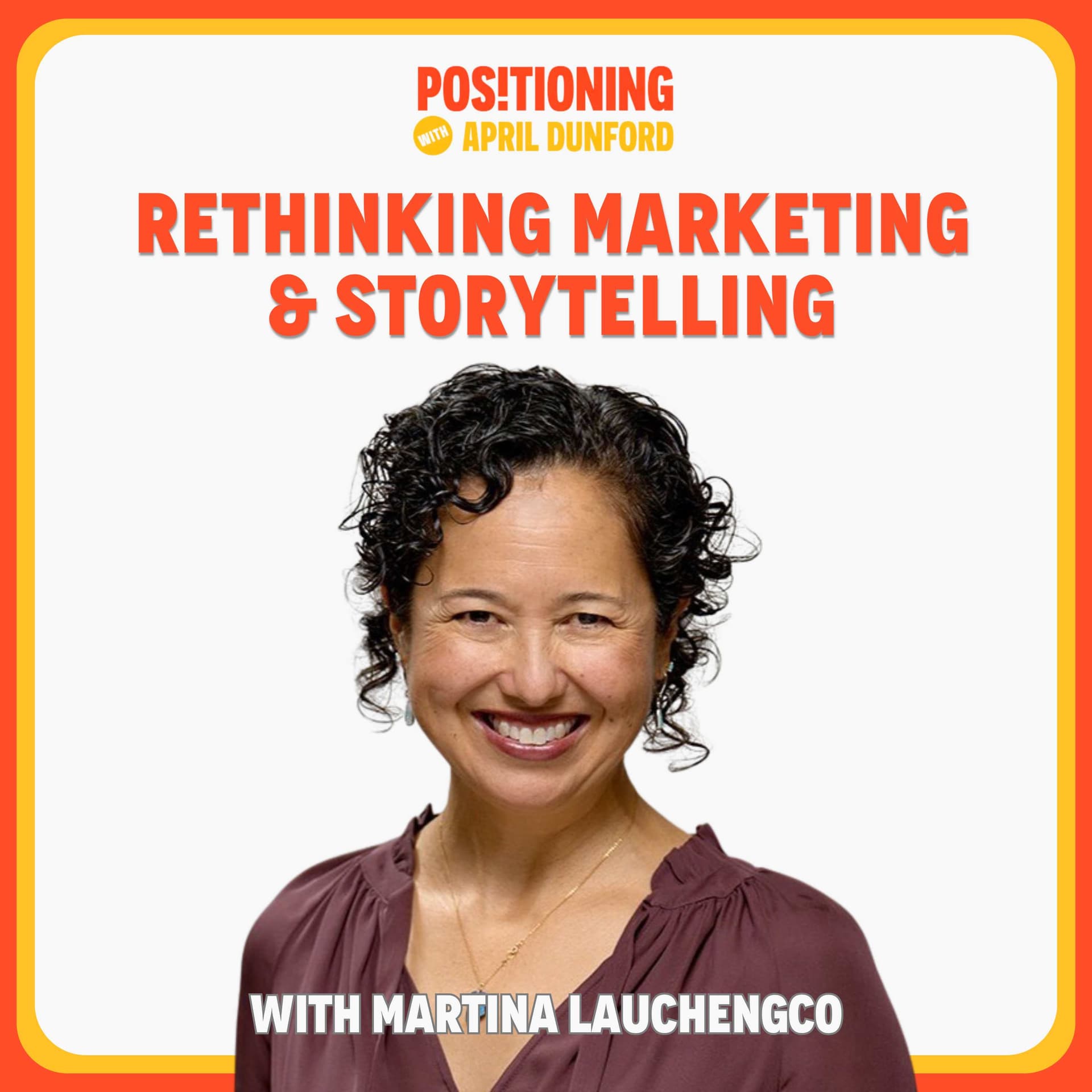
Loading summary
Transcript123 lines
- [00:01]
April Dunford
Welcome to the Positioning show where we discuss topics related to the practical application of positioning for marketing, sales and product teams. I'm April Dunford, a consultant, author, and the world's leading expert on positioning for B2B technology companies. Hi, welcome to another edition of the Positioning show with me, April Dunford. Hey, today I've got a guest. I'm pretty excited for this one. This was one of these guests that I've been trying to get on the show for a long time, but my calendar was terrible and her calendar was terrible. But we finally made it happen. Today I've got Martina Lechenko and she is one of the most experienced product marketers that I know. You folks might know her as one of the instructors at Silicon Valley Product Group where she teaches product marketing stuff there. Prior to joining them, she had a long career working on products that you might have heard of, like Microsoft Office and Netscape Navigator. A lot of you might also know her for this book called Loved how to Rethink Marketing for Tech Products. This is a great resource book if you're new to product marketing and you're trying to figure out what's this all about? What are we supposed to be doing here? I really like her thinking on this, how she breaks product marketing down into a set of core competencies. And so I thought it would be really fun to have her on the show and we could talk a little bit about her four pillars or four core competencies of product marketing. I think that, that there aren't a lot of people out there that know a lot of stuff about product marketing and have seen the way it works across a lot of different companies. In addition to her work at Silicon Valley Product Group, Martina is also partner at Costa Noa Ventures where she sits on boards and advises a lot of startups. So she's seen a lot, from very small companies to large world class companies. And I think she comes with a lot of experience and a really neat lens on product marketing. I think you folks are really going to enjoy this conversation. I know I did. Let's get into it. Martina is so great to have you on the podcast. Welcome. How are you doing?
- [02:07]
Martina Lechenko
Oh, it's so great to be here, April. I've been a, a fan girl from afar, so to actually have the two of us together, I'm just loving it.
- [02:15]
April Dunford
Yeah, this is so great. And we, you know, we had a hard time scheduling this too because, you know, I think I moved it. You moved it. It was, you were busy people. But I'm happy we're finally getting this done. I. I read your book. I read your book. I even have it for people with the video. You can see it's my profile problem here. Read your book. I actually marked it up. I have a habit of marking up books. I read it, I marked it up and I thought, oh, this is going to be such a good conversation. I wanted to talk a bit about. One of the things I really liked about your book was the way you define product marketing at a high level. Like, I thought it was. I thought it was a really interesting perspective on that. And in particular, you talk about four fundamentals of product marketing. And I really love the way you broke it down. So the first one was connecting customer and market insights. The second one is around go to market strategy. And I've got a billion questions for you on that one. The third one is storytelling or shaping how the world thinks about your product. And that's where we get into positioning and some other stuff in there. And then the last one is evangelizing or, you know, making sure that everybody else is enabled to tell the story. And so I have a bunch of questions on each of those things that I thought would be fun, but I wanted to start with market insight. So, um, can you talk a bit about how product marketers should be gathering these insights? Because I get a lot of questions on this, like, how should we do it? How often should we do it? Like, the mechanics of it, like, and I'd love to hear your perspective. Yeah.
- [03:44]
Martina Lechenko
So this is the ambassador of fundamental. And I'd say the. The very best in class that I have seen. A VP of marketing basically made it a requirement for everyone on his team to talk to a minimum of two customers every single week. And it was up to them how they did it. Do they DM them? Do they out to them on LinkedIn? Do they basically go into the sales flow and reach out and contact people and do a formal interview? But it was just to make sure that everyone was constantly touching the market and why people were engaging with this company. So that was the best in class that I've seen was like, it's just a requirement. Everyone has to do it, everyone has to do it. And because it was part of how everyone did their jobs every week, it was foundational and people said like, oh, I don't really know how I might want to say this, so let me talk to a customer. So that was sort of best in class. That was ongoing all the time. I've also seen the episodic. We're going out in the field for two weeks, everybody is deepening their customer knowledge on site. And the things that you learn by observing people doing their jobs in the context in which they're doing them, you just get all this inferred insight that is not obvious if you're only engaging in conversation. And this sounds a lot like what product managers do. And the best product market marketers work a lot like product managers, but you're looking for market insight instead of product insight. So just writ large, I think just anything that a product manager might do, you should ask yourself, should I be doing this too? And I say the last one, which is very tech enabled, Gong has been, has become a fantastic or anything like that.
- [05:25]
April Dunford
Yeah.
- [05:25]
Martina Lechenko
Unbelievable proxy. So when I drop in and I do work with companies, I'll be like Sheraton Gonco. Because I can't have 10 customer conversations.
- [05:34]
April Dunford
Yeah.
- [05:34]
Martina Lechenko
I'm outside the company. I listen to 10 gong calls and then I have a really good sense of how actual conversations with customers are, are going. Where they lean in, what they say, you can hear in these calls where there's presumption and how the rep is starting to engage with the customer versus oh yeah, they were really, they were really listening. So I think those are three examples of how it can be done really easily.
- [06:00]
April Dunford
I can't believe, like Gong, like, like I talk to people now and I'm like, there was a time when we didn't have this and boy, was it hard.
- [06:10]
Martina Lechenko
It's, it's incredible.
- [06:12]
April Dunford
I spent so much of my career basically just wandering down to sales, being like, I'm gonna sit in on your calls. Or back when, you know, when I was working with companies where, you know, sales reps actually went on the road and we did face to face meetings, I'd be like the person in the corner, like, don't mind me, I'm just here taking notes.
- [06:29]
Martina Lechenko
I was the same, April, I was the same. And you were begging the sales reps, can I please, please, please do a ride along?
- [06:35]
April Dunford
Yeah, the sales reps didn't want you to come. The sales reps are like, it's going to look weird. Nobody wants this other person, you know? Yes, totally, totally.
- [06:42]
Martina Lechenko
Yeah. So, so do the technology cheat. It's extraordinary.
- [06:47]
April Dunford
Yeah. I love this idea of going out and watching customers as they use stuff and do stuff. Like, I got to say, I don't, I don't think I've done enough of that. How do you think, like in all of these things? Like, even if you're interviewing customers or if you're in observing customers in their day to day. But I guess more on the interviewing side, like are there best practices around that? Like I get a lot, I get a lot of questions around, but this is more specifically related to just the positioning piece. But I get a lot of questions around, well, if we're going to do customer interviews, how do we do it? Like what are the right questions, what are the weight? And then I get lots of people asking me like, you know, would a positioning interview look the same as the jobs to be done interview and what would be common and what would be different? So I'm interested in your perspective on that and what you've seen other companies.
- [07:35]
Martina Lechenko
Yeah, that's such a great question. I would say I find that where you are in stage influences the style in which it's conducted. So in that earlier stage company it is massively overlapping with how pro, how product is learning and ingesting information. And so because you don't know, get your new software product that isn't established. And so you're really trying to find like what's, what's my entree? And I have to find it not just in them trying to do their job, but in their, how do I get their attention? Like where are they going? So even this, I don't know if it's called this anymore, but we used to call it anthropological where you would just observe someone work for an hour, not on your stuff, just let me see you in your day. And part of that and you can actually do that with the interview which is like, hey, before I, before I show you anything, walk me through the average day and you start, it starts to paint a picture of not them trying to accomplish this is my only beef with jobs to be done is you're trying to, to understand within a particular framework. You are a data scientist. I want to understand within this frame, but you kind of understand the bigger context of that person. You start your day, what happens like, oh, I have two meetings and then I come back to my desk and have half an hour in which I'm trying to accomplish a task. Jobs to be done is going to look at the job within that 30 minute. I'm trying to get that task done and not the two hours that preceded it, which means I am hopping in and I need to jump in with very little additional context into software that I might only use once a week instead of every day. It's not email, it's not slack, it's not where I am spending all of my time. And that changes the framing in which gosh I need to make it even easier. Once someone's an expert in my software, then they know what to do. But when they're first starting to use it, they're doing it one way. So that's early stage. You have to figure all that out. And it's super complicated. So that's why early stage is a little different. Later when you're established, people know what you are. It is a different game. And so there you're trying to glean nuances in what's going to make them see us different. Because your positioning is always like, we were this and now we're that. We have to evolve in your mind because there's something newer and better so that you're upgrading people. You are. You have a much more expansive product suite that you're trying to get them to adopt. And so that the context of their perception of you is changing. And so you have to examine it in. Within that context, which is a little different than what you're trying to discover. All that other stuff. I know that was a really long answer, but.
- [10:07]
April Dunford
Yeah, yeah, no, I know what you mean. I know what you mean. What about win loss analysis? What do you think about that? I get asked about win loss analysis all the time. You know what? Like, I get asked about loss analysis all the time and I'm always like, what about win analysis, man? Like, do we only care about the ones we don't get?
- [10:24]
Martina Lechenko
Yeah.
- [10:25]
April Dunford
What do you think about that?
- [10:26]
Martina Lechenko
I think it's a critical tool. I'd say doing it at least once a quarter, again, depending on scale and size is really important. And I agree with you. Understanding why you win is as important as understanding why you lose. What I'll say about why you lose is having being really objective and being willing to hear about what they say and what they mean. So, for example, companies will report our budget got cut.
- [10:56]
April Dunford
Yeah.
- [10:56]
Martina Lechenko
And so that's what they're telling you. Like, our budget got cut. Sorry, we couldn't say yes. And it's like, well, you just were. You didn't make the line for which you couldn't be cut. Like, there's certain things. That's right. Weren't cut. So what was not valuable enough. So with a lot of loss analysis, they don't ask that next question. And so I say that's the, the big caution I have on when loss analysis ask that next deeper question, not just take the service answer.
- [11:22]
April Dunford
Yeah, yeah. I think, you know, I think that the sales team is often bad at reporting this stuff. Like for that reason. Right. Like they'll come back and say, we lost the deal because we didn't have this one thing. And you'll be like, yeah, okay, well, let's actually scratch down on that. You know, and it turns out it was a thousand things and, you know, and customers don't always tell us the truth. Yeah. Talking about the sales team, like, what can we get out of the sales team? Like, what's your opinion on that?
- [11:51]
Martina Lechenko
I think there's so much that can be learned in just working so collaboratively with sales. So you just wrote your book on the sales deck and what a critical tool that is. And I. I agree with you that it really needs to be developed together with sales. And from a process perspective, that's one where I'm like, hey, don't. Don't be in your marketing ivory tower and say, and now we've done this beautiful thing. Here you go. It's sort of like, hey, this is our first pass. Have a couple of partners in sales that actually put it through its paces and then tell you, all right, this worked well. This didn't work as well. This was a little hard. And I've. I've done this with companies, and salespeople are always trying to be really nice. They're like, well, this was really great. I really, really love this. And this is a little. This, like, hey, just keep it really real.
- [12:39]
April Dunford
I have the opposite. Sales are so mean to me. Like, like, like, they're so. They're not worried about hurting my feelings at all. Like, yeah, they're like, you know, you know, anytime we're starting on sales pitch decks, like back when I was in house, you'd show up with something and sales would be like, the going in attitude was, this is hot garbage. Get this out of my face.
- [13:05]
Martina Lechenko
Well, then that. They were being so hot.
- [13:09]
April Dunford
Oh, my God. But one of the things I'm interested in, though, is like, because, you know, and maybe this is top of mind because I had somebody asking about. Ask me about this the other day, and I was like, oh, this is question. I don't actually. I'm not sure I know the answer, but the question was, is they said, you know, we get. So the. The. The person I was talking to was trying to make the argument that the reason product people don't work more with sales is because, you know, sales is always coming to them with these requests that are bad. Like, so, you know, I got one customer, you know, and the customer is big and weird, like Walmart, and they want this weird thing and no one else wants it. So obviously we're not going to build it. But, you know, and I said, so I'm taking the stance, like, I think you can get all this interesting information out of sales. And the, the person I was talking to was saying, yeah, but how do you filter the good stuff from the not good stuff? Like, how do you know? How do you filter what is generally true from what is just true for this one big account? Therefore it's not true because the salespeople tend to like, you know, the last big customer they talk to is what's in their brain.
- [14:15]
Martina Lechenko
Of course. And I, I say presume there's an element in truth and everything sales is telling you and your job, your job as a product person is not to take it on face value, but it's to examine it in context and say, okay, I heard this from Walmart giant customer, and I'm hearing all these other little things. Is it the feature that they're asking for or are we just not easy enough to use in this type of use case, which happens to be in common between these.
- [14:44]
April Dunford
That's a good point.
- [14:45]
Martina Lechenko
So much of what I think a lot of people look for the easy answer from customers or sales saying, like, oh, what are we missing? You tell me. And then we're going to build it, as opposed to, let's infer from all of this in inbound requests what a better solution to these problems might be. And that's, that's the art of product management that I think often gets lost in the conversation. And that's why, like, ask everything, ask for tons of information from sales. It doesn't mean that that's what you have to build.
- [15:13]
April Dunford
Yeah, yeah, exactly, exactly. What about, you know, coming back to this idea of understanding the market, like, how do we, how do we look for disruption or changes in the market? Like, what do you, what have you seen? Like, is there anything smart companies are doing to try to have an early warning system that things are changing and maybe we need to change what we're doing, like either from positioning or the story or any other sort of aspect. Like, do you got any, got any tips on that?
- [15:44]
Martina Lechenko
Yeah, well, I mean, we're in the midst of a really like a tectonic shift right now with what's happening in AI. And this is one where I, I personally have seen the desktop, the Internet, the mobile, social, all of these big shifts in technology, but this is the biggest that's happening, the fastest I have ever witnessed. And so I would just say how we are all doing our jobs is changing and will be different. And we know that is happening. We just don't know how fast. And that's monumental. Like the speed at which I'm having to learn everywhere, I'm like, man, I didn't even know that was possible. And now all of a sudden next week's up. That is important, I think, for everyone in the go to market side to be parsing because your customers are asking themselves that question too. What do I need to be doing differently? So this just present instead of like, hey, let's paint everything with an AI paintbrush. It's how is everybody re examining what they do and the assumptions that you have and how can you help make them smarter? How can you educate them in this? We're all figuring this out at the same time. There's no one that's expert because it's all new to all of us. So that's one of those tectonic, disruptive things that everyone must be paying attention to and they have to identify their role with it and the opportunity it presents. So that's a big, big one. But then for the little ones that you're talking about, which is, all right, Q4 closed and it wasn't that great. So what do you need to be doing differently? But those are the things that ideally you're seeing in advance. Our sales velocity is slowing, our sales cycle is increasing and we're doing great. Those are the telltale signs. Maybe we are not positioning well enough relative to the competition or how the market has shifted, or it's just not striking a chord. There's a company, I work within our portfolio called bugcrowd. They've done the exact same study results five years in a row. And then the fifth year they just packaged it differently and they made it more dynamic. They made it an easy. They did all these things that made it feel very different. Same kind of data. And it wasn't, it wasn't monumentally new, but they just packaged it differently. And the prior four years they would get about 200, 200 to 300 leads. Enough in a few weeks. They had 200 leads within the first 48 hours. So this quality of execution matters a lot. And the words you say and the context in which you put it matters a lot. The visual context. Are we all the dressing around it. So I wouldn't underestimate those other things in addition to are we saying the right things?
- [18:23]
April Dunford
Right. Yeah, I agree. I want to shift a little bit to go to market strategy, you know, because I love that, as you know, that was kind of your Second pillar of, of product marketing stuff. Like can you define go to market strategy? Just like give us your definition of it. Because everybody's definition.
- [18:41]
Martina Lechenko
So the one I and, and I had to spend a lot of time on this in the book because there is, there are so many ways of talking about go to market strategy and.
- [18:48]
April Dunford
So marketing stuff, we're the worst when it comes to definitions. Like we just, we just like invent a new definition for everything every 10.
- [18:55]
Martina Lechenko
And then you ask somebody in sales and they'll say the same thing, but they mean something different. Right. So with product marketing and I specified that the strategist is, you're the product go to market strategist. And so this is, which is different than go to market strategy writ large, which is like, hey, how, how is the whole go to market machinery working together? Product go to market strategy is you've built product X and you're the product marketer's job is to understand how that product X is penetrating the market, which is why that ambassador the customer Market insights is thing one. Because if you don't have it, you can't figure the strategy out. But it's how does the product we've built intersect with this market? And what are the things that we say, what are the key activities that we need to do? And then the marketing team, they take that foundation and they amplify it and they promote it, but they need a foundation on which to build and amplify. And without that work of like, hey, here's, here's roughly how we think we're, we need a channel partner to do this particular work. Or here's where we really need to lean into analysts to tell the story for us. It can't right us. So that's the product go to market strategy aspect. That's distinct from the go to market strategy writ large, which is the marketing and sales machinery together.
- [20:15]
April Dunford
Interesting. And where does lead generation fit in that? So when I was, when I was reading your book, I got to the go to market strategy part and I was like, yeah, yeah, yeah, yeah, yeah, yeah, yeah. And then at one point I was thinking, wait a second, like, have I ever worked in a company that actually did this? I was trying to think of, did I have. And so there were, there were absolutely places where product marketing was defining some of the things you talk about there. Like, you know, we're gonna have to do this part with a channel partner and not with another. We definitely did a lot of stuff in analyst relations. Like, you know, we're gonna need an analyst to believe this stuff because otherwise we're not credible in the market without that. And we know our customers use analysts, so we got to do that. But when it came to things like lead generation, I, you know, I don't know if I worked in a company where that piece of the go go to market strategy was getting driven by product marketing. And so I'm curious, like, you know, in the bigger companies I worked at, we didn't have product marketing function.
- [21:19]
Martina Lechenko
Yeah.
- [21:20]
April Dunford
For the most part, like the product marketing was getting done.
- [21:23]
Martina Lechenko
The bigger companies you didn't have it, but the smaller ones you did.
- [21:26]
April Dunford
Yeah.
- [21:27]
Martina Lechenko
Oh, interesting. Very, very interesting.
- [21:29]
April Dunford
The smaller companies, smaller companies we did like there was someone I could point to and say you're a product marketer. The bigger companies it tended to be there were roles that were like. So for example, when I was at IBM there was a role inside IBM that was called a market manager and a market manager was kind of like marketing and product marketing all rolled up together.
- [21:52]
Martina Lechenko
Yeah.
- [21:53]
April Dunford
So they did it and they definitely own go to market strategy all the way across the soup to nuts. Yeah. But there wasn't this idea of a separation between that.
- [22:03]
Martina Lechenko
Yeah.
- [22:03]
April Dunford
And so anyways, I'm curious what you see with all kinds of companies that are trying to figure out what this function is in their organization. So and I was curious about lead gen in particular. Like who owns the lead gen strategy? Like is it marketing and how does product marketing fit in there? And like how do the two work together?
- [22:22]
Martina Lechenko
Yeah, so lots of questions in there. So thing one product marketing different in different companies. It is, it can. The function can be called different things in different companies and different people. The the function must be done. So the product good market strategy has to be quarterback somewhere. It might not be someone that has the title of product marketer. Sometimes it's someone that has the title product manager. Sometimes it is some a marketing manager, sometimes it's a strategic marketing group, sometimes it is a strategy group. But it's the function of figuring out how does this product intersect with the market and what are the key things that must be done. So you asked about Legion. Where does that fit? That's part of the go to market engine. So this is part of the marketing and sales engine that take the foundation work that product marketing does and amplify it and create. So Legion. I'm creating content. On top of this, I am running webinars. It's, it's all of the tactical execution of the things that will actually bring leads in. And product marketers might be involved in the creation of some of that content, but they're not the ones that are owning that execution. So lead generation and our demand generation, as many people on the B2B side call it, that's really like take some foundation pieces and then just blow it up to bring a lot in. And product marketing is an assist on that. But they aren't necessarily the ones that are doing all of the tactical execution. Does that answer?
- [23:46]
April Dunford
Yeah, like, I found, I found that product marketing got involved a lot in, like, again, when we were talking about the strategy of it, not just the execution, the strategy of it, like, you know, were we going to do webinars at all? Yeah, like, you know, and should we do be doing events? Like our events, the right thing for our people? Yes, right, like. Like, do our people go to events? And so, you know, definitely the product marketing function, I thought had a lot of good impact, like input into that to say, well, you know, like, you know, this is what the champion our kind of a deal looks like. This is where they hang out, this is what they do. Therefore, I wouldn't worry too much about this, but this kind of a tactic might work better.
- [24:27]
Martina Lechenko
Exactly.
- [24:27]
April Dunford
You know, as opposed to, I think that the, the marketers tend to get a bit distracted at the flavor of the month. Right. Everyone's doing this. You know, everyone's blogging, so we should be blogging. Everyone's doing podcasts right now. It's podcast. Everyone's doing podcasts and we should do podcasts. Whereas I feel like the product marketer is maybe sit there going, well, I don't know, like, you know, our people, do they, you know, the product marketer, I feel like, should have the answer.
- [24:52]
Martina Lechenko
Like, do these not thing one, they got to understand the market. So thing do is they're the strategist, the product go to market strategist, which is what's the right thing for this particular product. And I, and I'll use product somewhat loosely in that, you know, companies evolve early stage, you have one company later stage, you have an entire product suite. So you're orienting the product marketer differently. How you might orient them against the market and say you are now the enterprise product marketer. So you pull from our product suite and help us figure out how to penetrate this market with the suite of products that we have. But it is very much exactly what you said, which is events. Like, I remember when I was at Microsoft, it made a strategic decision to not do major events and it was huge. I was like, what? And they're like, look, we looked at things, we did the analysis. We spend gajillions of dollars because Microsoft would always have a huge presence. And like, everyone knows us. We don't learn as much. And like, it was kind of like, yeah, there are better ways to do what we're getting out of these events. And it seemed so crazy to pull out. I mean, they're backing them, obviously, but that, that was a really smart decision from a business perspective. And that's.
- [26:01]
April Dunford
I was at IBM when we made the same decision. So when IBM, and I forget what the big. Before it was the Consumer Electronics show, there used to be that big show in Vegas.
- [26:13]
Martina Lechenko
Oh, my God. Exactly.
- [26:16]
April Dunford
I actually have trauma from work in the booth at comdex and I obliterated it from my memory.
- [26:23]
Martina Lechenko
No, but that was the one.
- [26:24]
April Dunford
There was like the first year. And I think you were. I think you're right. I think it was IBM, Microsoft and somebody else.
- [26:30]
Martina Lechenko
Yes.
- [26:31]
April Dunford
One year just said, no more comdex. And it. And it obliterated the whole show. Within two years, it was gone and it became this Consumer Electronics Show. But I think it was all the companies that were doing B2B stuff kind of collectively looked at the results of this stuff and said, you know what? This isn't working for us and we're just not going to do it anymore and we're going to take that budget and spend it elsewhere. At the time, you're right. It was like, it felt like this big thing. Like, what?
- [26:53]
Martina Lechenko
Exactly. You're like, well, no, conduct. Because. Because it was the centerpiece. Like, you started planning Conex a year and in.
- [27:00]
April Dunford
Right.
- [27:01]
Martina Lechenko
And all of a sudden, oh, my. It's not.
- [27:02]
April Dunford
And it was the. It was literally the. Like, the last time I went and I worked on the. On, on the show floor, I was like. The whole time I was there, I was like, why do we do this? Why? Why don't we do this? Nobody that we care about is here.
- [27:17]
Martina Lechenko
Totally, totally just became this biggest boondoggle for everybody. It's like, okay, that's. That's not helpful for the company, you know.
- [27:27]
April Dunford
And interestingly, it was different in different markets because the equivalent big show was CBIT in Germany.
- [27:33]
Martina Lechenko
Yes, that's right.
- [27:34]
April Dunford
For the European market. And that one was good. Yes, that's totally different type of person. Lots of decision makers, lots of very, very senior people attended that show. And so we decided CBIT was good, but COMDEX was out.
- [27:45]
Martina Lechenko
That's right.
- [27:46]
April Dunford
We.
- [27:46]
Martina Lechenko
I think we. I think all the majors at that.
- [27:49]
April Dunford
Time made the same decision, Made the same Decisions. We're all like, not. Not doing that one anymore.
- [27:53]
Martina Lechenko
Yeah.
- [27:54]
April Dunford
But I also have trauma. Trauma about cbit. Like, that thing was. Was too big, went on for too many days. Yeah. Good meetings, though. I want to switch gears a little bit and. And make sure that we get some time to talk about this storytelling piece, because this is a positioning show, so we should talk about positioning. So one of the things I loved about your book was, you know, we got. I got to the part where you're talking about the positioning statement, and you were like, positioning statement is bad. And I'm like, yeah, preach. Exactly. Hate it. I think anybody that's deep on this stuff would say that. I mean, I think I, you know, I think it was the stopgap thing that people used when there was that. Maybe nothing else to use. But so. So how do you like to think about positioning? Like, you know, obviously, like, positioning statement. I think, you know, in some cases, maybe you could use it to write down positioning. I don't even think it's a good way to write down on positioning, personally. But, like, if we're not using the positioning statement, what do we use? Like, what do you. What do you see in the companies you work with? Like, what are best practices? Like, how are people getting positioning done? I'm so curious about, like, I know how people are doing it that work with me, but they're coming to me to use my stuff. So I'm curious, like, you know, what. What else is that? Like, what else are people doing out there?
- [29:09]
Martina Lechenko
Yeah, well, the positioning statement. I think that you say this in your book, which is this position state. Don't ever write a positioning statement. And I think it becomes this crutch of, oh, we found the perfect way to articulate everything that we do. And then we say again and again everywhere in everything the same way. And I think that's the. The crutch that everyone got. Like, that's. Isn't that what we're supposed to do? And positioning itself is what's the position that your product holds and you want it to. To be this container that is the foundation that you build all these messaging spokes off of that are.
- [29:46]
April Dunford
Right.
- [29:47]
Martina Lechenko
So what is with the articulation of this in the sales deck in your. Your next book? Because that's such an important thing, and it's different than an investor deck. You cannot say, even though you're same product and you're the same. Positioning needs to be messaged, specific to its audience and its context. What you'll say in a text message. And an email and a website are going to be different because you have a context that is really different. So to answer your question, the companies that I work with, the biggest thing that we ask ourselves are, what's the context? And where does this. The journey in terms of how do we craft messaging around the market position we want to hold so that it can be heard and that it breaks through. And the biggest thing I work with people on is what is it that people want to hear? And without exception, when we talk to each other as ordinary human beings, trying to convey what it is that we're trying to do that is helpful, it's literally like hit record. And that right there should be your messaging, because I would say truly, 8 out of 10 times, how someone would explain it and what they're trying to do to an ordinary person better captures the essential essence of how they should be communicating about it right now. The other thing I'll say is, I think we have this trap of we get this perfect statement and then it's done. Check. As opposed to it's a living beast and it will evolve. And I work with early stage companies at Costa Noa. It evolves a lot in the early.
- [31:18]
April Dunford
Oh, yeah, it does.
- [31:19]
Martina Lechenko
It's a lot more still in later stages. Or you might hold still on this for a year. But in the early stages, it's pretty dynamic. And to your point about sales, what do you learn from sales? You'll learn about how to message better because they're the ones that are doing the laps at the front line.
- [31:35]
April Dunford
Yeah, that's true. And it is true that in the. In the early stages, things change so much. And then the later stages, I mean, you're really knob turning.
- [31:43]
Martina Lechenko
Yeah.
- [31:44]
April Dunford
You know, the bigger the thing gets occasionally, every once in a while, you might do a big tectonic shift as a result of something big going on in the market. But there's not as much big stuff going, you know, and it's so different from consumer products like B2B versus consumer. Like in B2B, we often have changes in positioning built into the strategy, like we're positioning here. But the plan is, you know, a year from now, we'll have the capability to position there, which we don't do that in consumer companies. We're like, you know, we're selling fizzy water and that's it, man.
- [32:15]
Martina Lechenko
Right, right. And here comes summer. So let's make sure we launch a new flavor in the summer.
- [32:21]
April Dunford
Right, right. What do you think about storytelling frameworks? I get asked about Hero's Journey stuff, and where do we use that and where do we not use that? You got any opinions about that? Storytelling?
- [32:35]
Martina Lechenko
I, I, I love frameworks as a way to be helpful in getting people to think about things as narrative and that we, as human beings, we love stories. And so I think it's really helpful for that. What I find in the practical application is it's really difficult for people to use these frameworks and come up with something good because they're like, oh, I'm, I'm using the framework, therefore it's going to be good. Yeah, but you always have to apply this context of, well, who is this person? So, like, will that hero's journey work for that data scientist who's just trying to get his algorithm better, faster? I don't know if, if that's right for, for that or that particular context. Is it an essential thing in doing a pitch to an investor so that they can imagine the world that you envision? Yeah, it is. Or to a decision maker where you've done all of the influence and all the technical stuff and now you're, you're just wanting them to love you as a vendor. So I think context matters a lot. And I think again, it's another one where people might use it as a crutch, saying, well, this is the magic answer. That being said, I think you talk about this in your, how do you create a sales, a great sales pitch? We always want, people want to envision the world that you see, so you don't want to just come at them hard with like, here's product stuff. So in that respect of, of paint a picture, that helps me connect. Like the purpose of stories is connection. And so I think be focused on the purpose and not the framers are helpful, but the purpose is the more important thing to be focused on.
- [34:12]
April Dunford
Yeah, I think that's true. And I think some of this stuff is a good, it's a good starting point and we can use it in some ways. But yeah, I think you're right. People get kind of like, you know, slavishly attached to it like this and it's like, no, we don't get a cookie. You mentioned, you mentioned investor, investor positioning a couple of times. And I'm curious, like, in the companies you work with, does product marketing get involved in helping the company position for investors?
- [34:44]
Martina Lechenko
Typically, I would say not typically, but where it becomes important is if product marketing has identified for us to get to. You talked about B2B strategy, which is like, hey, next year for us to be there, we actually have to shift our positioning. That can be important in an. Invest in an investor hearing that you understand that the market is shifting, that you are shifting along with it. So it's not that the product marketer is involved with the investor pitch, but the product marketing team has identified we need to occupy this position 18 months from now. And it's a build for us to get there. And we're going to have these gates that we are going to try and move toward and that's going to be a key. That's going to be part of a slide or might be part of the story. But I think from an investor perspective, especially the later you get, it's like the. If you don't reflect market reality in how you're pitching, sort of like you're missing the mark of what? Like you need to just add water later on for the growth to continue, for investors to be excited. And so. Right.
- [35:43]
April Dunford
Yeah.
- [35:45]
Martina Lechenko
Help us understand that you truly understand your market. And so. So painting that picture accurately and saying that you know how to keep moving the game and the ball forward is important.
- [35:55]
April Dunford
Yeah, yeah, I totally agree with that. And then I want to touch quickly, you know, on sales enablement and sales pitch stuff, because that's my jam right now. But do you think, who do you think should own building this sales pitch? Like, do you, like, do you think there's an, there's a. Again thinking about the companies you work with, like, who's building sales pitches? Is it product marketing? Is it sales enablement? Is it a collaborative effort between marketing and sales? Like, who's building these things?
- [36:27]
Martina Lechenko
The best companies make it a collaborative effort between marketing and sales. And so it's product marketing. It again, depends on the scale of the company. If you have sales enablement, of course they're involved. If you have product marketing, they should be involved. Or product marketing is not doing their job and sales has to also be involved because it can't just just be created in the ivory tower and then handed down. And so always the best teams are making this massively collaborative effort that is also iterative. Like, I'm a big believer in, you don't try and get it perfect and then roll it out and train people on it. It's. We think this is good. You have a pilot team that runs with it. One of the best examples I saw of this was in Workiva's early days. They would have these, these sales teams that would be the lead. I'd never seen this before, where the sales teams would take the lead and they'd Have a solutions architect out there with them. And they would just run P point saying like, let's see what sticks in advance of product. They're like, let's see if we can sell it before we even build.
- [37:23]
April Dunford
Oh, that's so smart.
- [37:24]
Martina Lechenko
It was. And they'd have like two people working on it. And it's like, okay, we have, we. We know, we. That there is demand to buy. Let's make sure we build. So it was totally backwards from everything I'd seen everywhere else, but it was really effective.
- [37:39]
April Dunford
Yeah, I've seen little, little companies do that. Like, you know, and, and it's usually the, the founder doing it where they're out pitching a thing and it's not built yet, but they, you know, pitching a thing. And I have seen a lot of the companies that I've worked with, you know, they'll, you know, there's the products there, we do a shift in positioning. And then they will have this little beta tester team that's Te testing the new sales pitch before we try to roll it out to everybody else, we're testing the new sales pitch in this very controlled way so that we can get a bunch of reps in because we know we're going to make adjustments on it. And so let's not throw it out to everybody else and have everybody barf on it and go, oh, this thing is, you know, and then everybody comes at you with their 9 million things that they want adjusted. So we do this sort of controlled thing at the beginning where we get a lot of reps in, we get a lot of exposure to customers, and we, we're trying to work the kinks out of it before we send it off to everybody else because otherwise it's a nightmare.
- [38:34]
Martina Lechenko
That's my favorite way of doing it. It's like, get all the reps in, make it really good, and then you roll it out because. And then also there's, if you think about the credibility, that establishes too, which is like, hey, we have. We did reps on it. We actually got this in front of customers, so we know it works.
- [38:49]
April Dunford
Yeah, yeah.
- [38:51]
Martina Lechenko
The other way I've seen people do it, which is interesting, is they take like. Because inevitably, the very best sales reps have done a variation on a theme that makes them really effective, is they're like, all right, let's take those best, those bests, and let's suck in what they've learned. Why are they so good? What are they doing differently than everyone else? And let's see if we can bring that in absolutely. The. The. What I think is terrible is when people are like, oh, well, those best reps are just so special and they just do their own thing instead of like, let's bring all that intelligence back into the rest of the sales team and the ma and the master deck that everyone can, you know, iterate from, but you want it to be the strongest it possibly can be.
- [39:30]
April Dunford
Yeah, that's a really good point. I hear that a lot too, where people say, oh, well, John does this different. And we let him do this different thing because John does it different most of the time. I think there's things you can steal from the way John's doing it. Now, sometimes you'll have John has some weird thing that you're like. Like, I don't know how John gets that to work, but. Okay, right, exactly.
- [39:51]
Martina Lechenko
There's some cowboy specials in there, but there's probably some good things that we should be bringing in.
- [39:57]
April Dunford
But usually there's a bunch of stuff you can steal from it. Like, you can't forklift the whole thing because John's got his shtick.
- [40:05]
Martina Lechenko
100%. Yes.
- [40:08]
April Dunford
Yeah, I just did. I just did a workshop recently where, you know, the equivalent of John was in the room and John was like, here's how I do it. And we were all like, like, okay.
- [40:18]
Martina Lechenko
And you're like, here's the bit that works for you, but for the mere mortals in the room. That actually happened to me when. So when, when I first joined Microsoft, they did this, this training for a bunch of us who were new. It was the first time they'd ever done. Done product manager training. They were training us on more to the product marketing stuff. And this guy came in that does demos and he was electric and he was literally throwing candy at us at various points. And he was a theater major. And I, I looked at that and I was like, I will never be able to do that. And so I just put in my hand, I was like, if we aren't you, like, how do we demo? Well, if that's the bar. I mean, it was kind of crazy. He's like, oh, well, here's how you make it your own thing. So I do think there a little.
- [41:02]
April Dunford
Mental image of the guy showing up and tossing candy.
- [41:05]
Martina Lechenko
No, I mean, it really was. I was just like, this is. It was a production. I was like, oh, my God. But I did learn some really valuable lessons, like, how. How do you make it a show?
- [41:16]
April Dunford
You.
- [41:16]
Martina Lechenko
You make it really engaging where you're. You're going from thing to thing really quickly. Where there's a narrative there, a narrative spine in a demo, but the hero's journey as I'm using a product as opposed to just as I'm messaging or positioning. So demos is another place where you can apply that. And I was like, oh, okay, so I can do it in my style with some energy in the flow through the product.
- [41:37]
April Dunford
Right, right. A couple of questions just because we're getting to the end of time here. Do you think product marketing as a function is misunderstood? And I'll caveat this with, I was very surprised. I started out in product marketing and then I became more sort of marketing vp. But I always kind of consider myself product marketer. But to product managers, I felt like, like whenever I went and spoke at a product management conference or I was surrounded by product managers, the product managers seem to have this existential thing like, who are we? You know, they were always, they were always asking me like, you know, what, how do you define it and what's in and what's out of product management? And I've been listening a lot to like Marty's got his new book out and so I've been listening to him on podcasts and he's great. And you know, and his whole thing is like, you know, you're a product manager, not a project manager. And so if you define it this way, it's. That's bad. And, and I kept thinking to myself, like, do we have the same like existential sort of thing where people like, do you think product marketing is as misunderstood as product management?
- [42:46]
Martina Lechenko
I would. And like, yeah, I would say product marketing is more misunderstood than product management because at least there's consensus that a product manager builds the product. Product marketing is done differently in every single company. You. The edges. What defines the edges of where product management and marketing begins and ends are. It's not an, there's not an absolute definition and it is contextual and it shifts over time. And like when you're an early stage company and what the focus of a product market would be versus a later stage company. So that's what makes it so challenging uniquely and why it's massively misunderstood. And because it's done differently everywhere, it's very rare that someone has experienced like that top 5 or 10% of how product markets market can be at its best. So their mental model of it is, oh, are you the person that writes like both sides, product and marketing? Product marketing? You mean the people that do the collateral, the people that, that will do the products on the website, the people that are Are are taking notes and gonna magic marketing things for out of the product team. And so it's. It's very misunderstood. And so that's actually why I wrote loved. So it is part of the SVPG series which was. There needs to be this much more global understanding of the functions, regardless of the title, regardless of the shape of your organization. That's why I distilled it down to those four fundamentals. The ambassador, the strategist, the storyteller, the evangelist. So that if the edges are different at your company, the foundational work can still happen. Like in Europe. A lot of people talk about we don't have a lot of product marketers here. The discipline hasn't existed for a long time. So how does it begin? Like, well, it's probably going to begin in product more than it is in marketing because marketing is an animal that. It's the amplification, it's the promotion, it's all the tactical activities so that more strategic view that connects it to the product and make sure. Are we leveraging the differentiated asset that we have? Are we understanding who the real user of this is? And is sales actually able to sell to the person we've envisioned and do we actually have product market fit? That stuff is. You need a lot of depth to be able to do that. So that's why we'll more typically start a product. So. So that's why I wrote the book.
- [44:57]
April Dunford
There's a really good explanation. Do you think that product marketing should report into product in general?
- [45:03]
Martina Lechenko
Great question.
- [45:04]
April Dunford
I'm sure you get asked that all the time because people ask me all the time where should it report? I'm like, I don't know, man.
- [45:10]
Martina Lechenko
I would say most places it is a marketing function that reports into marketing. And the only times I think it makes sense to move it into product is if you're trying to solve a business business problem that way. Oh my gosh. The product marketing team is way too far removed from what's happening in product. So we, we need to get them closer so they have more of that product intelligence that they can bring into the marketing team. But I'd say that the single most important thing is who the leader is on either side.
- [45:35]
April Dunford
Totally agree with that.
- [45:36]
Martina Lechenko
The leader on the marketing side does not understand how to utilize product marketing. But the product leader does move it over. But if the inverse is true, like the product leader has known or they're like what am I doing with these product marketers? Bring it in marketing. Because at least it's, it's, it's where it's more expected to be and sales is looking for it there. They're not looking for it as much in product so that that evangelist partnership, they'll at least look there. So yeah, very much who your leadership team, I think very much shapes at where it lives.
- [46:07]
April Dunford
Yeah, I agree with that too. Anyways, that's it for us. Is there anything like, if people want to connect with you or find out more about you and your work, what's the best way for people to.
- [46:17]
Martina Lechenko
I'm on LinkedIn. That's pretty much. That's my social platform of choice.
- [46:21]
April Dunford
I know, me too.
- [46:22]
Martina Lechenko
I was formerly on Twitter, but I'm like, I just Xed it for myself. So yeah, LinkedIn is, is, is kind of my, my, my one place where I will do. I'll try and post things that I find interesting and especially why I'm such a fan of yours is I think, think having more women examples succeeding in the work that they do is really important for people to see. So I, I do a lot of that on and talk about that about that a lot on LinkedIn as well.
- [46:53]
April Dunford
Okay, cool. Well, it's been so great to have you on the show. Thanks so much for taking the time. I really appreciate it.
- [46:59]
Martina Lechenko
Oh, April, it's just been an absolute delight to talk to someone about all of this. The nitty gritty.
- [47:06]
April Dunford
That's awesome. All right, well, thanks again and we'll see you later.
- [47:10]
Martina Lechenko
All right, thanks. Equal.
- [47:20]
April Dunford
Hey, thanks so much for listening. If you're listening to this podcast and you're thinking to yourself, hey, my company could use some help with positioning, maybe we should talk. So as a consultant, I work with tech companies, but very specifically B2B tech companies that have a sales team. I don't really have a size requirement. I work with very, very large businesses, but I also work with growth stage companies that are as small as 10, 20, 30 million revenue. The work I do with companies is focused on getting a very tight definition of how you win in the market and then taking that and translating it into a really compelling story that clearly answers the question, why pick you over the other guys? If you're interested in learning about how we might work together, you can visit aprildunford. Com Consulting. Thanks again for listening.