← Post Reports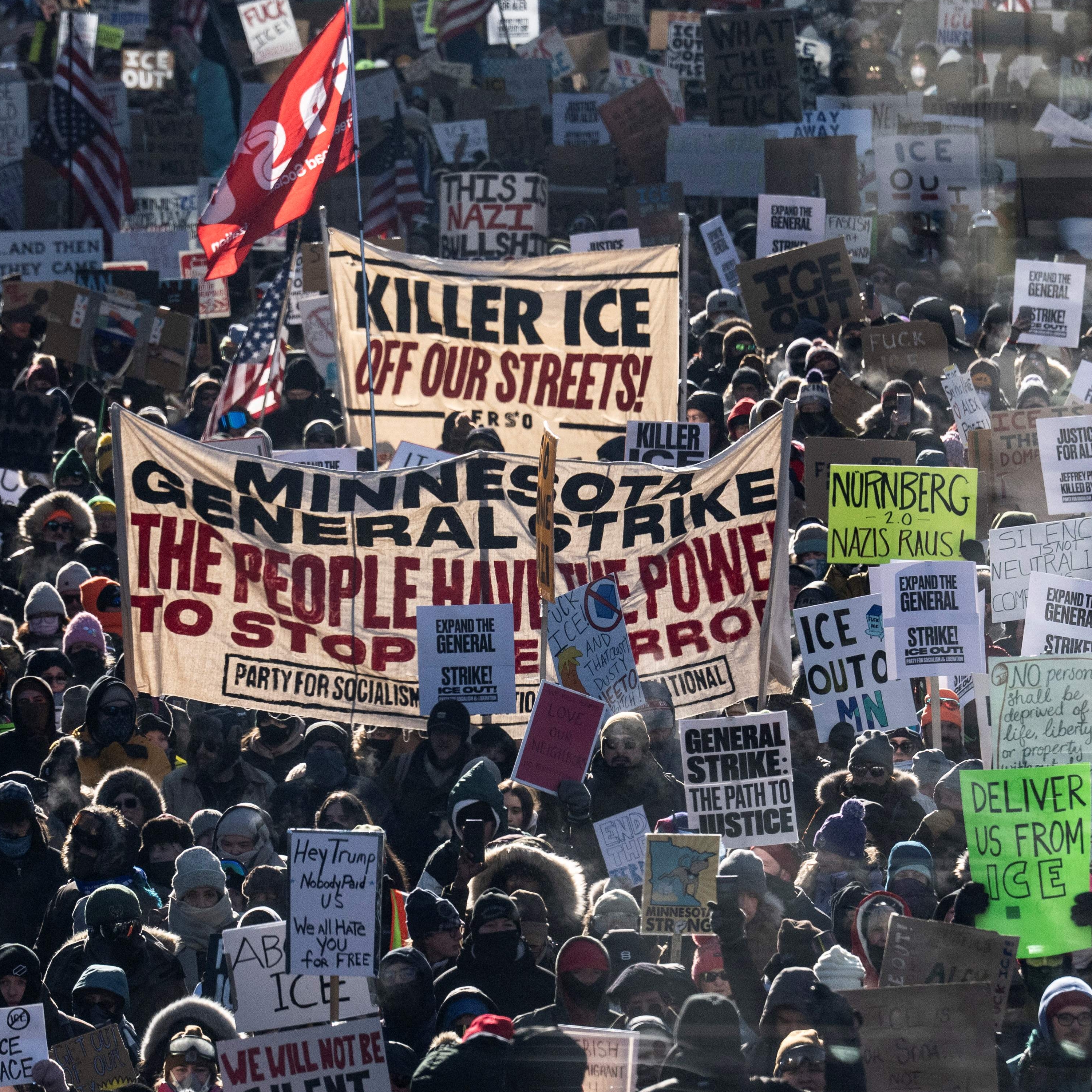
Post Reports
After Alex Pretti's killing, a battle of narratives
00:31:36
What we know about the killing of Alex Pretti, and what this incident tells us about the debate around gun rights.
Loading summary
Transcript54 lines
- [00:03]
A
The killing of Alex Preddy on Saturday morning is a dramatic escalation of what was already a very tense moment for Minneapolis. Now, Minnesota Governor Tim Walls is calling on President Trump to pull immigration officers out of Minneapolis. Trump says he is sending border czar Tom Homan to Minneapolis. And in court, a federal judge's ruling on whether Department of Homeland Security operations in the city are legal. It's a critical time for a city that is still in shock over Preddy's death and outraged at video footage that shows what transpired in the moments before he was shot by Border Patrol. For many Minneapolis residents, there is anger and there's intense fear. You can hear that from 35 year old Ben Porter, who spoke to one of our reporters in South Minneapol.
- [00:58]
B
Every instance of violence in every video you see, there's a gut wrenching moment where you realize that this is not in any way, shape or normal.
- [01:08]
A
Ben said that he has never felt more afraid and anxious on a daily basis.
- [01:15]
B
It's the same sort of sentiment that you would encounter to cities or communities that have been affected by natural disasters. But in this case, the disaster is the federal government attacking us Foreign.
- [01:29]
A
From the newsroom of the Washington Post, this is Post Reports. I'm Martine powers. It's Monday, January 26th. Today we're talking through what we know about the death of Alex Preddy and why people are worried that this shooting won't get a thorough investigation. And we'll hear how this encounter is raising important questions around America's gun debate and, and exactly who gets to exercise their Second Amendment right to do all this. I'm turning to my colleague Kim Belwer, a national reporter based in the Midwest. Kim, thank you so much for being with us today.
- [02:14]
C
Thanks for having me.
- [02:16]
A
So I want to start with the basics. Can you tell me what do we know about exactly what happened on Saturday morning in Minneapolis?
- [02:26]
C
So I was not in Minneapolis on Saturday, but from the accounts that we have from our colleagues, from their reporting and reviews of video footage of the scene, it really has created this question of what the government has said happened and the reality of what this footage has showed and what eyewitnesses have said they saw happen in front of them. So on early Saturday, there were residents and bystanders gathered out to protest the DHS operation in South Minneapolis. People are blowing whistles to warn residents of the agent's presence. And people are recording with their phones. And in one of these videos that was filmed from a passing car, we can see Alex Preddy in the street. We can see him talking to an agent, and he's filming the agents with his phone. He is not holding a gun in either of his hands. And an agent moves him back towards the sidewalk. And we can't hear how this interaction began or what they might have said to one another. So then we see him again in a second video filmed shortly after the first Preddy again is seen on the block. He walks towards the agents, still appearing to film them with his phone in his right hand and still not holding a gun. One of the agents pushes a person who appears to be a bystander or a protester down onto the sidewalk. And that's when Preddy steps between this person and the agents. And then the agents pepper spray Preddy.
- [03:56]
A
And just to be clear here, we do not know what prompted this, this law enforcement officer, this border patrol agent, to pepper spray him or why that agent felt that he needed to use it to subdue Pretty.
- [04:09]
C
That's right. So there is a lot that we can't hear that wasn't captured in the audio on these various videos. What we do know is that Preddy begins to interact with this person who was pushed. This exchange is inaudible after we see this person push and Preddy interact with them. The agent appears to try to pull Preddy away. And that agent is joined by several of their colleagues who are now trying to force Preddy to the ground. Over the next about 10 seconds, Preddy never fully appears to be completely prone on the ground or fully yield to the agents. At times, you can see his knees are tucked under his body and the agents are holding him down with their hands on his back. And at this point, at least four agents attempt to bring Preddy to the ground. And then an agent who's wearing a gray jacket walks up, crouches down, reaches towards Preddy and lifts a gun from Preddy's back near his waistband. This is again, according to our video analysis, which was taken from multiple angles. The agent turns and begins to walk away while holding the weapon and pointing it towards the ground.
- [05:20]
D
And.
- [05:20]
C
And another agent standing behind. The agent in the gray jacket unholsters his gun at virtually the same moment and points it at Preddy's back at close range. At least two agents are attempting to hold Pretty down at this point. A split second later, you can hear the crack of the first gunshot. Though the videos don't clearly show which agent fired. Preddy gets up on one knee and he falls over as the agent who had unholstered his weapon fires in rapid succession. The agent in the Gray coat retreats. Later, a gun with an optical attachment is visible in his hand. It appears to match the same image of a gun that the Department of Homeland Security posted about what it said was the Hun handgun recovered from Preddy. And it's not clear from this video whether other agents realized that Preddy, who local authorities believe had a permit to carry the weapon, had been disarmed at that point.
- [06:17]
A
Kim, thank you for walking me through that. I think so many people have watched these videos and of course they're very difficult to watch. But I just want to repeat what you said. And I think it's important to understand that what our video forensic analysis has shown, because this is all happening so quickly when you're watching in real time, is that there is this moment where one of these border patrol agents removes the gun from Preddy's body and, and it is after that moment that another agent shoots him.
- [06:49]
C
And that's part of what makes this video or these videos, I should say, so disconcerting. It's really striking that it's been captured from multiple angles and, you know, just the sheer difference in numbers. There's a lot of agents on top of Preddy. There's this incredible tension in this moment. And then when you hear that first gunshot, it. You can just see everything change. And once they back up off a little bit, you can actually see pretty, you know, fall to the ground. And it just, there's something about it that is so clear in a way that a lot of other videos that have really angered people around the ICE response just haven't quite captured the detail in the same way.
- [07:38]
A
And what do we know about and Alex Preddy?
- [07:41]
C
So we've started to get a lot of insight into Alex Preddy's life. He was a 37 year old ICU nurse who worked at the VA hospital. He was a US citizen. And Minneapolis police said that he didn't have a criminal record. He did have a gun with him at the time. And according to officials, he was a legal gun owner. He was permitted to have that weapon and friends said that he had really been bothered by what was happening in his city. He had been part of a group of people who were protesting the DHS operation, especially on Saturday morning when people were out blowing whistles to warn residents about the agent's presence. It's important to note, we don't actually know why he had that gun. We don't know if he just regularly carried a weapon, which he's legally able to do, you know, as a concealed carry permit. Holder, we don't know if he even knew that he was going to a protest proper when he left the house that morning. Because something I want to note is what we saw in Chicago, and this was definitely repeated in other cities too, is that on the one hand, there are these organized protests of tens of thousands of people that are in the street, they have the roads blocked off, and you can see this is a huge gathering of people. Other times, because these immigration enforcement actions are just happening in neighborhoods. It's just the people living there who are reacting. You could call it protesting because they're protesting what's going on. But the shooting happened in front of a popular donut shop where people are going to get coffee and donuts on a Saturday morning. And when they see immigration officials out in force, they start to alert one another. So it's just really important to understand that these are not clear cut scenarios of here is a big formal protest as most people would recognize it. And we know for certain that he was going to arm himself for this. There's just a lot of unknowns and we have to lean into the uncertainty that this immigration enforcement in Minneapolis has just been so fluid that people end up protesting really spontaneously because it's a reaction as much as it's a protest.
- [10:09]
A
So what are officials, the Department of Homeland Security, the federal government, saying at this point about Alex Preddy's death?
- [10:19]
C
The response from the Trump administration and from President Trump has been really striking. Almost immediately after this shoot, Trump and officials in his administration were describing Preddy as a threat, as a criminal, and said that law enforcement acted in accordance with their training. This is an idea that's also been echoed by other officials with Homeland Security, including DHS Secretary Kristi Noem. This individual who came with weapons and ammunition to stop a law enforcement operation of federal law enforcement officers came committed an act of domestic terrorism. That's the facts.
- [10:56]
D
Where's the evidence of his ideology?
- [10:59]
A
And did she clarify what she meant by that? Like what act of terrorism he was engaging in?
- [11:05]
C
Noem described Priddy as looking to injure Homeland Security officials because he came armed to this observation, protest, what have you. And she said that the agent was fearing for his life and for the lives of his fellow officers around him and fired defensive shots. And I should note that Homeland Security, Border Patrol, ICE have shot several people across the country in the course of these operations. And this is very much in line with the pattern of what we hear after these shootings. Some fatal, some not. Where the shootings are always justified by the government. As this was some sort of imminent threat on the lives of the officials working.
- [11:51]
A
I want to talk a little later more specifically about the fact that Preddy was armed here and some of the implications of the fact that he was armed. But before we get there, I mean, I assume his death is going to be investigated and questions will be asked about the use of force by these Border Patrol agents at that scene. What do we know about that investigation and who will be doing it?
- [12:17]
C
So there is a really unusual and pretty striking aspect of a fight, I would say, over this investigation, which is, as of this moment, there is no joint investigation, as we normally see in situations like this, where you have the local or state investigative body working in conjunction with federal government investigators. Local law enforcement has complained that they were told to leave the scene by Homeland Security officials late on Saturday. Minnesota law enforcement did successfully get a temporary restraining order against the federal government to prevent it from destroying or tampering with evidence from the shooting. And we're expecting further rulings on that case today. And Minnesota Attorney General Keith Ellison is trying to make sure that all of the evidence is preserved so that state officials can have that when they, when they continue their investigation.
- [13:16]
A
Yeah, I think a lot of reasonable people looking at this have a concern that maybe this won't be a full throated or totally truthful investigation.
- [13:26]
C
I am constantly looking at different patterns that we see, repeat, as the federal government brings these immigration enforcement operations to different cities. And a few months ago, when they were in Chicago and there was an instance of Border Patrol non fatally shooting a woman five times, this similar concern came up about chain of custody of, you know, the major pieces of evidence, just irregularities in how the investigation and the integrity of the investigation was unfolding. In that case, I should add, the government ultimately dropped its charges because they had pursued them against the woman they shot. But these are all questions that I think when you talk to people in Minneapolis, they're really surprised and distressed and angry about what they perceive to be this unwillingness from the federal government to be transparent and get to the bottom of what happened in the shooting.
- [14:25]
A
Yeah, tell me more about that. The reactions from folks in Minneapolis both about the killing itself and about what has transpired since that killing in terms of the investigation and the narrative that's put out by President Trump and the federal government.
- [14:43]
C
Well, it all seems to be accelerating. You have the ramp up. You have the killing of Renee Goode three weeks ago. On Friday, there was a general strike. Demonstrators against the federal immigration crackdown in Minnesota are taking to the Streets in Minneapolis.
- [15:02]
D
According to community organizers, 700 businesses are shut down across the state today.
- [15:07]
C
And a general strike is, you know, broadly a work stoppage. People in different industries are not working. They're out in the streets protesting. On the streets of Minneapolis in the bitter mid minus 20s cold, they marched by the thousands.
- [15:23]
A
Say it loud, say it clear say.
- [15:26]
D
It loud, say it clear.
- [15:28]
C
The message ICE agents out there were members of labor groups, of religious groups, of just everyday Minnesotans that were out in the freezing cold protesting. I spoke to a resident who lives downtown and said, even in the sky bridges, in the, you know, glass tunnels overhead, so you can go from building to building without being exposed to the elements. There were people in wheelchairs, people who maybe couldn't be in the cold or couldn't be on the street that were all just wanting to witness it and be part of it. And it was thousands of people. And then Preddy is shot on Saturday morning, and that again, prompts protests, people coming out. And my colleague Lauren Gurley spoke to some people who came out on Saturday after the shooting to protest and, and to observe. And she spoke to this man, David Ponder.
- [16:27]
A
We don't know what to believe anymore. And so we're not gonna. We're out here to witness right what's happening and stand up for our community.
- [16:37]
C
And one thing that I wanna call out is a lot of this distrust. This unease is not simply breaking along partisan lines. There are people who might have been supportive of President Trump of this immigration operation at some point. And this is now the third shooting in Minnesota involving federal law enforcement since the year started. And the rhetoric being so different from what people have observed with their own eyes in multiple camera angles. A video that's been widely disseminated is really making them distrust law enforcement, distrust what the government is saying. And it's even, you know, bringing back some echoes of the anger and the frustration that people felt in Minneapolis after George Floyd was killed by a police officer in 2020. People want clarity, they want transparency, and they definitely want accountability.
- [17:38]
A
After the break, how Alex Preddy's death has complicated the debate around gun rights in America. We'll be right back.
- [17:58]
D
This is the year you stop overthinking and start building. The year your side idea becomes something real. Founder, creator, business owner. It all starts with one decision, and that decision is launching with Shopify. Maybe it's a product your friends already asked to buy, a service you know you're great at or a brand that's been living rent free in your mind. January is your window before another year slips by. 2026 is when you turn the idea into income and Shopify is how you begin. Millions of entrepreneurs have already made the leap from household names like Heinz and Mattel to first time business owners just getting started. Choose from hundreds of beautiful templates that you can customize to match your brand. Create email and social campaigns that reach customers wherever they scroll. In 2026, stop waiting and start selling with Shopify. Sign up for your $1 per month trial and start selling today@shopify.com reports. Go to shopify.com reports. That's shopify.com reports. Hear your first this new year with Shopify by your side. There's this moment every day right around 5pm where my brain just shuts down. Not because I don't want dinner, because I don't want to decide dinner. Before HelloFresh, it was always the same what do we have? What can I make? How long will it take? HelloFresh didn't magically turn me into a chef, it just removed the hardest figuring it out. The meals are already planned, the ingredients are already portioned, and the steps are crystal clear. Every week, HelloFresh offers over 100 recipes, so I'm choosing what sounds good, not what I can survive making. I've tried a lot of HelloFresh recipes, from their deli style turkey wraps to their street cart style chicken bowls and they're all fantastic, though their buffalo chicken melts are quickly becoming a new favorite. Go to hellofresh.com posttenfm to get 10 free meals plus a free Zwilling knife, a $144.99 value on your third box offer valid while supplies last. Free meals applied as discount on first box. New subscribers only varies by plan.
- [20:06]
A
So Kim, I want to talk more about the fact that Alex Preddy had a gun in this instance. And obviously that's a big piece of information that the federal government is holding up as a justification for this killing. How is the gun part of this kind of complicating the reactions to his killing, Especially the fact that he was a legal gun owner and that from what we see in this video, he wasn't really doing anything with his gun other than carrying it on his body?
- [20:40]
C
Well, when we think of the gun debate in America, it is often very coded in a partisan way. You know that conservatives tend to be more for gun rights and liberals are more about gun control. And then you have someone like Preddy who sort of scrambles that idea. You know, we understand that Preddy was a lawful gun owner and he has that gun as he's participating in some kind of protest to the federal government action. So now we have the Second Amendment question. A lot of conservatives who have been longtime proponents of the right to carry arms, even opposing gun safety regulations to prevent things like school shootings, saying that, you know, this is a right, this can't be infringed upon. A lot of these same voices are now trying to leverage the detail that Preddy had a gun at the time of the incident to justify the response by these federal law enforcement officers. And we heard this from Kirsty Noem and from members of Congress, including Oklahoma Representative Mark Wayne Mullen.
- [21:46]
E
And then unfortunately, a individual, deranged individual that came in to have to cause max damage with a loaded pistol with an extra mag that was completely loaded was shot and killed.
- [21:58]
C
And New Jersey Representative Jeff Van Drew, they spoke to Fox News about this.
- [22:04]
E
Peaceful protesters don't have 9 millimeter weapons with 2 extra magazines. Peaceful protesters. I don't know about you, but I'm sure the same as me, I don't go in my closet and I don't have professional grade gas masks ready to go in case tear gas is thrown. A normal neighborhood, what happens in a normal situation is they cooperate, they try to help where they just stay out of it. This is not normal.
- [22:30]
C
This is also making me think of Kyle Rittenhouse. He was the teenager from suburban Chicago who came armed to the civil unrest in Kenosha, Wisconsin in 2020. And he shot three people, killing two of them. And Rittenhouse was really kind of embraced as a darling of the pro second amendment political right and saying, look, you know, he was, he was lawfully carrying this rifle, he had a right to have that. And he fired in self defense. And even though it led to people dying, you know, the Second Amendment right was the self defense was justified in using this weapon. And Rittenhouse is a figure that I've seen those on the political left in particular point to, to, you know, kind of question what I think a lot of liberals are seeing as a hypocritical stance by pro Second Amendment folks, particularly conservative ones, when we're getting into this debate about what Alex Preddy's possession of a lawful firearm in this moment means in this situation.
- [23:45]
A
So in some cases you have Republican lawmakers, public figures, kind of repeating the line that we've heard from President Trump and other Trump officials about this, that he, he brought this gun and therefore that's a sign that he was up to no good or that he was threatening these officers. But I'm curious what, like, the NRA has said about this. I mean, like, organizations that exist to protect the rights of people to carry a gun.
- [24:14]
C
So the NRA is interesting. It is a political organization that consistently does come out really boldly in support of the right for people to have almost unrestricted firearms access. But they don't always respond in ways that you would expect. This being one of them, I'm reminded, in 2016, also in Minneapolis, there was a black motorist named Philando Castile who was fatally shot by a police officer during a traffic stop. Castile was a legal concealed carry weapons holder. He had a weapon in the car at the time. And the NRA did not speak out in his defense at the time. And they're putting out a pretty mixed message in the Preddy case. Earlier on Saturday, the nra, from their main social media account, seemed to join others on the political right in blaming Democratic leaders for violence and saying that their demonization of these immigration officials had, you know, predictably violent results. But later in the day, they kind of did a bit of a heel turn on that they were pushing back against California's assistant attorney who had said, if you approach law enforcement with a gun, there is a high likelihood that they will be legally justified in shooting you. And then the NRA hit back at Asale's comment and said the sentiment from the First Assistant U.S. attorney of the Central District of California is dangerous and wrong. The NRA said responsible public voices should be awaiting a full investigation, not making generalizations and demonizing law abiding citizens.
- [25:51]
A
I'm curious if you're seeing other ways in which there are. There's some, like, daylight here between what we're hearing from Trump and Trump officials and other kind of conservative voices who would normally be in lockstep with them. Like, is there a sense that there are some Republicans, or maybe I specifically mean like high profile Republicans who are looking at this video and saying, like, I don't know, like, doesn't seem like he necessarily deserved to be shot and killed on the street here.
- [26:24]
C
It seems like this is really splitting some on the political right, the traditional pro Second Amendment, pro unfettered access to carry types, because what the government is attacking is something that they had long stood up for, but now it's someone who was at the time standing in opposition to what the federal government was doing. And there have been some Republican lawmakers that have pushed back on the broader rhetoric from the Trump administration about what having a gun means in this situation. One of the stronger responses was from Kentucky Republican Representative Thomas Massie. He's often been critical of the White House. And in a statement on X on Sunday, he said, carrying a firearm is not a death sentence. It's a constitutionally protected, God given right. And if you don't understand this, you have no business in law enforcement or government. We also heard from Louisiana Senator Bill Cassidy, also with a post on X, who said the events in Minneapolis are incredibly disturbing. The credibility of ICE and DHS are at stake. There must be a full joint federal and state investigation. We can trust the American people with the truth.
- [27:42]
A
Interesting. So, Kim, I wonder if, I don't know if, like, statements like that are going to have any effect. I mean, obviously, just because a few Republican lawmakers are kind of speaking about their concerns here doesn't mean that there's some outcry from the conservative side. But I do wonder if your sense is that there is an increasing amount of pressure on President Trump for what's happening here, but both with immigration enforcement, but also the fact that US Citizens are dying.
- [28:11]
C
Yeah, I think it's gonna be really interesting to see what happens as far as President Trump's reaction and if he is at all moved to moderate his stances or the intensity of this current immigration surge in Minneapolis and other US Cities, they have this planned for. You know, we, we know that he doesn't really seem to be bothered by the criticisms of his political opponents by Democrats, broadly, by US Citizens, who he kind of categorizes broadly as, you know, just being Democrats and therefore, you know, not trustworthy. We saw how he talked about places like New York and, you know, residents of Chicago. But it is really important to think through the kind of pressure he is feeling in this moment from independents, from moderates who, you know, this might be the last straw. You know, if his coalition of support really starts fracturing over this, this could actually make him feel more vulnerable. We can't get inside his head. We don't know if this will ultimately change anything. It's just hard to say because so much of this has really shocked the conscience for people who've been experiencing this in their city. And it hasn't led to any moderation yet. It hasn't led to a lessening of intensity, of turning down the heat, of moderating the rhetoric, of striking any kind of conciliatory tone. But for now, this unprecedented deployment of federal agents into American cities like Minneapolis, Portland, Chicago, Los Angeles, this has just really amped up the temperature, the anger, this open hostility between largely, you know, largely Democratic populations Usually led by Democratic governors or mayors and the Trump administration. And this is just, it's making people feel, I think, a lot of frustration and a lot of fear when you see citizens and state and local officials having to square off so fiercely against the federal government.
- [30:27]
A
Yeah, Kim, I'll let you go in a second because I heard your dog in the background there waiting for you. But I'm wondering, is there anything else right now that might change the nature of this immigration enforcement in Minneapolis going forward? Like, is there anything that is going to imminently affect what people in Minneapolis are seeing on the streets from these law enforcement officers and that will change the kinds of interactions that they're having with, with these agents and officers?
- [31:01]
C
There's a few ways this could go. We did see in Chicago, for instance, after a federal judge limited the use of force that federal agents could use against peaceful protesters and member of the news media. That sort of marked the kind of wind down of the operation. It didn't solve the use of force problems that were happening on the ground. But the Operation Midway blitz did seem to kind of draw down sometime after that. But we don't exactly know, are they gonna come back to some of these cities? How long are they gonna stay in places like Minneapolis? But we do know, for instance, recently the Minnesota Chiefs of Police association has requested a meeting with President Trump because this group is saying they need this constructive and timely meeting to talk about these complex high pressure environments that local law enforcement are dealing with as a result of the Operation Metro surge in the Minneapolis area. And these Minnesota police chiefs, they want to be able to give their communities some kind of clarity, sense of reassurance, sense of stability. So I think getting pressure from groups or getting appeals from groups that President Trump has long professed to support, particularly the police, could yield some moderation in the approach. But we'll have to wait and see.
- [32:35]
A
Kim, thank you so much for explaining all of this.
- [32:38]
C
So glad to be talking about this.
- [32:41]
A
Kim Bellare is a national breaking news reporter. Order for the Post. Today's show was produced by Alana Gordon and Rennie Swinovsky, with help from Sabi Robinson. It was mixed by Sean Carter and edited by Ariel Plotnick. Thanks to Annie Gowen, who recorded that interview heard at the top of today's show, and also to Gina Harkins. As we continue to cover this story and other big developments happening around the country and the world, we are always curious what you're thinking. If you have reactions to this episode, questions you're wondering, or ideas for upcoming stories. Please share them with us. You can do that by emailing postreportsoshpost.com Again, that's postreportsoshpost.com we look forward to hearing from you. I'm Martine Powers. We'll be back tomorrow with more stories from the Washington Post.
- [33:35]
C
SA.