← Post Reports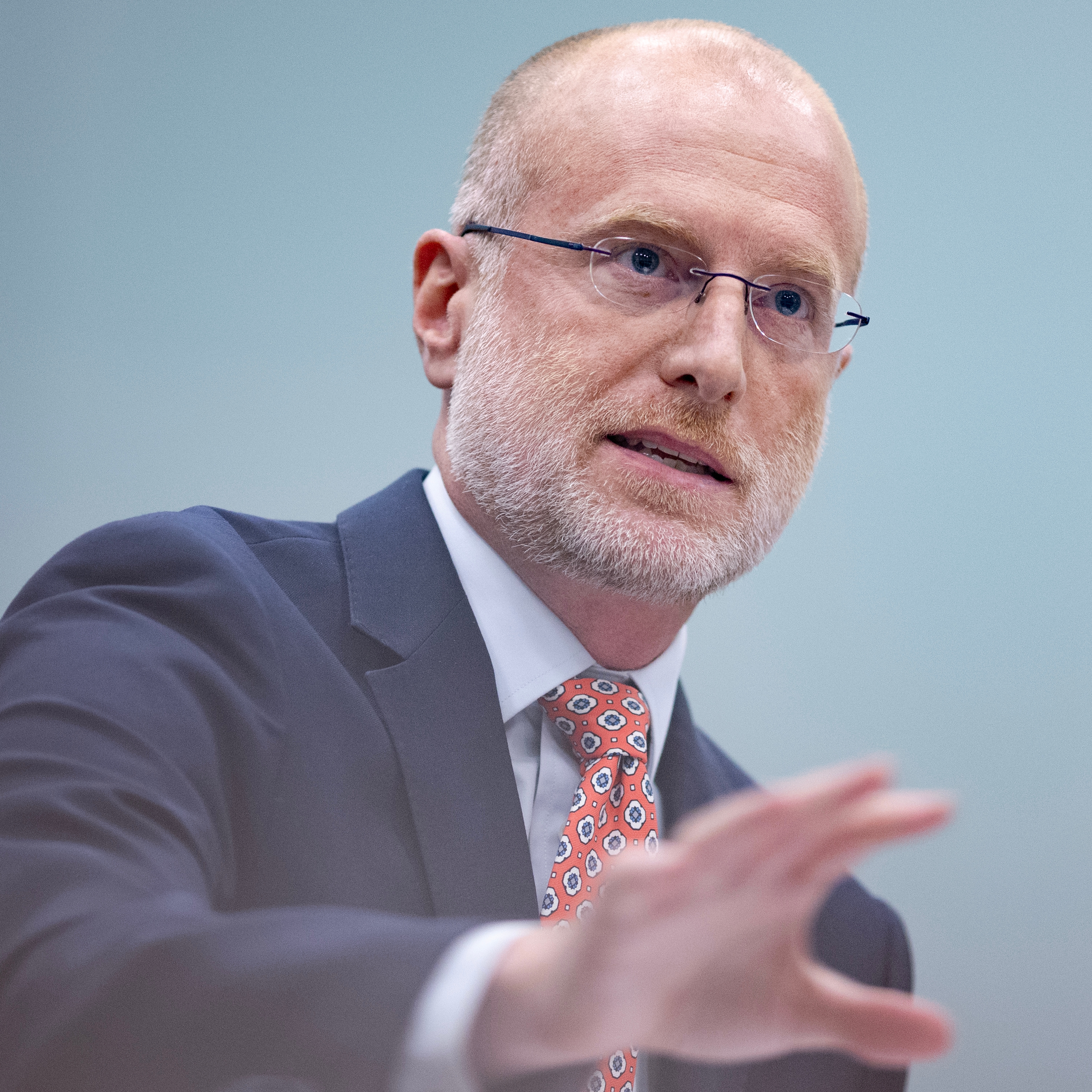
Post Reports
Brendan Carr, the FCC muscle behind Trump's anti-media crusade
00:19:56
FCC chair Brendan Carr has emerged as one of the top lieutenants in President Trump’s war against the media. How much power does he really hold?
Loading summary
Transcript64 lines
- [00:02]
A
Americans have been seeing an unprecedented surge in censorship, particularly over the last couple of years.
- [00:08]
B
This is Brendan Carr talking to News Nation's Chris Cuomo. Late last year, Carr was about to become the new head of the fcc, the Federal Communications Commission.
- [00:19]
A
Diversity of opinion is so important in this country and it's gonna be one of my top priorities is trying to smash this censorship cartel.
- [00:30]
B
For years, Carr had been a vocal advocate against the government intervening in free speech. But now, as head of the fcc, Carr is leading the Trump administration's pressure campaign on media companies over what they broadcast, including most recently the push for ABC to take late night host Jimmy Kimmel off the air.
- [00:52]
C
Brendan Carr's title is chair of the Federal Communications Commission, but in actuality he is the guy that is really providing the muscle for Trump's anti media agenda in the second administration.
- [01:04]
B
Scott Novor covers media for the Post and Scott says Carr's supporters view him as a welcome corrective to what they perceive as inherently liberal broadcast media. But his critics, including some conservatives, worry that Carr is taking the FCC into dangerous territory. From the newsroom of the Washington Post, this is Post Reports. I'm Elahe izadi. It's Monday, September 22nd. Today, how Brendan Carr, a previously little known policy wonk, has taken center stage as Trump's media enforcer. Scott joins me to explain how Carr is possibly pushing the limits of the FCC and how media companies are responding to this pressure campaign. Hi Scott, thanks for being in the studio with me today.
- [02:07]
C
Thanks for having me back.
- [02:09]
B
So Scott, just to start off, let's just remind ourselves of what happened last week with Jimmy Kimmel's late night television show and the role that Brendan Carr played in it being pulled off the air. I feel like a lot of people may not have heard of the name Brendan Carr until last week. Just take me back to Monday night, what happened last week.
- [02:31]
C
So Monday night Jimmy Kimmel and his monologue made some comments about the aftermath of Charlie Kirk's murder. Kirk was a conservative influencer that was gunned down in Utah just the week prior and sensitivities had been rocking, running high across media. Kimmel made a comment about the suspected shooter and it wasn't exactly clear, but essentially he was talking about how conservatives were trying to characterize the shooter and at the same time there wasn't enough information to be able to definitively identify the suspected shooter's political affiliations. We hit some new lows over the weekend with the MAGA gang desperately trying to characterize this kid who murdered Charlie Kirk. As anything other than one of them and doing everything they can to. To score political points from it.
- [03:13]
B
Yeah. And this is coming at a time when people are getting fired from their jobs for comments that they've made about Charlie Kirk after his murder. And so in this case, there was some conservative backlash to Kimmel's comments. But then Brendan Carr steps into the situation.
- [03:32]
C
Yeah. Two days later on Benny Johnson's podcast. Benny Johnson's a conservative talk show host, Brendan Carr. He took issue with Jimmy Kimmel's comments and threat implicitly or explicitly that he could remove ABC's broadcast licenses if they didn't take action on Jimmy Kimmel.
- [03:52]
A
Frankly, when you see stuff like this, I mean, look, we can do this the easy way or the hard way. These companies can find ways to change conduct to take action, frankly, on Kimmel, or there's going to be additional work for the FCC ahead.
- [04:07]
C
And just a few hours after Carr made these comments, nexstar and Sinclair, the two biggest owners of local ABC affiliates, said they wouldn't air Kimmel that night. Then ABC announced it was pulling Jimmy Kimmel live off the air for an indeterminate amount of time.
- [04:22]
B
So what, ABC took Kimmel off the air because the FCC chair made a comment that sounded like a threat?
- [04:27]
C
Yeah, that's kind of the going theory. You know, Brendan Carr would say that ABC was acting out of its own accord and that this is the free market exerting its will on comments that it didn't like. But to many Trump critics and car critics and people who are just very concerned about free speech in America, this looked a lot like government overreach and pressuring an independent media company to make a decision because of speech that the government didn't like.
- [04:54]
B
But just to be clear, Carr and the FCC didn't actually force ABC to pull Kimmel. Right.
- [05:01]
C
ABC wasn't technically forced to do anything. You know, people that support their decision could say that advertisers were starting to ask questions, and then affiliate station owners were exerting their will. And then ABC took action because Kimmel's show was untenable at the moment. And that's all free market forces. But what the First Amendment really protects against is government stopping speech. And what Brendan Carr was doing, kind of nudging ABC and nexstar in that direction, is much closer to what free press advocates consider real censorship.
- [05:41]
B
So we'll get more into the workings of the FCC and what exactly it can and cannot do. But let's talk about Brendan Carr, because based on what we've talked about so far. And in hearing him say what he said, I don't know, it doesn't sound like a typical FCC chair. They're usually these little known bureaucrats. What was Carr like before he became the FCC chair?
- [06:05]
C
Yeah, I can't say that there has been a radical transformation, but he has evolved over time to have a more expansive view of what the FCC does and what it should have a say in. Brendan Carr was a lawyer at the FCC for a long time and he rose to become the general counsel of the commission. Eventually he was nominated as a commissioner of the FCC under Trump's first term in 2017. And I can't say he was the furthest right person on the five person commission. But over time he certainly became that and really started speaking out publicly about bias and censorship in social media and tech companies in Silicon Valley, speaking out against content moderation policies on Twitter and Facebook and companies like that, which is pretty far from the remit of the fcc.
- [06:56]
B
The stances that he sort of advocated at that time, it sounds like he was saying there's too much censorship of speech on these platforms.
- [07:06]
C
Right. And so all of his comments are couched in the language of free speech. But the free speech that he seems to support is conservative speech, right wing speech. And critics of Carr would say that the First Amendment doesn't protect against private companies taking action against speech that they don't want. Private companies have their own free speech rights when the government intervenes, that is, when it becomes a First Amendment problem.
- [07:34]
B
So then why did Trump pick him to be his FCC chair?
- [07:38]
C
Well, by the time Donald Trump took office again in 2025, Carr was the senior most Republican on the commission. He was certainly part of Donald Trump's orbit, became friendlier with him. Notably, he even wrote a chapter in the Heritage Foundation's Project 2025 memo about how to reform the FCC.
- [07:55]
B
And so what were some of the ideas that he was advocating in that?
- [07:58]
C
He was basically talking about holding media companies to account, preventing conservative speech from being quashed, taking a harder stance on tech companies, things like that, that were consistent with what he had talking about in the prior administration.
- [08:12]
B
So Carr becomes the FCC chair. What has he been doing in that role since this second Trump term has started?
- [08:20]
C
So Brendan Carr has threatened many different companies over many different things. He's taken a special interest in media companies, especially those that have some sort of business before the fcc. He launched an investigation of NPR and PBS over their corporate sponsorships. He demanded answers from YouTube parent company Alphabet over allegations that discriminated against faith based programs, programming. He also threatened to block mergers of companies engaged in diversity, equity and inclusion practices. He has had a kind of a role of threatener or enforcer for Donald Trump. Whether or not he takes action on these things is to be determined, but he has definitely been someone who comes on the air, talks on conservative television about how companies better fall in line or face the consequences, as he did with the Kimmel situation.
- [09:14]
B
After the break, Scott explains what the FCC usually does and why some conservatives are speaking up against what Carr is doing. We'll be right back.
- [09:31]
D
Fall is the perfect time to give your wardrobe a reset and Quince makes it easy. Their pieces look as good as they feel so you can stay warm, polished and on budget. Think elevated fall essentials, 100% Mongolian cashmere starting at just $50 machine washable silk tops and skirts, perfectly tailored denim and even those timeless wool coats I've been eyeing as the weather cools down. The best part, you get designer level quality without the designer price tag. Quint's partners directly with ethical world class factories, cutting out the middlemen to bring you luxury that actually feels smart and effortless. Keep it classic and cozy this fall with long lasting staples. From Quince, go to quince.comreports for free shipping on your order and 365 day returns. That's quince.comreports to get free shipping and 365 day returns. Quints.com reports.
- [10:27]
E
You listen because you know the power of good journalism and the Washington Post is there for you 24 7. When you become a Washington Post subscriber, you get exactly exclusive reporting you can't find anywhere else. You also get sharp advice, columns, delicious recipes, TV and music reviews and so much more. Right now you can get all of that for just $4 every four weeks. That's for an entire year. After that, it's just $12 every four weeks. And you can cancel anytime. Add to your knowledge and discover all the Post has to offer. Go to washingtonpost.com subscribe. That's washingtonpost.com subscribe.
- [11:13]
B
So, Scott, we've been talking about how, you know, in normal times the FCC chair isn't someone that many Americans may know by name. But now you have this FCC chair taking a starring role in like the big political story of the moment. And I think one thing that would be helpful at this point to really understand is what does the FCC typically do?
- [11:32]
C
Yeah, I mean, it's a really good question. It's something that people don't really understand. They regulate anything that has to deal with the broadcast spectrum. So the origins of the commission and its predecessor really have to do with making sure that two entities aren't interfering on the same airwaves, and that kind of bringing order to chaos. And as we've transitioned out from a broadcast first media environment, the FCC has become less and less relevant. The commission doesn't even regulate cable networks like CNN or MSNBC or Fox News. They really just regulate local broadcast stations, those local stations that carry ABC and CBS and NBC and Fox in your local media markets.
- [12:16]
B
They have some influence over what's said, like indecency. Does the FCC have any other purview over content on the airwaves in the past?
- [12:26]
C
In the middle of the 20th century, the FCC was much more involved in regulating what was said on air. For decades, there was this thing called the fairness doctri that essentially required broadcasters to act in the public interest and do things like give equal time to political viewpoints when discussing certain news topics. But that ended in the late 80s, and now the FCC has really taken a backseat and been much, much more about the technical side of broadcasting and not about the content, which really insulates them from a lot of critiques that they are violating the First Amendment.
- [12:58]
B
Scott I also understand that the FCC also has to sign off on big media mergers, and that this function of the FCC has also come up in this moment with Jimmy Kimmel as well.
- [13:10]
C
Yeah, so telecommunications companies often need FCC approval for these big mergers, and there's some good examples of how these mergers have become politically complicated. If you recall, CBS owner Paramount was trying to merge with Skydance earlier this year, and it needed the FCC to approve. But Trump had a pending lawsuit against CBS over a 60 Minutes interview with Kamala Harris. And in the end, Paramount settled that lawsuit that many experts thought was pretty weak. CBS and Paramount made a bunch of concessions, but the FCC approved the Paramount skydance merger. Now, with the Kimmel situation, nexstar, the company that initially pulled Kimmel off the air on its local stations, they also have business before the FCC. Nexstar is pursuing a $6.2 billion merger with another local TV company called Tegna. Here comes Brendan Carr making these comments about Kimmel and what will happen if companies don't make changes. The fcc, he will need to do additional work.
- [14:10]
B
And has nexstar said anything about why they did this and specifically the going theory that they did this because they want FCC approval of this merger?
- [14:21]
C
Nexstar hasn't commented on implications that they did this under government pressure or to appease the government. They Merely say that they took issue with Kimmel's comments and decided that this is best for the communities that they serve.
- [14:35]
B
You mentioned the FCC deals with broadcast licenses. Could the FCC pull the broadcast license, effectively taking a network off the air for airing stuff that it doesn't like?
- [14:48]
C
Probably not. This has almost never happened. Usually when a broadcast license is pulled, it is because the station is not really functional or there's some sort of gross, gross misconduct about how it's being run. Maybe it's owned by someone in federal prison or something like that. There are one or two examples from decades past in a very different era of the FCC where broadcast license were pulled. But this is generally not something that people consider within the purview of the fcc.
- [15:22]
B
But I have to say that we are in a moment where throughout the government there are a lot of things like this, like, oh, this is unprecedented, probably illegal. But then the Trump administration does try to do these things and kind of test the limits. Here are the experts and the legal experts that you and your colleagues talking to. Do they view this as almost like a test case of the limits of the fcc? And like, if they actually move to do this, like an expansion of the.
- [15:43]
C
FCC's powers, that's the key thing is if they move to do this, they haven't actually tried to take away a broadcast license yet. But if you're reading the tea leaves, then you would assume that Brendan Carr will try to do that at some point. But yeah, it could be a test case before the Supreme Court or another high level court and see just what is the power of, of this part of the administrative state.
- [16:07]
B
So I know that Democrats are criticizing Carr for the comments he made about Kimmel and abc then pulling the late night host off the air. House Democratic leadership has called on Carr to resign. That's not surprising to me. But I wonder about Republicans because for the past several years there has been a lot of talk from them, from conservatives about censorship and railing against squashing speech and this portrayal of the left, that they are the ones pressuring companies to do things to quote, unquote, cancel people over their speech and calling it censorship. And this sort of feels like the same thing. Have any Republicans addressed what Carr said about Kimmel?
- [16:53]
C
Right. And in the last few days there have been two notable Republicans that have spoken out against Carr. Ted Cruz, the Republican from Texas, criticized Carr on his own podcast on Friday.
- [17:06]
A
Look, look, I like Brendan Carr.
- [17:07]
C
He's a good guy. He's the chairman of the fcc.
- [17:09]
A
I work closely with him. But what he Said there is dangerous as hell.
- [17:15]
C
Then on Sunday, Rand Paul, the senator from Kentucky, weighed in on Meet the Press criticizing Carr.
- [17:22]
D
Senator, do you believe that Brendan Carr's comments were appropriate?
- [17:27]
C
Absolutely inappropriate.
- [17:28]
A
Brendan Carr has gotten no business weighing in on this.
- [17:31]
C
And at least two other Republican senators, Todd Young of Indiana and Dave McCormick of Pennsylvania, have backed up at least some of Cruz's comments.
- [17:40]
B
The people who are kind of uncomfortable with this on the right, what is their argument against it?
- [17:45]
C
Well, they're saying that this is an affront to free speech and that the FCC shouldn't be pressuring private media companies to make editorial decisions. They might not like Kimmel, they might not like what he said. They might think that comments about Charlie Kirk have gotten out of hand since his death. But what Cruz and Paul and others have said is that the FCC shouldn't be in the business of censoring speech.
- [18:07]
B
And what about Trump and Carr? What have they been saying about this whole Kimmel situation?
- [18:12]
C
Carr has defended it adamantly. He thinks that this is the power of the free market exerting its will on speech that it doesn't like. And he's said it's not anything that he's done. And Trump has gone even further and said it's time for NBC to take off Jimmy Fallon and Seth Meyers from the air.
- [18:31]
B
Two other late night hosts on NBC. Yeah, just stepping back. You're a media reporter. How do you think of this moment right now where you have the FCC chair kind of weighing in on content in this way and you're having like a major talk show host taken off the air and questions about the future?
- [18:48]
C
I mean, I think it's part and parcel of what Donald Trump wants to be doing. You know, I think Trump has made no secret that he has this ongoing war against the news media, which he's long referred to as the enemy of the people. Trump has sued several media companies, including most recently the New York Times, even though a suit against them was tossed out by a Florida judge. He banned AP journalists from covering White House events when they refused to call the Gulf of Mexico the Gulf of America. He successfully got Congress to defund the organization that doles out money to PBS and NPR stations. And even this weekend, I broke a story about how the Pentagon is forcing journalists to pledge not even to gather information unless. Unless the Defense Department approves it. So I think Carr, in this role at the fcc, is just carrying out this sentiment to the best of his ability.
- [19:37]
B
So what will you be looking out for as this kind of war on media continues.
- [19:41]
C
Sure. So I'll be looking at how private companies are interacting with the FCC and how the FCC is pressuring private companies to do their bidding. And more importantly, I'll be looking at whether Brendan Carr actually tries to pull a broadcast license or, you know, really expand what he believes the scope of the FCC is to be much more involved in the editorial decisions of broadcasters.
- [20:12]
B
Well, Scott, thank you so much for taking time to explain all this. I appreciate it.
- [20:15]
C
Thank you for having me.
- [20:20]
B
After I recorded this conversation with Scott, ABC's parent company, Disney, announced that Jimmy Kimmel would return to his show on Tuesday night. Disney said it had pulled Kimmel off the air because, quote, we felt some of the comments were ill timed and thus insensitive. Disney then said it was bringing Kimmel back after having had, quote, thoughtful conversations with him in recent days. This all comes after considerable backlash against ABC and Disney from viewers and some prominent Hollywood celebrities. That's it for Post reports. Thanks for listening. If you're looking for the latest updates on the big news of the day, you should check out our morning News briefing. THE seven. We bring you the seven stories you need to know about every Weekday morning by 7am you can listen to it wherever you listen to podcasts. Today's show was produced by Peter Bresnan with help from Alana Gordon. It was mixed by Sam Baer and edited by Ariel Plotnick. Thanks to James Graff. I'm Elahei Izadi. We'll be back tomorrow with more stories from the Washington Post.
- [21:38]
E
You listen because you know the power of good journalism and the Washington Post is there for you 24 7. When you become a Washington Post subscriber, you get exclusive reporting you can't find anywhere else. You also get sharp advice columns, delicious recipes, TV and music reviews and so much more. Right now, you can get all of that for just $4 every four weeks. That's for an entire year. After that, it's just $12 every four weeks. And you can cancel any time. Add to your knowledge and discover all the Post has to offer. Go to washingtonpost.com subscribe that's washingtonpost.com subscribe.