← Post Reports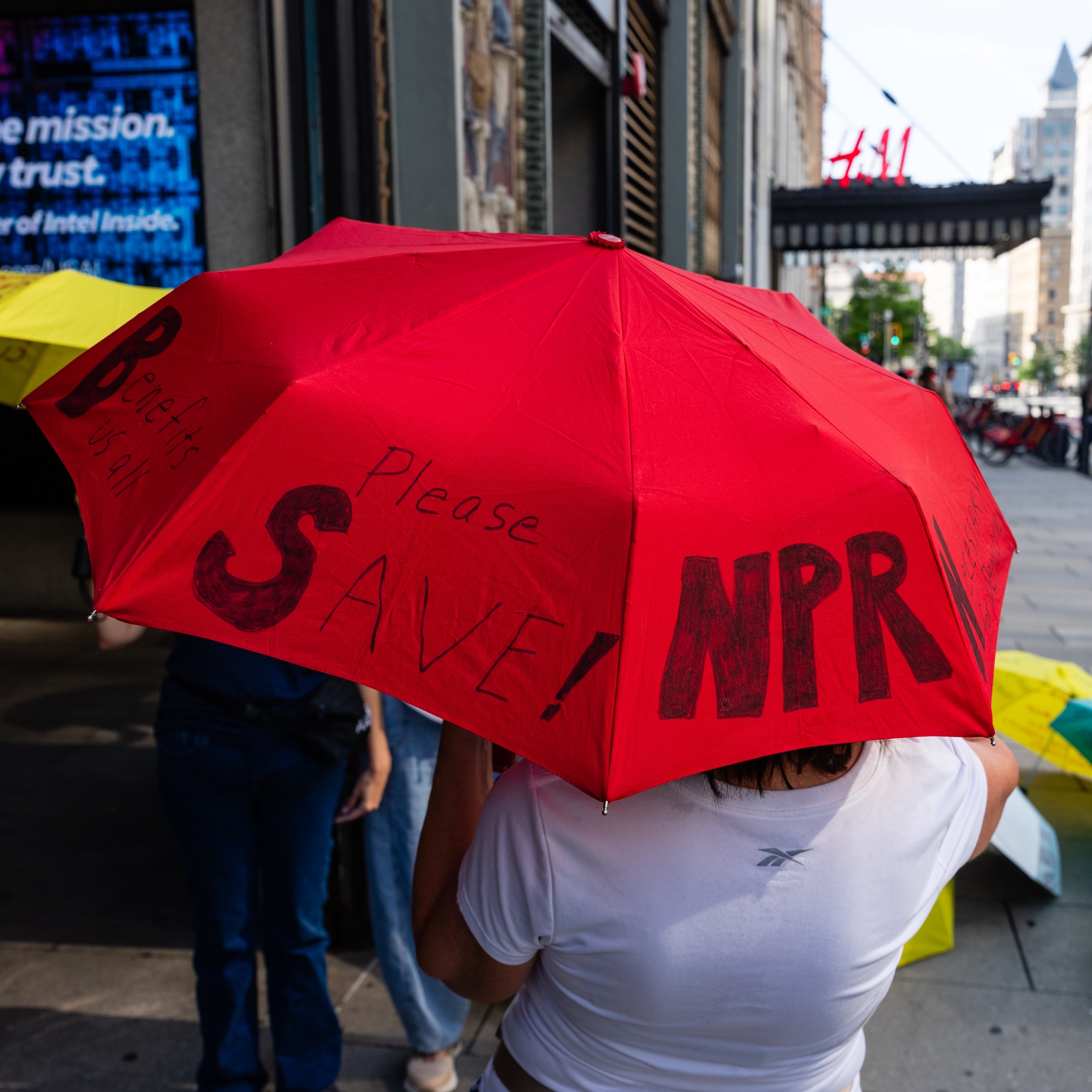
Post Reports
Congress cut public media funding. Now what?
00:25:13
What one rural community in Alaska could be losing now that Congress has defunded public media. And why this became a priority for President Donald Trump.
Loading summary
Transcript78 lines
- [00:00]
Dr. Horton Representative
Now is your time to get into a new Dr. Horton home by taking advantage of their national red tag sales event, now extended through July 27. Stop by any of their participating communities and find select red tag homes at Incredible Pricing. So whether you're buying your first home or looking for an upgrade, you don't want to miss the red tag sales event extended to July 27th. Discover the Dr. Horton Difference at drhorton.com Dr. Horton, America's builder and equal Housing Opportunity Builder.
- [00:36]
Elahe Izadi
What you're hearing is a lifeline for a community in Alaska. It's a newscast from the station kyuk. The station is based in Bethel, Alaska. It broadcasts in two English and Yupik. That's the local indigenous language you're hearing there.
- [00:59]
Kristin Hall
51 degrees southeast, 5 to 10 miles per hour.
- [01:03]
Elahe Izadi
KYUK is a small NPR member station. It also has a TV side, a PBS member station, and they've been doing this broadcasting in both languages for decades.
- [01:15]
Kristin Hall
Yuk in the Yupik language actually means real person, real people. That is why we chose our call letters so we have UKE to Yuk on Mondays, which is a call in show it creates.
- [01:28]
Elahe Izadi
Kristen hall is the interim general manager of kyuk. One of her favorite things to listen to on the station are their broadcasts of high school basketball games.
- [01:38]
Kristin Hall
I'm not a fluent Yupik speaker, but the bilingual calling of basketball, it is like a very cool experience.
- [01:45]
Elahe Izadi
KYUK also provides essential information for people in this remote place, like how to stay safe when getting around.
- [01:54]
Kristin Hall
The river that we lie on actually becomes almost like a US highway in the wintertime when it freezes.
- [02:01]
Elahe Izadi
But in the spring and fall the ice is thawing or still in the process of freezing, so it can be dangerous to drive on.
- [02:10]
Kristin Hall
So there are often holes or, you know, spots that we, during our call in shows will mark for each other to let each other know, hey, don't use this path. Don't go near here. It's an incredible tool for us to be able to communicate with each other during breakup and freeze up.
- [02:28]
Elahe Izadi
Most of the station's budget comes from the federal government. Congress has now cut that funding. Late last week, Congress passed a rescissions bill. It claws back the money set aside for public broadcasting for the next two years, meaning that at the end of September, most of kyuk's budget will evaporate.
- [02:52]
Kristin Hall
I've heard a lot of people referring to us as NPR and pbs. We are losing NPR and PBS and you know that's inaccurate. We choose to broadcast NPR and pbs as local broadcasters. We are not required to do so. I think what's being lost in this is local broadcasters, not NPR and pbs, local news, local information, you know, things like EAS messages, emergency Alert system. We are the originator for EAS messaging for our entire region. So, you know, if we are to go dark, that messaging doesn't go out. Things like translating election coverage, you know, these basic services that really aren't political in any way. That's what we're losing in small pockets of America across the country.
- [03:58]
Elahe Izadi
From the newsroom of the Washington Post, this is Post Reports. I'm Elahe izadi. It's Tuesday, July 22nd. Today we're talking about the defunding of public broadcasting. First, Kristin joins me from Bethel, Alaska to explain why, what the loss of public funding means for her station. And then I talk with my colleague, media reporter Scott Nover. He explains how President Donald Trump turned defunding public media into a pet cause of his and how after decades of talking about this, Republicans finally made it happen. Kristin, thanks for taking the time to join me all the way from Alaska.
- [04:49]
Kristin Hall
Yes, thank you for having me.
- [04:51]
Elahe Izadi
First of all, I want to learn more about kyuk. How long has it been around?
- [04:56]
Kristin Hall
So we went on the air on Radio in 1971 and then we launched our television station in 1972. So we have been on the air for over 50 years now.
- [05:09]
Scott Nover
Good morning. This Tuesday, August 13th, today in the news you will hear Eddie Hoffman speak out on the ASHA operation regarding bad roads and lack of concern for low income tenants.
- [05:22]
Kristin Hall
We are the oldest indigenous owned and operated station in the country. We have under 10,000 television viewers, but we are still a CPB television station offering five channels to our folks in Bethel.
- [05:37]
Elahe Izadi
And when you're meeting people and telling them about your station, what are some of the standout things for you when you think about what makes your station special or unique?
- [05:46]
Kristin Hall
We've been around since the early 1970s. You know our founder, his name is Robert Nick. You can still hear him calling into our Yupik call in shows on a regular basis. We are connected with our audience. We regularly have Yupik and English call in shows. That's pretty normal for us to open up a forum, a community conversation to talk about seasonal issues, whatever is going on from subsistence fishing to winter safety, like if there are holes in the river. We are off the road system. So you can only fly in and out of our town in Bethel from Anchorage. So we serve 56 Alaska Native communities that are situated along the Yukon and Kuskokwim Rivers. So during breakup and freeze up, we are a pretty critical resource for the region because we use our airwaves to kind of stay connected to know what's going on in the community.
- [06:54]
Elahe Izadi
You really painted a picture of not just what your station does and the information it provides, but what your community is like. Do you all also publish news stories? Are you investigating or looking into matters that really matter to mostly to the local community there?
- [07:12]
Kristin Hall
Yes. So we were very lucky to be able to have a partnership with ProPublica over the last year.
- [07:20]
Elahe Izadi
Oh, and that's a nonprofit newsroom that has partnerships with various local newsrooms around the country.
- [07:25]
Kristin Hall
Yes. So they have their local reporting network that partners with various news outlets around the country to help fund investigative reporting, which is really expensive for small shops like ours. You know, we wouldn't have been able to add an investigation investigative reporter to our staff without a partnership like ProPublica's. That staff member has been able to do investigative reporting on the relocation efforts from Nutak to Maktavik. And it's just been wonderful to be able to be able to provide that local coverage, that local perspective on such an important issue. You know, so often in rural Alaska, you know, we are often seen through a lens of folks that don't necessarily live in our communities. You know, KYUK and rural broadcasters like KYUK are really able to deliver news and a perspective that you're not going to find from the national outlets. Projects like partnering with ProPublica are investigative reporting. They're really only possible because of our federal funding.
- [08:37]
Elahe Izadi
Well, that brings me to why you and I are really sitting down to talk today. Because of these federal funding cuts to public media. How reliant has KYUK been on federal funding? What percentage of your budget is federal funding?
- [08:51]
Kristin Hall
So we're radio and television stations, so we actually receive two community service grants, one for radio and one for television. Those funds account for nearly 70% of KYUK's operating funds.
- [09:07]
Elahe Izadi
Wow, 70%. So what does it mean now that Congress has rescinded all this money? I mean, they've rescinded $1.1 billion overall. That's all federal funding for NPR, PBS and member stations like yours. And that money was meant for the next two years. So what does a cut for KYUK mean? Because you all are. 70% of your budget is coming from this federal money.
- [09:30]
Kristin Hall
During the Senate hearings, Senator Dan Sullivan has mentioned funding that he has been trying to secure work with the administration on trying to secure from the Bureau of Indian aff. We are hopeful that work and that additional funding is possible for us because without it, I don't see Kyuk continuing to provide the robust coverage that we have in the past. I think we'd be very lucky to keep our licenses in place and stay on the air with the loss of 70% of our funding. We've heard of a couple of options that have been mentioned in terms of carve outs for rural or tribal stations. And honestly, as a station manager, I haven't gotten a lot of details. I'm really hoping to get more details so that it can become a bit more clear to us. You know, I don't think any of these potential agreements, as far as the details that we have, seem to be sustainable solutions at this point. I just really don't have enough details.
- [10:36]
Elahe Izadi
I wonder, if you were to lose all federal funding, could you make up for that with donations I think a lot of people around the country might be familiar with when they hear their local NPR member station, for instance, supported by members like you. How is that outlook for you?
- [10:53]
Kristin Hall
Yeah, sure. So annually during our fall fundraisers, we raise about $50,000. This CPB funding that we're losing is about $1.2 million. I really don't think we could replace our funding from, you know, local sources. It's very unlikely. We serve some of the most economically strained communities in America. I really think our market is one of those markets where it really needs additional funding from, you know, federal sources or national funders to come in and make this realistic for us to continue.
- [11:32]
Elahe Izadi
And if your station did lose at least most of this federal funding, what would that mean for the types of programming that you all provide now? Would you have to pare back? Would you have to focus on just the essentials? What would be lost?
- [11:51]
Kristin Hall
I'm thinking back to a podcast that we produced during our 50th anniversary and one of our Yupik translators, Julia Jimmy, is talking about what Kyuk has meant to her in her life. And I think she put it really well.
- [12:11]
Scott Nover
Yup' Ik is still here. We're still Yup'. Ik.
- [12:15]
Kristin Hall
I'm still allowed to be Yup'.
- [12:17]
Elahe Izadi
Ik.
- [12:19]
Kristin Hall
I can be Yupik on the radio. Yupik continues to be one of the most commonly used native languages in Alaska. And I think the reason for that is layered and complicated. But I would like to think a part of that has to do with Kyuk's history and normalizing the use of the Yupik language. I think that's a part of what we're losing right now. You know, Kyuk has been a champion for Yupik language for decades, and we have continued to lead with Yupik culture and values at our core. And there is no other media outlet that is making it so normalized to be Yupik in the year 2025. That is what really kind of breaks my heart right now, you know, this really precious piece of America that if Kyuk is not providing this platform, who is?
- [13:31]
Elahe Izadi
Kristen hall is the interim general manager of kyuk. After the break, I talk with my colleague Scott Nover about why a decades long crusade to defund public media finally notched a victory.
- [13:46]
Kristin Hall
We'll be right back.
- [14:00]
Elahe Izadi
Hi, Scott. Thanks for joining me today.
- [14:02]
Scott Nover
Thank you so much for having me.
- [14:04]
Elahe Izadi
So, Scott, I just spent some time talking with a general manager at kyuk. This is an NPR member station in rural Alaska. And she was talking about what these cuts would mean for them. Like literally they would just try to keep the lights on if they could because so much of their budget comes from federal funding. But I wanna zoom out to other places around the country and just understand generally, how do these local stations, public media, NPR member stations, get their money?
- [14:38]
Scott Nover
There's a lot of different ways that people might be familiar with. So donor drives. You might hear your local NPR affiliate ask you on the radio for money one or two or three times a year, and you might hear on a program that this program has been underwritten by a foundation or a company or something like that. So in addition to the federal funding, there are individual donors, big money donors every once in a while that give like a big grant, but also corporate and foundation underwriters who just give some money and let these stations do what they do without interfering with the editorial product.
- [15:18]
Elahe Izadi
So you've described these three buckets of money, but then you also said stations in rural parts of the country are more reliant on federal dollars than stations maybe in more metropolitan or affluent areas. Why is that?
- [15:31]
Scott Nover
Well, it makes sense if you think about it. There's just not as many people in rural Alaska as in New York City. There's not as many companies, there's not as many foundations based there. You know, if you are serving a population of 400 people, you've got 400 people plus maybe they're very generous cousins to expand your donor pool or maybe a nonprofit that does work in that part of the country. But if, you know, 200 of those 400 people aren't that into NPR programming.
- [16:03]
Elahe Izadi
Or they just don't have the money.
- [16:04]
Scott Nover
Or they don't have the money that they're not making those payments, which is the case for most of the country, is that they don't have extra money to spend on public radio and tv.
- [16:16]
Elahe Izadi
What about NPR itself? Because I think so much of this conversation, or at least the conversation I was hearing from Capitol Hill, focused on NPR or pbs. So how much does NPR rely on federal money?
- [16:29]
Scott Nover
So NPR only relies on about 1% of its budget, maybe 2% of its total budget from federal funding. And that's from the Corporation for Public Broadcasting, which is this middleman that Congress kind of set up to dole out the funding. NPR produces a lot of programming. It's the Mothership. They are the most well resourced part of the whole organization and the biggest nexus. And so smaller member stations do pay NPR to run their programming such as All Things Considered and Morning Edition. And wait, wait, don't tell me.
- [17:02]
Elahe Izadi
I feel like I've been hearing for as long as I can remember from Republicans that the government should not be in the business of funding public media, that this is just an inappropriate use of taxpayer dollars. How long have Republicans been trying to defund public media?
- [17:20]
Scott Nover
Probably since the beginning. The federal government has been in the business of funding public media since the late 60s during the Johnson administration. It passed the Public broadcasting act in 1967, set up the Corporation for Public Broadcasting, and created this mechanism for funding the NPR and PBS and member stations all across the country since then. But over the decades, the kind of Republican chorus that has been denouncing government involvement in media that they often think is more left leaning or liberal has just grown louder and louder. And it really hit a fever pitch during the Trump administration.
- [17:57]
Elahe Izadi
What has long been the argument against funding for public media?
- [18:01]
Scott Nover
Well, there are arguments on both sides of the aisle and from journalism organizations as well that don't think that journalism and government should be in the same business. Journalism is supposed to be the fourth estate. We're supposed to hold the government to account. We shouldn't be, you know, liable to mercurial whims of the federal government and changing sentiments. Taking this money has kind of been a curse in some ways for pbs, NPR and their stations, but it is a really important lifeline as well.
- [18:31]
Elahe Izadi
And then on the right, what has been the argument?
- [18:33]
Scott Nover
Well, the conservative critique of NPR is that it's too liberal, it's too biased. You know, there is a bias against conservatives and Republican principals and Republican politicians. And the White House specifically has called out specific articles that it thinks are indicative of this liberal bias.
- [18:55]
Elahe Izadi
And then what has the head of NPR said about Allegations of bias.
- [19:00]
Scott Nover
Yeah. So last week, Catherine Marr, the CEO of npr, actually addressed this on cnn.
- [19:05]
Catherine Marr
I would stand up and say, please show me a story that concerns you, because we want to know and we want to bring that conversation back to our newsroom. We believe that as a public broadcaster, we do have an obligation to serve all Americans, and we need to make sure that our coverage reflects the interests and perspective and we hear from Americans across the political spectrum. That's important to us, and we want to make sure we look up to that.
- [19:26]
Elahe Izadi
So you said this has been something since the beginning of the concept of public media in this country, that there have been lawmakers, especially Republicans, who've been against it. So what changed? Why are they just successful now?
- [19:39]
Scott Nover
Trump has made this a pet issue of late. Trump has been trying to use something called a rescission bill to claw back dollars that have already been appropriated by Congress for different purposes. And what actually made it into this rescission bill was only two things. Foreign aid, foreign aid funding and public media funding. And so the whole package was about $10 billion, and only 1.1 billion of that money was for public media. And that was over a two year span.
- [20:11]
Elahe Izadi
So basically, President Trump has used his political capital and his sort of strength among Republicans on the Hill to push forward this agenda of his that he has wanted to make. Sort of like the holy grail for Republicans for many decades. Not all Republicans, but some a reality which is taking back and not funding public media.
- [20:32]
Scott Nover
Right. And there is enough Republican opposition to the defunding that even a week or two ago, it looked kind of questionable whether this rescission bill would pass. There were four Republican senators that opposed cuts to public media. That's the two senators in Alaska, Lisa Murkowski, Dan Sullivan, Senator Mike Rounds from South Dakota, and Susan Collins from Maine. And Donald Trump went on Truth Social, his social media platform, and said, if you don't support these cuts, I'm not supporting you in your next election. And threatened.
- [21:06]
Elahe Izadi
Wow.
- [21:06]
Scott Nover
Threaten these senators over this? Over this. He explicitly said, pass my rescission bill as it is and you'll be fine. And by the end of it, he cut a deal with Mike Rounds. And Dan Sullivan flipped as well. And so there were only two nay votes on the Republican Senate side and the bill passed, and that's history.
- [21:28]
Elahe Izadi
And my understanding of what the concession was that Mike Rounds, a senator from South Dakota, received was some money set aside for tribal stations. Is that right? How much was set aside and how does that work?
- [21:42]
Scott Nover
So Mike Rounds represents South Dakota, which is a very rural and sparsely populated state in the Union. And he, he saw the value for PBS and NPR in his state and was concerned. And most importantly for him was the effect on tribal media, Native American coverage and issues in local TV and radio stations. And so what he extracted from the White House in some sort of deal that isn't actually written into the law, but just a promise from Donald Trump is that $9 million approximately would go from a fund from the Department of the Interior tribal media. But that's only a one time payment. It doesn't cover every single tribal station in the country. But it was enough to help sway his vote.
- [22:30]
Elahe Izadi
I understand you and a colleague recently did some reporting on which stations would be hit the hardest. And as part of that reporting, speaking with people, Republicans like prominent local Republicans in places like Wyoming and Indiana, as to whether they rely on their local public media stations, what's your big takeaway from those conversations?
- [22:50]
Scott Nover
I mean, it's kind of split and it really depends on the person and the location. There are some people that couldn't care less and don't see a direct impact on their lives by getting rid of these stations or they get their news in small segments on commercial radio, but it really depends on what's available. There's a large amount of the country that doesn't have a lot of options when it comes to media. The whole idea of public media is to be where there aren't commercial interests. Right. Where there isn't necessarily a, a commercial market for distributing the news and to plug those gaps so the entire country is served.
- [23:27]
Elahe Izadi
It kind of reminds me of like the post office almost totally.
- [23:30]
Scott Nover
Yeah. I mean, these are public services. You know, these stations are using public airwaves and are acting, in their view, in the public interest and doing something that isn't always commercially sustainable and they don't have a lot of extra money and they barely can afford to pay the reporters that they have.
- [23:48]
Elahe Izadi
Scott, what happens next?
- [23:50]
Scott Nover
The funding for public media ends at the end of the fiscal year, which is the end of September. So it's already crunch time for any sort of station that is even remotely dependent on federal funding. I would imagine if you're listening to the radio, you're going to hear a lot more donor drives and more direct pleas to help fund these stations if you care about them. There's also the regular budget process. These public media stations will need to go back to Congress and try to get funding again through the normal budget process. And so this could be a yearly thing. Could we be seeing a new political environment where every time Democrats win an election, PBS and NPR get funding, and then when Republicans win, they take it away.
- [24:35]
Elahe Izadi
Like, yeah. And that makes me think, like, how can you even run a sustainable organization based on those sort of political whims?
- [24:41]
Scott Nover
That is part of the journalistic argument against taking money from the government. Should you be beholden to political interests that are so fickle?
- [24:57]
Elahe Izadi
Well, Scott, thanks so much for joining and sharing your reporting. I appreciate it.
- [25:00]
Scott Nover
Thank you so much for having me.
- [25:06]
Elahe Izadi
Scott Nover covers media for the Post. That's it for Post Reports. Thanks for listening. Today's episode was produced by Tadeo Ruiz Sandoval. It was edited by Maggie Penman and mixed by Sam Baer. Thanks to Alana Gordon, James Graff and Renita Jablonski. I'm Elahei Izadi. We'll be back tomorrow with more stories from the Washington Post.
- [25:45]
Washington Post Advertiser
Think about why you listen to podcasts. It's like having a friend who makes you think or can help you wind down right? Well, the Washington Post has a lot of people you can turn to at any hour. You can read the most important and interesting stories. We can help you cook something delicious, give you advice on a tricky friendship. Rave about a movie or book that you shouldn't miss. When you become a Washington Post subscriber, you have a companion for whatever part of your day needs it most. Get it all for just $4 every four weeks. That's for an entire year. After that, it's just $12 every four weeks. Cancel anytime. Go to washingtonpost.com subscribe that's washingtonpost.com subscribe.