← Post Reports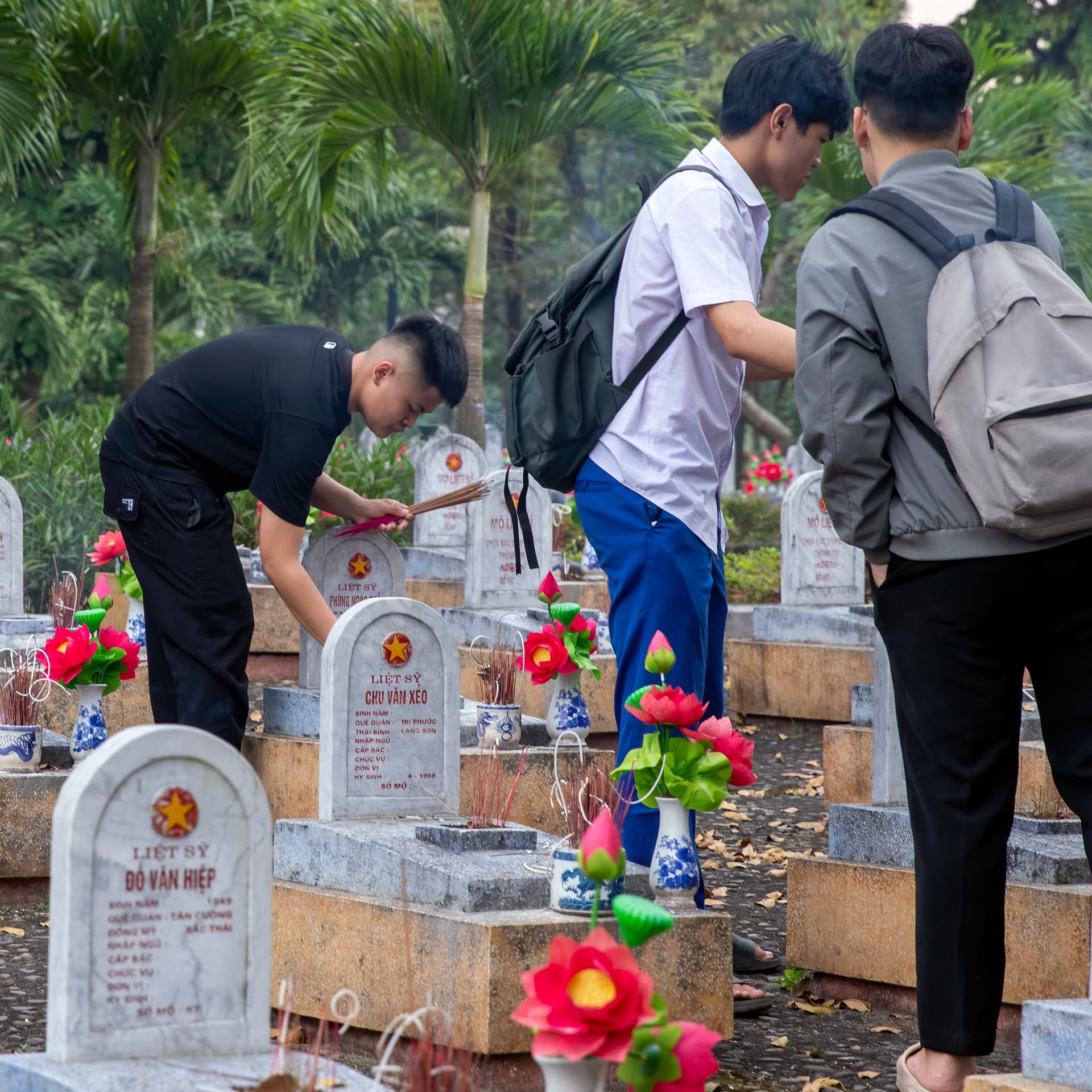
Post Reports
Decades of trust-building in Vietnam, coming undone by Trump
00:32:38
Fifty years ago today, the Vietnam War ended, starting a long journey toward peace and reconciliation between the two countries. Now that progress and U.S.-Vietnam relations are faltering under President Donald Trump.
Loading summary
Transcript78 lines
- [00:07]
Rebecca Tan
So we're in a commune in Gangchu province. There's a team right now. There was a call yesterday into the hotline that said that there was some kind of unexploded ordinance found in this commune. We're with the team that's trying to figure out what it is before they decide how to detonate it, how to get rid of it.
- [00:37]
Colby Ikowicz
I'm here with a translator, and she says the team has seven team members, one team leader, a deputy leader, a medical staff member, and 4D minors.
- [00:49]
This is Rebecca Tan, the post Southeast Asia bureau chief. She's with a group of D miners during a recent trip to Vietnam. These are people with a dangerous task. They respond to community reports of munitions and unexploded bombs from the Vietnam War. These bombs are still all over the region, even though the war ended 50 years ago. And what these D miners do is find those explosives and destroy them because they're still live. They can kill people.
- [01:26]
So I'm walking through a field to where the munition was spotted, which was at the bottom of a tree.
- [01:36]
Rebecca Tan
So we're just approaching, I think, what is the site? Let's.
- [01:45]
Colby Ikowicz
Is that it? Yes. Oh. Oh, nice. So the head of operations leads us over to where the munition is found and basically tells us that it's a rifle grenade.
- [02:00]
Rebecca Tan
Oh, okay.
- [02:03]
Colby Ikowicz
Some of the crew stay there and remove that grenade, which is being brought back to the demolition center to be destroyed. In the meantime, we head out with another team who has found a cluster munition in the middle of a field, and that can't be moved. It has to be destroyed on site. They have indiscriminate weapons. They'll kill everything around it, basically. So they have to be destroyed where they're found. So they build a little mound around the cluster munition and they surround it with their own explosives. And then they fan out in five different directions. They say, hello, hello, and they give out warnings. They warn people that an explosion is about to happen. So we back up about 200 meters away, and I set up next to the detonator, basically, and he begins to count us down. 10, 9, 8, 7, 6, 5, 4, 3. Jeez. You know, the process of getting rid of all of them, it's so laborious. It's so difficult. And, you know, talking to the de miners, it'll take 10 years more to even remotely make the province safe. So these weapons, these remnants of war, are very much present.
- [04:08]
Today. April 30th represents an important moment in history. On this day, 50 years ago, the US war in Vietnam ended. It was a war that left more than 3 million Vietnamese dead and killed more than 50,000 U.S. service members. The emotional and physical reminders of the war are still present all across Vietnam, from unexploded munitions like the ones Rebecca encountered to the residual effects of lethal chemicals like Agent Orange. According to Vietnamese authorities, there are more than 300,000 Vietnamese soldiers whose remains are still missing, and some 1200 US soldiers are still unaccounted for. Addressing these legacies has become a massive binational effort by the US And Vietnam in the decades since the war, and Rebecca says it's helped build peace and trust. That is, until this year, when funding cuts from the Trump administration changed everything.
- [05:09]
To put it succinctly, these efforts have been upended. There's a whole host of bilateral cooperation between the US And Vietnam areas that, you know, the two countries weren't able to work on closely together for many, many years. Those efforts have just been dropped entirely. It's a very complicated picture, but the overarching impact has been one of chaos.
- [05:38]
From the newsroom of the Washington Post, this is Post Reports. I'm Colby IKOWICZ. It's Wednesday, April 30th. Today, the fraying of Vietnam and U.S. relations 50 years after the end of the war. Rebecca, hi. Thanks for joining me.
- [06:04]
Hello.
- [06:05]
So, Rebecca, April 30th, it's an important.
- [06:08]
Unnamed Interviewer
Day in the legacy of the Vietnam War. Tell us what was going on 50 years ago on that date, what happened at the end of the war?
- [06:16]
Colby Ikowicz
So on April 30, 1975, that's when the North Vietnamese army, or what the Americans at the time called the Viet Cong, made their final push to capture the city of Saigon in South Vietnam. This triggered the panicked evacuation of thousands of U.S. personnel on American warplanes and the collapse of the South Vietnamese government.
- [06:39]
Unnamed Historical Narrator
Saigon, April 30, 8:00. The last American helicopter on the roof of the American Embassy prepares to lift off the last of the evacuees fleeing before the advancing Communist armies. Hundreds scrambled in panic onto any boats they could reach, not caring how they got aboard or what they left behind.
- [07:00]
Colby Ikowicz
It marked for what many today see as the end of the Vietnam war, which lasted 20 years and which was about a lot of things, but was rooted chiefly in this question of ideology, in this belief now denounced by a lot of people of the need for containment, that if Vietnam was allowed to become communist, it would trigger this series of events, this contagion that would eventually threaten America's Ability to be democratic. And what, you know, a lot of people now say was a needless war, was a war that was based on a false premise. You know, in the U.S. the Vietnam War was a major political issue for two decades in Vietnam, both North Vietnam and South Vietnam, it was hugely devastating.
- [07:53]
Steve Morrissey
Civilian deaths approached.
- [07:55]
Unnamed Historical Narrator
2 million civilians paid the highest price. Nearly 2 million of them were killed across Vietnam.
- [08:01]
Colby Ikowicz
We're talking about women, children, entire communities that were absolutely wiped out.
- [08:09]
Unnamed Historical Narrator
The US military sprayed millions of hectares in Vietnam with Agent Orange, a defoliant that turns thick jungle into barren wasteland.
- [08:22]
Unnamed Interviewer
So, Rebecca, you recently visited Vietnam on a reporting trip. Tell us why you went there.
- [08:28]
Colby Ikowicz
So, you know, we were approaching the 50th anniversary of the end of the war, which is, you know, a hugely consequential point for Vietnam, for the us, for the bilateral relationship. But apart from that, or I guess around that, there's also just been a lot going on in Vietnam. Trump's dismantling of usaid, of the US Institute of Peace, these have had huge ripple effects on Vietnam because of the joint work on war legacies. His trade decisions, his trade war has also had huge repercussions in Vietnam. In the last 30 years. Vietnam has created this highly export reliant economy, you know, largely in response to American coaxing. But that model of trade is now kind of existentially threatened by Trump's trade war. You see, all of this is happening and swirling as the country readies itself to remember 50 years since the end of the war in Vietnam. Even though this war is 50 years ago, it's hard to find people who don't have some kind of connection to the war. They had a grandfather, an uncle, a neighbor who fought in the war. But I also met a lot of Vietnamese veterans, and I spoke to a lot of Vietnamese veterans who fought directly in the war who are now in their 70s or 80s. And I think this is something that people forget as well. 50 years ago, yes, it's a long time. But the people who fought in that war are still very much alive.
- [09:56]
I mean, I was hoping you could.
- [09:58]
Unnamed Interviewer
Tell us about some of the people that you met and how people who lived through the war kind of remember and process it today.
- [10:06]
Colby Ikowicz
So I spent one afternoon in Hanoi with a retired general, Hong Kong Hong, who's also the chair of the Vietnam Martyr Family Support association, which is a group of several thousand volunteers who support the families of those who were killed in the war and who try to find the remains of those still missing. Does he mind if I ask him how old are you? And I spoke to him through an interpreter.
- [10:40]
Unnamed Historical Narrator
He was born in 1948.
- [10:43]
Colby Ikowicz
Born in 1948. So, General Hong, he's 77 now, and he was 17 when he joined the Vietnamese army in 1965.
- [10:51]
Wow.
- [10:52]
He, you know, he's got a full head of white hair. He's an old guy, but he's extremely sprightly, energetic. He spends all his time traveling Vietnam trying to raise funds for his association, and he feels very motivated.
- [11:12]
Unnamed Historical Narrator
We founded this association because of our emotion, our responsibility with the fallen soldiers.
- [11:26]
Colby Ikowicz
We talked for a long time, and the word that kept coming up was, you know, he felt haunted by the people that he saw who had been killed on the battlefield. His comrades, his brothers, he called them. There are, you know, some 300,000 or so Vietnamese soldiers who are unaccounted for, who've never been found. You know, their remains are somewhere across the country, presumably, but, you know, they've never been located. Just, you know, in the past couple of years, you know, some mass graves have been uncovered. People are using DNA technology to try to identify their relatives. You know, this work and then the anniversary, for a lot of people, it's brought to the surface these very painful memories from 50 years ago. You know, Vietnam for a long time focused on developing itself, on building its economy. It couldn't really afford to grieve, if that makes sense. But I felt while I was there that now there's a sense in opening for some of that. That grief to come out.
- [12:27]
Yeah.
- [12:28]
Unnamed Interviewer
I mean, for people who lost loved ones during the war, I imagine continuing to look for the remains of their loved ones is a way to kind of process that grief.
- [12:36]
Colby Ikowicz
Like I said, it's very slow, painstaking work. You know, it's trying to triangulate information from 50 years ago, trying to find out who was the last person to see their brother, where they were, how they died. Everyone that I talked to who was involved in this work talked about this concept of coming home, you know, that the souls are forever wandering the land unless the remains can be recovered and given a proper burial. And it's not just the Vietnamese who feel this way. They're relatives of American soldiers who feel this lack of closure, this lack of resolution as well.
- [13:19]
Unnamed Interviewer
How long have these kind of searches been going on and who's kind of behind who's funding these efforts?
- [13:27]
Colby Ikowicz
So the search for American soldiers has actually predates the search for Vietnamese soldiers. You know, even before US and Vietnam had diplomatic relations, had a commercial relationship, America had asked the Vietnamese government, Communist government, to help find its soldiers who were killed in the war. So this was in, you know, the early 1990s, and only more recently has there been an effort, I guess, to find the Vietnamese soldiers who went missing. And this is in part because of a lot of volunteer organizations. Vietnamese volunteer organizations have then received the help of what used to be the US Institute of Peace, which is a congressionally funded think tank and advocacy group that focuses on fostering peace in places of conflict. But it picked up this effort, I want to say, from five or six years ago. And they did so by connecting these Vietnamese groups to American veterans, to American archives. They flew American veterans out to Vietnam so that they could pinpoint. These were where we buried the bodies, basically.
- [14:36]
Unnamed Interviewer
Wow.
- [14:37]
Colby Ikowicz
And that work, again, it's slow, it's painstaking, but there was progress that was being made.
- [14:43]
And, Rebecca, when you were there, did you talk to anyone from the US who's actively looking for family members?
- [14:49]
While I was in Vietnam, I managed to connect with this guy, Steve Morrissey from Sun City, Arizona.
- [14:57]
Steve Morrissey
My father was a career Air Force officer, went to Vietnam three times, and on the 7th of November, 1972, is aircraft was left on a single aircraft strike mission in southern North Vietnam and never returned.
- [15:17]
Colby Ikowicz
He was in Vietnam in April to try to find the site where his father, who was in the American Air Force, he was shot down in 1972. He was there with the help of USIP. USIP had helped him organize this search. Basically, his mother had passed away a couple years ago, and he wanted to place his mother's ashes at the crash site to reunite his parents.
- [15:41]
Steve Morrissey
I know that at one moment when I was there, I wept a little bit, and I felt like I was saying to my dad, I brought her here. I brought her back to you, Mom. I brought you to dad.
- [15:57]
Colby Ikowicz
It was this deeply meaningful experience for him. As you said, he got to see maps and recognize his father's handwriting. He went to the bridge where he could kind of see in his mind's eye where the plane went down and where he lost his father. And he was able to have a little ceremony there.
- [16:16]
Steve Morrissey
It all came together in such a way that I felt like I understood what happened to my dad.
- [16:21]
Colby Ikowicz
But he, you know, described it as a kind of bittersweet moment because he might be one of the last families able to do that, because it's been, you know, dissolved basically by the Trump administration.
- [16:35]
Steve Morrissey
The United States is a great nation. We're the wealthiest, and at least we claim to be the most powerful nation on Earth. And it just seems so small and mean spirited. We've had this amazing experience, this healing experience that no other agency, this is what they're here for, is person to person diplomacy, reconciliation.
- [17:08]
Colby Ikowicz
After the break, Rebecca and I talk about how the US And Vietnam built back trust in diplomatic relations after the war and how those decades long efforts are falling apart. We'll be right back.
- [17:31]
Jason Rezaian
My name is Jason Rezaian and I am the director of Press Freedom Initiatives here at The Washington Post. May 3rd is World Press Freedom Day. Back in 2014, when I was the Tehran bureau chief for the Washington Post, my wife and I were arrested from our home. I was held for 544 days, almost a year and a half from the very first moment after my arrest. The Post was involved in trying to secure my release. Every day, journalists defend our democracy by holding power to account. My job is now to stand up for the rights of journalists in the United States and around the world, and especially those journalists who've had their voices silenced. I know what it is to lose a day or 544 of them of my life for the work that I do, and I don't want anybody else to suffer that fate. When you subscribe to the Washington Post, you support this kind of work. Learn more@washingtonpost.com subscribe I'm Jason Rezaian, and I'm one of the people behind the Post.
- [18:47]
Unnamed Advertiser
You listen because you know the power of good journalism and the Washington Post is there for you 24 7. When you become a Washington Post subscriber, you get exclusive reporting you can't find anywhere else. You also get sharp advice, columns, delicious recipes, TV and music reviews, and so much more. Right now, you can get all of that for just four $4 every four weeks. That's for an entire year. After that, it's just $12 every four weeks. And you can cancel anytime. Add to your knowledge and discover all the Post has to offer. Go to washingtonpost.com subscribe that's washingtonpost.com subscribe.
- [19:33]
Unnamed Interviewer
Rebecca let's take a step back and talk about how the US And Vietnam, after such a devastating war, were able to then kind of come together to work together to find people to demine bombs and kind of reconcile this really horrific past. How did that happen?
- [19:55]
Colby Ikowicz
This took decades of trust building. When the US first normalized relations with Vietnam in 1995, almost immediately after, the first things that the two countries were willing to work with each other on was war legacies. Some of this was out of necessity for Vietnam, for example, the first place they accepted international help and permanent international presence was in Quangxu, the province that I was in. And that's because that province in central Vietnam was so riddled with unexploded American bombs. There were literally hundreds, hundreds of people dying every year from these unexploded munitions. It was like the war had never ended there. Right. And they needed the help. And so that's where the first kind of formulations of US Vietnam Corporation emerged. Right. And the same with the US in the 1990s, it was facing a lot of pressure domestically to do more, to find the missing American soldiers, and they had to ask the Vietnamese authorities for help. So in order to kind of recover repair from the war, the two countries had to work together. And that cooperation is the basis of the bilateral relationship that we see today.
- [21:08]
Unnamed Interviewer
Hmm. What other kind of programs came out of these relations being restored?
- [21:14]
Colby Ikowicz
So there's the demining that started in the 1990s. There was dioxin removal, and that's the removal of these very toxic dioxins left behind by chemical agents like Agent Orange. This really only began under Obama. So it's fairly recent. There's support for the victims of Agent Orange, for the people who have disabilities, because. Because of the use of that chemical agent. And then there's the search for the missing soldiers. As this kind of corporation grew, though, on war legacies, the two countries have been able to work on other things together. On public health, on infectious diseases, on climate, on tech. In 1995, when diplomatic relations were restored, the US also lifted a trade embargo in Vietnam. And since then, there's been really a flourishing commercial relationship. And as recently as last year, I guess if you spoke to someone in December 2024, they would say that the US Vietnam relationship has never been stronger than it was at that point.
- [22:21]
Unnamed Interviewer
That all kind of brings us to today. President Donald Trump takes office, and immediately his administration has kind of slashed the federal government, especially foreign aid. How has that affected the US Vietnam relationships that we've been talking about?
- [22:41]
Colby Ikowicz
The impact has been hugely consequential in Vietnam. I spoke to over a dozen USAID officials and contractors who work in Vietnam. Usaid, of course, is the United States Agency for International Development. And before it was dismantled by the Trump administration, it had a huge, huge presence here in Vietnam, working on health and climate, but chiefly working on addressing those legacies of war. And I was able to review some documents as well about their work in Vietnam. So at least 34 of 43 USAID contracts with Vietnam have been dropped entirely. And there were 100 or so USAID employees, you know, a mix of staff and contractors who have all been terminated. There were, for example, two programs that were started immediately after Covid, you know, to try to stop the spread of infectious diseases from animals to humans. Those programs have been ended. And then there are the efforts to address the after effects of the war.
- [23:42]
Right.
- [23:42]
We've talked about some of it already. The demining, the cleanup of toxic chemicals, the search for the remains of Vietnamese soldiers. Those have all been thrown into uncertainty as well.
- [23:55]
So what do we know about the status of those programs? Can you explain, I guess, the limbo that they're in right now?
- [24:01]
It's a bit of a complicated picture. So the dioxin cleanup at a former American air base, Bien Hoa Air Base. This is a huge project that was started in 2019, $465 million or so it was given, supposedly, one of the waivers to continue operations. But we spoke to USAID officials who said that in actuality, progress on this is still stalled because Washington won't approve the release of funding to a contractor who needs to build a treatment plant for this toxic soil. So this is kind of extremely dangerous because this contaminated soil has already been disturbed. It's already been excavated, and it needs to be treated before the arrival of the monsoon season, the rainy season in Vietnam. The risk there being the toxins could go into the water, which then leads to a river that passes to Ho Chi Minh. On the demining, it was forced to stop for a month, then supposedly given a waiver, as the Trump administration does this review of aid programs. But the deadline for that review has come and gone without any official verdict. And the demining groups, the mine action groups, they say they need at least. At least 10 years more of funding at current levels just to make this one province, Quangxi, livable.
- [25:28]
Unnamed Interviewer
So you said the administration had reviewed some of these programs and offered waivers. I mean, has some. You know, the cuts across the federal government have been fairly indiscriminate. Has anyone in the administration talked about why it decided to do this or kind of, what? Have they understood the cost of what it means for Vietnam to have some of these programs slashed?
- [25:51]
Colby Ikowicz
I don't think so. I mean, like, the Trump administration hasn't addressed the cuts in Vietnam specifically, broadly, they've said that they're a burden to the American taxpayer. It's not something the US should be paying for. The issue with Vietnam is that, you know, that's quite complicated because of the US Role here. You know, these munitions, these chemicals, they were left behind by the American military. You know, the missing mass graves were dug by American soldiers. So I think the question of, you know, US Responsibility and involvement, it's a little bit more complicated in Vietnam than it might be somewhere else.
- [26:29]
And what about.
- [26:30]
Unnamed Interviewer
You mentioned trade relations. Obviously, Trump has proposed these across the board tariffs. How is the normalization of trade relations, which was such a turning point For Vietnam and US 30 years ago, how has that changed now?
- [26:47]
Colby Ikowicz
So when Trump initially issued his list of tariffs, he proposed 46% on Vietnam, which is one of the highest tariff rates for any country. And this was really received with shock and a sense of betrayal in Vietnam. There was a sense that, you know, the commercial relationship, the official relationship between the two countries had gotten so good that, you know, a tariff rate of 46% kind of wasn't possible. A lot of what was made in China moved to being produced in Vietnam during Trump's first trade war. And so it's actually since 2016 that that trade relationship has grown exponentially.
- [27:32]
Unnamed Interviewer
And, Rebecca, you mentioned a sense of betrayal over this 46% tariff on goods from Vietnam. Is there also a sense of betrayal that they would abandon some of these programs that were going to help clean up and reconcile from the war?
- [27:49]
Colby Ikowicz
Officially, Vietnam's government has been pretty muted on what they think about the aid cuts. They've expressed objection, but they've held back. And that's because they're in these negotiations for a trade deal, which they really need. It's kind of a question of survival for the economy. But in private conversations that I had with official advisors to the Vietnamese government, they said the Trump administration has managed in four months to generate a level of distrust toward the US that has not been seen in Vietnam in a really long time. There are questions about whether it's possible to continue on that path of, you know, on that long arc of reconciliation.
- [28:29]
Unnamed Interviewer
Has anyone taken this on as an issue and kind of pushed back on the Trump administration and said, like, no, these programs are really important to a relationship that we've built over the last several decades with Vietnam.
- [28:43]
Colby Ikowicz
So there's been some objection among, you know, Democratic legislators, but really, the voice, you know, that would have been the biggest kind of opponent to it is Senator Patrick Leahy, who is retired. He is a retired Democratic senator from Vermont who championed reconciliation with Vietnam. And he was the last senator to serve through the 1970s, when he retired in 2023. So I called him, and I could hear in his voice how kind of aghast he was. He told me that he Thinks Trump is making a colossal mistake. And that Trump quote threatens to sabotage 30 years of cooperation with a key partner. Another person that I spoke to, you know, her name is Susan Hammond. She's the daughter of a US Vietnam War veteran. She's dedicated her life to humanitarian work in Vietnam. She told me, you know, she felt like her heart was breaking for all the progress that had been made that was now being eroded in the span of a couple months, a couple weeks.
- [29:45]
Unnamed Interviewer
Yeah, Rebecca, I mean, given this new backdrop with Trump in office and making all of these changes and this really important anniversary, the 50th anniversary of the end of this devastating war, I mean, how are people kind of making sense of those two things happening at once? Right. Marking the end of the war 50 years ago, but also having to reconcile the fact that the US Is suddenly making things harder.
- [30:13]
Colby Ikowicz
I think it's, you know, this feeling of a huge shame. You know, there's a sense of irony to it, certainly, as well. You know, a lot of the programs that we talked about, they were expanded in anticipation of the 50th year anniversary. You know, maybe a particularly poignant symbol of the state that we're in right now. There was meant to be this joint first of its kind exhibition at the War Remnants Museum in Ho Chi Minh City to mark the 30th anniversary of the normalization of relations here. And if you've been to this museum in Ho Chi Minh City, it's basically a display of American atrocities. And so there had been this effort on the side of both the US And Vietnam to make a new exhibit that would bring the story forward, that would tell the story of cooperation and repairing the consequences of war. It was a great opportunity for the US to kind of update its image. Right. But that exhibition has been left in indefinite limbo because the USAID and the USIP officials who were in charge of it are no longer allowed to work. They've all lost their jobs.
- [31:21]
Unnamed Interviewer
So, Rebecca, what is your takeaway from all this? What does the future hold for relations between these two countries?
- [31:28]
Colby Ikowicz
So, you know, Vietnam is very pragmatic. Its government is. Its people are. You know, it will keep negotiating with the Trump administration. It will try to get the best deal possible on trade to prove for the Trump Organization to build a golf course in central Vietnam. It's approved for Elon Musk to expand Starlink operations in Vietnam. They'll do what they think will help. And the country has certainly also been through more turbulent periods of history than this. But there is something lost, qualitatively in the relationship between the two countries. There was an analyst I spoke to from the International Crisis Group, Huang Le Tu. And she put it like this. She said the relationship will become more transactional. It'll be about what I can get from you, what you can get from me. The sincerity that existed for a few decades will kind of be lost. You know, the sincerity of, you know, President Obama and Anthony Bourdain eating noodles on the side of the street, that sincerity will be lost. And overall, you know, the relationship will become, quote, unquote, shallower.
- [32:42]
Unnamed Interviewer
Rebecca, thank you so much for joining us.
- [32:45]
Colby Ikowicz
Thank you.
- [32:49]
Rebecca Tan is the Post's Southeast Asia bureau chief. That's it for Post Reports. Thanks for listening. Today's episode was produced by Ilana Gordon. It was mixed by Sam Baer. It was edited by Lucy Perkins with help from Maggie Penman. Thank you to Peter Finn and Emma Talkoff. I'm Colbykowitz. We'll be back tomorrow with more stories from the Washington Post.
- [33:28]
Unnamed Advertiser
Think about why you listen to podcasts. It's like having a friend who makes you think or can help you wind down right? Well, the Washington Post has a lot of people you can turn to at any hour. You can read the most important and interesting stories. We can help you cook something delicious, give you advice on a tricky friendship. Rave about a movie or book that you shouldn't miss. When you become a Washington Post subscriber, you have a companion for whatever part of your day needs it most. Get it all for just $4 every four weeks. That's for an entire year. After that, it's just $12 every four weeks. Weeks. Cancel anytime. Go to washingtonpost.com subscribe that's washingtonpost.com subscribe.