← Post Reports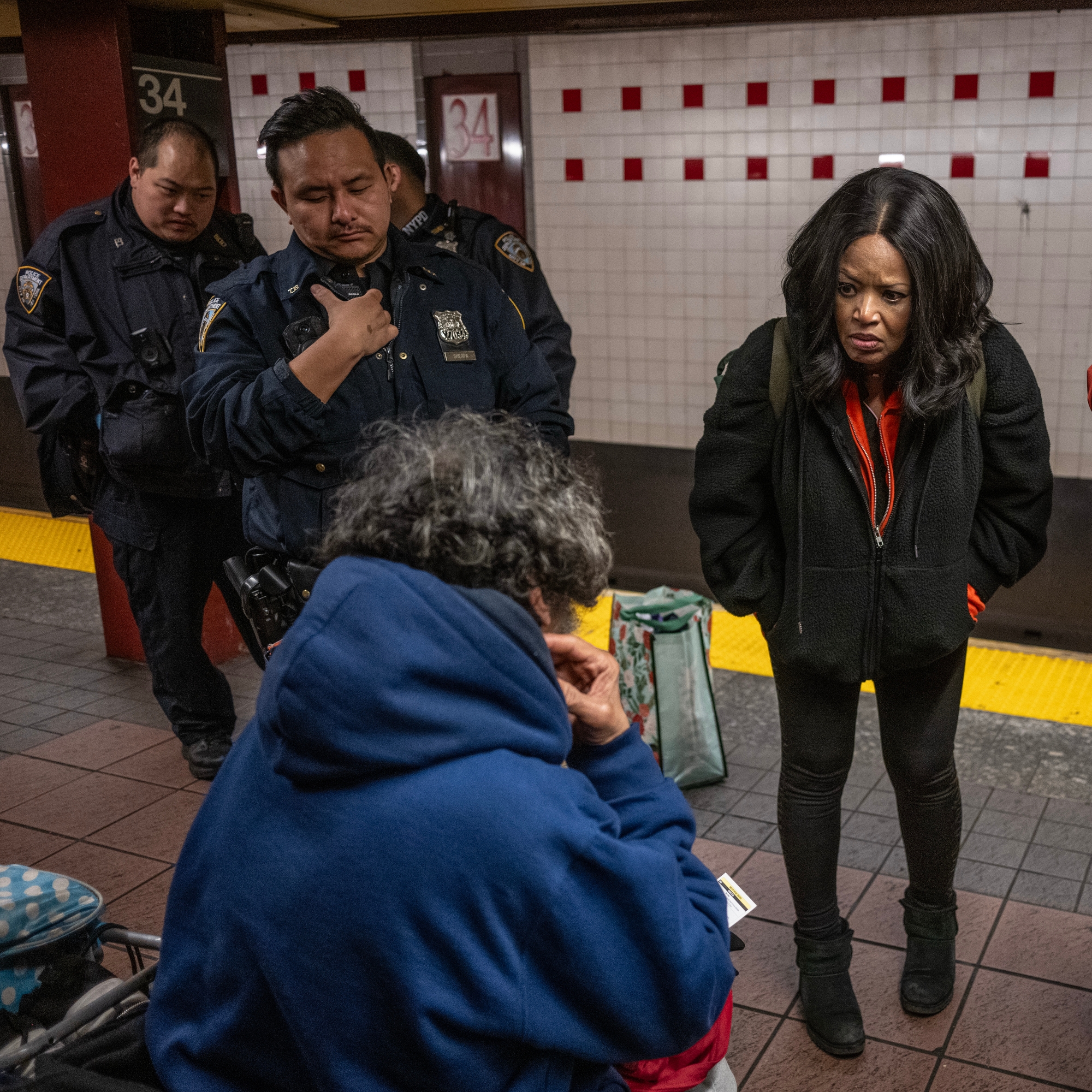
Post Reports
Deep Reads: The nurse in the NYC subway
00:27:02
As subway assaults rise and calls for safety increase, a psychiatric nurse must decide who is a risk.
Loading summary
Transcript1 lines
- [00:01]
Ruby Kramer
Hi, I'm Ruby Kramer, an enterprise reporter for the Washington Post. I wrote this story as part of our Deep Reads series, which showcases narrative journalism here at the Post. This is a story about a nurse named Lisa who works in the New York subway system. Lisa works nights and moves from subway station to subway station. Her patients are the people she meets on, on the platforms. They might be experiencing homelessness, drug issues, and a lot of them have untreated mental illness. It's very difficult work. She often has minutes to make her assessment before somebody walks away or steps onto a train. And it's all happening in a very chaotic environment. As you will soon hear, part of Lisa's work is deciding when to send someone to the hospital against their will. It's a controversial tool that the mayor and the governor in New York are trying to use more and more, and it's become the subject of a big policy debate in practice. As you'll hear in this story, a lot of the work is really one nurse trying to make the best and most humane decision she can. I reported this story in New York City. You'll hear me reading the story, and you'll also hear bits and pieces of sound from my tape recorder that I used while I was reporting the piece this spring. Okay, here's the story. The first thing Lisa Singh saw that worried her was the way the woman on the subway platform waved her off. The dismissiveness. Sometimes that was a sign of something. Lisa, a 53 year old psychiatric nurse, took a step closer and scanned the woman's face, searching for answers about what kind of care she might need. The woman was slumped over on a bench at the 34th Street Herald Square station, one subway stop in a city where the mayor, the governor, and now the president were all demanding a more forceful approach to the type of person Lisa was beginning to assess. She and the rest of her team, five police officers and two homeless outreach workers huddled around the bench. Lisa saw swelling near the woman's left eye and a bump on her head. She took out her phone and began taking notes. Soiled clothing. Malodorous. Several large tote bags. A container of raw rice that had spilled onto the platform. Hi, I'm Lisa. I'm a nurse, was how she usually began her clinical assessments. But the woman on the bench wasn't speaking English. I will just wait a little and I will go, she said in Cantonese as the team's NYPD supervisor, Captain Han Ji Liu, began to translate. The woman went on to say that it was morning, sometime around 8, that stores would be open soon and that she was waiting here because she had hurt her leg or maybe it was her foot, liu said. She wasn't being clear, she believes right now it's eight in the morning, lisa said, and asked the captain to try reorienting her to the fact that it was nearly 10pm Lisa had spent the past six months working overnight on the subway platforms of New York, where homelessness, mental illness, drug addiction and crime had been unfolding as overlapping crises. The estimated number of people living outside and underground has grown to its highest level on record, according to the city's most recent annual count. At the same time, while overall subway crime is down, assaults have tripled since 2009, which researchers interpret as a shift away from calculated crimes such as robberies towards spontaneous violence since Lisa had taken the job. A woman died after being lit on fire on an F train at Coney Island. A man was pushed into the path of an oncoming train in Manhattan, and other riders were shoved, punched and stabbed in unprovoked attacks. In response, the city had nearly tripled the number of nurses on staff at its Agency for the homeless and was sending more clinicians like Lisa into the subways with the power to order involuntary removals of people with mental illness and hospitalize them for up to 72 hours. The protocol was called a958, a shorthand for a section of the state's mental hygiene law, and Lisa could use it at her discretion to remove mentally ill people who couldn't meet their basic needs even if they weren't acting dangerously toward others. During her shifts from 8pm to 4am she had seen patients with obvious signs of acute psychosis. But more often Lisa encountered what she called the subtle face of untreated mental illness, with minutes to piece together a clinical picture before a patient walked away or disappeared into a train. Okay, lisa said to the captain. Her eye. Can you ask about her eye? The woman said in Cantonese. There's no problem. Lisa pointed to the raw rice and asked. She said she was eating it. The woman said. I don't have rice. Lisa thought again about her repeated references to it being mourning, which suggested the presence of delusions. How long had the woman been here? Had she arrived at 8am and been underground all this time, more than 12 hours later? Then there was the pain in the leg. Was it a leg or a foot? And the swollen eye and the knot on her head. Had she fallen? The woman was becoming agitated, her voice growing louder as people passing by began to watch. Do you know where you are? The captain asked as Lisa continued to take notes, another member of the team came closer to ask what she thought. Lisa said, I'm still trying to figure that out, but it's a 958. Soon after, two paramedics arrived and a collapsible stretcher clicked open in the middle of the platform. The woman said in Cantonese, I don't want to. Before a group of police officers struggled to lift her off the bench, the woman began to scream. The officers restrained her with handcuffs, a protocol they sometimes used, though the woman was not under arrest, and they managed to move her onto the stretcher, where a strap was secured around her waist. Help, the woman said in Cantonese. Help, she said again, this time in English. As another train screeched on the tracks, a man played the drums and an emergency exit alarm went off. So much noise. And now Lisa heard another voice, one of the paramedics, saying to the woman on the stretcher, I'm sorry. I'm sorry. I hate that I have to do this to you. I'm sorry. It's not my decision. The decision had been Lisa's alone. Of all the people standing on the platform, only Xi was certified to call a 958. And she was used to the reactions by now. When Lisa joined New York's homeless outreach effort in September, Donald Trump had already released his campaign plan to restore order to America's major cities, describing them as unlivable, unsanitary nightmares. He promised to bring back mental institutions and relocate homeless people to tent cities on large parcels of land. Now his administration was projecting cuts to half the staff of the Department of Housing and Urban Development, the federal agency that oversees homelessness. And his transportation secretary had threatened to pull federal funding from New York's transit system if the Metropolitan Transportation Authority didn't provide data to prove it had a plan to decrease crime. Lisa's team was supposed to be one answer to the problem. The NYPD's chief of transit, Joseph M. Gulotta, whose officers worked alongside Lisa on the same outreach program, had described their work as, quote, finding the next person who's going to push someone onto the tracks before they do. The city's mayor, Eric Adams, had been pushing for more involuntary removals from public spaces since the early days of his administration in 2022, when Michelle Go, a 40 year old woman, died after she was pushed in front of a train by a homeless man with schizophrenia. Now the governor, Kathy Hochul, was trying to expand involuntary care, too, setting off a debate about whether the kind of work Lisa did was humane and compassionate. Or inhumane and ineffective. Lisa had spent years as a nurse in a psychiatric emergency room, so she knew how difficult it could be to treat schizophrenic or bipolar patients who couldn't always advocate for themselves. She also knew that homelessness worsened every condition, both medically and psychiatrically, and that the risk of walking away from someone with mental illness who might need critical medical care often outweighed the discomfort she felt about forcing that person to go to the hospital. Back in an NYPD van at the start of another shift, she arrived at her next stop, a station on 47th Street. With the bag of clean socks she liked to carry under her arm, she approached a man with three carts of belongings and a tarp on the floor. An officer on her team said, we have a nurse here. I don't need a nurse, the man replied. By now, Lisa had called dozens of 958s and learned how to gauge the extreme circumstances that one required. She looked down and noted the tarp and the galoshes the man wore on his feet, preparations he had made for the rainy weather outside, and a clear sign of his self orientation. Whatever was going on in the man's life, this was not a 958. Back into the van and on to another station. Lisa walked along the platform where a woman sat under a blanket and said, get out of here. Lisa said, I'm a nurse. The woman said again, get out of here. Lisa said, so what about shelter services? Get out of here. Get out of here. Later, the homeless outreach worker paired with Lisa that night, Kvar Middleton, who was 39 years old, saw the woman again in another part of the station, wandering near the edge of the platform. She was just leaning over a little bit. I don't know, Middleton told Lisa. She was just leaning over. So I'm just saying I'm just keeping an eye on. Wait, wait, wait. Lisa said, wait, wait, wait. Leaning over. What? She was just looking to see what we were doing. She was just looking to see what we were doing, Middleton said. But before they could decide whether to check on her again, they heard yelling in another part of the station. They followed the sound upstairs to a man shouting near the turnstiles, and once the team had spoken to him, the woman was gone and there were other stations to check. Check. Back in the van and out again at 53rd Street. This station was empty and quiet. The team walked down the main hall and came to a halt at the top of a staircase leading to the next platform. Middleton said, all right, so down here sometimes there's yeah, yeah, lisa said, already knowing the spot he was trying to warn her about. Around the corner and down the stairs, they reached the platform for the queensbound E train. Syringes lay on the ground between the rails. The area was empty except for an oversized umbrella propped open against the wall, concealing whatever was beneath it. Lisa moved closer to try to see as one of the police officers asked, what's going on, guys? But underneath there was only one man who said loudly, don't talk to me. Don't say S to me. Five NYPD officers stood near him on the platform, and the man began to speak even louder. I said, stay away from me. That's it. I said, stay the f away from me. That's it. Lisa took a step forward and locked eyes with him. She said, sir, I'm a nurse. My name is Lisa. He said, can I go to the train? She said, can we help you with shelter? The man said, no, you cannot help me with shelter. No offense. Being surrounded by cops right now isn't making me feel any more comfortable when I'm just sitting here as a homeless person trying to get out of the rain. Lisa said, okay, I think. But you're not thinking. The man said even louder. You're putting me in danger right now. Your thinking is not putting me in a safe place. You're putting me in danger right now. Okay, lisa said. The man went on, you should understand exactly where I'm coming from. He walked a few steps down the platform, but the only exit was in the other direction, past where the team was standing, looking at Lisa as he spoke. The man said he had been abused by police officers in the past. He said he didn't want to be here, but he couldn't go upstairs because he was disabled and this was not an accessible station. I'll get on a train. This is the safe place for me to go. I'm handicapped. I can't go up the stairs. That's it. I'm gonna go on the train because that's the safe place for me to go. He said before he began to yell, that's it. I know my law and I know the police. I know my law. I know my reasons why I have every right to get on the goddamn train. Lisa took a step closer to him. She noticed one of the officers on her team looking at her like, lisa, just say the word. But she turned back to the man. She could see that he was making unbroken eye contact with her. She could also see that he was intent on trying to get his point across that spoke to his self awareness and his need for safety. And maybe even his need for connection, she thought. So she made another small step toward him, not so close as to make him uncomfortable, but close enough that she hoped it would let him know that she wasn't someone to fear. This was not a 958. Instead, Lisa listened as the man went on, his voice getting quiet again. He said, I wouldn't have outbursts if I wasn't surrounded by cops right now. Lisa said, I understand. So leave me the f alone, ma'am, and stay the away from me. I understand, lisa said again. Would you like a pair of socks? Sure, ma'am, I'll take a pair of socks. Do you want gloves, too? Sure, ma'am, he said. Got another train coming in, one of the police officers said. They stood in silence until the E train arrived. This is a queenbound E train. The next stop is Lexington Avenue, 53rd Street. The man stepped on board and the doors closed behind him. I feel like I've talked to him before, lisa said after the man disappeared, leaving her wondering whether she had made any kind of positive impact in the short time they had stood on the platform talking. Where did the man go? She had no idea. Maybe he got off at the next stop, or maybe he kept riding east to the edge of Manhattan, over the east river, into Queens, all the way to the end of the line. There, at the Jamaica center station, another effort was underway involving six MTA police officers, five NYPD officers, one cleaning crew, three homeless outreach workers, and another nurse. This team stayed in one place on the platform from midnight until 5am where they had seen drug overdoses, psychotic breaks, and, just a few months earlier, two people found dead on arriving subway cars. All right, an officer said at the start of a shift. This is an up and out operation. This is an up and out operation. A train pulled into the station. The doors opened up and down the platform. The officers moved in pairs, stepping in and out of cars, rousing people. Outreach workers trailed close behind, trying to coax them into shelter for the night. Make sure everybody's up and awake and alive, an officer said as the cleaning crew began to sweep and mop the floors of each car. Soon the doors closed, the train left, a new train arrived, and the routine began again. It was one more effort in a system of 472 stations and only so many outreach teams whose effectiveness was being measured on a daily basis. Every time there was a 958, whether from the end of the line or from Lisa, the details of it filtered back to a joint command center at the city's Street Homelessness Division. There a report was assembled and disseminated more widely across the city government and including to City hall, where it eventually landed in the inbox of the mayor's senior advisor on severe mental illness, Brian Stettin. Stettin scanned the reports every morning and inputted the details of each involuntary removal into a spreadsheet on his computer, trying to monitor outcomes as best he could. He tracked the length of each hospital stay where patients were supposed to receive a psychiatric evaluation and medical care, and the outreach team assigned a follow up on each case on the order of a physician. Some patients were admitted for long term treatment, but most were discharged, and that was where the spreadsheet ended. Lisa didn't know what happened to her patients after they left the hospital. Her concern was the short time she did have with them. Her body language, the calm tone of her voice. She had trained herself to send one message out into the noise and chaos of the New York subway system. No judgment whatsoever, she said one night before the start of another shift. That was what she had been trying to figure out how to convey since she was a young nursing student. In those days, Lisa cried when she read case studies in class and thought about hugging all the patients in the stories. Once she began working as a nurse, she learned that allowing herself to get teary eyed meant she was going to miss something about the patient in front of her, and hugging, like any form of touching and nursing had to be handled cautiously. In the hospital where she worked, she found that every assessment had a social element to it. That was where the stories came out. Past traumas, hard childhoods. Lisa's father was Indo Guyanese and her mother was Puerto Rican. She had grown up feeling ostracized by both sides of the family. She didn't look Indian and she didn't speak Spanish. In time, she came to understand it as the reason she gravitated towards marginalized patients. And when she saw an ad for a nursing job next to the words homeless outreach, she applied right away. It was only at her orientation that she learned she would be doing involuntary removals. The first time she had to call one, she had been horrified. Not because of the decision she had had to make, but because she had almost missed the severe infection on the man's leg and the explanation he had finally given for it. Oh, don't worry about it, he had said. It's because the cell phones are zapping me. After cases like that. She asked herself, what if we had left him there or if we missed him or we were short staffed. What could have happened? Then there were the cases that she knew the police officers on her team were looking for the man on the Lower east side who had a record of more than 100 arrests, some of them for violent crimes, and told Lisa, quote, I'm a killing machine. Did the job scare her? Sometimes it did. Mom, be careful, her three sons sometimes told her before she went to work. Don't stand next to them. Have the police between you and them. Lisa hadn't told them that most of the time she was the one leading the conversations on the platforms and that she often liked to stand close because fear was never the emotion she wanted to convey. Lisa said, love is such a huge motivator. I think it's the number one motivator. I don't believe that fear is the Next time Lisa returned to the station at 34th Street Herald Square, she saw a man she recognized from two weeks earlier. He had white hair and had positioned his wheelchair in a small alcove overlooking a network of ramps and staircases down below. Same spot as before, she said. I'm Lisa. We met before a couple weeks ago. The man said. No. Lisa nodded. Okay, she said. The man's voice was alert and steady, just like it had been the first time she had seen him. But his condition looked worse, his clothes more soiled, Lisa thought. She watched as an officer held out a bag of bottled water and snacks and the man shook his head. Lisa asked him, when was the last time you ate? He said, I'm not hungry. I'm alright, really. How long have you been here? Not long. Do you feel like hurting yourself or anyone else? No. Where are you going tonight? A friend's, Lisa said, okay. I'm thinking that maybe we can get you someplace to rest, to sleep, to eat, to shower, and the next day you can think about. I'm alright, he said. I'm all set. Lisa scratched her head and held up a hand, gesturing for the man to bear with her just a few moments longer. She asked, is there anything you want to tell me? No. The man said, nothing. By now the outreach worker paired with Lisa and a few police officers had begun to walk away. Lisa bent down closer to the man. She said again, my name is Lisa. What's your name? He told her, and she said that he looked a bit worse than when she had seen him last. He said, don't worry. I promise. She asked him if he knew what day it was. Surely, he said, and he told her. He added, and the President of the USA Trump. Lisa took a step back and nodded. She said, I understand. You're telling me you're okay? She told him to take care of himself and then turned to catch up with the rest of her team, following them down a ramp and onto another platform. This one had tracks on both sides and large pillars every few hundred feet, obstructing the view. Most of the team was already ahead, leaving Lisa with one officer. They navigated to a narrow stretch of the platform where a crowd of people stood waiting for the next train. In the crowd, Lisa noticed a man looking at her with an intense, wide eyed gaze. A moment later she saw him lift his finger to his throat, move it from one side to the other in a slashing motion, and then point at her. Lisa stopped walking and reached for the officer in front of her, tapping his shoulder with more force than usual. She nodded in the direction of the man and saw him make the movement with his finger a second time. Here was the danger that people feared occurring right in front of her. She scanned the platform. There were people standing close by. There was a garbage can obstructing the space, a train set to arrive at any moment, and not enough police officers to handle an involuntary removal. That was what would have to happen. The man had made a homicidal gesture, an automatic 958. Sir, Lisa said, trying to make her voice sound calm like she usually did. You did something, the man said quickly. I didn't. It's just an observation. You're not in trouble, alright? The man mumbled something in response, but Lisa couldn't make out the words. She said, it's okay. My name is Lisa. I'm a nurse, so I want to help you, alright? Do you feel like you want to hurt yourself or anyone else? The man took a few steps back, but Lisa and the officer moved closer. A blast of warm air hit the platform and the train came rushing onto the trail tracks a few feet away. The train doors opened, people stepped inside and others stepped off as the rest of the police officers stepped through. The crowd, surrounded the man, and placed him in handcuffs. Lisa said, you did something across your neck to me. The man said, I didn't do that to you. You did it twice. She said, and then trailed the officers as they moved the man back up the platform, around a pillar, and through another crowd of people toward an elevator. The doors opened and they all stepped inside. It was a small elevator. Lisa and the man stood with their faces inches apart. The doors closed. The elevator began moving. Lisa took a breath. She said, we're gonna get you help, okay? This story was reported and read by me, Ruby Kramer. The audio was produced with original music by Bishop Sand. I'm Molly Roberts. And I'm Drew Goins. Each Friday on Impromptu, we talk through the questions we can't stop thinking about. Do we need to rethink how much we drink? Why are companies really asking workers to come back to the office? Does boycotting a business actually work? Should we quit social media? We're here when the news gets personal and the headlines hit home. Join Molly and me every Friday on Impromptu. From Washington Post opinions. Find impromptu wherever you get your podcasts.