← Post Reports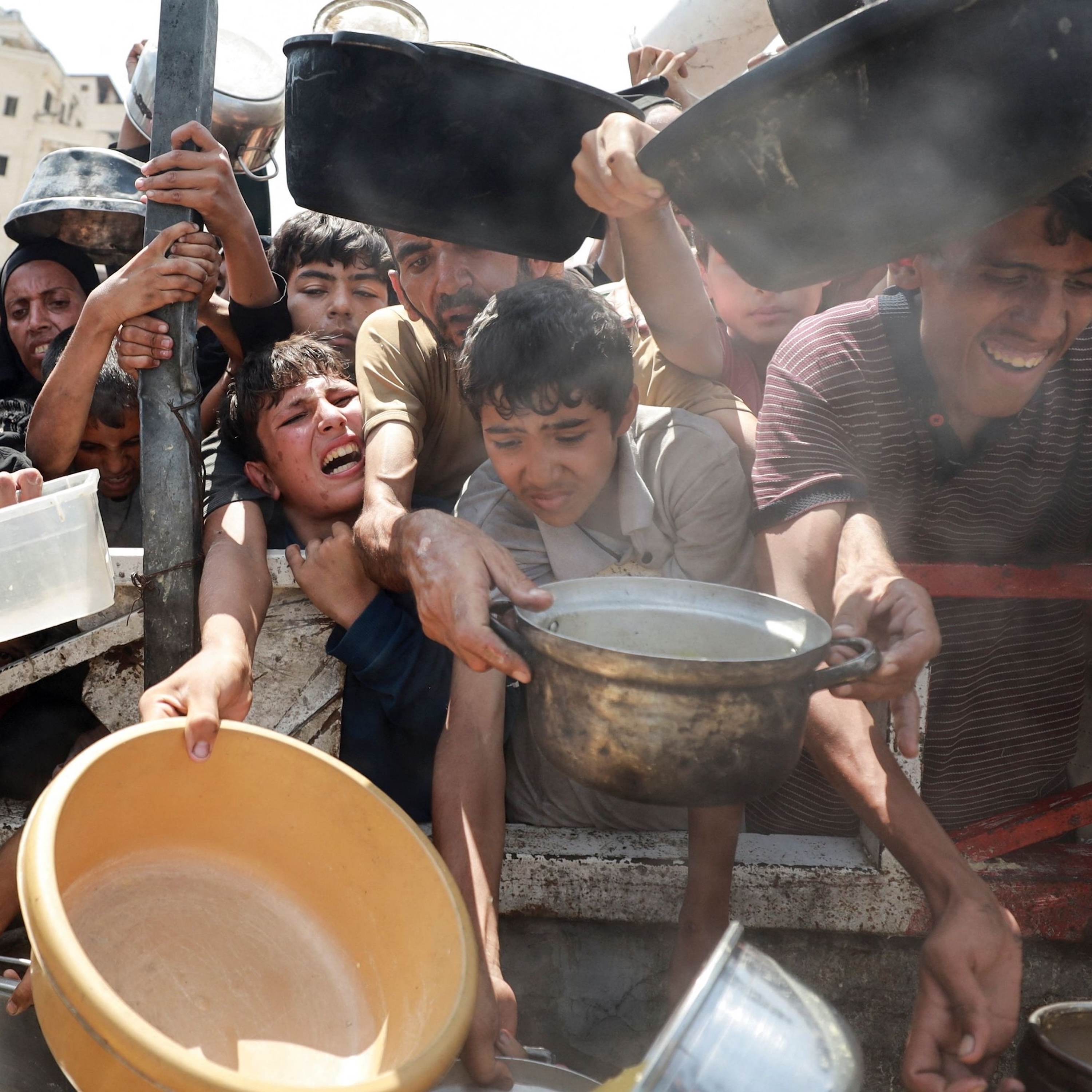
Post Reports
Gazans are starving. Will aid get in?
00:22:37
Despite aid being allowed into Gaza over the weekend, the hunger crisis continues. Louisa Loveluck explains how we got here.
Loading summary
Transcript52 lines
- [00:03]
Colby Bjekowicz
The hunger crisis in Gaza is getting worse. The United nations estimates that nearly one in three people in Gaza are going multiple days without eating. Hospitals are reporting rising deaths from malnutrition. A pediatrician named Fida Al Nadi, she recently told the Post that she herself has been struggling to provide for her kids. Her daughter just turned five.
- [00:24]
Louisa Lovelock
She wake this morning and asked me.
- [00:27]
Colby Bjekowicz
For a cake for her birthday, but I cried.
- [00:31]
Louisa Lovelock
Really? We have no adults to do any cakes in here. There's no flour, no eggs, no sugar. Nothing, nothing, nothing here. You can say.
- [00:47]
Colby Bjekowicz
International pressure has been mounting on Israel to lift its near total block on aid. On Sunday, Israel did start to allow in more aid, but it's really minimal.
- [00:58]
Louisa Lovelock
The trucks and aid drops coming in are a momentary reprieve. The need far exceeds it.
- [01:07]
Colby Bjekowicz
From the newsroom of the Washington Post, this is Post Reports. I'm Colby ekowitz. It's Monday, July 28th. Today I turn to my colleague Louisa Loveluck, a foreign correspondent for the Post. She's been reporting for months about the growing humanitarian crisis in Gaza and what the future holds. Louisa, thank you so much for joining us today.
- [01:33]
Louisa Lovelock
Thank you.
- [01:34]
Colby Bjekowicz
So, you know, we've been hearing about a humanitarian crisis in Gaza since the start of the war, but it seems like in recent months and weeks and even days, it's just been getting worse and worse for the people in Gaza. How has it been getting worse?
- [01:52]
Louisa Lovelock
Well, we've been hearing since the start of the conflict that if large amounts of food aid were not allowed into Gaza, then it was likely that malnutrition would rise and ultimately people would starve. And we've reached something of a tipping point. In the last week or so, we've started to see an alarming number of deaths from starvation. Conversations with our sources are never easy at the best of times. The situation has pretty much been terrible since the very first day of the war. The. But in conversations this week, particularly with doctors, particularly with people who have a bit more standing in society, who sometimes have a bit more money, a bit more access to resources, we've found that even they are struggling to function. Please forgive me one minute because I talk to him.
- [02:38]
Colby Bjekowicz
Oh, of course. I'm so sorry. I'm so sorry.
- [02:41]
Louisa Lovelock
Eyad Amawi, who's the doctor of the Al Aqsa Martyrs Hospital in Deir El Bala, that's in central Gaza, told my colleague Miriam Berger that it's hard for doctors to do their jobs right now. So the weakness we feel is also affecting our activity at all, not just with our patients. Or our case workers or our distributions, we cannot. So what he's saying here is something that we've heard from a growing number of doctors. It's that they're simply so hungry during these long shifts that they find it quite hard to keep going themselves. We've had people talking about how they're having to sit out part of the night shifts because they simply can't stand up and, and people have even fainted inside the wards. Woo.
- [03:21]
Colby Bjekowicz
So what else have you heard from doctors in your reporting about the other consequences that they're witnessing with their patients?
- [03:28]
Louisa Lovelock
When a person is malnourished, it makes it harder for their bodies to recover from injuries. There are tens of thousands of war wounded in Gaza today. And when we talk to their doctors, we're hearing that people are starting to be readmitted because their healing has gone so badly, that wounds have opened up. Sometimes they become infested by maggots and people have even died where people are not eating for days at a time. Even patients inside the hospitals, their bodies just can't do the things they need to do. And then leading on from that, we also have the ripple effects that we're going to see through the generations. When a mother is malnourished, a child is heavily affected. When a child is malnourished, their growth, their psychological development is heavily affected. The elderly appear to be dying younger because of a host of things relating to this blockade. But time and time again, every juncture of life in Gaza, if people are not being killed by war injuries, by traumatic violence, they're being eaten away at by the lack of food.
- [04:34]
Colby Bjekowicz
And I imagine you also are talking to aid agencies that, you know, have a handle of the crisis. How do they describe what's going on in Gaza?
- [04:43]
Louisa Lovelock
Well, they describe it in more serious terms than anything we've heard or conflict. And that is saying something. This is a conflict where people talk sometimes about exhausting hyperbole. Things have got worse than one could imagine time and time again. And this is yet another example of that. The Gaza Health Ministry said Monday that 14 more people had died of starvation in the previous 24 hours. And that brings the total number of those killed by hunger to 147 since the start of the war. The International Rescue Committee, they said Wednesday that their teams had reported an increase in the number of children being rushed to hospitals because of malnutrition, for example. And almost every charity we speak to has some version of that. In fact, medical aid for Palestinians. Just before we started speaking, they said that half of Pregnant women screened in their clinics turn out to have malnutrition.
- [05:33]
Colby Bjekowicz
Which of course then, you know, has serious impacts on their babies.
- [05:38]
Louisa Lovelock
Right. And for the rest of the life of the child.
- [05:40]
Colby Bjekowicz
Right. I mean, Luisa, the images that I think that have stuck with me and probably stuck with most people are the ones we see of children, babies with descended bellies. I mean, are children bearing the brunt of this?
- [05:56]
Louisa Lovelock
If we look at the numbers of deaths from malnutritional starvation, they certainly seem to be. Of the 147 people who have died thus far, 88 of them were children, according to the Gaza Health Ministry. And there are many reasons for this. Children, you know, they're small, they're still developing. And one of the things that has come up time and time again in our reporting is the near total lack of baby formula that a lot of families have. Families are bartering online. They are trading what little they have left for baby formula for their kids to keep them alive in some cases. And we did speak to the aunt of a two month old recently who said they'd no longer been able to afford it and the baby had died.
- [06:47]
Colby Bjekowicz
Louisa, how did we get here? You know, when again, it's been a humanitarian crisis for a year and a half? It's. We've all seen the horrific images out of Gaza, but again, in the last several months, it just seems to be at a completely different level. Can you kind of walk us through the chronology of how we got to this point?
- [07:08]
Louisa Lovelock
Yes. So we started this year with a ceasefire. And during the ceasefire, there were about 400 aid distribution sites every single day being operated by the United nations across Gaza. And that meant that where malnutrition had been increasing in the past, there was some work done to alleviate the crisis. But then on March 2, Israel unilaterally broke that ceasefire. It reimposed the blockade, and that really is where the roots of this new crisis begins. Israel did partially lift the blockade in May after Israeli Prime Minister Benjamin Netanyahu said that pictures of mass starvation could cost his country the support of the United States and other allies. But the amount of aid that's got in since then is very small. And of course, the situation being as bad as it is, the displacement crisis being as bad as it is, meant that people were already vulnerable. It just made everything get much worse much quicker.
- [07:59]
Colby Bjekowicz
I want to try and understand what Israel's thinking has been behind limiting aid into Gaza. But let's first continue this chronology of what has happened so far. I mean, beginning in May, with this partial lifting of the aid blockade, I think critics would say that it hasn't been sufficient. And from what I understand, it's also been incredibly controversial because it's gone through a US registered organization called the Gaza Humanitarian Foundation. Could you tell us about that organization?
- [08:30]
Louisa Lovelock
The Gaza Humanitarian foundation is a private company which has been set up by former US intelligence and defence officials, by American businessmen, and in close collaboration with the Israeli authorities. It is effectively a model of aid distribution that has been created to replace, to sideline and to phase out the United nations in Gaza. And what we have to remember is that the roots of the tension between the Israeli government and the UN go back a long time. They predate this war. But they have become particularly difficult during this conflict. Early on, the Israeli government accused the UN Agency for Palestinian Refugees of having a number of its staff involved in the Oct. 7 attacks, causing the agency to fire nine accused among 13,000 of its employees in Gaza. And Israeli officials have repeatedly condemned the UN as being a voice that they describe as anti Israel. The un, for its part, has been front and center in putting out statistics, putting out information about what is happening on the ground in Gaza. And in the last week or so, the top UN official in Gaza, well, his visa was not renewed by Israeli officials. That means he will not be coming back. And that is a sign of where their relations are right now. So enter ghf. GHF has a very different model of distribution. It has a model that is, critics would say, easier to control. The aid is distributed inside Israeli controlled zones. The problem with this is that for the most part, these are combat zones. These are places where Israeli soldiers are stationed and where they have repeatedly opened fire. Aid agencies had warned for months that this plan, if it did come to fruition, would lead to people being killed. A UN briefing paper from several months before predicted that Israeli forces may open fire on the crowds to use crowd control. And that is effectively what we've seen. Ghf, for its part, says that it has repeatedly appealed to the UN and to other aid agencies to join it to make the model better. But the UN in particular says that it won't because it fundamentally disagrees with the model of distribution and it considers it deeply unethical.
- [10:57]
Colby Bjekowicz
So how does their model actually work? I mean, how do people in Gaza find out where this aid will be and when it will be given out? Is there any order or structure to how it's distributed?
- [11:09]
Louisa Lovelock
So these announcements are being put out on social media the night before and a distribution site opens. Usually there are four in Gaza and there will be a time that is put online. People will be told to come. They will be told to come in an orderly fashion. They will be told to respect their hours of operations. But because this aid is first come, first served, and frankly, because people are completely desperate, they are gathering hours ahead of time because they want to be at the front. They want to be actually carrying something home to their families that day. And so this is where a lot of the problems have come. People have been gathering hours ahead of time, during which a lot of the soldiers stationed in the area consider these areas to be a combat zone. They see people in the area, and testimonies from Israeli soldiers published by the Israeli media suggest that they have therefore believed them to be militants. Sometimes commanders have even given orders to control the crowds by firing around them. And this is where the deaths have started. So thousands of people have been gathering before the sites open. And according to local health authorities, more than 1,000 people have been shot dead as they wait for aid, most of them close to these GHF sites.
- [12:23]
Colby Bjekowicz
Do we have confirmation that Israel is shooting into these crowds? Has Israel taken, you know, responsibility for these deaths?
- [12:33]
Louisa Lovelock
What the Israeli military has done is put out a number of statements saying that they've opened fire with warning shots, and sometimes they've said that, as I quote, suspects continued moving towards their positions. They then started firing towards the people. From their perspective, these people are framed as potential suspects, people who might be coming to attack them. And this. This is where critics of the program will point to the militarized nature of the distribution sites as the big problem. Under normal humanitarian protocol, you don't have people with guns around these aid sites. You don't have this sort of combustible situation of young soldiers, young reservists who aren't used to dealing with crowds of people. They're there to fight a war in very close proximity to desperately hungry people who are running as fast as they can to get to the aid site.
- [13:29]
Colby Bjekowicz
How has Israel talked about its decision making? Its, you know, the decision to limit aid so severely to the point that so many people in Gaza are starving?
- [13:40]
Louisa Lovelock
Israeli officials have tended to justify it by essentially arguing that they're starving out Hamas. They're pressuring the group to release the remaining hostages that they hold in Gaza?
- [13:49]
Colby Bjekowicz
Yeah, Luisa, to that point, I imagine that a lot of people feel that to some extent, you know, Hamas is the one that's responsible here. If they were just to release the hostages, that this would all end. I mean, what do you make of that? And of the allegations we've heard that Hamas is the one that's been taking the aid that is actually meant for Palestinians in Gaza.
- [14:09]
Louisa Lovelock
That's a very good question. Israel has cited Hamas's culpability in diverting large amounts of aid since the start of the conflict. And when we see these pictures of people malnourished or starving in Gaza, the response of the military and of Israeli officials is very frequently to say no. This is because Hamas is taking everything.
- [14:29]
Colby Bjekowicz
And is there evidence to the claim that Hamas is doing this?
- [14:32]
Louisa Lovelock
In conversations we have had with Western officials, some of whom have been trying to independently vet these claims, they have said that while these claims have been made throughout the conflict, they have never been presented with any meaningful evidence from the Israeli officials they deal with that. There is wide scale diversion. They say, of course, this is a war. Sometimes there will be things that Hamas or other militants are able to pick up. But the wide scale diversion, which is at the crux of why the United nations, for example, is being phased out of a delivery in Gaza, they are being accused of having a method of distribution which allows widespread diversion. We understand from Western officials, Israeli officials just have not presented the evidence for thus far.
- [15:16]
Colby Bjekowicz
How has Hamas responded to these accusations?
- [15:19]
Louisa Lovelock
I mean, they completely deny it. The Israeli government certainly points to the fact that when pictures of starving children are front and center in the media that Hamas benefits. Hamas certainly publicizes them. It certainly criticizes the Israeli government and says, you know, that it's their fault. But at the end of the day, it is a starvation crisis that is man made. And regardless of who is using it for what political talking points, it is real. And yet again today we have the deaths from starvation. They are happening regardless of who benefits.
- [15:58]
Colby Bjekowicz
After the break, how the world has reacted to starvation in Gaza and how Israel is responding now. We'll be right back.
- [16:17]
Emily Davies
My name is Emily Davies and I cover the federal workforce and Trump administration for the Washington Post. I think journalism at its best is a conversation with both readers and with sources taking what we learn from people who are in powerful positions and sharing it with people who care. A story I wrote that resonated widely was about a federal worker who lives in upstate Michigan who voted for President Trump and was later fired by him as part of his cuts. The story got inside of her head how she was reckoning with her own vote and how the choices made by the candidate she believed in were hurting her life. And I think that story helped people understand how directly and personally people can feel the effects of decisions made in Washington. Working for the Washington Post means being in the center of the stories that matter most. Subscribers support this work learn more@washingtonpost.com subscribe I'm Emily Davies and I'm one of the people behind the Post.
- [17:23]
Colby Bjekowicz
So then, Louisa, over the weekend we. We saw that Israel began allowing more trucks of food aid into Gaza and it resumed power to a critical water treatment plant. What happened? What changed?
- [17:35]
Louisa Lovelock
Well, I think what happened over the weekend was we reached a crescendo of international interest in pressure in what was going on in Gaza. You know, these pictures of emaciated children were on the front, were front and center, front pages across the US across Europe. And so the Israeli military has come out and said it's changing course. They've said that there are going to be aid drops and those have begun. They've said that more trucks are going to be allowed into Gaza, but we don't really know at this point how much of a difference that is going to make. We know, for example, today that 100 trucks worth of supplies were collected from the border, some of them already looted by hungry crowds. But it was previously an average of 69 trucks a day. So it's not a massive increase at this stage and it's not the sorts of numbers that will alleviate the crisis overnight. As we said during the ceasefire earlier this year, the UN was running 400 distribution points across the enclave every day. And so it's not a massive change as it stands, but it is an opportunity to scale up. And UN officials have told us they don't know how much is going to be allowed in this week, but this is the opportunity and they're really hoping that it will help to alleviate the crisis.
- [18:53]
Colby Bjekowicz
But it really does seem that international pressure focus on the devastation kind of made Israel reevaluate. I mean, how concerned was Israel? I guess that they were gonna start to lose even more support than they've already lost over this war.
- [19:11]
Louisa Lovelock
I think that will have been a real concern. These pictures of starving children have been incredibly shocking to people around the world. I don't know about you, but in my own life, I've had so many conversations in the last week with people who don't normally read the news about Gaza. You know, looking at these pictures and saying, what can we do? In an open letter published Wednesday, 115 organization that included doctors Without Borders, Mercy Corps, Save the Children. They said that Israel's blockade and ongoing military operations were pushing more than 2 million people, including their own staff, towards starvation. And I think, wow, for once, the message really Cut through.
- [19:50]
Colby Bjekowicz
Thinking about this humanitarian crisis on the ground, when does it end? I mean, I saw light last week that another round of ceasefire talks broke down. Is there an end in sight to this war, to all the suffering?
- [20:04]
Louisa Lovelock
I think the tragic irony of this moment is that while the humanitarian situation in Gaza is front and center of everyone's mind, and to some extent more aid does appear to be coming in, there isn't really an end in sight for the conflict as it stands. We've had talks between Israel and Hamas in different forms throughout much of the conflict. Sometimes they've led to temporary ceasefires. But these talks broke down again last week with President Trump saying Friday that Hamas didn't want to make a deal. That was what he said. Hamas, for their part, said that they had been close to what had been a US Proposed agreement on how to end the war. Hamas continues to hold about 50 hostages, according to the Israeli authorities, 20 of them believed to be still alive. And it is very much the concern of the Israeli population as a whole that they are out and that they are out soon. But there are not many indications that that is on the cards.
- [21:06]
Colby Bjekowicz
And so until then, as these international talks, as the United States is involved in these talks, I mean, how do Gazans survive in the meantime?
- [21:20]
Louisa Lovelock
They do what they can. They sell possessions if they have them, in order to buy food, where the prices are stratospheric, in the markets, the most people cannot afford basic foodstuffs. They hope that they can access aid where it comes. They hope that the increase in aid entering the enclave will reach them. The stories we're hearing are heartbreaking. People say that, you know, parents are regularly just not eating. Sometimes they're going days without food because the food they have, they're giving to their children. And then when even that doesn't work, they're trying to find a way to explain why no one's eating. And I'm just. I was talking to a doctor from Doctors Without Borders, and it just really sticks with me that she said, you.
- [22:14]
Colby Bjekowicz
Know.
- [22:16]
Louisa Lovelock
A parent, parents would give anything to be able to feed their children, to be able to keep them safe. And in this context, they can't. They're having to tell them that they can't. And the shame and the sort of deep suffering that comes with that is real.
- [22:37]
Colby Bjekowicz
Luisa, thank you so much for your reporting and for coming on our show.
- [22:42]
Louisa Lovelock
Thanks for having me today.
- [22:48]
Colby Bjekowicz
Louisa Lovelock is a correspondent for the Post, based in London. Trump acknowledged the mass starvation in Gaza on Monday and called on Israel to allow, quote, every ounce of food into Gaza. He also said the US Would set up food centers in Gaza. It wasn't clear whether he was referring to a new US Effort or continuing the current aid effort that the US And Israel have backed. The White House did not respond to requests for clarification. That's it for Post reports. Thanks for listening. Today's episode was produced by Rennie Siernofsky with help from Alana Gordon. It was mixed by Shawn Carter and edited by Erin Cunningham and Maggie Penman. Miriam Berger contributed reporting. I'm Cole Bjekowicz. We'll be back tomorrow with more stories from the Washington Post.
- [23:43]
Sally Jenkins
I'm Sally Jenkins and I'm a sports columnist and feature writer for the Washington Post. My job entails pulling the curtain on really big sports events at what is going on in locker rooms? What's going on in the stadium tunnel, Most importantly, what's going on in the minds of the athletes that I cover. I think that we have an instinct that sports are really important in some primal way. We pay a lot of money for them, we build really big stadiums for them. And I think that athletics really gets us in touch with aspiration and teach something very, very important about accountability, about self determination. And so my job is to really make those links explicit for readers and users. Subscriptions support this work and the people behind it. Find out more@subscribe.washingtonpost.com I'm Sally Jenkins and I'm one of the people behind the Post.