← Post Reports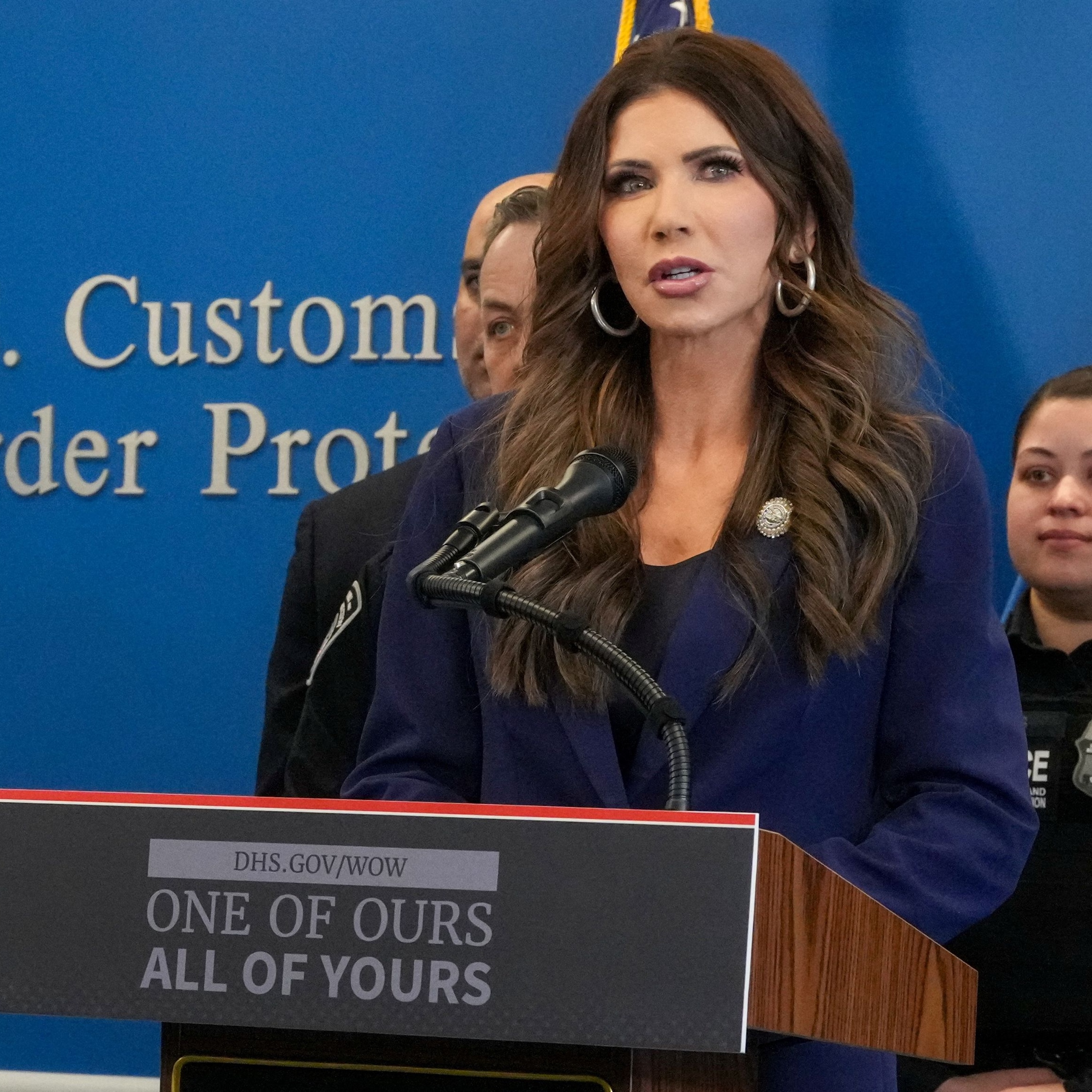
Post Reports
How Kristi Noem transformed immigration enforcement
00:24:42
The Department of Homeland Security was founded after the attacks of Sept. 11 to prevent further foreign terrorist attacks. Now, under the leadership of Kristi L. Noem, it is almost exclusively focused on apprehending undocumented immigrants.
Loading summary
Transcript48 lines
- [00:02]
A
After both Alex Preddy and Renee Goode were shot and killed weeks apart by Department of Homeland Security officers in Minneapolis, the story from DHS Secretary Kristi Noem was the same.
- [00:15]
B
You asked about a shooting that we just had in Minneapolis, Minnesota. It was an act of domestic terrorism. What happened was our ICE officers were out in enforcement action. They got stuck in the snow because of the adverse weather that is in Minneapolis. They were attempting to push out their vehicle and a woman attacked them and those surrounding them and attempted to run them over and ram them with her vehicle. An officer of ours acted quickly and defensively, shot to protect himself and the people around him. This individual who came with weapons and ammunition to stop a law enforcement operation of federal law enforcement officers committed an act of domestic terrorism. That's the facts.
- [01:00]
A
Right now. NOME is one of the most visible defenders of the tactics being used by Immigration and Customs Enforcement, which sits under dhs. ICE officers and Border Patrol are fanning out across Democrat run cities. They're deploying to city streets. They're entering neighborhoods and homes to make arrests. They're aggressively spraying protesters with tear gas and even detaining U.S. citizens. DHS officers have been involved in 16 shootings during enforcement operations or at protests since July. They've killed three people, including two US Citizens. From the newsroom of the Washington Post, this is Post Reports. I'm Martine powers. It's Tuesday, January 27th. Today, immigration reporter Marianne Levine talks with us about how the Department of Homeland Security transformed under Kristi Noem's leadership and the push to get her removed. Marianne, thank you so much for joining us.
- [02:16]
C
Thank you for having me.
- [02:18]
A
So I want to start by having you explain what came before the Department of Homeland Security and how was this agency formed.
- [02:28]
C
So the Department of Homeland Security was really formed in the aftermath of 9 11. There was this sense after the terrorist attacks that there needed to be a single agency that could really coordinate and prevent an attack like 911 from happening again. So what took place was you had 22 federal agencies and departments that were ultimately combined to address the threat of terrorism. And so it also combined agencies that focused on immigration as well as the Coast Guard and other agencies that focused on disaster management to really have this one entity that would address and coordinate against any potential threats.
- [03:10]
A
So then when you think about the Department of Homeland Security, like, what did it look like after that remaking? I mean, we have dhs, which I guess is the overall umbrella, but then there are these, these various kind of subparts of DHS inside of that before.
- [03:25]
C
Department of Homeland Security was created. We had basically the Immigration Naturalization Service, which handled the issues of immig immigration. And when DHS was created, there were new sections of the department that were going to focus on immigration. You had cbp, which was Customs and Border Protection, which houses Border Patrol. And you also had the creation of ice, which focuses on interior enforcement.
- [03:50]
A
And so it sounds like in that moment when these new entities were created or kind of shuffled around, that the thought was immigration was going to be mostly focused on anti terrorism. Right. That like you had people in the country that you thought were potential threat or could have American citizens as targets. And so this was a way to like tackle that problem. How has that evolved over time in terms of what we're seeing, the focus of ICE and the focus of CBP or Border Patrol, and how they've evolved since this post 911 inception?
- [04:25]
C
So I think we've seen it evolve in a few ways. We saw in the first Trump administration the shift towards immigration enforcement. Trump was obviously very focused on immigration in his first term as well. But I think what's really different about the second Trump administration is that we're seeing all these resources, this almost like all of government approach that's going towards his mass deportation campaign, where we're seeing federal government employees who are in agencies that are not focused on immigration being reassigned to focus on immigration. And so I think it's just a reshuffling of the resources generally towards one policy area versus an agency that was originally founded from 22 different federal departments that focus on many things that are not just immigration.
- [05:12]
A
And it seems like a lot of the impetus behind all of these parts of the federal government focusing on immigration enforcement is because of the leadership of DHS Secretary Kristi Noem. I wanna talk a little bit more about her. Obviously we see her in the headlines a lot these days, but tell me about her background and kind of how she got to this job.
- [05:35]
C
So, Kristi Noem is from South Dakota. She is someone who came to Congress in 2010 as part of the Tea Party wave. Though at the time she did not identify as a member of the Tea Party. And she is someone who we've seen, like many people in the Trump era, really shift in the last 10 years or so. She rose to prominence in the House. She was viewed as a rising star at the time and someone who is willing to work across the aisle. She's, you know, talks a lot about being a rancher, talks a lot about being from South Dakota. She also, after her time in Congress, became the governor of South Dakota in 2019. And that's when people who knew her in Congress say that they saw a shift in her and her approach to messaging and to her image towards the public.
- [06:30]
A
What do you mean by that? Like, how did her messaging, her image, shift?
- [06:34]
C
So from talking to former members of Congress and people who knew her at the time, Noem was, when she first got to the Hill, someone who was viewed as a more low key member. I spoke with former Representative Adam Kinzinger. He's a Republican who's been very critical of Trump and was in the same class as Kristi Noem in Congress. And Kinzinger told me the story about how she and her husband really tried to avoid doing television at the time because she didn't want to be objectified as a young woman. We've obviously seen a big shift there. She's on television a lot. She's in an ad campaign, campaign for dhs, thanking Trump for securing the border.
- [07:14]
B
Thank you, President Donald J. Trump, for securing our border, for deporting criminal illegal immigrants, and for putting America first.
- [07:23]
C
She's definitely been much more media forward in her role as DHS secretary than she was when she was a member of Congress. And from talking to people who knew her at the time, they say that the difference is very drastic from how she was as a Republican member. And she really started to get more attention after she became governor of South Dakota, and she got a lot of attention for how she handled the COVID pandemic, where she really rejected a lot of restrictions. She was someone who did not have mask mandates.
- [07:55]
B
I think the mandate is inappropriate for government to come in and mandate that somebody wear a mask. And I think it's inappropriate for us to shame people who choose not to wear a mask. That's not what America is about, and it's not what South Dakota is about.
- [08:07]
C
Her response to the pandemic was viewed as a way for her to really kind of launch her image and her national image. And we also saw that with, you know, how she sent troops to the US Mexico border as governor of South Dakota, despite South Dakota being 1,000 miles away from the border. And so we started to see this shift where she seemed to be someone who had ambitions on the national stage based on how she was handling the governorship in South Dakota.
- [08:37]
A
Well, I remember this moment in 2024 when we were wondering who Donald Trump was gonna choose as his running mate. She was on the short list for a while, and then she had a memoir that came out and there were things in there that a lot of people didn't like, including her, like, shooting her dog because her dog was poorly behaved. And it was just kind of a bad PR moment for her. So, you know, it was clear why she wasn't going to be Trump's VP pick. But she remained in the Trump orbit and then ended up in this job as DHS secretary. How do you think that happened, and why do you think Trump saw her as a potential, like, executor of his vision for mass deportation and immigration enforcement?
- [09:21]
C
I think a big part of this is her relationship with Corey Lewandowski, who is Trump's former campaign manager and still has a pretty close relationship with Trump. Corey Lewandowski is someone who also became a top political advisor for Kristi Noem back during her days as governor of South Dakota. And so I think a lot of roads lead back to Corey when it comes to this question of Noem being at the head of dhs. Cory is also basically her de facto chief of staff at DHS now. And so I think her relationship with Corey Lewandowski played a really significant role in her ultimately landing this. And also I think Trump, in Noam's telling, basically told her at one point that he did like these ads that she had recorded in South Dakota, South Dakota's hiring.
- [10:12]
B
We stayed open for business during the pandemic, and now businesses are growing so fast, our workforce can't keep up.
- [10:19]
C
During her time as governor of South Dakota, Noam recorded a lot of ads where she played different roles, where she pretended to be, you know, dental hygienist or played different professional roles to try to get people to come work in South Dakota.
- [10:33]
B
Wait, aren't you Governor Noem? Yes, I am.
- [10:36]
C
It's my first day South Dakota Freedom Works here. And Noem tells this anecdote about how Trump asked her to film an ad thanking him for securing the border and mentioned these ads in South Dakota that she had filmed. So I think it's hard to always know why Trump makes the decisions he makes, but I think that she was also very loyal to him throughout the campaign. And I think she also has the benefit of having Corey as someone who both worked as Trump campaigns manager and is now her top political advisor.
- [11:09]
A
So in the year or so since she's become the head of the Department of Homeland Security, how has she kind of marshaled the resources and purview of this department to really aim it full on at immigration enforcement rather than thinking about terrorism threats or the other kind of things that DHS used to be focused on? In the past?
- [11:34]
C
Well, I think we've seen a lot of reassignments for federal agents. And I think that one aspect that's been really significant, especially in light of the shootings that have taken place, is kind of the redirection of the role of Border Patrol. For example, Border Patrol is a division of CBP that really has focused on the border, the U.S. mexico border. And we've seen this reshift of Border Patrol's focus into the interior of the United States, which is not a role that they've really played to that extent before. So I think that's one example. Another example is that we've seen FEMA employees really being reassigned to focusing on immigration.
- [12:15]
A
And of course, that's the Federal Emergency Management Agency.
- [12:19]
C
Yes, exactly. We're seeing people who normally work on disaster relief being reassigned to immigration efforts. And so there has been really this all of government approach that we've seen beyond dhs. But DHS has really been leading that effort by making people really focus on the deportation effort versus other parts that the agency has been historically focused on.
- [12:47]
A
After the break, how DHS has tried to justify ICE's change of tactics and how lawmakers are trying to hold Kristi Noem accountable. We'll be right back.
- [13:08]
D
This is the year you stop overthinking and start building. The year your side idea becomes something real. Founder, creator, business owner. It all starts with one decision. And that decision is launching with Shopify. Maybe it's a product your friends already asked to buy, a service you know you're great at, or a brand that's been living rent free in your mind. January is your window before another year slips by. 2026 is when you turn the idea into income. And Shopify is how you begin. Millions of entrepreneurs have already made the leap from household names like Heinz and Mattel to first time business owners just getting started. Choose from hundreds of beautiful templates that you can customize to match your brand. Create email and social campaigns that reach customers wherever they scroll. In 2026, stop waiting and start selling with Shopify. Sign up for your $1 per month trial and start selling today@shopify.com reports. Go to shopify.com reports. That's shopify.com reports. Hear your first this new year with Shopify by your side. There's this moment every day right around 5pm where my brain just shuts down. Not because I don't want dinner, because I don't want to decide dinner before. Hellofresh. It was always the same, what do we have? What can I make? How long will it take? HelloFresh didn't magically turn me into a chef, it just removed the hardest part, figuring it out. The meals are already planned, the ingredients are already portioned, and the steps are crystal clear. Every week, HelloFresh offers over 100 recipes, so I'm choosing what sounds good, not what I can survive making. I've tried a lot of HelloFresh recipes, from their deli style turkey wraps to their street cart style chicken bowls and they're all fantastic, though their buffalo chicken melts are quickly becoming a new favorite. Go to hellofresh.com posttenfm to get 10 free meals plus a free Zwilling knife, a $144.99 value on your third BO offer valid while supplies last. Free meals applied as discount on first box. New subscribers only varies by plan.
- [15:15]
A
So Marianne, I'm curious to hear more about how the Trump administration is defending this shift of DHS more toward immigration enforcement. And I can imagine, you know, there are people who will say, look, well, this has always been part of the government's mandate and DHS's mandate, and just because previous presidents didn't choose to prioritize immigration enforcement mean that it's wrong or out of step with what DHS is supposed to be doing. But I'm curious to hear from you what you've heard from these officials about how this agency has changed over the last year.
- [15:52]
C
I think that Noem and others in the administration have tried to frame this as a matter of public safety, and they would argue that this is an effort to focus on security. And we've seen how the agency has really tried to paint people who are in this country here illegally as criminals, as individuals who've committed violent crimes. And I think the messaging is that that is an issue of national security, and that is how they are trying to argue that this is in line with the effort of the Department of Homeland Security. But also in our reporting, we've seen that many of the people who've been arrested don't have violent criminal records. But I think that the agency and the way that they've messaged this is that they're going after violent criminals and that is a national security and safety issue.
- [16:41]
A
But then you see that messaging start to extend wider and wider, including to the aftermath of the killing of Alex Preddy. We heard that tape from Kristi Noem describing him as a domestic terrorist. But like, how are you seeing Noem and other DHS officials kind of use that messaging around what the new DHS is all about.
- [17:04]
C
Yeah, I mean, I think it really links to this almost reflexive defense of law enforcement that we're seeing where Noam and other officials at the Department of Homeland Security have emphasized or argued that ICE officers are facing significant threats and assaults. And I think they're really trying to flip the narrative to say that they are the ones being attacked in these situations and that these are all acts of self defense. And I think that's a real shift from how previous leaders of the Department of Homeland Security have reacted. I think from talking to former DHS officials who talked about Noem's response to, for example, Renee Goode's killing. And at least in previous administrations, many people I talked to said that what would have happened would have been that the DHS secretary would have taken a more measured approach, would have not jumped to a conclusion so quickly, and would have proceeded with a cautious investigation before coming to a conclusion about what happened. And I think there is such a jump to defend law enforcement that Noem and also White House Deputy Chief of Staff Stephen Miller have taken on that posture that at a time, it comes without matching what many people are seeing in the videos that's coming out of these incidents.
- [18:26]
A
Marianne, tell me more about the legal authority that some of these agencies have here, that ICE has, that Border Patrol has DHS at large to do what they're doing in Minneapolis and whether there are questions about that legal authority.
- [18:41]
C
I think there are a lot of questions about the use of force. We've been looking at this question in terms of in what situations can officer use force? And according to the guidelines, according to protocol, the use of force is typically something that takes place when an officer feels like there is a direct threat to their life and should only be used in that situation. And so I think that DHS would argue in these situations that these officers were feeling threatened in the shootings that we've seen and that the use of deadly force was justified, even though video evidence has really called that into question. In terms of the role of Border Patrol being in these cities, Border Patrol actually has a fair amount of leeway to operate in the interior. Basically, they're essentially allowed to operate within 100 miles of the border. And the border can really be a very broad definition. It doesn't have to be the US Mexico border. And so there is that justification for them operating in the interior that DHS can rely on. But it is very unusual and it's something that we really haven't seen to this extent before.
- [19:55]
A
In light of everything that's happened in Minneapolis and especially, you know, first since Renee Goode's killing, then since even more since Alex Preddy's killing. Walk me through the ways in which lawmakers are trying to react to this and to oppose what Noem is directing the Department of Homeland Security to do here.
- [20:14]
C
We're seeing this playing out in a couple of ways. You know, shortly after Renee Goode's killing, Representative Robin Kelly of Illinois introduced articles of impeachment on three grounds. The first is obstruction of Congress for blocking members from entering detention facilities. The second is looking at the enforcement, immigration enforcement tactics that have taken place at DHS under her leadership, including a raid that took place in Chicago last year in the middle of the night and the tactics that were used there. And then finally, they're looking into self dealing and looking at the way in which Noem has used taxpayer money to finance this $200 million ad campaign out of DHS and looking at the circumstances under which the contracts for that ad campaign were awarded. And we're seeing that effort getting more and more support from House Democrats. I think more than 130 House Democrats have backed that effort to impeach Noem. Now, it's important to note that it's not likely to move forward in a Republican controlled House, but it's still a sign of Democratic lawmakers are trying to push back on what DHS is doing. We were also seeing this fight playing out this week in the government funding debate. There's a potential for a partial shutdown later this week. And we're seeing that Democrats are really insisting in the Senate that there be more guardrails on dhs. And so they're basically trying to revise and remove the DHS funding portion of the government funding bill. Unless there are some serious changes that.
- [21:55]
A
Are made, would that shutdown mean that now federal agents in Minneapolis can't do their jobs anymore because they're not being paid for it and that, like, that part of the government would in fact, shut down?
- [22:07]
C
I think it's hard to say. I mean, they also have a lot of money that was allocated from Congress last year. And so I think there's a sense that DHS would likely use a lot of those funds even if there was a shutdown, but I think it's hard to say.
- [22:21]
A
So clearly there are a lot of questions to ask about Kristi Noem's future as the head of the Department of Homeland Security. But also we're seeing other officials like Greg Bovino, the commander of Border Patrol. There's a question about, yeah, There's a question about his future. Tell me a little bit about that. What we're seeing with him being taken out of Minneapolis and being replaced.
- [22:42]
C
Yeah. So we're expecting Bavino to leave Minneapolis soon. And I think that that is a clear sign that the White House wants to shift the direction of these Blue City operations, because Bevino has really been the face of the operations. He's been leading them in the Blue Cities, has had very bombastic commentary on social media. And I think the fact that Tom Homan, whose Trump supporters are, is coming in to Minneapolis, is a sign that the White House wants to change direction. It's interesting because Homan is a longtime career person similar to Pavino. But Homan also is someone who we haven't heard as much from in the second Trump administration as Christine Oem. And Homan is someone who I've been told by sources that does not especially get along with Noem and that the two of them do not talk frequently. And so it's been interesting to see that Trump has chosen Homan to be the one to go into Minneapolis.
- [23:45]
A
Interesting. So tell me about what's at stake here going forward, both for the general Department of Homeland Security operations in Minneapolis and also for Christina or I think.
- [24:00]
C
It'S very hard to say how the next few days are going to play out, but we've at least seen more of an effort to reach out to the Democratic leadership in Minnesota. I think it's been telling that President Trump posted yesterday that he had spoken to Governor Tim Walz and that he had also spoken to Minneapolis Mayor Jason Fry and described these conversations as positive and said that Homan was going there essentially to reach a solution or to have a bipartisan conversation about this. And so it seems like there's this recognition from the administration about the need to de escalate what's been happening in Minneapolis. And so I think that what that means for the actual operation remains to be seen. But the fact that Homan is in there and the fact that Trump has personally spoken to Waltz and the Minneapolis mayor is a sign of potentially wanting to reach some kind of compromise here and deescalate the situation. And for Noem, I think it's really unclear. I think we don't quite know yet what it means for her, but she is going to continue to come under scrutiny. She's expected to appear before the Senate in March. And I think that there are going to continue to be a lot of questions about how she has handled these two shootings that have led to this, the death of U.S. citizens.
- [25:28]
A
Marianne, thank you so much for speaking with me.
- [25:31]
C
Thank you for having me.
- [25:35]
A
Marianne Levine is an immigration reporter for the Washington Post. That's it for Post Reports. Thanks for listening. Today's show was produced by Sabi Robinson with help from Rennie Swarnofsky. It was edited by Dennis Funk and mixed by Sam Baer and Sean Carter. And before we go, one note about subscriptions. If staying informed is one of your goals for this year, the Washington Post is the perfect place to start. And we have a new subscription sale right now. You can unlock your first six months of access to the Washington Post for just 50 cents a week. After that, it'll cost $14 every four weeks. You can cancel anytime. You'll get unlimited access to trusted journalism that helps you make sense of what's happening now and what's ahead. Go to washingtonpost.com subscribe and start the year informed with the post. Again, that's washingtonpost.com subscribe. I'm Martine Powers. We'll be back tomorrow with more stories from the Washington Post.
- [26:50]
E
The holidays may be over, but smart savings can still continue. Right now, you can unlock your first six months of access to the Washington Post for just 50 cents a week. After that, it's $14 every four weeks. You can cancel anytime. You'll get unlimited access online and in our app to trusted journalism that helps you make sense of what's happening now and what's ahead. If staying informed is one of your goals for the year, this Post holiday sale is the perfect place to start. Go to washingtonpost.com subscribe and begin the year informed. That's washingtonpost.com subscribe.