← Post Reports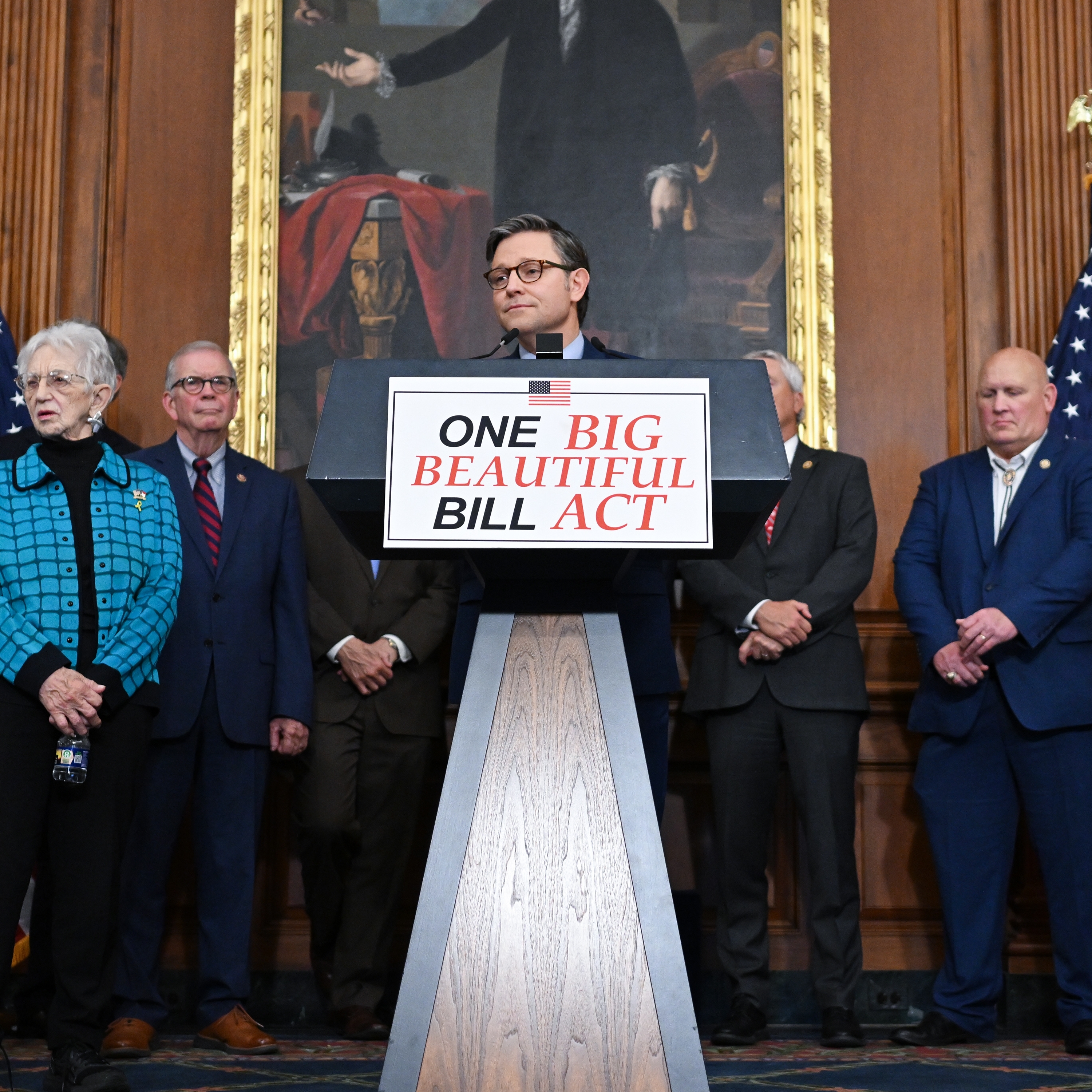
Post Reports
How Trump got his One Big Beautiful Bill Act passed
00:30:14
The House has passed the One Big Beautiful Bill Act, sending it to President Donald Trump’s desk. Today, how this massive tax and spending package got over the finish line.
Loading summary
Transcript69 lines
- [00:02]
Cole Bietkowitz
So the median age in Congress is 57, which is a bit older than me. And I definitely cannot pull an all nighter. Like I go to bed at 9:30. Like, could you guys? I mean, I guess, Theo, you have. But like, how do these congresspeople stay up all night?
- [00:20]
Dan Marika
Sleep has played a large role in this bill's passage, with it almost not passing the House because of somebody falling asleep off of the House floor.
- [00:29]
Cole Bietkowitz
Is that true?
- [00:29]
Theo Meyer
Yes. You're referring to back when it first passed the House? Yes, in May when Congressman Andrew Garbarino, Republican of New York, fell asleep and missed the vote. The bill passed anyway. I saw that James Blair, who's the top White House aide, tweeted a few hours ago that Congressman Garbarino was awake this time around.
- [00:58]
Cole Bietkowitz
From the newsroom of the Washington Post, this is Post Reports. I'm Cole Bietkowitz, politics reporter and host of Post Reports weekly Politics roundtables. It's Thursday, July 3rd. I'm joined this week by Theo Meyer, who covers the Senate for the Post. Hey, Theo.
- [01:14]
Theo Meyer
Hello.
- [01:14]
Cole Bietkowitz
And we're here with Dan Marika, politics reporter and co anchor of the Early Brief Newsletter.
- [01:19]
Dan Marika
Hey, Dan, thank you for having me.
- [01:23]
Cole Bietkowitz
So we're talking about the push this week to pass President Donald Trump's signature tax and spending bill through Congress. We've talked about it a lot on this show. And just as a reminder, this is a bill that would lock in tax cuts, reduce benefits for low income Americans, add to the national debt and put more money towards Trump's signature issue, which is increasing deportations. Today we're going to get into all the drama, the deals that were cut to try to get it across the finish line and the political repercussions of this bill. Here's where things stand. We're Talking at almost 10 in the morning on Thursday. The bill eked through the Senate on Tuesday and now it's back in the House. And many will remember, as we talked about earlier, the House already passed this bill back in May. But for it to get to the president's desk, the House has to pass it again. Because the text changed so significantly in the Senate, the House pulled an all nighter and several of our colleagues were up there with them. So this morning we got an update from congressional economics reporter at the Post, Jacob Bogage, about when the action started to heat up.
- [02:24]
Dan Marika
You know, I'm sitting here in Congress and it's 11pm and nothing's happening. And it's midnight and nothing's happening. And it's 1:00am and 2:00am you know, and nothing's happening. And finally, at 3:00am we get some action. They vote on the rule. They pass the rule by the skin of their teeth, they do it.
- [02:46]
Cole Bietkowitz
So passing the rule for debate, it's a. It's procedural congressional jargon, but ultimately it means that the bill itself is likely to pass now. So there are enough Republicans on board. Are you guys surprised at how quickly it's moved through the House?
- [03:01]
Theo Meyer
I thought it could have gone a little bit slower, but I'm not surprised that it's passing by July 4th.
- [03:07]
Cole Bietkowitz
You're not?
- [03:08]
Dan Marika
No. I mean, I think this really highlights how the Republican Party is now molded, shaped into the party of Donald Trump. I mean, you look back at his first term, there were so many people in both the House and Senate who were anti Trump for one reason or another, or at least were willing to stand up to him.
- [03:25]
Cole Bietkowitz
Yeah.
- [03:26]
Dan Marika
Eight years later, whatever we're at now, it's completely different when you have people who are quote, unquote, holdouts, who have issues with the bill, who express those issues on social media and get some attention for it. But in the end, they mostly folded, and it's because in large measure of the threat of Donald Trump and what his kind of MAGA movement could do in a Republican primary.
- [03:49]
Cole Bietkowitz
Yeah. What do we know about what happened overnight? Do we know kind of what was happening behind the scenes?
- [03:54]
Theo Meyer
We don't know exactly what was happening behind the scenes. That is part of what we and our colleagues will be trying to figure out today. But there was sort of a gradual process over the course of yesterday. There were several, actually sort of preliminary votes that people were holding out on. And at first it was a group of maybe two dozen people, a mix of moderate House Republicans who had concerns about parts of the bill, especially the deeper Medicaid funding cuts included in the Senate version. And then a group of hardline conservatives, most of whom are members of the House Freedom Caucus, who wanted this bill to cut further, were upset about some changes the Senate made that they thought made the bill less conservative and were really angry that it added to the deficit as much as it does.
- [04:49]
Dan Marika
I think what was really interesting yesterday is you could see the messaging change over time. You know, in the morning, afternoon hours, it was all. I mean, I think the President even posted something. We're united. It was all very positive, and this is gonna happen. But as the afternoon turned to night, turned to post midnight, you saw a lot of people around Trump begin to basically threaten members who were holding out. Jason Miller is a longtime advisor, basically said this is a binary choice. You're with us or against us. It really highlights how, okay, the Trump side of the party is willing to have people who are holdouts, who have questions, who need to go to the White House to meet with the President and have their arm twisted a little bit. That's what happened yesterday. But in the end, they made very clear that if you were not with Republicans on this, you were against Donald Trump. And that has major repercussions in midterm races which all of these House members will face. And we saw in the first term how that can play out. There were a number of people who stood up to the President in one way or another and eventually either didn't run for reelection or lost.
- [05:54]
Cole Bietkowitz
And Theo, I know we're still reporting out kind of the details of those negotiations overnight, but as far as I can tell, those holdouts didn't really didn't get anything. I don't know what was promised them.
- [06:04]
Theo Meyer
But it's a very different situation than in the Senate. When Senate Majority Leader John Thune was trying to put together 50 Republican votes to pass this bill in the Senate early Tuesday morning, he was negotiating with them over the bill. Text was making changes that Lisa Murkowski wanted, or of Alaska at least. Yes, Senator Lisa Murkowski, the independent minded moderate Republican senator from Alaska. Thune was making changes to try to win her over, was trying to win over other senators as well. The challenge for House Speaker Mike Johnson, Republican of Louisiana, is that he couldn't really offer them anything. He had decided it's the Senate bill. That's the only way to send this to the president's desk by July 4th. We don't want to have to try to get this through the Senate again if we make changes. So we're not going to change this bill. We can't really offer our members anything other than one, assurances that we'll try to cut spending or do whatever else you want at some date in the future, which seems possible, but it's always easier to say you'll do something in the future than do it immediately. And two, pledging that Trump will issue executive orders or enforce certain things in ways that members want.
- [07:26]
Cole Bietkowitz
Theo, I'm glad you brought up the Senate because there were three notable no votes in the Senate, three senators that they couldn't get on board. Tell me about them and kind of what their holdups were.
- [07:37]
Theo Meyer
Yes, that's right. There were three. The first was Senator Rand Paul, Republican of Kentucky. It had been known for weeks, if not months, that he was Almost certainly going to be a no on this bill. His objection was pretty simple. Simple. One thing this bill does is raise the debt limit by $5 trillion. It doesn't accumulate any debt itself. It's just to authorize the United States borrowing more money to keep everything going. So Paul's concern was the debt limit. He said he would vote to raise the debt limit by $500 billion, which would last a few months, but not $5 trillion, which would likely last a few years. And Republicans really wanted to do a big number so they didn't have to do this again. Paul was very against it and said he wouldn't vote for the bill if it included that. And he held out. The second senator was Senator Susan Collins of Maine, probably the most moderate Republican in the Senate. She is the only Republican in the Senate to represent a state that Kamala Harris won November. She is up for reelection next year. I think she tried to get to yes, but it's not surprising that she ended up voting no. The third Republican who was against it was more of a surprise. Senator Thom Tillis, also up for reelection next year in North Carolina. In North Carolina, yes. Republican of North Carolina, a swing state, a state that Donald Trump won narrowly. Tillis, I think most people thought was going to get to yes. But he said late last week that he was going to vote no, at least on starting debate on the bill. And then he did vote no. Trump attacked him on social media, threatened to recruit a primary challenger against him. And in a very surprising move the next day on Sunday, Tillis came out and said, I'm done. I'm not running for reelection. I'm voting no on this bill. That's it.
- [09:50]
Cole Bietkowitz
It's wild. I mean, Tillis, as far as I remember, has always been considered a pretty conservative Republican, Right? So for him to come out and say that he had all these concerns about the loss of Medicaid coverage for his constituents was pretty surprising.
- [10:02]
Dan Marika
I think it gets to a policy issue in this bill that is going to turn into a political issue in this bill as time goes on. And many of these Republicans represent states where there are a number of rural hospitals that serve tens of thousands of people. Those hospitals will be directly impacted by the cuts to Medicaid. Rural hospitals, more so than other hospitals, rely on Medicaid reimbursement to basically keep the doors open because it is so expensive to provide medical care in rural areas. And that was a big reason that he had an issue. It's a reason that many Democrats, probably the biggest reason that some Democrats had with this bill. It's a huge reason that some Republicans in the House had an issue with this bill, but then eventually went along and voted to move it along. It is the issue that Murkowski said she had with this bill, but then she won over some concessions that helped Alaska in that department.
- [10:55]
Cole Bietkowitz
Dan, I'm glad you brought up Murkowski, because the concessions that she got in order to vote for this bill have gotten a lot of criticism. She spoke to our colleague, congressional reporter Mariana Sotomayor, in the hallways right after she voted yes. So let's take a listen to that.
- [11:10]
Lisa Murkowski
Kill it. And the provisions that are going to be very helpful for economic development in my state would no longer be available. Kill it. And the. The provisions that we got to soften the impact on Medicaid recipients, on our hospitals, particularly our small community hospitals, that would all be gone. And so this is probably the most difficult and agonizing legislative 24 hour period that I have encountered. And I've been here quite a while.
- [11:50]
Cole Bietkowitz
So, Theo, what exactly did she get for Alaska that got her to yes.
- [11:56]
Theo Meyer
So Lisa Murkowski was faced with a choice. Republicans were going to find a way to pass this bill. If she had voted no on Tuesday, perhaps it could have derailed it for a little bit. But this bill contains most of President Trump's agenda for his second term. It's his top priority. There was just no way that they weren't going to pass this bill eventually. So she faced a choice of voting for a bill that she had a lot of concerns about, but that included some stuff that she and other senators had fought really hard to get in that would help her state. Or voting no. Having Republican senators cater to a different senator to win over a 50th vote and risk having all of the stuff that she thought was good about the bill stripped out. The biggest thing was a $50 billion rural hospital fund. This was something that multiple Republican senators had demanded because of the concerns of that the cuts to Medicaid in this bill would hurt rural hospitals in their state. So the idea that they came up with was a special fund to help rural hospitals that were hurt by the other policies in this bill.
- [13:16]
Cole Bietkowitz
And is that just in Alaska or is that across the country?
- [13:19]
Theo Meyer
It's across the country.
- [13:19]
Cole Bietkowitz
Okay.
- [13:20]
Dan Marika
Republicans have tried to say, though, that this bill does not impact Medicaid and does not hurt rural hospitals. But the mere existence of. Of a fund, a $50 billion fund to help rural hospitals is sort of like a billboard saying that this bill actually does hurt rural hospitals. And here's what we're doing to help them. It is interesting that that is what got Lisa Murkowski over the line. I think when we talk about the politics of this bill, though, that sort of deal undermines the messaging that Republicans have had on this bill throughout the entire process.
- [13:53]
Cole Bietkowitz
And she also said to another reporter, I think that she was voting for it, hoping that the House would change it. So she was voting for something she didn't like, crossing her fingers that the House would change it. Obviously, now we're seeing that the House has not changed it.
- [14:06]
Dan Marika
Pork Works is probably a good bumper sticker for getting Murkowski on board here. She would bristle at the idea that it is pork because it is going to help her state and the people that she represents. But I mean, pork is effectively anything that is added to a bill as a bit of a sweetener, trying to get someone on side. But this is why it's interesting that Donald Trump kind of ran against being the status quo. He ran against changing politics, draining the swamp. A big part of, in the eyes of many Trump voters, a big reason that the swamp is the swamp is because of pork filled bills that just dole out cash taxpayers money to do X, Y and Z. That doesn't end up matching the focus of the bill. But now here we are a decade into kind of Trump's political time, and pork still works. It still works. It still gets people on side, including on side of a bill that Donald Trump really wants to pass and sign before July 4th.
- [15:06]
Cole Bietkowitz
We're going to get to the politics of this. We've talked about some of the bargains struck in the Senate. And after the break, we're going to go a bit deeper on the fallout from this bill and why it's making Democrats a little bit more optimistic about the 2026 midterms. We'll be right back.
- [15:35]
Sally Jenkins
I'm Sally Jenkins and I'm a sports columnist and feature writer for the Washington Post. My job entails pulling the curtain on really big sports events at what is going on in locker rooms, what's going on in the stadium tunnel, most importantly, what's going on in the minds of the athletes that I cover. I think that we have an instinct that sports are really important in some primal way. We pay a lot of money for them, we build really big stadiums for them. And I think that athletics really gets us in touch with aspiration and teach something very, very important about accountability, about self determination. And so my job is to really make those links explicit for readers and users subscriptions support this work and the people behind it. Find out more@subscribe.washingtonpost.com I'm Sally Jenkins and I'm one of the people behind the Post.
- [16:35]
Cole Bietkowitz
So we talked about this a little bit in Dan, you made some great points on this. But you know, one big change between the Senate version of this bill compared to that earlier House version is that the Senate's version made even deeper cuts to Medicaid. Obviously, that's the government health insurance for low income Americans. More than 11 million people could lose health care. And Thom Tillis, the North Carolina senator, in his speech condemning the bill, warned Republicans not to repeat the mistakes they made with the Affordable Care act during the Obama administration. Dan, what was he talking about?
- [17:06]
Dan Marika
So Democrats suffered significant losses in the midterms immediately after the passage of the Affordable Care act because in many respects, voters were frustrated with the way that the bill was rolled out. They had also seen the process, seen the bill pass, but had yet to feel the impacts of the bill. And that damaged Democrats at the time. And so that's what Thomas Hillis of North Carolina was warning Republicans of. I think the other interesting aspect of this is the 2018 midterms, which was the first midterms under Donald Trump. They attempted to repeal Obamacare. They failed to do that. But it was still the main Democratic attack during the midterms that saw the party sweep into the House pretty convincingly. So there are a lot of Democrats right now who look at this bill, they think it's an abomination, but they also think it's a political winner for them. You could see an ad very easily in a few months that says, you know, Republicans passed this bill, gave tax breaks to wealthy earners and took away health care for lower income Americans. And that's what their priority was.
- [18:14]
Cole Bietkowitz
And Democrats, you know, we mentioned earlier that Tillis, he's not running for reelection now in North Carolina. And North Carolina has been a state that Democrats have hoped to win back for several cycles. Now. Theo, how are Democrats feeling about that specific turn of events? Do they feel like North Carolina is now?
- [18:33]
Theo Meyer
Well, North Carolina and Maine, where Susan Collins is up for reelection were already the two states that Democrats were targeting. Every other Republican running for reelection or Republican held seat that is up is a state that Donald Trump won by more than 10 points. These are places that are increasingly forbidding terrain for Democrats like Iowa, places like Texas, places like Ohio. These are states that are not easy for Democrats to win anymore. So there was always going to be a huge focus on North Carolina next year. But certainly having an open seat is probably easier for Democrats to win than running against Tillis, who has won tough races before.
- [19:23]
Dan Marika
I think Democrats came into this cycle very worried about any path in the Senate. And I think if you ask them right now, I think some of the smart Democrats would say they don't think they're the favorites to win back the Senate, but that they can see a clearer path to how they could do it. It's still incredibly difficult, and I think it's probably unlikely that Democrats sweep into power in the Senate, but the path is clearer than it was a few months ago.
- [19:49]
Cole Bietkowitz
Another political wrinkle for Republicans is Tesla CEO Elon Musk, the former Trump adviser who has been against this bill from the start. And he was back on his social media platform X this week bashing it. To say he doesn't like it obviously is, to put it mildly. He's continuing his threats of creating a third party. He said if it's his last thing he does on earth, he's going to primary any Republican who votes for this bill. What do you make of this?
- [20:17]
Theo Meyer
Yes, Musk has been a little hot and cold on this bill. He didn't like it as it was coming together in the House, but after it passed the House and after he, he left the White House, he came out really hard against it, caused a huge sort of spat with Trump about a month ago and then kind of shut up for a little bit. There was sort of a detente with Trump. And as the Senate was preparing to take up this bill again, he attacked it again and went even harder in some ways, pledged, as you said, to fund primary challenges against Republicans who vote for it. That's going to be a tough task. It's a lot, because almost every Republican voted for this bill. Now maybe he is talking about he.
- [21:03]
Cole Bietkowitz
Does have the money, though.
- [21:05]
Theo Meyer
Yes, yes, he does have the money. He could, in theory, devote millions of dollars to primarying every single Republican member of Congress. I am not sure that is going to work. He would have to find people to run against them. He would have to go up against President Trump. There's a lot of unknowns here about this, how it would work, but he could certainly help to take out some members of Congress who voted for this, perhaps people who were against it, and then sort of flipped at the last moment who he might be especially disappointed in.
- [21:41]
Cole Bietkowitz
I mean, Dan, why does Elon hate it so much?
- [21:44]
Dan Marika
That's a very good question that I think many in Washington are wondering. The stated reason, the reason that he has railed on X. His social media site is he came into the government to cut government spending. And this bill does. Does the opposite. It balloons the deficit. It's a large spending bill. That is what he has said is the reason that he does not like this bill. There are also personal reasons, or I guess professional in his regard, reasons that he doesn't like this bill. The bill would get rid of EV tax credit that helped people who were buying new cars, new electric vehicles in specific, to kind of offset the cost of those. That is being done away with in this bill. I think part of it also is reflexively just he had this spat with Trump and so now he's kind of in it, you know, and so, like, standing up and opposing this bill is kind of what he has staked this moment on. The President has responded in kind. He even said that without those subsidies, quote, Elon would probably have to close up shop and head back home to South Africa. No more rocket launches, satellites, or electric production. Our country would save a fortune. I mean, so this is. It started for Elon Musk as a opposition to this bill. It has turned into kind of a personal tit for tat with the President of the United States.
- [23:04]
Cole Bietkowitz
It struck me that despite these threats for these Republican holdouts, like, Trump was far scarier than Elon Musk.
- [23:12]
Dan Marika
It's Trump's party. It's not Elon Musk's party.
- [23:14]
Cole Bietkowitz
Right.
- [23:14]
Dan Marika
Elon Musk was kind of like a passenger on the train, and Trump is the train.
- [23:20]
Theo Meyer
Also, Elon Musk is out of the White House. He doesn't have a role anymore. It's like, when you're a US Senator, you are very powerful. When you are a former US Senator, you are not powerful. And that change happens.
- [23:33]
Cole Bietkowitz
One last thing I want to mention that is related to this bill. As the Senate was kind of going through this really painful vote earlier this week, we saw President Trump leave D.C. and he visited what he calls Alligator Alcatraz, which is an ice detention facility in the Florida Everglades. According to Trump, there are live alligators surrounding this facility that will guard it from anyone trying to escape. So let's listen to Trump talking about this.
- [24:03]
Donald Trump
You know, snakes are fast, but alligators are.
- [24:07]
Theo Meyer
But we're going to teach them how.
- [24:08]
Donald Trump
To run away from an alligator.
- [24:10]
Theo Meyer
Okay. If they escape prison, how to run.
- [24:13]
Donald Trump
Away, don't run in a straight line.
- [24:16]
Cole Bietkowitz
Someone asked him, like, is the idea that the alligators would, like, eat or kill these undocumented immigrants that escape? And he basically said, like, that's the concept related to this bill. J.D. vance also said in a tweet that he considered the ICE and detention center funding in it to be the most important part and that the Medicaid cuts were, quote, immaterial. So, Dan, I'm wondering, is all of this a viable political strategy? Is Trump's efforts on immigration popular enough that it would outweigh cuts to Medicaid?
- [24:47]
Dan Marika
The first answer is no. I mean, Trump's actions on immigration are not popular. Poll after poll have shown just general disapproval for the way he's handling immigration. A PBS poll published this week found 52% disapprove of Trump's handling of immigration and 43% approved. Now, obviously, those numbers are different when you look at the political breakdown. Republicans are more supportive than Democrats. Of course, that's pretty obvious. I think with both immigration and Trump, the way that he handles immigration is somewhat baked into Republican support, just general support for him and for Republicans. It's what he ran on. It was the focus of so much of his messaging. It is just kind of assumed that this is how he views the world and what he was going to do in office. Now, I think there are a number of folks who think he's even gone beyond what they expected. I mean, branding something alligator Alcatraz and then suggesting that alligators are going to basically be provide security and eat people, I don't necessarily think would have been on anyone's bingo card during the 2024 election. I do think that immaterial may come back to not haunt, but it may look foolish in a few months and years, because I don't think you can say that the Medicaid cuts are not going to matter through a political lens. We just laid out here how they could matter. And if Republicans end up, you know, losing seats in the House, losing the House, I think if you look back, you'll probably be able to say that this bill and the Medicaid cuts in this bill played a significant role, given how Democrats are previewing that it's going to be a large part of what they run on in 2026.
- [26:24]
Theo Meyer
I think it's important to remember, Colby, that this was not supposed to be a health care bill. And in many ways, it's not a health care bill. This is a tax bill. The lion's share of this bill is simply extending expiring tax cuts that Trump signed into law in 2017. It's not anything new. It's an extension of tax cuts that already exist. Republicans added these Medicaid funding cuts in part to offset the new spending in this bill, the defense spending, the immigration spending, new provisions like no tax on tips, no tax on overtime, no tax on auto loan interest for American made cars. They had to find some cuts so that this bill did not blow up the deficit even further. And because President Trump was very adamant about not cutting Medicare and not cutting Social Security, Medicaid was the place they had to look. And it has sort of morphed into a bill where the political focus at least has been so much on these Medicaid funding cuts. And to some extent, the administration has embraced that. Mehmet Oz, the Centers for Medicare and Medicaid Services administrator, said that was very impressive. Said a few weeks ago that this was the biggest health care reform bill in generations or in the nation's history, which is sort of a remarkable thing to say for a bill that was supposed to be focused on taxes. Republicans have talked about this as cutting Medicaid waste, fraud and abuse. And I think that sort of means different things to different people. Some Republicans clearly consider all of the Obamacare Medicaid expansion spending a waste. And if you see that as a waste, then you can describe cutting that as just cutting waste, even though it would take health care away from some people who haven't currently. And that's, I think, sort of part of the Republican perspective on this.
- [28:39]
Cole Bietkowitz
Well, guys, we're gonna have to leave it there. That's it for today's show. Dan, Theo, thank you so much for coming on. It's been a crazy news week.
- [28:46]
Dan Marika
Thank you for having us.
- [28:47]
Theo Meyer
Thanks, Colby.
- [28:50]
Cole Bietkowitz
Dan Marika is a politics reporter and co anchor of the Daily Brief newsletter for the Post. Theo Meyer covers the Senate for the Post. So after we taped this conversation this morning, the House did pass the bill Thursday afternoon with just two Republicans voting no. The vote came later than expected because Democratic House Minority Leader Hakeem Jeffries spoke on the floor in opposition to the bill for more than eight hours, breaking the record for the longest House speech in history. Here's a little of what he said.
- [29:19]
Donald Trump
Our Republican colleagues tried to jam this reckless, extreme bill, Mr. Speaker, down the throats of the American people. People had the nerve to start this debate at 3:28am we made clear that we were going to expose all of the things that are being done to harm the American people, not in the dark of night, but in the light of day.
- [29:56]
Cole Bietkowitz
And so Trump will get his July 4th signing ceremony. It's scheduled for Friday at 5pm at the White House, mere hours before the nighttime fireworks. The Post reports team is taking off tomorrow for July 4th, but you should come back to our feed for a fun dispatch from another Washington Post podcast. Try this Try this offers short audio courses aimed at improving your life. And the new season is all about the gut, which I've learned is not just about where you hold all your anxiety. It's basically where food and nutrients are broken down. And this impacts your health in a big way. So give it a listen to learn how to take care of your gut. Today's episode was produced by Arjun Singh. It was edited by Laura Benshoff and mixed by Sam Baer. Our team also includes Maggie Penman, Rena Flores, Ted Muldoon, Alana Gordon, Ariel Plotnick, Bishop Sand, Rennie Siernoski, Sabi Robinson, Emma Talkoff, Sean Carter, Peter Bresnan, Thomas Lu, Tadeo Ruiz, Sandoval, Renita Jablonski, Alahia Ezadi and Martine Powers. I'm Colby Ikowicz. Have a great July 4th weekend.
- [31:19]
Colby Ikowicz
Think about why you listen to podcasts. It's like having a friend who makes you think or can help you wind down right? Well, the Washington Post has a lot of people you can turn to at any hour. You can read the most important and interesting stories. We can help you cook something delicious, give you advice on a tricky friendship. Rave about a movie or book that you shouldn't miss. When you become a Washington Post subscriber, you have a companion for whatever part of your day needs it most. Get it all for just $4 every four weeks. That's for an entire year. After that, it's just $12 every four weeks. Cancel anytime. Go to washingtonpost.com subscribe that's washingtonpost.com subscribe.