← Post Reports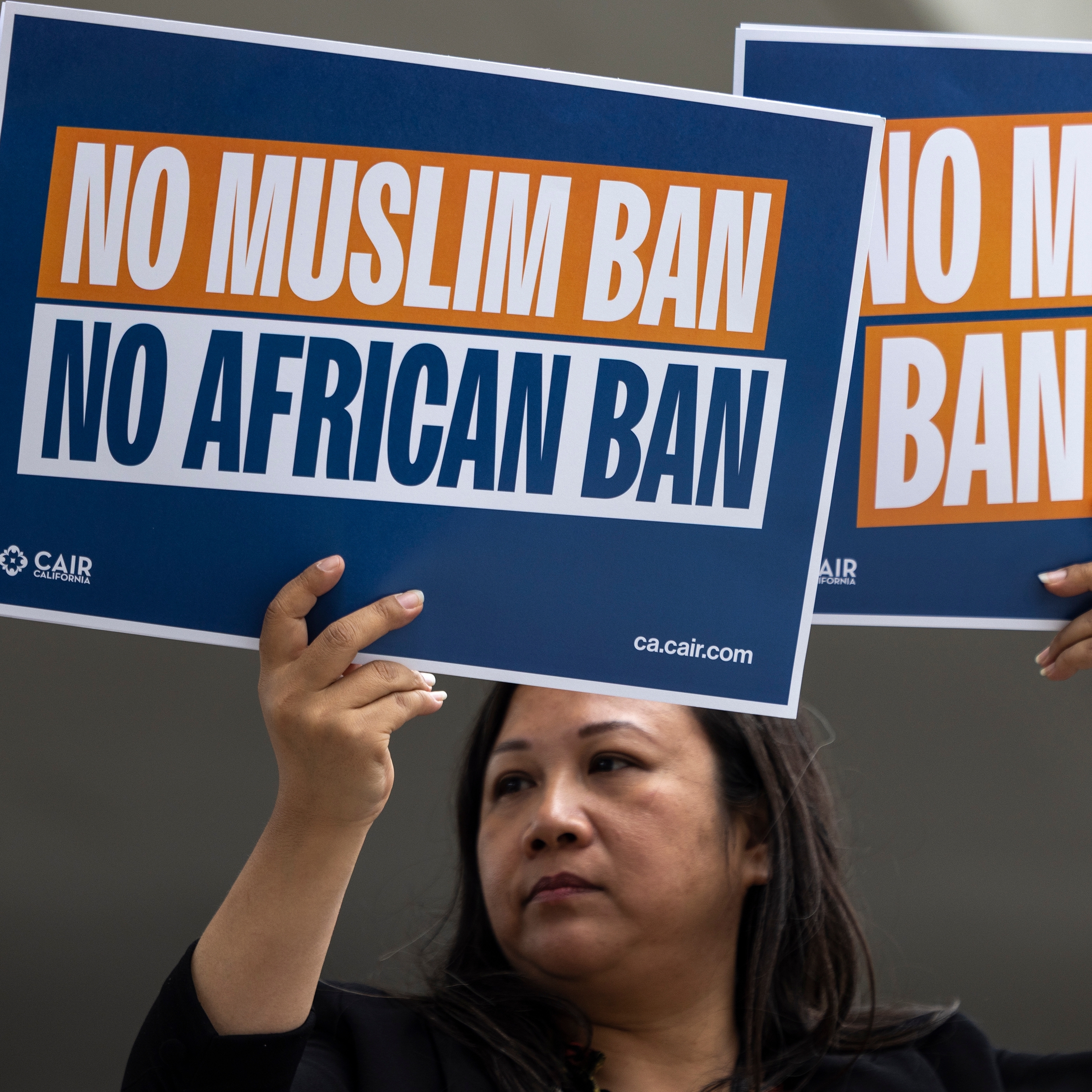
Post Reports
How Trump tried to build a lawsuit-proof travel ban
00:23:25
The first time President Donald Trump announced a travel ban, in 2017, it touched off protests at airports and a legal fight. Now, Trump has announced a new ban on travelers from 12 countries. It could be harder to challenge in court.
Loading summary
Transcript74 lines
- [00:00]
Greenlight Infinity
Did you know? 39% of teen drivers admit to texting while driving. Even scarier, those who text are more likely to speed and run red lights. Shockingly, 94% know it's dangerous, but do it anyway. As a parent, you can't always be in the car, but you can stay connected to their safety. With Greenlight Infinity's driving reports. Monitor their driving habits, see if they're using their phone, speeding and more. These reports provide real data for meaningful conversations about safety. Plus, with weekly updates, you can track their progress over time. Help keep your teen safe. Sign up for Greenlight Infinity@Greenlight.com podcast Within.
- [00:33]
Elahe Izadi
Days of becoming president in 2017, Donald Trump banned travelers from seven Muslim majority countries from entering the U.S. this travel ban stunned a lot of people. It created mass chaos at airports. People showed up in droves to protest. Let them see their lawyers.
- [00:53]
David Nakamura
Let them see their lawyers. Show me what America looks like. This is what America looks like. Show me what America looks like.
- [01:01]
Elahe Izadi
The ban also sparked immediate legal challenges. Eventually, the Supreme Court upheld a version that stayed in place until Trump left office. Now Trump is president again, and he's rolled out a new travel ban that went into effect Monday. People from a dozen countries are now barred from entering the US and this policy seems much more carefully crafted to withstand legal challenges. So will this ban be here to stay? From the newsroom of the Washington Post, this is Post Reports. I'm Elahe izadi. It's Tuesday, June 10th. Today I talk with immigration reporter David Nakamura about how the Trump administration crafted this travel ban, who will be affected, and why the response has looked so different this time. David, thanks for making time to join me today.
- [02:07]
David Nakamura
Hi, Elahi. Thanks for having me.
- [02:09]
Elahe Izadi
Okay, so David, before we go any further, let's just talk about the basics of this ban. As I said, There's 12 countries they are fully banned from entry into the U.S. it includes Afghanistan, Myanmar, Chad, the Republic of Congo, Equatorial Guinea, Eritrea, Haiti, Iran, Libya, Somalia, Sudan, and Yemen. So this means travelers from those countries cannot come into the US but can you tell me more about the groups of people within that who will be most impacted by this?
- [02:42]
David Nakamura
Sure. The broadest things are you could separate into two different categories. One is sort of family reunification visas. And these are folks who have some family members in the US who are trying to come as legal permanent residents and eventually get green cards. So they apply and they sort of take their time to try to get here. That is completely shut down for all of these countries.
- [03:00]
Elahe Izadi
So let's say there's someone who is a US Citizen and they have a family member from one of these countries like Yemen or Sudan, and the family member wants to visit them, but they can't visit them in the US Anymore.
- [03:12]
David Nakamura
Yes, there are some exceptions broadly to these which we can get into. And for the US Citizens, if it's their spouse or minor children, they will be still allowed.
- [03:19]
Elahe Izadi
Okay.
- [03:19]
David Nakamura
But any other relatives, adult siblings, parents, things like that, will be banned under this. The second group are basically folks who come temporarily under tourist visas. It's called B1 or B2 visas, that allow people to work here for business reasons temporarily. Student visas also are suspended, as well as what are called J1 cultural and exchange visas, which allow people to do educational and cultural activities for a temporary basis. And this is a pretty broad category. But these folks are also mostly not permitted to come.
- [03:49]
Elahe Izadi
And then there's a partial ban. Right. Which countries are included in that?
- [03:53]
David Nakamura
Right. The partial ban affects the countries of Burundi, Cuba, Laos, Sierra Leone, Togo, Turkmenistan and Venezuela. So the partial ban also blocks all family reunification immigration visas. It also covers a great deal of the sort of temporary visas, but does allow some exceptions on those, including some temporary work visas as well as other specialty visas in categories where we need certain kinds of workers or the US Judges otherwise that folks could come.
- [04:20]
Elahe Izadi
And how many people are estimated to be affected by this.
- [04:23]
David Nakamura
So there's no clear estimates. What some, some analysts I've talked to have looked at was the number that have come into this country from the 19 countries that are on these banned lists in 2023. And if you look at that, the numbers range from about 25 to 30,000 family visas from those countries in one year, and then more than 100,000 if you add up the categories of tourist, business and cultural exchange and student visas. So 100,000 to 120,000. So it's a significant population.
- [04:53]
Elahe Izadi
What is the reasoning from the Trump administration as to why travelers from these particular countries should not be allowed to come to the U.S. right.
- [04:58]
David Nakamura
So the administration, when they announced this last week, offered a sort of a rationale. And so they're saying some of these countries have, you know, kind of connections to terrorists. They're not doing enough to stop terrorists around the world. There's another category which I would say slightly it's about terrorism, but it's slightly different as well. They said, look, there's countries that don't keep track of their own criminals. You know, it may not be full on terrorism. Right. But these are criminals and they're just giving them travel passports. You know, and they're coming into the United States. Trump talks about, as, you know, sort of about immigrants who are coming in criminal gangs and to make mischief in American cities. That's another area saying they're not monitoring passport control as folks get a passport and then apply for a US Travel visa. The third category, though, was very new, was not something that had at all been mentioned in his first term. And that is what's called visa overstays. People who get a US visa, they come from another country, maybe it's a 30 day or several month visa, but. But suddenly it expires, but they remain in the country. What you heard the president do when he announced this last week was tie this to the situation with the attack on the protesters who were demonstrating in Boulder, Colorado on behalf of Israeli hostages a couple weekends ago, where they were attacked by a man who the administration's accused of doing this, who was an immigrant from Egypt.
- [06:15]
Donald Trump
The recent terror attack in Boulder, Colorado has underscored the extreme dangers posed to our country by the entry of foreign nationals who are not properly vetted, as well as those who come here as temporary visitors and overstay their visas. We don't want them.
- [06:32]
David Nakamura
And he had ultimately, it looked like, been here on a visa, temporary visa, and then he did overstay. Now, he apparently applied for asylum, which could potentially have allowed him to stay. But the administration said, look, this is a visa overstay. And Trump connected it to what, his rollout of the travel ban. Even though Egypt was not one of.
- [06:49]
Elahe Izadi
The countries, Egypt isn't one of the countries. So is it actually connected or is it more about the, like, the politics of the moment?
- [06:55]
David Nakamura
I think that the advocates would say, look, this is a politics of the moment. In fact, some did accuse Trump, said it was all about politics, looking for an opportune political moment to do this and scare people. But, you know, I think the administration would say and did say that Egypt has been, quote, working on, you know, these issues with the United States. So we're letting them off the hook, essentially.
- [07:14]
Elahe Izadi
You talked about the reasons why the Trump administration said that these countries need to have travel banned from them, that it's national security and other reasons. Right. Or they're not properly vetting travelers from these countries. What do we know about how true that is or not?
- [07:30]
David Nakamura
So it's, you know, some of the analysts that we talked to and heard from the first days pointed out that the number of American citizens who've been killed by any sort of terrorist on this list, I think was one. How do you judge how dangerous country is based on its overall population. Is it based on incidents around the world, not necessarily in the US Is it fatal incidents? I think advocates who are looking at national security but are sort of supportive of broader immigration, the United States would say this is too extreme. On the issue of vetting and areas around travel documents from some of these countries, people have said, look, there's some truth to some of that. Some of these countries don't have the best controls, and that should be improved. But is shutting down all travel from these countries the right way? Way to go? And the third thing is these visa overstays. If you look at the 2023 data, which is the last one we have from different countries around the world, how many of their citizens are coming here and overstaying visas? A number of countries that are not on the list, including Spain, had thousands of visa overstays, much more than Chad, which is on the list, was on the list the first time people were comparing the two and seeing that Spain seemed to have a lot more. So is this consistent? And could that then open up an avenue in a court of law to say what is the rationale? And is that a legitimate rationale?
- [08:45]
Elahe Izadi
And what do immigration advocates or people, you know, groups just focusing on human rights in some of these countries, what do they have to say about banning people from these countries coming to the.
- [08:56]
David Nakamura
U.S. yeah, they're outraged. They think it's political opportunism, inhumane. They think it's racially motivated. Others would say, look, this is bad because these people are trying to do it right. They're trying to get a visa. They're going through the right channels. They're not sneaking over the border. They're coming through points of entry. And some are trying to be reunited with American family members or legal permanent residents who are here, and that they've been waiting their turn in line and now they're suddenly just denied.
- [09:20]
Elahe Izadi
And how have the countries that are on this list responded to the travel ban?
- [09:24]
David Nakamura
You know, it's a good question because it's kind of run the gamut. You've seen some of the countries say, yes, we want to work with the United States. You know, we're going to do what we can and try to get off the list and help our citizens. But others have been more combative. I think Venezuela in particular was saying, you know, this is not something that in any way is supported by law, and people don't want to come to the United States. I think you don't want us.
- [09:46]
Elahe Izadi
We don't want you kind of.
- [09:47]
David Nakamura
Right. So there's been a mix of reactions in much the way you've seen with other Trump policies. And what's the best way to sort of confront Trump. Right. And so it depends on the country's, of course, interests, its own standing and its own leverage. But I think the Trump administration thinks that the American public will look at a lot of these countries and say, okay, we're supportive of this, at least his base. And so they're not thinking so much about the reaction of these other governments.
- [10:14]
Elahe Izadi
So this ban went into effect Monday. So how has it played out so far? What has been the scene at airports? Is there mass chaos and confusion?
- [10:23]
David Nakamura
Right. There was a lot of outrage when this was announced last week. But the Monday when this went into effect, US Airports did not see major disruptions. There were some protests in places like Los Angeles, Chicago, Indianapolis, New York City. There was one downtown. But these were fairly modest sized protests from what we've seen before. And the another thing is that there was some lead time, so there were no travelers that appeared to be denied entry once they got here.
- [10:47]
Elahe Izadi
I see. Whereas the first time there was some chaos because people were coming back, people.
- [10:50]
David Nakamura
Were being detained and sent back and there were, you know, lawyers for them rushing and their families rushing to the airports to deal with that.
- [10:55]
Elahe Izadi
Right, right. You know, we are gonna talk a little bit more about the first time President Trump did this, you know, back in 2017. And as we said, there was a lot of outrage and protests at that time. And it seems like a very different response this time. What do you make of the difference between the response?
- [11:13]
David Nakamura
You know, a couple things. The Trump administration did put in some lead time for people to be prepared. I think the other thing is that I talked to is people said, look, the president in his first day in office, the second term signed a number of executive actions just aimed at immigration. And he's rolled those out. And a number of them have been perhaps even more shocking than the travel ban had been the first time. And so one of the folks who was involved in one of the protests yesterday in Los Angeles, I talked to her on the phone. She's from cair, a group that deals with sort of advocating on behalf of Muslim Americans. She said to me, look, we can't have sustained outrage. It's hard to notch it up another level over this travel ban because we've seen so many extreme things in her view. And so even in Los Angeles, there's protests going on just down the way from the airport. Right. Based on what happened over the weekend with the ICE raids and a number of the protesters at the airport were then heading over to join the other protests. So it's not that they're saving their outrage, but they're working on other areas and this is part of it. But they're saying, look at the broader aspect. We have to fight so many areas.
- [12:11]
Elahe Izadi
This is coming at a time when Trump is trying to crack down on immigration in a variety of ways. There's mass deportations, the attempts to ban birthright citizenship, the protests in Los Angeles this week, and sending in the National Guard over the objections of the California governor. How does this, what the Trump administration is doing with this travel ban fit into its broader approach on immigration?
- [12:36]
David Nakamura
Right, you're seeing them try to shut down as many avenues as they can, both getting into the country obviously at the border and points of entry, which this fits into. Right. Shut down as much of that new immigration while at the same time ramping up the deportations within the country. The Trump administration has been largely successful in really tamping down the number of border crossers coming in from over the U. S. Mexico border. This area issue of points of entry. You've seen already reports earlier this year about, you know, green card holders and other students being stopped at airports, getting bigger screenings. I think they're overall, there's a activist would say it's not only trying to stop it, but also get folks to sort of not want to come and essentially either self deport and leave the country voluntarily if you're here as an immigrant who's not a full American citizen or, you know, just decide you're not going to come. And that sort of ultimately gets to the goals of the administration, which is to say, you know, we're making this country for native born Americans and America first.
- [13:33]
Elahe Izadi
After the break, what a Supreme Court precedent means for this travel ban. We'll be right back.
- [13:50]
Thanet Naropil
As the temps start rising, I feel that familiar urge to refresh my closet. But I'm not wasting money on pieces I'll only wear once or just for one season. Quince changes that their clothes are timeless, lightweight and far more elevated than anything else. At this price, it finally feels like my wardrobe matches my standards. By working directly with top artisans and cutting out the middlemen, Quint's gives you luxury without the markup, and Quinn's only works with factories that use safe, ethical and responsible manufacturing practices and premium fabrics and finishes. For me, a linen shirt is a wardrobe staple, especially for the humid D.C. summers. But quality linen at an affordable price is hard to find. The ones from Quince are made from 100% European flax linen, so they're lightweight, breathable and get softer every time it's worn. Exactly what I want in a summer shirt. Give your summer closet an upgrade with Quince. Go to Quince.com reports for free shipping on your order and 365 day returns. That's Q-U-I-N-E.com reports to get free shipping and 365 day returns. Quince.com reports.
- [14:56]
Unknown Speaker
I'm Thanet Naropil and I'm health reporter for the Washington Post. My job is to cover public health, and that means I'm writing about infectious disease threats like Covid mpox and bird flu. And I'm also holding the federal government and state government officials accountable for how they respond to these disease threats. So when we write about public health issues, we want to serve our readers by going deep into the science and by making sure that what they're reading is authoritative information that's been vetted by experts and written by people who've covered these issues for years. We want to empower people to live their best lives and to protect themselves and their loved ones. And that's what subscriber supported work does, is that it gives me the time and resources to really spend on a story that when you subscribe to the Washington Post, you support this kind of journalism and the people behind it. I'm Fennet Neerpil, and I'm one of the people behind the Post.
- [15:57]
Elahe Izadi
So, David, as we've said, President Donald Trump during his first term enacted a travel ban. And that very first one created a lot of chaos. Let's now talk about that first ban in 2017. Who did it affect?
- [16:10]
David Nakamura
People will recall that was within the first week of his taking office. And it was a real shock. But, you know, they essentially were targeting Muslim majority countries. And it was seven countries, all of them Muslim majority. And, you know, it immediately shut down all pathways into the country from any travelers coming from those countries, including those who were in route, you know, and so this did not have a provision like the current order where it does allow folks who had already received a visa to arrive here.
- [16:35]
Elahe Izadi
Yeah. And I remember while he was campaigning, he talked about a Muslim ban. So then when this happened was instituted, a lot of people perceived it as a Muslim ban because the countries were Muslim majority.
- [16:46]
David Nakamura
Right. And President Trump was at the time, candidate Trump, back in 2016, was calling this a Muslim ban. He was saying, look, this is related to terrorism and we have to protect the borders, protect the country.
- [16:56]
Donald Trump
Donald J. Trump is calling for a total and complete shutdown of Muslims entering the United States until our country's representatives can figure out what the hell is going on.
- [17:11]
David Nakamura
And that was one of the first big moves out of the box for him. People then looked at that and said, look, you're discriminating. You're discriminating based on religion and not based on necessarily facts and figures about terrorist acts or how this is gonna actually be about national security.
- [17:23]
Elahe Izadi
So then what happened with that ban?
- [17:25]
David Nakamura
So that ban was immediately challenged, or very quickly challenged by a number of entities, including the aclu, but also some states, led by the State of Washington, filed federal lawsuits, and it was immediately enjoined by the federal judges, and they blocked it from moving forward. And so then that launched a fairly lengthy legal battle.
- [17:43]
Elahe Izadi
And then where did that legal battle end up?
- [17:45]
David Nakamura
The first Trump administration revised the ban, and they tried sort of another version of it that was also challenged in another court and stopped. Ultimately, it went on for many, many months. And the administration adopted a third version, which added some other countries like North Korea and Venezuela, I think, to get around the idea that this was targeting religious groups. And ultimately, almost a year and a half later, In June of 2018, the Suprem Court did uphold the third version of the travel ban. The court said that as a whole, the president had the authority to keep the public safe and that this could be judged fairly as a national security issue, of which the president gets a lot of power from the Constitution to take those kind of actions, including on immigration. And so the court also agreed that the administration had made a number of changes to their initial version that sort of gave more specific reasoning as to why the specific countries on the list were on there.
- [18:37]
Elahe Izadi
And then Joe Biden becomes president. And I know that he rescinded the travel ban on his first day in office in 2021. But all of that brings us to today, 2025. Did Trump promise on the campaign trail this time around that he would enact another travel ban?
- [18:56]
David Nakamura
Yes, he talked about this, as, you know, in sort of the broader areas of things they were going to do.
- [19:02]
Donald Trump
When I return to office. The travel ban is coming back even bigger than before and much stronger than before. We don't want people blowing up our shopping centers, we don't want people blowing up our cities, and we don't want people stealing our farms. So it's not going to happen.
- [19:18]
David Nakamura
It was not a surprise whatsoever to advocates that on his first day in office, he directed in one of his executive orders that he signed that first evening on January 20th, directed the state Department to undertake a study to look at how they may enact a new travel ban.
- [19:32]
Elahe Izadi
That's fascinating to think about the contrast between 2017 and today, where in 2025, this Trump administration directed a study to do this. Whereas I remember from the first travel ban, the perception was this was hastily put together and rolled out, which was part of the reason it had to be revised a number of times before it was taken. Withstood legal challenges. So. Yeah. Has this one been in the works for a while?
- [20:00]
David Nakamura
It has been in the works, actually. We heard some reporting suggested that this could have been dropped or announced in February of this year. And we were a bit surprised they had not announced the travel ban. When was it coming? And that's why some people point to the idea that after this Boulder attack, there was a window to say, oh, these are tied also to visa overstays. We're gonna drop this. And the public would see Trump's taking action sort of politically more palatable. We have not actually seen any report from the State Department that they apparently delivered to Don Donald Trump. You know, the. The White House said the president received a report and reviewed it from the State Department.
- [20:31]
Elahe Izadi
And this is a report to see the impacts or how to do this.
- [20:35]
David Nakamura
Policy, how to judge which countries should be on this. Right. And so. And this is a changing list, according to President Trump. He said, you know, countries that make improvements to their vetting could be taken.
- [20:42]
Donald Trump
Off the list, is subject to revision based on whether material improvements are made. And likewise, new countries can be added as threats emerge around the world. But we will not allow people to enter our country who wish to do us harm.
- [20:59]
David Nakamura
But, you know, there's been a lot made of the idea that we're in this moment of the boiling frog, where things are getting hotter and the frog doesn't necessarily know it. Right. And so the idea that there was all this outrage over the first travel ban, and that's kind of muted now. We kind of getting used to these kind of extremes. Right. And so it has to be even more extreme for the public outcry which you're seeing in Los Angeles.
- [21:18]
Elahe Izadi
So given that the Supreme Court did eventually rule that the president can enact a travel ban, does that mean legal challenges to this ban are.
- [21:27]
David Nakamura
Yeah. You know, we talked to a number of lawyers from, you know, immigrant rights groups, as well as some of the Democratic state attorney generals who have sued this administration quite a bit over a number of their policies, including on Immigration. And a number of them did say that this appeared to be much more carefully written. Someone said that the first one was sort of a statement of policy goals in the way that was written the first time, or whereas this one is written a bit more as a legal document and sort of explaining exactly had rationales for each country why they're on there with some statistics. It also had the exceptions that we talked about that made, I think the courts look at this as a more favorable thought through policy. So advocates said it will be harder to win in court to shut down this entire thing. We haven't even seen any lawsuits that we know of yet, really. Right. And so in the first, that seems.
- [22:12]
Elahe Izadi
Unusual because it just seems like anything that Donald Trump is doing these days.
- [22:15]
David Nakamura
Immediately, almost immediately challenged. And they had a lot of time. The advocates knew this was coming, but one of them said to us, you know, this is bad, but not as bad as it could have been. You know, there was some reporting, like I said early in the first few weeks about what this ban could look like. A lot more countries. There was an idea it could be 30 or 40 countries. So the advocates had time to sort of think about their legal strategy, but they said that it could be harder to go after this policy and get it enjoined because of that Supreme Court ruling. It gave them broad latitude. This was written in a similar way. What one person did tell us was, look, this could maybe be challenged on an individual basis. You know, if this person is trying to come, you know, and they feel like they should be on the exceptions list, or the administration didn't do the right, you know, examination of their personal case, then they could try to sue over that. Now, that would potentially lead to a lot of lawsuits from individuals who hire lawyers and their families. But this idea of getting a national injunction that we've seen, a nationwide injunction, we've seen in so many cases, is one that could be harder here.
- [23:08]
Elahe Izadi
Yeah. So what's next? What will you be looking at when it comes to the travel ban?
- [23:12]
David Nakamura
I think if we don't see mass protests or mass problems or some sort of shutdown in the courts of the whole program, how is this being implemented? Because there's this idea the administration is also wearing away sort of the government offices that have personnel to do this kind of thing. As you see budget cuts and sort of redirecting immigration services away from services of immigrants, coming more toward the deportation of immigrants. And so the idea that there are a number of cases could be bogged down, which are probably ones that People should be allowed. I think it also is interesting if Trump uses this, as he likes to do with leverage of you could be on the list and sort of use.
- [23:48]
Elahe Izadi
That like for individuals or countries.
- [23:49]
David Nakamura
No, not individual countries. You know, he did say there was a video the president put out on the night he announced this where he said, this is a changing list. And depending on circumstances, you could be added, you know, and so, you know, so could this come up in other negotiations over economics or other interests that the president had? One of the things also that the administration was looking at was countries that accept deportation flights. So some countries don't want to take back some of their migrants who could potentially actually be criminals here. Not all are that they're being sent, but administration saying, you know, those who don't work with us on our immigration goals, they may be on this list, essentially. So now they're. Now that could be a challenge in court because that's sort of broad and vague. But that's one thing they've hinted.
- [24:25]
Elahe Izadi
Well, that's fascinating. Thinking of it as this is potentially a chip in negotiations.
- [24:30]
David Nakamura
Yeah, well, you know, this president likes to make deals. I mean, he's doing economic tariffs. I mean, could this. Immigration certainly falls in broadly to one of his most important goals politically. And so his administration has made clear they're going to do everything they can, including trying to force countries to take immigrants. They've looked obviously to third countries, El Salvador and others who are willing to take migrants, not even from their country, so that careers favor. And so could you want to get off this list for one reason or another and you agree to do things that you might not otherwise do, that's possible.
- [24:59]
Elahe Izadi
Well, David, thanks so much for taking time to explain all this.
- [25:01]
David Nakamura
Sure. Anytime.
- [25:04]
Elahe Izadi
David Nakamura covers immigration for the Post. That's it for Post Reports. Thanks for listening. If you want to show your support for the show, please subscribe to the Washington Post. Not only is it a great way to help us continue to do this work, but you can now get access to Washington Post podcasts ad free in Apple Podcasts. Today's show was produced by Emma Talkoff with help from Rennie Srinofsky and Taddeo Ruiz Sandoval. It was mixed by Sam Baer and edited by Ariel Plotnick. Thanks to Christine Armario. I'm Elahei Izadi. We'll be back tomorrow with more stories from the Washington Post.
- [26:02]
Greenlight Infinity
Did you know 39% of teen drivers admit to texting while driving? Even scarier, those who text are more likely to speed and run red lights. Shockingly, 94% know it's dangerous, but do it anyway. As a parent, you can't always be in the car, but you can stay connected to their safety with Greenlight Infinity's driving reports. Monitor their driving habits, see if they're using their phone, speeding, and more. These reports provide real data for meaningful conversations about safety. Plus, with weekly updates, you can track their progress over time. Help keep your teens safe. Sign up for Greenlight infinity@Greenlight.com podcast.