← Post Reports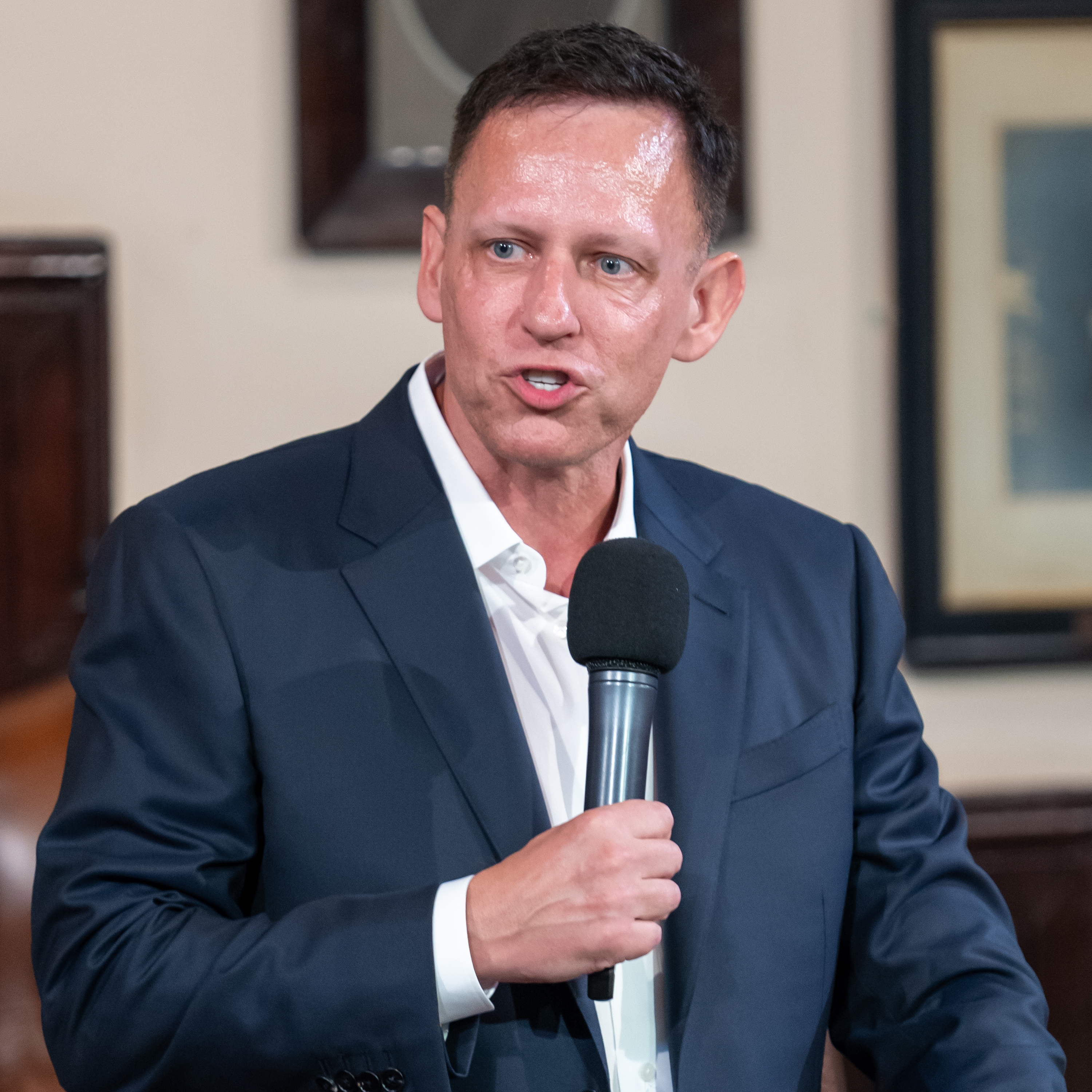
Post Reports
Inside billionaire Peter Thiel’s private ‘Antichrist’ lectures
00:24:48
The billionaire Peter Thiel recently hosted a series of exclusive lectures in San Francisco. The topic? The Antichrist. Today, his arguments and what they say about an emerging mindset in Silicon Valley.
Loading summary
Transcript68 lines
- [00:03]
Peter Thiel
Good evening. Thank you for having me. Many of you know me from public life as a technology investor entrepreneur.
- [00:12]
Colby Ekowicz
That's tech billionaire Peter Thiel. The Post obtained exclusive leaked recordings of a series of talks he gave in San Francisco recently. The topic, broadly, was faith and technology.
- [00:25]
Peter Thiel
In private, a small o orthodox Christian, humble classical liberal, with just one seemingly minor deviation from classical liberal orthodoxy. I am worried about the Antichrist.
- [00:38]
Colby Ekowicz
That's right, the Antichrist. At these lectures, Thiel made the case that some who want to limit the power of tech companies are working against.
- [00:47]
Peter Thiel
God in the 21st century. The Antichrist is a Luddite who wants to stop all the science.
- [00:58]
Colby Ekowicz
Thiel has been a big figure in Silicon Valley for a while, but now he's close to political power, too. He has allies in the White House like Vice President J.D. vance and White House crypto czar David Sachs. Post tech reporter Garrett De Vinck says that makes his views especially potent.
- [01:16]
Garrett de Vinck
Peter Thiel has always been conservative. He's always opposed most tech regulation. But he is more politically influential now than he's probably been at any point in his career. And he's also bringing in his religion, his faith, which just sort of amplifies these ideas and gets a lot more people talking about them.
- [01:39]
Colby Ekowicz
From the newsroom of the Washington Post, this is Post Reports. I'm COLBYAKOWICZ. It's Thursday, October 23rd. Today, inside a secretive lecture series that's the talk of Silicon Valley and what it says about tech's great growing power and ambition during the second Trump administration. Hey, Garrett, thanks so much for joining me.
- [02:09]
Garrett de Vinck
Of course.
- [02:10]
Colby Ekowicz
So, Garrett, before we dive too deeply into these lectures, I think it'd be helpful to know about Thiel, who he is, and how has he gained all this power in the tech world.
- [02:22]
Garrett de Vinck
Peter Thiel is one of the richest people in the world. So that's a big place of where his power comes from. And his wealth really stems from being an early investor in a lot of the big technology companies that have kind of grown in size over the last 20 years. He helped found PayPal, and he sort of traveled in these circles, investing in different companies. Probably the biggest one was Facebook, and that's where a huge portion of his wealth has come from over the years. Then he helped to launch Palantir, which is a data company that is one of the most valuable companies in Silicon Valley today. And they're a data company that helps law enforcement agencies. And so he's actually gained his wealth from multiple big investments, and that's given him a platform as a venture Capital investor. A lot of people want his advice. They want his money for their own startups. But he's also very conservative politically, and that's something that up until recently has been pretty rare in Silicon Valley. Yeah.
- [03:23]
Colby Ekowicz
What has his role been in our political system?
- [03:28]
Garrett de Vinck
Yeah, I mean, it goes back all the way to when he was in college at Stanford. He created a conservative journal there. He's, you know, been someone who sort of believes in getting ideas out there into the culture. And in 2016, he supported Donald Trump's presidential campaign and actually later served on his transition team.
- [03:47]
Colby Ekowicz
Was the Donald Trump campaign, was that the first time he really got himself involved in national politics in that way?
- [03:54]
Garrett de Vinck
That was definitely the most prominent. I mean, he also supported J.D. vance, who's actually one of his mentees, of course, J.D. vance, now the Vice President of the United States. They worked together for a short period of time, and he supported J.D. vance's Senate campaign. You know, he kind of picked this guy early on in his career, helped fund his rise. And now JD Vance is really at, you know, the center of the MAGA movement.
- [04:18]
Colby Ekowicz
Okay, so Thiel has what you're saying. He's got a lot of power and influence, obviously in the business and tech worlds, but also now in the White House. Let's turn to these lectures, though. What exactly were they advertised to be about?
- [04:32]
Garrett de Vinck
Yeah, it's really interesting. It was marketed very directly. The title was the A four part lecture series. It happened every Monday for four weeks. And in order to get in, you actually had to agree to go to all four lectures. And each one took over two hours. And so this is a fairly big commitment. It's almost like taking a college seminar is kind of what it seems like.
- [04:58]
Colby Ekowicz
But these were all off the record, right? I mean, how did we get recordings of these lectures?
- [05:03]
Garrett de Vinck
So, you know, we were leaked these recordings by, you know, one of our sources. Obviously, we're protecting their identity because they, you know, had agreed not to do that, and we were very careful with that. But that's how we got that, actually from someone who was in the room during all four of the lectures. We also actually ran the audio through some AI AI deepfake detectors. Those didn't, you know, identify any potential manipulation. We also talked to Peter Thiel's spokespeople, and they did not deny that the recordings we had were authentic.
- [05:37]
Colby Ekowicz
And were there a lot of people that attended these lectures?
- [05:40]
Garrett de Vinck
There were several hundred people at the venue. It was kind of the hottest ticket in town. And that's not necessarily because people here in San Francisco really want to hear about theology, but people are interested in Peter Thiel. And, you know, he's kind of become this cultural villain for a lot of liberal people. People may remember that he participated in funding a lawsuit against Gawker, a liberal leaning news website that actually led to Gawker eventually being shut down. And also his support of Palantir, which a lot of people see as this sort of spooky, kind of vaguely sinister data and surveillance company, even though in reality they're a little bit more boring than that. You know, especially among people who identify as strong liberals, he kind of comes across as a bit of a Bond villain. And so he is a controversial figure in and of himself. And when he says, hey, I'm gonna do this lecture series about the Antichrist, it definitely gets people talking. And I think a lot of the interest to go was just out of curiosity. People wanted to see what was this even about, what was he gonna say? And, you know, it sold out.
- [06:48]
Colby Ekowicz
So what was Steele's central argument here?
- [06:52]
Garrett de Vinck
Thiel's central argument is that those who oppose technological and, you know, really capitalist progress represent the forces of the Antichrist.
- [07:03]
Peter Thiel
The book of Revelation tells us that the Antichrist will abolish financial freedom. Revelations 13, 16, 17. He causes all, both great and small, rich and poor, free and bond, to receive a mark in the right hand or in their foreheads that no man.
- [07:18]
Garrett de Vinck
And so in Christianity, there's this idea that in the end times, an Antichrist will appear. And depending on your interpretation, this could be a single person, a very powerful and, you know, charismatic politician. It could be sort of, you know, a system of social forces that sort of oppose God and oppose God's final plan for humanity and the earth. But it is this sort of dramatic showdown between good and evil. And, you know, historically, a lot of people had said, oh, you're the Antichrist, the Antichrist. A lot of people thought Napoleon Bonaparte was the Antichrist. He was sort of rallying people together and growing more and more powerful. And then when, you know, Hitler came on the scene, people thought he was the Antichrist as well. So every generation sort of has their own Antichrist. And Peter Thiel says that although in the past people may have said, you know, the Antichrist would be someone who was, you know, pro science, pro technology and anti religion, today the people who are, you know, the Antichrist are actually opposing what he would say is, you know, scientific progress so AI becoming more and more capable and used in more and more places. Capitalism and free market policies becoming more and more commonplace versus regulation to, you know, stop climate change or stop industries from polluting the environment. He says people who advocate for those sort of controls on business, especially at the international level, to him represent the Antichrist.
- [08:49]
Peter Thiel
This Antichrist like system, this machinery, has been set up not overnight, but, you know, relatively quickly. And there's a feeling that, you know, it could be activated at the flip of the switch.
- [09:12]
Colby Ekowicz
So in Thiel's view, are there like, specific people who actually are the Antichrist?
- [09:18]
Garrett de Vinck
So Thiel doesn't identify the actual Antichrist, but he does name a few people that he says are legionnaires of the Antichrist.
- [09:25]
Peter Thiel
It's someone like Greta or Eliezer.
- [09:27]
Garrett de Vinck
He mentions the climate activist Greta Thunberg and some people who are advocating for regulations for AI, such as Eliezer Yudkowski.
- [09:37]
Peter Thiel
The East Bay rationalist. Eliezer Yudkowsky. I'm embarrassed about all the ways I, I was once affiliated with these various people. How crazy they've all gone.
- [09:51]
Garrett de Vinck
Greta Thunberg, she has rallied a lot of young people to do very direct actions. Protests demand stricter, more rigorous climate action from politicians for years now. He says she is one of these people who is trying to constrain progress, constrain economic growth, because she's worried about the environment, about the impact of CL change on human society. And Eliezer Yudkowski, who's actually, you know, growing in prominence, he is one of these people who believes that as AI becomes more and more powerful in, you know, a very short period of time, you know, just a number of years, less than 10 years, maybe AI could become so powerful that, you know, humans can no longer control it. He also name checks a Swedish philosopher, Nick Bostrom.
- [10:42]
Peter Thiel
I'm going to speak a little bit on Nick Bostrom from the ea, who's.
- [10:46]
Garrett de Vinck
Sort of responsible for popularizing the idea of a super intelligence. So that is this theorized AI that is way smarter than humans and will make decisions that we can't even fathom. And he sort of says these are all people in hyping up the dangers of AI or hyping up the dangers of unrestrained progress or economic growth are hastening the coming of the Antichrist.
- [11:11]
Colby Ekowicz
Is the argument there, Garrett, that God is pro technology, God is pro capitalism.
- [11:18]
Garrett de Vinck
I mean, it's very convenient, right? Because Peter Thiel's fortune does rest on tech companies continuing to grow and make more money and not to be constrained by regulation. And so Peter Thiel, when you listen to these recordings, he's clearly spent a lot of time thinking about these things, reading about these things. I do think his beliefs are probably truly held that he is a religious person. But ultimately, I mean, that's what he's saying, right? He's saying people who want to slow down the progress of AI because they're worried that AI could become so powerful that humans can't control it anymore. Those people are the forces of the Antichrist, because they will sort of come at a moment when the world is nervous about technological advancement, and they will say, we will give you an answer, and if you just follow me and follow my rules, we can avoid the dangers of technology. And right now, in the conversation around AI is talking about that, right? I mean, some people truly do believe that in the next few years, artificial intelligence will become so powerful that humans won't be able to control it anymore. And a lot more people also believe that even though that's probably not going to happen, AI is still a technology that needs regulation. When you poll people in the United States, most regular people say, yeah, of course, we should regulate this technology to make sure that it's not being infused with bias. You know, being used to decide, like, who's a criminal, who's not, you know, being given to children without checking to make sure that it won't have negative impacts. And there's a lot of conversation about tech regulation. And Peter Thiel says, you know, anyone who's sort of pushing that regulatory framework is just sort of setting the stage for more control over people's lives, totalitarianism. And that's really where his argument goes.
- [13:16]
Colby Ekowicz
After the break, Thiel defends his ideas and what this merger of tech and religion says about the crossroads Silicon Valley finds itself at right now. We'll be right back.
- [13:35]
Shopify Advertiser
We all have tons of decisions we juggle every day at work and in our businesses. Even us here at the Post. Scripts, show artwork, recording schedules. It can get overwhelming. And that's especially true if you're starting a small business. It can be pretty intimidating wearing so many hats and learning everything on the fly. So finding the right tools and partners that not only help you out, but also simplify everything can be such a game changer for millions of businesses. That tool is Shopify. Shopify helps you in so many ways. From building a beautiful online store using their hundreds of templates to helpful AI tools that write product descriptions, page headlines, and even enhance your product photography to help you easily create email and social media campaigns to target your customer, wherever they may be. That's why millions of brands like Allbirds and Skims use Shopify to grow their businesses every day. Turn your big business idea into with Shopify on your side. Sign up for your $1 per month trial and start selling today at shopify.com reports. Go to shopify.com reports shopify.com reports.
- [14:43]
Washington Post Advertiser
You listen because you know the power of good journalism. And the Washington Post is there for you 24. 7. When you become a Washington Post subscriber, you get exclusive reporting you can't find anywhere else. You also get sharp advice columns, delicious recipes, TV and music reviews and and so much more. Right now, you can get all of that for just $4 every four weeks. That's for an entire year. After that, it's just $12 every four weeks. And you can cancel anytime. Add to your knowledge and discover all the Post has to offer. Go to washingtonpost.com subscribe that's washingtonpost.com subscrib.
- [15:31]
Colby Ekowicz
So in these lecture series, Thiel is basically arguing that people like Greta Thunberg are bad for society as a whole. But I guess I'm still confused, like, why he's making a religious argument about tech regulations. Like, what's the connection there?
- [15:49]
Garrett de Vinck
He says that, you know, as a religious person, he thinks in these terms. And essentially he's saying that we are living in the most apocalyptic times yet.
- [16:02]
Peter Thiel
You just need to open a newspaper or look at the Internet or whatever, wherever you get your news, to read about the apocalypse and Silicon Valley.
- [16:09]
Garrett de Vinck
We have all this technological progress. We also have all this geopolitical conflict. The old assumptions in the 20th century about the US being the most powerful nation in the world is potentially, potentially starting to slip. We have China rising. We have the war in Ukraine, we have war in Gaza and all this conflict. And I think a lot of people would say, yeah, that sounds about right. It feels like things are getting worse in the world again. A lot of generations have said that about their own times. But Peter Thiel sort of makes this argument that we're in this apocalyptic time and as humans, we need to avoid that apocalypse where maybe we have a nuclear war and millions and millions of people die. And we also need to avoid the Antichrist, who he believes is someone who will come in and say, hey, if you want to avoid that conflict, follow me. Follow the one world order, the world totalitarian government.
- [17:11]
Peter Thiel
I think there are a lot of rational reasons I can give away One world state's a bad idea, turn the planet into a prison. I think the tax rates will be very high. There's sort of ways in which, you know, I can describe the sort of financial ideological machinery that's been set up and that has this sort of incipient totalitarian quality.
- [17:31]
Garrett de Vinck
He also brings up a lot of international financial regulations which affect him personally as a billionaire with money that he likes to keep and not give up to governments. And so, you know, a lot of his arguments for this sort of budding global totalitarian system are essentially saying, you know, I don't want countries to conspire together to make sure I pay my taxes. And so there's definitely a large self serving part of that, but that's kind of where he's coming from.
- [18:03]
Colby Ekowicz
Yeah, I find all of this a little hard to follow because his argument seems a little hard to jump from, you know, the Antichrist to totalitarian rule to technology. Like, when you were hearing these arguments, what was your reaction?
- [18:23]
Garrett de Vinck
I mean, I do think that there's a lot of holes in his argument. Thiel actually, you know, talked about some of these ideas on the New York Times columnist Ross Douthat's podcast. I just don't see the promise of safety from AI, safety from tech, even safety from climate change right now as a powerful universal rallying cry absent accelerating change and real fear of total catastrophe. Douthad is a fellow conservative, and even with him in that conversation, Thiel has trouble sort of justifying some of these arguments.
- [19:03]
Peter Thiel
Man, these things are so hard to score. But I think environmentalism's pretty powerful. I don't know if it's absolutely powerful enough to create a one world totalitarian state, but man, it is.
- [19:19]
Garrett de Vinck
I think it is not in its current form.
- [19:21]
Peter Thiel
I want to say it's the only thing.
- [19:23]
Garrett de Vinck
He also talks about the International Criminal Court, but again, those are not very strong and enforced rules. He says the fact that Israeli Prime Minister Benjamin Netanyahu can't really travel around the world because he might be arrested by the International Criminal Court shows that there's this incipient form of global regulation. But I think anyone who has studied international relations, they know that all attempts to have strong international law, it hasn't really gotten anywhere.
- [19:56]
Colby Ekowicz
Well, it's interesting to hear Thiel kind of rail against the idea of totalitarianism when, you know, there would be some in this country who would argue that President Trump is moving the US towards authoritarianism, you know, centralizing power around the executive. I mean, has Thiel ever been questioned about that?
- [20:18]
Garrett de Vinck
Yeah, I mean, it's something that I wish had come up in the Q and A. You could point to the United States, you could point to other, you know, governments where there, there is this sort of, you know, anti Democratic backsliding, and he doesn't address that. He has asked about Trump a couple times. And, you know, one of the questions is, you know, Trump went, went in front of the United nations and he sort of railed against globalization. The entire globalist concept of asking successful industrialized nations to inflict pain on themselves and radically disrupt their entire societies must.
- [20:52]
Peter Thiel
Be rejected completely and totally, and it must be immediate.
- [20:56]
Garrett de Vinck
Isn't this a sign that, you know, the good guys are winning, essentially, you know, the anti globalists, those who oppose international orders, are winning. And Peter Thiel says, yeah, I guess so. But, like, you know, Trump is just one person and we can't put all our eggs in one basket.
- [21:10]
Peter Thiel
It's. That's, that's an unfairly high bar you're giving to Mr. Trump. All right, you're just trying to make a subtle anti Trump argument. I'm not going to let you do that.
- [21:20]
Colby Ekowicz
Okay, interesting. So back to these lectures, Garrett. It seems almost like Thiel, he's preaching his beliefs here. Right. So why did he want them to be so exclusive?
- [21:33]
Garrett de Vinck
Yeah, and I think this, you know, is a sort of interesting part of this, too, which absolutely added to the intrigue. Right. The events were off the record. Everyone who attended had to essentially, you know, agree and kind of sign this web form saying, you know, I will not talk about what I heard here. This is sort of, you know, for us only, this sort of in group thing. And when you listen to the recordings, there's actually a part where Peter Thiel himself kind of admits that the whole thing is a bit of a marketing shtick for, you know, drumming up interest.
- [22:07]
Peter Thiel
Hey, it's a pretty good marketing shtick to just, if you want everyone to hear about something, not to let anyone into the room, not Brandon, but I.
- [22:16]
Garrett de Vinck
Think that's probably the main reason they were off the record. I also think he may be sort of working out his own ideas.
- [22:23]
Colby Ekowicz
How much is this a reflection of where Silicon Valley is right now? Are there other tech leaders that also kind of share Thiel's ideology?
- [22:31]
Garrett de Vinck
Yeah, I mean, there's definitely, I would say, a resurgence of sort of public Christianity here in San Francisco and in Silicon Valley. I mean, there's always been religious people here, but I do think, you know, you are seeing more people who maybe have been quiet about their religious faith, being a bit more public about it, being a bit more open about it, maybe being more comfortable with it as they see other people like Peter Thiel, you know, prominent leaders in the tech community, talking about it openly. And I think there's also, you know, it kind of goes together with, I would say, this growing public conservatism in Silicon Valley. Right? Because for many years, people here, even if they weren't necessarily politically liberal, they were skeptical about, for example, working with the military, building technology for, you know, the military to build, you know, AI for machines that may be used to kill people. You know, as a very intense example, they were skeptical of building technology that could be used by law enforcement or national security agencies for surveillance. That was not seen as something that Silicon Valley did. And over the last few years, I think a couple things have happened. Obviously, the Republican Party being so successful on the electoral front, the rise of Donald Trump and the MAGA movement has definitely empowered people here who have those political beliefs to say, look, we were right. You guys should actually be listening to us. And a lot of people have said, huh? Okay, yeah, we should be listening to them. Maybe we should switch our politics. Because at the end of the day, what really matters here in Silicon Valley is, you know, growth and making money. And I think companies like Palantir, which had a lot of success selling to the government, selling to the military, have proven that you can actually make a lot of money. And that's, you know, a lot of people who maybe would have been a bit squeamish about that before they've dived right in.
- [24:29]
Colby Ekowicz
Well, that kind of brings me back to something that you said earlier, that this argument is, you know, convenient for Thiel because less regulation on tech benefits him financially. How much of this is just about money?
- [24:42]
Garrett de Vinck
I mean, I think it is convenient. I also think that Peter Thiel and a lot of people here in Silicon Valley, they believe that they are the ones who've created the world that we live in. They're the ones who've created the future. And they've become immensely wealthy because of these technologies that they've invested in the Internet, Facebook, all these kinds of things. And they think because they've had that success in the business realm, they should have influence in the way society works. And that's a very deeply held belief. I would say, here in Silicon Valley, across the political spectrum, that ideas here are correct or better than maybe ideas coming from other sectors of society. And if only the government and the activists would just get out of the way, then they would show that all these technologies are actually good for the world and are ultimately going to be positive. And that's really a deeply held belief here. And I think Peter Thiel's conversations about the Antichrist and It's sort of a version of that.
- [25:47]
Colby Ekowicz
Well, Garrett, thank you so much for coming on the show.
- [25:51]
Garrett de Vinck
It was great. Thanks for having me.
- [25:58]
Colby Ekowicz
Garrett de Vinck is a tech reporter for the Post. That's it for Post Reports. Thanks for listening. If you're looking for the latest updates on the big news of the day, check out our morning News briefing. The Seven we bring you the seven stories you need to know about every Weekday morning by 7am you can listen to it wherever you listen to podcasts. Today's show was produced by Sabi Robinson. It was mixed by Sean Parder and edited by Laura Benchoff. Thanks to Tom Simonite. I'm Colby Ekowicz. We'll be back tomorrow with more stories from the Washington Post.
- [26:43]
Washington Post Advertiser
You listen because you know the power of good journalism. And the Washington Post is there for you 24 7. When you become a Washington Post subscriber, you get excited exclusive reporting you can't find anywhere else. You also get sharp advice, columns, delicious recipes, TV and music reviews, and so much more. Right now, you can get all of that for just $4 every four weeks. That's for an entire year. After that, it's just $12 every four weeks. And you can cancel anytime. Add to your knowledge and discover all the Post has to offer. Go to washingtonpost. Com subscribe. That's washingtonpost. Com. Subscribe.