← Post Reports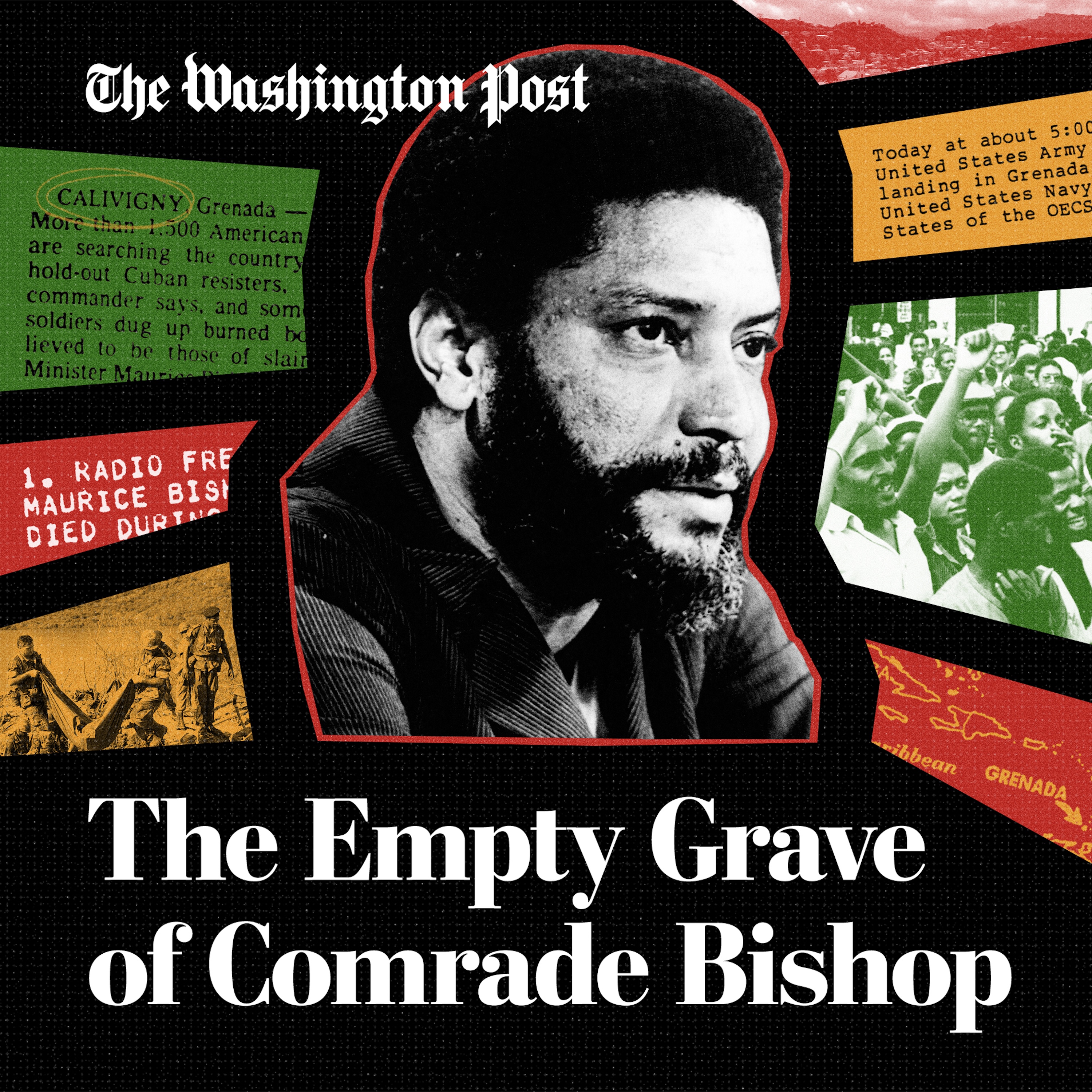
Post Reports
Listen to ‘The Empty Grave of Comrade Bishop’
00:51:43
A question has haunted a Caribbean nation for more than 40 years: What happened to the body of Prime Minister Maurice Bishop? The Washington Post investigated how the U.S. fits into this mystery.
Loading summary
Transcript164 lines
- [00:03]
Martine Powers
Hey, everybody. Martine Powers here. So post reports listeners, I just want to say how much I have been missing you these past few months. I'm about to start maternity leave, and before I do that, I wanted to take a moment to make sure that you know about my other podcast, our investigative series, the Empty Grave of Comrade Bishop. This is a podcast about a thousand fascinating mystery on the Caribbean island of Grenada that has been unsolved for decades and our attempt to try to get to the bottom of that mystery. It was a pretty incredible reporting journey. I think it's a pretty fascinating listen. So if you have the day off today for the Juneteenth holiday and you're looking for something to listen to, I really hope you'll check it out. And if you've already listened, I would be honored if you left a review or even better, if you shared the podcast with a friend or family. All right, so here's the first episode of our investigative podcast series, the Empty Grave of Conrad Bishop. Enjoy. So I just want to ask, to be clear. Sure. Did you ever see the body of Maurice Bishop? No. You're sure? Absolutely. Did you see Maurice Bishop's body? I didn't see his body. Not at the fort?
- [01:29]
Francine Powers
Not at all.
- [01:30]
Martine Powers
Did you see the bodies of anyone else who. I didn't see the bodies of anyone else. Do you remember speaking with any of the people who were involved in looking for Maurice Bishop's remains? None. Over the past two years, I've asked a lot of people some version of this question. What happened to the body of Maurice Bishop and the bodies of the people who died with him? What do you know?
- [02:02]
Francine Powers
No, I have no idea.
- [02:05]
Martine Powers
What do people think happened?
- [02:07]
Francine Powers
Well, people. People speculate. People said different things, but the people who are behind it never say so. You will never.
- [02:21]
Martine Powers
Going around and asking people about human remains is not usually my thing. Some people listening to this podcast might know me from my day job. I host a daily news podcast at the Washington Post, which is to say, I don't specialize in crime reporting. I'm certainly not a true crime junkie. I mean, I can't even watch CSI without it giving me bad dreams. But then a few years back, I learned about this mystery on the Caribbean island of Grenada. Forty years ago, Maurice Bishop, the country's beloved prime minister, was executed along with seven other people. And to this day, no one can say what happened to their remains. Since I first heard about this mystery, I haven't been able to shake it. So I've been asking questions. At this point, I've interviewed more than 100 people. People who witnessed the killings, people who were convicted of the murders and others who, for reasons I'll explain later, also have a connection to all this. Soldiers, diplomats, intelligence officers, even a member of the US Congress. Can I ask, like, what do you think happened to the bodies? Like, if you had to guess, where do you think they are?
- [03:40]
Francine Powers
I don't know. I mean, that's.
- [03:42]
Martine Powers
I really don't know. I have no idea.
- [03:45]
Francine Powers
I can't even put two and two together on this.
- [03:49]
Martine Powers
And these questions I've been asking have led to some strange conversations.
- [03:54]
Francine Powers
No, the US Navy is not in the body snatching business.
- [04:01]
Martine Powers
I can assure you of that. Still, I've kept asking because the question of these missing remains matters.
- [04:12]
Francine Powers
We'd have liked to have a body to bury and to respect, you know, so you live with your pain and sorrow and what have you.
- [04:26]
Martine Powers
This mystery has been weighing on the family members of these victims for 40 years. It's also left a gaping hole in the psyche of an entire nation. And after two years of asking questions, we've gotten some new answers. Hello? Hi, my name is Martine Powers. I'm calling from the Washington Post. I'm calling because I'm trying to find a forensic pathologist who was in Grenada in 1983. Is that you?
- [05:02]
Francine Powers
Yes, it is.
- [05:07]
Martine Powers
These answers offer new insight into what happened to the bodies and the role that the US Government played in shaping this crucial part of Grenada's history. I've been involved in a lot of.
- [05:18]
Don Rojas
Investigations, foreign seek investigations and criminal investigations.
- [05:23]
Martine Powers
And I can tell you, in my words, this thing stinks. From the Washington Post, I'm Martine Powers and this is the empty grave of Comrade Bishop. Episode 1 Before we get any further, I should tell you how this all started. Six years ago, I got a phone call from my parents that every 20 something dreads. Martz. We are moving to a new place, we are selling our house, and you need to come pick up all your books and stuff that you've left here for the last decade.
- [06:13]
Francine Powers
Well, I. That is not accurate because it's that that makes it sound like it was a spur of the moment decision, which it absolutely was not.
- [06:22]
Martine Powers
That is my mom, Francine. She's originally from Trinidad, but she spent most of her adult life in Miami, where I grew up. And when she and my dad got to retirement age, they started thinking about making a change. My dad wanted to be somewhere with less traffic and less noise. Somewhere with beautiful views. For my mom, it was a little more personal.
- [06:44]
Francine Powers
I was sort of tired of living in a foreign country, trying to sort of simulate Caribbean life while living in America, I wanted to get back to my own Caribbean roots. I really quite honestly wanted to deal with my own Caribbean people.
- [07:03]
Martine Powers
So my parents decided to relocate to the island of Grenada, this former British colony right at the bottom of the Caribbean, where they had some old friends. This island is stunning. Mangoes and cocoa and nutmeg just grow on trees on the side of the road. The beaches have the bluest, clearest water I have ever seen in my life. And when it gets dark out, it's so tranquil. There's just the sound of the breeze and these little frogs that come out at night and chorus all over the island. They're so loud that I can hear them through the phone when I'm talking with my parents.
- [07:50]
Francine Powers
Right? Because we had reached retirement age and I always wanted to be back in the Caribbean. I really. Hold a second for me. Jo Jo Martin is recording something with me, so could you not do the bottle, please?
- [08:11]
Martine Powers
I share all this with you, including my dad scraping the last bit of horseradish out of a glass jar. Because it wasn't until my parents moved to Grenada that I started to learn more about the history of this country. And as part of that, I learned about this radical young lawyer named Maurice Bishop. In the late 1970s, when he was just 34 years old, Bishop led a revolution in Grenada. He overthrew a dictator. He became the prime minister and he governed for four years. I learned about how this prime minister was adored by Grenadian people. Some of them knew him as Comrade Bishop. He identified as a socialist, believing that the government had a responsibility to provide education, health care and jobs to all Grenadian citizens. But he was also controversial. Bishop spoke out against American imperialism. He was close to Cuban President Fidel Castro, who gave Grenada weapons and military training. And that put Bishop and Grenada right at the center of tensions between the US and the Soviet Union during the Cold War. Then came the events of October 19th. You're going to want to remember that date because it's going to come up a lot. On October 19, 1983, Maurice Bishop was killed. He was shot execution style by members of his own army.
- [09:40]
Don Rojas
Grenada's Marxist Prime Minister, Maurice Bishop had been under house arrest by more hardline Marxist military leaders.
- [09:46]
Martine Powers
Three cabinet members and four of his closest supporters were there too, killed in the same way. Right next to the Prime Minister.
- [09:54]
Don Rojas
There, soldiers commanded by Cuban trained General Hudson Austin shot and killed Bishop and several of his cabinet ministers.
- [10:09]
Martine Powers
Let me just Underline here. The executions took place in the courtyard of a military fort in the heart of Grenada's capital in broad daylight. Plenty of witnesses saw it happen. Even more heard it happen. Everybody knew who did it. Seventeen people were ultimately convicted, some for planning the murders and others for carrying them out. They spent more than two decades in prison. So there's no question of how this group of people died. And that's part of what makes this all so strange. Because shortly after the executions took place, this fact became clear. The remains of Prime Minister Maurice bishop and his seven allies were missing. And like I said before, 40 years later, their remains still have not been recovered. Their families have never been able to bury them or hold a proper funeral. The people who went to prison for their murders say that they don't know what ultimately happened to the bodies. And here's another thing you need to know. Six days after the executions, the United States launched an invasion of Grenada. I'll explain more about that in just a second. But that's all to say. These bodies went missing during what was almost certainly the most chaotic and frightening week in Grenada's history. The bodies of all eight people who were executed are unaccounted for. Seven men and one woman. And the question of the whereabouts of these bodies has haunted Grenada to this day. The more I learned about all this, the more questions I had and I wanted to get some answers. My mom warned me that this wouldn't be easy.
- [11:53]
Francine Powers
By and large, Martha, a lot of people don't talk about it. A lot of people don't talk about all that.
- [11:58]
Martine Powers
You know, she wasn't wrong. There are a lot of people who don't like to discuss this. But even more people do talk about it. They talk about it a lot.
- [12:19]
Francine Powers
So right now we ask to do a roll call and we asking everyone.
- [12:25]
Martine Powers
After each name that is called to say present. And in the meantime, Last year, around October 19, 2022, I was in Grenada. I was there to experience for myself this anniversary and how people remembered it.
- [12:42]
Francine Powers
Evelyn Bullen Manager MA Bullen & Sons Limited Insurance Jacqueline Creff Minister for Education.
- [12:52]
Martine Powers
Norris Bain Minister for Housing I attended a ceremony that's held every year commemorating the dead. This was at that old colonial fort where the executions took place. I stood right at the site where these people were killed.
- [13:07]
Francine Powers
As we continue to request for any information, everyone who knows about the bodies of our loved ones, please come forward.
- [13:21]
Martine Powers
And to me, one of the most revealing parts of that visit happened when I was just at my parents house. It was Friday night, 8 o' clock, the frogs were coursing outside. My mom was sitting on the couch watching TV. With the volume about 30% too loud, she had the local news on. And then this program started. This is a show on the Grenada Broadcasting Network that comes on every week.
- [13:54]
Francine Powers
Good evening, everyone, and welcome to WE Culture for another Friday, the 21st day of October 2022. Well, hey, I've got a big surprise for you. I've got a co host. I've got my co host in studio with me tonight.
- [14:12]
Martine Powers
Every episode has a topic. Sports, music, politics. The host of the program is Godfrey Augustin. There's a panel of guests who join from different places. Viewers call in with their questions and their comments and their complaints. We have room for the rest. Yes, indeed, this program is both charming and chaotic in all the ways you'd expect from public access television. So there are people calling in with bad phone connections, people not knowing how to use zoom. There's a guy standing outside under a street lamp for some reason.
- [14:49]
Francine Powers
Well, let me say I'm using the street light just so this fellow commented about the telephone port.
- [14:55]
Martine Powers
And then they finally get into that evening's topic. Well, I am very excited about this evening's program.
- [15:03]
Francine Powers
As the topic says mystery in our.
- [15:06]
Martine Powers
History, the mystery, it says in a graphic on the bottom of the screen, quote, where are the bodies?
- [15:17]
Francine Powers
I was a child around the time of the revolution.
- [15:21]
Martine Powers
And we need some perspective to know.
- [15:23]
Francine Powers
As much as possible the facts about everything. Every year we do this program and it seems like we never get enough. Yes, indeed, indeed, indeed. There is a lot. And one of the things that we hear about a lot is this issue of closure. And how would we eventually bring closure to this mystery in our history? And October 19th was responsible for creating that mystery.
- [15:54]
Martine Powers
What you don't hear in this program is an explanation of what happened on October 19th. They never even specify what bodies they're talking about because they assume everybody already knows. Instead, the conversation is all about answers or what the answers might be. No one knows for sure. So what you hear is a lot of theories.
- [16:17]
Francine Powers
Okay, let's go back to the telephone. WE Culture. Good evening. Hello, good evening.
- [16:23]
Godfrey Augustin
Yeah, good evening, caller.
- [16:24]
Francine Powers
Yes, it is very strange people. There are people in Grenada now who know what happened with the bodies. They must know they were part of the revolution. They were there. So why is it so difficult to.
- [16:43]
Martine Powers
Get the truth from them? Thank you very much.
- [16:48]
Francine Powers
Thank you very much, Kola.
- [16:49]
Godfrey Augustin
Thank you very much indeed.
- [16:52]
Martine Powers
All these listeners agree there must be some conspiracy at work. Someone deliberately disappeared the bodies but the question is who and why? People on the show have different positions on that. Some blame the Grenadians responsible for the murder of Maurice Bishop.
- [17:09]
Francine Powers
So think about you. A prime minister is being executed.
- [17:13]
Godfrey Augustin
That is a deliberate plan.
- [17:16]
Francine Powers
The person that have the most to gain would be the person that is instrumental in doing that or leading that execution.
- [17:22]
Godfrey Augustin
That is the first point.
- [17:24]
Martine Powers
So what this guest is saying is that the executioners would have had the most to gain the by disappearing the remains, basically getting rid of the evidence of their crime. But most of the people calling in actually believe an entirely different theory about who's responsible. I'm convinced that the Americans know about the body, definitely. It's simple.
- [17:46]
Francine Powers
The United States government knows of the.
- [17:50]
Martine Powers
Final movement and what happened to the.
- [17:54]
Francine Powers
Bodies of our leaders in this country.
- [17:59]
Martine Powers
Okay. As you can tell, people are really heated about this and I think it's worth sitting with that for a second. So remember that invasion that I mentioned a little earlier? If you are an American under the age of 40, it is highly possible that you have never heard about this invasion. Most older Americans tell me that it's just a vague memory, but for Grenadians like the man that you just heard, they have never forgotten. Six days after Bishop and his cabinet members and supporters were executed, people woke up hearing the drone of a US Military plane and the sound of helicopters and gunfire. The US Was sending in thousands of troops with the goal to restore democracy and protect the lives of a group of Americans living on the island. The fighting lasted just about three days. The US, Assisted by troops from neighboring Caribbean islands, easily overpowered the Grenadian military, which had been backed by a small Cuban force. In reporting this podcast, I've spoken to plenty of Grenadians who were grateful to have the Yankees, as they called them, come in and bring back order. But Grenadians weren't naive. The US Was a superpower with its own political motives. And as years went by, many Grenadians became suspicious of whether the US had anything to do with the disappearance of the bodies.
- [19:27]
Francine Powers
There's been a cover up on the disposal of the bodies of the people killed there on that day.
- [19:34]
Martine Powers
And that's why you're hearing the people on this TV show get so worked up about this.
- [19:38]
Francine Powers
The bodies were not buried here at.
- [19:40]
Martine Powers
All, but they were taken by the.
- [19:43]
Godfrey Augustin
US to some place that nobody knew.
- [19:52]
Martine Powers
The theory you're hearing from these callers is that at some point during or after the invasion, the American government disappeared the remains of Maurice Bishop and others. The specifics of these allegations range pretty widely. Some people think American troops buried these remains in secret somewhere on the island. Some believe that the US had them quietly cremated or thrown into the ocean. Some even think that the remains of Maurice Bishop and the others were brought back to the US for testing, like still sitting in some lab in Washington or something. But why would the US do something like that, hide the remains of a prime minister? That was my question the first. First time I heard these theories. And Grenadians have an answer because of what Maurice Bishop represented with.
- [20:44]
Francine Powers
And I believe it was a deliberate attempt by the United States government at the time to not have any kind of inkling that a revolution occurred in Grenada in which you had this man here and this cabinet who were all martyrs. Yeah, somebody knows.
- [21:11]
Martine Powers
As I said, Bishop described himself as a socialist who wanted to elevate the working class. But he was viewed by the US Government as a threat, a radical allied with the Communist Soviet Union. So an underlying theory is that the American government might have been worried that Bishop's grave could become a shrine, or that if there was a big national funeral to lay him to rest, it could turn him into a martyr, inspire his surviving comrades to keep pushing his ideas against imperialism. The example you'll hear Grenadians bring up again and again is Osama bin Laden. The US Government knew that a shrine to bin Laden could be dangerous, so they buried him at sea, made sure those remains were never recovered, did it.
- [21:58]
Francine Powers
All over Latin America. No evidence, no shrine, no martyrs, no enemies.
- [22:09]
Martine Powers
It's as simple as that. I just want to be clear what you just heard from the people on this show. This isn't some fringe view. I can say from my many conversations with Grenadians over the last few years that it is a widely held belief that. That the Americans know where the bodies are. The country's diplomats, journalists, historians, many of them say that they are certain about this. Even the current Prime Minister of Grenada, Deacon Mitchell. Do you think that the US has been dishonest about their role in this or that they've covered up their actions?
- [22:48]
Francine Powers
Well, the fact that we don't know certainly points to that. I mean, we have to be real. Grenada is a dot compared to the U.S. if you got here in six days after the execution of Morris and so on, and if you were able to relatively take control of the island, I think you probably would have some influence as to what would have happened and where the bodies were. So I certainly think they know.
- [23:13]
Martine Powers
Grenada's leaders have been asking the US government about this in one way or another, for four 40 years since the beginning, the US has consistently denied having any involvement in anything to do with Bishop's remains. When I reached out to the State Department about this, they said what they've said several times over the years. We have no knowledge of or information about the remains of Prime Minister Bishop. In my interviews with people who were in the State Department or the White House or the military back in 1983, they've responded in a similar way. In fact, they think it's kind of ridiculous that the US Would care enough about the politics of this island to orchestrate some plot to abscond with the remains of her prime minister. But you need to understand, back in 1983, it was the height of the Cold War. The US was engaged in an existential battle against communism, which was seen as a threat to capitalism and American democracy. Ronald Reagan was in his first term as President of the United States, and he did care about Grenada. He cared a great deal.
- [24:28]
Don Rojas
Grenada, we were told, was a friendly island paradise for tourism. Well, it wasn't.
- [24:34]
Martine Powers
And as you'll hear after the break, Reagan was willing to sacrifice American lives, international credibility, and a massive amount of money to influence the future of this place.
- [24:46]
Don Rojas
We got there just in time.
- [24:50]
Martine Powers
We'll be right back. These days, everything's getting more expensive. Groceries, gas, prescriptions. So when it comes to your meds, finding ways to save really helps. That's where Goodrx can come in. Goodrx lets you check prices for prescriptions, whether it's for allergies, heart health, diabetes, or even pet meds. And sometimes you can save up to 80% before you even head to the pharmacy. It's easy to use. Just search your prescription on the website or app and show the free coupon to your pharmacist. You can use it at over 70,000 pharmacies, including CVS, Walgreens, Walmart and more. Allergy meds are expensive, so I look to Goodrx to save me money, and you should, too. Remember, Goodrx is not insurance and you don't need insurance to use it. In some cases, the GoodRx price might even beat your co pay, beat high prices at the pharmacy and save up to 80%. With GoodRx. Go to GoodRx.com reports. That's GoodRx.com reports. As the temps start rising, I feel that familiar urge to refresh my closet. But I'm not wasting money on pieces I'll only wear once or just for one season. Quint's changes that Their clothes are timeless, lightweight and far more elevated than anything else. At this price, it finally feels like my wardrobe matches my standards. By working directly with top artisans and cutting out the middlemen, Quince gives you luxury without the markup, and Quince only works with factories that use safe, ethical and responsible manufacturing practices and premium fabrics and finishes. For me, a linen shirt is a wardrobe staple, especially for the humid D.C. summers. But quality linen at an affordable price is hard to find. The ones from Quince are made from 100% European flax linen, so they're lightweight, breathable and get softer every time it's worn. Exactly what I want in a summer shirt. Give your summer closet an upgrade with quinte. Go to quince.com reports for free shipping on your order and 365 day returns. That's quince.com reports to get free shipping and 365 day returns. Quince.com reports it might help to picture how all of this was playing out in 1983. In one corner there was Ronald Reagan.
- [27:24]
Don Rojas
My fellow Americans, Tonight we're launching an effort which holds the promise of changing the course of human history.
- [27:30]
Martine Powers
The American President, a conservative, former actor and governor. At 72 years old, he was about halfway through his first term as president. In the other corner was Maurice Bishop.
- [27:44]
Godfrey Augustin
Long live the people of free Grenada.
- [27:48]
Martine Powers
A black revolutionary in his late 30s, he was the leader of a political party called the New Jewel Movement. It described itself as Marxist, Leninist and was allied with Cuba and the Soviet Union. On March 23, 1983, President Reagan delivered a speech from the Oval Office. It was broadcast live on national television, 8pm on a Wednesday, right after Family Feud.
- [28:15]
Don Rojas
My fellow Americans, thank you for sharing your time with me tonight. The subject I want to discuss with you, peace and national security, is both timely and important.
- [28:24]
Martine Powers
Later, people nicknamed this address Reagan's Star wars speech. That night, Reagan was laying out an argument to increase military spending.
- [28:34]
Don Rojas
That budget is much more than a long list of numbers, for behind all the numbers lies America's ability to prevent the greatest of human tragedies and preserve our free way of life in a sometimes dangerous world.
- [28:46]
Martine Powers
Among other things, Reagan wanted to spend billions on new technology that would zap nuclear missiles out of the sky. Hence the Star wars reference. The message was, if I can paraphrase Reagan here, the US Military needs to get its mojo back.
- [29:03]
Don Rojas
It is part of a careful long term plan to make America strong again after too many years of neglect and mistakes.
- [29:11]
Martine Powers
It had been almost a decade since the end of the Vietnam War. The US was still hurting from that loss against Communism. And now it seemed that the Soviet Union was gaining ground in the Cold War. They were building more weapons and sending those weapons to allies all over the world, including countries in America's backyard.
- [29:32]
Don Rojas
They're spreading their military influence in ways that can directly challenge our vital interests and those of our allies.
- [29:39]
Martine Powers
The Soviets had sent missile launchers to leftist revolutionaries in Nicaragua. They'd sent warplanes to Cuba, America's closest enemy. And then, about halfway through the speech, a photo comes up on the screen. An aerial photo of a Runway, two long strips of asphalt stretching diagonally across the screen.
- [30:00]
Don Rojas
On the small island of Grenada at the southern end of the Caribbean chain, the Cubans, with Soviet financing and backing, are in the process of building an airfield with a 10,000 foot Runway. Grenada doesn't even have an air force. Who is it intended for?
- [30:20]
Martine Powers
Imagine at this point, a lot of Americans watching this broadcast had likely never heard of Grenada before, or they had it confused with Granada, which is a city in Spain. So not only were they finding out that this island at the bottom of the Caribbean was in fact a country, they were learning that the highest levels of the US Government thought that this country was a threat. An airfield was being built by hundreds of military construction workers sent over from Cuba. This airfield could be used to bring in Soviet weapons and planes.
- [30:53]
Don Rojas
The Soviet Cuban militarization of Grenada, in short, can only be seen as power projection into the region. And it is in this important economic.
- [31:03]
Martine Powers
This was genuinely worrying to a lot of Americans. They remembered what took place two decades earlier, the Cuban Missile Crisis, when the Soviets sent nuclear missiles to Cuba. For a couple of weeks, it seemed like the US and the Soviet Union were headed for nuclear war until the Soviets agreed to remove those missiles. So if something similar was brewing in Grenada, that could be very dangerous for.
- [31:27]
Don Rojas
The US the rapid buildup of Grenada's military potential is unrelated to any conceivable threat to this island country of under 110,000 people and totally at odds with the pattern of other Eastern Caribbean states, most of which are unarmed.
- [31:46]
Martine Powers
The fact that Reagan was talking about Grenada in a primetime speech on national television was a big deal. And it was a major escalation of Reagan's disapproval of what was going on in Grenada the year before. In a speech in Barbados, Reagan had said that Grenada was helping to, quote, spread the virus of Marxism. And then in a speech to the national association of Manufacturers, I know a.
- [32:10]
Don Rojas
Good many people wonder why we should care about whether communist governments come into power.
- [32:15]
Martine Powers
Reagan brought up Again, this country that up until recently was only known for exporting nutmeg.
- [32:20]
Don Rojas
Grenada, that tiny little island, by the.
- [32:23]
Martine Powers
Way, you know, it's never just Grenada, right? Like it's always tiny Grenada or little Grenada Grenada in America's backyard.
- [32:29]
Don Rojas
That tiny little island is building now or having built for it on its soil and shores, a naval base, a superior air base, storage bases and facilities for the storage of munitions, barracks and training grounds for the military. I'm sure all of that is simply to encourage the export of nutmeg.
- [32:57]
Martine Powers
And that's why by this point, the US Government had taken steps to punish Grenada. They'd cut off diplomatic ties. They'd refused to recognize Grenada's ambassador to the U.S. they put a pause on economic aid to Grenada, and then they pushed international banks to also stop giving them money.
- [33:14]
Don Rojas
It isn't nutmeg that's at stake in the Caribbean and Central America. It is the United States national security.
- [33:29]
Martine Powers
Of course, this rhetoric from Reagan wasn't just for Americans. Prime Minister Maurice Bishop was hearing this message, too. I asked somebody in Bishop's government about how it felt to be on the receiving end of all this.
- [33:41]
Francine Powers
We're very small. How could we possibly pose a threat?
- [33:44]
Martine Powers
But what about the airport?
- [33:46]
Francine Powers
What about the airport?
- [33:47]
Martine Powers
Don Rojas served as Bishop's press secretary during this period. And Don remembers feeling outraged.
- [33:54]
Francine Powers
The airport was being built for civilian purposes only. All right? And it proved to be the case. All right. They claimed that we were also building submarine bases in Grenada. There's absolutely no evidence of that. We in Grenada were the victims of disinformation 40 years ago coming from the US government.
- [34:14]
Martine Powers
To many Grenadians, Reagan's statements seemed like direct threats. But at least in public, Bishop played it cool.
- [34:22]
Francine Powers
His reaction was, all right, we'll fight those sobs kind of thing. We'll take them on. Small as we are, we will not compromise our dignity and our independence and our self respect. That was his fighting response. And that was a way, of course, to also inspire us, those close to him, to stiffen our backs against this kind of pressure coming from the US.
- [34:54]
Martine Powers
So he says Bishop came up with a strategy on how to deal with this pressure. They would make a visit to the US for a kind of PR campaign, speak with influential groups, get out Grenada's side of the story, and hopefully get a meeting with Reagan, sit down face to face, president to prime minister for the very first time, and just talk things out. Deescalate.
- [35:16]
Francine Powers
Exactly. Lower the temperature. Absolutely.
- [35:19]
Martine Powers
So if you were able to meet with Reagan in June, of 1983 with all that stuff in your head, all.
- [35:25]
Francine Powers
This, what would we have said to him? Nothing to fear. We want to have cordial diplomatic relations with you based upon certain fundamental principles. You don't mess with what we're doing in Grenada. We're not going to mess with what you're doing in the U.S. grenada doesn't pose a threat to the United States or to its so called vital interests.
- [35:46]
Martine Powers
So Bishop Don and a delegation from Grenada went to Washington, but he did not meet with you.
- [35:52]
Francine Powers
Did not meet. He shunned us. Even secretary of State. He said, all right, if we can't meet with the president, we meet with the secretary of state of state. They also denied us a meeting.
- [36:11]
Martine Powers
They did end up getting a meeting later with a deputy secretary in the state Department along with a national security advisor. What they were told was, this is American policy. There would not be a higher level meeting until Grenada cut ties with Cuba, which Bishop was not going to do. During this trip, the Grenadian contingent also went to New York City. And there, a lot of people wanted to get some facetime with the prime minister of Grenada. An event was set up where people could hear him speak. It was held in an auditorium at Hunter College on the Upper east side of Manhattan.
- [36:48]
Francine Powers
The event itself was completely sold out, standing room only. And there was an overflow into the street, so they had to put up loudspeakers outside. For there must have been several hundred people who could not get into the auditorium, waiting outside and listening to the speech.
- [37:08]
Martine Powers
By the time Maurice Bishop took the mic in that auditorium, he was no longer in diplomacy mode. He was ready to throw some punches.
- [37:16]
Godfrey Augustin
Greetings from the free people of revolutionary Grenada.
- [37:28]
Martine Powers
I've watched this speech dozens of times. It's his most famous address, and you can see and hear the qualities that made him someone that people were willing to follow. There's Bishop standing in a lectern on the stage of this auditorium, members of his government behind him. Hanging above the stage was a big sign. Welcome Prime Minister Maurice Bishop. Grenada is not alone.
- [37:53]
Godfrey Augustin
And may I also write at this very beginning, say how very, very pleasant it is to be in this great hall where there are so many of our sisters and brothers. And I will certainly report your warmth, your enthusiasm, and your revolutionary support for our program when I returned.
- [38:17]
Martine Powers
From the moment you see him on stage, it's clear, whatever the look is, that you need to be a successful politician. This guy has it. You know, he kind of reminds me of that actor from that TV show, Atlanta.
- [38:30]
Francine Powers
Lakeith Stanfield he had a commanding presence. He was, you know, a good looking guy with a small afro, a light skin in color. He was probably 6, 2, 6 3. He was impeccably dressed.
- [38:46]
Martine Powers
Were you there for that? Were you in the room for that speech?
- [38:48]
Francine Powers
I was sitting right up in the front row. This was in the eyes of the Grenadian and Caribbean diaspora community in New York, this was a truly historic event.
- [38:59]
Martine Powers
There were all sorts of people in this audience. Students, activists, diplomats, young guys with dreadlocks, old women in church hats, almost everybody black.
- [39:09]
Francine Powers
And I recall seeing people just spontaneously jumping to their feet and applauding and clapping at certain lines in his speech, particularly the more militant lines.
- [39:22]
Martine Powers
You know, as Bishop gazed out at the masses with a little smile on his face, you could tell that he knew this was his crowd and this was his opportunity to set the record straight on all these allegations made by President Reagan.
- [39:39]
Godfrey Augustin
This other allegation concerns the question of our international airport project. This one is of course the most comical one of all. According to the formulators of this famous theory, Grenada's international airport is now going to become a military base and will now become a strategic jump off point from where we can launch an attack on the great big, powerful, mighty United States. It looks like if we have become a superpower. But the reality of the airport, of course, is well known to all those who make those statements. This airport is an ancient dream of the people of our country.
- [40:42]
Martine Powers
Bishop explained that Grenada needed to increase tourism. There was an existing airport, yes, but the Runway there was too short for, for any aircraft bigger than a prop plane to land. And yes, as Reagan said, this new airport was double in size, but the standard required length worldwide for any International Airport was 10,000ft.
- [41:02]
Godfrey Augustin
They have produced manuals saying what length of strip is required if their planes are to land. So unless we born big and stupid, you can't expect us to put down a strip that planes that can carry people, normal jet planes won't be able.
- [41:20]
Martine Powers
To use unless we born big and stupid. I love that line because it's how Caribbean people actually talk to each other.
- [41:27]
Godfrey Augustin
And therefore, what we want to do on 13th March itself is to open our international airport on Dagu.
- [41:38]
Martine Powers
To have this room of people year like that for an airport. There is something else going on here because for the people in the audience, this wasn't about some big construction project. This was about Bishop. And it was about a revolution, a vision of what black power could really look like. That revolution led by Bishop, it happened in 1979 four years before the speech. And there's a lot to unpack, which we'll do more in the next episode. But what you need to know now was that the vast majority of Grenadians were the black descendants of enslaved people, and they were still very poor. Part of the legacy of colonialism, unemployment.
- [42:20]
Godfrey Augustin
Hunger, malnutrition, disease, illiteracy. These are the crimes and the sins that have visited upon the poor developing countries of the Third World while the industrialized countries continue to exploit our resources and to keep the profits.
- [42:41]
Martine Powers
But since Bishop's new government had taken over, that was starting to change. Rather than relying on food imported from other countries, Grenadians were growing more of their own food, investing in new farming techniques, increasing production and exports, raising the GDP by 25% in four years.
- [43:00]
Godfrey Augustin
And by this time, the experts were saying, that is impossible. You don't have the resources, you don't have the management, you don't have enough tractors, you don't have enough trucks, you don't have enough engineers. You can't possibly do it. And then we gave them the secret. We told them that in a revolution, things operate differently in the normal situation.
- [43:26]
Martine Powers
Grenada had also found friends who were willing to help Cuba in particular.
- [43:31]
Godfrey Augustin
We see Cuba as part of our Caribbean family of nations.
- [43:39]
Martine Powers
The Cuban president, Fidel Castro, saw Bishop as a son. Castro provided military support, but his government also sent over people to help Grenada. Teachers and doctors and nurses and, yes, airport construction workers. Because of all this change, many Grenadians began to have hope for the future. The government started to provide free education and affordable health care.
- [44:02]
Francine Powers
It wasn't socialist yet. It was developing. It was on a path towards socialism.
- [44:08]
Martine Powers
Unemployment rates began to go down. Literacy went up. Poor people could now afford regular checkups with a doctor, which, as Bishop pointed out, was not the case in the US and that, Bishop said, was the truth. Why the American government was so worried about Grenada. Not because of an airport, not because of Cuba, not even because of communism or socialism, but because, in the words of Maurice Bishop, Grenada showed that black people could do well for themselves without bowing to the power of the United States. They didn't need to play by America's rules to succeed. He really hammers this point home in this one part of the speech where he talks about what he calls a secret State Department file. Before I play this chunk for you, I should tell you that we asked the State Department's Office of the Historian if this report actually exists. They said they didn't have information on that question. We also requested it under the Free Freedom of Information act. The estimated date when the State Department said they'd get back to us is January of 2025. So we're waiting. But Bishop describes the supposed file to the audience in great detail.
- [45:24]
Godfrey Augustin
There's an interesting one that we saw very recently in a secret report of the State Department. I want to tell you about that one so you can reflect on that.
- [45:32]
Martine Powers
One.
- [45:34]
Godfrey Augustin
That secret report made at this point that Grenada is different to Cuba and Nicaragua and the Grenada Revolution is in one sense even worse. I'm using their language than the Cuban and Nicaraguan revolutions because the people of Grenada and the leadership of Grenada speaks English and therefore can communicate directly to the people of the United States. I can see from your applause, sisters and brothers, that you agree with the report. But I want to tell you what that same report also said and said that also made us very dangerous, and that is that the people of Grenada and the leadership of Grenada are predominantly black. They said that 95% of our population is black and they had a correct statistic. And if we have 95% of predominantly African origin our country, then we can have a dangerous appeal to 30 million million black people in the United States.
- [47:28]
Martine Powers
Bishop was tapping into something powerful. He was challenging centuries of white supremacy. He represented what it meant to be a black person striving for something more and demanding something more is why Grenada meant so much to so many black people in the Caribbean and in America and around the world. This embodiment of pride and success and power, this vision of what a black country could make for itself in a post colonial world.
- [47:58]
Godfrey Augustin
They like to talk a lot about backyard and front yard and lake. Grenada ain't nobody backyard and in part, a Nobody Lake.
- [48:22]
Martine Powers
Four and a half months later, Maurice Bishop was dead. 17 Grenadians would be convicted for his murder.
- [48:32]
Francine Powers
Yeah, October 19, 1983 is when he was assassinated.
- [48:37]
Martine Powers
Do you think it's accurate to say that Maurice Bishop was assassinated during a coup?
- [48:43]
Francine Powers
Yes, yes, it was a military coup. He was assassinated. Cold blooded. And not only him, there were a number of other ministers of his cabinet who were with him at the time. Horrible mistakes that led to horrible crimes. And exactly one week later, October 25th, the US invaded. And just say the rest is history.
- [49:08]
Don Rojas
Early this morning, forces from six Caribbean democracies and the United States began a landing or landings on the island of Grenada in the eastern Caribbean. We have taken this decisive United States.
- [49:23]
Martine Powers
Paratroopers have invaded Grenada with helicopter gunships.
- [49:27]
Francine Powers
Our armed forces forces are engaging them in fast battle.
- [49:31]
Martine Powers
All grenadians report immediately to our respective militia bases.
- [49:38]
Francine Powers
Didn't last very long, a few days. I mean, things were under control militarily. I mean, how could you possibly put up a lengthy resistance to the strongest military force on the planet?
- [50:10]
Martine Powers
How soon did people realize, wait, these remains. Nobody has them. Nobody knows where they are.
- [50:19]
Francine Powers
It took a few weeks after things settled down. And I must say that the effort to find them and to bury them in a proper and respectful manner in Grenada is an effort that is ongoing. You know, there is no burial ground anywhere in Grenada at the moment where you could say, well, this is where Maurice Bishop lies.
- [50:42]
Martine Powers
I mean, how much do you think about those families that have been waiting for 4, 40 years to get some answers?
- [50:48]
Francine Powers
It must be horribly painful for them. This is a question that will remain hanging without an answer. And I don't think that it is fair to the Bishop family, those that are still living, to all of Bishop's supporters in Grenada and around the world, and to the Grenadian people at large. I think this needs to be put to rest, and I hope it does. The time has come, in my view, for us to bring closure to this and to provide Bishop's life and legacy with a proper memorial. That the time has come is wrong, overdue.
- [51:39]
Martine Powers
Next time, on the Empty Grave of Comrade Bishop, we'll hear from some of those families and we'll go back to the beginning of the revolution and tell you the story of Maurice Bishop's rise to power. Episode two is available now, so please go listen. And when you do that, make sure that you're following the Empty Grave of Comrade Bishop on your podcast app so you get the alert when new episodes come out. This show was reported and produced by me, Martine Powers, along with Ted Muldoon and Rennie Swarnofsky. Our editors are Sarah Childress and Renita Jablonski. Fact checking by Nicole Pasulka. Mix editing by Theo Balcombe. Our series theme and music is by Keshav Chandrath Singh, mixing sound design and additional music by Ted Muldoon. Our show art was designed by Lucy Nayland. Project editing by Casey Schaefer. Thank you to Nate Jones, the FOIA Director at the Post, as well as Monica Campbell for research assistance for this episode. Also. Also, a special thank you to Allison Michaels. The recording of Maurice Bishop's Hunter College speech is courtesy of Caribbean Insight Television. Additional archival tape courtesy of the Ronald Reagan Presidential Library and the Grenada Broadcasting Network. If you want to learn more about the history and reporting that you heard in this episode, check out the episode guide for this series. You can find it@washingtonpost.com Emptygrass Rave. You'll also find a link to become a subscriber to the Washington Post. That is the best way to support the investigative reporting that you are hearing on this podcast. And later in the series, Post subscribers will have access to early episodes, so stay tuned for more on that. Thank you so much for listening to the empty grave of Comrade Bishop and see you in episode two. Think about why you listen to podcasts. It's like having a friend who makes you think or can help you wind down right? Well, the Washington Post has a lot of people you can turn to at any hour. You can read the most important and interesting stories. We can help you cook something delicious, give you advice on a tricky friendship. Rave about a movie or book that you shouldn't miss. When you become a Washington Post subscriber, you have a companion for whatever part of your day needs it most. Get it all for just $4 every four weeks. That's for an entire year. After that, it's just $12 every four weeks. Cancel anytime. Go to washingtonpost.com subscribe. That's washingtonpost.com subscribe.