← Post Reports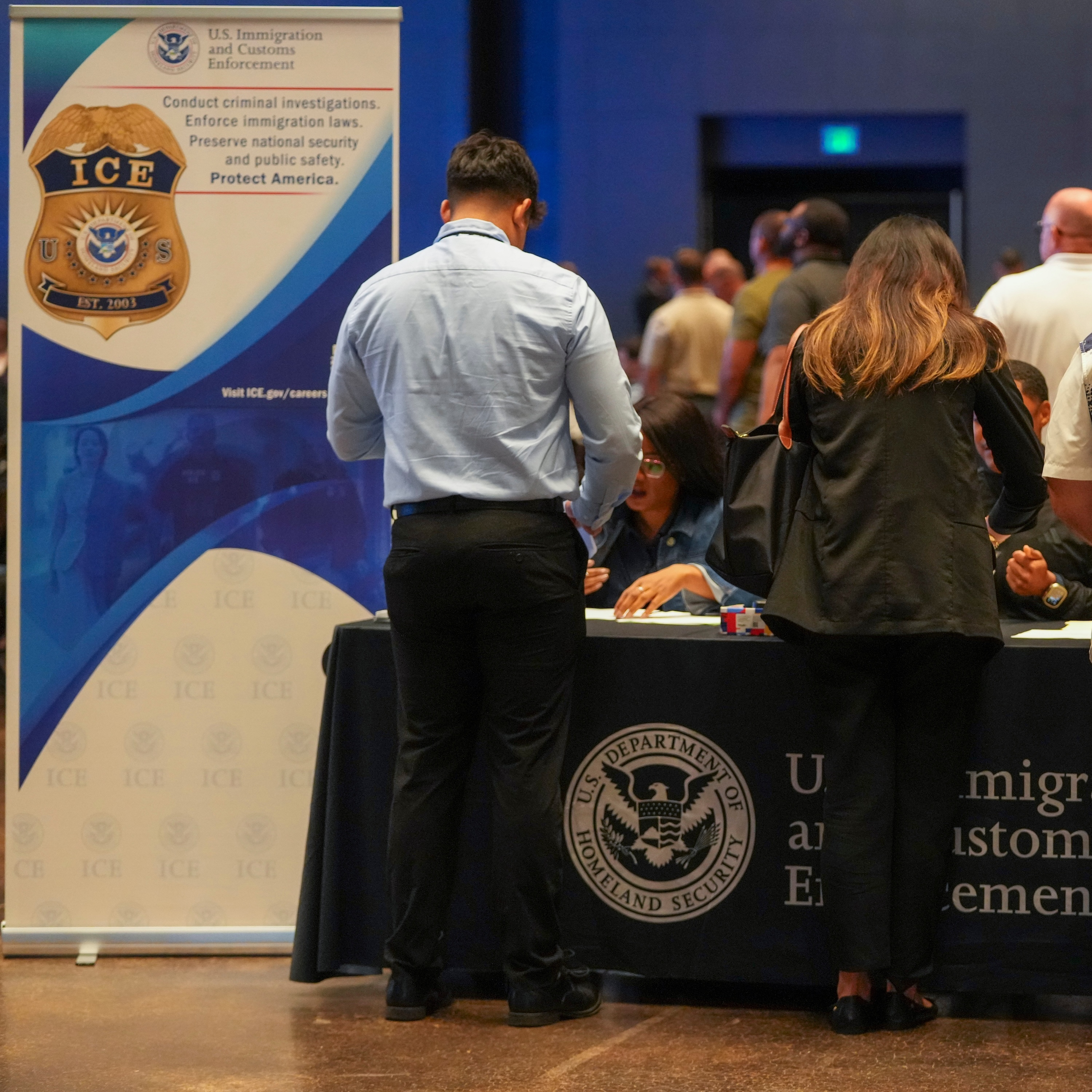
Post Reports
Meet the people signing up for Trump’s ICE
00:27:52
Immigration and Customs Enforcement is hoping to hire thousands of new officers this year. Who’s signing up and what do the recruitment efforts look like?
Loading summary
Transcript97 lines
- [00:00]
Constellation Energy Announcer
At Constellation, we bring the energy powering America's growing economy every minute, every day. As the nation's largest producer of clean and reliable American made energy, Constellation is wherever you are. From families to corner stores to manufacturers to the biggest data centers, we meet the nation's energy needs by generating emissions free electricity today and for our future.
- [00:29]
Robert Klemko
A few weeks ago I went to Arlington, Texas to this video game competition arena. It was about the size of a small college basketball arena, but instead of video games, there was an ICE recruiting fair there.
- [00:44]
Elahe Izadi
That's Robert Klemko, criminal justice reporter for the Post. He showed up at this expo center because the Department of Homeland Security is doing a huge hiring push. They're hoping to recruit more officers for ICE. U.S. immigration and Customs Enforcement. ICE wants to hire 10,000 new officers this year. President Donald Trump is relying on ICE for his big immigration crackdown. And the organization's mission is a broad one. Some agents conduct global crime investigations into things like drug smuggling or human trafficking. But many of the officers ICE is looking to hire will, will be tasked with arresting, detaining and removing unauthorized immigrants throughout the US to get its numbers up, ICE has promised some hires a signing bonus of up to $50,000. That's on top of salaries that could be in the six figures. This approach is divisive. Robert was seeing some of that when he showed up at the arena.
- [01:50]
Robert Klemko
As soon as you pull into the parking lot, there's a group of about a dozen protesters out there accusing the applicants to ICE of being Nazis and signing up for the Gestapo.
- [02:00]
Constellation Energy Announcer
Do you get a job as a.
- [02:01]
ICE Recruit/Applicant
Nazi for the Gestapo?
- [02:05]
Elahe Izadi
But inside, Robert found thousands of people eager to join the cause.
- [02:11]
Robert Klemko
You're seeing the new ICE branding everywhere. So you're seeing Defend the Homeland all over the place. They've got a kitted up black Mustang in there with the ICE logo on it. They've got tables with agents and HR folks sitting behind them ready to interview people. We were interested in learning why people wanted to join ice. We understood there would be people there from all walks of life who were attracted by this $50,000 signing bonus. But what was more interesting to me was, you know, how people individually identified with Donald Trump's immigration enforcement mass deportation push, in what ways that brought them out.
- [02:51]
ICE Recruit/Applicant
Just loved and wanted to serve my country and better it.
- [02:53]
I don't want people coming over illegally due to the simple fact of it leaves that those doors open for, you know, people to, I mean, I'm speaking very frankly, like, hey you, here's a pound of coke, go Run across the board.
- [03:08]
I'm gonna do what. What I feel like is my part.
- [03:10]
Robert Klemko
Yeah.
- [03:10]
ICE Recruit/Applicant
At the end of the day. And not. And my. My duty is not to change people. If I can change the world, I will. But if I'm not going to change every individual person's, you know, aspect on life, so.
- [03:24]
Elahe Izadi
From the newsroom of the Washington Post, this is Post Reports. I'm Elahe izadi. It's Wednesday, September 10th. Immigration enforcement has ramped up across the country this week. On Monday, the Supreme Court lifted limits on immigration raids in Los Angeles. And in Chicago, the Trump administration launched Operation Midway Blitz. It dramatically amps up the ICE presence in Illinois. So today, Robert takes us inside an ICE recruiting event. We learn why people are signing up for this mission and the possible risks of rushing to fill the ranks. Robert, thanks for joining me today.
- [04:18]
Robert Klemko
Thanks for having me.
- [04:19]
Elahe Izadi
Welcome back from Texas. Before we dive deeper into this bigger meeting conversation, let's go back to the Expo. Just paint the picture for me. You walk in and what were you confronted with and what was it like in there?
- [04:32]
Robert Klemko
I think folks were really excited to learn about what their jobs could be and what roles they could have in this deportation push. So there was, like, an air of excitement. And I think also, you know, the protesters outside added a little bit of tension. And, you know, if you stood out there for a while, you saw a number of people having a back and forth with the protesters. I think people were eager. You know, there was this promise that you might actually get a tentative job offer that day based on your resume, pending a drug screening and a background check. And that was sort of reflected in my interviews with some folks.
- [05:17]
Elahe Izadi
Yeah. So I want to ask you about some of those, but before we get there, there's been a lot of attention on immigration enforcement lately. We've seen These raids in LA, increased enforcement in Washington, D.C. this ICE operation in Chicago that was announced this week. Robert, just remind us, what is Trump's intention with the stepped up ICE enforcement? What is he trying to achieve here?
- [05:39]
Robert Klemko
Well, the initial push was to try to deport 1 million people in 2025, in his first year in office. And what the priority of previous administrations has consistently been is that, you know, we're going to deport people who commit crimes, you know, once they get to the United States, and that's going to be the priority. But to deport 1 million people, you end up having to arrest a large number of people who have not been convicted or accused of a crime.
- [06:12]
Elahe Izadi
Mm. So you're there in Order to achieve this goal, the administration wants to hire more people at this recruiting event. What sorts of people were there to join this mission?
- [06:27]
Robert Klemko
It sort of ran the gamut in terms of age and race, but I think across the board, people identified with Donald Trump's policies. The folks that I talked to, they felt that immigration and the way we've enforced immigration law has worsened the country and American lives and livelihoods at risk. I mean, it's not just middle aged white guys or young white guys. You know, when I was in Arlington, I'm sitting in the parking lot waiting on people to come out and I'm approaching them to interview them. And, you know, for every three white men, there were two Hispanic men. For every five men there was one woman. And then, you know, you had a fair amount of African American folks coming in to apply. So it was a far more diverse crowd than I think people assume. And I was very curious to hear from some of the Hispanic men, especially, you know, how they felt about the rhetoric surrounding this deportation push and what they felt their role could be in it.
- [07:33]
ICE Recruit/Applicant
I think it's everybody's fair chance to live here in this country. And I would love for everybody in the world. I'm a God fearing, God loving man and I believe that we're all equal. I don't think that I'm better than any other race or any other ethnicity.
- [07:46]
Robert Klemko
I spoke with this 29 year old, Arturo Sanchez, who felt that, you know, human trafficking, drug smuggling, these are things that not just, you know, degrade the lives of Americans, but the people who are often unwittingly shoved into those roles. And that he could, you know, be part of the solution to that.
- [08:08]
ICE Recruit/Applicant
I think that it would be beautiful if we could all live together in peace and happiness, but Satan doesn't allow that to happen. Unfortunately, there is evil people out there. There are evil deeds that do go unpunished. And so that's where people like me want to see if I can help contribute to bringing justice, some kind of justice to the system.
- [08:29]
Robert Klemko
And many of them felt that maybe they weren't enthusiastic about grabbing and deporting people who hadn't committed any crimes, but that they could get into the organization and then work their way up towards, you know, human smuggling investigations, drug trafficking investigations, the sort of things that the administration has used as justification for this broader push. And then on the other end of the spectrum, There was a 36 year old former MMA fighter named Aaron Eli who limped into the arena hoping to offer ICE his it. He was the very first person I talked to when I got to Arlington.
- [09:07]
Elahe Izadi
Why it? Did he used to work in it or something?
- [09:09]
Robert Klemko
He works in it now, and he walks with a limp because of his MMA career. And right off the bat, he said that he was frustrated with his career and he felt that Indians were to blame in the tech sector. He said, I keep seeing these memes where Indians are bragging about taking our tech jobs. So I said, oh, yeah? Well, I'm going to work with these guys that are going to arrest you, slam your face on the pavement, and send you home.
- [09:34]
Elahe Izadi
I'm sorry. He's just, like, telling this to you directly that he's motivated by wanting to not just deport Indian immigrants, but, like, slam their face on the pavement.
- [09:47]
Robert Klemko
Yeah. I mean, you'd be shocked at what people are willing to say to a reporter, apparently.
- [09:54]
Elahe Izadi
And people like this who openly voice opinions like this are getting hired.
- [10:00]
Robert Klemko
Well, that we don't know. So ICE has not in the past had and does not have psychological screening. So it's very possible that people with those views are being hired by ICE as long as they can pass a drug screening, a background check, and make it through the training. So, I mean, we may never know how many folks who feel that way and are joining up for those reasons actually make it through during this recruiting push. I don't think he represented the majority of people at that convention, and I only say that because I talked to over 30 people, and maybe one or two people had something outwardly racist to say, but he really stood out in an extreme way.
- [10:46]
Elahe Izadi
I see. But did Eli then get hired?
- [10:49]
Robert Klemko
So he was not eligible for a deportation officer job because he has a bum hip from his MMA career. He was hoping to get hired in it, and he said that they pointed him in the right direction to apply for that role, but that he wouldn't be eligible at that specific expo.
- [11:07]
Elahe Izadi
And so what happens at this convention? Like, people are submitting their resumes and waiting to see if they're going to move to the next stage.
- [11:12]
Robert Klemko
Yeah, people are bringing in their resume and then doing a short interview with an HR person or an ICE agent. They're getting fingerprinted, they're doing drug screening, and then they're waiting to find out if they have a tentative job offer.
- [11:27]
Elahe Izadi
I see. Robert, I think this is interesting. I mean, we mentioned this tension going on that these people inside the convention center, this Expo center in Arlington, Texas, are very excited at the prospects of having this job. And at the same time, we have these handful of protesters outside, and when we step back. And just think about the approval ratings for Trump's handling of immigration. It's dropped in recent months. This used to be a very strong issue for him politically, but. But a Washington Post average of polls from last month show he's losing support on his handling of immigration policy. Now, a majority of Americans disapprove. And there's also been some polling on ice. Specifically, a Pew poll this summer had ICE rank as one of the least popular government agencies. So how did you see this tension between, you know, the popularity or perception of either ICE or just how the immigration enforcement is going play out at this expo?
- [12:23]
Robert Klemko
You know, I was curious about how these men and women perceived this immigration enforcement effort and particularly some of the rough arrests and, you know, constitutionally questionable tactics that you've seen ICE and Customs and Border Patrol employ over the last several months.
- [12:44]
Elahe Izadi
And, like, are you speaking to. You know, I see a lot of videos of, like, ICE covering their faces. Or are you talking about that?
- [12:51]
Robert Klemko
I'm talking about that, but I'm also just talking about, like, just just grabbing people off the street and on the basis of, you know, they're Spanish speaking or they. They look Hispanic. Things that police can't do.
- [13:02]
Constellation Energy Announcer
Another violent ICE arrest rocks Encinitas. Two landscapers ripped from their truck just.
- [13:08]
Elahe Izadi
Blocks from where a father was detained.
- [13:10]
Constellation Energy Announcer
Near an elementary school this week.
- [13:12]
Robert Klemko
But that our laws have given ICE more wiggle room around.
- [13:16]
Constellation Energy Announcer
Many are masked, their identities concealed.
- [13:19]
Elahe Izadi
The tactic part of the effort to.
- [13:21]
Constellation Energy Announcer
Carry out the Trump administration's deportation agenda becoming a flashpoint.
- [13:26]
Robert Klemko
You know, how do these people feel about being asked to do those things? And this one man who was a former police officer, Kevin Tucker, stood out to me. And his feeling was that he didn't know what to believe. He felt that all of these stories, all of these images and videos that have been reported in the local news and reported by the Washington Post and New York Times and what have you could be faked, or they could be taken out of context. And I think it reflected for me what I've been feeling for the last few years is that people have become more insular as they discover more and more reasons to distrust the media. I think broadly, the majority of people that I talked to felt that immigrants were a drain on the American way of life and the economy and had been convinced of that, in part because of Donald Trump's political rhetoric and where our politics have moved over the last decade and felt strongly that they could solve what they felt was a problem.
- [14:34]
Elahe Izadi
Yeah, like, this is their way of, like, serving their country in that view?
- [14:37]
Robert Klemko
Yeah, yeah. A lot of guys talked about service and talked about ICE the way that you hear people talk about the military. One of the more interesting conversations I had was with a young former Marine, Christian Osborne, who had been discharged from the Marines for refusing the coronavirus vaccine. He felt that his life was empty in a way because he was no longer serving and he wanted to fill that void with ICE service. But interestingly, he felt conflicted about what he might be asked to do if he ended up getting a job with ice. And he brought up this scenario of arresting and deporting a father of a, say a young American born child.
- [15:22]
ICE Recruit/Applicant
The moral question of deporting a, let's say a legal. Well, let's say you have a 40 year old something man, right. Who's in the country, he's been here for 10 odd years, illegal, and he brought his family up and he has a nine year old daughter.
- [15:36]
Robert Klemko
Yeah, right.
- [15:36]
ICE Recruit/Applicant
Who's a legal citizen.
- [15:38]
Robert Klemko
Right, right. And he said, I'm not even sure what I could do and I don't know if I would have a choice.
- [15:45]
ICE Recruit/Applicant
That would hurt me. I would weigh in my heart. Right. Because it's like, yes, you have a situation where it's a double edged sword.
- [15:54]
Robert Klemko
And yet he's still there signing up to do this job.
- [15:57]
Elahe Izadi
You know, part of it is like, do people just like need work?
- [16:00]
Robert Klemko
I think that's part of it. ICE officers can make anywhere between 49,000 to, depending on experience in the position, around $140,000. But it's not just that. It's not as though there's a dearth of available law enforcement jobs in this country. You can go become a police officer right now. There are departments that are short staffed all over the country, in every state. But I think the people I talked to overwhelmingly felt that they'd be doing a service. And some acknowledged that there could be collateral damages and injustices. They'd be asked to perform things they'd be uncomfortable with, but ultimately they felt that their lives would be more meaningful and more just if they were to get this job. Similarly, Arturo Sanchez, this former Air Force veteran I spoke with, he recognized and acknowledged that if he got this job, he might be working with people who had racist views, who were doing the job for the wrong reasons. But ultimately he felt like he could handle that and he could do good and be a force for good within the agency.
- [17:02]
ICE Recruit/Applicant
I've worked with racist people. I've worked with, I mean gang members, you know, while being in the military, people that come from that gang background and are people that come from racist households and never bothered me once. It's not who I am, it's not who I plan on being. All you can do for those people is pray for them. Yeah, can't do anything else for them. You ain't gonna change them.
- [17:27]
Robert Klemko
And again, he just, you know, wanted to return to service.
- [17:31]
Elahe Izadi
Before we leave this arena, do you know how, like how many resumes were submitted? Can you scale it for me?
- [17:37]
Robert Klemko
Yeah. So over the course of two days, Homeland told us that 3,000 resumes were submitted. They also say they've got over 100,000 applications. We sort of take that with a grain of salt because, you know, there's no proof.
- [17:55]
Elahe Izadi
You know, we heard earlier this protester accusing these people of signing up for the Gestapo. That's the Nazi secret police. How did people inside react to that comparison?
- [18:08]
Robert Klemko
Some people laughed as they walked by, some people flipped them off, A couple people argued with them. But again, they're not dealing with, for the most part, the same set of facts as the protesters are dealing with. The protesters are seeing these images on the news and they're also feeling what the research says, which is that when you add immigrants to a community, especially first generation immigrants, communities get less violent, not more violent. There's less criminality, not more criminality. And so they're approaching it from that lens. While everybody signing up to work for ICE believes exactly the opposite.
- [18:52]
Elahe Izadi
After the break, how ICE plans to train this new workforce. We'll be right back.
- [19:05]
Constellation Energy Announcer
At Constellation, we bring the energy powering America's growing economy every minute, every day. As the nation's largest producer of clean and reliable American made energy, Constellation is wherever you are. From families to corner stores to manufacturers to the biggest data centers, we meet the nation's energy needs by generating emissions free electricity today and for our future.
- [19:34]
Elahe Izadi
Nationwide. What has recruiting been like? How many people have applied?
- [19:39]
Robert Klemko
Yeah, there's just no way for us to know how successful it's been. Homeland Security says They've received over 130,000 applications, but no word on how many of those people are actually viable candidates. So we just won't know how successful it's been until we start seeing their numbers rise and they start disclosing those numbers.
- [19:59]
Elahe Izadi
So, yeah, and like we don't know anything more about who these 130,000 people could even be. Like age, gender, race. None of that at this point, right?
- [20:06]
Robert Klemko
No. And I asked Homeland specifically concerning the Career Expo in Arlington for numbers on former law enforcement who applied, veterans who applied. Just curious about the demographics of who was signing up and the. They declined to provide those.
- [20:24]
Elahe Izadi
But in your conversations, it seems like there were some people who had that experience.
- [20:28]
Robert Klemko
Yeah, yeah, there was a lot of folks who were former law enforcement or veterans, which is not a surprise. About 30% of ICE are veterans.
- [20:36]
Elahe Izadi
Oh, okay. Current ICE officers. What has the marketing been like for ICE in trying to push these jobs?
- [20:44]
Robert Klemko
Yeah, so the slogan that I think has been the most prominent is Defend the Homeland, but the branding online has had a number of white nationalist dog whistles sprinkled throughout. So they're using a lot of World War II American propaganda imagery, a lot of Uncle Sam, again, accentuating this sort of call to service to defend the homeland. One of their recruitment tweets is an image of Uncle Sam scratching his head at a crossroads. And the caption reads, which Way, American Man? Which many took as a reference to the white supremacist book, which Way, Western Man.
- [21:26]
Elahe Izadi
Now, let's talk about how Homeland Security is trying to pull off all of this hiring, and one piece of it is the incentivizing with money. How are they trying to incentivize people to sign up with money?
- [21:40]
Robert Klemko
Yeah, the $50,000 signing bonus was something that was on a lot of the folks minds that I spoke with.
- [21:47]
Elahe Izadi
You sign up, and if you're hired, you get out the gate $50,000.
- [21:52]
Robert Klemko
Well, that's what some people thought.
- [21:54]
Elahe Izadi
Okay, that's not true. What is the case then?
- [21:59]
Robert Klemko
If you are an absolutely overqualified candidate, if you're one of the top candidates, so small percentage of people, you get 25,000 upfront and then installments over the next several years of that signing bonus.
- [22:13]
Elahe Izadi
And where does that money come from?
- [22:15]
Robert Klemko
So that's gonna be coming from the big, beautiful bill which gave ICE and deportation enforcement at large almost $30 billion.
- [22:22]
Elahe Izadi
Okay, so we talked about the dangling of some money for some people. Has this administration changed any of the sort of eligibility rules for people to initially sign up and apply?
- [22:38]
Robert Klemko
Yeah, so in order to make the pool of potential applicants bigger, they've lifted the age gap. So it's used to be that you couldn't be over 40 years old and apply to be a deportation officer, but that's gone now, and you can apply at any age. And they've also reached out to former ICE officers, retired ICE officers, to try to bring them back and hire them immediately.
- [23:00]
Elahe Izadi
Okay, so then once people apply, they need to go through a training before they're officially hired. Is that how it works?
- [23:09]
Robert Klemko
Right. Yeah. So there's a training that Spans several months. There was a report actually in the Atlantic that said that they'd shortened that training in order to get more deportation officers on the street. But Homeland Security has denied that that's the case. But they've removed what had been a five week Spanish immersion course and replaced that with a language translation technology. But how that works in practice, we don't yet know.
- [23:38]
Elahe Izadi
Do you know anything about how training for deportation officers, how that might differ from regular police, or anything more about what that training looks like?
- [23:48]
Robert Klemko
So the training is going to be different in terms of what the law allows them to do. Police have to strictly follow standards and learn things like how to articulate reasonable suspicion if they're going to detain somebody. None of those standards apply to ICE because of the leeway we gave the agency with its formation after 9 11, and especially now that the Supreme Court has given them the ability to detain people and target people on the basis of race. I don't imagine that ICE training in a legal sense is nearly as complicated as police training.
- [24:31]
Elahe Izadi
Yeah. On the Supreme Court thing, we did mention that the Supreme Court is giving the administration more leeway for immigration enforcement and ICE raids. Can you explain a little bit more about that? Like, what are they actually allowing now?
- [24:45]
Robert Klemko
So the court lifted limits placed on federal agents doing immigration raids in the Los Angeles area. Those limits have been placed by a lower court who ruled that agents were targeting people based on things like race and language. The Supreme Court ruling only applies to Southern California. But a lot of advocates are worried that this now opens the door to racial profiling wherever ICE is.
- [25:05]
Elahe Izadi
Robert, I think a lot of people listening to this might feel concerned because ICE officers are not technically police officers, but they are law enforcement. And their actions can have major ramifications for people's lives. They can detain people, they can pick them up off the street, they can ask people all sorts of questions. And hearing you lay all this out, I think the question here boils down to is this massive push safe?
- [25:37]
Robert Klemko
Yeah, I mean, I don't think I'm in a position to answer that question. But what I can tell you advocates are worried about is not just the fact that ICE seems to be building an army of officers, but that they're expanding their relationships with police departments and working in conjunction with police departments. Political pressure, both local and national, is being put on these police departments to not just let ICE do their thing, but to cooperate with them. And you're going to see the influence of ICE expand, not just in terms of the number of people they have on the street, but in the information they're getting from local police and in the cooperation they're getting from local police.
- [26:16]
Elahe Izadi
You know, Robert, your conversations with people showing up to this expo gave me an insight into people's motivations. I guess. When you left that expo, what were you left with?
- [26:32]
Robert Klemko
You know, I went into it curious about who these people were who, you know, were masked and armed in the Streets of Washington, D.C. at the moment and, you know, all over the country, but particularly in these, in these major blue cities and in blue states. And I walked away sort of jarred by the knowledge that there was not going to be any psychological screening for these people and that people like Aaron Eli, who explicitly want to take out revenge on immigrants are going to get some of these jobs. And then when you see the videos of how these officers behave and how they're allowed to behave on the street without identifying themselves while wearing masks, grabbing people and getting in their cars and driving away, you know, it's not hard to imagine the abuses that may be ahead of us.
- [27:29]
Elahe Izadi
Robert, thank you so much for joining and sharing this. I appreciate it.
- [27:32]
Robert Klemko
Thank you.
- [27:35]
Elahe Izadi
Robert Klemko reports on criminal justice for the Post. That's it for Post Reports. Thanks for listening. This journalism and Robert's insights, that's what you support when you become a Washington Post subscriber. If you don't yet subscribe, the Washington Post Labor Day sale is still happening, so it's a great time to subscribe. You can get our core subscription for just $20 for an entire year. This is billed as a single $20 payment for the first year and then renews at $120 per year thereafter. And you can cancel anytime. Go to washingtonpost.com subscribe. That's washingtonpost.com subscribe. We'll also include a subscription link in our show notes. Today's episode was produced by Sabi Robinson. It was mixed by Sam Behr and edited by Rena Flores. Thanks to Christine Armario. I'm Elahi Izadi. We'll be back tomorrow with more stories from the Washington Post.
- [28:48]
Constellation Energy Announcer
At Constellation, we bring the energy powering America's growing economy every minute, every day. As the nation's largest producer of clean and reliable American made energy, Constellation is wherever you are. From families to corner stores to manufacturers to the biggest data centers, we meet the nation's energy needs by generating emissions free electricity today and for our future.