← Post Reports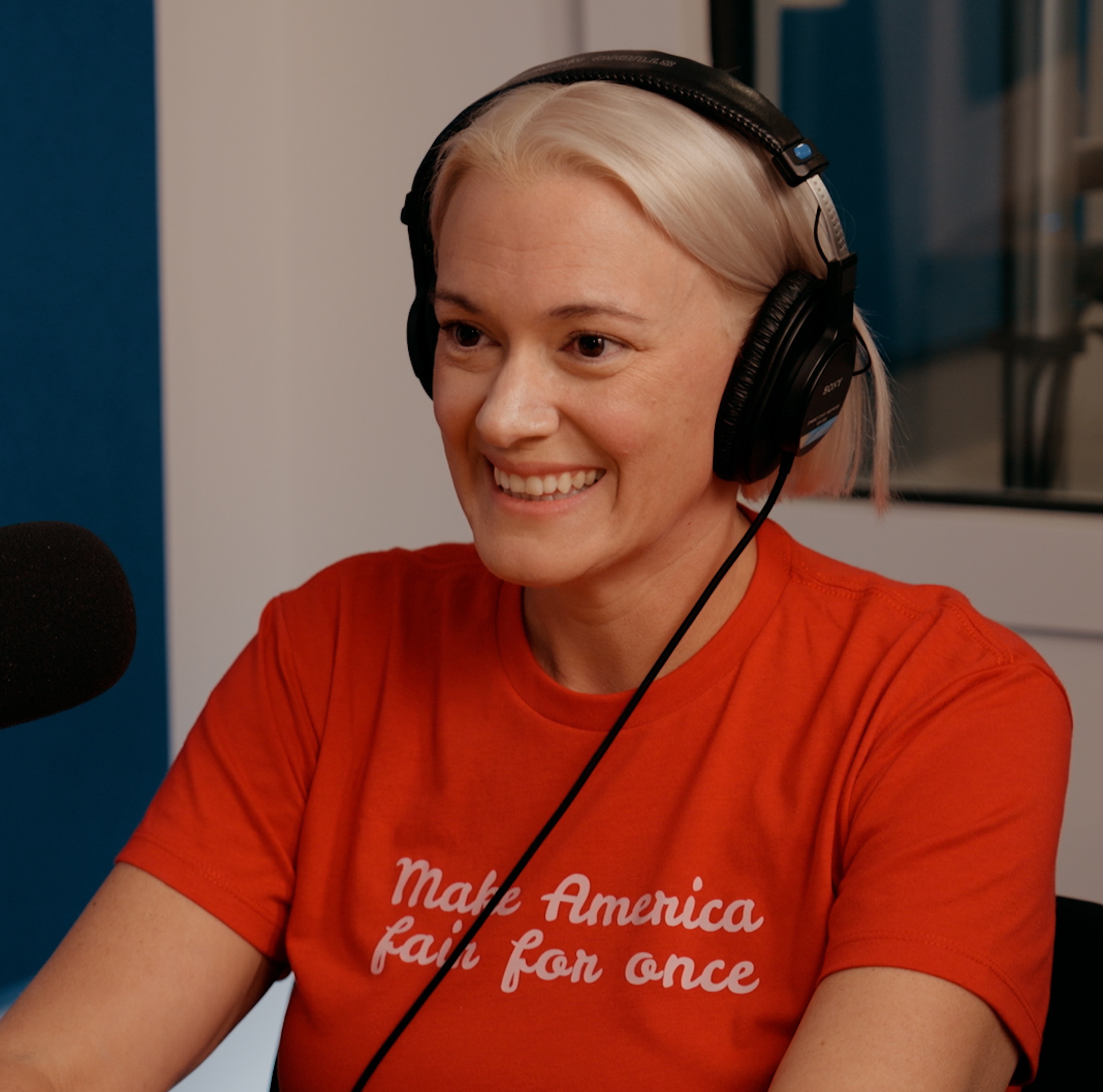
Post Reports
She couldn't win as a Democrat. Will running as a Republican work?
00:18:53
In 2024, Kate Barr ran an intentionally unsuccessful campaign for state Senate in North Carolina to draw attention to gerrymandering. The North Carolina Democrat announced today that she is switching parties and running for Congress as a Republican.
Loading summary
Transcript75 lines
- [00:01]
A
Hi, I'm Susan Glaser.
- [00:02]
B
I'm Jane Mayer.
- [00:03]
C
And I'm Evan Osnos. And we host the Washington Roundtable from the New Yorker's Political Scene podcast.
- [00:08]
A
For me, this is the water cooler. This is a wonderful chance to sit down with two of the smartest colleagues in the country and, you know, just kind of compare notes.
- [00:19]
B
Now that's so true. Cause first of all, we are actually friends in real life. But I can't wait till Fridays to hear what you guys think. Everybody sees the headlines, but you guys fill in the gaps.
- [00:31]
C
I also think, though, occasionally we get somebody to come on, and I'm always smarter for it. If you get a great historian who can tell you about a presidential election 50, 60 years ago, often it can help you understand about what's happening today.
- [00:42]
A
So if you're looking for weekly insights into what's going on inside the Beltway, please join us every Friday on the Washington Roundtable, part of the New Yorker's Political Scene podcast.
- [00:58]
D
Kate Barr can't win. That was her campaign slogan a year ago when she ran for a state Senate seat in North Carolina.
- [01:09]
E
A local state senate race. It is getting international attention for one candidate's unique platform.
- [01:15]
D
It's not close at all. Barr is running enthusiastically for a state.
- [01:21]
E
Senate seat just outside Charlotte. It is a vote for the future we want to see for our democracy. Barr is not, however, running to win.
- [01:32]
D
She was running as a Democrat in a district that was drawn to favor Republicans, and that's why she had no real chance of getting elected.
- [01:40]
E
We need fair maps. We deserve fair elections. We as voters should be able to hold our elected leaders accountable. And it's wrong that we can't. And so that looks like fair maps. I want, frankly, fair play.
- [01:54]
D
Now. Barr is back with a new campaign and a new tactic. If you can't beat him, join them. From the newsroom of the Washington Post, this is Post Reports. I'm Colby Yakowitz. It's Friday, November 7th. Today, Barr has just announced that she's running for Congress as a Republican. She's taking on a powerful local politician in the 14th congressional district. That's just outside of Charlotte, North Carolina's biggest city. I sit down with her to talk about what she hopes this might achieve and how gerrymandering, the very thing that she has been fighting against is being embraced by Democrats. Kate, thanks so much for joining me in studio.
- [02:38]
E
Thank you for having me.
- [02:40]
D
So, Kate, let's start with this. You're a Democrat through and through. Today you announced your bid for Congress Yes. As a Republican.
- [02:50]
E
Yes. Why? We're in kind of a mess as a country right now. That includes the way that our voting maps are drawn. So we've watched this gerrymandering arms race across America. North Carolina just passed, like, a more gerrymandered map a few weeks ago. Right. Cause we were already pretty gerrymandered afraid. And the only way to compete in a gerrymandered district is in the primary because the outcome of the general election has been determined by the map makers. And we have a Congress that desperately needs to be held accountable for both what they're doing and what they're not doing.
- [03:31]
D
Okay. For people that don't follow this stuff super closely, it's complicated. Like, let's have a quick, like, gerrymandering, one on one. Like, how does it work in America? How does it work in North Carolina?
- [03:44]
E
Yeah. What do you mean? People don't follow this super closely? So our Constitution says that every 10 years, every citizen of the country has to be counted. That's the census. And then that census data is used by each state to make equally sized voting districts for our state houses, our state senates, and our U.S. house of Representatives. And the reason that that's so important is that's how you get, like, each person's vote to be equ. Equal in, like, value. So that one person, one vote. Right. You need to have your district be about the same size. What gets different is that different states have different ways of drawing these districts. So the ideal method is an independent commission. That's when citizens basically sit on a board and they have some, like, expert advisors and all of that, but they come up with the voting maps for their state. Then there's what North Carolina has, which is where our state legislature draws the maps. And yes, if you are following along, that means they are drawing the maps that will then determine if they themselves get reelected. So that is when gerrymandering happens, when the folks in power in the state legislature start slashing up the voting maps into, frankly, odd shapes in order to ensure that they get the outcome they want for each of those voting districts.
- [05:13]
D
So what is it? Because I think a lot of people probably aren't familiar with North Carolina's congressional districts. And the map, the way you are, describe a little bit about where you live specifically and what makes running as a Democrat there so uncompetitive.
- [05:26]
E
Sure. So I live In Davidson, N.C. it's north of Charlotte. That's like, our metro area. It's a suburb. It's a really cute town. We think of it as being kind of like Mayberry or for the Gilmore Girls fans out there, it's very Stars Hollow. There is a lot of land around Mecklenburg county, where Charlotte is.
- [05:46]
D
Yeah.
- [05:46]
E
That's rural. Mecklenburg county itself is very blue.
- [05:51]
D
Right.
- [05:51]
E
And so what they do when they draw the maps is they make sure that Mecklenburg County's blue votes are canceled out by all of the red areas around. And they basically prey on the fact that people have busy lives and are used to using Rs and Ds as shorthand when they get to the ballot box.
- [06:10]
D
And so Davidson, then, although it's in Mecklenburg county, is drawn in such a way that it's lumped in with these other rural areas.
- [06:19]
E
Yes. It makes it difficult for anyone to advocate for their specific community because we're so spread across so much geography and also interests and things that are important to us. Like, I don't. Davidson folks don't need someone who can represent farmers the same way that someone a little bit west of Charlotte might.
- [06:44]
D
So who is the congressman that you'll be running against in the primary? Tim Moore.
- [06:48]
E
Tim Moore.
- [06:48]
D
What do we need to know about Tim Moore?
- [06:50]
E
Tim Moore was in the state House and then drew himself this congressional district last cycle. And so he's actually a freshman congressman, but he's been a part of North Carolina politics for a long time. Tim has gotten rich off of being a politician, and we've seen that continue while he's in Congress. The best example of it is during the big, beautiful bill time, Tim was publicly stating how much he loved his bill, how good he thought it was going to be for the US economy. Meanwhile, he put $245,000 into fund that gave him money when the economy tanked. So if we follow the money, it seemed like Tim didn't think the American economy was going to do well, even though the words coming out of his mouth were inconsistent.
- [07:38]
D
Yeah. And, you know, if you're a voter in Davidson, the way gerrymandering works is that the congressman doesn't need to campaign for the votes of people in Davidson because it's predetermined that he's going to win based on the votes that he's going to get in these other parts of the district.
- [07:57]
E
Exactly.
- [07:59]
D
So this strategy to run as a Republican because the only vote that matters in a gerrymandered district is the primary. You're going to be running as a Republican. What does that actually practically mean?
- [08:12]
E
So there are two parts to that question. The first thing to understand is the way that primaries Work in North Carolina is we have registered Republicans, registered Democrats, and then unaffiliated voters. Yeah. And registered Democrats have to vote on a Democratic primary ballot. I won't be on that. Registered Republicans have to vote on the Republican primary ballot. I will be on that. And then unaffiliated voters get to pick which party's ballot they want to vote on. When you look at this district, 38% of those voters are registered unaffiliated. Oh, wow. Because North Carolina voters are, like, actually pretty savvy about this stuff. And they understand that as an unaffiliated voter, you can choo. Choose where your vote's gonna go based on where you can actually have a say.
- [08:58]
D
So the idea here is that maybe you can get some of these unaffiliated voters to come out and vote for you in a Republican primary.
- [09:05]
E
Absolutely.
- [09:06]
D
Is your message then still gonna be one of whatever Democratic policies you support?
- [09:12]
E
I'm not gonna pretend to be anyone other than who I am. Right. Like, I am, generally speaking, left leaning or pretty far to the left in some cases. My message is really about fairness, and it's consistent with when I ran for State Senate in 24. We need fair maps. We deserve fair elections. We as voters should be able to hold our elected leaders accountable. And it's wrong that we can't. And so that looks like fair maps. I want, frankly, fair play.
- [09:45]
D
When you ran, your whole slogan was, I can't win. I'm a loser. I cannot win. Is that your slogan going into this race? Like, can you win this? Or is this still, like, there's no shot?
- [09:58]
E
This is where it gets totally freaking bizarre.
- [10:00]
D
Okay.
- [10:01]
E
Okay. Running as a Democrat in the general election for state Senate or even in this race, I could not win because that is how the maps are drawn. However, running as basically a Democrat with an R next to my name in the primary, I can win. That is how messed up this system is. And the reason I can win there are a couple. One is that nobody shows up to vote in a primary.
- [10:26]
D
Right.
- [10:27]
E
And so a big picture part of this campaign is making sure that voters know these primaries are the places that you have power. So if you have feelings about who's representing you, go vote in the primary. Show up for the primary. We need better than 10% turnout.
- [10:47]
D
Kate, let's take a quick break. And after the break, we're going to talk about Kate's last losing campaign and how the Democrats have embraced gerrymandering this year. We'll be right back.
- [11:02]
F
The holidays are coming up, which means the air is getting crisper and comfort becomes the best gift of all. And that's where Quint's comes in. Delivering layers that last. Their sweaters, outerwear and everyday essentials feel luxurious, look timeless and and make holiday dressing and gifting a breeze. That's because Quince has it all. $50 Mongolian cashmere sweaters made for everyday use. Denim that literally never goes out of style. Silk tops and skirts that add polish and down outerwear built to take on the season. Perfect for gifting and maybe even better for upgrading your own wardrobe. You've heard me talk about the Mongolian cashmere sweaters before and now is when they really shine. Next on my list are the Italian wool coats. Designer cuts with quality that rivals high end brands but without the high end markup. Because Quince works directly with ethical top tier factories, they skip the middlemen and can pass the savings on to you. Sometimes as much as 50% less than similar brands. Step into the holiday season with layers made to feel good, look polished and last from Quince, perfect for gifting or keeping for yourself. Go to quince.com reports for free shipping on your order and 365 day returns. Now available in Canada too. That's Q U-I-N-E.com reports to get free shipping and 365 day returns. Quince.com reports.
- [12:21]
A
Hi, I'm Susan Glaser.
- [12:23]
B
I'm Jane Mayer.
- [12:23]
C
And I'm Evan Osmos. And we host the Washington Roundtable from the New Yorker's Political Scene podcast.
- [12:29]
A
For me, this is the water cooler. This is a wonderful chance to sit down with two of the smartest colleagues in the country and, you know, just kind of compare notes.
- [12:40]
B
No, that's so true. Cause first of all, we are actually friends in real life. But I can't wait till Fridays to hear what you guys think. Everybody sees the headlines, but you guys fill in the gaps.
- [12:52]
C
I also think, though, occasionally we get somebody to come on and I'm always smarter for it. If you get a great historian who can tell you about a presidential election 50, 60 years ago, often it can help you understand about what's happening today.
- [13:03]
A
So if you're looking for weekly insights into what's going on inside the Beltway, please join us every Friday on the Washington Roundtable, part of the New Yorker's Political Scene podcast.
- [13:20]
D
Okay, so Kate, I think this is where we give listeners some more Kate Barr history and tell people how you and I first met. Because I was on the Washington Post Democracy Team last year. I was covering election rights and Voting rights, looking for stories. And I heard about this woman running a very unconventional race for a state senate. And that person was you. And so we connected. And I came and I spent some time with you on the campaign trail down in North Carolina. What were you trying to accomplish with that losing campaign?
- [13:57]
E
I think you can't fight what you won't face. And our voting maps, the lack of competition in our government, it's a real problem for democracy. I personally believe that the lack of competition in democracy is a core part of how we have ended up in the place that we're in. There are actually a lot of things that Americans agree about, and some of them are even surprising. Like 80% of people think that childhood vaccines are a good idea, which, sure, obviously, but Also we've got RFK Jr in the department of Health and Human Services, like, making really poor vaccine choices. Right. That don't represent the people because he was put there. Whatever. I could go on about this, but we have a lot of things in common as Americans. People believe that safe storage laws should exist for guns. People believe that we should have access to reproductive health care. That's birth control, IVF and abortion services. And yet our government doesn't act on those things. And the root cause of all of that is a lack of competition. So the Can't Win campaign was about calling attention to the fact that these gerrymandered elections are predetermined by map makers. We have to be honest about them. And then once we see it, we can build political will to change it.
- [15:26]
D
So, Kate, I think here is when we should talk about what's been happening nationally with redistricting. Because earlier this week, California voters just agreed to let the state to let Governor Gavin Newsom redraw their congressional maps in order to gain maybe an additional five seats for Democrats in the midterms next year. And now this is a direct response to something that President Trump has asked Republicans to do. President Trump has asked Republicans in places like Texas to redraw their maps so that Republicans can gain more seats ahead of next year's midterms. But I wonder how you feel about the fact that now we've got states like California, a number of Republican states, making maps even less competitive.
- [16:15]
E
I mean, I honestly, I hate it all. I think all of it is bad for voters. California, like, if you're trying to split hairs, and I think it is important to call out that in California, this is a time limited thing, and that the voters actually chose this. To me, that means we have to make their Sacrifice, matter. Because there are now millions of people whose votes will not matter in the same way that they used to. And so that means in the places where people's votes do still matter, we have to show up and we have to work really hard in those places. You don't gerrymander when you have good ideas. You don't gerrymander when people like you. You don't gerrymander when people think you're doing a good job. So it is meaningful that we are seeing, like, massive Republican gerrymandering to try to maintain control of the U.S. house, frankly, in spite of the voters.
- [17:08]
D
Right.
- [17:08]
E
I understand why the Democratic Party feels like their response needs to look like gerrymandering in return, but, like, this is a losing race to the bottom. Yeah. And it's horrifying to me. Something I feel excited about in this approach to running is that instead of using voter suppression tactics to try to fight back against gerrymandered, maps were actually offering voters more power. So Tim Moore was not gonna be contested in his primary, and now he has to come home and answer to his voters, because I'm gonna be there. And if he doesn't show up, then you bet I will. That means that voters who weren't gonna have a vote or have a voice in who their representative was now will.
- [17:57]
D
Because what you said earlier, and I wanna interrogate something you said earlier, which is that you. You gerrymander because you don't have good ideas or you don't think you can win on your ideas, so you redraw the lines to make it easier for your side to win. If Democrats are doing that too, do they then also not have good ideas that they can sell to voters? And is it harder for them to make the case to voters now?
- [18:23]
E
It begs the question, doesn't it? Like, the whole point of democracy is that we voters are supposed to get to choose. That said, if you have one side, frankly, just blatantly cheating, at some point you have to say, we're not gonna just sit on our high horse and on our moral high ground. We have to do everything to fight back. Especially when we're talking about, to be reasonably dramatic about it, preschool teachers being dragged out of preschools by ICE agents. When we're talking about people who rely on SNAP benefits having to fight for half of their benefit while the government is shut down. And the government is shut down because our healthcare costs are exploding. And the Republican Party doesn't seem to want to do anything about that. So this moment is critical. We have to show up for it. We don't want to bring a whoopee cushion to a knife fight. Like a knife fight. I get that. And it just makes me really sad.
- [19:32]
D
Does it worry you? Because, you know, in 2024, you know, Joe Biden and then Kamala Harris at the end really made democracy the American ideal a huge part of their message. You know, if you hand the reins over into Donald Trump, we're going to lose our democracy. And people just kind of shrugged and voted for him anyway. Do voters care about these issues?
- [19:59]
E
This is interesting. The joy of running the way that I do is we're gonna find out. For me, the outcome is the least important part of this. And so I, I think voters should care about it. They should care about it a lot. It's my job to make sure that voters understand how these like, big, ridiculous sounding poli sci thesis kind of words impact their daily lives. But they might not. We'll find out. I'm great at losing love to find out what it feels like to win. Like, this is how we fight back against a system that wants to silence us. This is how we bend the system to our. The voters will. And we'll see if the voters want to get behind me on it or not.
- [20:53]
D
Kate, thank you so much for coming in.
- [20:54]
E
Thank you, Colby.
- [20:56]
D
Kate Barr is running for Congress in North Carolina's 14th congressional district. After we talked with her, we reached out to Congressman Tim Moore's campaign for comment. Jordan Shaw, a Moore advisor, said, quote, all I know about this person is what I found in 15 seconds on her website that she's a far left liberal. Good luck selling that to GOP voters. That's it for Post Reports. Thanks for listening. If you'd like to watch this episode, we also filmed it. You can find it on our Washington Post podcast YouTube channel. I'll include a link in the show Notes. Today's episode was produced by Sabi Robinson, Rena Flores, and Josh Carroll. It was mixed by Sean Carter. It was edited by Laura Benchoff. Thanks also to politics editor Noah Beerman. Our team also includes Ted Muldoon, Alana Gordon, Ariel Plotnik, Rennie Srinovsky, Emma Talkoff, Peter Bresnan, Zoe Cummings, Renita Jablonski, Alahia Ezadi, and Martine Powers. I'm Cole Bjkowicz. Have a great week.
- [22:08]
A
Hi, I'm Susan Glaser.
- [22:09]
B
I'm Jane Mayer.
- [22:10]
C
And I'm Evan Osnos. And we host the Washington Roundtable from the New Yorker's Political Scene podcast.
- [22:16]
A
For me, this is the water cooler. This is a wonderful chance to sit down with two of the smartest colleagues in the country and, you know, just kind of compare notes.
- [22:27]
B
Now that's so true because, first of all, we are actually friends in real life. But I can't wait till Fridays to hear what you guys think. Everybody sees the headlines, but you guys fill in the gaps.
- [22:38]
C
I also think, though, occasionally we get somebody to come on, and I'm always smarter for it. If you get a great historian who can tell you about a presidential election 50, 60 years ago, often it can help you understand about what's happening today.
- [22:50]
A
So if you're looking for weekly insights into what's going on inside the Beltway, please join us every Friday on the Washington part of the New Yorker's Political Scene podcast.
- [23:06]
G
You listen because you know the power of good journalism and the Washington Post is there for you 24 7. When you become a Washington Post subscriber, you get exclusive reporting you can't find anywhere else. You also get sharp advice columns, delicious recipes, TV and music reviews and so much more. Right now, you can get all of that for just $4 every four weeks. That's for an entire year. After that, it's just $12 every four weeks. And you can cancel anytime. Add to your knowledge and discover all the Post has to offer. Go to washingtonpost.com subscribe. That's washingtonpost.com subscribe.