← Post Reports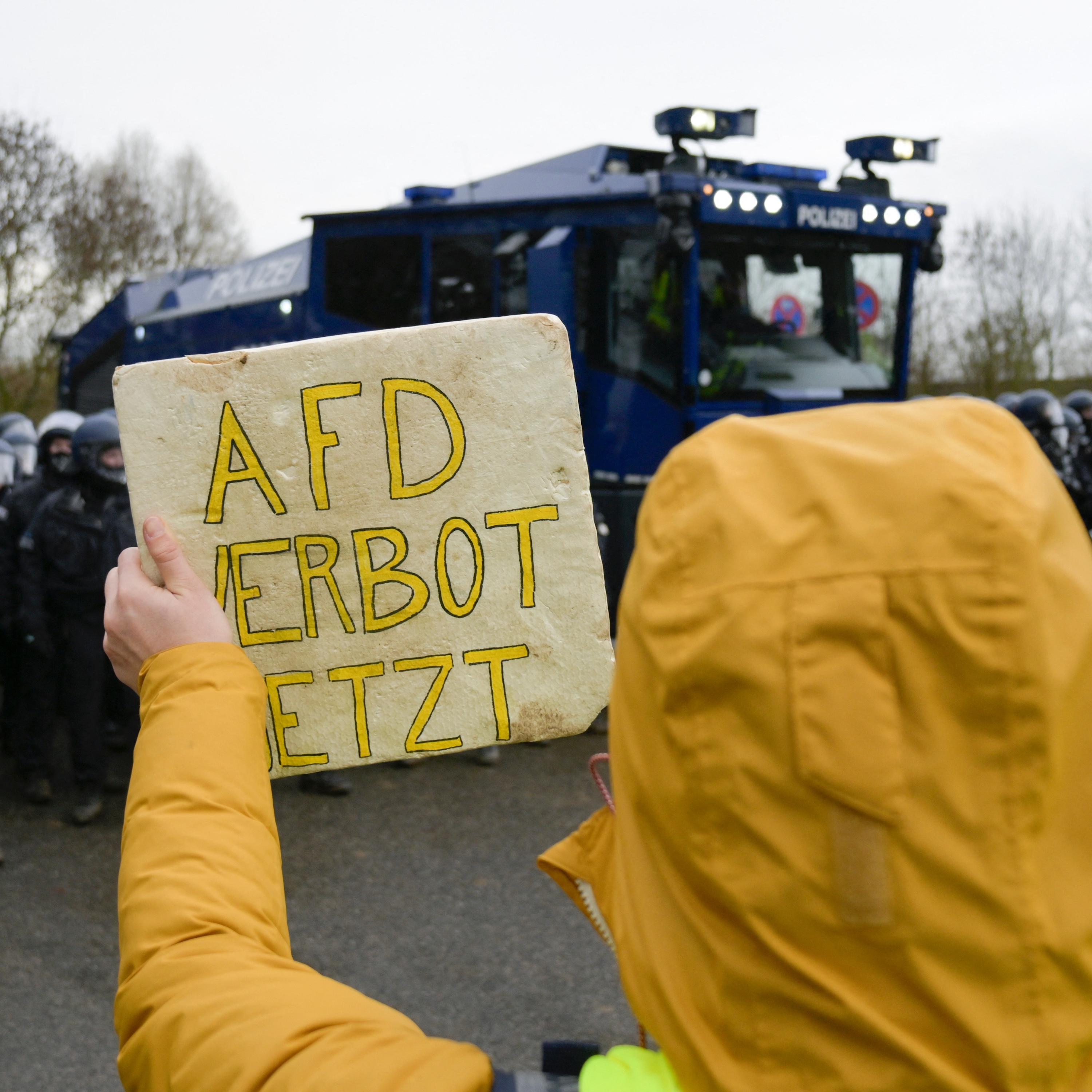
Post Reports
Should Germany ban its far-right party?
00:29:35
Germany can ban extremist political parties. Should it? Today, a deep dive into Germany’s heated debate over whether to ban the country’s far-right party.
Loading summary
Transcript118 lines
- [00:00]
PhRMA Announcer
This podcast is supported by Pharma. Did you know that America is the only country in the world where half of every dollar spent on brand medicines goes to entities that don't make them? It's true. Learn more@phRMA.org Middlemen.
- [00:22]
Emma Talkoff
In August, I visited the town of Zamfenburg, a couple hours outside of Berlin. It has this really picturesque town square, and on the day that I visited, that square had been transformed for a summer festival.
- [00:35]
Colby Yakowitz
That's Emma Talkoff. They're one of the producers on our show. And this summer they reported from Germany.
- [00:41]
Emma Talkoff
There were these long picnic tables where people were drinking big glass mugs of beer. There was a bouncy castle set up for kids. There was someone grilling bratwurst.
- [00:53]
And at one end there was a temporary stage where politicians were greeting everyone and giving speeches.
- [01:04]
It was this really lovely afternoon scene, almost a storybook setting. But if you listen to what was actually being said in these speeches, they painted a very different picture. According to these local politicians, Germany is on the brink of collapse.
- [01:24]
In their speeches, these politicians talked about a laundry list of things that they see going wrong. They talked about immigrants overrunning small towns and wind turbines destroying the natural beauty of Germany and wanting to burn pride flags. Basically this general sentiment that the country is going downhill, and they alone have the solution to that.
- [01:50]
Colby Yakowitz
This was a political rally for the Alternative for Deutschland, or the AfD, which is Germany's far right populist party. They're often compared to the MAGA movement here in the United States.
- [02:01]
Emma Talkoff
Here's Hans Christoph Berndt. He's the AFD leader in the Brandenburg State Parliament, which is where this town is.
- [02:15]
He says they can't stop us anymore. If there can still be a rescue for Germany, then it's the AfD. Only the AfD can save Germany.
- [02:26]
Colby Yakowitz
Germany's far right has seen a surge of support in recent years. According to polls, the AFD is one of the most popular parties in the country. Still, many others oppose the AfD. They see the AfD's platform as a threat to German democracy. And they have a proposal for how to fight back.
- [02:44]
Emma Talkoff
German democracy is built to make sure that a party like the Nazis can never come to power again. So. So they have this built in last resort, break glass in case of emergency option for stopping a party from taking over and then dismantling democracy. Basically, they can investigate whether a party violates the German constitution. And if it does, that party can then be banned. And a lot of people right now are saying it's time to ban the AfD.
- [03:15]
Colby Yakowitz
From the newsroom of the Washington Post, this is Post Reports. I'm Colby Yakowitz.
- [03:19]
Emma Talkoff
It's.
- [03:20]
Colby Yakowitz
It's Tuesday, December 9th. Today, an argument that is dividing Germany whether to take the drastic measure to ban their far right party.
- [03:33]
Emma, hi. It is so exciting to have you on this side of the microphone.
- [03:36]
Emma Talkoff
Yeah. Exciting to be here. Hi, Colby.
- [03:39]
Colby Yakowitz
You know, Emma, I've covered politics here at the Post for a long time. I've covered American democracy. It's hard for me to wrap my head around this idea that a country could ban a political party.
- [03:53]
Emma Talkoff
Yeah, Colby, I was really intrigued when I first learned that Germany has this option to ban political parties. I worked a lot on this story with Aaron Wiener, who's the Berlin bureau chief for the Washington Post.
- [04:05]
Aaron Wiener
It's a really interesting philosophical debate because it's unlike one that I think we would have in America.
- [04:10]
Emma Talkoff
Aaron explained to me that part of this is because of different ways that America and Germany think about protecting democracy and free speech in the United States.
- [04:19]
Aaron Wiener
Political parties, political speech, it's all protected. Here in Germany, it's a little different. And you're not allowed to make pro Nazi or anti Semitic statements. These things are against the law here in a way that they wouldn't be in the United States. And likewise, you can't have a political party that's advocating for the subversion of the core principles of the Constitution.
- [04:42]
Colby Yakowitz
I want to learn more about kind of the principles of the AfD, like who they are, what they stand for. Is there a belief that they are subverting the core principles of the Constitution?
- [04:54]
Emma Talkoff
Yeah, that's the big question. The AfD came onto the scene around 2013, and at that time, what they were advocating for was mainly German pride and independence from the rest of Europe. But since then, they've only moved further and further to the right. So they've made things like anti immigration, anti Muslim, anti LGBTQ stances, bigger and bigger parts of their platform. Immigration specifically, is at the heart of this question about whether the AfD could be banned. Basically, if they advocate for deporting or pushing out German citizens just because they or their parents are immigrants or because they're not white or not Christian, that would violate Germany's constitution. I wanted to talk to an expert to understand more about this.
- [05:39]
Marie Breitling
My name is Marie Breitling, and I'm an investigative reporter based in Berlin, and I mostly report about the AfD.
- [05:46]
Emma Talkoff
I asked her about some of the things that I saw at that AfD event and whether they fit into this question of Constitutionality. When I went to that event in Stuffenburg that I was mentioning to you, they had these tents that said zeit for remigration.
- [05:58]
Colby Yakowitz
Yeah, yeah.
- [05:59]
Emma Talkoff
It's their favorite word, Zeit for remigration that I saw. That means time for remigration.
- [06:05]
Marie Breitling
If you go to their rallies, it's always remigration, remigration, remigration. I think a few years ago, many Germans, if you would have asked them, what is remigration? Everybody would have been like, what does that even mean? I only know immigration. And now it's a very common word. It's been repeated in media over and over and over again. And they mean re migration in the sense of also pushing citizens to leave the country. People who are non white, people who are part of minorities. And that is unconstitutional.
- [06:45]
Colby Yakowitz
What she's saying is deporting citizens would be unconstitutional. Is that the issue that got people calling for the AfD to be banned?
- [06:56]
Emma Talkoff
Yeah, and a lot of people tuned into this issue. In early 2024.
- [07:05]
There was this really explosive article published in an investigative news outlet called Correctif. Reporters had snuck into this highly secretive AFD strategy meeting in the city of Potsdam.
- [07:16]
Colby Yakowitz
Oh, wow.
- [07:17]
Marie Breitling
What Corrective reported back then was that AfD politicians met at this villa outside Berlin and they discussed these ideas of pushing citizens with migration background to leave the country.
- [07:35]
Emma Talkoff
At the meeting, speakers targeted groups who they consider foreigners, including asylum seekers, and also natural naturalized German citizens who they felt weren't assimilated enough into German culture. They wanted them out of Germany.
- [07:50]
Marie Breitling
Honestly, it's not the first time that this has ever been reported. There were previous instances, but I think it's never become this clear before. And also, this whole picture of these people sitting in this room and this villa just made it so scary. Suddenly it just seemed very like they were really planning it or they're actually considering how to put this into practice.
- [08:15]
Emma Talkoff
This article about the secret meeting touched off a huge wave of protests.
- [08:27]
And there was a swell of support for banning the AfD.
- [08:36]
Marie Breitling
In the aftermath. Of course, AfD politicians have denied that this was anything they actually planned to do. Some of them have denied that this was even a topic at all.
- [08:48]
But, yeah, I think it really shook a lot of people in Germany and scared them.
- [08:56]
Colby Yakowitz
Well, yeah, Emma, because I think, you know, when you hear about this group having like a secret meeting and talking about how to push out certain groups of people out of Germany, you think about the Nazis and how they singled out specific groups of people, Jewish people, gay people, disabled people, and deemed them unfit for German society. Yeah.
- [09:18]
Emma Talkoff
Totally. And I think people are afraid that once you start categorizing different groups of people as unfit for citizenship, it could lead to something worse.
- [09:26]
Marie Breitling
German history plays such a major role in this whole debate. So the reason why we even have this measure to ban a political party in our constitution is because the founders of our constitution looked at our Nazi past and were like, we need a last resort. And so a lot of the debate in Germany around right, extremism is always centered about the idea, or it's really part of the German identity that we can never let right extremists take over this country ever again and commit such crimes. And so honestly, nowadays, when people, minorities in Germany say that they don't feel safe, that they are scared, this is shameful for all Germans. This is almost unbearable because it was supposed to never happen again.
- [10:25]
Colby Yakowitz
So it sounds like this reporting, like, really brought up a lot of deeply rooted feelings for Germans. So then what happens?
- [10:34]
Emma Talkoff
That story broke in early 2024. Then in February of this year, Germany had national elections.
- [10:43]
The winners of that election are the Center Right Christian Democratic Union, or the cdu. That's the party of the new Chancellor, Friedrich Merz. So they won the most seats in parliament. But then the party that came in Second was the AfD.
- [10:59]
Just like in a lot of other countries, the far right in Germany saw a surge of support in last year's election. And the AfD is now the largest opposition party in parliament.
- [11:12]
Now, the other more mainstream parties in the parliament refused to work with AfD. And so for now, the AfD hasn't been able to get any of their legislative goals done. Since the spring, the AfD has actually been neck and neck with the CDU in polls because Germany has a lot of political parties. That means that they are both hovering at around 25%, which is the highest of any party.
- [11:37]
But then right around that same time, something else happened that actually reignited calls to ban the party. Germany's domestic intelligence agency got involved. They're called the Federal Office for the Protection of the Constitution. And they have a lot of power. They actually have the ability to surveil political parties to make sure that they aren't violating the constitution. And that's exactly what they've been doing with the AfD. In May of 2025, the intelligence agency published this long report, so over a thousand pages saying that they think the AFD is, quote, confirmed right wing extremist. And they pointed to widespread racist and anti Muslim sentiments in the party when they made that conclusion. Now, the AFT has Opposed that ruling and that's now being fought over in court. So we're waiting on kind of a final decision on that. This came up a lot in the speeches I heard at that summer festival that we heard earlier in the episode. The AFD was talking about this ruling and saying, look, this is a political witch hunt. We are being targeted by the government.
- [12:40]
Colby Yakowitz
Say more about that because how does the AfD defend itself against these accusations that they're violating the constitution?
- [12:48]
Emma Talkoff
Yeah, I think they're very careful to toe the line, especially their higher up leaders and more public facing members. While they'll say, look, we are advocating for things that are perfectly legal. At the summer festival that I went to, I pulled aside One of the AfD politicians, Fabian Yank.
- [13:07]
Fabian Yank
I will have my speech in a few minutes, so I. I will take the speech and then I will come to you.
- [13:13]
Emma Talkoff
Is it okay?
- [13:14]
Marie Breitling
Yeah, I'll be here.
- [13:15]
Emma Talkoff
Thank you.
- [13:17]
He's 29 years old. He's a member of the state parliament there in Brandenburg. I wanted to get his response to that preliminary ruling that his party is right wing extremist.
- [13:27]
Fabian Yank
We think they are only labeling the AfD as extremistic because they want to make it harder for us to get political, political power.
- [13:38]
Emma Talkoff
What will happen if the party does eventually get banned?
- [13:42]
Fabian Yank
If the party gets banned, democracy in Germany has finished.
- [13:47]
Emma Talkoff
He was saying, like, look, a lot of people voted for us. If you ban this party, then you're ignoring those people's votes, you're silencing them.
- [13:57]
Fabian Yank
25% of the people are voting us. And if you are cutting the afd, the.
- [14:04]
These people have no voice in the parliament and in the democratic process. And that's a big problem for democracy and not the AfD is existing.
- [14:13]
Emma Talkoff
One thing I'll note here. So when the Federal Office for the Protection of the Constitution made this ruling saying that the AFD is confirmed, right wing extremist people like Vice President J.D. vance and Secretary of State Marco Rubio actually both chimed in to say that they thought it was anti democratic. So that was a moment that you could see these resonances and this growing alliance actually between the AfD. Yeah.
- [14:35]
Colby Yakowitz
So is the US policy then, or at least some of our highest leaders supportive of the AfD? Or at least I guess in this case, not supportive of banning the afd?
- [14:44]
Emma Talkoff
Yeah, they are. And that support has actually only grown since I was in Germany this summer. There's been some interesting reporting in the Post lately that There was an AfD supporter in Germany who's now seeking asylum in the United States because she says she's being persecuted for her beliefs. And there's also been reporting that there are some high level Trump strategists who are now working with the AFD to help them in their strategy. And in fact, later this week, AfD politicians are scheduled to meet with House Republicans here in D.C. so there are.
- [15:14]
Colby Yakowitz
Definitely these growing ties because there are so many similarities. I mean, as you have been talking and we've been listening to the people that you interviewed, so much of what the AfD is saying sounds like the rhetoric of the MAGA movement.
- [15:29]
Emma Talkoff
Yeah, Colby, there are a lot of similarities in the rhetoric. And in fact, in recent days, we've seen the Trump administration using language that directly echoes some of this rhetoric from the AfD. So, for example, in recent weeks, in talking about updates to the United States asylum policy, Trump wrote on Truth Social, quote, only reverse migration can fully cure this situation. And we also saw the Department of Homeland Security tweeting, quote, remigration now. So we're seeing actually some of the same language being used by these two parties. And I think that's really important context for this conversation.
- [16:05]
Colby Yakowitz
So let's say a decision is made to ban the AfD. What does it look like for that process to actually get underway? Who would have to, I guess, start it?
- [16:17]
Emma Talkoff
Yeah, so it's a little bit complicated. Basically, one of the branches of the government would have to ask Germany's Supreme Court to open a case looking at whether the AFD put poses a viable threat to the German constitution. Basically, the other parties would have to sort of come together and say, we want this process to begin. They wouldn't decide, we think this party should be banned, but they would ask the court to look into it. One way this can happen is for members of Germany's parliament, which is called the Bundestag, to vote on it. But there is massive disagreement in the Bundestag right now about whether this is the right move.
- [16:55]
Aaron Wiener, the Berlin bureau chief, and I sat down with some Bundestag members to talk about this. Aaron talked with Gunter Krings, who's a lawmaker from the governing party, the Center Right cdu Aron asked him what he thinks about voting for the AfD case to go to Germany's High Court.
- [17:10]
Gunter Krings
It's all theoretical questions right now. I don't think we are at that point yet. Maybe we'll never be at that point. But again, I wouldn't rule out that we might have to consider such a step.
- [17:22]
Aaron Wiener
If the Bundestag, if it somehow came to a Vote in the Bundestag, you know, tomorrow.
- [17:28]
Gunter Krings
Would you vote for it tomorrow? No, because I don't think that we have the material and the evidence yet. So it would be premature. Right now.
- [17:43]
Emma Talkoff
The bar for the court to actually ban a party is really high, which is a good thing. Right. So the option isn't abused by parties just banning each other for political reasons.
- [17:54]
Many on the center right, like Krings, also think that there are better ways to combat the AfD. They hope to win back some of the voters who have swung further to the right, the people who vote for the AfD now, they have this hope that they can just defeat the party through politics, win elections, have policies that are popular enough that people don't need to go to the far right and they will move back to the center right. But there are a lot of lawmakers in more left leaning parties who feel differently. They say it's absolutely not the time to hesitate with me.
- [18:24]
Aaron Wiener
Erin Weiner with Washington Post.
- [18:26]
Emma Talkoff
Hi, I'm Emmett Talkoff. Nice to meet you.
- [18:29]
Aaron Wiener
It's not a bad view here.
- [18:31]
Ralph Stegner
No, that's true.
- [18:32]
Emma Talkoff
Small but Aaron and I met with Ralph Stegner, a longtime Bundestag member from the center left Social Democratic Party. People in this camp say, look, the Nazis rose to power through official democratic channels. They were elected and then they destroyed democracy.
- [18:48]
Ralph Stegner
So we lost democracy once. We cannot be.
- [18:53]
Unserious about anything that could only come close to some of this could happen again.
- [19:00]
Emma Talkoff
Stegner also said something that really stuck with me. He says he often thinks about what would happen if the AfD did come to power. And then down the line he had to sit down and explain to his own grandchildren why he didn't do more to stop them when he could. That's why he wants to start this process as. As complicated and messy as it may.
- [19:17]
Ralph Stegner
Be, it's a difficult thing to do. Far less than the secure bet if you start a procedure like that. But nothing you can run away from and definitely nothing where you could later on if things go wrong. Could argue I didn't know.
- [19:36]
What my responsibility was.
- [19:45]
Colby Yakowitz
After the break.
- [19:46]
Emma Talkoff
Why?
- [19:46]
Colby Yakowitz
Many people, even those who oppose the AfD, are scared that trying to ban them could backfire. We'll be right back.
- [20:07]
PhRMA Announcer
In America. Half of every dollar spent on brand medicines goes to entities who don't make them. While middlemen like PBMs and 340B hospitals drive up costs, BioPharma is investing $500 billion in new infrastructure and manufacturing here at home and helping patients buy medicines directly at lower prices. Tell Washington. To end middleman markups and put American patients first, visit phrma.org Middlemen.
- [20:42]
Colby Yakowitz
So Emma, we kind of established that the AFD is more popular than ever in Germany right now, but it still sounds like the majority of people don't support them. So how do voters just in general feel about potentially banning the AfD?
- [20:58]
Emma Talkoff
Yeah, that was something I also really wanted to understand. So Aaron Wiener and I met up in Charlottenburg, which is this really lovely neighborhood in the west part of Berlin. We wanted to know more about what average Germans or like at least the Berliners out on a weekday afternoon think about the idea of a ban.
- [21:21]
So we approached a few people who are out having coffee or picking up groceries.
- [21:29]
You're hearing 77 year old Gudrun Rothberg and she says, I'm completely against banning political parties in a democracy because it doesn't change anything except that they disappear underground and become completely uncontrollable. I think we should listen more closely to where the real problems lie, why people vote for these parties. It was interesting because basically everyone we talked to that day said more or less the same thing. We talked to a half dozen people and they all said like, look, I'm not a fan of the AfD. In fact, I like really don't support them, but I don't think that they should be banned either. I think it's also interesting that this is a similar argument to the one that we heard from the AfD politician Fabian Yank, but coming from a totally different perspective, it sounds like people are.
- [22:13]
Colby Yakowitz
Kind of suspicious or at least wary that this is an effective way to combat this party. But since this is in the German constitution, has it ever been tried before?
- [22:25]
Emma Talkoff
So in the 1950s, when this Constitution was still new, Germany banned a Nazi successor party and a Communist Communist party. But I think the possibility of starting this process and having it fail is something that's really present for Germans, because that's also happened much more recently.
- [22:45]
Germany has tried and failed multiple times to ban the neo Nazi Party NPD. The first time that happened in 2003, it was over a complicated procedural issue. Basically they hadn't gone about collecting evidence against the NPD in quite the right way and they had to throw that out. But then in 2017, they failed again. And that time it was because the court said that although this party, like definitely advocated for things that were unconstitutional, they are neo Nazis, there wasn't enough evidence that it posed a genuine threat to German democracy. That's because they had been kind of waning in popularity. They weren't winning elections. They were seen as this kind of fringe group that only a few people supported. This gets into a really interesting question about viability. Basically, in order to meet the threshold for a constitutional ban, a party has to be considered a legitimate threat to Germany, German democracy. So they have to have enough support that they could plausibly gain control of the government. Now, that's obviously not in question for the AfD, as we've talked about, they have a lot of supporters. In fact, they have so many supporters that it starts to raise the opposite argument. It becomes this Goldilocks or kind of catch 22 situation. Right. Like, what would be the perfect size for the party to be viable, but not so big that it feels too big to ban?
- [24:05]
So I think with all that context, people are really worried about the consequences of trying to ban the AfD and then having that effort fail. For one thing, they think it could serve as a kind of stamp of validity on the AfD in their positions.
- [24:22]
I think what's also interesting, though, is that there are a lot of concerns that people have about what would happen if there was a successful ban. Yeah.
- [24:29]
Colby Yakowitz
Because what does that even look like? You know, could they no longer run for office? Like, they couldn't show up on a ballot? Like, what would be the practical effect of banning the AfD?
- [24:40]
Emma Talkoff
Yeah, I asked Marie Brookling, she's the investigative journalist we heard from earlier that question.
- [24:46]
Marie Breitling
Immediately, all assets owned by the party would be confiscated. All of their offices would be closed, and all of their. The AfD politicians would be beard from entering the parliament. So, yeah, which definitely.
- [25:06]
Would create scenes that are potentially very. Could turn very violent and could definitely, I think, in our social media age, be used to victimize the party.
- [25:21]
Emma Talkoff
Also, I think people are really worried that, like, even if you ban a party, obviously support for these ideas is not going to go away. So banning the AfD could just embolden their supporters, further radicalize them, and also they could just start a new party. So banning them doesn't fully deal with this issue.
- [25:39]
Colby Yakowitz
How likely is it then that they're going to ask the Supreme Court to do this? Like, what are the next steps?
- [25:47]
Emma Talkoff
Yeah, Colby, there is a deadline for this in the sense that Germany's next federal election is likely to happen in a couple of years, although it could be sooner. At that point, the AfD could gain enough seats in parliament to start enacting their legislative goals, and they could prevent a ban from happening. But to be honest, I think right now there isn't a lot of appetite for starting this process. For me, there was a moment that helped crystallize where things stand. Towards the end of my time in Berlin, I had spent a lot of time with this group that's in favor of banning the afd. They're called AFD Verbot Jets, AFD Ban Now. And I went out with some members of this group to a big protest and parade that was happening in the center of Berlin to support the rights of refugees.
- [26:39]
So this is an event that would be, like, completely opposed to the goals of the AfD.
- [26:44]
I spent the day with members of this group. They didn't want to give me their names because they're worried about being targeted by the AfD or having their information revealed online. I followed them around as they were trying to get people in the crowd to carry signs that say, Ban the AFD Now. I noticed something kind of surprising. Do you feel like people are reluctant to take the sign?
- [27:06]
AFD Ban Now Activist 1
I mean, a little bit, maybe. I mean, there's. Even within, like, the left, there's, like, dissent about whether banning the party is the right move or not. So I guess that might be a reason. But also, just carrying a sign around is a hassle. So I guess a bit of both, maybe. I think there's just fear about what happens if the ban doesn't go through, if we try banning them and it isn't successful, or.
- [27:35]
If the ban is successful. But then there's a lot of voters who lost the party that they would like to vote for, essentially. So I think there's fear of, like, civil war, unrest, stuff like that. So I think that's. That's an issue even among people who are, like, very against the AfD just out of fear.
- [27:56]
Emma Talkoff
But to these activists, all the downsides of trying to ban the AfD are far outweighed by the idea of just letting them gain more power. Here's another person I spoke to at the march.
- [28:06]
AFD Ban Now Activist 2
Yeah, to me, it all doesn't make sense. They are worried, like, yeah, they're going to be angry, and then it's going to be riots or whatever. But if that's what you're scared of, like, why then are you not scared of this party being the government? That's even scarier then. Right?
- [28:23]
Colby Yakowitz
So, Emma, after all of the reporting that you've done on this story, what are you left with? What is your takeaway?
- [28:33]
Emma Talkoff
Yeah, Colby, one thing that I didn't expect is that in a lot of the conversations I had with people who were opposing the AfD, either activists calling for a ban proceeding to begin or protesters who showed up at AFD events is that they specifically said that they were motivated by the rise of the MAGA movement and by the developments over the last year here in the US and that that is what they were looking to as a cautionary tale.
- [29:01]
I think as Americans, it's surprising, maybe even a little humbling, to hear Germans say that they are looking to us as an example of what can happen if a far right movement is left unchecked.
- [29:17]
Colby Yakowitz
Emma, thank you so much. This has been so, so fascinating.
- [29:20]
Emma Talkoff
Thanks for having me, Colby.
- [29:23]
Colby Yakowitz
Emma Talkhoff is a producer on our show. That's it for Post Reports. Thanks for listening. If you want to support the in depth on the ground reporting you heard in this episode, subscribe to the Washington Post. For a limited time, you can access the Washington Post for just 99 cents. That's unlimited access to all of the posts for only 99 cents every four weeks. That's a great deal for the first year. After that it'll cost $12 every four weeks and you can cancel anytime. Go to washingtonpost.com subscribe and grab it before it's gone. That's washingtonpost.com subscribe Today's episode was produced by Emma Talkoff, who reported this story with Aaron Wiener. It was edited by Ariel Plotnick and mixed by Shawn Carter. Thanks to David Herzenhorn. I'm Colby Ekowitz. We'll be back tomorrow with more stories from the Washington Post.
- [30:22]
PhRMA Announcer
In America, half of every dollar spent on brand medicines goes to entities who don't make them. While middlemen like PBMs and 340B hospitals drive up costs, BioPharma is investing $500 billion in new infrastructure and manufacturing here at home and helping patients buy medicines directly at lower prices. Tell Washington to end middlemen markups and put American patients first. Visit phrma.org middlemen.