← Post Reports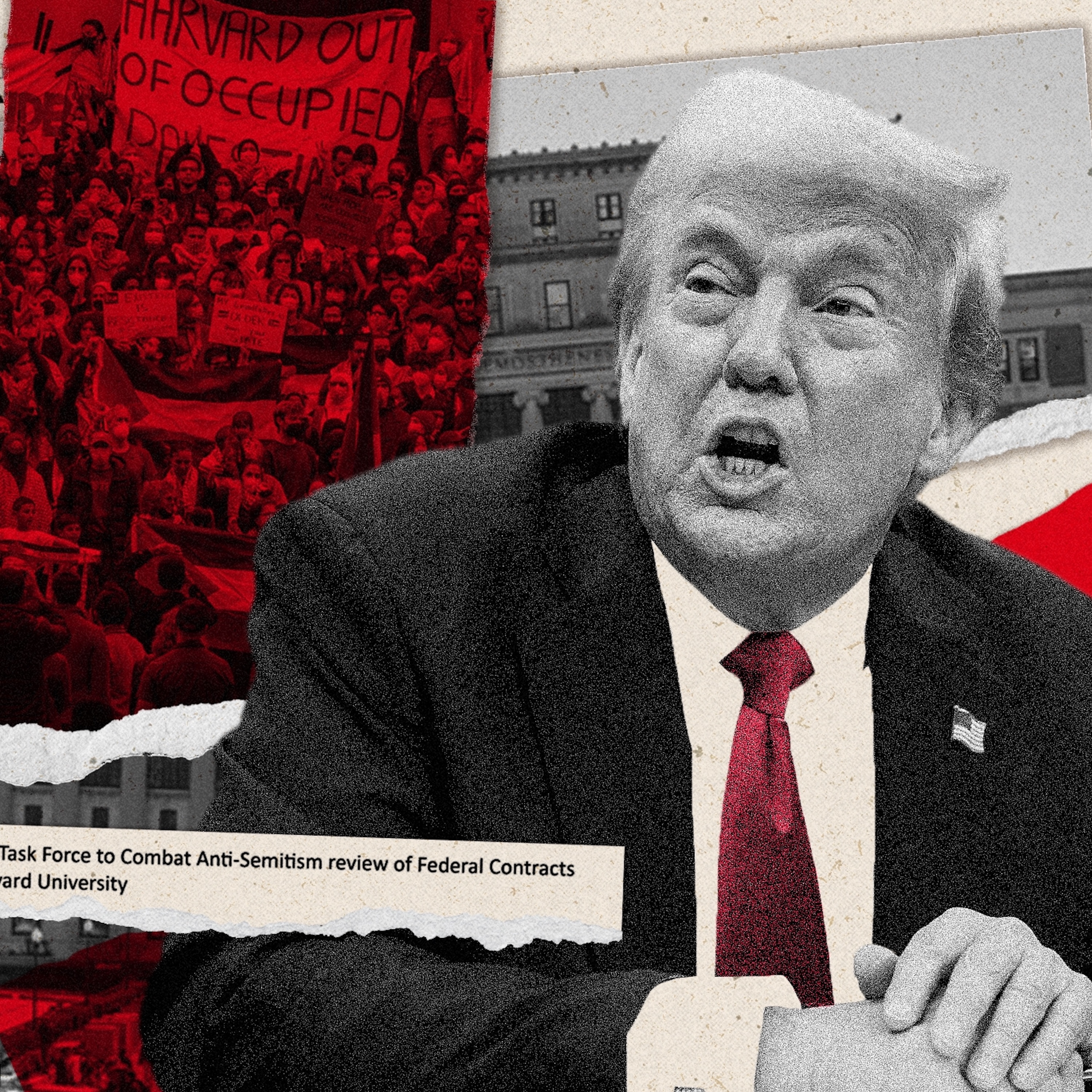
Post Reports
The antisemitism task force carrying out Trump’s anti-DEI agenda
00:25:17
How the Trump administration is using antisemitism as a vehicle to push its conservative agenda on America’s universities.
Loading summary
Transcript57 lines
- [00:03]
Colby Ichowicz
For years, conservatives have complained about American universities.
- [00:06]
Leo Terrell
You have to be on the lookout for inappropriate curriculum. Seems to me that staff at diversity, equity, and inclusion departments on many college campuses today are noticeably anti Semitic.
- [00:16]
Laura Meckler
There's a great rot on these campuses. They've become very woke.
- [00:20]
Colby Ichowicz
Here's Future Vice President J.D. vance at the National Conservatism Conference in 2021, back when he was running for Senate. If any of us want to do the things that we want to do for our country and for the people who live in, we have to honestly and aggressively attack the universities in this country. President Donald Trump spoke about this explicitly on the campaign trail in 2024.
- [00:43]
Laura Meckler
The time has come to reclaim our once great educational institutions from the radical left, and we will do that.
- [00:52]
Hannah Natenson
Now.
- [00:53]
Colby Ichowicz
The Trump administration has created a way to try and force universities to make the changes conservatives want to see. And that is mostly because of an internal government, the Task Force to Combat Antisemitism.
- [01:05]
Laura Meckler
We've talked to dozens of people, both inside the administration and out, and concluded that in reality, much of the task force work, its thinking, its demands have gone well beyond antisemitism to really attack universities for a liberal point of view, including DEI and other types of things that rub the Trump administration decidedly the wrong way.
- [01:28]
Colby Ichowicz
From the newsroom of the Washington Post, this is Post Reports. I'm Colby ICHOWICZ. It's Wednesday, July 23rd. Today, education reporter Laura Meckler unpacks a Post investigation into how the Trump administration is using antisemitism as a vehicle to push its conservative agenda and drastically alter how American universities are run. Laura, hello. Thanks for being here.
- [01:54]
Laura Meckler
Thanks so much for having me.
- [01:55]
Colby Ichowicz
So, Laura, let's go back to the beginning. How exactly did this task force? How did it come to be?
- [02:02]
Laura Meckler
So this is all in response to the Israel Gaza war, which of course started at the end of 2023, and there were many pro Palestinian protests on college campuses. There was concern first under the Biden administration and then definitely under the Trump administration about some anti Semitic sentiments that were growing out of these protests as well as some actions. And the Trump administration really wanted to cracked down on this, and they created this anti Semitism task force in February of this year. And they said that the whole point was to make sure that colleges were doing what they were supposed to do under federal law to protect Jewish students.
- [02:36]
Colby Ichowicz
The idea really was to kind of root out antisemitism on college campuses, to.
- [02:41]
Laura Meckler
Root out and also make sure that people who were guilty of it were being appropriately punished, that the universities were putting in systems and enforcing those systems and that they were addressing incidents when they came up.
- [02:52]
Colby Ichowicz
So this was created at the beginning of the year. So has it actually worked towards those goals?
- [02:57]
Laura Meckler
To some extent, yes. A lot of it revolves around how universities deal with protests on campus. There was, of course, a lot of dispute around whether universities were appropriately responding to protesters, especially when protesters, say, set up encampments and refused to leave, even though maybe they didn't have a permit for it or they didn't have any kind of permission to be there at all. So the Trump administration is asking universities, in some cases demanding that universities have better enforcement of their policies, that they maybe ban masks. Sometimes protesters wear masks so people won't know who they are or even make changes to academic departments that say, deal with the Middle east and in cases where the administration feels that the department is biased against Israel. But it has also done a lot more than that.
- [03:45]
Colby Ichowicz
Really.
- [03:45]
Laura Meckler
It's become a vehicle to go after universities in a much more wholesale way. You know, we heard at the top of the show from J.D. vance and from President Trump as they were talking about their concerns broadly about universities. And these are longstanding conservative complaints. And now the administration is really going.
- [04:03]
Unnamed Conservative Commentator
Right at that in quite an aggressive way. But we also should say that they're going at it in an inconsistent way. So, for instance, they sent warning letters to 60 universities telling them that they might be in violation of federal law and essentially saying, you better get your act together. But we reached out to all 60 universities, and more than a third of them have not heard another word. It's been months since that letter was sent. Similarly, they told 10 universities that they were going to come and visit and interview a whole bunch of people on campus, do a big investigation about their handling of antisemitism on campus. And at least four of those universities have yet to hear any follow up and haven't had any visits. The other six didn't tell us what had happened there, but at least four of them haven't had any. So it's really been quite inconsistent.
- [04:54]
Colby Ichowicz
So then what is the central case that the administration is making in these letters?
- [04:58]
Laura Meckler
So what they're saying is that universities need to abide by Title VI of the Civil Rights act, which says that any institution, including universities, that receive federal funding, cannot discriminate on the basis of race, color or national origin. National origin includes a shared national ancestry, such as a Jewish heritage. So it's not so much discriminating on the basis of religion per se. It's discrimination on the basis of a shared Jewish ancestry. So. So these are what the warning letters say is basically, you better not be allowing antisemitism or discrimination against Jewish students to persist on your school.
- [05:31]
Colby Ichowicz
So there's been all of these schools that have gotten letters about this, but then there are, like, specific schools that have been really targeted by the Trump administration. Right.
- [05:39]
Laura Meckler
They've really gone after Columbia University and Harvard University. And in the demands that they've made to these schools, they go well beyond anti Semitism. They include things like, you have to change the way you hire people. You cannot consider race in your hiring process. You don't have enough ideological diversity. We want to audit every department, the faculty, the staff, the students, and every part of your university to be sure there's ideological balance. And they've threatened a variety of schools that they're going to pull or freeze federal funding, and in some cases, they have already frozen that funding, including for Columbia and Harvard universities. These are things that don't relate to antisemitism, but do relate to this larger conservative campaign against both diversity, equity, and inclusion, and more broadly, against sort of the liberal worldview that a lot of universities have and that they are very much against.
- [06:33]
Colby Ichowicz
But so, Laura, are they doing all of this under the guise of the antisemitism task force? Because you have this anti Semitism task force, but you're saying they're pressuring schools to NDI initiatives. Those seem like those are two different.
- [06:46]
Laura Meckler
Priorities, and they're getting very much intermeshed together. Yes, a lot of this is being done by the task force itself. And, you know, the reasoning on the part of the administration. We asked them about this, and they're like, yeah, we're going after all of this. It's all related. Sort of like, well, how is this related?
- [07:05]
Colby Ichowicz
Right.
- [07:05]
Laura Meckler
And they say that. That antisemitism and DEI are both racist. They have the same racist roots. Now, that, of course, is a assertion that many would disagree with, but that is what they say.
- [07:18]
Colby Ichowicz
So let me try to wrap my head around that. So they're saying that DEI programs and initiatives in and of themselves are racist. But isn't the point of DEI to not be racist?
- [07:30]
Laura Meckler
This is one of the abiding things to get your head around in the Trump administration. They, in fact, argue that DEI in and of itself is because what those initiatives do is consider race. They think about race. They analyze the world through the lens of race. And they say, for instance, are there certain groups, certain racial groups that are not represented well, that are not feeling included, they're not having equal Opportunities. That's what DEI is all about. And they're saying, well, if you're looking at it through the lens of race, that's racist. You're not supposed to be considering race in any of this. You're supposed to be treating everybody equally. So that's where it kind of gets flipped on its head. And the way this all kind of connects up with antisemitism is they would say that DEI divides the world into oppressors and oppressed. Well, no, this is not all that DEI does, okay? In this formulation. What we have is that there's the people who are sort of the people in charge, and then there are the people being victimized, and Jews are being put in the group of oppressors. The criticism of Israel on behalf of the pro Palestinian protesters very much is that Israel is the bad guy. They are the oppressors. They are oppressing the Palestinian people. That links up with dei, from a conservative point of view is that, oh, Jews are in the category of oppressors, and that's offensive and that's anti Semitic.
- [08:55]
Colby Ichowicz
I see. And so what do critics of that way of thinking say? Like, what is the pushback to the administration kind of lumping in antisemitism and DEI as one mission?
- [09:06]
Laura Meckler
Well, they would say that these are two completely different things. And there's a lot of people who will defend DEI initiatives as working to try to make sure everybody has a voice, everybody feels included, everybody's represented, that diversity is a strength, and that all of those are good things. You don't find many people defending antisemitism per se. Even universities will say that we are also concerned about antisemitism, and we're trying to make sure it doesn't happen. Now, of course, there are some people who would say that the administration is calling things out as anti Semitic that aren't really anti Semitic. They're just free speech. And that is critical of the state of Israel. And they would say for good reason.
- [09:47]
Colby Ichowicz
So who exactly in the administration is behind this task force? Who's, like, making these decisions and pushing for this agenda?
- [09:55]
Laura Meckler
The members of the task force. Leaders of the task force are senior administration officials from the Education Department, the Department of Health and Human Services, which controls a lot of money for universities through the National Institutes for Health, and the General Services Administration, which sort of manages contracts. So you've got these senior officials, mostly people that most people have never heard of. And then you've got this guy at the Justice Department named Leo Terrell, who is sort of the public face. He's a black civil rights attorney who recently was a Fox News contributor. Before that, many years ago, he was a Democrat. He's converted and now is all in on Trump. Here he is speaking on Fox News.
- [10:36]
Leo Terrell
The academic system in this country has been hijacked by the left, has been hijacked by the Marxists. They have controlled the mindset of our young people and they haven't stopped there. They're going to the schools, the public schools, K to 12. And we have to put an end to it. We have to seek injunctive relief. We have to stop these practices.
- [10:58]
Laura Meckler
He is out there talking a lot about what this task force is up to. Republicans love this guy. They call him LEO 2.0. They even have hats that say LEO 2.0 to symbolize nod to his transformation from Democrat to Trump supporter. From what I can tell by his X feed, he spends a lot of time tweeting and posting and reposting all throughout the day. You know, he'll have just periodically, I hate dei or he'll say, somebody is a DEI hire or he'll warn, we're coming for you, Harvard. Like, he's just out there very aggressively online. And I should also say that he himself has echoed anti Semitic comments, which is one of the things I think is important when we're talking about this administration's approach to anti Semitism. There are a lot of critics who say that if Terrell was really worried about antisemitism that he and also, in fact, President Trump wouldn't be promoting anti Semitic ideas or echoing people who are known anti Semites. For instance, he retweeted a tweet from a guy who is a white supremacist who said that Trump should revoke Senator Chuck Schumer's quote, jew card, unquote, because of his views about the conflict in Israel. The idea that somebody has a Jew card that can be revoked by the government is not your everyday kind of pro Jewish thought. And of course, President Trump himself has a history of associating with white supremacists, saying things that are viewed as anti Semitic. Just recently, he made a comment about bankers that was seen as anti Semitic. He had dinner with Nick Fuentes, who is a known anti Semite. So there are people out there who are saying, like, what's really going on here? Another important person is Harmeet Dhillon. She is the head of the civil Rights division at this Justice Department and she really is involved with the investigations. Here she is speaking at a Justice Department event with the Union of Orthodox Jewish Congregations in May. The task force represents an all of government approach to eradicating antisemitism. It is this administration's commitment to use the entire array of tools available to the executive branch to address the scourge of anti Semitism experiencing a horrific resurgence in this country. She also has said some controversial things, at least in private. You know, we talked with some people who were with her at a White House meeting. As it happens, this meeting took place in June, right after this brutal attack in Boulder, Colorado, where demonstrators on behalf of the hostages in Gaza were attacked. And she was talking about that these.
- [13:36]
Colby Ichowicz
Were Jewish protesters on behalf of Israeli hostages.
- [13:39]
Laura Meckler
Exactly, exactly. And so this was clearly an act of antisemitism. And so she's talking to people about the antisemitism task force, and you would think that she would sort of like zero in on like the core issues of antisemitism there, or at least that's what some of the Jewish leaders who attended this felt like. But in fact, she said this whole incident showed why Americans needed expanded gun rights, which was puzzling to some. And she also compared the people who were guilty of antisemitism to people involved in other liberal causes like Black Lives Matter, Occupy Wall street, antifa. Now, these are all sort of movements that most people do not really think of when they think of anti Semitism. But, you know, she connected them up saying these are like all ideologically aligned with Marxism. So this is sort of just another example of taking these liberal movements and connecting them up with antisemites. And if you do that, if you're able to make that connection, then it makes more sense why when you go after universities, you would be trying to get them to stop DEI and force them to have conservatives on their faculty and say that that's all part of the same thing.
- [14:54]
Colby Ichowicz
So, Laura, hearing all of this, the one thing I'm thinking, you know, Judaism, Jewish people, this is not a monolith. Right. Everyone's not going to have like the exact same opinion of all of these issues. But when you're talking to Jewish leaders, when you're talking to other Jewish people, I mean, how do they feel about the fact that the administration has created this anti Semitism task force and has taken on antisemitism as a cause?
- [15:20]
Laura Meckler
Yeah, it's definitely not a monolith when it comes to this. There has been a range of reactions. Some people are just really grateful for the fact that the administration is like taking this issue on in a real way. And they point out that there has been real antisemitism on universities. There have been, like, physical attacks. There have been spray paint, target symbols, death threats. There's survey data that shows that about one in three Jewish college students in recent years has failed reported experiencing at least one episode of antisemitism personally. So there are some Jews who look at this whole task force and are like, this is very welcome. Other Jews respond to this that they're sort of offended by the idea that they're using antisemitism as a pretext. They would say to go after other things that they actually support and that many Jews do support. So that they're actually quite offended by this. And some, in fact, go even further to say that this could make it even worse for Jews because they'll be seen as the reason why DEI got shut down and that that could be dangerous, in fact, for Jewish students. So there is a wide range of responses to this.
- [16:28]
Colby Ichowicz
So, Lara, you said you've talked to the administration about this. How have they responded to the critique that this task force is really, it's just a vehicle for their conservative agenda?
- [16:38]
Laura Meckler
Well, in many ways, many of the administration officials that we talked to didn't really push back on any of this. They said that, yeah, we're concerned about antisemitism and we're concerned about dei and we're going after both of them. The White House spokesperson who officially commented for this story did say that he is sort of offended by the idea that it's outrageous to suggest that the administration is weaponizing the fight against antisemitism to implement an alternate agenda. But both he and everyone else that we really talked to essentially said that there's nothing wrong with putting these issues together, that they're all a problem.
- [17:23]
Colby Ichowicz
After the break, the task force latest fight and the precedent it could set for free speech at universities. We'll be right back.
- [17:40]
Hannah Natenson
My name is Hannah Natenson, and I'm an education reporter for the Washington Post. Although lately I've been covering the U.S. doge Service. I write about what the Trump administration is doing to the federal government and what the consequences will be. One story we did recently that had an immediate impact was about a proposed end to phone service at Social Security that would have affected millions of disabled and elderly Americans. After our story, the agency scrapped those plans and walked them back to a softer version. There are stories that we put out every day that you can't read anywhere else. Regardless of whether you agree with what the Trump administration is doing, one of the ways that you know what they're doing is because of the Washington Post and reporters who are spending hours well into the night trying to understand what changes they're making. When you subscribe to the Washington Post, you support this kind of journalism. Learn more@washingtonpost.com subscribe.
- [18:44]
Colby Ichowicz
So Laura, this anti Semitism task force, it's actually in the news this week because of its months long conflict with Harvard. You mentioned earlier that Harvard has kind of been at the center of all of this. And now Harvard, the federal government, they're in court. How did they end up there? What's been going on?
- [18:59]
Laura Meckler
So this fight between the administration and Harvard really intensified in April when the task force sent a letter to Harvard alleging the school had not been in compliance with civil rights law, specifically failing to keep Jewish students safe and free from discrimination as the law requires. And the letter just included this litany of demands, many of which had nothing to do with anti Semitism. Among them. It demanded that Harvard stop racial hiring and admissions preferences. It's not entirely clear that they actually are giving racial hiring and admissions preferences, but they demanded that they stop, demanded that they stop all DEI initiatives, that they conduct an audit, that they, to assure that there was, quote, viewpoint diversity, like across the whole university, in the student body, in the faculty, staff, leadership. I mean, I don't even know how you audit viewpoint diversity in the student body as well as in every department, field and teaching unit. So this was just a sweeping demand. Now, Harvard did make some changes. They renamed their Office of Equity Diversity and Inclusion. It's now just called the Community and Campus Life office. There also are ongoing talks going on about opening some sort of a pluralism hub, which was actually in the work works before the Trump administration sent its letter to Harvard, even before the Trump administration took office. But that essentially seems to be a way to be welcoming more conservative viewpoints on campus and an acknowledgement that viewpoint diversity is important in a place where you're supposed to be challenging yourself to consider new ideas. But still, this was still a really sweeping demand letter. And Harvard essentially said, no, it would not do the things in that letter. And then within hours, the Trump administration froze Harvard's vote federal funding. And then after that, Harvard responded with a lawsuit. So there's this lawsuit pending that says that you cannot pull federal funding, that this is just patently illegal, that you're trying to essentially control a private nonprofit organization, which is the university. They're saying that you're trying to control what we're doing. You're essentially trying to chill us from expressing a liberal point of view. And also they allege that they didn't go through any of the procedures that they're supposed to go through in doing this.
- [21:12]
Colby Ichowicz
And what is the government supposed to do?
- [21:15]
Laura Meckler
Well, the law actually lays it out. A number of steps you're supposed to take. For starters, you have to actually have an investigation, which there's no sign there was any real investigation, which involves interviewing people, like actually asking a diverse group of people what happened. Then you're supposed to try to come to a resolution with the university, like say, hey, can you agree to stop doing these bad things that we found? And then if the university refuses to agree, you can't come to an agreement, then you can go to a court and you can say, okay, they won't comply. We want to pull their federal funding. And then the judge can order that the funding be halted. Now, guess how many of those steps happen?
- [21:52]
Colby Ichowicz
I was going to say, did they do any of that?
- [21:53]
Laura Meckler
They didn't do any of those things. So this is all in the lawsuit.
- [22:01]
Colby Ichowicz
But the government, as we've discussed, is making this about antisemitism. What do they argue the legal grounds are for taking away, say, cancer research money on the grounds of antisemitism?
- [22:13]
Laura Meckler
Well, first of all, you are not entitled to federal funding for anything, including cancer research, if you are in violation of civil rights law. So that's the first thing. But they actually don't make that argument in court. The argument they're making is not actually that they're violating Title 6 of the Civil Rights act, which bars discrimination on the basis of national origin, including shared Jewish ancestry. What they actually are arguing is that it's a contract dispute, that they are allowed to have their own priorities in their contracts. And in this case, their priority is they don't want to spend federal money on schools that are guilty of anti Semitism. So now they're in federal court this week. There was a hearing on Monday in Boston. The issue is before Judge Allison Burroughs, and it will be up to her to decide whether to grant summary judgment to either party, which essentially would mean a victory without a trial. Just based on what the legal arguments, I think it's fair to say that no matter which way it goes, it will be appealed and likely all the way up to the Supreme Court. So we're going to wait a little while for this first decision and summary judgment, and then we'll see how it develops after that.
- [23:17]
Colby Ichowicz
So we've got them in court this week. I mean, what are the longer term implications of whatever this decision is like in terms of First Amendment protections? And then as well as kind of the future and the power of this anti Semitism task.
- [23:31]
Laura Meckler
I mean, all of higher education is watching this suit. Everybody is watching to see what's going to happen here, to see whether the administration is going to have the power to essentially pull federal funding when they don't like what you are doing. And if they're allowed to do that, then this is just a very, very big stick that they're wielding and that they'll start going to many other universities and doing the same thing, essentially trying to bring higher education writ large to heal. I mean, DEI has spread across many univers. This was a big initiative in the last decade as universities were trying to be more welcoming to all sorts of different groups. We've already seen rollbacks on that. We've seen DEI office names change. We've seen these statements stripped from websites. We've seen policies that required faculty applying for jobs to explain how they would contribute to diversity. Those statements no longer being required. We've seen a lot of things already changing. But there could be even more. If Harvard loses this case, it will show that the administration just has enormous power.
- [24:39]
Colby Ichowicz
Laura, thank you so much for coming on and explaining all this. Really appreciate it.
- [24:43]
Laura Meckler
Thanks for having me. It's good to be here.
- [24:50]
Colby Ichowicz
Laura Meckler is a national education reporter for the Post. The Trump administration continues this week to target universities. The State Department announced today that they are opening a new investigation into whether Harvard has considered national security risks when approving faculty and student international visas. Though they did not provide any evidence of this, a university spokesperson said, quote, this investigation is yet another retaliatory step taken by the administration in violation of Harvard's First Amendment rights. Also this week, Columbia University announced it would be suspending or expelling dozens of the students who participated in a protest protest against Israel's actions in Gaza. This comes as Colombia is in talks with the administration to unfreeze $400 million of federal funding which the government froze because it said Colombia hasn't done enough to combat antisemitism. That's it for Post Reports. Thanks for listening. If you're looking for the latest updates on the big news of the day, check out our morning news briefing. The Seven. We bring you the seven stories you need to know about every Weekday morning by 7am you can listen to it wherever you listen to podcasts. Today's show was produced by Sabi Robinson with help from Thomas Lu. It was mixed by Shawn Carter and edited by Ariel Plotnick. Thanks to Chastity Prep. I'm Colby Ikowicz. We'll be back tomorrow with more stories from the Washington Post.
- [26:21]
Sally Jenkins
I'm Sally Jenkins and I'm a sports columnist and feature writer for the Washington Post. My job entails pulling the curtain on really big sports events at what is going on in locker rooms, what's going on in the stadium tunnel, most importantly, what's going on in the minds of the athletes that I cover. I think that we have an instinct that sports are really important in some primal way. We pay a lot of money for them, we build really big stadiums for them. And I think that athletics really gets us in touch with aspiration and teach something very, very important about accountability, about self determination. And so my job is to really make those links explicit for readers and users. Subscriptions support this work and the people behind it. Find out more at subscribe Washington Post I'm Sally Jenkins and I'm one of the people behind the Post.