← Post Reports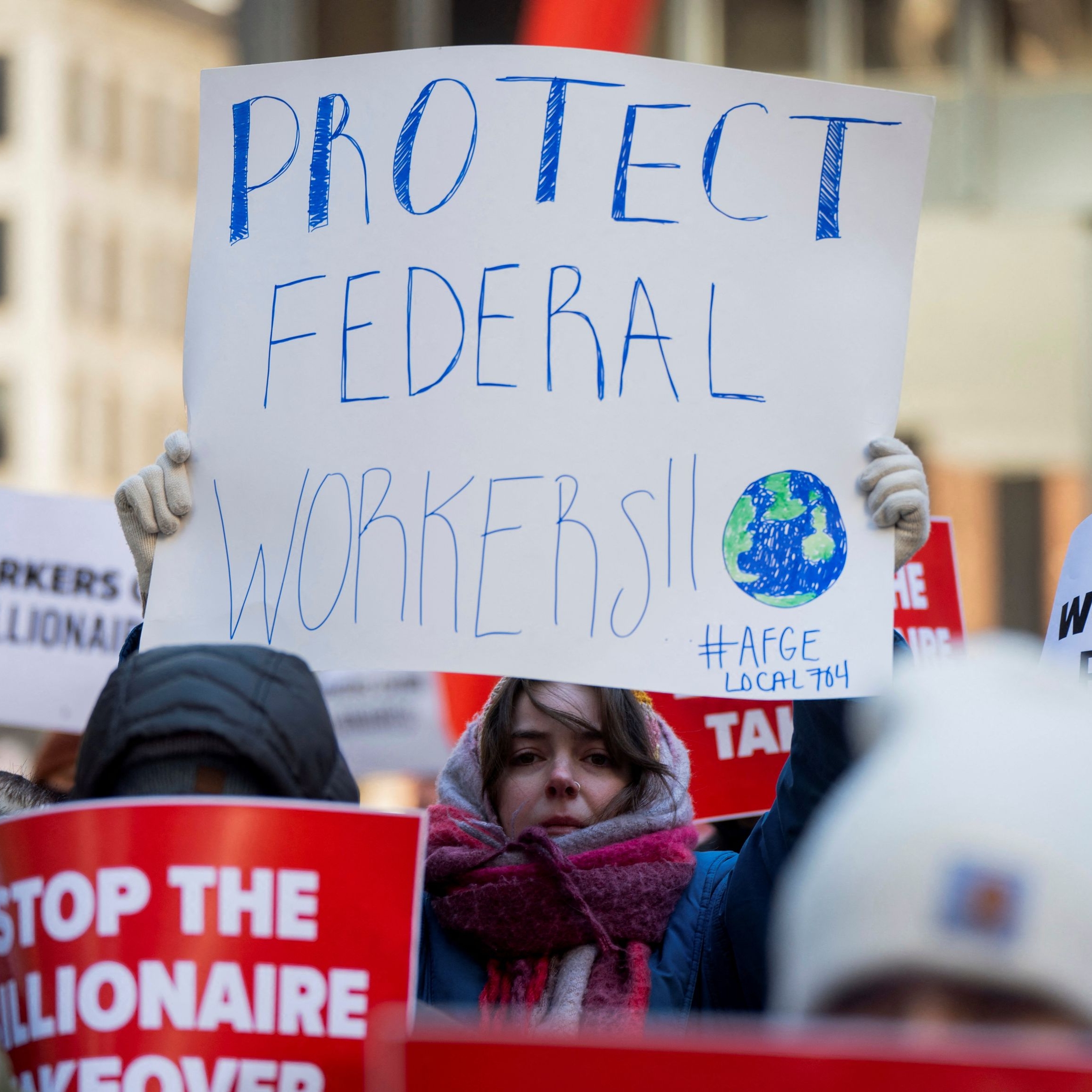
Post Reports
The gutting of the federal workforce
00:30:43
The cuts to the federal workforce and what they’ll mean for the American people.
Loading summary
Transcript79 lines
- [00:02]
Martine Powers
Up until recently, Greg Bufundo worked as a wilderness ranger in Natchez, Washington. He was there last July when a propane tank exploded nearby and a fire broke out.
- [00:16]
Greg Bufundo
It was a 90 degree day and it just took off. And the winds were really shifting and bouncing and the fire was jumping back and forth across the valley and across the river. And the fire went from an acre to 1,000 acres in 30 minutes, an hour, something like that. It just blew up. And we were able to get trucks ahead of the fire and use terrain features and tie that fire in before it burned the town of Natchez, Washington.
- [00:50]
Martine Powers
Greg doesn't work for the fire department, but he does have basic wilderness firefighting training. He was one of many workers in the U.S. forest Service who helped on the front lines during fire season. Wilderness rangers, biologists, people who lead their recreational activities at the parks, they all step up to contain the flames. But a couple of weeks ago, many of them were laid off via email.
- [01:16]
Greg Bufundo
Two sentences. It's from my deputy forest supervisor and it's titled Notification of termination during Probationary Period. And then it, there's no, no, dear Greg, none of that stuff. It just says, an orderly offboarding process is critical to successfully closing out your employment. Please work with your district ranger or supervisor for offboarding. And then he provides some links to my offboarding checklist. And you know, what's going to happen to my health insurance, which I'm losing. That's it.
- [01:58]
Martine Powers
This month, tens of thousands of federal workers received an email along these lines. They were probationary employees, those generally on the job for less than a year. And even though Greg had worked for over a decade as a ranger, he'd accepted a promotion the year before. That meant he was back to probationary worker status.
- [02:21]
Kyle Swenson
Who was affected ranged across a huge variety of jobs, from people who were working in hospitals and administration, to folks who were helping veterans at outreach centers, to people working with small communities to help them on community development grants and things like that, to people helping voucher holders get housing in smaller communities. The vast scale of what these people were doing kind of hit every single sector of American life.
- [02:50]
Martine Powers
Kyle Swenson is a reporter at the Post. He's been speaking with federal workers to understand the scope of the job losses.
- [02:58]
Kyle Swenson
And the long term impact. I think, and I think we have to take kind of the politics out of it for a minute, is that the federal government is one of, if not the largest employer in the country. It reaches into almost every corner of people's daily lives, whether they realize that or not. And so what we're seeing in such a quick way is a vast kind of recalibration of how the government is potentially going to be serving Americans.
- [03:25]
Martine Powers
From the newsroom of the Washington Post, this is Post Reports. I'm Martine powers. It's Wednesday, February 26th. Today, the cuts to the federal workforce. We're examining what it was like for federal employees to lose their jobs and also what the American people lose without them. So, Kyle, I know you spoke to many federal workers who were laid off specifically via email. There were people like Greg who we just heard from. What was their initial reaction to that, to this email coming into their inbox.
- [04:10]
Jared Blockas
Saying, you don't have a job anymore.
- [04:12]
Kyle Swenson
Because Donald Trump had been very clear on the campaign trail that this was a priority for his new administration, some people felt that cuts might be coming. They were in the air, and they could possibly be impacted. But quite a lot of the people I spoke with did not think that they would be impacted. They thought that their jobs were too critical or that they were involved in parts of the bureaucracy that were too essential to actually be cut. So surprise is what most people felt.
- [04:44]
Greg Bufundo
It was so ridiculous that I laughed.
- [04:48]
Kyle Swenson
Me and my colleagues at the Post talked to a number of people, including Greg, who worked at the U.S. forest Service.
- [04:53]
Greg Bufundo
I mean, it's so, it's, it's just, I mean, it's, it's, it's straight up bank robbery.
- [05:00]
Kyle Swenson
Jared Blockas, who worked at the Department of Veterans Affairs.
- [05:03]
Erin Williamson
In my mind, I had this kind of long term plan for my family and how we're gonna start, go from A to B. And this just threw a huge wrench in it. You know, this income, this kind of stability I had been counting on had just been completely uprooted in moments.
- [05:22]
Kyle Swenson
Erin Williamson, who worked at the Department of Agriculture, I think the words that.
- [05:27]
Aaron Fontenot
Come to mind in my head are clownishly operatic. Like, it just felt like, from my perspective, like a cosplay of work.
- [05:41]
Kyle Swenson
And then there was Aaron Fontenot, who worked at the Department of Veterans Affairs.
- [05:45]
Unknown Speaker
Yeah, it's just kind of like, what the is this? I did not expect it at all. I mean, I was angry, I guess. Luckily I was home alone at the time. I was kind of pretty pissed and just surprised that, I don't know, it was just kind of a kick in the face.
- [06:08]
Kyle Swenson
I think we also have to keep in mind, like, it's only been a month and some days since the inauguration and this has happened at such warp speed that I think everyone is reeling, including the federal workforce trying to understand how this has happened, but also what rights they have and whether this was done properly and what's next for them.
- [06:32]
Jared Blockas
And can you give me a sense of where these firings have happened or which departments, which federal agencies have been targeted?
- [06:40]
Kyle Swenson
The list of impacted agencies is so long it's kind of brain numbing. But it includes the Department of Education, Consumer Financial Protection Bureau, Department of Energy, the Department of Health and Human Services, which obviously includes the CDC and nih, Department of Homeland Security, Department of the Interior, the Department of Veteran Affairs, Environmental Protection Agency, gsa, General Service Administration, the Internal Revenue Service, IRS, and the Department of Defense. So we know that thousands and thousands of government workers have been impacted by this across the federal government and in many departments. But one of the difficulties here is, like I said, because this is happening so quickly and happening via email and happening in a way that doesn't seem very process oriented to a lot of the people who are impacted, that we're still struggling to figure out how many people are being let go or who will be cited for termination eventually and whose government services ended. So it's become hugely difficult to just even assess the scale of it. The federal government is very process oriented. There's a way you specifically do things. Again, you might think that that is cumbrous and not good and slows things down. You might think that that's a way to protect employees. I'm not saying either way, but there are processes that are there. Those processes, it appears, have not been followed really in any case. And that's brought up a lot of the legal problems that are now kind of clogging the courts about this issue.
- [08:14]
Jared Blockas
And what is the case that President Trump or that Elon Musk are making for why these cuts are necessary?
- [08:23]
Kyle Swenson
The mantra that the administration and Elon Musk have cited is waste, fraud and abuse. But again, we haven't really seen any concrete evidence of where they're finding that. And it becomes really hard when Musk will put something on X and then later a government will come out and give a different number. So we just don't know. And again, I keep saying this, but I think this is important to note. This is all happening so fast. So, yeah, maybe there is waste, fraud and abuse, but you would think that there would be a legal requirement, but also just a process wise best practice to investigate, cite and bring evidence about that. And we haven't seen any of that so far.
- [09:08]
Jared Blockas
I want to talk more about some of these workers who have been affected. For the folks that you spoke with, tell me a little bit more about them and the work that they were doing.
- [09:18]
Kyle Swenson
Sure. So I spoke with a. A guy named Jared Blockus who works at a VA hospital in North Carolina, and he was let go via email. He was an administrator in the Veterans Association. What's interesting about him is that he is a Army veteran, and he had served his country for a number of years. He'd been deployed overseas. He felt a real calling. And after a number of years, he had a family, he had children. He decided to transition out of the military, and he felt that a perfect place for him to continue his service to the country would be working for the federal government. He ended up getting a job for the va.
- [09:58]
Erin Williamson
The great part about me jumping into the VA from the military specifically was I was a veteran, so I kind of knew who we were serving. I also understood a lot about the government, how it works, the contracting, the terminology.
- [10:15]
Kyle Swenson
The job of the VA was administrative. You know, he wasn't a doctor or nurse, but he was the guy who would make sure that the machines were ordered, make sure that the contracts were filed. He was basically behind the scenes making sure that the veterans were getting the care that they deserved for serving our country.
- [10:34]
Erin Williamson
A good example is the EKG technicians, the medical instrument technicians that actually operate those and do the tests for the veteran. It's also onboarding them, getting the paperwork in to get their hiring approved through the facility. So a lot goes into just that one, getting that equipment up and running to keep helping the veterans.
- [10:58]
Kyle Swenson
And he found this incredibly meaningful. This was an extension of his service to his country. It was very natural for him, even to the point where federal employees take an oath to the Constitution, which is very similar to the oath that members of the military take when they join. And so he felt that this was a very natural extension of this urge that he had to serve his country. Then he got an email.
- [11:24]
Erin Williamson
I kind of went into panic mode because I didn't really know what to do. I didn't want to wake my wife up. I didn't want to wake my kids up and kind of worry them in the middle of the night. So doing all that research, I kind of went to bed with that anxiety, or at least tried to go to bed, and ultimately woke up, and I didn't really have the right words to tell my wife. So I just showed her the email, and she kind of just looked at me in disbelief, like, what does this mean? And I said, I guess I'm terminated from the va.
- [11:54]
Jared Blockas
I think what is surprising to me, hearing Jared's story is that he used to work at the va. I mean, this is a place that's about providing services for veterans. And that is, I think, to a lot of people, pretty apolitical issue, or one that seems pretty necessary to the country. What was his reaction to. To not only the fact that he was laid off, but the fact that he was laid off at this agency that in his mind was so important to the mission of the country.
- [12:24]
Kyle Swenson
It's important to point out that historically, if you talk to lawmakers or policymakers or really anyone around Washington, that the VA has always been considered a protected institution. Both political parties have historically acknowledged that this is an important space. This is an important network of hospitals for providing care for the veterans who have done their country service. And so it's always been seen as a place that you couldn't go in and cut the budget or slash the staff. It's also an incredibly large institution. We're talking about almost a half a million employees work at the va. And also Jared is a veteran. And across the entire federal workforce, about 30% of the workers are veterans as well. And so even going into this, he felt that he would maybe not see these cuts and they wouldn't impact him because the VA was a place that was kind of non political. There wasn't a target on its back like some of the other agencies that have been seen to be politicized have been. And so that was the double shock for him, that not only did these cuts come, not only did they come to him, but that they came and are now impacting veterans care.
- [13:37]
Jared Blockas
Can I ask, did you talk to him about who he voted for in the election?
- [13:42]
Kyle Swenson
I did. He voted for Donald Trump.
- [13:45]
Jared Blockas
So what did he have to say about the fact that these were cuts that were made under Trump, that the person he voted for for president resulted in him losing his job?
- [13:55]
Kyle Swenson
He was driven to vote for Trump because of the economy and his family. And again, now he's feeling, I think, a sense of betrayal, a sense of shock.
- [14:05]
Erin Williamson
I like to consider myself a more moderate voter. I'm registered Democrat. However, this election I did vote for President Trump in the sense that I was very concerned about my family and the economy. And I think that was kind of the driving factor behind my vote.
- [14:23]
Kyle Swenson
So he expressed that to me and as well my colleague Rena Flores on the audio team, that he felt that he would not have voted for Trump if he knew that this was the scale and the scope of what would happen. And I feel like that is a sentiment that I heard a few times from people I spoke with.
- [14:43]
Aaron Fontenot
Do you have any regrets about that vote, especially given everything that's happened?
- [14:50]
Erin Williamson
Yeah, I would say so, 100%. If I probably known about these plans and if they're probably a bit more clear in the campaign about what they wanted to do, and if that was made more clear to voters, I'm not sure he would have the same amount of votes that he did.
- [15:08]
Jared Blockas
So what was your reaction to hearing him say that?
- [15:13]
Kyle Swenson
Well, on the campaign trail, Trump made his priorities very clear that he wanted to reduce the federal workforce. But I don't feel that many voters really paid attention to the kind of fine grain detail of what that would mean. And I think a lot of voters didn't realize how deeply their own lives were impacted by the federal bureaucracy and the federal government. And so that is why, like I keep saying, that there's been this whiplash of people realizing what these cuts actually mean for them and what it means for their lives and how they go about their daily business and how they feed their families and how they get health care.
- [15:55]
Martine Powers
After the break, we hear from more workers who were laid off and discuss whether any of this is legal. We'll be right back.
- [16:13]
Thanet Naropil
I'm Thanet Naropil, and I'm a health reporter for the Washington Post. My job is to cover public health, and that means I'm writing about infectious disease threats like Covid mpox and bird flu. And I'm also holding the federal government and state government officials accountable for how they respond to these disease threats. So when we write about public health issues, we want to serve our readers by going deep into the science and by making sure that what they're reading is authoritative information that's been vetted by experts and written by people who've covered these issues for years. We want to empower people to live their best lives and to protect themselves and their loved ones. And that's what subscriber supported work does, is that it gives me the time and resources to really spend on a story. And when you subscribe to the Washington Post, you support this kind of journalism and the people behind it. I'm Fenit Niropil, and I'm one of the people behind the Post.
- [17:13]
Unknown Speaker
Are you looking to save on heart medications? If so, you're not alone. More than a third of Americans are living with a heart condition, and it can definitely get expensive. Luckily, there's GoodRx, which offers 30 popular heart medications and all under $30. GoodRx is free and easy to use. Just search for any prescription on the GoodRx website or app, get your coupon and show it to the pharmacist. In some cases, you can save up to 80% at pharmacies near you, including Walmart, Walgreens, CVS, Publix, Kroger, and many more. GoodRx works whether you have insurance or not. And even if you have insurance, GoodRx could beat your copay price. I've suggested GoodRx to a few friends and they were amazed at how easy it is to find discounts for their prescriptions. GoodRx.com is my go to Anytime I need a prescription. To save on everyday prescriptions, go to goodrx.com reports.
- [18:09]
That's goodrx.com reports support for post reports comes from Coda. You're starting a new project at work and your vision is clear. You know exactly what you need to do, where to find the necessary data, who's involved, and what they need from you. You don't have to waste time searching for anything because everything your team needs, from project trackers and OKRs to documents and spreadsheets, are in one tab, all in Coda. With Coda's collaborative all in one workspace, you get the flexibility of docs, the structure of spreadsheets, the power of applications, and the intelligence of AI in one easy to organize tab, more than 50,000 teams. Trust Coda to try it for yourself. Go to Coda I.O. reports today to get started for free. That's Coda I.O. reports to get started for free Coda I.O. reports.
- [19:13]
Jared Blockas
So, Kyle, I want to talk a little bit more about other folks who have been affected by this. Who else stuck out to you in your reporting?
- [19:22]
Kyle Swenson
Yeah, I spoke to a woman named Erin Williamson who lives in Washington state, and she was really interesting to me because this was her first time in the federal government. She had been an entrepreneur. She owned a coffee shop and a cold brew business in the Seattle area for about 10 years. She sold that. After that she went to work in economic development in the private sector and she chose she decided she wanted to work for the federal government and ended up getting a job for the U.S. department of Agriculture doing rural development.
- [19:51]
Aaron Fontenot
There's all of these people supporting those spaces all across America and kind of laying on my own land at night and feeling this almost, I don't think it's too big of a word to say, like the holiness of that space. I just wanted to kind of contribute to that, contribute to the fabric of keeping those spaces and those communities thriving.
- [20:18]
Kyle Swenson
And this was a pay cut from what she was getting in the private sector, she was in her 40s, she'd already been a successful business owner, but she, as she told me, loved this job. She would drive around to different communities, very rural communities In Washington state, 200, 300 plus mile drives at a time, and talk to really small communities about what they could do, what was available to them financially to get a new sewer system or get better broadband access.
- [20:48]
Aaron Fontenot
If people in that small town need help to build a retirement community, they know where to get that help and I can help them get it. If they need help to put in broadband service, they know where to get that help and I can help them get it. If they need help to figure out how to build more single family housing for young families in their small town, I can help them find that resource.
- [21:17]
Kyle Swenson
So she really was this connective tissue that the federal government has between what's available, the grants, the money, the financing, and smaller communities that really are usually pretty overwhelmed. I know she told me she was working with a community of like 160 people enroll Washington state that needed a new sewer system.
- [21:38]
Jared Blockas
That seems like a pretty interesting job. That basically her role was coming to these communities saying, look, what do you need? Let me know and then I'll help you figure out a way to find federal grant money that could help you build this thing and improve infrastructure and help people who live here.
- [21:55]
Kyle Swenson
Yeah, for sure. And what she told me is that most of these people wear multiple hats, right, in their community. It's so small. Like the mayor was a volunteer firefighter while also having a job and a business and, you know, trying to provide for their family. So a lot of these people were unfamiliar with kind of the chutes and ladders of federal grants and the process and things like that. And so she could show up and be like, this is what we can do. She told me that she thought it was the best job she'd ever had. She loved it, she was in the right place. And then she gets the email.
- [22:26]
Aaron Fontenot
So it says the attached notice of termination is based on your probationary status. Please contact your supervisor regarding return of your equipment. If you have any questions, please send them to hrfosda.gov thank you. The notice of termination was attached and it said, what many other people have said about you have not demonstrated that your further employment at the agency would be in the public interest.
- [22:58]
Kyle Swenson
And so a lot of these employees, including Aaron, what they feel is like, well, is anybody going to be there when I'm not there? Like, if I go away, if I'm not there anymore. Who's going to go out to that town? Is somebody going to go out in town? Is that program just going to not be there anymore? And that kind of gets to what I was talking before about how this is potentially really changing how the federal government interacts with people's lives. Because if that person's not driving the 200 miles out to tell that small town, these are the options for you to get a sewer system, well, they're not going to find it on their own, so they don't get a new water system. So that's exactly an impact, I think.
- [23:36]
Jared Blockas
That she felt, for many of us who have been hearing stories about how this is all playing out, how federal workers have been affected by this. We hear about some of these emails and specifically some of the more high profile emails that came from Elon Musk. One in particular is the Fork in the Road email that I know that we've talked about on the podcast a few times before. This idea of Musk sending out this message to all federal employees saying, like, look, if you aren't along with the ride of what's gonna happen going forward, you can just take this buyout and you'll be paid until September and you can just hang out at home if you want, but if you wanna leave, this is your opportunity. And then more recently, this directive from Musk telling everyone in the federal government to bullet point list five things that they did or that they accomplished in the past week.
- [24:28]
Martine Powers
Can you tell me more about, about.
- [24:30]
Jared Blockas
These emails and what you make of them?
- [24:33]
Kyle Swenson
Well, I pointed out before that everything is chaotic right now. And I think that that bullet point email is the best example because that went out over the weekend, which means a lot of federal employees who I've talked to, they don't have necessarily access to their computers, they're not in the office, so they can't respond until they get back into war. So people were incredibly confused. But then another level of confusion is that cabinet members from Trump's own administration began telling employees not to respond to it. Kash Patel told the FBI they didn't need to respond, that we would evaluate within our own branch and many other agencies as well. But then some reversed course and said, wait, no, you should respond to this email with the five things you did.
- [25:22]
Jared Blockas
I saw some reporting that some agencies were saying you should start drafting the email with the bullet points, but don't send the email yet. Like, hang on to the email.
- [25:30]
Kyle Swenson
Yeah, yeah. I mean, so what are you supposed to do if you're just an Employee like, the guidance has been so confusing. And some advocates of the email have said that it's a way of people to rise up and stand out and show that they're earners, and this is what they did. And also a good question is be like, who's going to comb through all these emails? We're talking about literally the biggest employer in.
- [25:55]
Jared Blockas
Kyle, you mentioned a couple times before that this is not generally the way things are done in the federal government, that for specifically some of these layoffs and some of these people who have lost their jobs, there's a question of is this an actual violation of either union agreements or of regulations around how if they are being fired or if they are being laid off, how that's supposed to work. But just to put a finer point on it, is this legal? What's happening?
- [26:22]
Kyle Swenson
So the question of legality is incredibly important. It's also really important to these employees. A lot of the people I talked to, they told me to be very careful with the language. They wanted to be known that they were wrongfully terminated or illegally terminated. And so I'm not a lawyer, I'm not a legal expert, I don't know. But for them, it was a point like, this is wrong. And so from what I understand, the federal government does have policies that are in place that a lot of this could have violated. There's been multiple legal challenges that now are kind of moving through in various parts of the court system. The US Office of Special Counsel, which is an independent agency that protects federal workers from illegal action, they have a suit that is moving forward that alleges that the Trump administration violated federal law in the firing of probationary employees. But we don't know how that case will play out at this point. And again, so much of this is happening so quickly that it's almost like our legal system is having difficulty kind of staying up to date with the actual actions of the administration.
- [27:35]
Jared Blockas
And then for the agencies themselves and the people who head those agencies, managers, are they pushing back against any of this?
- [27:44]
Kyle Swenson
So we haven't seen kind of leadership within these agencies necessarily stand up and vocalize their concerns or displeasure with how these processes have been going. I think that's due to a lot of the career staffers in the leadership level are worried about their jobs. And also a lot have been placed on leave as part of this whole shakeup. At the ground level, though, we have seen some pushback. There have been union rallies and protests. We've fired workers, do sit ins in the offices of some senators. We've also seen staffers resign in protest at how these cuts are being done.
- [28:23]
Jared Blockas
And then when we think about the potential consequences of this, I think it's also worth asking about the future of the economy and what it will mean that there's this significant number of Americans who've now lost their jobs.
- [28:38]
Kyle Swenson
Yeah. Again, think about it as one of the largest employers in the country, laying off thousands and thousands of people. So what's that going to look like? You're going to see a lot of people applying for unemployment, obviously, which means that's not going to help the economy. People are going to be buying less, they're going to be spending less at the grocery store if they have no income coming in. They're going to, if it gets this bad, start going to food banks, start applying for rental assistance and utility assistance, financial help from the federal government. So there's no way that this doesn't impact the economy. And that's a conversation that I also think is getting lost in. Kind of just the daily slam of events that keep coming is that we're not thinking of the financial and kind of economic consequences of this right now.
- [29:24]
Jared Blockas
And then for all these fired workers and particularly the ones that you've spoken with, what did they tell you about how this moment and how this last month or so has played out, how that's affected the way that they think about the government?
- [29:41]
Kyle Swenson
The people I talked to seem to have totally reframed their way of thinking about the country. Even if they necessarily weren't Trump supporters, they still believed in the federal government as this apparatus that was doing good. Even if they were Trump supporters, they thought that cuts were necessary. The federal government was too big. They didn't think it would go down like this and so quickly and in such a chaotic manner. So it really, for the impacted federal workers that I talk to, it has really upturned their entire idea of the country and the government and what the government owes to the people it's supposed to serve.
- [30:19]
Aaron Fontenot
The slashing without thought, it doesn't seem. I think my frustration is there isn't any effort to think about what's next. There isn't any effort to think about how does this impact people on the ground, people who need services?
- [30:36]
Unknown Speaker
I guess it's kind of confirmed for me this idea that conservatives care about veterans, like, until they come home for more and then they don't care anymore.
- [30:46]
Greg Bufundo
We don't walk up to a patient that has just fallen off a cliff and think to ourself, who did this person vote for and what I fear is that this administration is not only creating that reality for the United States, they're encouraging it.
- [31:05]
Kyle Swenson
Like if the faa, which has gone through cuts, if suddenly lines at airports are crazy, if Suddenly you're an 80 year old veteran and you call up the VA and you can't get into your see your doctor because the waiting list is suddenly jumped because there's no one there to take the calls. If these things start trickling in, we're gonna see a real different conversation.
- [31:28]
Jared Blockas
Kyle, thank you so much.
- [31:30]
Kyle Swenson
Thank you.
- [31:35]
Martine Powers
Kyle Swenson is reporter for the Post. That's it for Post Reports. Thanks for listening. If you have been feeling overwhelmed by the deluge of news out of the Trump administration, we have a newsletter for you. It's called the Seven Tracking Trump. It comes out every evening around 7pm and it gives you the top stories you need to know about from the day so you can get caught up in just a few minutes. We'll include a link in our show Notes where you can subscribe. Today's show was produced by Sabby Robinson. It was mixed by Sam Behr and edited by Rena Flores. Thanks to Kanyakrit von Kitkajoran and Hannah Ntensen. I'm Martine Powers. We'll be back tomorrow with more stories from the Washington.