← Post Reports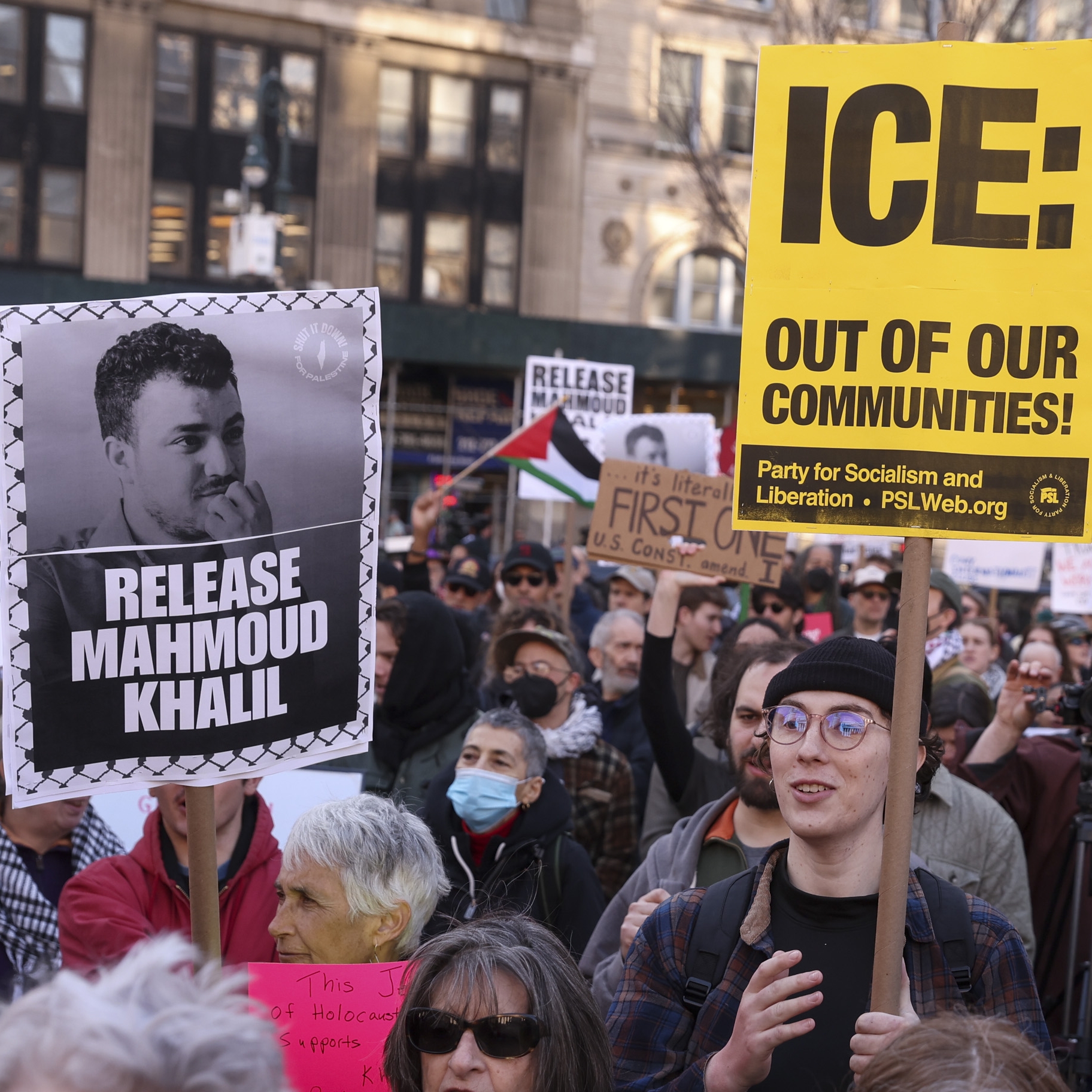
Post Reports
The ICE arrest of student activist Mahmoud Khalil
00:15:57
ICE detained activist and Palestinian graduate student Mahmoud Khalil over the weekend. Today, what the Trump administration is accusing him of and the questions his arrest stirs about protections for immigrants and free speech.
Loading summary
Transcript30 lines
- [00:02]
Colby Ikowicz
On Saturday night, Mahmoud Khalil was returning home from a friend's house in New York. He was with his wife, who was eight months pregnant with their first child. They were in the lobby of their Columbia University apartment when they were approached by a group of men in plain clothes. The men were working with ice, Immigration and Customs Enforcement. They told Kahlil they'd come to arrest him despite his wife's pleas that he's a legal resident of the United States. They took him away. From the newsroom of the Washington Post, this is Post Reports. I'm Colby IKOWICZ. It's Tuesday, March 11th. Today, we're looking at the detention of Mahmoud Khalil, a Palestinian graduate student and pro Gaza activist. I'm sitting down with immigration reporter Maria Saqeti to talk about Khalil's arrest and the accusations by the Trump administration that he sympathized with Hamas terrorists. We'll talk about why legal experts are worried about what this signals for immigration enforcement and free speech. So, Maria, tell me more about the man that ICE detained over the weekend, Mahmoud Khalil. What do we know about him and his life prior to his arrest?
- [01:39]
Maria Saqeti
What we knew first about him is that he was a student protester.
- [01:43]
Unknown Advertiser
This encampment is a minor inconvenience compared.
- [01:46]
Maria Saqeti
To the generational shaping events taking place now in Gaza. He was someone who was a public figure on campus. He would negotiate with campus officials. He would protest US Involvement in the war between Israel and Hamas. He would protest the deaths of thousands of Palestinians. He was someone who felt compelled as a Palestinian, though he was raised in Syria, to really speak up for people who were being killed. And that is how he first comes to the attention of Columbia University, where he's a graduate student, student, and the public. He was in national news and, of course, the Trump administration. But in the past few days, we've been learning a bit more about him. We know that he came here on a student visa. He married a US Citizen, and they're having their first baby, who is due in April. He was studying at Columbia as a graduate student in the School of International Affairs. He had finished his studies in December. He was set to graduate in May. And then he came home on a Saturday night, and federal agents approached him and his pregnant wife and arrested him and threatened to arrest her, even though she's a US Citizen if she didn't leave.
- [03:05]
Colby Ikowicz
And then what happened next?
- [03:07]
Maria Saqeti
The way his lawyer tells the story in court records after he arrived home, you know, with his wife on a Saturday night, they're discussing this with federal agents in the lobby of his apartment building. And he said the agents told him they were there to revoke his student visa, but he was trying to explain to federal agents that he wasn't here on his student visa anymore. He was a legal permanent resident, which is one step below US Citizen. And in spite of showing them documentation that he was a green card holder, they took him to custody anyway, and now he's facing possible deportation.
- [03:44]
Colby Ikowicz
And where is he now?
- [03:45]
Maria Saqeti
Well, according to the court records, he was handcuffed and he was taken away. The officers told his wife that he was going to be taken to Federal Plaza New York, which is, you know, where the federal building is, and could have been a holding area. But apparently he may have been taken to New Jersey and then that's near the airport. And he may have then been flown to Louisiana, where he is now.
- [04:11]
Colby Ikowicz
And so what is he waiting for in Louisiana? Now, you mentioned that he's facing a possible deportation, but for what? Has he been charged with a crime?
- [04:20]
Maria Saqeti
So that's an excellent question. There is no public record that says he's being charged with a crime. So I've seen no evidence that he's being charged with a crime. So far, he's in civil immigration detention. These are civil proceedings. And the immigration court records are not public records. And the laws in immigration courts at least just do not match the criminal system for transparency and due process.
- [04:45]
Colby Ikowicz
But, Maria, even if you're a legal permanent resident, even if you have a green card, you can still be arrested under this system with threat of deportation.
- [04:54]
Maria Saqeti
Absolutely. And green card holders face deportation all the time because they have committed serious crimes, such as a drug offense or a violent crime. Even citizens have been denaturalized if there was fraud in their application or there was something very serious that happened. But to be pursued for your activism, for opposing the war, that is uncommon. And this happened to some degree under Trump's first term, where he was accused of pursuing the deportation of activists. Now, several of them had criminal records of varying degrees, but one did not, and she had to sue to make sure that she was protected.
- [05:39]
Colby Ikowicz
So, Maria, I definitely want to come back to this later. The idea that Khalil may have been detained because of his activism on campus, but let's stay in the moment of his arrest for a little bit longer. So we know that ICE officers detained Kahlil as he was coming home to his university owned apartment. And we don't know to what extent Columbia University was aware that this was going to happen. I saw there was an email from the dean to students at Columbia that the university only provides non public information to officers in response to a valid judicial warrant or a subpoena, and that to date, they haven't received one in connection with this incident. So do we know if agents had a warrant for his arrest?
- [06:19]
Maria Saqeti
Yeah, the lawyers say that one of the immigration agents told them he had a warrant, but it was an administrative warrant. And so these are some of the semantics involved in the immigration system. An immigration detainer, a warrant is something typically signed by a judge, meaning that a judge who is not an interested party has signed an order letting police go down and knock someone's door down or go into someone's house and search it. Immigration warrants, for the most part don't exist unless there's been a crime committed or alleged. And so usually if an immigration officer is going to arrest somebody for civil immigration violations, which is what is happening to Mr. Kahlil right now, that would be an administrative document. Like they would give him a notice to appear in immigration court or they would arrest him for civil violations. It's not the same as a warrant signed by a judge. Usually it's signed by an immigration officer.
- [07:21]
Colby Ikowicz
So, Maria, tell me, what do we know about why Khalil was detained and faces deportation? Now, I know that finding paperwork on this has been really challenging, but I did see that President Trump posted about this case specifically, what did the President say?
- [07:37]
Maria Saqeti
So he said U.S. immigration and Customs Enforcement proudly, that was his word, detained him. Khalil, in compliance with his executive orders to target noncitizens who the President thinks engage in activities that are against U.S. interests. So he didn't provide evidence, but he accused Khalil and others of engaging in, quote, pro terrorist, anti Semitic, anti American activity. And he vowed to banish them permanently. He said they just will not tolerate it. He said he expected all American colleges and universities to comply, but he didn't really say what he would ask of these colleges and universities. So it's a big question about what this means for protests. I mean, protesting on colleges is very common. I mean, it's been going on for many, many years. I mean, you go back and think to the 60s, the 70s, and after 9, 11, and it's just a staple of college. And we've had over the years, more and more foreign students come into the country, they tend to pay higher tuition that funds universities. And so to put out such a broad threat and show this example of someone who was prominent and is now essentially in a jail sends a chilling effect Now, I will say this is the kind of protest that we're seeing going on. A lot of Jewish people, Jewish students, students felt unsafe on campus. And, you know, there's a real debate out there about the protests and some of the things that have been going on that may have made students on perhaps all sides feel unsafe and faculty. But to target one person, to brand them as pro terrorist without any evidence, I mean, that's a pretty broad dictate. And if you go back and look at Secretary of State Marco Rubio's Twitter feeds and other feeds on social media, you can see he's been talking about this for a while before Mr. Kahlil's arrest. He's talking about, you know, using his power as Secretary of State to look inward toward the United States instead of outward as the Secretary of State, you know, usually does, and start kind of plucking people from college campuses or communities because of their speech inside the United States. The question is, where does it end? You know, does another president come in and disagrees with something other people are saying? You know, do they get kicked out of the country? It's really one of the bedrock principles of this country that we have the right to free speech under the First Amendment. And this is, you know, likely to face legal challenges, for sure.
- [10:32]
Colby Ikowicz
After the break, we'll dig into the backlash to Khalil's arrest. We'll be right back.
- [10:46]
Unknown Advertiser
Are you looking to take control of your health? Well, one way to do that is to check out GoodRx and stop overpaying for your prescription medications. With Goodrx, you can find huge savings on your prescriptions for everything from GLP1 medications to remedies for your allergies and so much more. GoodRx is free and easy to use. Just search for any prescription on the GoodRx website or app, get your coupon, and show it to the pharmacist. In some cases, you can save up to 80% at pharmacies near you. Best of all, GoodRx works whether you have insurance or not. And even if you have insurance, GoodRx could beat your copay price. You've heard me say this a few times now, but I've been suggesting Goodrx to my friends. They raved at the savings and how easy it was to find discounts for their prescriptions. Next time you need a prescription, you should check out GoodRx too. For simple, smart savings on your everyday prescriptions, go to goodrx.com reports. That's goodrx.com reports for years and Years.
- [11:47]
I overpaid for wireless, but then I finally got fed up. The crazy high bills, bogus fees, and quote unquote free perks that actually cost more in the long run became too much. Then I switched to Mint Mobile and the savings I'm seeing are incredible. Say goodbye to jaw dropping monthly bills because Mint Mobile is here with premium wireless plans starting at 15 bucks a month. All plans come with high speed data and unlimited talk and text delivered on the nation's largest 5G network. You can use your own phone and current number with any Mint mobile plan. Get three months of premium wireless service from Mint Mobile for 15 bucks a month. Shop plans@mintmobile.com reports that's mintmobile.com reports upfront payment of $45 for three month 5GB plan required, equivalent to $15 per month. New customer offer for first three months only. Then full price plan options available, taxes and fees extra. See Mint Mobile for details.
- [12:46]
Colby Ikowicz
I was going to say, Maria, that, you know, you can disagree with the protests at Columbia. It's obviously a very fraught and passionate issue, the situation in Gaza. But detaining someone because they fall on one side of that debate or the other, I mean, what has been the reaction to this from all sides?
- [13:09]
Maria Saqeti
So there have been protests and letter writing campaigns. People are upset about this and calling for his release. People are afraid. They're worried about exercising their free speech. You know, they're worried about being punished. And that's an even broader problem. You know, that's a big problem for a lot of people because it goes well beyond this one case, which is, you know, in many ways, you know, a profound example of what the government can do to an individual. But it's also a question of what effect will it have on college campuses. Will there be fewer protests? Will people be less willing to speak up about their beliefs?
- [13:58]
Colby Ikowicz
Yeah, and to that point, Maria, I mean, the Trump administration is also targeting universities and threatening like huge cuts in their funding, including Columbia. They canceled something like $400 million because they say the school failed to protect their Jewish students. Does this feel like a conceal concerted effort from the Trump administration to clamp down on protests at universities?
- [14:23]
Maria Saqeti
I mean, I think by limiting their funding, that's also a huge penalty for them. And so the question is really, what will universities do next? Universities have really been the guardians of free speech in many ways. And now the question is, what really will universities be doing when they're facing these penalties from politicians? What action will they take? Will they protect free speech? I guess, you know, the One thing that gives me pause about all this, you know, is that I don't want to draw too many conclusions because there's still a lot we don't know about Mr. Khalil's case. You know, we learned yesterday that he was facing disciplinary proceedings by Columbia University. That doesn't mean he was doing anything wrong. I don't know that they were resolved, but I think there are just a lot of questions we don't have answers to. So I don't want to draw too many conclusions.
- [15:15]
Colby Ikowicz
Maria, do you think we should expect more arrests of student protesters in the coming days, weeks? Are they just making kind of an example out of Kahlil?
- [15:28]
Maria Saqeti
I think I would just go point back to what President Trump said. He says the first of many more.
- [15:34]
Colby Ikowicz
And what do we know about what's next for Khalil and his case?
- [15:40]
Maria Saqeti
Well, we know that he has a case in the real federal courts in New York, which is before an appointed judge who is part of the independent judiciary who will decide whether Mr. Khalil should be allowed to come back to New York from Louisiana and whether he should be released from detention. Separately from that, though, he's facing deportation, possible deportation in the immigration courts, which, unlike the regular federal courts, report to the Department of Justice. They're under the attorney General, Pam Bondi, the nation's top prosecutor. So those are two parallel tracks. One we know about because we can pull the records. The other one in immigration court, we don't know where that stands today.
- [16:33]
Colby Ikowicz
Maria, thank you so much.
- [16:35]
Maria Saqeti
Thank you.
- [16:36]
Colby Ikowicz
Maria Sichetti reports on immigration and the Department of Homeland Security for the Post. After we spoke, Maria found out a crucial detail in Kahlil's case. She reported that, according to a federal official, ICE officers arrested Kahlil based on a section of U.S. immigration law that lets the secretary of State claim a person is deportable because his actions in the US could have serious foreign policy consequences. And that's it for Post Reports. Thanks for listening. If you want to show your support for the show, please subscribe to the Washington Post. Not only is it a great way to help us continue to do this work, but you can now get access to Washington Post podcasts ad free in Apple Podcasts. Subscribe in Apple Podcasts or by following the link in our show notes. Today's show was produced by Reni Svirnovsky with help from Sabi Robinson. It was edited by Rena Flores and mixed by Sam Baer. Thanks also to Jenna Johnson. I'm Colby Ikowicz. We'll be back tomorrow with more stories from the Washington Post. You listen because you know the power of good journalism. And the Washington Post is there for you 24 7. When you become a Washington Post subscriber, you get exclusive reporting you can't find anywhere else. You also get sharp advice, columns, delicious recipes, TV and music reviews and so much more. Right now, you can get all of that for just $4 every four weeks. That's for an entire year. After that, it's just $12 every four weeks. And you can cancel any time. Add to your knowledge and discover all the Post has to offer. Go to washingtonpost.com subscribe. That's washingtonpost.com subscribe.