← Post Reports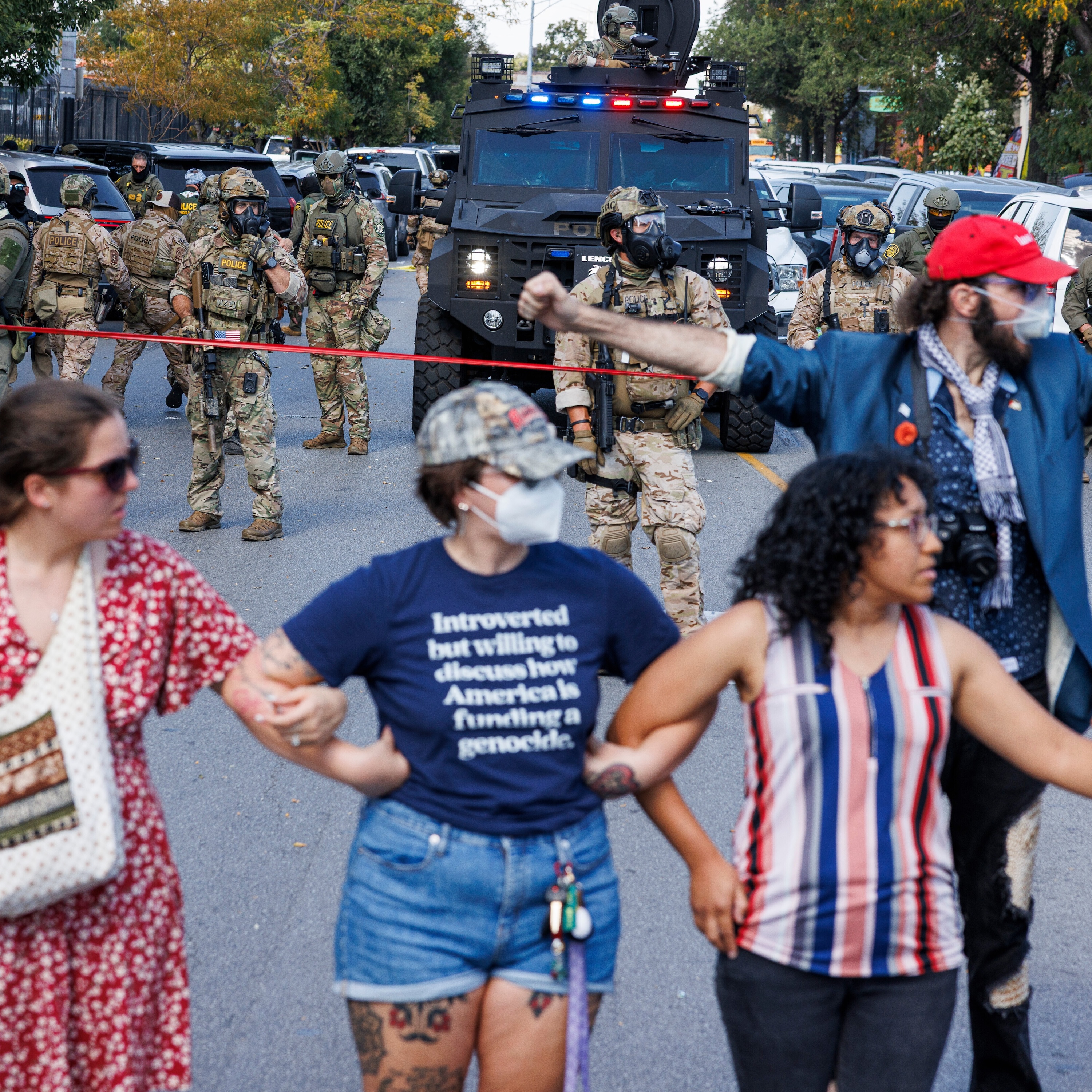
Post Reports
The National Guard arrives in Chicago
00:26:47
After more than a month of increased ICE enforcement in Chicago, hundreds of National Guard troops deployed to the city this week. Today, what it feels like on the ground, and how politicians and residents are resisting.
Loading summary
Transcript64 lines
- [00:03]
Colby Ikowicz
Chicago has become the epicenter of President Donald Trump's war on Democratic cities. Over the last week, tensions have escalated dramatically. The Trump administration has ramped up its immigration enforcement in Illinois and Chicago. In particular, Immigration and Customs Enforcement, or ice, have taken a more aggressive approach in the city. They've initiated raids and arrested hundreds of people. Those actions have inspired heated protests from local residents.
- [00:34]
Protester/Activist
No fascists, police, no justice, no peace, no action.
- [00:40]
Colby Ikowicz
Then on Saturday, a woman was shot by an ICE agent after an alleged confrontation with officers. President Trump used the incident to justify sending the National Guard to Chicago.
- [00:50]
Protester/Activist
If you look at Chicago, Chicago's a great city where there's a lot of crime, and if the governor can't do the job, we'll do the job. It's all very simple.
- [00:58]
Kim Belware
Well, as of Tuesday, at least 500 National Guard members have been federalized and activated into Illinois. And as of Wednesday, they are here, mostly in Chicago and the surrounding area.
- [01:09]
Colby Ikowicz
Kim Belware is a national reporter for the Post based in Chicago, where she's been watching all of this unfold.
- [01:15]
Kim Belware
And this is all coming at the same time that President Trump has continued to pump out really heated rhetoric about the city and many would say inaccurate rhetoric about the city's crime problem.
- [01:29]
Colby Ikowicz
Now that federal troops are on the ground in Chicago, Kim says the situation in the city could get worse. Illinois Governor J.B. pritzker and Chicago Mayor Brandon Johnson are actively fighting Trump in court and in the court of public opinion. Then this morning, another escalation on his platform, Truth Social. Trump said that Pritzker and Johnson should be put in jail for, quote, failing to protect ICE officers. From the newsroom of the Washington Post, this is Post Reports. I'm COLBYAKOWICZ. It's Wednesday, October 8th today, why the Trump administration is sending federal troops to Chicago and how Chicago residents and politicians are trying to fight back. Kim, hi. Thanks so much for joining us today.
- [02:22]
Kim Belware
Hey, Colby, thanks for having me.
- [02:24]
Colby Ikowicz
So, Kim, as we just heard, President Trump has sent the National Guard into Chicago. But this came after weeks of tension in the city and escalating rhetoric from the president about the city. Can you tell me, you know, what's been going on over the past month?
- [02:39]
Kim Belware
Well, for the past month, President Trump has kept up this steady drum beat that seems cities, Chicago being maybe top of this list, are dangerous, overrun with crime, and that local residents and local officials are interfering with federal immigration enforcement and that he needs to send members of the National Guard in against the wishes of the governor to quell the situation. Now, two things are happening with this One is that Chicago has always been a city that President Trump has fixated on. He has one of his big towers here, and he's also kind of used it as a stand in for the opposition to his administration. You know, it's a shorthand for Democrats. It's a shorthand for liberalism. It's a shorthand for all of the things that are, you know, counter to what he supports in many ways.
- [03:31]
Colby Ikowicz
And, Kim, this started really in September, right? He announced the launch of this major immigration enforcement initiative in Chicago.
- [03:42]
Kim Belware
Yeah, there was a big, dramatic rollout from the Trump administration when they were announcing what they're calling Operation Midway Blitz. Midway is a reference to the great Chicago Midway. And this immigration enforcement initiative, according to the administration, is aimed at undocumented individuals with criminal records in Illinois. And the government has said that they are looking to especially prioritize those with violent records.
- [04:07]
Colby Ikowicz
But has that been happening?
- [04:09]
Kim Belware
That's definitely not what we've been seeing. One of the most striking examples from the past week was there was a family who was downtown. They were by the Crown Fountain. Anybody who's visited Chicago, it's the one that has the big faces and the LED screens. It's been a really nice early fall so far, so people are out enjoying the beautiful city. And immigration officials came and arrested a young family in front of their daughter.
- [04:35]
Protester/Activist
Video shows the arrest near the Crown Fountain. And according to court documents, two parents and two children were taken into custody.
- [04:42]
Kim Belware
And we blurred their faces and there's video and photos of this young girl, maybe as young as five or six, who's translating for her parents with these federal immigration agents. We've also seen in some of the high profile arrests that have been made, these are people who are undocumented, maybe didn't have authorization when they came into the country, maybe have overstayed a visa and are just working. They've been here 20, 30 years. They have families and they're just working jobs, but they work out on the street. Maybe they're a street vendor, they're a flower vendor, they're a day laborer, and they're much more vulnerable to being picked up in these sweeps. And there's also been US Citizens who have been detained.
- [05:26]
Colby Ikowicz
Since this law enforcement presence has kind of ramped up. What is the feeling of being in Chicago right now?
- [05:31]
Kim Belware
Well, it's just. It's so incongruous with what we're hearing from the administration and how they're describing the scene with the reality on the ground. You know, the president has said Chicago is like A killing field, you know, that things are out of control, that people are begging and pleading for help. Chicago also has a reputation for particularly gun violence, for, you know, a high level of homicides. You know, back after Covid, those numbers were eye popping. And nobody that you talk to will deny that there is an issue with crime, with quality of life, nuisance crimes, violent crimes in the city. But it's certainly not something that is widespread over the entire city. And given, you know, our famously volatile weather, it's actually been very nice lately. And this pleasantness that you see people enjoying the city and all it has to offer is being contrasted with, with this really doomsday kind of rhetoric. And then you're also seeing these scenes of militarized federal agents in neighborhoods. And even in my own neighborhood, the local alderwoman, the city councilwoman was arrested at a hospital when she was asking ICE officials if they had a warrant for a man they were trying to detain.
- [06:48]
Colby Ikowicz
I mean, you mentioned that there was an uptick in crime in Chicago after Covid. That's been true in cities across America. But is there any evidence to suggest that those crime rates were related to undocumented immigrants, that it was undocumented immigrants, you know, carrying out those crimes in any kind of large numbers?
- [07:08]
Kim Belware
There's little research on the connection between crime and immigration in Chicago, and this is in part because of local laws that limit the collection and sharing of individuals immigration status. But right now there's no data that supports that the COVID crime spike or any of the higher crime levels in Chicago are because of undocumented immigrants. We also know from pretty extensive data that immigrants writ large tend to commit crimes at far lower rates than native born Americans.
- [07:35]
Colby Ikowicz
You know, you mentioned some of the incidences that have been happening. We've seen these videos on social media coming out of Chicago that are pretty jarring. There was one specific incident that happened over the weekend in the south side of Chicago at an apartment building. Can you talk to us about what happened there?
- [07:51]
Kim Belware
In the case of this raid on a South Shore apartment building, this happened in the middle of the night. There was a Black Hawk helicopter that was hovering over the building. You have agents rappelling down, kicking in windows, arresting people, and, you know, not in a sense that had any kind of order or what felt like just a disciplined planned operation that people might expect from the federal government. Footage shows people, including women carrying children.
- [08:26]
Colby Ikowicz
Being led away by federal agents.
- [08:28]
Protester/Activist
Immigration authorities have not released specific charging information against anyone taken into custody.
- [08:33]
Kim Belware
Which is why, and you know, the Government said that they were looking for violent criminals. They were said the building was frequented by members of the Transur Aragua, this gang from Venezuela. And, you know, you have this really dramatic scene, and people are being pulled out of their beds. People are. Some people were not fully clothed. Their doors were busted open, their belongings were kind of ransacked. And, you know, as we continue to report on this, my colleague Marianne Levine, who's in here on this story, had said there is still so much confusion in the neighborhood because there are neighbors who are still trying to find people who were taken in that raid and appear to be unaccounted for. And this was a really high profile incident in the city. Illinois Governor J.B. pritzker even mentioned that there might have been children who were caught up in this raid, and he was very unhappy with how this has been playing out.
- [09:31]
Protester/Activist
You don't ransack the building, break the windows of the building and create turmoil and mayhem. Why do you think they're doing that? They're doing that because they want to create the pretext for bringing troops in, for making it seem like there is a war zone in Chicago. They're the ones creating that war zone. They're trying to create the situation in which they can bring more and more military into our cities.
- [09:57]
Colby Ikowicz
Speaking of Pritzker, you know, you hear in that clip he's furious, right? He's furious about what ICE has been doing in the city. Let's talk a little bit about what his reactions to both their tactics and President Trump's rhetoric has been.
- [10:16]
Kim Belware
Well, Governor Pritzker has emerged as perhaps one of the strongest voices on the Democrat side for pushing back against rhetoric and different strategies in President Trump's second administration. He has not minced words as he has condemned how the president has described the city and also the efforts that he's been endeavoring when it comes to immigration enforcement and federalizing National Guards on the street. He said this is something that is unconstitutional and completely unnecessary.
- [10:50]
Protester/Activist
Let me be clear. Donald Trump is using our service members as political props and as pawns in his illegal effort to militarize our nation's cities.
- [11:02]
Colby Ikowicz
Another thing that you have been covering is that someone was shot by ICE over the weekend. What happened there?
- [11:11]
Kim Belware
Yeah, over the weekend, on the city's southwest side, there was an incident where Customs and Border Patrol agents said they had been tailed and boxed in by a civilian convoy. And when they were unable to move on the street, they got out of the cars and one officer fired defensively at one of the drivers and struck her at least five times. So then the shooting happens, and immediately this draws a lot of attention because this is in a neighborhood where there's been a lot of mobilization of neighbors to warn one another about when ICE is being spotted. So you have people come out. Word travels very quickly. This is a city that's very much used to protesting. They're quick at springing into action. And so you see several protests along a stretch of South Kedzie Avenue that are erupting very quickly after the incident. There were a lot of questions about what actually happened here. And DHS was quick in putting out a statement that really raised a lot of questions. This big deal that the government made in their press releases, in their tweets and, you know, less formal communication on Saturday was that this woman was armed with a semiotic weapon. The weapon is not mentioned at all in the criminal complaint. And then at the detention hearing the next day, the woman's lawyer tells a very different story that based on body camera footage, which I would note neither the Washington Post nor any other news outlet has been able to view because it's currently under seal. But it was described to me by the woman's lawyer. And he also described this at the hearing where he's saying there was no box in, that the agents were driving as part of regular traffic with these two drivers who were charged on either side of the CBP vehicle, and that one of the agents actually said something provocative and pointed a weapon at her and that they actually rammed their car into her, not the other way around, as DHS said in their statement. And that they got out and within seconds they fire. And a judge did decide that she was going to deny the government's request to keep them both in detention, and they both are released now in $10,000 bond. But that has only heightened fears and also anger in the city over how these immigration operations and just interactions with residents are playing.
- [13:42]
Colby Ikowicz
After the break, the resistance forming against Trump's immigration crackdown.
- [13:46]
Kim Belware
We'll be right back.
- [13:59]
FirstNet Advertiser
To first responders. Every second counts. Firefighters, paramedics, law enforcement officers and 911 operators need to communicate instantly. And that's why FirstNet exists. FirstNet is the only network built with and for first responders. It's a unique public private partnership with the FirstNet authority, making sure America's first responders always have priority access, whether in the heart of a big city, a rural county or a remote territory. During natural disasters, major storms or large scale events, first responders know they can count on FirstNet to keep them connected, even when Other networks are congested or unavailable. FirstNet is more than a network. It's a commitment to first responders, a promise that America's public safety always comes first. FirstNet built with AT&T. Learn more@firstnet.com Public Safety first.
- [14:58]
Washington Post Subscription Advertiser
Think about why you listen to podcasts. It's like having a friend who makes you think or can help you wind down right? Well, the Washington Post has a lot of people you can turn to at any hour. You can read the most important and interesting stories. We can help you cook something delicious, give you advice on a tricky friendship. Rave about a movie or book that you shouldn't miss. When you become a Washington Post subscriber, you have a companion for whatever part of your day needs it most. Get it all for just $4 every four weeks. That's for an entire year. After that, it's just $12 every four weeks. Cancel anytime. Go to washingtonpost.com subscribe. That's washingtonpost.com subscribe.
- [15:45]
Colby Ikowicz
Kim one thing that you've been reporting on there in Chicago is how, like local residents and local officials have been responding and trying to resist the Trump administration's efforts. How have people, both organically and in an organized way, kind of rose up to resist?
- [16:04]
Kim Belware
We have the saying that Chicago is a city of neighborhoods and the way that people are protesting, yes, you have these massive mobilizations downtown or outside of the suburban detention facility, and you will have huge crowds. But by and large, and I can't stress this enough, by and large, this is just neighbors being disturbed and heartbroken by what they're seeing and they just want to do something. There are a lot of Know youw Rights trainings. There have been these whistle giveaways where people are trying to get, you know, everybody on a certain block to have a whistle so they can blow the whistle if they see ICE and warn their neighbors. Or people have phone trees and they have text trees and they have signal chats and, you know, different social media groups. And it has just been, I mean, I haven't seen this kind of mobilization since COVID where you had people coming together, even though we're supposed to be distanced, to try and, you know, do something that was taking some kind of, you know, positive action. These individuals who have been arrested by ICE are they may be undocumented, but they are absolutely the fabric of these neighborhoods. These are the flower vendors. These are the ladies that make tamales. These are the guys who are, you know, working at grocery stores. They're doing contracting work. They're just picking their Kids up to school. And so when one of these people goes missing, there's that hole in the school community, and the parents and teachers know about it, and they want to do something about it. So that's why you're seeing, you know, when you pull on the fabric of these neighborhoods and you take people out of it who are known, who are maybe beloved, and it's creating this response which is very much, you know, motivated by, I think, a care for their neighbors.
- [18:01]
Colby Ikowicz
And, Kim, you went to one of these, what they're calling whistle events, right, where you did some reporting on what happens there. What are they telling people about what to do when they see ICE is coming, or they know that ICE is in a neighborhood or in a community.
- [18:18]
Kim Belware
This was a whistle assembly kit event, and it was actually sponsored by a local dog rescue. And the. The thing about Chicago is that even the dog rescue has a political perspective. So this is a progressive dog rescue. At the event, I talked to Imelda Milagro, who organized this event, and she told me why she thought it was important to put something like this together.
- [18:41]
Imelda Milagro
The purpose of it is to be able to alert if they're nearby or if they're currently detaining somebody, to not only inform the immigrant community, but to inform the community if this is happening. That way, your neighbors could start showing out if somebody is being detained, and you could come out, take video of the. Of the detention to make sure that their rights aren't being violated.
- [19:07]
Kim Belware
And she's just one of these people. If you think, what do pets and immigration enforcement have anything to do with one another? Well, they don't, but it's a way to get people together. And at this event, they were having people make little kits that have a guide over how to use the whistles, as far as, I think, different signals that might indicate, you know, where ICE is.
- [19:31]
Imelda Milagro
You know, everybody, I think, is just desperate to be able to do something. And there's people that stand in the corners sometimes, and they just, like, sit with a street vendor and, you know, kind of hang out with them while they work to make sure that they're protected. And a lot of it is just using your privilege of your presence and your voice to be able to be there and alert the immigrant, the ICE line, the hotline, or your community page.
- [19:59]
Kim Belware
So that really speaks to the kind of response you're seeing at these kind of things.
- [20:03]
Colby Ikowicz
And it seems like tensions between Pritzker, the mayor of Chicago, and the president are only escalating.
- [20:10]
Kim Belware
Well, there certainly has been no love lost Ever anywhere between Trump and Chicago and Illinois political leaders. But Chicago Mayor Brandon Johnson and Governor Pritzker, who are two Democratic figures that are not always aligned on everything, they are very much on the same page in renouncing this rhetoric and renouncing the threats that they say the president is putting the city under, that actually makes a relatively safe and improving situation worse.
- [20:45]
Colby Ikowicz
So, Kim, I remember when Trump sent the national guard here in D.C. and there was a lot of talk about how he could do it in D.C. because there's a certain jurisdiction that he has over it, but that it would be a lot harder for him to do it in cities and states where there's a governor who's supposed to be making these calls about deploying the National Guard, but here he is sending the National Guard to Illinois anyway. Like, is there anything legally that can be done to stop this? Like, what can Pritzker or Mayor Johnson do, maybe to resist in an official way?
- [21:20]
Kim Belware
Governors who are facing the prospect of having the National Guard federalized in their state against their will mostly are turning to the courts for relief. And when it comes to the government federalizing the Guard, I would think of it on this big spectrum of. There's most of the spectrum, it is unconstitutional, and the President does not have this authority. And on this other end of the spectrum, there's a higher bar that the President has to meet in order to take control of the Guard and send it in when the governor themselves have not called this. What we've seen in California with Governor Gavin Newsom and in Oregon with Governor Tina Kotek is that once there is in order for the Guard to deploy into that state, they're going to the courts, they're filing a lawsuit. They're seeking usually a temporary injunction to stop this deployment until they can sort out between the government and the state whether this kind of deployment is actually legal, given the situation on the ground. And to give you a sense of this bar that the President would have to meet, there has to be a kind of insurrection. There has to be, you know, some threat to federal spaces or federal officials that. That might necessitate the Guard. The Guard cannot perform civilian law enforcement duties. So when they're sent into a state, the expectation is that they might be securing federal buildings, for instance, or as the President has mentioned, maybe providing some kind of protection or support to federal immigration agents that are working there.
- [23:07]
Colby Ikowicz
And Pritzker and Johnson, they. They did file a federal lawsuit this week. Right. And what happened with that?
- [23:13]
Kim Belware
Yeah, this lawsuit was filed when this announcement came in on Sunday night and on Monday, there was a hearing at the federal courthouse in downtown Chicago. And the attorney, Chris Wells, for the State of Illinois, he was really impassioned in asking the judge to. To temporarily block this deployment. He said the sovereign injury grows only more grave if the National Guard is allowed to be deployed in the city. He described this as really just government hostility towards a population and political leaders in an area that are at odds with the president and that there is no insurrection, there is no sedition, there is no grave threat to federal facilities or federal personnel here that would warrant this. The judge did seem a little annoyed that the government couldn't answer some of the questions, like where in Illinois will the Guard be stationed? Exactly what functions will they perform? But given the volume of information and how recently the lawsuit was filed, she put off making a decision until Thursday. So she didn't. She declined the state and the city's request for this temporary order. But that could change on Thursday. Hmm.
- [24:33]
Colby Ikowicz
I mean, this is different. You mentioned Portland. In Portland, Oregon. This is different than what a federal judge did there. When the governor sued and tried to block the National Guard from being sent in.
- [24:44]
Kim Belware
In Oregon federal court, there was. The judge decided pretty quickly that they were going to grant this temporary restraining order that was going to block any action by the Guard, at least for the short term.
- [24:56]
Colby Ikowicz
And how did Trump respond to that?
- [24:59]
Kim Belware
So after this decision came in by the federal judge, who I would note was a Trump appointee, the president floated the idea of using the Insurrection Act. And that allows the president to nationally deploy the US Military or federalized state National Guards to tamp down what the President deems is an insurrection against the United States.
- [25:19]
Colby Ikowicz
So can he just do that? Can he label an insurrection in a city, in a state? Has a president ever done that before?
- [25:28]
Kim Belware
The most recent time this was done was in 1992 during the LA riots. And when these deployments were ordered in California over the summer, for instance, there were a lot of historians that reporters at the Post talked to that said, other than the 92 LA riot situation, it had been a long time before the president had used the Insurrection act or even federalized the Guard. And. And notably, when the Guard had been federalized, it was usually to protect citizens. One historian I remember speaking to mentioned that it was when school desegregation was happening in the South. The Guard was deployed to protect the students attending these desegregated schools.
- [26:15]
Colby Ikowicz
And, Kim, if I'm correct on this, with the LA riots, the president was doing that in coordination with the governor and the mayor at the time. He wasn't doing it against their wishes, right?
- [26:27]
Kim Belware
Yes. That's the huge difference here, is that in 1992, this was assistance that leaders in California sought from the president. This was not something that was being done, as is the case now in Illinois, in California and Oregon against their will.
- [26:45]
Colby Ikowicz
So, Kim, where do things go from here? I mean, the federal troops, they're actually in Chicago. These arrests have been happening. What do you think is going to.
- [26:55]
Kim Belware
Happen next in talking to people around town? What they fear most is that the National Guard presence and ongoing aggressive immigration enforcement is going to be a provocative situation that only draws out more protests, more confrontations, that at some point people think whether they turn violent or not, they will be used as a pretext for the federal government to use force against civilians. In talking to neighbors, that is very much what they fear the most. At the same time, people are trying to keep a level head and are hoping that this dies down, is diffused somehow. But for the moment, it looks like it's only going to escalate in the short term.
- [27:47]
Colby Ikowicz
Well, Kim, thanks so much. Thanks for your reporting on this and for coming on the show.
- [27:50]
Kim Belware
Thanks for having me.
- [27:54]
Colby Ikowicz
Kim Belwer is a national reporter for the Post. If you love the show, help other people discover it by leaving a rating on Spotify or a rating and review on Apple Podcasts. Today's show was produced by Sabi Robinson with help from Rennie Sirnofsky. It was mixed by Sean Carter and edited by Peter Bresnan. Thanks to editor Gina Hawkins. I'm Colby Ikowicz. We'll be back tomorrow with more stories from the Washington Post.
- [28:30]
Washington Post Subscription Advertiser
You listen because you know the power of good journalism and the Washington Post is there for you 24 7. When you become a Washington Post subscriber, you get a exclusive reporting you can't find anywhere else. You also get sharp advice columns, delicious recipes, TV and music reviews and so much more. Right now, you can get all of that for just $4 every four weeks. That's for an entire year. After that, it's just $12 every four weeks. And you can cancel anytime. Add to your knowledge and discover all the Post has to offer. Go to washingtonpost. Com subscribe. That's washingtonpost. Com. Subscribe.