← Post Reports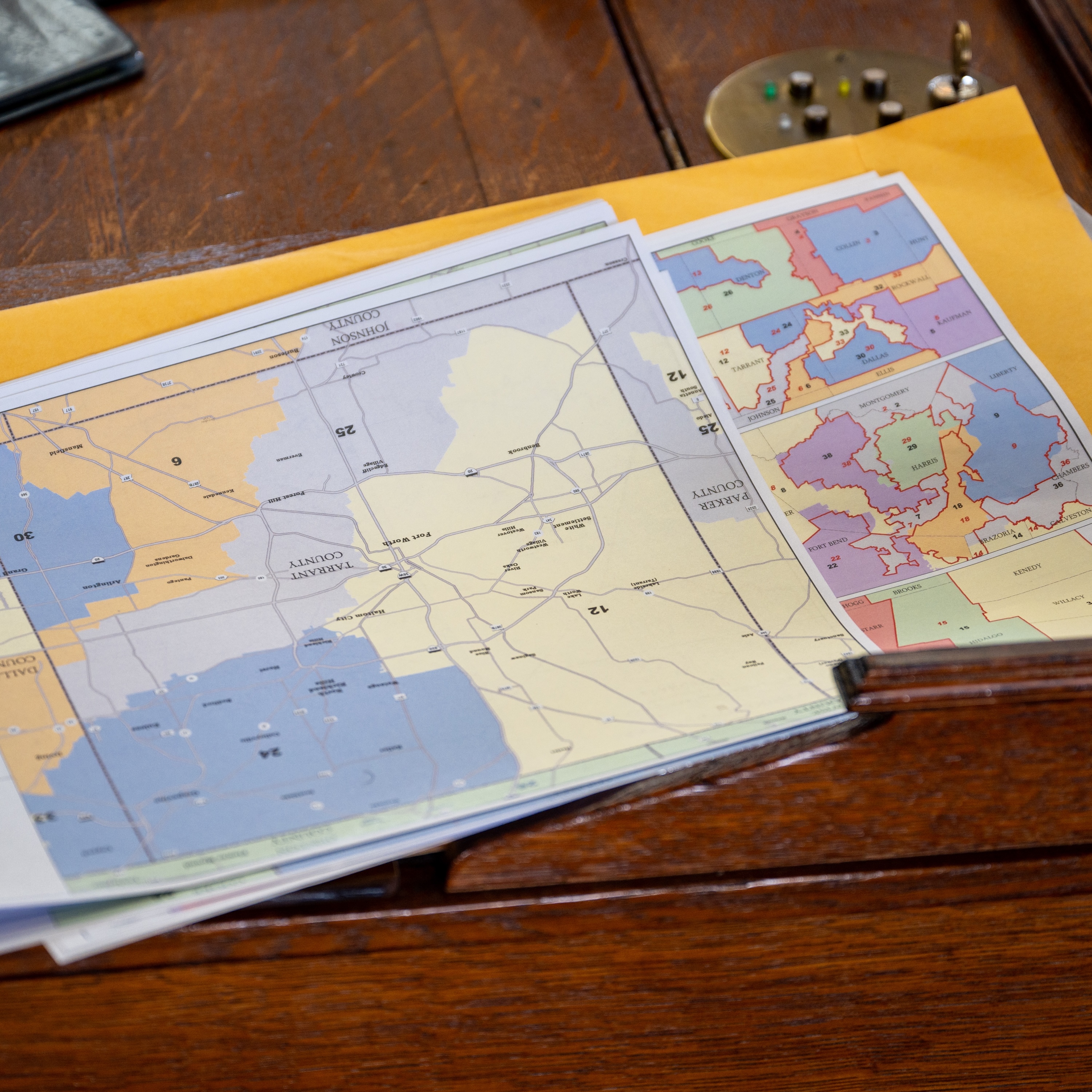
Post Reports
The Texas-California showdown over redistricting
00:26:09
The Republican push to redistrict in Texas, and how California and other blue states are responding with redistricting plans of their own.
Loading summary
Transcript72 lines
- [00:03]
Ava Wallace
Have all members voted?
- [00:07]
Maeve Reston
Have all members voted?
- [00:10]
Host/Interviewer
On Wednesday night, Republicans in the Texas state House passed a controversial new election.
- [00:14]
Maeve Reston
Map, 88 ayes and 52 nays.
- [00:18]
Ava Wallace
House Bill 4 is finally passed.
- [00:22]
Host/Interviewer
That vote gets Texas one step closer to creating five new congressional districts that lean heavily red. It was not a straightforward process. You might have heard a few weeks back about the Texas Democrats who left the state. They were trying to stop a vote from even happening.
- [00:38]
Ava Wallace
These Texas legislators ain't fleeing. These Texas legislators are fighting. They are fighting corruption, they are fighting racism, and they are fighting rigging.
- [00:50]
Host/Interviewer
You may have also heard about Texas Governor Greg Abbott, a Republican, threatening those Democratic lawmakers with lawsuits and arrests.
- [00:59]
Democratic Lawmaker
These Democrats, because they broke quorum, have.
- [01:01]
Ava Wallace
Tied the hands of the state to.
- [01:03]
Democratic Lawmaker
Be able to address the needs of our fellow Texans.
- [01:05]
Ava Wallace
Our fellow Texans are angry at these Democrats for not showing up and doing their job.
- [01:12]
Host/Interviewer
But those Democratic lawmakers came back, the vote happened. And now two things are true. In 2026, when Americans turn out to vote in midterm elections, it'll be that much easier for Republicans to hold onto their majority in the House. Or it won't be because Democrats are trying to do the same thing in the states where they're in control. From the newsroom of the Washington Post, this is Post Reports. I'm Eva Wallace in for Elahi izadi. It's Thursday, August 21st. Today I talk to Post Politics reporter Maeve Reston about the race to redistrict. Maeve explains how we got here in Texas and how states like California are punching. Maeve, thank you so much for joining us. So catch us up. How did this redistricting fight in Texas actually begin?
- [02:07]
Maeve Reston
So it started with President Trump saying that he wanted Texas to find more seats.
- [02:14]
Democratic Lawmaker
And I won Texas.
- [02:15]
Maeve Reston
I got the highest vote in the history of Texas, as you probably know.
- [02:19]
Democratic Lawmaker
And we are entitled to five more seats.
- [02:22]
State Representative Suleiman Leilani
I don't know.
- [02:23]
Maeve Reston
This was in an interview with CNBC. The 2026 election, which is the midterms, is not looking particularly great for him. First of all, just because of historical patterns, often the opposition party is able to net a lot more seats at this time in a presidency. But also because, you know, there is a lot of concern about the economy and there also is some concern about the immigration tactics that President Trump has been using. And so he really felt it was necessary to lean on the Texas Governor Greg Abbott and Texas GOP lawmakers to say, look, you've got an opportunity to redraw the maps. Even though it's mid cycle and this normally happens after the census. That's done every 10 years. And that's how it all got started.
- [03:17]
Host/Interviewer
Okay, this might be a super basic question, but what's wrong with this new map, and why do Democrats hate it so much?
- [03:24]
Maeve Reston
Well, basically, you know, the maps were drawn by Texas GOP lawmakers to yield five more seats in Congress for the gop. And so they have drawn, you know, members into completely new districts that add a lot more Republicans. They have split up communities of color. As one Texas lawmaker was saying, these maps are cracking and packing the districts to stack them against Democrats. And it's just effectively what we call a partisan gerrymander. But what ended up happening is that Texas Republicans were delayed in trying to pass these maps for two weeks by Democrats who fled the state to prevent the GOP from having enough members present to conduct legislative business.
- [04:17]
Host/Interviewer
Maeve, just quickly, you said that Democrats were saying that this map was gerrymandered. What is the difference between gerrymandering and, like, standard redistricting?
- [04:27]
Maeve Reston
Yeah. So gerrymandering means essentially, that you are manipulating the boundaries of an electoral constituency to favor one party or class. So, you know, that could be that you're manipulating the lines that break up a city with common interests, or you are doing other things that split communities of interest, and that you're doing all of that essentially to serve partisan interests.
- [04:57]
Host/Interviewer
And redistricting is just like the neutral. We're just redrawing the lines here. Yes, thank you for explaining that. Okay, so back to the map. Maeve, you said that Texas Democrats fled the state to keep the Legislature from achieving a quorum, from having enough members. Members present to conduct business. Democrats are pretty outnumbered in the Texas Legislature, so them coming back would certainly mean that the map would get voted through. So why did they come back at all?
- [05:23]
Maeve Reston
Basically, Texas legislators couldn't stay away forever from home. The Democrats knew they were not going to ultimately win this one. And, of course, they had been threatened in lots of different ways by the GOP officials in Texas. The other factor here was that California Democrats had unveiled their plan to counteract the Texas map by redrawing their own lines. Those new maps in California would essentially wipe out the gains that the Texas GOP was trying to make with their maps. Democrats in California are aiming to give their party as many as five additional seats under these new maps. And so that essentially allowed Texas Democrats to go back, knowing that California was going to very swiftly take that action. So they came back.
- [06:19]
Host/Interviewer
I see. I definitely want to come back and unpack all of the kind of counter moves by California. But first, I'm wondering what was the experience of these Texas Democrats when they did return to the state? I know our colleague Molly Hennessy Fisk talked with State Representative Suleiman Leilani.
- [06:36]
Maeve Reston
Yeah. So he and most of the other Democrats have been under constant surveillance by the Texas Department of Public Safety officers that have been tracking them since their return, ostensibly making sure that they did not flee the state again. And Leilani told Molly that, you know, this is a pure form of bullying. And he also, you know, said basically that this is not freedom.
- [07:07]
Host/Interviewer
So, doctor, how does it work now? You're where are we going? And where is your DPS officer?
- [07:14]
State Representative Suleiman Leilani
So I have my freedom paper, and I am able to go wherever I need to. But, you know, I have this DPS who is following me, so I'm actually not free to do things. It's kind of intimidating that they want to follow us in the daughter waste of state resources that these DPS officers who have actual job to find criminals and do other things.
- [07:36]
Host/Interviewer
Yeah, I saw these incredible videos that Molly took while driving around with him, just talking about the symbolism of the surveillance, what it all means. So this is him behind you in the gray truck?
- [07:49]
State Representative Suleiman Leilani
I believe so.
- [07:53]
Host/Interviewer
So do you have to drive differently knowing he's back there?
- [07:57]
State Representative Suleiman Leilani
No, I'm just behaving my own, trying to behave my normal self because I don't think I've done anything wrong. And that's what we're doing. And this actually is more for the people, for the public, for you to know that what they are showing the might is if we can do this to your elected officials, we can come do it to you. So you just follow what we tell you. Otherwise, your. Your safety, your security, your life, your freedom at the stake.
- [08:26]
Maeve Reston
And then another state representative, Nicole Collier, she declined to remain in custody of DPS officers and instead chose to sleep on the House floor for two nights. And it was really interesting. I was on a Democratic National Committee call with other reporters this week where Collier had joined that call. It also included California Governor Gavin Newsom and New Jersey Senator Cory Booker, who is also a Democrat. And in the middle of an answer that the Democratic National Committee chairman, Ken Martin was giving to a reporter, Collier interrupted and said, sorry, I have to leave. They said, it's a felony for me to do this. Apparently, I can't be on the floor or in the bathroom. She had told us earlier in the call that she was being confined to a bathroom to join this call with the Democratic National Committee and We could hear someone in the background. And she said, well, you told me I was only allowed to be here in the bathroom. No, hang on. Bye, everybody. I've got to go. It was unclear exactly who was giving her that information and what piece of the law they were talking about. I mean, often there are rules in every state legislature about what kinds of political things you can do in a place like the state Capitol. But of course, she was not leaving the Capitol at that moment. And so she was told that she could make this call from the bathroom, but that then apparently they decided that that was not appropriate. She very hurriedly rushed off the call. Senator Booker then spoke about how outrageous it was to experience that moment in real time. And he said, hey, that.
- [10:10]
Ava Wallace
That's. That is outrageous. First of all, let me tell you something. Representative Collier in the bathroom has more dignity than Donald Trump in the Oval Office.
- [10:18]
Democratic Lawmaker
There you go.
- [10:19]
Ava Wallace
That is outrageous. What they're trying to do right there is silence. An American leader, silence a black woman, and that is outrageous. And I hope everybody took note of that. The fact that she can't even let her voice be heard is frickin outrageous. And this is what we're fighting for here. This is ultimately what this is about. What we just witnessed them trying to shut her down and say it's illegal for her to be in the bathroom. And on this call, wow, that is.
- [10:49]
Host/Interviewer
More intense than I was expecting. Being confined to a bathroom. That's. That's quite a lot. Okay, I want to return to the map. What happens now that the Texas House has passed it? Is there. Is there more? Are we waiting for litigation? Is there any other kind of hoops that they have to jump through or what?
- [11:05]
Maeve Reston
Now there will definitely be litigation, and it's unclear how that will go. Lawmakers in California are actually watching that very closely because as we will talk about in a moment, their new maps will not go forward unless the Texas GOP leaning maps end up prevailing not only, you know, in the legislature and being adopted, but also in the courts. So we're going to have to see how that process plays out. But if the courts, for example, were to find that these maps do not comply with the Voting Rights act, then they could be tossed out. And, you know, Texas potentially could have to start from scratch. And I don't know what all the legislative timelines are, but there are certain rules about getting maps in place, you know, a certain amount of time before the 2026 elections. So we'd have to see how that all plays out.
- [12:02]
Host/Interviewer
What is it about these Maps that could be out of compliance with the Voting Rights act or, like, what could the legal challenges look like to these maps and to maps in other states?
- [12:12]
Maeve Reston
So we could see all kinds of legal challenges to the maps in Texas as well as California and other. That has happened over and over again because a lot of times what the courts are looking at, in particular the Supreme Court has looked at is, you know, whether maps comply with the Voting Rights act of 1965. And what the Voting Rights act protects is that that the drawing of the congressional districts has to protect communities of color and that you can't. It's called crack or pack the maps in order to limit the influence of those communities. And that is what we will see play out in the courts. There could be other kinds of challenges, you know, on transparency or, you know, giving the voters enough time to digest and learn about these maps that were being put into law. So. So it could be a maze of court battles over the next year or.
- [13:21]
Host/Interviewer
So, pending litigation, then, I guess. How do these maps theoretically change kind of the party calculus for the midterms?
- [13:29]
Maeve Reston
Well, so until this whole redistricting fight erupted, it seemed likely that Democrats had the upper hand and could flip enough seats to take control of the House. A Democratic House majority could impede the president's agenda, and it would give Democrats the ability to launch investigations into his administration. So a lot would change very fast. And, of course, that is why President Trump is trying to guard against that possibility with every tool that he has.
- [14:02]
Host/Interviewer
Okay, so all that said, this Republican plan to make it harder for Democrats to flip the House might not actually work. Right? Because, Maeve, you mentioned earlier that Democratic lawmakers in states including California, are responding with their own redrawn district maps. We're going to get into what those efforts look like right after the break.
- [14:29]
Quince Advertiser
As summer comes to an end, I'm all about refreshing my wardrobe with staple pieces for the season ahead. And nobody nails it like Quince does, with luxe essentials that feel effortless and look polished, but perfect for layering and mixing. Think chic cashmere and cotton sweaters starting at just $40. Washable silk tops and classic denim pants. Timeless styles you'll keep coming back to. And the best part, everything with Quince is half the cost of similar brands. By working directly with top artisans and cutting out the middlemen, Quince gives you luxury without the markup. Quince only works with factories that use safe, ethical, responsible manufacturing practices and premium fabrics and and finishes. Elevate your fall wardrobe essentials with quints. Go to quints.com reports for free shipping on your order and 365 day returns. That's Q-U-I-N-C-E.com reports to get free shipping and 365 day returns, quints.com reports.
- [15:33]
Washington Post Advertiser
Think about why you listen to podcasts. It's like having a friend who makes you think or can help you wind down right? Well, the Washington Post has a lot of people you can turn to at any hour. You can read the most important and interesting stories. We can help you cook something delicious, give you advice on a tricky friendship. Rave about a movie or book that you shouldn't miss. When you become a Washington Post subscriber, you have a companion for whatever part of your day needs it most. Get it all for just $4 every four weeks. That's for an entire year. After that, it's just $12 every 44 weeks. Cancel anytime. Go to washington post.com subscribe that's washingtonpost.com subscribe.
- [16:17]
Host/Interviewer
Maeve, you're in California. That's one of the states that's starting to clear some of the hurdles that they need to get through to do their own redistricting, but doing so in favor of the Democrats. So what does that look like in California and how is it kind of different from how it might be in Texas?
- [16:35]
Maeve Reston
So in California, Democrats have a super majority and so in full control of the legislature. On Tuesday, they began clearing these procedural hurdles to move forward with a redistricting plan. And it's a bit complicated, but the proposal would ask the voters to amend the state constitution and set aside these current maps, which were drawn by an independent redistricting committee if another state like Texas or Florida changes its map to favor the GOP in the 2026 elections. And the independent redistricting committee, I just should note, was something that was very popular in California and was approved by voters actually in two earlier ballot measures in 2008 and 2020 10. So what the Democrats are arguing is that this new map that leans toward their party would only be in effect for 2026, 2028 and 2030. And after that point, the independent redistricting panel would go back to their normal work of drawing lines, which will be done after the 2030 census. And so those maps would be used beginning in 2031. So the Democrats are saying this is temporary. We love the independent redistricting commission, too, but we have to make this change because of what they framed as Trump's power grab here.
- [18:10]
Democratic Lawmaker
It's not good enough to just hold Hands have a candlelight vigil and talk about the way the world should be. We have got to recognize the cards that have been dealt, and we have got to meet fire with fire.
- [18:23]
Maeve Reston
Governor Newsom has argued that these maps will completely neuter and neutralize what is happening in Texas. And he also has really emphasized this trigger in the ballot measure, saying that these new maps will only go into place if, you know, these other states, like Texas and Florida, have approved their maps, and those maps are going forward.
- [18:49]
Democratic Lawmaker
This does not go forward. I want to remind everybody, unless one of these other states move forward, there's still an exit ramp. Not just Texas, but Missouri, as I mentioned, or Florida, Indiana, and these other states that are considering doing the unprecedented rigging their elections with midterm redistricting.
- [19:05]
Maeve Reston
You know, it was became clearer in legislative hearings this week that, for example, if the courts were to throw out the Texas maps, then California could revert to its old maps. So that's how they're making the argument, with Governor Newsom repeating this phrase, that there's still an exit ramp.
- [19:24]
Host/Interviewer
Maeve, why is there such a difference in the way these states are able to kind of go about redrawing these lines, if I have you? Right. So California can do something essentially that's reactionary, and it's temporary. But all Governor Abbott needed in Texas was to call an emergency session. Why is there such a difference in the way those states, or maybe those two parties kind approach something like redistricting?
- [19:50]
Maeve Reston
So it really shows the power of the voters here in California who put this independent redistricting commission into place through ballot measures because they wanted a fairer process. They got behind the idea that there should be competition in these congressional districts. And that has been sort of a bedrock principle for the Democratic Party. So it's just become this really interesting debate where Democrats now have kind of flipped to the position that they previously have had, but have said, you know, these are different times. This is a different presidency. If Trump wasn't using these tactics, we wouldn't have to resort to these measures.
- [20:33]
Host/Interviewer
So given that, you know, it is being posed as such a dire measure, how do people in California feel about what's happening now?
- [20:40]
Maeve Reston
Well, so internal polling that I have heard about a lot of different groups, as well as Governor Newsom's team were doing polling on this ahead of time to see where the voters would end up. And it appears that over 50% they believe will be behind this ballot measure. They think they can inch that number up higher once they really explain what's at stake. Here because of course, you know, Democrats have overwhelming numbers in California, but, you know, people from Republican districts really don't like it. And at the legislative committee hearings this week in Sacramento, there was a long line of people from more Republican areas of the state like Fresno and Bakersfield, Riverside, California, who lined up to say that there has been no transparency in this process, that this is not what the voters want. They also don't want more than $200 million of taxpayer money to be spent on this special election.
- [21:40]
Host/Interviewer
Wow.
- [21:41]
Maeve Reston
And say that there's a lot, you know, better things that that money could be used for, especially at a time when California is having to make cuts to other essential services.
- [21:51]
Host/Interviewer
Of course, elections cost money. Yeah. Something we haven't mentioned yet, but we have reported that Republicans in other states are considering changing their kind of district lines as well in places like, like Florida and Indiana and Missouri, Ohio. Are there any other Democratic led states that are thinking about kind of doing the same thing that California is and just going kind of tit for tat?
- [22:09]
Maeve Reston
Other states certainly are talking about this. Illinois, for example, is one of the states that's looking at whether they could squeeze more Democratic seats out of their maps, which are already very gerrymandered. And you know, almost all of the seats in Illinois are Democratic controlled, but they were looking at whether they could potentially get one more seat out of their maps. New York is also looking at that as well, but they have some more constitutional and other hurdles. It has to be a multi step process. So, you know, it's likely that New York would not be able to get anything done before the 2026 midterm elections. And there are some other Democratic states looking at this, but nobody is as far along or as committed to this as California thus far.
- [23:01]
Host/Interviewer
Maeve, is this a fair fight, this kind of like tit for tat we're seeing between Republican and Democrat controlled states? It feels like what you're saying is that Republican led states can move much faster than Democrat led states.
- [23:15]
Maeve Reston
Yes. Republicans are considering changing district boundaries in states like Florida, Indiana, Missouri and Ohio, even though some GOP lawmakers in those states have had reservations. And there also may be some legal hurdles in those states, but a lot of these Republican states just have made it easier to create Republican leaning maps and don't have as many safeguards against that. So that's why Democrats in places like California have been arguing that this is not a fair fight and that they have essentially tied their own hands in their states with some of these measures to ensure that the maps are nonpartisan.
- [24:00]
Host/Interviewer
Just simply think we're not going to take advantage of this. Right. It's a philosophical thing they're talking about that they've tied their own hands with.
- [24:06]
Maeve Reston
Yeah. And you have people like the former Attorney General Eric Holder, who spearheaded a whole huge group to try to work toward independent redistricting and make this, this process less political. And even he is now, you know, saying that the Democrats have been too hamstrung and that these are different times that call for different measures.
- [24:28]
Host/Interviewer
Maeve, if, if we're just kind of going back and forth with this where different, you know, a Republican led state redraws the lines, a Democratic led state redraws the lines. And it gets to the point, hypothetically, I guess, where even if you want to vote against redistricting and vote against gerrymandering, that your vote doesn't really matter because of how the lines have been drawn. Like, I feel like I'm having an existential crisis over this. But what happens in the long term when we start going down this road?
- [24:54]
Maeve Reston
Well, I think that will be up to the voters of America to decide whether this is the kind of back and forth that they want. Because a lot of people have described this as kind of a race to the bottom, including some of the people who have been involved with the independent redistricting commission here in California, including former Governor Arnold Schwarzenegger, a Republican who championed it. And, you know, he has argued that two wrongs don't make a right, and even went to the gym a morning a little while back with like a custom made T shirt that said gerrymandering is evil. And so there's a lot of different voices in this debate, and we're gonna see that thought out over the next. I think it's 11 weeks here in California. It is going to be a hugely expensive campaign over this ballot measure with both sides talking about raising more than 100 million to try to win this. You know, the former Republic Republican leader Kevin McCarthy in Congress, who's now in the private sector, has said he'll be very involved in fundraising for the no side fighting against the ballot measure. Governor Newsom, who has one of the best lists in politics, is going to be raising a ton of money on the yes side. And you've got groups from all over the country, partisan groups, that are going to get involved in this. And both sides are trying to frame this as a fight that has national consequences because it will potentially decide who controls Congress in 2026.
- [26:29]
Host/Interviewer
It's going to be a long 11 weeks.
- [26:31]
Maeve Reston
It really is.
- [26:34]
Host/Interviewer
I'm sending you stamina. Wishing stamina for you. Maeve, thank you so much for joining us. As you said, amidst a very, very busy year and a very busy couple of weeks here for you in California.
- [26:44]
Maeve Reston
My pleasure.
- [26:48]
Host/Interviewer
Maeve Reston covers politics for the Post. That's it for Post Reports. Thanks for listening. There's a way now to dig in on the news that matters most to you and build a community around staying in the know. This is a way to level up your group chats. A premium subscription to the Washington Post now comes with three extra logins. You can give them to friends and family and dive in on stories together, chat about them and get immediate access to the Post's exclusive stories. Check out the link in our show Notes for details. You can also go to washingtonpost.com subscribe again. That's washingtonpost.com subscribe. Today's show was produced by Rennie Svirnobsky. It was edited by Rena Flores and mixed by Sam Baer. Thank you also to Thomas Liu, Molly Hennessey Fiske and Noah Bierman. I'm Ava Wallace. We'll be back tomorrow with more stories from the Washington Post.
- [27:57]
Washington Post Subscriber Promoter
You listen because you know the power of good journalism and the Washington Post is there for you 24 7. When you become a Washington Post subscriber, you get excited, exclusive reporting you can't find anywhere else. You also get sharp advice, columns, delicious recipes, TV and music reviews and so much more. Right now, you can get all of that for just $4 every four weeks. That's for an entire year. After that, it's just $12 every four weeks. And you can cancel anytime. Add to your knowledge and discover all the Post has to offer. Go to washingtonpost. Com subscribe. That's Washingtonpost. Com Subscribe.