← Post Reports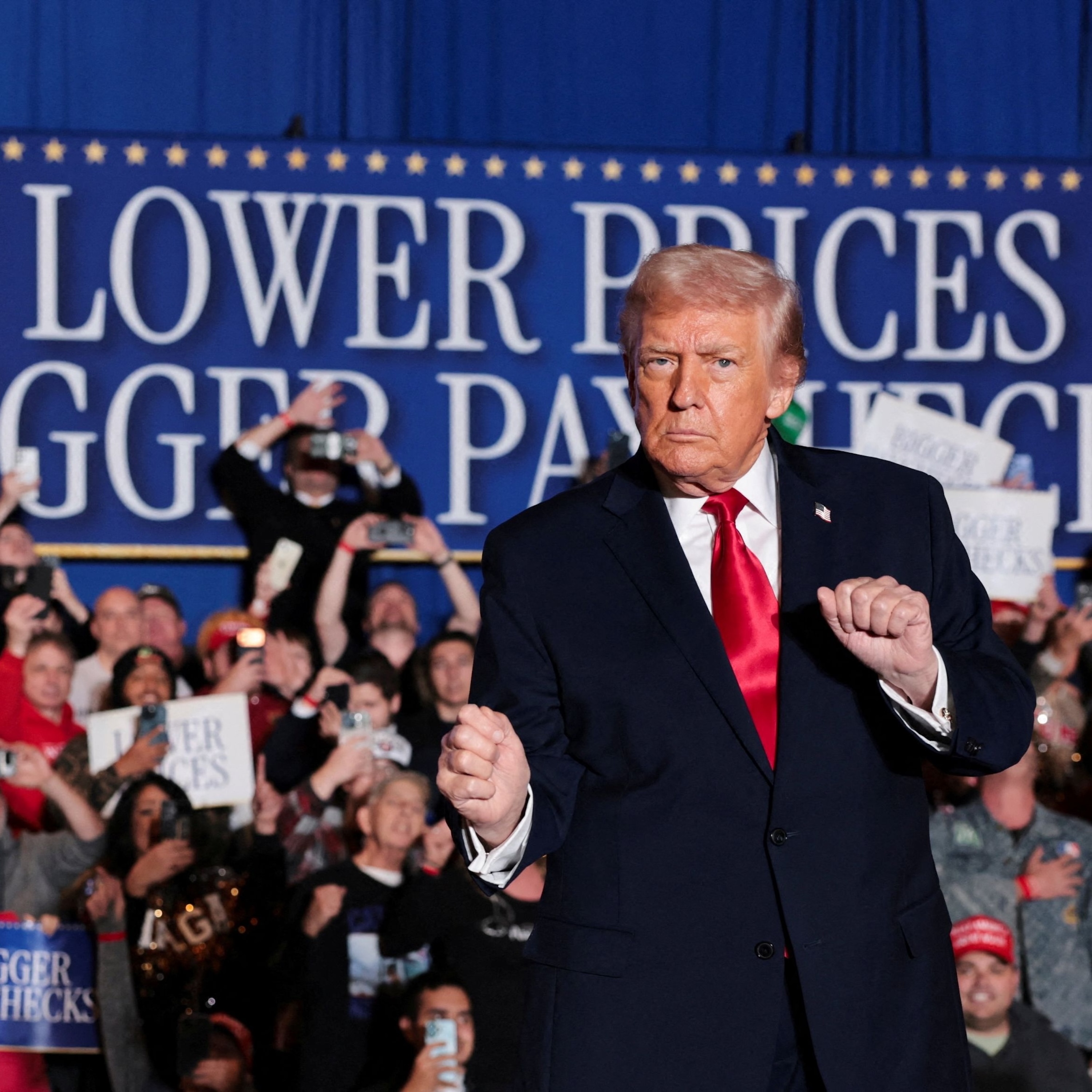
Post Reports
Trump calls affordability a "hoax"; Democrats take note
00:25:37
This week, President Donald Trump kicked off his affordability tour in Pennsylvania and called “affordability” a democratic “hoax.” Meanwhile, Democrats are taking note and feeling momentum heading into the 2026 midterm elections.
Loading summary
Transcript78 lines
- [00:00]
Pharma Sponsor
This podcast is supported by Pharma. Did you know that America is the only country in the world where half of every dollar spent on brand medicines goes to entities that don't make them? It's true. Learn more at P H R M a dot org Middlemen.
- [00:16]
Dan Marika
You know, I've talked to a Democratic strategist who, you know, there's just times in a political cycle where writing the attack ad is pretty easy. And the strategist told me that, you know, when Donald Trump goes on camera and says that affordability is a hoax, when he goes on camera and diminishes concerns about inflation and says that the economy's great, when he does an interview with Politico on camera and says that his economy, the rating for his economy would be an A plus plus plus plus plus five five. That's five pluses for those counting. Yeah. I mean, they're just hitting record on all those moments and you can expect to see them in attack ads later in the cycle.
- [00:58]
Colby Yakovic
From the newsroom of the Washington Post, this is Post Reports Weekly Politics Roundtable. I'm Colby Yakovic. It's Friday, December 12th. Today we're going to be discussing Trump's mixed messaging on affordability. And later we'll discuss why Democrats think that they have the edge ahead of next year's midterms. Back at the table with me this week is Dan Marika. He's the co anchor of our politics newsletter, the Early Brief Edition. And I'm thrilled to be joined this week by Matt Visor, our White House bureau chief. Guys, thanks so much for joining me.
- [01:30]
Dan Marika
Thanks for having me.
- [01:30]
Matt Visor
Great to be here.
- [01:33]
Colby Yakovic
So, Matt, I want to start with you because you traveled with President Trump this week to Pennsylvania happens to be my home state because he kicked off this affordability tour. What is that?
- [01:43]
Matt Visor
So it's an effort for Trump to start talking a little bit more about economic concerns among the electorate, something that's kind of been on the back burner a little bit as he's been in pursuit of the Nobel Peace Prize. He's gone on a foreign trips, his attention's been elsewhere. So this is a little bit of a recognition to try to get him back to talking about really the issue that drove the 2024 election, which is.
- [02:06]
Colby Yakovic
The economy and back into the country.
- [02:09]
Pharma Sponsor
Right.
- [02:09]
Colby Yakovic
Talking directly to voters.
- [02:11]
Matt Visor
Yeah. I mean, he's done relatively little domestic travel throughout his first year in office. So it's getting him back on the campaign trail a little bit. It's getting him in front of voters and kind of a more Rally like atmosphere, which we have not seen much of him for months or throughout really his entire presidency. He's just not been out that much.
- [02:34]
Colby Yakovic
Yeah.
- [02:34]
Dan Marika
Probably his most comfortable environment as well.
- [02:36]
Colby Yakovic
You know, Dan, the fact that they even launched this tour seems to suggest that they realize that this is a growing problem for the White House. Right. That it is a political liability, that the President has not gotten the issue of rising costs of affordability under control.
- [02:52]
Dan Marika
I mean, I think Matt is right that the first year of Trump's term has really been focused on international issues. And I think if you would have asked voters when they went to the ballot box to vote for Donald Trump, if that was gonna be the case, they would've been shocked by that.
- [03:04]
Colby Yakovic
Yeah.
- [03:05]
Dan Marika
Because he ran on affordability and polling bears this out. We had a Washington Post ABC News Ipsos poll that found 62% of Americans disapprove of Trump's economic performance.
- [03:16]
Colby Yakovic
Wow.
- [03:17]
Dan Marika
While just 37% approve of it. And in large part, Trump just doesn't wanna acknowledge this issue or hasn't wanted to acknowledge this issue for months now. You know, I've a Democratic strategist who. There's just times in a political cycle where writing the attack ad is pretty easy. And the strategist told me that when Donald Trump goes on camera and says that affordability is a hoax, when he goes on camera and diminishes concerns about inflation and says that the economy is great. When he does an interview with Politico on camera and says that his economy, the rating for his economy would be an A plus plus plus plus plus.
- [03:54]
Colby Yakovic
I wonder what grade you would give a a A. Well, it's interesting because I, I talked to a supporter of yours.
- [04:03]
Dan Marika
That's five pluses for those counting.
- [04:05]
Colby Yakovic
Yeah.
- [04:05]
Dan Marika
I mean, they're just hitting record on all those moments and you can expect to see them in attack ads later in the cycle.
- [04:12]
Matt Visor
I, I think there's also a, a fairly deep irony in that Joe Biden, I, I went to many events with him in Pennsylvania.
- [04:20]
Colby Yakovic
Yeah.
- [04:21]
Matt Visor
Where he also had attempted to speak to economic concerns. Largely failed, which Trump exploited in the campaign to win.
- [04:30]
Dan Marika
And there's this reality that the President can only do so much about prices. I mean, there are things the President can do that can certainly raise prices. Some would argue that tariffs do exactly that. But I think Biden kind of dealt with this as well, that there was only so much he could do after Covid to bring prices down. Trump is now dealing with that same reality.
- [04:49]
Colby Yakovic
It's so interesting, Matt, because you have covered Both administrations now, the Biden administration and the Trump administration. And like you said, in both cases, the president had a really hard time accepting or acknowledging that the economy was not doing well under their watch. Why is it so hard for the President to just say, yeah, it's really hard for people out there?
- [05:09]
Matt Visor
I think it's part of what I mean, Dan was mentioning this where it is hard for a president to actually have control over prices. And I think both of them have wanted to cast themselves as transformational and sort of speak to the economy in the most glowing terms. And I think that's hard for a president to sort of do the I feel your pain kind of attitude that Bill Clinton I think, channeled of speaking to that. That plight. Yeah. I was probably more struck that Biden couldn't do it just because of. Biden's political biography has been all about being a middle class, Amtrak Joe kind of guy. Trump's biography is much different, you know, and he sort of typically speaks to aspirations and, you know, he's a salesman and he tries to sell you on things being rosier than maybe they are because he tends to view them rosier than they. They may actually be.
- [06:00]
Colby Yakovic
So, Matt, with all of that as a backdrop, Trump goes to Pennsylvania and he holds this event. You were there set the scene for me.
- [06:09]
Matt Visor
So it's at the Mount Airy Casino Resort.
- [06:12]
Colby Yakovic
Know it well.
- [06:14]
Matt Visor
So it's sort of tucked away off a couple side roads and. And you enter it and there is a. There is a large casino floor where people are smoking, carrying their Dunkin Donuts inside. Yeah. And so Trump's event is sort of at a. At a ballroom that's right next to that. I mean, connected internally. But he's not speaking from the casino floor and you can't hear the slot machines in the background. It's sort of in a little bit of a different area. Big line outside, lots of people waiting in the freezing cold to get in, you know, before the event. And also interestingly, in a county that's kind of swingy, you know, Trump narrowly won this in 2024, you know, but Kamala Harris was quite close to him. He lost it to Joe Biden previously and Hillary Clinton. So it's in kind of an interesting political area.
- [07:09]
Colby Yakovic
It's the kind of area in Pennsylvania that can decide who wins. Pennsylvania.
- [07:13]
Dan Marika
Yeah.
- [07:13]
Colby Yakovic
How did it go? How much was he able to focus on this question of affordability?
- [07:18]
Matt Visor
I mean, it was interesting because, you know, he came, there were charts, bar graphs during it where he was trying to sort of Talk about interest rates, you know, how the mortgages are different now and, you know, kind of get in the weeds of some of the economic data that he's trying to showcase. There were signs about higher wages. You know, everything the visual tapestry was geared toward talking about the economy. Treasury Secretary Scott Besant kind of warmed up the crowd by. By forecasting a good bond market in 2026. You don't typically see people cheering for, but you. Trump got on stage, you know, he often veered away from that. He talked about climate change, transgender issues, made fun of the media in the back of the room, as he typically does. Disparaged Somalia, you know, kind of weaving around to different topics and trying to, like, find his way back. But, you know, there were digressions from. From what the focus was supposed to be and even how he talked about affordability, sort of referring to it as a Democratic hoax.
- [08:26]
Donald Trump
But I say, you know, and I said the other day, and a lot of people misinterpreted. They say, oh, he doesn't realize prices, prices are coming down very substantially. But they have a new word. You know, they always have a hoax. The new word is affordability. So they look at the camera and they say, this election is all about affordability.
- [08:48]
Matt Visor
He later kind of tried to walk that back a little bit, saying, you know, the issue afford of affordability is not necessarily a hoax itself. It's that Democrats are talking about it, you know, and that's the hoax. But, like, Democratic consultants got their sound bite.
- [09:04]
Dan Marika
This is kind of the inherent issue with President Trump is that. And his rhetoric is that he uses the term hoax quite liberally and describes issues as hoaxes, even if they are pressing to the minds of voters. And I just have to say, nothing screams like powerful political event like the Treasury Secretary warming up the crowd with monetary policy while at a casino. Right. That combination has got to be just like. That has to be the first of its kind in political speak history.
- [09:31]
Colby Yakovic
Well, Matt, you can speak to that because you actually were out in the casino talking to voters, right? Like, you were there among the penny slots.
- [09:39]
Dan Marika
I heard a rumor he was gambling. I don't know.
- [09:41]
Colby Yakovic
I mean, how many, like, your pockets were filled with pennies? You were ready.
- [09:46]
Matt Visor
Yeah, Actual pennies, you know, actual pennies.
- [09:48]
Colby Yakovic
Yeah. And they're going to be out of production soon, so. So you better get it while. Get it while you can. But you spoke to voters. What do they say about this? How are they feeling about Trump, his performance, him being there, you know, covering the White House?
- [10:02]
Matt Visor
These are some of the best events because it gets you outside the Beltway. It gets you to actual voters and actual people. So there were two things I did. First, I went to a grocery store that was about five miles from the casino. Yeah. And then once I got to the, to the site, I sort of wandered around as people were at the craps tables and penny slots to, to talk to them. And it was pretty universal. Anyone you approached and asked how the economy is doing, what do they think about affordability? Immediately, it' Energy prices are up. The meat over in the, in the meat aisle is, is way up. You know, it did not take long for people to sort of speak to the economic conditions that they're facing. Yeah, the, the variety came in, like, okay, who, who do you blame for that? And do you think that Trump, it bears some responsibility? And those answers depended somewhat of where their perspective came from. There were a couple of Trump voters who said, I wish he would speak more about this. I wish he would address this. But for the most part, if you voted for Trump, if you Trump supporter, you're willing to give him a little bit more time, you're, you're sort of willing to see how the tariff stuff shakes out, you know, and see how some of his policies, you know, go into effect. And, you know, in that regard, if you didn't vote for Trump, then you're sort of fully blaming him and you're upset that he's distracted and not speaking to this.
- [11:26]
Dan Marika
I mean, this is what's interesting about the affordability issue is, yes, it's a policy concern, but it's so much more personal to voters than that. Like, we've covered elections that have been decided by abortion policy or the issue of guns or foreign policy. All of those have some impact on a voter's life, but none, like affordability, do. So you can talk to somebody at the penny slots in Pennsylvania and they can remember that, oh my gosh, my energy bill was $30 higher than it was a year ago. That's something that they have personally had to deal with. And that's why I think it's so front of mind when you talk to voters, because they know how that's impacting their daily life.
- [12:04]
Matt Visor
And I think the way that Trump talks about it, he doesn't talk about it in a visceral way that necessarily connects with some of those people. When he talks about the economy, he talks about the stock market, your 401ks.
- [12:16]
Donald Trump
I mean, the only thing that you. It's really going up big. It's called the stock market. And your 401ks is going up.
- [12:25]
Colby Yakovic
It's not relatable.
- [12:26]
Matt Visor
The woman at the penny slots who's like, gambling more now than she used to because she's hoping to make some money on this. Yeah. It is. Not receiving the message about the bond markets and the 401ks the same visceral way as she is when she looks at the gas prices or the grocery store prices.
- [12:47]
Colby Yakovic
Speaking of affordability, there's also this issue of healthcare costs, right? I mean, millions of Americans are seeing their healthcare premiums rise. This was an issue that shut down the government very recently because Congress could not agree on whether or not to extend these Affordable Care act subsidies that help bring the cost of health care down. It's Thursday, late morning. The Senate is actually voting on this right now. So I'm curious, Dan, where it stands. But also, if they fail to do this and nearly 25 million Americans either have to pay extremely higher premiums or maybe choose to forego their health care in 2026, what is that gonna mean for the political climate? And is Trump paying attention to that?
- [13:34]
Dan Marika
I mean, I think this is the issue for Republicans is that kind of everything feeds into the affordability issue. You can look at inflation, you can look at the way prices are going up at the grocery store, but you can also look at health care policy. That's an affordability issue as well. So the Senate is gonna vote Thursday on a Republican bill and a Democratic bill on the ACA credits. Both are expected to fail, which really raises this question about what did the Democrats get out of the shutdown, the longest shutdown in US History, because this was the vote that they said was gonna be kind of the thing that they won. If both of these bills fail, especially if the Democratic bill fails, you have to ask the question of what did Democrats really achieve in that shutdown and the deal that they struck with Republicans to reopen the government. But as a political issue, Democrats are looking at next year as the affordability election. I had somebody tell me that in 1992, James Carville, who was the political mastermind for Bill Clinton's rise and eventual ascension to the presidency, wrote on a whiteboard in Little Rock, the economy's stupid. And you could write on a board in Little Rock or wherever, this election, it's affordability stupid. And so there is a political message that Democrats can take away from this fight. You've seen Democrats sort of carefully argue that. That, like, even if these bills fail, the politics of this are very good for the party that ignores the fact that there could be millions of Americans next year either paying more for health insurance or just forgoing health insurance entirely. And what does that mean is like for the health of the country is a big existential question and is probably not good, but Democrats do feel pretty good that the politics of this are on their side.
- [15:11]
Colby Yakovic
Yeah. Matt, is the White House worried about this health care question? Is it top of mind for them or do they think that they can kind of get, move past it?
- [15:19]
Matt Visor
I mean, you have heard Trump talk about it a little bit more, but as he said, like it's, it's more a concept of a plan. And so I, I think they, they recognize the issue and they have for some time.
- [15:34]
Pharma Sponsor
Yeah.
- [15:35]
Matt Visor
But as to what they're doing about it, it's sort of still an open question. And I think to Dan's earlier point, like, I think Democrats did not get something functional out of the shutdown. I think their bet is that they were willing to shut down the government to try to act as soon as possible to do something because they were sort of seeing this issue on the horizon and nothing's been done. And so I think they think that they can remind people of that and try to blame Republicans for not acting on a problem, that everybody knew that words, there was something coming.
- [16:08]
Colby Yakovic
Right. The deadline for these subsidies to expire was not a surprise secret.
- [16:12]
Dan Marika
Yeah, I mean, you wouldn't want to be a Republican going to the ballot box in 2026 if there are tens of thousands, hundreds of thousands, depending on what state you live in, of voters who either don't have health care or are paying a lot more for their health care. That's a pretty bad equation for a Republican facing reelection this cycle. And that's why they're motivated in large part because they know that they're aware of that.
- [16:34]
Colby Yakovic
Yeah. Well, that's a great place to pause because after the break, we're gonna go deeper on the issue of why Democrats feel this affordability issue is giving them the political advantage. We'll be right back.
- [16:54]
Pharma Sponsor
In America, half of every dollar spent on brand medicines goes to entities who don't make them. While middlemen like PBMs and 340B hospitals drive up costs. BioPharma is investing $500 billion in new infrastructure and manufacturing here at home and helping patients buy medicines directly at lower prices. Tell Washington to end middlemen markups and put American patients first. Visit phrma.org middlemen.
- [17:28]
Colby Yakovic
So, Dan, we've talked a lot on the show about Democrats electoral successes this year. You've been following Them closely, including some recent elections in Tennessee and in Florida where Democrats have really outperformed expectations. What happened in those races?
- [17:45]
Dan Marika
Yeah, it's really interesting. I mean, Democrats entered 2025 at a real low point, kind of in the wilderness, searching for who they are as a party. And over the last few months, they've had a lot of success at the ballot box, where you could argue it matters the most for a political party. You mentioned that the Tennessee race that I covered, a special election for a House race the Tuesday after Thanksgiving. Afton Bain was the Democrat. She ran against Matt Van Epps, the Republican. This is a district that Donald Trump won by over 20 points in 2024, that Republicans have dominated for years. And then in a normal election, you likely wouldn't have a Democrat, you know, being at all viable in this seat. And Afton Bain actually kept it very close in this special election, ended up losing by in single digits. She focused intently on affordability, which we've talked about. That seemed to really work for her. It boosted turnout in this district around Nashville and kind of the more progressive areas around Nashville. Democrats saw that as a win, even though she did lose. Yeah, Democrats did win in the Miami mayoral race this week. The Democrat in that race defeated her Republican opponent by around 20 points. I believe it figured out around 19 percentage points. And why that matters is that South Florida is a hugely politically significant area of the country. It has moved to the right over the last decade during Donald Trump's rise in a really dramatic fashion. I mean, when Matt and I were covering Hillary Clinton's campaign in 2016, we spent a whole lot of time in South Florida, in Miami. And they're Democratic candidates for president. Just don't do that anymore.
- [19:26]
Colby Yakovic
Yeah, it's not a swing state anymore.
- [19:27]
Dan Marika
Yeah. Because Miami has moved so far away from their party. All of this is to say that Democrats think and sense that they have momentum headed into 2026, in large part because of the way they're performing in these elections, backed by that affordability message. And if they can keep that up into 2026 and into the midterms, where obviously control of the House is at stake, possibly control of the Senate is at stake. They do feel like this could be a really good year for them politically after what was in 2024 a pretty crushing loss for the party.
- [19:59]
Colby Yakovic
Yeah, I mean, it's interesting you mentioned momentum, cuz that's what this is all about. Right. I've always been a little skeptical that you can read too much into like an off year election that has lower turnout than, you know, your typical November elections. But the Democrats certainly feel like the wind is at their back. And I wonder, Matt, like, do the White. Does the White House sense that? Does the White House feel like they're on their heels?
- [20:21]
Matt Visor
There was a moment on Wednesday where President Trump was having a business roundtable and he started to talk about trends in off in years where the power that the party out of power typically wins for whatever reason.
- [20:38]
Donald Trump
And nobody's been able to give me an answer. When you win the presidency, you seem to lose the midterms. Even if you win the presidency bailout and you do a great job as president. You know, some presidents have done good and they've lost.
- [20:52]
Matt Visor
You know, a, he's right, but B, it sort of is sounding like Trump laying the groundwork for not a good year next year and kind of acknowledging the political headwinds that, that Republicans are, are now facing. The other thing that's kind of interesting, I think, for next year for them is it's, it's one of our early windows into the post Trump Republican Party. They've always struggled when Trump's not on the ballot, and Trump won't be on the ballot for the midterm. So how do they grapple with that? And how does Trump. He was not involved in many of these races, you know, that we've had year in Virginia. In some of these ones where Democrats have had momentum, he kept an arm's length sometimes, oftentimes intentionally. But so what is his role going to be next year? And, you know, how invested is he going to be in building the party?
- [21:46]
Dan Marika
And Trump isn't this political newcomer anymore. He has experienced this himself. I mean, he experienced this after the 2016 election, in 2018, right, when Republicans were swept out of power in the House in an election that was largely about his leadership. There's a chance here, if Democrats can continue this momentum, that it's going to be deja vu for the president again, where he's going to win a presidential election. He's going to have this control of Washington, and then he's going to slowly lose power. And I think Republicans know that beyond just control of the House, the kind of the future, the last two years of Trump's presidency, are on the line as well, because there are serious questions about what he could get done if Republicans lose control of the house in 2026.
- [22:31]
Colby Yakovic
All right, guys, we're gonna end here the way we've been ending the last couple weeks, which is Dan asked his newsletter readers to send us questions that we could answer here on the podcast. And we're thrilled that they've been responding so enthusiastically about it. So we're gonna take one today from John Moore of Asheville, North Carolina, and he asks about Texas Democratic Representative Jasmine Crockett's decision to run for the Senate and whether her entrance into the Democratic primary, whether that destroys any chance of a Democrat actually winning the Senate in Texas.
- [23:04]
Dan Marika
I love these very milquetoast questions we get at the newsletter.
- [23:08]
Colby Yakovic
Jen, what do you think?
- [23:09]
Dan Marika
Yeah. So Jasmine Crockett is a progressive firebrand member of the House. She represents Dallas and some areas around Dallas. She has made her name by being a firebrand by someone who has taken on the Trump administration. In largely viral moments, she jumped into a race for Texas Senate against James Talrico, who is a state rep in Texas, but has really risen in recent years with these also viral moments that are distinctly different than what Crocketts offers. He often talks about religion. He talks about somewhat bringing down the temperature. He talks about how the political divisions in this country are not right versus left, but top versus bottom, kind of drawing the ire at the wealthy and about the 1% and less about Republicans versus Democrats. Taurico is largely kind of the type of Democrat that people think can win in Texas. It has been, I believe, since 1994 since a Democrat has won statewide in Texas. It is a deep red state despite Democrats who for the last 15 years have said Texas is going to go blue. It has not gone blue. And so there's this concern that by jumping into the primary, Crockett will clearly fire up the Democratic base in Texas. She has a unique ability to capture what Democrats kind of innately feel about Donald Trump, to capture their anger. And that may push the primary to the left. And Republicans in that race have a very interesting primary as well. But to answer John's question is we don't know, but there are certainly Democrats who are concerned that the kind of Democrat that Crockett represents, the kind of strain of the Democratic Party that she represents, may not resonate with general election voters in Texas. But this could be a very good year for Democrats. So there is a chance that she could surprise people and actually pull something off in Texas that hasn't happened in three decades.
- [25:00]
Colby Yakovic
Yeah. Well, we're gonna leave it there. John, thanks for your question. That's it for today's episode. Dan, Matt, this was a lot of fun. Thanks so much.
- [25:06]
Dan Marika
Thanks for having us. Thanks, Colby.
- [25:10]
Colby Yakovic
Dan Marika is the co anchor of our politics newsletter. The early brief Matt Visor is the Post's White House bureau chief. After we had this conversation, the Senate voted on one of the affordability issues that we talked Healthcare senators voted down a Democratic bill to extend ACA health care subsidies. They also rejected an alternative health care plan from Republicans. So absent a deal in Congress, millions of Americans will see their health insurance costs skyrocket in the new year. If you want to watch our show, you can find it on the Washington Post's podcast YouTube channel. We'll include a link in our show Notes Today's episode was produced by Josh Carroll and Thomas Liu. It was mixed by Shawn Carter and edited by Rena Flores. Thanks also to our Politics editors. Our team also includes Ted Muldoon, Alana Gordon, Ariel Plotnik, Rennie Stranovsky, Savvy Robinson, Emma Talkoff, Peter Brosnan, Laura Benchoff, Alahia Ezadi and Martine Powers. I'm Colby Ekowitz. Have a great weekend.
- [26:27]
Pharma Sponsor
In America, half of every dollar spent on brand medicines goes to entities who don't make them. While middlemen like PBMs and 340B hospitals drive up costs, BioPharma is investing $500 billion in new infrastructure and manufacturing here at home and helping patients buy medicines directly at lower prices. Tell Washington to end middlemen markups and put American patients first. Visit phrma.org middlemen.