← Post Reports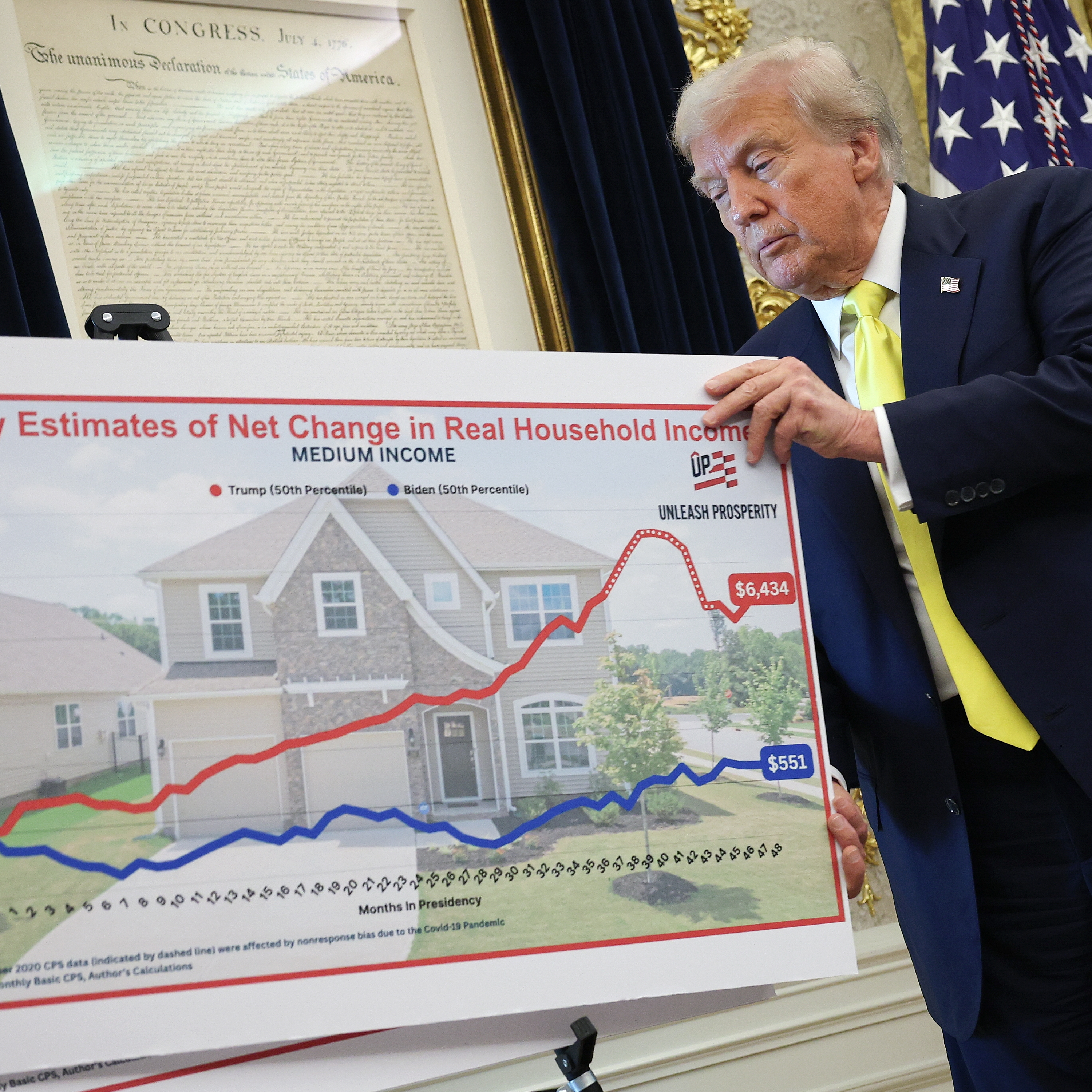
Post Reports
Trump's battles with data, DC, and world trade
00:24:38
How Trump’s economic policies are playing politically. And, he says he wants the federal government to take over D.C. Can he do that?
Loading summary
Transcript55 lines
- [00:03]
Colby Ikowicz
So this week we saw President Trump wandering around on the roof of the White House. What was he doing up there?
- [00:13]
Emily Davies
He told reporters that he was taking a walk and looking around.
- [00:18]
Naftali Ben David
I mean, he, as we know, he's planning this enormous ballroom there. So he didn't say this, but maybe he was just sort of checking out the landscape.
- [00:26]
Colby Ikowicz
I'm just trying to imagine how that conversation went. Like, who did he turn to? And was like, I could really use a walk. Can we go to the roof?
- [00:32]
Emily Davies
I mean, if Trump is good at one thing, it's producing himself. And it was effective.
- [00:38]
Naftali Ben David
Yeah. He finds a way to get himself in the conversation, whether it's about Sydney Sweeney or Taylor Swift or himself wandering around the roof of the White House.
- [00:49]
Colby Ikowicz
From the newsroom of the Washington Post, this is Post Reports weekly Politics Roundtable. I'm Colby IKOWICZ. It's Friday, August 8th. I'm joined this week by White House reporter Emily Davies. Hey, Emily.
- [01:00]
Emily Davies
Hey. Thanks for having me.
- [01:02]
Colby Ikowicz
And we're also here with the Post's senior national political correspondent, Naftali Ben David. Hey, Naftali.
- [01:06]
Naftali Ben David
Hey, how are you doing?
- [01:11]
Colby Ikowicz
So today we're going to be talking about how President Donald Trump's recent economic moves are playing politically. That includes his sweeping tariffs which hit dozens of countries yesterday, and his decision to fire a federal economist. Later in the show. We're also going to get into his threats to take over D.C. and recent moves by the Department of Justice to investigate Trump's political enemies. So let's begin with tariffs. We've talked about the economics of tariffs during last week's roundtable and on Post reports yesterday. But Naftali, I'd love to delve into the politics of it. Voters made it clear in 2024 they do not like paying higher prices for things. It was a big reason why many people voted for Trump. Most experts agree that slapping tariffs on nations that we get goods from are gonna mean higher prices for consumers. So how is all of this gonna play out with voters?
- [02:00]
Naftali Ben David
I mean, I think it's a real risk for him. I think it's a real zone of political danger. We haven't seen prices shoot up yet, but economists do say that's coming. And if they're right and if it does, I think that could create a lot of problems. I mean, I think we shouldn't forget that in the last election, a lot of people told pollsters afterwards that they voted for Trump despite not liking a lot of things about him, just cuz they thought at least he could get of prices. And the economy. And so if that turns out not to be true, I think that's going to really disenchant a lot of those voters. The other thing that really makes this different is Trump has tied himself so closely to the policies that could result in price increases that he's not gonna have a lot of places to go. In other words, people always say, well, the president only has a limited effect on the economy. Can't blame him too much when things go south. But in this case, the tariffs are so clearly his. I mean, he's literally deciding personal tariff rates on individual. I will say he started to, in a way, arguably prepare scapegoats. And by that, I mean he's, for example, criticizing Jerome Powell, chairman of the Fed. I think he's gonna look for other people to blame should this happen, but I think that's gonna be challenging for him.
- [03:06]
Colby Ikowicz
So then, Emily, why does he think that tariffs are a winning issue for.
- [03:10]
Emily Davies
Him, it's about the vision of America that he is selling to voters, that this is a country that puts its people first, production in this country first. And even if it takes a little bit to readjust after these tariffs, ult it will bring jobs back to the people who need them in this country. And it's that pitch to voters, like, give me a little bit of time. This will help us. That he thinks will ultimately be effective.
- [03:38]
Naftali Ben David
Which we should note is different from his message in the campaign, which is day one, everything was going to happen on day one, whether it was ending wars in the Middle east and in Russia, or whether it was the economy suddenly arriving and it being a golden era, his inaugural address was about new golden era of America starts now. So this message of, well, things may be a little rocky before they get good is a change for him.
- [03:58]
Colby Ikowicz
And to your point, like, there's no guarantee that manufacturing comes back to America. And even if it were to come back to America, which is a big if, we're talking years down the line, like, they're not going to see the immediate benefits. If there are, in fact, benefits to this tariff policy, people are probably going to feel the pain before they would ever feel or see any benefits, right?
- [04:21]
Emily Davies
That's right. As far as I understand it. And it really comes down to, in the end, how much people are willing to believe and trust Trump's word. I was surprised. I was out in the country about a month ago talking to people and a lot of folks who were not political junkies per se, but, like, Trump, like, what he stood for, like, understood his message on the economy that they needed a little bit of time to readjust and put America first. Now, if those same people are willing to wait, I mean, I would be surprised if, like, love for Trump ultimately trumped their own personal need for rent and groceries. Right.
- [05:02]
Naftali Ben David
I mean, I think it has to be said that the impact has in some ways been less dramatic so far than a lot of economists predicted. The stock market is still doing well. Prices are mixed. But if that is the lull before the storm, it could just make the shock greater. There could be a moment, and I'm not predicting, but there could be a moment in a month or two when sudden prices are clearly going up and the economy is clearly starting to struggle. And that could create this sort of shock effect that I think could be particularly difficult politically.
- [05:32]
Colby Ikowicz
That leads me to something else that Trump is doing with the economy. These tariffs are coming at a time when other parts of the economy look kind of shaky. Late last week, the Department of Labor, they released a report on unemployment, saying that actually not as many people are getting jobs this summer as they had previously said. And that report, it infuriated Trump, who then fired Erica McEntarfer, commissioner of the Bureau of Labor Statistics. I'm like, catch us up on what happened there.
- [06:00]
Emily Davies
Yeah. So up until now, the federal government's economic data has been seen largely as pretty reliable. But after this jobs report, which showed a massive revision to numbers that were published in May and June about jobs, Trump said, hey, this is wrong, and I'm going to fire the person who's in charge of handling it. He accused the person in charge of handling that report as being politically motivated and out to get him personally and skewing the numbers to that effect. And so that made a lot of people quite concerned that at the end of the day, the next person he would put in that place would be motivated to do the exact same opposite, to skew those numbers so that Trump was happy and they could keep their jobs.
- [06:46]
Naftali Ben David
And one thing that really seemed to bother him was the revision of numbers. In other words, in some earlier months, the first numbers that bls, the Bureau of Labor Statistics, had put out suggested that job growth was relatively robust. And then they revised those sharply downward. Now, revisions are very, very typical. They happen almost every month. This was admittedly a pretty sharp revision, but Trump doesn't like that when he thinks he's getting good numbers, and then it changes. It reminds me of election night on 20, when a lot of states kind of seemed like they were going for Trump. And then this thing called the blue shift Happened where other precincts came in, and he felt that that showed that things were rigged. And it seems to particularly get under his skin when he feels like he's getting good news and then that's pulled out from under him, even if there's very explainable reasons. The other thing I wanted to mention is this particular agency, the Bureau of Labor Statistics, has kind of a history of being attacked by presidents who don't like the numbers it puts out. And there was a famous, or infamous, really, incident in the Nixon years when he wanted to have all the Jews removed from the Bureau of Labor Statist because he was sure that they were conspiring against him. And some people with Jewish surnames were, in fact, demoted and removed from. Yeah, I mean, because these numbers, while they're seemingly dry statistical, they have a big political impact. And so more than one president has chafed when they felt like those numbers aren't serving them.
- [08:03]
Colby Ikowicz
Well, as far as I can tell, though, there's no evidence that Trump has put forward that these. That this was a political revision. He's basically just said, it's my opinion that these numbers are wrong. But again, there's no evidence that anyone at the Bureau of Labor Statistics was out to get him politically. Right?
- [08:19]
Emily Davies
Yeah, that's right.
- [08:20]
Colby Ikowicz
And he can't let it go. I mean, yesterday, he called reporters into the Oval Office for an impromptu press conference. He brought out his own charts that were made by the conservative think tank, the Heritage foundation, and they were showing some positive economic numbers, like household income was rising. When he gets fixated on something, he really. He just can't let it go. Right.
- [08:38]
Emily Davies
I was at the White House at the time, and we were all lining up to go into a Purple Heart ceremony, which was an event scheduled for that afternoon. And suddenly the White House press people come out and call the press pool, and everyone starts running toward the Oval Office to try to see what the President has to say. It was like a surprise to even his staff that this press conference was happening.
- [09:00]
Colby Ikowicz
I mean, I'm just wondering, like, politically, Nafeli, you made the great analogy to 2020. He constantly pushes back against information that he doesn't think is favorable to him. He's now undermining, like, a source of government data that people have relied on for forever, trying to suppress data he doesn't like. Is there a political consequence to challenging something like the Bureau of Labor Statistics?
- [09:26]
Naftali Ben David
I mean, I have to tell you that, honestly, I don't know. I mean, in an earlier era, I would say, oh, obviously, you can't Just do this and have no consequences. But Covid made me think really differently. I mean, Covid was a clear, obvious, measurable pandemic when a million or more Americans died, including people's friends and relatives. And he was out there saying first that there was no problem, then saying it could be cured by things like bleach or hydroxy. I'm sorry, I don't remember how, I can't pronounce the whole thing. But he was coming up with remedies that were clearly not effective. And then now he's been reelected and the Democrats seem to be taking the heat for the handling of COVID So I hesitate at this point, point to say that when things are happening on the ground that seem to be different from what he is saying publicly, that he will suffer or pay a price for that.
- [10:13]
Colby Ikowicz
And you wrote, Naftali, that Trump obviously has this long history. To your point of citing incorrect numbers, he just makes them up. Sometimes they're either flat out wrong or impossible, like pie in the sky numbers. But he uses this as a tool for his messaging, right? Like he throws out these numbers or he disagrees with someone else's facts and figures. How does that work for him and his ability to message?
- [10:39]
Naftali Ben David
Well, I think this probably goes back to the fact that people really these days often reach for their own version of the truth. They don't believe necessarily that there's a neutral version of the truth. They just sort of believe that there's theirs and ours. But the thing that jumped out at me in that regard is he kept on saying that he was gonna cut drug prices by 1500%. You know, we've cut drug prices by 1200-1300-1400-1500%. I don't mean 50%. I mean 14, 15, 100%. Clearly, you can't cut price anything by more than 100%. But he said it more than once. And he will say very specific things. They'll be wrong, but they'll be specific. But the specificity makes them sound right. So he'll say gas prices have fallen to 199 in five states. They haven't fallen to that price in any state. But that sounds so specific, you kind of think that it's gotta be true. And the irony of this is that statistics are hardly seen as emotional, colorful things. But he uses them to build more of an emotional case, I think, than to build a real evidence based one. So he's using numbers in a different way than we're used to seeing them used. And that's just become part of his style.
- [11:46]
Colby Ikowicz
We're going to take a quick break and when we come back, can Trump take over running this town? Washington, D.C. we'll be right back.
- [12:14]
Sally Jenkins
I'm Sally Jenkins and I'm a sports columnist and feature writer for the Washington Post. My job entails pulling the curtain on really big sports events at what is going on in locker rooms, what's going on in the stadium tunnel, Most importantly, what's going on in the minds of the athletes that I cover. I think that we have an instinct that sports are really important in some primal way. We pay a lot of money for them, we build really big stadiums for them. And I think that athletics really gets us in touch with aspiration and teach something very, very important about accountability, about self determination. And so my job is to really make those links explicit for readers and users. Subscriptions support this work and the people behind it. Find out more@subscribe.washingtonpost.com I'm Sally Jenkins and I'm one of the people behind the Post.
- [13:17]
Colby Ikowicz
So this week Trump threatened a federal takeover of Washington, D.C. after a former staffer of Elon Musk's Department of Government Efficiency was nearly carjacked and beat up pretty badly on the streets. His name is Edward Korostein, but is known online by the nickname Big Balls. Emily. What happened?
- [13:35]
Emily Davies
So Sunday at about 3am Somebody who's now known pretty widely as Big Balls, a former Doge employee, was around Dupont Circle area at 3 in the morning and a group of people came up to him and a woman who he was with and tried to take their car. And this young man about 19, threw the woman in a car and basically tried to fend off this group of people and they beat him up quite badly.
- [14:07]
Colby Ikowicz
This happens. And what does Trump say he wants to do?
- [14:11]
Emily Davies
So a few days later, Trump posts a pretty long truth social message that includes a picture of a boy beaten up and says, I'm going to take over or I'm threatening to take over D.C. if you don't get your act together and start prosecuting kids as adults, among other tougher on crime measures. And the White House is very upset about this and see it as an accelerant of this long held belief that D.C. is a mess run by liberal leadership that can't figure out how to keep it safe.
- [14:47]
Colby Ikowicz
And so then, so he's talking about federalizing D.C. like the D.C. police Department, and how would all of that work?
- [14:56]
Emily Davies
So it's a really complicated issue. Constitutionally, Congress has oversight of D.C. and so that means that Congress has final say on DC's laws now, a Home Rule act made it so that DC has a right to self governance. So we have a mayor here, there's a D.C. police department that, that is controlled by the mayor's office. There's both a local prosecutor and a federal prosecutor. But that act could be repealed. Now, that would take more Republicans in Congress likely than are currently in Congress. So it's unlikely that we actually see the Trump administration start running DC completely and, you know, say bye to its mayor. But there are a lot of other ways that the Trump administration can exact a lot of control over this city.
- [15:42]
Colby Ikowicz
And so, I mean, how likely is it that that happens, that Trump starts exerting control over this city that we live in?
- [15:51]
Emily Davies
I mean, it's already happening. So I would say it's pretty likely. We've already seen more arrests from federal law enforcement agencies for crimes that might not have before generated much attention. They have said over and over again they will continue to pour more federal police officers into this city. They are watching very closely what the mayor does. And it's creating this really uneasy political environment where if the very Democratic officials here take any sort of action that the Trump administration disagrees with, they could immediately pounce.
- [16:28]
Colby Ikowicz
Naftali, what do you make of this desire by the President to, quote, take over dc?
- [16:35]
Naftali Ben David
Well, a terrible thing happened to these people, and I don't in any way want to track anything from that. And so I say that as we talk about it in a political frame, But I mean, this fits into a lot of Trump narratives. I mean, he presents himself as somebody who brings order to chaos in the campaign. He talked about crime, he talked about immigration, he talked about inflation. And the overall picture was the country's going to hell in a handbasket. It's descending into chaos. I'm gonna bring order and I'm gonna bring control. And it's a message that he's brought to the presidency as well. And specifically he's brought it when he talks about cities. I mean, he has always disparaged cities, whether Chicago, San Francisco, obviously he sent a military force into Los Angeles. The President at the White House earlier this week was using this language to describe D.C. as filthy, crime ridden and generally kind of a basket case that he might need to take over. The graffiti that you see, the papers all over the place, the roads that are in bad shape, the medians that are falling down, the median in between roads that's falling down, we're going to beautify the city, we're going to make it beautiful. And what a Shame. He's not alone in this. I mean, as the country becomes more politically divided between urban and rural areas, you hear more Republicans just absolutely disparaging cities as places of chaos and disorder run by Democrats. You're seeing this a little bit in New York now that Zoramdan seems like he's likely to be the next mayor. So this all fits into a lot of narratives. The other thing I would say is he's a politician who's very good at using anecdotes. And again, by anecdotes, I don't mean things that are superficial or trivial, but really that he takes a single incident or event. Sometimes it's true, sometimes it's not. But to paint a broader picture, that's why he's seized repeatedly on cases where undocumented immigrants have committed sometimes horrific crimes. Now, the statistics show that undocumented migrants don't commit more crimes than anybody else, but of course they commit some because all groups do. And then he'll use that to talk about the dangers of immigration, the dangers of crime. And so what happened in D.C. recently just fits into all those things that President Trump tries to do.
- [18:46]
Colby Ikowicz
And to your point, like Trump ran his campaign on being tough on crime, right. Not only has he railed against like lawless Democratic run cities, but he was also going to get back at people. He was going to find retribution against people that he felt had wronged him. And he's been using the power of the presidency to kind of push law enforcement to carry out that agenda. That includes investigating people who he sees as political enemies, which is something that you wrote about this week, Naftali. So who has he asked the Department of Justice to look into?
- [19:18]
Naftali Ben David
Well, you know, we should probably start by saying that the Justice Department really has a unique role in American government because on the one hand, of course, it answers to the president. He appoints its leadership, and it's out there to it's there to carry out his policy. On the other hand, it is expected to have a certain independence because in this country, we believe that everyone, including the president, has to obey the law. So it's always occupied this precarious and sometimes uneasy role. But that said, President Trump has, I think, crossed a couple red lines that were just considered taboos in this country. It's sort of known that you don't use the Justice Department to investigate a political opponent absent a lot of evidence. Obviously, if your predecessor did a lot of things that don't look so good, that's one thing. But right now, there is an investigation of the Obama administration for purportedly mishandling the 2016 Russia allegations. And President Trump personally ordered up an investigation of President Biden and his administration for ostensibly misusing the auto pen. But there's many other things that he's done. He's attacked judges, he's attacked defense firms, he's fired prosecutors, sort of longtime civil service prosecutors whose crime seems to have been to, you know, carry out their assigned responsibilities on, let's say, investigating January 6th. So he's really handled the Justice Department in a very, very different way than I think we've ever seen before.
- [20:33]
Colby Ikowicz
I mean, there was a lot of talk, Emily, during the campaign that he was gonna use this second term as a way to get back at his political enemies, that he was all out, that he was out for revenge and retribution. And then there were others that were saying that that was kind of an overblown storyline. It seems to be the true. Now.
- [20:49]
Emily Davies
I mean, one thing that is definitely true about this White House is they cite what Trump said on the campaign trail a lot. Every time I go in there and I'm sort of surprised or confused by something that just came out, they're like, well, yeah, he talked about it on the campaign trail. So I do think that if somebody, one of his senior advisors was sitting here right now, they would tell you, like, yes, we are making good on our campaign promises. So that was one of his campaign promises, and here we are.
- [21:16]
Naftali Ben David
Another thing that I feel like we should say is that if there was a senior Trump advisor here, they would say, no, it's Biden who weaponized the Justice Department by coming after Trump. You know, there were the classified files investigation, there was the investigation for overturning the election. There was all kinds of ways in which Trump feels that he was victimized, and the Justice Department was weaponized under Biden. So that's their response if you challenge them on this.
- [21:40]
Colby Ikowicz
So it wouldn't be a politics roundtable in the summer, this particular summer, if I didn't also talk about the Jeffrey Epstein files. But Trump's base, he really wants the administration to release more information about the life and death of financier Jeffrey Epstein, who was charged with federal child sex trafficking. Naftali, you wrote that all this DOJ stuff is happening while the DOJ is trying to turn the page on that story. What's the latest on the Epstein files?
- [22:07]
Naftali Ben David
Well, I think we're in a little bit of a lull, to tell you the truth, in part because Congress is out of town. But I certainly don't Think it's going away by any means? I think certainly as soon as Congress comes back. There's subpoenas now for documents held by the Trump Justice Department, as well as people like Bill and Hillary Clinton. It's gonna be quite a mess, I think, as the Government Oversight Committee continues its investigation. When they. But I was out in a small town in Indiana a couple weeks ago covering up anti Trump protest and counter protest. Both sides were obsessed with the Epstein matter. I think it's one of those rare cases where the left and the right has some reason to be really worked up about this. For the left, this shows everything that is sleazy and deceptive and kind of gross about President Trump. And for the right, it shows everything that's shady and manipulative and evil about the deep state. So it's rare that you have kind of a conspiracy or a narrative that plays into the proclivities of both sides. And I think that's one reason this has been so combustible.
- [23:05]
Colby Ikowicz
It's interesting to me, though, like, there's a chance that what comes out of this is that Trump is the deep state, right? This deep state that he has railed against for so long. If he's, you know, part of the reason why these files aren't getting released, will his base start to see him as the deep state?
- [23:24]
Emily Davies
I mean, that is the question that the Trump administration is trying to figure out a strategy to answer in a way that makes Trump look like he has taken down the deep state and is not at the center of it. Like, that is the political risk for him here. And so you see them sort of trying to prepare and figure out what they can do when that moment comes to make their guy look like the good guy.
- [23:48]
Naftali Ben David
You know, it's so unusual that people who've been out there promulgating a conspiracy theory for years suddenly get put in charge of the agency that's supposedly. I mean, what I think of sometimes is, you know, there are people out there who say, there never was a moon landing, it was faked. If suddenly somebody like that was put in charge of NASA, I mean, what would they do? They'd either have to produce evidence that it was faked, or if they couldn't, all their fellow conspiracy theorists will say, aha, you're now part of the moon landing conspiracy. And I feel like that's kind of what we're seeing right now. And it's been remarkable. I haven't seen the Trump administration sort of be flummoxed like this on any other issue.
- [24:22]
Colby Ikowicz
Well, we will leave it there. That's it for today's episode. Emily Naftali, thanks so much for coming on.
- [24:28]
Emily Davies
Thanks for having us.
- [24:33]
Colby Ikowicz
Emily Davies is a White House reporter for the Post. Naftali Bendavid is a senior national political correspondent for the Post. Today's episode was produced by Arjun Singh and mixed by Sean Carter. It was edited by Laura Benchoff. Thanks also to Politics editors Dan Egan and Katie Burnell Evans. Our team also includes Maggie Penman, Rena Flores, Ted Muldoon, Ilana Gordon, Ariel Plotnick, Rennie Sirnovsky, Sabi Robinson, Emma Talkoff, Peter Bresnan, Tadeo Ruiz, Sandoval Thomas Liu, Josh Carroll, Hyo Jung Kim, Renita Jablonski, Alahia Azadi and Martine Powers. I'm Colby Ikowicz. Have a great weekend.
- [25:41]
Emily Davies
You listen because you know the power of good journalism and the Washington Post is there for you 24 7. When you become a Washington Post subscriber, you get exclusive reporting you can't find anywhere else. You also get sharp advice, columns, delicious recipes, TV and music reviews and so much more. Right now, you can get all of that for just $4 every four weeks. That's for an entire year. After that, it's just $12 every four weeks. And you can cancel anytime. Add to your knowledge and discover all the Post has to offer. Go to washingtonpost.com subscribe. That's washingtonpost.com subscribe.