← Post Reports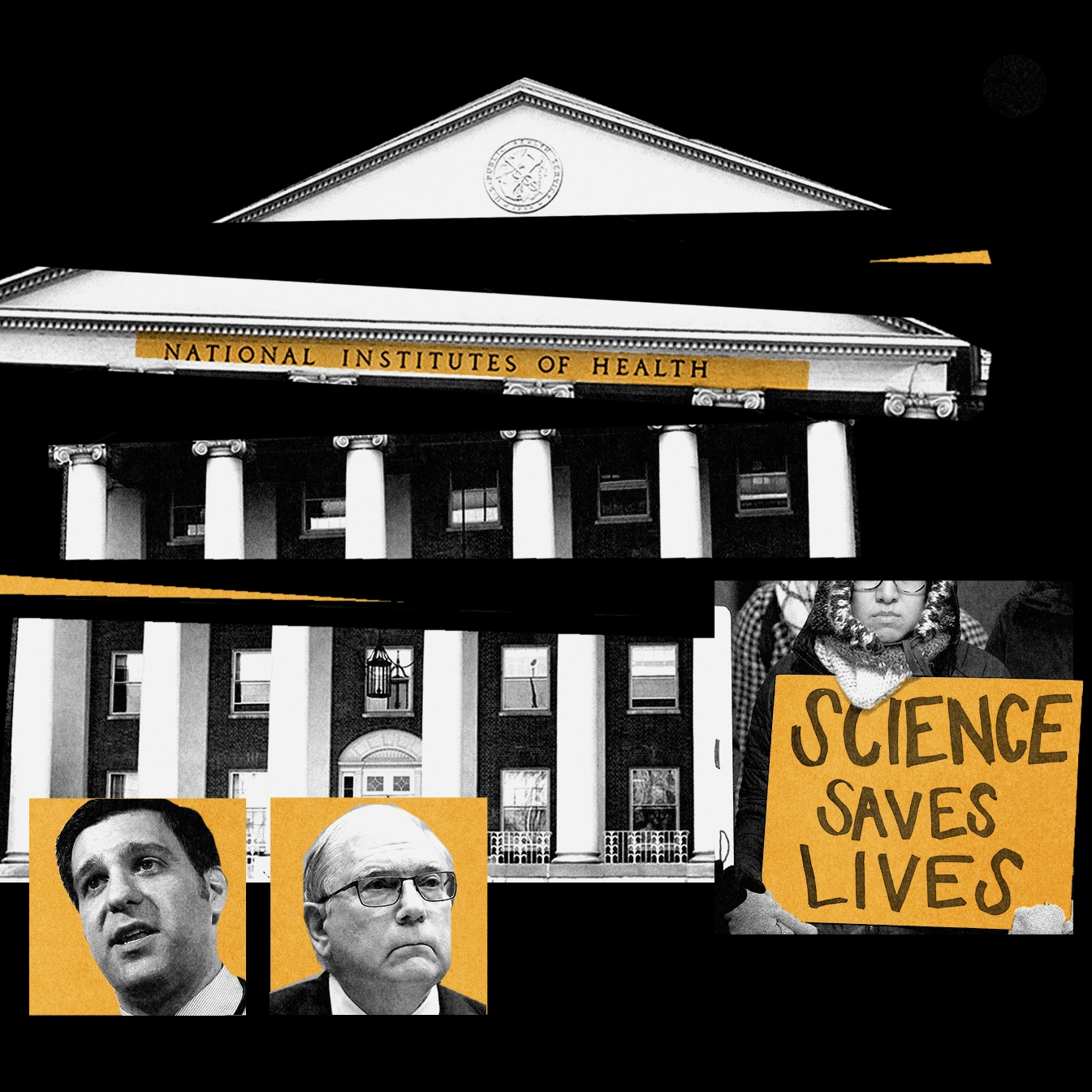
Post Reports
Trump's chilling effect on medical research
00:20:15
Inside the largest funder of biomedical research in the world, the past six weeks have been chaos. The NIH has long been a driver of scientific discoveries on treatments for diseases from cancer to covid – but under Trump, its future is uncertain.
Loading summary
Transcript42 lines
- [00:00]
AT&T Business
And now a next level moment from ATT Business. Say you've sent out a gigantic shipment of pillows and they need to be there in time for International Sleep day. You've got AT and T5G so you're fully confident, but the vendor isn't responding. And International Sleep Day is tomorrow. Luckily, AT&T 5G lets you deal with any issues with ease, so the pillows will get delivered and everyone can sleep soundly, especially you. ATT 5G requires a compatible plan and device. Coverage not available everywhere. Learn more@att.com 5G Network.
- [00:32]
Martine Powers
Hey there, it's Martine. So before we start today's show, I want to share some news with you about a couple things that are going on with me. A short term assignment coming up and then a arguably much longer term assignment. So first, I'm going to be spending the next few months reporting on the White House team here at the Post, covering the new Trump administration, holding President Donald Trump and his administration accountable. And that is what I'm gonna be doing this spring, which I'm very excited about. And then at the beginning of the summer, I'm becoming a parent and I'm gonna be going on parental leave for the months after that. So all of this together means that I won't be hosting the show for the next few months, basically through near the end of the year. But luckily, folks who listen to Post reports are going to be in wonderful hands because my fabulous friend Colby Itkowicz will be filling in for the first part of me stepping away. Colby is wonderful. She's a democracy reporter here at the Post in addition to having covered so many other things during her time here, and she has so many ideas and interesting questions, and you will love hearing more from her. Folks who've been listening will have heard her on the podcast this week as a guest and have heard her insights in the past. But she is going to be doing a great job co hosting the show along with Elahi Azadi. So that's my news. We're gonna be dropping a quick bonus episod on Saturday so you can hear a little bit more from Colby, get to know her better. But in the meantime, thanks for listening. And here is today's show.
- [02:15]
Carolyn Johnson
How are you doing?
- [02:17]
Mark Pifer
How am I doing? I'm depressed and angry, but besides that.
- [02:22]
Martine Powers
Mark Pifer has taught biology at UNC Chapel Hill since the early 90s. He also runs a lab at UNC looking at what goes wrong inside people's cells when they get sick with cancer. Mark loves his job.
- [02:39]
Mark Pifer
I'm in it for understanding how things work. But it really does pay off.
- [02:43]
Martine Powers
Thanks to research that labs like his have been doing for years, the prognosis for a lot of cancers has gotten a lot better.
- [02:51]
Mark Pifer
Changing something that was a death sentence into a chronic disorder. Unbelievable.
- [02:57]
Martine Powers
But then a few weeks ago, right after President Trump's inauguration, Mark got an unusual message from the university.
- [03:06]
Mark Pifer
We get an email, right? And they're like, there's been a freeze on federal funding. Things are chaotic. It's hard for us actually to know what this really means. You should just keep doing your work.
- [03:20]
Martine Powers
Like thousands of biomedical research labs across the country, Mark's lab is funded through the National Institutes of Health, the nih. That money pays for pretty much everything mark does. The 10 people who work in the lab, the materials he needs for research, his own salary. In late January, the Trump administration issued an order freezing all federal grants. That touched off weeks of legal and administrative battles over what NIH should do. Continue funding science research as normal or halt operations. That uncertainty has affected not just staffers at NIH headquarters in Maryland, but also scientists all over the country who work in NIH funded labs. In the midst of all this uncertainty, Mark is consumed by this fear.
- [04:14]
Mark Pifer
My money will run out at the end of August and everyone in my lab will have to be fired.
- [04:21]
Martine Powers
In the past, NIH has operated with bipartisan support. Typically, a presidential transition might hold things up for a couple weeks as the new administration installs new leadership and sets new priorities. But the level of disruption right now is on a completely different scale.
- [04:38]
Mark Pifer
If we literally have a whole year without graduate students, how are we going to restart this enterprise? People are actually literally looking for jobs in Europe now, including faculty level people. We thought this would be bad, but we just went. We didn't have near enough imagination.
- [04:57]
Martine Powers
Scientists like Mark say that could have serious, lasting effects for the way science is done in America.
- [05:05]
Mark Pifer
Zero new grants are getting funded that will literally kill biomedical science.
- [05:16]
Martine Powers
From the newsroom of the Washington Post, this is Post Reports. I'm Martine powers. It's Thursday, March 6th. Today we dive into what has been going on at nih. I'll talk to my colleague Carolyn Johnson, who has spent weeks talking to scientists like Mark Pifer and people inside and out, finding out the details of the turmoil inside the most important institution for biomedical research. And we'll hear from her about the profound impact this is all having on scientific research across America. So, Carolyn, I think a lot of people have heard of nih, which stands for the National Institutes of Health, but they might not understand what NIH does. So what is the mission of this government entity?
- [06:10]
Carolyn Johnson
It's the biggest funder of biomedical research in the world. It's a $48 billion agency that has really a lot of different missions. It has a huge biomedical research enterprise, thousands of scientists and labs that study different diseases, which could be diabetes, Alzheimer's disease, cancer. They do experiments and they train young scientists and they try to build our understanding of human biology. It also has a clinical research hospital where they run stud. So people who receive experimental drugs or participate in scientific research come there from across the country, and it delivers care to very sick people. And then the third thing NIH does with most of its budget is it spreads billions of dollars to academic medical centers, universities and hospitals across the US that all do research studies that are also aimed at different diseases. People know that pharmaceutical companies make drugs. They've heard of companies. But a lot of the research that those drugs are based on begins at NIH or begins by NIH funded research. So one example recently would be the COVID vaccines, which grew out of research at NIH that occurred way before the pandemic, when it was just known that coronaviruses posed a pandemic threat. And there was a lot of basic research that allowed the very quick response and the record time development of the COVID vaccines.
- [07:43]
Martine Powers
What started to become clear for NIH staffers about how their jobs and their agency was changing and that they're like kind of positioning as an agency that was sort of immune from politics, like how that was no longer the case.
- [07:57]
Carolyn Johnson
Right off the bat, there was a hiring freeze, a travel ban, a ban on communications, and grant review meetings, which are outside experts that meet to review the merit of different proposals, were canceled. And for a brief period, scientists were also told they couldn't even purchase basic lab supplies and reagents. On the Bethesda campus. There is some degree of this that occurs normally during a presidential transition, but the length of it and the chaos that it created would turn out to be a lot bigger than normal. Scientists were also trying to absorb the executive orders that Trump signed on his first day in office. And two of those really did affect science. One was an end to diversity, equity, inclusion activities. And that encompasses trying to make science more inclusive. The scientists who do science, it's been a historically white and male dominated field, so there's been longstanding efforts to just diversify who a scientist is that are really integrated into the entire enterprise. And there was a question about whether that included health disparities that affect people from different socioeconomic and racial backgrounds. And focusing on health disparities is a really big part of health research, because to improve health overall, you want to find those people who are suffering most, whether it's increases in cancer incidents in a rural population or greater risk of diabetes or Alzheimer's disease, and a racial minority, like amongst black Americans. So understanding those populations is really key to how health research works. And understanding how the DEI executive order would affect that research was something they had to just absorb and figure out. There was also an executive order on biological sex that said there were only two sexes, male and female. And this affects a lot of research, partially because there has been an increased effort to, first of all, just include transgender people in research, because understanding the health consequences of all humans has been a goal. So understanding how to shift that work to be in compliance with the orders was a challenge.
- [10:22]
Martine Powers
Okay, so then after this initial flurry of executive orders, what happened with all the research that NIH funds?
- [10:31]
Carolyn Johnson
A lot of things were happening as officials within NIH were trying to decide how to comply with executive orders and then also how to comply with a freeze that was announced on January 27 of funding from the federal government. Generally, there were court orders going back and forth and kind of navigating how to thread the needle on these different administrative requests, but also continue doing the work was a big challenge, I would say. It kind of just ended up making things get stuck. But there were lots of efforts to comply with the court, to comply with the administration, and that led to frustration and confusion.
- [11:15]
Martine Powers
So what was the direct effect of that? Like, what does it mean that NIH in some ways, lost the ability to.
- [11:23]
Carolyn Johnson
Issue grants to the outside scientists who depend on those grants? There was increasing alarm. There was frustration, There was uncertainty. There was panic to a certain extent and just confusion as well. People didn't really know what was going on, and that was bad for science because you can't just turn it on and off. People were worried. Some people had submitted grants after months of work, and they thought, are these grants ever going to get reviewed? Other people had grants that had been scored really well and were almost certain to be funded, but then they hadn't gone to this next step that would have gotten them funded. So those people were panicking that maybe they would not be able to keep their labs afloat or maybe have to fire a highly trained technician. So it was kind of raising a lot of existential questions for people, because so much depends on just the stability of the system. And there was uncertainty now about when or whether things would normalize. And some things have normalized. I mean, a lot of the effect of this was just the chilling effect of being afraid and not really knowing what to expect. A lot of the biggest worries that people have are on the next generation of scientists because those people are the most vulnerable. If they don't get a grant or if it doesn't look like a graduate program's gonna be able to admit them, maybe they will just go into another field. So the stops and starts are the hardest on the people who are kind of nascent scientists who could be the next people to invent, you know, a really amazing new drug technology or discover something we never even anticipated about cell biology that like, lays the platform for all these new ways of doing things. So there's a lot of worry about those young scientists who could be a lost generation just because of the uncertainty and the future looking so murky.
- [13:28]
Martine Powers
After the break, Carolyn and I talk about how the NIH has been impacted by the firings of probationary employees and where biomedical research stands now. We'll be right back.
- [13:50]
Sally Jenkins
I'm Sally Jenkins and I'm a sports columnist and feature writer for the Washington Post. My job entails pulling the curtain on really big sports events at what is going on in locker rooms? What's going on in the stadium tunnel, Most importantly, what's going on in the minds of the athletes that I covered. I think that we have an instinct that sports are really important in some primal way. We pay a lot of money for them, we build really big stadiums for them. And I think that athletics really gets us in touch with aspiration and teach something very, very important about accountability, about self determination. And so my job is to really make those links explicit for readers and users. Subscriptions support this work and the people behind it. Find out more@subscribe.washingtonpost.com I'm Sally Jenkins and I'm one of the people behind the Post.
- [14:49]
Mint Mobile
For years and years I overpaid for wireless. But then I finally got fed up. The crazy high bills, bogus fees, and quote unquote free perks that actually cost more in the long run became too much. Then I switched to Mint Mobile and the savings I'm seeing are incredible. Say goodbye to jaw dropping monthly bills because Mint Mobile is here with premium wireless plans starting at 15 bucks a month. All plans come with high speed data and unlimited talk and text delivered on the nation's largest 5G network. You can use your own phone and current number with any Mint mobile plan. Get three months of premium wireless service from Mint Mobile for 15 bucks a month. Shop plans@mintmobile.com reports. That's mintmobile.com reports upfront payment of $45 for three month five gigabyte plan required equivalent to $15 per month. New customer offer for first three months only, then full price plan options available, taxes and fees extra. See Mint Mobile for details.
- [15:48]
GoodRx
Are you looking to take control of your health? Do you want to stop overpaying for your prescription medications? The best way to do that is to check out GoodRx. With GoodRx you can find big savings on your prescriptions for everything from GLP1 medications to allergy remedies and so much more. GoodRx is free and easy to use. Just search for any prescription on the GoodRx website or app, get your coupon and show it to the pharmacist. You can save up to 80% at pharmacies near you, including Walmart, Walgreens, CVS, Publix, Kroger and many more. Best of all, GoodRx works whether you have insurance or not. And even if you have insurance, GoodRx could beat your copay price. I've suggested GoodRx to a couple friends and they couldn't thank me enough for how easy it was to find discounts. So next time you need a prescription, you've gotta go to GoodRx too. For simple, smart savings on your everyday prescriptions, check GoodRx. Go to GoodRx.com reports that's GoodRx.
- [16:52]
Martine Powers
In terms of how things have played out inside of nih, we have heard so many different stories over the last few weeks of different federal agencies where there have been widespread firings or layoffs or probationary workers let go. How did that play out at nih? What does it look like in terms of the ranks of NIH staffers and how they've been affected?
- [17:17]
Carolyn Johnson
They lost about 1,000 to 1,200 probationary employees in the mass firings across the government, and these were people who did job functions like processing blood in a clinical trial or scientists working on experiments trying to find new cancer drugs. These people are doing jobs that do have a close connection to the mission of the agency as it currently has been. And I think all of that has made other people inside NIH very uncertain and fearful about what's coming next. Their own jobs, are they going to be able to depend on those, but also whether science will look the same and what will it look like? There hasn't been necessarily a clear strategy about what it's going to be at the end of all this.
- [18:08]
Martine Powers
Carolyn, what is your sense of why this is happening and what the Trump administration is trying to achieve here?
- [18:14]
Carolyn Johnson
NIH is a really big agency, and even its most avid supporters would say there's room for reform, things that could be done more efficiently. It has 27 institutes and centers, and there's been a long standing discussion and debate about how to simplify that, how it could be reformed or made more targeted or, you know, a better fit for the future that we're in. I guess what is happening, at least to how it feels to the people I've spoken to inside nih, is that this is not targeted reform. It's more haphazard. It's kind of unclear what the goal is. Another reason people don't really know what the kind of end vision is for NIH right now is their permanent director is not yet in place. The confirmation hearing was this week. You know, there's been kind of mixed messages. The new HHS secretary, Robert F. Kennedy Jr. Gave a speech on his first week as director of NIH's parent agency, and he said kind things about NIH scientists and had fond memories of visiting the campus as a child.
- [19:21]
AT&T Business
And for me, that was an extraordinary thrill to see scientists who were engaged in this existential search for existential truths and who were working to make our country stronger and to make our people stronger. Those were different times.
- [19:42]
Carolyn Johnson
So it kind of remains to be seen what that adds up to once all of the leadership is in place.
- [19:49]
Martine Powers
Yeah, yeah. So, Carolyn, where do things currently stand with NIH's ability to fund research?
- [19:56]
Carolyn Johnson
There have been lots of stops and starts which have slowed things down, and it really varies across the agency. There are has been a restart of some activities, but then also what started happening last week is that certain grants started to be terminated, so researchers got notices that their work was ending. And these so far have been largely people who do work related to transgender research or diversity, equity and inclusion. On Tuesday night, President Trump did talk about trying to eliminate, and he did highlight some programs inside NIH that were being terminated, where they are ending grants that no longer align with the administration's priorities. What has become pervasive inside NIH and also in the outside research community is just fear and uncertainty. And that culture of fear that pervades everything is making people not be as ambitious in what they think they can do, and that's affecting their ability to plan the next experiment, to think about who they're going to hire instead. They're worried about the sustainability of their lab and keeping things afloat.
- [21:17]
Martine Powers
Carolyn, thank you so much for explaining all this.
- [21:19]
Carolyn Johnson
Thanks for having me.
- [21:21]
Martine Powers
Carolyn Johnson is a science reporter for the Post. This week, the Post reported that some universities are freezing hiring and admitting fewer PhD students, responding to the uncertainty about future federal funding for science. And the universities say this could have a lasting impact on medical research in the US the scientist Carolyn spoke to, who we heard from earlier, Mark Peifer, he talked about what that means so.
- [21:50]
Mark Pifer
Labs will shut down all over the country. It's unbelievable to me that we're going to do this right. We're going to take one of the smartest things that America did, which is invest in science, and shut it down at the whim of a handful of people.
- [22:09]
Martine Powers
That's it for Post Reports. Thanks for listening. If you're looking for the latest updates on the big news of the day, check out our morning News briefing. The seven we bring you through the seven stories you need to know about every Weekday morning by 7am you can listen to it wherever you listen to podcasts. Today's show was produced by Emma Talkoff. It was mixed by Sam Baer and edited by Maggie Penman. I'm Martine Powers. We'll be back tomorrow with more stories from the Washington Post.
- [22:49]
Washington Post
You listen because you know the power of good journalism and the Washington Post is there for you 24 7. When you become a Washington Post subscriber, you get exclusive reporting you can't find anywhere else. You also get sharp advice columns, delicious recipes, TV and music reviews and so much more. Right now, you can get all of that for just $4 every four weeks. That's for an entire year. After that, it's just $12 every four weeks. And you can cancel anytime. Add to your knowledge and discover all the Post has to offer. Go to washingtonpost.com subscribe. That's washingtonpost.com subscribe.