← Post Reports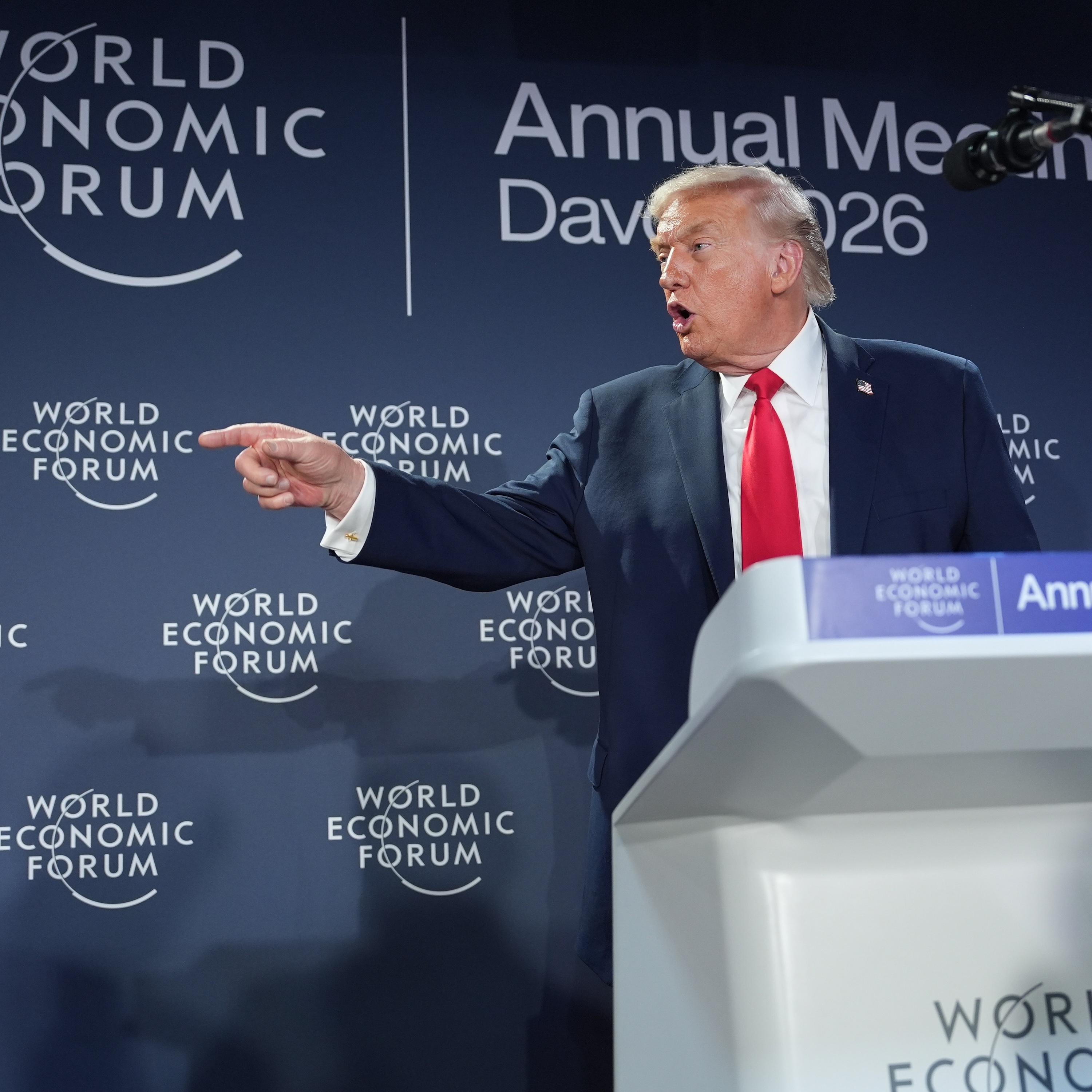
Post Reports
Trump’s Greenland ‘deal,’ and Democrats’ midterm math
00:40:46
One year into the second Trump presidency, what’s changed? Two speeches — at the White House and in Davos — demonstrate how President Donald Trump is more emboldened than ever. Meanwhile, Democrats have found new cause for optimism ahead of the midterms.
Loading summary
Transcript156 lines
- [00:01]
Cleve Woodson
So I actually met Dan. I did not know that he was a reporter. I met Dan on the basketball court. I was guarding him, like, 10 years ago. And I play basketball, even though my wife insists that I'm way too old to play still. And I hurt my pinky, which people can't see, sadly, because it's audio. But, like, no, it's video.
- [00:20]
Colby Ekowitz
Show them that pinky.
- [00:21]
Cleve Woodson
It's pinky. And I've been, you know, and I've been in the group chat talking about how I'm a big guy, I have a small pinky, and everybody's making fun of it, but there is a picture on the front of the Washington Post of my injured hand raised, asking Donald Trump a question that I immediately sent to the group chat, like, immediately. And they've been talking smack, just in.
- [00:44]
Dan Marika
Case viewers, listeners are wondering, Cleve was a very good basketball player. Still is a very good basketball player.
- [00:49]
Cleve Woodson
I will slide you $20 later.
- [00:55]
Colby Ekowitz
From the newsroom of the Washington Post, this is Post Report's weekly Politics Roundtable. I'm Colby ekowitz. It's Friday, January 23rd. Today we're discussing the latest from President Trump's visit to Davos, an elite annual gathering in Switzerland. We'll hear about his negotiations over Greenland and his power on the world stage. We'll also talk midterms and why Democrats think they just might be able to win the Senate. Back at the table with me today is Dan Marika, co anchor of our politics newsletter, the Early Brief. And we have with us at the table, White House reporter Cleve Woodson. Guys, thanks for being here.
- [01:28]
Dan Marika
Happy to be here.
- [01:28]
Cleve Woodson
Great to be back.
- [01:31]
Colby Ekowitz
So, guys, I wanna start with the fact that this week marks a year since Trump's second inauguration Just a year. Yes.
- [01:41]
Dan Marika
That also struck me. That's the same exact thing.
- [01:43]
Colby Ekowitz
I was like, how has it. Only it's been, like, 10 years.
- [01:45]
Dan Marika
I know, but that's by design.
- [01:47]
Cleve Woodson
I feel I have aged.
- [01:49]
Colby Ekowitz
To mark the anniversary, earlier this week, he came to the White House briefing room to talk to reporters.
- [01:55]
Cleve Woodson
A very close briefing room. Well, yeah.
- [01:56]
Colby Ekowitz
Cause Khalid, you were there. You were actually in the room. And I'm just hoping you can kind of take us inside, peel back the curtain a little bit. What was it like?
- [02:04]
Cleve Woodson
So it leaked a little early, maybe an hour or two before the briefing, that President Trump was going to be there on Tuesday. It's not surprising. It's a year anniversary. It makes sense. Right? And so I'm like, okay, I'm gonna get there a little bit early. I got There about a half an hour, a half an hour early. And it took me 10 minutes to get to my seat, and my seat is six feet from the door. And it took me 10 minutes to just squeeze through the thr of reporters and photographers and just people who were just hoping to ask the President a question. Also, Greenland was a big deal. Trump was about to head off to Davos, and so everybody wanted to ask whatever question they'd been writing down and pouring over all day, they wanted to ask Trump. And we sat there for about 30 or 40 minutes waiting for him to come out. And then he came out and it.
- [02:57]
Donald Trump
Was just, wow, that's a big crowd. That's a lot of people. It's like a record.
- [03:04]
Cleve Woodson
It was a lot. It was a lot.
- [03:06]
Colby Ekowitz
How so?
- [03:07]
Cleve Woodson
Well, it's not unusual for people to have people who are speaking at the White House lectern to have opening remarks. Trump's opening remarks lasted 80 minutes.
- [03:18]
Colby Ekowitz
80 minutes.
- [03:18]
Cleve Woodson
They handed out this.
- [03:19]
Colby Ekowitz
This is before he took any questions.
- [03:21]
Cleve Woodson
This is before any interrogative statement, you know, at all. They handed out this. This paper that was like, 365 wins in 365 days, which, again, you know, something politicians do or whatever. And I was like, he's gonna go over the highlights. And I was, in my mind, I'm just sitting there thinking, is he going to Talk about all365? My colleague, Matt Vizor, I was in the room, and Matt Visor was charged with writing the story and kind of linking it, you know, finding a through line in connective tissue. And I saw Matt afterwards, and I was like, good luck, buddy. Because there were just so many, like, kind of wildly disparate topics.
- [04:03]
Colby Ekowitz
Well, it was, to your point, like, quite rambling and unfocused. He was all over the place, right? I mean, what are some of the things that he was talking about?
- [04:11]
Cleve Woodson
I had a list going, and at some point I ran. I ran out of paper. He talked about playing Little League and his mom talking about mental institutions and how that relates to crime in cities.
- [04:24]
Donald Trump
He talked about Columbus Day, officially reinstated Columbus Day. I like the name Columbus Day. The Italian people are very happy about it. Remember when you go to the voting booths, I reinstated Columbus Day. That was an easy one.
- [04:37]
Cleve Woodson
Talked about refurbishing the White House. He talked about the Gulf of Mexico or the Gulf of America, or maybe possibly renaming it the Gulf of Trump. There is just.
- [04:47]
Advertisement/Announcer
Wait.
- [04:47]
Donald Trump
He said that I was going to call it the Gulf of Trump, but I thought that I would be killed if I did That I wanted to do it. I wanted to. My people work so hard, sir. I don't think it'll look too good. I'm telling you, it's a good thing.
- [05:01]
Cleve Woodson
Yeah, he joked, he joked that, and then he said I shouldn't say that.
- [05:05]
Colby Ekowitz
Because, I don't know, he's renamed other things.
- [05:07]
Donald Trump
So I'm, I'm joking. You know, when I say that I was not going to call it the Gulf of Trump, because tomorrow BE Trump wanted to call it the Gulf of Trump, but he was rebuffed by his people.
- [05:19]
Dan Marika
It seems like the better question is what didn't he talk about during the shorter visit?
- [05:23]
Cleve Woodson
Yeah, I think, right, yes, exactly. The, the. I mean, the one thing he didn't talk about during his 80 minute open statement was Greenland. And then everybody asked him about Greenland and Davos and all that stuff. And his answer was basically, you know, kind of an ominous, oh, you'll see.
- [05:38]
Dan Marika
And I think what set this apart is that his speeches are usually to an audience that adores him and that applauds him, and that gives him a lot of feedback, and he seemingly feeds off of that. What's been interesting this week is he's given two sets of remarks to an audience that does not adore him and does not clap at everything he says and has questions for him, or in Davos case, has issues with him. And so I think you see the President interacting in a way that he doesn't usually interact. That, yes, he takes questions from the press, but in the press briefing room is unique. He doesn't speak like that to an audience that doesn't applaud everything he says. So it's a different forum, really, for the President of the United States. And I think you saw that in how kind of meandering and unfocused it was.
- [06:23]
Cleve Woodson
A lot of what I think about with Trump is thinking about where Biden was at the same point in his presidency or even later points in the presidency, because they have a lot of, you know, they are diametrically opposed on a lot of issues, but they have a lot in common. They're both men who've aspired to the top of American politics and do not believe they've gotten enough credit for what they have accomplished. And to Dan's point, part of the reason that there were so many.
- [06:51]
Advertisement/Announcer
Just.
- [06:51]
Cleve Woodson
Disparate topics, it just seemed like Trump was like, I've done this and I've done this and I've done this, and you're not gonna report on this. But I've also done this and love him or hate him, Trump is a president who has done a lot of the things that he said that he would do when he got into office. Some people hate those things. Some people love those things. And I think that he. One of the. In fact, one of the things that he said was, I don't feel like I am getting enough credit for the good that I brought into America. And just trying to make that argument over and over again in the briefing room to a room of skeptical reporters, and then trying to do the same thing across the Atlantic in Davos. You know, this is what I've done. These are the things that I've accomplished. Like, look at this.
- [07:37]
Colby Ekowitz
Yeah, well, never is a good look, though. And it wasn't for President Biden, and it's certainly not for President Trump to be begging the world for confirmation of your successes. Right. Like, they should speak for themselves. And the fact that he has to go out there and say, well, look, I'm doing a great job. Tell me that I'm doing a great job, maybe suggests that people don't feel that way.
- [07:58]
Dan Marika
I think to some degree, every president feels like they don't get the credit they deserve for the work that they do. I think what's interesting about the last, I guess, two presidents, one Trump term, a Biden term, and now another Trump term is that there's this mass distrust in all institutions right now. Voters are skeptical of anything that anyone says. You can say that's because of the rise of AI or a partisan media or a fractured media system, whatever you might attribute that to. But there is this distrust in what is said just generally. And so I think that presidents Biden felt this. Trump certainly feels this. Are feeling that they aren't getting the credit they deserve because most Americans just don't trust what they're saying. And that's why I think you're seeing Trump in particular come out and say, look at all that I've done. Why am I not getting credit for this?
- [08:45]
Colby Ekowitz
But he's also up there calling Somalia not a real country, and disparaging Somalia, Somali Americans in Minnesota and accusing them of voter fraud because they vote as.
- [08:56]
Donald Trump
A bloc, it's a rigged state. And the Somalians vote as one group, even if they're not citizens. And they vote as one group. And, you know, you get 600,000 votes against you. They all ought to get the hell out of here. They're bad for our country.
- [09:11]
Colby Ekowitz
So he was not just up there touting his accomplishments. He was also doing what Trump does, which is kind of go off on tangents and in some sense insults people or entire groups of people.
- [09:23]
Cleve Woodson
He is a polarizing president. And so whereas half of America will be like, this is great, this stuff that you are doing, there's another half that will be like, this is absolutely horrible. And for Trump, it is him saying, I've accomplished all of these things, and he thinks of them as accomplishments. And his followers, like, what, Cleave?
- [09:44]
Colby Ekowitz
What is he saying that his accomplishments are that people should be giving him credit for?
- [09:47]
Cleve Woodson
Oh, man. Let's tick them off. Right?
- [09:49]
Colby Ekowitz
I mean, I don't. Not all365.
- [09:53]
Cleve Woodson
Yeah, exactly. It's sitting on my desk. D.C. let's just start right here. He says that D.C. is a safer city because he brought the National Guard to D.C. and he took over the police force. He touts how there's very, very few crossings at the southern border and that presidents for decades have had a difficult time getting a handle on immigration, and now there's none whatsoever. He touts the them a little bit about, you know, tax refunds that are coming and how they're going to be, you know, bigger and how they've kept inflation under control. The problem was that he kind of jumped from issue to issue 365 of them without, like, without transition. And so it's just like this and this and this and this and another thing. And before he even took a question, I just felt like there was this overload of, like, all that, all that. Trump wants us to know that he's.
- [10:51]
Colby Ekowitz
Done and we're gonna move on. But his accomplishments are also largely exaggerated, particularly around whether or not he's kept D.C. safe, whether or not he's brought down or leveled inflation. You can poke holes in a lot of the things, sure.
- [11:05]
Dan Marika
But, I mean, there are also some areas that he has had clear wins. I mean, people voted for him to tighten immigration policy. He has done that. Whether it's popular or not is another question, but he has done that. He has done what he has said on the southern border about limiting the number of people to come over illegally. There are plenty of holes to be poked in a lot of what he says about the economy, about other issues. But it is worth remembering that there are a large faction of Americans who voted for some portion of this, and that's why he kind of has the staying power that I think a lot of people are perplexed by.
- [11:37]
Colby Ekowitz
Sure. So let's move across the Atlantic, because in the hours after you saw him at the White House, he left for Switzerland. He was there to meet with leaders from around the world at the World Economic Forum in Davos. And we know that the mood going into this event was tense because Trump had been escalating his threats about taking over Greenland, his threats about issuing new tariffs on Europe. But Dan, what really struck me is how world leaders, particularly the Prime Minister of Canada, you know, stood up to Trump and challenged America as a world leader, challenged our place in the world. Let's listen to a bit of what Prime Minister Mark Carney had to say.
- [12:17]
Cleve Woodson
Now.
- [12:17]
Dan Marika
Canada was amongst the first to hear the wake up call leading us to fundamentally shift our strategic posture. Canadians know that our old comfortable assumptions that our geography and alliance memberships automatically conferred prosperity and security. That assumption is no longer valid.
- [12:36]
Colby Ekowitz
Dan, what do you make of that?
- [12:38]
Dan Marika
I mean, it's an elbows up moment for the Prime Minister of Canada, who I think it's correct. He had, he probably was the first to kind of recognize what was changed in the United States far earlier than I think some of the European allies recognized around the President and his threats.
- [12:53]
Colby Ekowitz
Because of the tariff threats, I think.
- [12:54]
Dan Marika
Because of tariffs, I think because of proximity, I think because of the president swept into power saying he was going to make Canada a 51st state. I mean, there's a number of reasons that Canada kind of woke up to this earlier, but it really was a dramatic moment. And I think it's fair to say that this is probably one of the more dramatic breaks in the world order that has been established since World War II.
- [13:15]
Colby Ekowitz
And to be clear, Trump spoke after Carney spoke.
- [13:18]
Dan Marika
Yes, he did.
- [13:18]
Colby Ekowitz
He spoke after Carney. He addressed what Carney said as well, right?
- [13:20]
Dan Marika
Yes, he did. And he, you know, criticized the Prime Minister and said that the only reason that Canada exists is because of the United States.
- [13:29]
Donald Trump
Canada gets a lot of freebies from us, by the way. They should be grateful also, but they're not. I watched your Prime Minister yesterday. He wasn't so grateful. But they should be grateful to us. Canada. Canada lives because of the United States. Remember that, Mark, the next time you make your statements.
- [13:48]
Dan Marika
Obviously that is not true, but it is kind of Trump's way of bloviating his rhetoric, attacking our neighbor to the north. I think a real takeaway from just one day in Davos with the President was that there are real fractures between the United States and our longest time allies, Canada, France, the United Kingdom. You have seen the way that a lot of people in the United States, a lot of institutions, political power, have not been able to find a way to stand up to the President in The way that our allies have in recent weeks because of Greenland. I mean, you've seen troops be moved to Greenland. You've seen negotiations around trade deals be ended because of what the President is doing in Greenland. You have seen really harsh rhetoric from world leaders because of the President's saber rattling around Greenland. So I think it's worth noting that while many Americans are wondering kind of, where is the line for the President? Like, where does this stop? European leaders did stand up to him in a way that we haven't seen, and I think that's why you saw, as he was leaving Davos, he announced that he had struck this deal to basically end his saber rattling around the Arctic island.
- [15:01]
Colby Ekowitz
But what's the deal? That's what I don't see. That's what I don't understand.
- [15:05]
Cleve Woodson
What's the concepts of a deal? We've heard.
- [15:06]
Colby Ekowitz
Yes, we've heard concepts of a plan before.
- [15:08]
Cleve Woodson
We've heard that before at the debate when he talked about concepts of a health care plan. Right. And this is concepts of a deal. And to Dan's point, I think a lot of what we've seen from Trump during his political career, but specifically over the last year, is notching the win before the details are worked out. He gets to walk away from Davos saying, I got what I wanted from these European leaders. America has won. Even though even a day later, we don't know exactly what that victory or that win looks like.
- [15:42]
Dan Marika
I also think it's. His speech was offensive to Europeans.
- [15:45]
Colby Ekowitz
Sure.
- [15:45]
Dan Marika
I mean, he was belittling French President Emmanuel Macron, who had.
- [15:50]
Cleve Woodson
With an accent.
- [15:50]
Dan Marika
Yeah, with an accent. Who had some sort of eye issue and was wearing aviators at the event.
- [15:55]
Donald Trump
So when I called up Emmanuel Macron, I watched him yesterday with those beautiful sunglasses. What the hell happened?
- [16:07]
Dan Marika
He obviously belittled Canada. He said that the United States has never asked for anything from NATO.
- [16:14]
Donald Trump
But the problem with NATO is that we'll be there for them 100%. But I'm not sure that they'd be there for us if we gave them the call. Gentlemen, we are being attacked. We're under attack by such and such a nation. I know them all very well. I'm not sure that they'd be there.
- [16:35]
Dan Marika
Which is just not true. The only time that Article 5, which is the agreement with NATO, that basically means that if there's an attack on one country, all other countries will come and support that country. The only time that has been evoked is by the United states around the September 11th in response to the September 11th attacks. And then he criticized Denmark as, you know, this small country, and really belittled them. Danish soldiers served alongside Americans in Afghanistan and had one of the highest death rates in that war per capita. So there are Danish families who have lost loved ones fighting alongside Americans. And it is offensive to have the president of the United States then go to Europe and criticize their ability to protect themselves and to serve.
- [17:22]
Colby Ekowitz
Levy, you mentioned that Trump gets to leave Switzerland declaring this win. But for European leaders, is it also a win for them because he backed down on tariffs? He's saying he's not going to take Greenland by force again. We don't know what he got in this deal in this framework. And we're talking Thursday morning. Maybe we'll have more details in the coming hours and days, by the time people listen to this podcast or watch this podcast. But it seems that Europeans could also be calling this a win.
- [17:51]
Cleve Woodson
Yeah, I think that everybody, every. Every world leader gets to walk away and say that we got some kind of win. One of the really important things to remember about events like Davos or NATO summits or G7s or any of the GS is that it's an international confab, but they are talking to a domestic audience. And so European leaders get to leave. And they say, before we came here, Trump was going to impose tariffs that were gonna ruin and wreck our economy. And now those things aren't happening. We win. We win. And Trump gets to say, we've notched the win. We all but have Greenland and all of that stuff. It is just always to a domestic audience and Trump trying to notch a win as early as possible. But like any good negotiation, everybody gets to leave with something.
- [18:37]
Dan Marika
I do think something that the Canadian prime minister said really stuck out in a way that I haven't heard world leaders kind of rebut Trump. He talked about middle powers. So much of the world is seen through superpowers. Russia, China, the United States and what they want, what they need. Clearly, that's how Trump sees the world. He sees the world kind of as this binary competition between the United States, Russia and China. The Canadian prime minister, in his speech, spoke about middle powers uniting, coming together. So middle powers would be, you know, these nations that are powerful but aren't superpowers. Canada, the United Kingdom, France, other. Other nations.
- [19:16]
Colby Ekowitz
But they have a lot to offer through their economy.
- [19:17]
Dan Marika
Absolutely. That have.
- [19:18]
Colby Ekowitz
We have trade deals with.
- [19:19]
Dan Marika
Absolutely.
- [19:20]
Colby Ekowitz
We need things from.
- [19:21]
Dan Marika
And so by him framing this as the United States is no longer a reliable partner, middle powers need to unite and become kind of a cohort of superpowers that can stand up to the president of the United States threatening to wreck our economies. I wonder if that carries on beyond Davos. And you see a partnership between these nations that have powerful economies, but not on the size and scale of the United States. And if you see a more united front in standing up to the president because someone like a Mark Carney, the prime minister of Canada, kind of led that push and took it right to Donald Trump in Davos.
- [19:57]
Colby Ekowitz
Yeah, I mean, Klebitz struck me you mentioned that, you know, for these European leaders, they're there, but they're really talking to a domestic audience. They're talking to their own constituents. Is that true for Trump, too? And how do people back here in America feel when he's overseas so focused on these international fights when again here in America people still feel like things.
- [20:20]
Advertisement/Announcer
Aren'T working for one in five Americans have learned a new language on their bucket list. I know because I'm one of them. So if you're like me, let's make 2026 the year we finally check it off the list with Babbel, the language app that makes grammar fun and is actually worth your time. Learning a language with Babbel is all about small steps, big wins and progress. You can actually track and feel. Their bite sized lessons fit easily into your daily routine and are also easy to remember. Just 10 minutes a day is enough to start seeing real results. Babbel lets you practice real life conversations step by step, without the stress. That's why I'm excited to use Babbel to learn French before I travel to Paris later this year. I can't imagine a better way to immerse myself in the culture. However, you learn best by listening, speaking, reading or writing. Babbel adapts to your style and keeps you motivated with personalized learning plans, real time feedback and progress tracking. Here's a special limited time deal for our listeners right now. Get up to 55% off your Babbel subscription at Babbel.com reports. Get up to 55% off at Babbel.com reports. Spelled B-A-B-B-E-L.com reports rules and restrictions may apply. You know what's something I really used to dread? Weeknight dinner. It's the thing that never goes away. Every single day around 5pm there it is again, just staring you down. How are you gonna solve dinner tonight? Well, luckily there's Hellofresh. Hellofresh doesn't just make you a better cook. It gives you your nights and sanity back. The thing is, I think I'm actually a decent cook and I do enjoy it. But weeknight dinner isn't about any of that. It's about the mental load of figuring it out every single night when you're already exhausted. Hellofresh removes that completely pre portioned ingredients step by step. Cards done in 30 minutes. I've now tried a bunch of Hellofresh turkey lettuce wraps, beef chili, Mediterranean salmon. All so good though 100%. The chili remains my favorite. Also easy to prepare too. Go to hellofresh.com posttenfm to get 10 free meals plus a free Zwilling knife. A $144.99 on your third box offer valid while supplies last free meals applied as discount on first box. New subscribers only varies by plan, particularly economically.
- [22:35]
Cleve Woodson
Sure, I think that Trump is talking to Americans, but he's talking to a particular subset of Americans. Those that voted for him, those that are on his side, those that are part of the MAGA movement and all of that stuff. And those are the people that he's trying to persuade that this way, the 800 pound gorilla argument is the right way, that we are America, that we will take what we want, that we will do what's in our interests, and that the other countries will fall in line. That that is sort of what they're trying to convince people who were formerly or used to be are, you know, transitioning from America first. You know, of that. Like it's in our best interest to assert, you know, our, our might across the hemisphere and across the world. But what we've seen from previous elections, both midterms and presidential elections, is that people tend to vote on domestic issues. They tend to vote on the economy, on pocketbook issues, on whether they, they have money and money in there at the end of the week or enough money to go on vacation or whatever. And so it's too soon to see whether Trump's foreign policy focus, particularly in the first part of this year, will have calamitous impacts for him or for his party a few months down the road. I think one question that we're watching very closely is not or it's and it's whether Trump is able to do this foreign policy stuff and to provide an economic benefit to people who really elected him to have that economic benefit.
- [24:06]
Dan Marika
Yeah, nothing says affordability like the Swiss Alps in the winter. Right?
- [24:09]
Colby Ekowitz
Right.
- [24:11]
Dan Marika
Switzerland, that famous place where everything is cheap.
- [24:13]
Colby Ekowitz
Davos, where only the, only the middle class.
- [24:15]
Donald Trump
Yeah.
- [24:15]
Colby Ekowitz
It's amazing and go on vacation.
- [24:17]
Dan Marika
Yeah.
- [24:18]
Colby Ekowitz
So let's take a break there, and when we come back, we're going to talk a little bit more about the midterms. Be back in a sec. So we touched on this a little bit before the break, which is, you know, Trump's focus abroad on all these international fights. It's not necessarily what Republicans who are facing tough elections coming in November, what they would like him to be talking about or at least be focused on. And that might be one of the reasons, not the only reason, why Democrats are feeling good, pretty bullish about their chances in the midterms, particularly in the House. But why are Democrats feeling like the wind is at their backs?
- [25:04]
Dan Marika
There's a number of reasons. History is on their side. Traditionally, when a president sweeps into power, the first midterms that they face are very difficult for the party in power. That was true for President Trump when he swept into office in 2016. The 2018 midterms were a huge blue wave for the Democratic Party, and they swept into control of the House. There are some hopes or some belief that the 2026 midterms could be similar to that. Democrats are very feel very good about the messaging environment that they're in as well. President Trump, as you note, did not run on a ton of international affairs issues. And that has been the main focus.
- [25:40]
Colby Ekowitz
Other than being the peace president.
- [25:41]
Dan Marika
Sure. And that has been the main focus of his first year. He promised throughout the 2024 campaign that he would bring inflation down, that he would bring prices down, that he would get a handle on the economy. And poll after poll after poll have shown that voters just don't think he's done that. Things remain unaffordable according to these polls. And the most damaging thing for the president that you've seen is that the electorate that backed him in 2024 and made him president has largely fallen apart. Latino voters, he did very well with Latino voters in 2024. Young voters, he did better than, I think, any Republican president in about 30 years with young voters, that has largely fallen apart for him. And young voters have swept back to Democrats or at least away from the president. That is why Democrats are very confident. And actually, I wanted to ask you a question, because you have done a lot of reporting this week about the Senate map. I was talking mostly about the House.
- [26:36]
Colby Ekowitz
Yeah, that's right.
- [26:36]
Dan Marika
But there are Democrats who actually think that the Senate now may be more in play than they did maybe two or three months ago.
- [26:43]
Colby Ekowitz
Yeah.
- [26:43]
Dan Marika
Why is that? And what will that mean for the hopes that they actually have to take.
- [26:47]
Colby Ekowitz
I like being on this side.
- [26:48]
Dan Marika
I know.
- [26:50]
Colby Ekowitz
Yeah. It's true. So I worked with our colleague Theo Meyer on this Senate map story where we looked at the map and suddenly Democrats, where a couple months ago, it was out of reach. There was no way that they could win the Senate battle.
- [27:03]
Dan Marika
And they have a 47 to 53 disadvantage in the Senate right now.
- [27:06]
Colby Ekowitz
Right. So they need to win six states, and that's a lot because the map is not overall very favorable to them, but they're suddenly looking at it and thinking we might be able to do this. One of those reasons is because they've got some strong recruits. Places like North Carolina, where the former Governor, Roy Cooper is running. He's very popular, has won statewide, but he's never lost. Right. He's never lost. We've seen in his fundraising and in even some preliminary polls like that, he's ahead. So while North Carolina has been really tough for Democrats, they think they can pick up a seat there. Alaska, which is not a state that you would necessarily think would be a Democratic pickup. Minority Leader Chuck Schumer is feeling really good about Alaska because he got former Congresswoman Mary Paltola to run, and she's very popular, and she's won statewide since there's only one member of the House in Alaska. So you've got a number of states where, again, a year ago, out of reach. Now with the economy where it is, where people feeling the way they're feeling about Trump, couple that with these strong recruits, there is a chance. It's been described to me as still a long shot.
- [28:11]
Dan Marika
Yeah. Question here is how big the blue wave may be, because I think most people agree that there's this wave building on the. On the side of Democrats and that the question is, how far does that crash reach? It's true. In the House, there are a lot of these reach districts that you. That may have seen out of reach maybe three or four months ago that maybe could be in play this year. I think you're exactly right about the Senate. I mean, the real. The. The math here is interesting, is that Democrats have to basically defend four seats. Georgia, Michigan, New Hampshire, and Minnesota. Some of those are open. Georgia is not. John Ossoffa very well funded. He's gonna have a ton of money to spend in Georgia, is running for reelection. That'll be probably one of the most interesting races in the nation.
- [28:53]
Colby Ekowitz
Yes. And there's a competitive primary on the Republican side in Georgia, where they're gonna be spending a lot of time fighting amongst themselves. And letting Jon Ossoff just shore up his war chest. But the same is happening on the other side of the aisle in Michigan.
- [29:06]
Dan Marika
And then, yeah, so Republicans are gonna have to defend Maine, where Susan Collins is running for reelection. And as you mentioned, North Carolina, where it's an open seat but was once held by Thom Republican there. And so it really looks like Dems have to pick up two of those long shots that you mentioned. Alaska, Ohio, Iowa's on that list. Texas is on that list. So there's these races that I don't think you and I would have been talking about a few months ago as possible for Democrats that now may be coming online. I think that the issue for the party is how do you spread your money around? Resources are always gonna be an issue. Many of these races are going to be incredibly expensive. So if you have this widening map, where do you make decisions about spending money? Does that open up Republicans chances in other areas? It's gonna be fascinating for the next few months because I do think the bigger the map gets. It's great news for Democrats, but it also means they've gotta make some strategic decisions when it comes to.
- [30:02]
Colby Ekowitz
Well, I talked to a Democratic consultant in Texas who basically said, here's my advice to the Democrats running in Texas. Don't expect any national money until the very end. Unless it really looks like you can win, you're on your own. And national Democrats. And even Schumer did not list Texas as one of the ones that he thought was most in reach for them, out of the reach states. And so they might spread their money in places like Alaska, probably Ohio, where former Senator Sherrod Brown is running. That's considered a big opportunity, a big recruit win for Democrats. But there's other states where Democrats are probably gonna hold off on spending until they can see that there's really a chance.
- [30:41]
Cleve Woodson
I'm gonna be a little, just a tiny bit contrarian. But I also wonder, like, what are their deepest fears? Because four years ago we were.
- [30:51]
Dan Marika
That is a question.
- [30:52]
Colby Ekowitz
What are the Democrats deepest fears?
- [30:53]
Cleve Woodson
Four years ago we were having a similar conversation about a red wave under Biden. And then we saw that that was vastly kind of blunted and did not happen. And even maybe gave Biden a little bit of overconfidence going into the next two years. And I just wonder what causes. I understand the math, I get the war gaming. But like what causes all of this stuff to fall down?
- [31:15]
Dan Marika
I think that the difference between Biden and Trump is the polarization of each. I think Trump is such A pervasive figure. He's in everyone's lives. He's on the news every day.
- [31:26]
Cleve Woodson
He's in their cities.
- [31:27]
Dan Marika
He's in their cities. Biden was not as all over the place and in your face as the president is. And I think what we've seen is that has lead to a faster decline in the polling than we have, than we saw during the Biden presidency. You're absolutely right. I mean, this could all be for naught, and Democrats could be once again projecting overconfidence. But I do think there's a big difference between the way voters feel about Donald Trump, because they've had this feeling before in 2018, and the way voters felt about Joe Biden in 2022.
- [31:58]
Colby Ekowitz
I also think in 2022, you were coming off of Roe v. Wade being overturned. Yeah, you were. It was the first major election since the January 6 attack on the Capitol, which at that time was still considered a pretty appalling and horrible thing. And President Trump was still somewhat treated as a pariah, even among some in his own party. And so. And Joe Biden, again, was not, to Dan's point, as polarizing as Trump is for so many voters who are gonna be galvanized, I think, to vote in November.
- [32:30]
Dan Marika
But to Cleave's point, I mean, and this is like the grain of, you know, take this all with a grain of salt dynamic of it.
- [32:35]
Cleve Woodson
Or a bucket.
- [32:35]
Dan Marika
Or a bucket of salt. Yeah. Or like a salt mine. We're a long way out. I mean, we're speaking to people in January of 2026. We don't really know what the most. The biggest issue will be in November. It could change. It likely will change. It will probably be, as Cleve pointed out smartly earlier in this podcast, some sort of economic question about whether people feel like their money is going as far. Can they take their family on vacation? Can they afford their groceries? Those kind of questions. But we don't know kind of the atmosphere that these elections will be happening in. And I think that will tell a lot about. Is this a blue wave? How big is the wave? Where does it crash?
- [33:14]
Colby Ekowitz
Let me ask. Cause, Cleave, you spend a lot of time out in the country talking to voters. I mean, how much is Trump's aggressive immigration play resonating with voters? I know that there are a lot of people angry about it on social media. Is that gonna be on people's minds when they vote in November? That they feel. Because I think a lot of Americans feel that Trump has gone there too far. But Is that something that will motivate them to vote?
- [33:37]
Cleve Woodson
I don't know how much it will be on their minds, but I feel that it will be more on their minds than it has in the past one. I forget who I was, which voter I was talking to that said something like ICE has always kind of existed in the shadows, right? Like ICE is doing investigations and trying to find people and deport them. But they've never been battling it out with protesters on the streets of American cities. And now in city after city after city, you are seeing ICE in the headlines, ice on the news, you know, ice in the streets and all of that stuff, and seeing them literally as an extension of Donald Trump's policy and in many cases impacting everyday average Americans, not just immigrants who are on the verge of being deported. And so I do think it will play a larger role or a larger impact. Now. There's a lot of time and will we still be talking about this three months from now or four months from now? And if the economy craters or if bad things happen economically, that could just change the entire calculus writ large. I think one other thing that I will say is that what you said about the races, not necessarily getting a lot of injection of national money or something like that, I think a lot of these races will also come down to the strength of the individual candidates. Roy Cooper's probably a good. I'm from North Carolina. He's probably a good candidate in North Carolina. Name recognition, former governor, all of that stuff. But in race after race, race across the country, do you have Democrats who have that name recognition, who have that charisma, who have that ability to mobilize voters, or does it just become a conversation about Donald Trump?
- [35:18]
Colby Ekowitz
Right.
- [35:19]
Dan Marika
Yeah. That's why those primaries will matter. I think on the ICE question, I think there are a lot of people who think that it'll be most interesting in Minnesota, which has an open Senate seat this cycle. It's been years since Republicans have won in that state. And that's why I think the, the better state to watch will actually be Maine, where Susan Collins is up for reelection. And the news broke this week that there will be more ICE enforcement in that state, particularly in Portland and Lewiston, two of the biggest cities in Maine.
- [35:45]
Cleve Woodson
Large Somali population.
- [35:47]
Dan Marika
Large Somali population is exactly right. It is also going to be home to the most closely watched Senate race in the country, with Susan Collins running for reelection, likely against the governor of Maine, Janet Mills. She has a primary challenger from a guy named Graham Plattner. We've talked about him before, but it'll be interesting to see. How do those immigration enforcement activities play out? Is it similar to what we've seen in Minnesota? Does it get a similar backlash to what we've seen in Minnesota? And does that blow back on Susan Collins, who has picked her spots with Trump, I was reminded this week, has never voted for him, has never been endorsed by him, and she has never endorsed him as well. So she's won reelection in 2020 when the president was also on the ballot. So it's not like she needs the Trump endorsement to win. But these atmospherics, what's happening in a state at a time when people are thinking about voting will matter. And so if there's this big blowback to ice in Maine, that could blow back on Susan Collins, you're gonna need a warmer coat.
- [36:46]
Cleve Woodson
We're headed north.
- [36:47]
Dan Marika
I'm happily, I'll happily go there. My family's up there. I'll happily go up there.
- [36:51]
Colby Ekowitz
Volunteer to spend the whole summer there.
- [36:53]
Dan Marika
Summer's great.
- [36:54]
Colby Ekowitz
Happily, I'll go in August.
- [36:56]
Dan Marika
Got it. We could do a post, reports from Portland.
- [36:59]
Colby Ekowitz
I mean, oh, my goodness. Live from.
- [37:02]
Dan Marika
Can we get that approved back there?
- [37:04]
Colby Ekowitz
Yeah.
- [37:04]
Dan Marika
All right, great. They just nodded. I want everyone to know that it's happening.
- [37:09]
Colby Ekowitz
So we're ending the show again with a reader question, which is amazing.
- [37:12]
Dan Marika
Love it.
- [37:12]
Colby Ekowitz
We have a reader from Dan's newsletter who writes. And we got this one from Layla Khan of Kensington, Maryland, and she writes, as Trump's popularity wanes, why aren't we seeing more Republicans, especially those in swing districts, standing up to him? It seems like the threat this is still from Layla. It seems like the threat of a primary challenge by a candidate solidly aligned with an unpopular president is losing its teeth. What do we think? Is that true?
- [37:42]
Dan Marika
I mean, I think it's a reflection of Trump's hold on his party. I don't know how Layla feels about the president. There's certainly polling out there that says he's largely unpopular. That's a fair statement. But he remains popular with his base. And in primaries, those are the people who vote. The people who are, you know, died in the wool Democrats, died in the wool Republicans or the people who usually vote in primaries. And that's why the president has been so successful when it comes to endorsing in primaries, oftentimes in the last decade, the Trump backed candidate in a primary is the candidate who wins that primary. And that's why I think you have seen a lot of these candidates who are in competitive races have to be very careful about how they approach the president. That includes incumbents who are unlikely or won't face a primary challenge. Kind of as stout as maybe a challenger. But it'll be a huge question for the next few months is how do vulnerable Republicans, especially in the House, how do they approach Donald Trump? Do they check him in some ways, do they raise questions about the actual state of the economy? As the President is saying, it's all great. We've seen this a little bit on Epstein. You saw some Republicans buck the president on releasing the Epstein files. You've seen it a bit on health care, on extending these ACA credits that were to prevent skyrocketing premiums, because that's a politically difficult issue for some of these vulnerable Republicans. But it will be kind of the story of the next few months is how do Republicans, who are facing incredibly tough campaigns in November, how do they handle the president? Because he is well known to not handle criticism well from within his own party. We've seen it throughout his time in office. Cleve can probably speak to that.
- [39:26]
Cleve Woodson
Yeah. I was at an event at the Kennedy Senator a few weeks ago where Trump named names. I like this guy. I don't like this guy. This guy comes from central casting. And so Trump has the ability to, as my mom would say, to put you on blast really quickly and to put your name in the national spotlight as somebody that is antithetical to the MAGA movement, antithetical to what Trump is trying to accomplish. And so that's just standing up to Trump, quote, unquote, may seem easy for somebody Democrat or even independent, but if you are a Republican trying to win Republican voters, that is a difficult calculus.
- [40:05]
Dan Marika
And there's examples of this. I mean, look at Thomas Massie, Congressman from Kentucky, who was one of the leaders of releasing these Epstein investigative documents and releasing the Epstein files. We can say, look at Marjorie Taylor Greene. Look at Marjorie Taylor Greene. But Thomas Massie now has a primary challenger. The President is vociferously against him. It is going to be a race because of the fact that he has crossed President Trump. Marjorie Taylor Greene, one time huge ally to the President, breaks with him. Yeah. Breaks with him on the Epstein file. And is now no longer a member of Congress because he threatened, he pulled his endorsement. She was gonna pick up a bunch of challengers in the primary and basically had to leave the House because of that.
- [40:46]
Colby Ekowitz
I do think to Layla's question, one thing that will be interesting is, and Democrats will be watching for this very closely, is the Republicans that try to pivot post primary. Right they get through the primary and then they're facing a Democrat in a swing district going into November, then do they start criticizing President Trump? Then do they feel more emboldened or like they have to in order to win over some of those moderate voters? And we see that sometimes that, you know, it's like that pull back to the center that we see after a primary. And how which Republicans do that? How will Trump respond to that and how will Democrats try to exploit that?
- [41:20]
Dan Marika
That's when you'll see the ads that say X. Republican congressman said X in January.
- [41:25]
Colby Ekowitz
Exactly.
- [41:25]
Dan Marika
Then said Y in September. And can you really trust what he says? I mean, that's like the kind of trademark attack at in a political campaign. And you're exactly right. That is the scenario where that will happen is they're trying to be too cute with Trump, they go a different way after the primary and they get called out for it.
- [41:40]
Colby Ekowitz
That's right. Guys, thanks for a great conversation.
- [41:43]
Dan Marika
Thanks for having me.
- [41:43]
Colby Ekowitz
Loved having you on.
- [41:44]
Cleve Woodson
Yeah, it's great being here.
- [41:47]
Colby Ekowitz
That's it for Post Reports. Thanks for listening. Dan Marika is co anchor of our politics newsletter, the Early Brief. Cleve Woodson is a White House reporter for the Post. We love to hear from our listeners. And just like we've loved getting questions from Dan's newsletter readers. If you've got a question about politics that you'd like us to answer on an upcoming episode, please send it to us. Write us an email or even record a voice memo and send it to postreportsohpost.com and as always, if you want to watch this episode, you can Find us on YouTube. The video version of our Politics Roundtable is on the Washington Post Podcast channel. We'll put a link to that in our show. Notes, notes Today's episode was produced by Josh Carroll and Thomas Lu. It was edited by Martine Powers. Our mix engineer is Sean Carter. Thanks also to our Politics editors. Our team also includes Ted Muldoon, Alana Gordon, Emma Talkhoff, Ariel Plotnick, Dennis Funk, Rennie Srinovsky, Sabi Robinson, Laura Benshoff, Elahi Zadi and Rena Flores. I'm Colby Ekowitz. Have a great weekend. The holidays may be over, but Smart Savings can still continue. Right now, you can unlock your first six months of access to the Washington Post for just 50 cents a week. After that, it's $14 every four weeks. You can cancel anytime. You'll get unlimited access online and in our app to trusted journalism. That helps you make sense of what's happening now and what's ahead. If staying informed is one of your goals for the year, this post holiday sale is the perfect place to start. Go to washingtonpost.com subscribe and begin the year informed. That's washingtonpost.com subscribe.