← Post Reports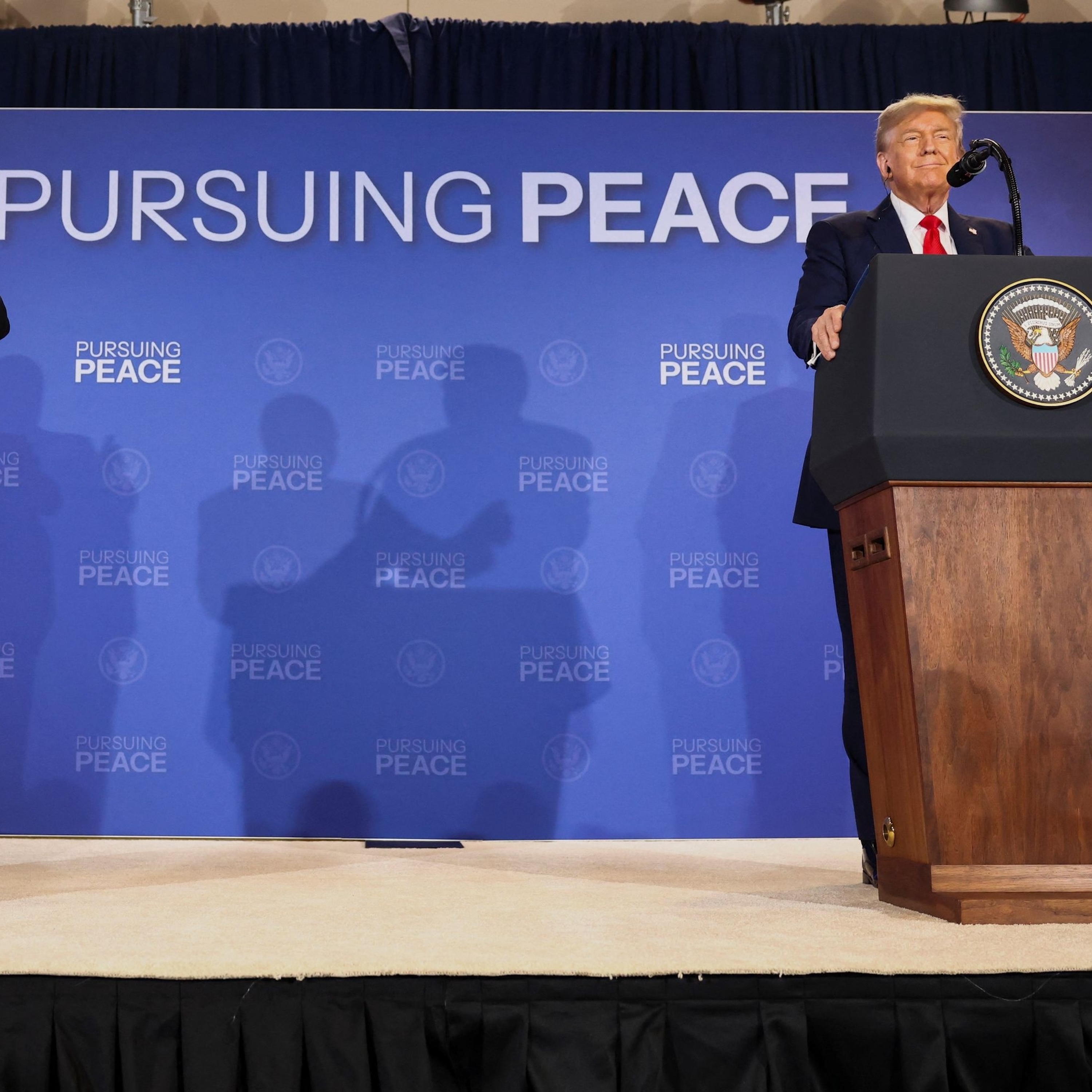
Post Reports
Trump's peacemaking dreams and D.C. pizza party
00:28:59
President Donald Trump claims he’s ending conflicts around the world, despite the prospect of the war continuing in Ukraine. Plus, his pizza party for law enforcement in D.C. and the FBI raids on former Trump national security adviser John Bolton.
Loading summary
Transcript76 lines
- [00:03]
A
We could do the Rose Garden Patio if you want.
- [00:05]
B
What is it about the Rose Garden patio? Is that particularly on your mind?
- [00:08]
A
I got a tour of it this week and heard Trump's playlist as he tested the sound system.
- [00:13]
C
Trump played his music for Cats on the rose Garden and 10 other performances.
- [00:18]
B
What is the playlist? Isn't his playlist mostly the musical Cats?
- [00:22]
A
No. Andrew Lloyd Webber was played. It was some Elvis Presley. The reason we got brought back out there, I think, is we just all of a sudden heard God Bless the USA blasting from that side of the building. And I went back to the Wranglers and said, is there a party happening? And then all of a sudden, they told us to line up at the door and took us out to the Rose Garden.
- [00:46]
B
What's on the playlist?
- [00:47]
A
You are so beautiful. Are you lonesome tonight?
- [00:51]
B
Is there any symbolism in this?
- [00:54]
A
Yeah.
- [01:01]
B
From the newsroom of the Washington Post, this is Post Report's weekly Politics Roundtable. I'm White House reporter Cleve Bootson. I'm feeling in for Colby Itkowicz this week. It's Friday, August 22nd. Today, I'm joined by fellow White House reporter Kat Zakreski. Hey, Kat.
- [01:16]
A
Hey, thanks for having me on, Cleve.
- [01:19]
B
And we're also here with Michael Birnbaum, White House correspondent, covering the Trump presidency and foreign policy. Hey, Michael Cleave, we're all together. I know it's a White House takeover. Today we're going to look at President Donald Trump's hopes to create a legacy as a peacemaker and how that's coming up against the brutal realities of geopolitics. We'll also impact Trump's speech to D.C. police and national Guardsmen last night. And other news from the continuing federal takeover of DC's law enforcement. Michael, you came on Post Reports earlier this week to talk about Trump's recent efforts to try to end the war in Ukraine. He met with Russian President Vladimir Putin last week, and then earlier this week with European leaders and Ukrainian President Volodymyr Zelensky. What does any progress towards peace look like after those meetings?
- [02:10]
C
You know, Cleve, I was kind of sitting back this morning drinking some coffee and thinking about where we are after all these days of diplomacy. Sure. And, you know, we're kind of where we started. This has been an awful lot of kind of heat and light. But we've ended this week where Ukraine and Russia are trading strikes. Russia continues to hit Ukraine pretty hard. And President Trump said something on Thursday that was quite notable. It was blaming Biden for keeping the Ukrainians from striking into Russian territory. And he said, it's awfully hard to win a war when you have essentially one hand tied behind your back. And so where we are today, Friday, versus where we were a week ago, when Kat and I were sitting in Anchorage as Trump and Putin were meeting, I don't know how much progress we've made. It's hard to see movement toward peace. And Trump really wanted to get Zelensky and Putin into a room together, and that sure doesn't seem to be happening anytime soon.
- [03:25]
B
Kat, I wonder if you can opine on that. You've been the pool reporter and the duty reporter following Trump closer than anybody on the White House team this week, and you've written about how he's kind of hitting a wall with negotiations. What kind of setbacks has he been encountering, and what do those look like?
- [03:42]
A
So the big announcements coming out of the meeting on Monday with the European leaders were that we would have this meeting between Putin and Zelensky, and they also were talking about security guarantees for Ukraine that would, in Trump's own words, involve boots on the ground from Germany, France, and other big European countries. And what we've seen play out since then is the Russian government push back strenuously on any of these kinds of terms. Basically, in the days following the meeting with the European leaders, we saw Russian Foreign Minister Sergei Lavrov come out and really just cast doubt that these would be terms that Russia would ever agree to. And so I think it really throws into question what actually has Trump been able to convince both sides of following all these days of splashing meetings?
- [04:37]
B
Michael, do you have a sense of what Trump's relationship with Putin is now? I mean, he's expressed some frustration about stonewalling, about the difficulty that he's had sort of dealing with Putin, who's kind of nice to him in person, but doesn't give him what he needs.
- [04:53]
C
Trump put so much emphasis on personal relationships, and he really literally rolled out the red carpet last week in Alaska, and the bombers, right, and a big fat B2 bomber, and they were joking with each other. There was so much camaraderie between the two men that was clearly on display. And yet here we are a week later. In substance, we haven't made much progress. And I think that there's a gap between Trump's faith that through friendship and personally warm relations with other leaders, he can make progress. And then the simple reality that just because Putin is happy to get feted by Trump on American soil, that's not gonna make him give Trump a peace deal in Ukraine. Russia's interests in Ukraine are unchanged. Ukraine's interests in defending its own territory are pretty fundamentally unchanged. And so whether there is a kind of blowup from Trump toward Putin, you know, kind of remains to be seen. But I think that we're edging toward the limits of what Trump can achieve with this kind of personal diplomacy and.
- [06:14]
A
Just building off of that quickly. Trump himself this week was asked, what's the plan here? How are you doing this? And he talked about how he's relying on his instincts in these negotiations. And when Michael and I have talked to foreign policy experts and people who previously worked in national security for the US Government, they all raise concerns that this style does not work with the Russians. Putin specifically is extremely detail oriented. He knows everything about the battlefield in Ukraine. He has very specific aims that he's going for. And so there's a real concern that this style of diplomacy through vibes does not cut through in that kind of a situation, you know.
- [06:59]
C
But I will say there's the counter argument. I think what Trump would say is that diplomacy through expertise also wasn't working in Ukraine and that this conflict has stretched for years. There is some argument from some analysts and some folks saying that maybe it's not a bad thing to get these leaders into a room and that he is shaking things up, that the conventional way wasn't working either. And so this is worth a throw of the dice.
- [07:27]
B
Can you lean into that a little bit more? Because as I understand it, Trump's peacemaking style varies vastly from the peacemaking styles of previous administrations. How does it differ for the folks that are not as steeped in it as you are, and what are the questions about its effectiveness or lack thereof?
- [07:47]
C
Well, President Trump has gotten rid in large part of expertise in these negotiations. Trump has significantly reduced the role of the State Department in all of this. I mean, the State Department has laid off many of its employees. He's radically shrunk the size of the National Security Council, which is the kind of in House group of the White House that coordinates among, among all the foreign policy arms of any administration. And he's just kind of relying on himself, on his instincts, and on a few close advisors to handle all of these conflicts. The administration increased its count of conflicts that Trump has solved this week, I believe, from six to seven.
- [08:34]
B
Can we talk about those six or possibly seven wars? During his meeting with European leaders on Monday, Trump claimed to have ended six wars. I also heard that number increased to seven. Can you break that down. Michael, for those of us keeping score at home, what is Trump's actual record?
- [08:52]
C
Okay, so I have called up on my screen here the list of conflicts that the White House supplied. Right, Kat?
- [09:01]
A
Yes.
- [09:03]
C
When asked which conflicts he solved, they are Armenia, Azerbaijan, which have been at war with each other in various levels of heat for decades. The Democratic Republic of Congo, and Rwanda, Serbia, Kosovo, which, like, we weren't really aware there was a war and maybe there never was one. Egypt, Ethiopia, which have had conflict over water rights and a dam for a long time, but they haven't actually signed a deal. India, Pakistan. They did get into some, you know, kind of back and forth earlier this year. Thailand, Cambodia, and Israel, Iran. Kat, can you remind me which conflict they added to the list this week?
- [09:47]
A
I am not 100% sure, but I had never before heard them talk about the Serbia, Kosovo conflict in their count. So I think that is the new one that we had not been tracking in this record. I was the one who went to the White House and asked for the full list. I will tell you that even White House officials have trouble coming up with the full list.
- [10:10]
B
What was that conversation like?
- [10:13]
A
So I talked to two White House officials about it first, and they listed a few of the conflicts, but then referred me to another staffer to provide a list. And then that staffer gave me a hard time as a White House reporter who spends a lot of time there for not being able to keep track. They said the headline should be that we're making so much peace that even White House reporters can't keep track of it all.
- [10:36]
B
I'll mention that to the editors, but. But are they. Are they furious claims at best? Does Trump really have an argument, you know, even ending two real wars and four kind of conflicts? You know, what is the meth for that?
- [10:49]
C
So it's complicated. I mean, I think that in most of these cases, these things are being oversold. These are conflicts that either the Trump did have some success in getting opposing leaders into a room with each other, potentially. In the case of India, Pakistan, those are two nuclear countries and long history of tensions between the two of them. There might be some real credit to the Trump administration there for managing and averting that conflict. Pakistan gives him credit. India does not.
- [11:30]
B
Six and a half.
- [11:31]
C
Six and a half. You know, and in the case of Iran, now, that was a fascinating moment. That was in June when Israel was kind of upping its attacks on Iran. And ultimately Trump joined in with a kind of one massive strike, US Strike against Iranian nuclear facilities. That was an unconventional move on his part and something that foreign policy policy experts say that may have worked out more or less okay. But in a number of these other conflicts, they've made some framework agreements, they've made some progress, but it's not quite locked down. People from previous administrations would say Trump is not the first president to care about global stability or ending conflicts. But that often, if you're really immersed in the details, it's hard to find some middle ground between countries or ethnic groups or opposing parties that have deep seated grievances against each other, often legitimate on both sides.
- [12:42]
B
Kat, this may exceed your mandate as a White House reporter, but is this enough to get Trump into heaven? He called into Fox and Friends on Tuesday and talked about stopping the killing in Ukraine is something that will help him get into heaven. Let's take a listen to that.
- [12:59]
D
You know, if I can save 7,000 people a week from being killed, I think that's a pretty. I want to try and get to heaven if possible. I'm hearing I'm not doing well. I hear I'm really at the bottom of the totem pole. But if I can get to heaven, this will be one of the reasons. Well, I think I saved a lot of lives with India.
- [13:17]
B
He seems to be down on himself on his peacemaking efforts here. What do you make of these comments?
- [13:24]
A
Well, on your first question of whether this is going get him into heaven, dive right in. I have been unable, unable to secure an interview with God or St. Peter.
- [13:35]
B
The pearly gates declined, could not immediately be reached.
- [13:39]
A
Run that one down. But it was an interesting moment where Trump, who I think always projects an incredible amount of confidence in himself and what he's doing, seemed to briefly question his own ability to get into heaven. That was a bit surprising as someone who listens to everything he says. And I think that, you know, this was a bit of a surprise that he brought the spiritual motivation into the conversation. Caroline Levitt, who's the White House press secretary, was asked about it and she said that she does think that is a part of it for the president and that she hoped that all of us in the press briefing room also were trying to get into heaven. And that is one of the, you know, I think he's brought it up twice this week now that this is something that is on his mind. So I think when he's talking about this issue of Ukraine, it shows that he does see it as a big part of his legacy. He's also connected his push for peace in Ukraine to his campaign for a Nobel Peace Prize.
- [14:49]
B
One of the things that we do, we cover the daily news, but we also cover sort of the arc of the presidency and the arc of history and all of that stuff. I wonder if you guys have thoughts on whether this represents Trump's efforts to cement his place in history. Yeah, you mentioned the Nobel Prize. To the extent that you can say, is this sort of Trump making a big push on heaven and on earth to say, this is what I stood for and this is how I want to be remembered?
- [15:17]
C
This is a multi front battle for his legacy. And I think that is the case. Cleve. This is a president in his second term. He talks about a third term, but at least for now, he doesn't seem formally to be running.
- [15:33]
B
There's Trump 2028 hats in the gift shop.
- [15:36]
C
He does. And he showed off those Trump 2028 hats to fellow world leaders this week. But I do think that this is about his legacy and thinking about how he's going to be inscribed in the history books and, you know, something that goes beyond just workaday domestic policy, but, you know, really shaping global conflicts and global events. My sense is that a Nobel Peace Prize, which he's raised repeatedly, although he's sometimes skeptical that he'll actually get one, that would be, you know, a kind of gold marker on his legacy, but also, of course, resolving these conflicts, I think that he is thinking about how he's going to be remembered in history and sees this as a ticket to both to the pearly gates and to, you know, good write up later on in some big books.
- [16:31]
B
Okay, enough about who may or may not be getting into heaven. Let's take a quick break there, and when we come back, we'll talk about Trump's continued takeover of the Washington, D.C. police force and his appearance with law enforcement yesterday. We'll be right back.
- [16:58]
E
As summer comes to an end, I'm all about refreshing my wardrobe with staple pieces for the season ahead. And nobody nails it like Quince does. With luxe essentials that feel effortless and look polished but perfect for layering and mixing. Think chic cashmere and cotton sweaters starting at just $40. Washable silk tops and classic denim pants. Timeless styles you'll keep coming back to. And the best part, everything with Quince is half the cost of similar brands. By working directly with top artisans and cutting out the middlemen, Quint gives you luxury without the markup. Quince only works with factories that use safe, ethical, responsible manufacturing practices and premium fabrics and finishes. Elevate your fall wardrobe essentials with quints go to quints.com reports for free shipping on your order and 365 day returns. That's Q-U-I-N-C-E.com reports to get free shipping and 365 day returns. Quints.com reports.
- [18:00]
F
You listen because you know the power of good journalism and the Washington Post is there for you 24 7. When you become a Washington Post subscriber, you get exclusive reporting you can't find anywhere else. You also get sharp advice columns, delicious recipes, TV and music reviews and so much more. Right now, you can get all of that for just $4 every four weeks. That's for an entire year. After that, it's just $12 every four weeks and you can cancel anytime. Add to your knowledge and discover all the Post has to offer. Go to washingtonpost.com subscribe that's washingtonpost.com subscribe.
- [18:48]
B
We've been talking about Trump's mark on the globe, but we're talking here in the Washington post office in D.C. where we're over a week into Trump's military deployment and police takeover of the city. Yesterday afternoon, he visited the US Park Police headquarters in Southeast Washington. He brought pizza and he said this effort had been a great success so.
- [19:09]
D
Far, but the crime numbers are way down. I'm looking at you saw some of the stats. They just read them out to me inside the numbers that we haven't seen here ever, actually, ever.
- [19:21]
B
Kat. He also said he would spruce up parks in D.C. with new grass and a new sprinkler system. What do we know about whether crime is actually going down in response to this takeover?
- [19:32]
A
So what we do know, Cleave, is that prior to this takeover, violent crime in Washington, D.C. was already going down from the levels that it was at in 2023. And the White House has been putting out statistics that show that since this effort, crime is down. I do think that having National Guard troops deployed all over the city and the level of enforcement action we've seen is having an impact day to day. But the question is, what is the long term impact of this on the city? How long will these troops be here? And is it actually changing any of the root causes of violence and crime in Washington, D.C. yeah.
- [20:14]
B
And Republicans and Democrats differ on the best way to address crime. You know, Democrats, especially in D.C. have talked about addressing root causes and getting at the societal ills that lead to crime and other issues, whereas Trump, leading the Republican Party, has said more police, more police, more police. And here's a little bit more police and I wonder if, does Trump win the argument even if he's unable to sustain these crime drops?
- [20:43]
C
I think that both sides here are going to use what's going on to fuel each of their arguments, and Trump will be able to say he's made some impact on crime in D.C. and I think that Democrats and certainly a lot of presidents of Washington are going to say this is something that did not take into account local views, that this is something that was more about publicity than really kind of targeting the big crime problems that Washington does face. And we're like a week and a half into this. I do see more people around in some of the places where I am, but I'm not necessarily inhabiting the parts of Washington that have the deepest problems.
- [21:33]
B
One of the things that I've noticed is that they haven't been entirely transparent about who they're arresting, the types of arrests that they are making. When somebody is arrested, there's usually a police report, and you can link an alleged crime to a person that is in jail or has received a citation. What do you make of that, Kat?
- [21:53]
A
So there's a lot of questions around the transparency of this effort. There's also been instances as the White House has been rolling this out, where they've cited incorrect data about what the state of crime was in D.C. prior to this takeover. And so it really calls into question, can you trust the information that the White House is putting out on this effort? And I think generally, as reporters at the Washington Post, we have a huge Metro team who works very closely on covering what's happening on the ground in D.C. and certainly the way the information is coming out now is very different than it was just a couple weeks ago.
- [22:33]
B
Other White House officials have also been out there making appearances with law enforcement and promoting the takeover. This week, we saw Vice President J.D. vance, Defense Secretary Pete Hegseth, and Deputy Chief of Staff Stephen Miller go to Union Station. I wonder if they got Annie Anne's pretzels there, the big train station in D.C. and they did a media event thanking the national guard for making D.C. safer. But while they were there, there were some protesters yelling, Free D.C. there are people just not happy with what's going down in the city. Is that kind of protest what the Trump administration wants?
- [23:07]
C
I think so. I mean, they are happy to portray Democrats as soft on crime. They're happy to get these kinds of images that they can project outside of Washington to the country saying, look, Democrats are not defending you, they're defending criminals. And that's not really what's happening in Washington. I mean, these are complaints about how this process is being handled. These are complaints about autonomy and who gets to decide and institutions. But I don't think that the administration is complaining when they're getting protested in this way.
- [23:49]
B
There's also an interesting paternalistic vibe that I've picked up on, you know, that the African American residents of D.C. are more likely to be victims of the crime that happens in D.C. and we're protecting them from that crime. But there's also polling that says that the greater majority of people in D.C. don't want this takeover. Can you suss that out for us, Kat?
- [24:15]
A
I would say that one, it was very notable that Trump went to Anacostia yesterday with his meeting with police, a historically Black neighborhood in D.C. where they're trying to send the message that, okay, we're not just focusing on these touristy areas, which was the initial criticism of the effort, but there is this real question of, do people in the community want Trump there? And I think certainly a lot of the displays we've seen, the answer is no. The polling that the Washington Post has done shows the answer is no. But it raises the question of is Trump really doing this for the residents of D.C. or for his own base? Because obviously these images that he is projecting are playing on Fox News and on the channels that his base watches, and they're sending a message that he's tough on crime, which has been part of his political identity since he announced his run again for the presidency. He talked about this issue of crime in cities extensively in his first speech announcing his campaign.
- [25:20]
B
One more thing. One thing just flashed across my screen. We are reporting that former National Security Advisor John Bolton's home has been raided by the FBI. Michael, I know you're in this room here with me, but you talk to him all the time. What do you know about this?
- [25:36]
C
Yeah, that's right. I mean, it's 7:00am Today, Friday, FBI agents raided the home of John Bolton. He lives in Bethesda. He was Trump's National Security advisor during a large stretch of the first term.
- [25:52]
B
So, Michael, how did John Bolton go from being Trump's National Security Advisor to being on Trump's bad side and raided by the FBI.
- [26:03]
C
So there was a time in the first term when Trump and John Bolton were relatively close. Bolton is someone who for decades has been an extremely hawkish Republican foreign policy official. They broke in the first term. They had a lot of disagreements in the end about, among other things, whether to negotiate with the Taliban. Trump ultimately cut Bolton out a lot of the foreign policy discussions in the first term. Bolton wrote a memoir that was quite critical of how Trump handled a lot of foreign policy decisions. He had to submit it for pre clearance about whether he could publish some of the things he was talking about. And a lot of things were denied. There was a big dispute and then ultimately an investigation into whether he had disclosed classified information. And so what seems to be happening today is an extension of that investigation. That's something that didn't continue during Biden's term. And it's a revival of an old dispute.
- [27:13]
A
It certainly is. And it sends a message to people who criticize the president that there could be consequences for that. Right. We've seen this concern since President Trump run, since President Trump won reelection, that he would use the powers of the presidency to punish those who have been critical of him. And we've seen that happen in instances where he's taken action against law firms, for instance, that were involved in litigation that was against him. We've seen, obviously, a number of examples where he's taken action, for instance, against Chris Krebs, who was the cybersecurity official during the first term who, you know, disputed his claims of election fraud. And so certainly this is part of a broader pattern that we're seeing and one that people have been really worried about since Election Day.
- [28:07]
B
All right, so glad you guys were both able to talk about this developing story. We'll leave it there. That's it for today's episode. Thank you, Michael and Kat, Thanks a lot.
- [28:17]
A
Clef, thanks for having me on.
- [28:23]
B
Kat Zakreski is a White House reporter for the Post. Michael Birnbaum is a White House correspondent covering the Trump presidency and foreign policy. But before we go, we have one more important update.
- [28:35]
C
Today's date is Thursday, July 24th. This will be the recording of a proffer agreement of Ghislaine Maxwell.
- [28:47]
B
The Justice Department dropped some news on Friday afternoon. They released transcripts and audio recordings of an interview with Ghislaine Maxwell. She's the imprisoned associate of Jeffrey Epstein. She's currently serving a 20 year prison sentence for sex trafficking. The interview was conducted by Deputy Attorney General Todd Blanche.
- [29:08]
C
Good morning, Ms. Maxwell.
- [29:09]
B
How are you?
- [29:10]
A
Good morning, Mr. Black.
- [29:11]
C
Good.
- [29:12]
B
In the interview, which took place over two days this past July, Maxwell tells the Justice Department she never saw Trump act inappropriately in the Times.
- [29:22]
A
That I was with him. He was a gentleman in all respects.
- [29:25]
B
Days after the interview, Maxwell was transferred to a minimum security prison camp in Texas. For weeks, Trump's base has been calling for the release of more files from the Epstein case. It's important to note this interview was not part of the original cases against Maxwell and Epstein. So far, federal courts have blocked requests to unseal some of those files. This is a fast moving story, and reporters at the Post are scrubbing through the audio and transcript as we record. So check out more updates on washingtonpost.com Today's episode was produced by Arjun Singh and mixed by Sean Cardiff. It was edited by Laura Benshoff. Thanks to Politics editor David Lauder. Our team includes Rena Flores, Ted Muldoon, Ilana Gordon, Ariel Plotnik, Rennie Svirnovsky, Sabi Robinson, Thomas Liu, Emma Talkoff, Peter Bresnin, Colby Itkowicz, Renita Jablonski, Elahe Izadi and Martine Powers. I'm Cleaver Bootson. Have a great weekend.
- [30:50]
G
Think about why you listen to podcasts. It's like having a friend who makes you think or can help you wind down right? Well, the Washington Post has a lot of people you can turn to at any hour. You can read the most important and interesting stories. We can help you cook something delicious, give you advice on a tricky friendship. Rave about a movie or book that you shouldn't miss. When you become a Washington Post subscriber, you have a companion for whatever part of your day needs it most. Get it all for just $4 every four weeks. That's for an entire year. After that, it's just $12 every four weeks. Cancel anytime. Go to washingtonpost.com subscribe that's washingtonpost.com subscribe.