← Post Reports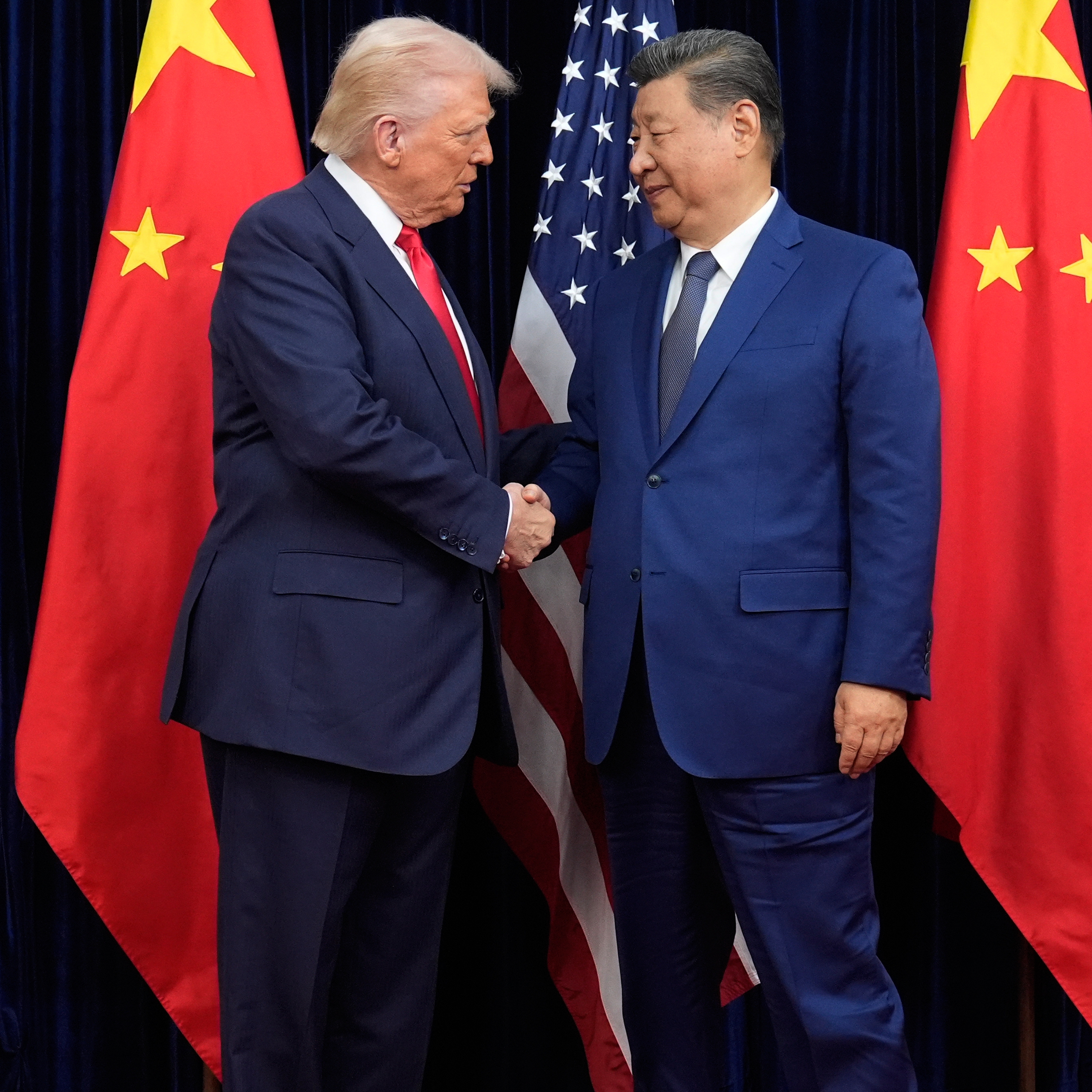
Post Reports
Trump's tariff truce, nuclear test orders, SNAP pain
00:28:00
President Donald Trump and Chinese leader Xi Jinping deescalate their trade war – for now. And the politics of losing food assistance because of the government shutdown.
Loading summary
Transcript107 lines
- [00:01]
A
Foreign leaders have learned after a decade now of dealing with president, former president, and now President Trump, they've learned what he likes. And so the reception was heavy on gold ornamentation. It was heavy on flattery. It was heavy on pomp and circumstance.
- [00:18]
B
Yeah, there were some pretty fancy golf clubs too. I think I saw there were some golf clubs.
- [00:22]
C
The South Korean president literally gave him.
- [00:24]
A
A crown, a replica, we should say replica of the crown worn by a long dead Korean leader.
- [00:31]
B
It makes you wonder what kind of gift you'd get if you were a world leader on the world stage.
- [00:36]
A
I'm biting my tongue, but I was thinking of various whiskey bottles from duty free shops and far flung airports.
- [00:48]
B
From the newsroom of the Washington Post, this is Post Reports weekly Politics Roundtable. Eli I'm Elahe izadi. It's Friday, October 31st. Today we'll dig into President Donald Trump's big trip to Asia and the tariff news to come out of it. And we're going to talk about a big shutdown fight on Capitol Hill this time over food assistance. I'm joined this week by Jacob Bogage, a White House economic policy correspondent for the Post, and David J. Lynch, who covers trade for the Post. Jacob? David, thanks so much for joining me today.
- [01:22]
A
Glad to be here.
- [01:25]
B
So Trump just wrapped up this big trip to Asia this week where he was meeting with leaders from multiple countries, South Korea, Japan. And the meeting I think a lot of people were paying attention to was this meeting with Chinese leader Xi Jinping that happened Thursday morning local time. David, you're the trade expert here. What did Trump need to accomplish on this trip?
- [01:49]
A
Well, I think the president was looking to get some more details nailed down of trade frameworks that had been announced previously, try and flesh those out with some of the smaller countries. But the real action and the event that people were focused on was the meeting with Chinese President Xi. You know, we've been engaged in what the President Trump has called a trade war with China for most of this year and it has resulted in a quite serious decline in two way US China trade. And there were fears that things were beginning to escalate, that it was getting to the point where we'd see very high triple digit tariffs on Chinese goods and that the Chinese were prepared to employ their near monopoly over some very important raw materials that are needed in the production of everything from smartphones to jet fighters. And if they were to go through with that, that could be crippling for US Industry. So this was a time when people wanted to see the President, step back from the brink.
- [02:55]
B
And you know, every time I've talked to you, David, about tariffs, we always need to do this little bit of tariff 101. That is something that is paid upon the import of it into the United States. Correct?
- [03:08]
A
Correct. Tariff is just a fancy word for tax. And in this case, it's a tax on imported goods. And the entity pays, that literally pays the United States government. That tax is the American importer of record. That could be Walmart, that could be a small business. And then it's up to that importer to decide whether they absorb the total cost of that in the final analysis, or whether they try to pass that on to their customers.
- [03:37]
B
So the stakes were pretty high for this trip, particularly this visit with Xi. First of all, how was Trump just received on the world stage by these various leaders? What was your takeaway from that, David?
- [03:51]
A
Well, my takeaway was foreign leaders have learned after a decade now of dealing with President, former president, and now President Trump, they've learned what he likes. And so the reception was heavy on gold ornamentation. It was heavy on flattery. It was heavy on pomp and circumstance.
- [04:10]
B
Yeah, there were some pretty fancy golf clubs too. I think I saw there were some golf clubs.
- [04:14]
C
The South Korean president literally gave him.
- [04:17]
A
A crown, a replica, we should say, a replica of the crown worn by a long dead Korean leader.
- [04:24]
B
It makes you wonder what kind of gift you'd get if you were a world leader on the world stage.
- [04:29]
A
I'm biting my tongue, but I was thinking of various whiskey bottles from duty free shops and far flung airports.
- [04:37]
C
I would say when the South Korean president visited Joe Biden in the White House, the big pomp and circumstance was that he sang the lyrics to American Pie.
- [04:46]
A
Something touched me deep inside the day the music died.
- [04:59]
C
And now Donald Trump has gone to South Korea and gotten a replica crown. So very different, to be clear, with the American Pie song, that was a different South Korean leader. But it gives you a sense of how differently the leadership of that country is treating President Trump versus previous administrations.
- [05:16]
B
Yeah, very different outcomes there, very different gifts. So that's the pageantry of it all. But what was your big takeaway from what ended up happening with the South Korean leader, David? What was at stake and what came out of those talks?
- [05:34]
A
Yeah, I think it was an important meeting for the South Koreans. They were in a position where they were worried about being disadvantaged by the final terms of their trade deal with the United States, disadvantaged against other regional players in East Asia. And what was key for them was they secured a reduction in the tariff on Korean cars being shipped to the United States from 25%, which it had been down to 15%, which was, is, you know, obviously 15 is better than 25 if you're a.
- [06:05]
B
But it ain't zero.
- [06:06]
A
But it ain't zero.
- [06:08]
B
Okay, now let's turn to this meeting with Xi, the Chinese leader. What do we know right now about any terms that were agreed upon by the two sides, US and China?
- [06:21]
A
Yeah, we don't have much paperwork on this yet. So we're going off the statements from President Trump on Air Force One and similar but not identical statement from Chinese officialdom. And what happened is both sides have kind of taken a step back from the worst escalatory measures. So the Chinese have agreed to pause by a year new restrictions that they had proposed on the export of these so called rare earth minerals that I alluded to.
- [06:52]
B
Yeah, that's right. Those are the materials you need for everything from like jet planes to smart.
- [06:56]
A
Exactly, exactly. And these are sort of exotic minerals. They're not rare strictly speaking, but they are called rare earths. And China has a near chokehold on them, particularly in terms of the processing and refining of these materials. Because wherever they're buried, you can't just dig them out of the ground like coal. You have to dig out a lot of rock and then put the rock through an acid wash and sort of leach out the valuable minerals. And separating the good stuff from the worthless rock is environmentally messy. Takes a while. And what you're left with, these, these minerals are absolutely critical for running a modern advanced economy. We can't produce the stuff we need to produce without Chinese inputs.
- [07:44]
B
So China really has like as you said, almost a monopoly on this. So they agreed to pause for a year on restrictions on that. What else did the US get out of this?
- [07:54]
A
Well, that's what we got out. That, that is what.
- [07:57]
B
That is what we got.
- [07:57]
A
Absolutely.
- [07:58]
B
We didn't get anything else?
- [07:59]
A
Well, no, I mean that's, that's, I guess that's big. That's a lot. Okay, think of it this way. If we hadn't gotten that, and these restrictions would have applied to other countries beyond the US but they were quite draconian. And if we hadn't secured relief from that, you know, in the worst case, auto plants would be weeks away from running out of goods. Once these restrictions took effect, we were.
- [08:22]
C
A couple weeks removed from the Treasury Secretary Scott Besant, and the US Trade Representative, Jameson Greer, trying to move to decouple strategically from China absent the removal or Delay of some of these draconian export controls.
- [08:42]
B
They were preparing for a worst case scenario.
- [08:44]
C
Yeah, they were edging toward the brink pretty quickly.
- [08:46]
B
So what did China get in return? What did we give up?
- [08:49]
A
Well, we agreed to reduce some of the tariffs that President Trump had imposed earlier this year. You recall back in March, February and March, he had imposed tariffs on China, also in Canada, Mexico at the time, over his concerns about fentanyl smuggling. Now, that leaves Chinese goods, on average, facing US tariffs of about 47%, which is down from 57%, but still high. How much progress this represents really depends on your point of view. We're in a better situation in terms of being able to trade with China today than we were yesterday. But tariffs on Chinese goods are still much higher than they were a year ago.
- [09:33]
C
You and I spend a lot of time shouting back and forth at each other at our desks upstairs, politely, politely, polite, professional shouting. Yes, of course. About how much tariffs are really a stick against the Chinese government and how much a high tariff rate, 47%, 57%, whatever it is, is a self inflicted wound on the U.S. economy.
- [09:59]
A
Well, and the truth is, I think it's both right, because if we raise, if we, the US Impose a tariff on a foreign product, that's making it more expensive for Americans to buy that product. So that hurts us. I would face a higher cost to get a Chinese smartphone or a piece of industrial circuitry or something from the Chinese. But it also, of course, hurts the Chinese exporter, that company that is trying to sell its products into the United States. So that's why traditional mainstream economists regard this sort of trade war as a bad idea, as reducing economic welfare across the board.
- [10:42]
B
I mean, before we leave, this Asia trip and the China and other deals that Trump is trying to strike with various countries. David, big picture. I know Trump is saying at least his meeting with Xi was great. Scale of 1 to 10, he said on Air Force One, what did he call it, like a 12?
- [11:00]
A
He said it was a 12.
- [11:01]
B
It was a 12. Was it a 12 to you? For the United States, how would you rate this?
- [11:05]
A
Well, I'm sort of growing jaded in my old age, so I would not give it a 12 again. I think the good news is we have stepped back from what could have been a cycle of escalation that would have left both sides worse off. So that's good. But compared to a year ago, tariffs on Chinese goods are much higher, which makes them more expensive. Now, that could be a good thing from the administration standpoint because there is an argument. There are people within the administration, of course, who want to reduce US China trade and have much more of what we consume produced here in the United States. Maybe that's a good thing, but from the perspective of the American consumer, not so much.
- [11:51]
C
We step back from one brink on trade, and this is an entirely different kettle of fish. But we stepped up to another brink on national defense because the president ordered the military to begin testing nuclear weapons again. That is a renewed era of brinksmanship with traditional Cold War adversaries.
- [12:12]
B
Jacob, that's actually a great point, and I want to pick that back up after the break. We'll be right back.
- [12:27]
D
We all have tons of decisions we juggle every day at work and in our businesses. Even us here at the Post Scripts, show artwork, recording schedules. It can get overwhelming, and that's especially true if you're starting a small business. It can be pretty intimidating wearing so many hats and learning everything on the fly. So finding the right tools and partners that not only help you out, but also simplify everything can be such a game changer for millions of businesses. That tool is Shopify. Shopify helps you in so many ways, from building a beautiful online store using their hundreds of templates to helpful AI tools that write product descriptions, page headlines, and even enhance your product photography to help you easily create email and social media campaigns to target your customer wherever they may be. That's why millions of brands like Allbirds and Skims use Shopify to grow their businesses every day. Turn your big business idea into With Shopify on your side, sign up for your $1 per month trial and start selling today at shopify.com reports, go to shopify.com reports shopify.com reports to first responders every second counts. Firefighters, paramedics, law enforcement officers and 911 operators need to communicate instantly. And that's why FirstNet exists. FirstNet is the only network built with and for first responders. It's a unique public private partnership with the FirstNet authority making sure America's first responders always have priority access, whether in the heart of a big city, a rural county or a remote territory. During natural disasters, major storms or large scale events, first responders know they can count on FirstNet to keep them connected even when other networks are congested or unavailable. FirstNet is more than a network, it's a commitment to first responders, a promise that America's public safety always comes first. FirstNet built with AT&T. Learn more@firstnet.com PublicSafety first.
- [14:31]
B
So before we Leave entirely. Trump's trip through Asia. I did want to bring up what Jacob alluded to before the break, and that is this announcement that President Donald Trump made on social media. He posted this on Truth Social, actually, right before his meeting with Xi that he had directed the Pentagon to resume nuclear testing and that this would be, quote, on equal basis with Russia and China. What is your take on about him making this announcement, the timing of it, right before his meeting with Xi?
- [15:02]
A
My sense is that this may not happen. I suspect and don't know. Although in an earlier life, I was a Pentagon correspondent and I covered strategic nuclear affairs. So I'm familiar with the issue. It seems to me, and I'm just inferring from what I've read and seen, that the president may have been reacting to recent reports out of Russia about new military hardware, specifically missiles that the Kremlin has been testing. Now, to be clear, Russia is not testing nuclear bombs. China is not testing nuclear explosions, and the US hasn't tested nuclear explosions in over 30 years. So this is. This is. Would be an incredibly distinctive event, and it would represent a serious change in the US Force posture relative to where we're standing.
- [15:53]
B
I mean, the cynic in me was also just thinking about the timing of the announcement right before this meeting. Was it some kind of, like, playing split level? Yeah, like a point of leverage. I mean, I believe our reporters who were traveling with the President said there's no evidence that the two even spoke about this.
- [16:09]
A
Right. I mean, it. Again, I hate to be cynical, but it could be as simple as the President might have seen something on Fox News while sitting on the tarmac and had just fired off a tweet. Who knows?
- [16:21]
B
Well, and to be clear, that isn't necessarily just cynicism. There is a pattern of that sort of behavior.
- [16:25]
A
That's why I say, and I mean, there's also. Even in the. You know, the President, over the first term and the current term, often says things or tweets things, and then they just.
- [16:36]
C
That never happen.
- [16:37]
A
They just sort of evaporate.
- [16:38]
B
Right, right.
- [16:39]
A
So before, you know, my advice to folks who might be getting nervous about resumption of nuclear testing. David, tell us what to think and do right now. Yes. Well, I have this conversation with my w. Wife every night when I go home. It's like, don't. We got plenty of real things to react to. Let's wait until this becomes real. He has, as Jacob says, or I've forgotten now, who said it doesn't matter.
- [17:00]
B
It belongs to the group now.
- [17:02]
A
He has directed the Pentagon to resume testing on an equal basis. But if everybody else is not testing, then strictly speaking, an equal basis would be to continue not testing.
- [17:13]
B
That's a good point.
- [17:14]
A
So we'll see.
- [17:14]
C
He also ordered the Pentagon to do it and the Department of Energy is the one that's actually responsible for doing it.
- [17:19]
B
So now I want to come back to the United States and I want to turn to this other major economic story. And this is part of the ongoing federal government shutdown. We're now past the four week mark of this shutdown and there is a big pressure point looming, and that is financial assistance for food, the program formerly known as food stamps called SNAP, that is expected to run out starting November 1st. There is a legal battle playing out right now over this. As of Friday morning. We're still watching the developments there. Even if some funding does get restored, it's likely people will still have to wait to get their SNAP dollars, depending on where you live. Jacob, can you just speak to the importance of this program? Like how many people use it?
- [18:04]
C
Yeah, this is an incredibly vital program. We're talking about 42 million people a month. The average benefit for a two person household is something like $300. I mean, it's, this is not a tremendous amount of money. And it is the main way that the most vulnerable people in this country put food on the table.
- [18:25]
B
Sorry, when you say it's not a tremendous amount of money, like how much money are we talking about here? How much is used a month, for instance, for this program?
- [18:31]
C
Yeah. To fund this program for the month of November would be $9.2 billion. We spend as a country per year $7 trillion. So in the grand scheme of things, not a lot of money.
- [18:42]
D
I see.
- [18:43]
B
Yeah, it's like, how can you even imagine like that amount of money? So, Jacob, I do know that Democratic led states, some of them have mounted a legal fight over this. This is ongoing. They sued the Department of Agriculture to try to get some, you know, emergency funds used to cover some of the month of November. Why is this a fight that Democrats are waging right now?
- [19:05]
C
The most interesting part of this to me is that we assume that SNAP has run out of money. There is no money. Benefits can't go out. Snap has $5.5 billion sitting in the bank that they could use and the administration is choosing not to use it.
- [19:21]
B
What is the argument?
- [19:22]
C
The argument is that if there is a national emergency, catastrophe, a hurricane, a wildfire, whatever, and we have to surge money to states where people have literally lost everything we need to have something held in contingency to do that. Now, the last time there was a government shutdown and SNAP almost ran out of money. What did the same Trump administration do to backfill those benefits? It tapped this backup fund, which it is now saying it can't do.
- [19:50]
B
So are they trying to use it as leverage?
- [19:52]
C
Essentially, they won't admit to that. And there is a compelling argument that Hurricane Melissa is a horribly devastating, potentially destructive storm.
- [20:04]
B
Well, destructive in the Caribbean.
- [20:06]
C
Yeah. And if it comes up, you know, the coast of Florida or ends up in the Gulf somewhere, I mean, that could be devastating to Americans and they would have to flood resources there. There are other ways to do that in the federal budget. So are they using it necessarily as leverage? I don't think that is a point they would concede, but that is something that Democrats are arguing and at least in the court of public opinion are doing that rather effectively.
- [20:31]
B
Well, so there's also this other fight that's happening. So that's Democratic led states, but then there's Democrats in Congress and also some Republicans. But Democrats in Congress attempted this week to force a vote in the Senate because the House hasn't been in session for a while to fund snaps. What happened there, Jacob?
- [20:48]
C
This shutdown's been going on. We're almost at the month long period. And the administration has been moving around funds on how to keep different federal workers paid or troops or whoever it is. And Democrats tried to do the same thing on SNAP and on wic, which is the food stamp program for women, infants and children. I think about throwing a single dart at a dartboard. Can we at least agree on this single issue? Can we get funding done on this single issue? And that is failing. Government shutdowns are about political pain.
- [21:25]
B
Well, to force it to end. Right, right.
- [21:27]
C
To force government shutdown to end. They're about political pain. And this is a leverage point that if you take SNAP off the table, if you take that issue off the table, there is far less incentive to come to a deal.
- [21:42]
A
I find the political pain element of this interesting because to my mind, there's sort of an artificial or almost phony nature to government shutdowns, right?
- [21:52]
C
Oh, they're entirely phony.
- [21:54]
A
If the government truly shut. If we said, okay, sorry, folks, the federal government is just out of business for the moment. If there were no air traffic controllers, if they were all just at home, no planes flying, if the military stood down, our borders were naked and undefended, if every government, if the post office stopped working, Social Security, I Think that the way these shutdowns are massaged and managed, where a president is able to sort of cherry pick and find pots of money to fund the troops and to fund favored initiatives, masks and minimizes the true extent and allows people out in the country to feel like, ah, what difference does it make anyway? You know, a bunch of lazy government workers are not doing anything anyway. I haven't seen any effect on my life. Well, if there were no air traffic controllers, it would be, you know, you'd be feeling it. Nobody would be flying to go home for Thanksgiving. And that would make real political pain.
- [22:53]
B
Well, and that's an interesting point you're bringing up because I do think this is one of the first. If this does happen, you know, people stop getting SNAP benefits throughout the country. Red states, blue states, rural communities, urban centers, there are gonna be people who are gonna feel that pain. Absolutely right. And so the question is like this coming up on Capitol Hill as a political fight in this moment, I also find fascinating because you also have Republicans. There are Republican senators. Republican senator from Missouri, Josh Hawley has a bill, he's got some Republican co sponsors, and he wants to fund SNAP and get SNAP funded too. So what do you make of this bipartisan concern there?
- [23:33]
C
I wouldn't necessarily think about it as bipartisan concern. I would think about it as a fissure in the Republican conference because Josh Hawley represents this ascendant MAGA America first wing of the Republican Party, this very populist wanting to be the party of the working class. Family policy means more than, like, you know, what's on late night television. It means encouraging people to have more children. I mean, like, that kind of like.
- [24:03]
B
The culture piece of it.
- [24:04]
C
The culture piece of it. And there is overlap there with the Democratic Party. And so if they can forge a common alliance over an issue like SNAP or. Josh Hawley's been outspoken as well on Affordable Care act credit, which is, we should say, which is the animating issue of this government shutdown. So I wouldn't necessarily think about it as a moment of bipartisanship, but as a fissure within the conservative movement.
- [24:31]
B
Well, and it also sort of creates this schism at a moment when they're trying to. Both sides are trying to present a united front in this big shutdown fight. David, how much is this government shutdown costing the U.S. economy?
- [24:45]
A
Well, CBO, the congressional budget Office nonpartisan scorekeeper up on the Hill, came out with a report this week and said the cost will be up to $14 billion. Now, that sounds like a lot of money, but in fact, it's not much money at all. I mean, we have a $30 trillion economy, so losing 14 billion, if that's what actually happens. Honestly, these numbers are tossed around because they're big numbers. And so they, they might get the voters attention. And a normal person would say $14 billion, oh, my God, we're wasting that. Just because you guys up on the Hill can't agree to something that sounds like a lot, but I don't think it'll move the needle. That said, I do think if we step back from sort of the political maneuvering and score settling that's going on in this episode, you know, this is no way to run a government. And my guess is the people on both sides of the aisle know that would admit to it. But to me, this is an example of how the, the governing system is breaking down.
- [25:49]
B
Before we go, I did want to touch on a few big elections happening next week. It is 2025, I know, but there are big elections happening this year. It's an off year. There's governor's races in Virginia and New Jersey, and obviously there's the New York City mayoral race. There's a lot of attention there where the Democratic candidate, Zohran Mamdani, he's poised to win right now. That's what the polling is indicating. And he's a Democratic socialist. So a lot of people are paying attention to that race week. We'll have a whole episode digging into some of these races and the results and the takeaways. But I'm curious from both of you how you're going to be watching these races. Should we be reading these as a referendum on Trump and national Democratic politics?
- [26:34]
A
Well, I think inevitably that's how they're going to be seen. If the Democrats win the gubernatorial races in Virginia and New Jersey and do so by comfortable margins, that will be taken to suggest that people have turned on President Trump and his agenda. If the Republicans are fortunate enough to capture an upset in one or both of those states, that would no doubt be seen as an endorsement of the president's approach to quite controversial issues. Immigration, trade, the deployment of the National Guard in multiple cities, et cetera. So there are, there are high stakes, and I think it's inevitable it'll be interpreted through a Trump lens.
- [27:14]
C
These two states are important for a couple of reasons. Virginia, Dave mentioned margins, and that's what I'm paying attention to. In Virginia, the Republican candidate, Winsome Earl Sears and Republicans elected Republicans. Republican operatives will say this privately. They're not necessarily proud of the candidate quality there. If she is able to keep it close with Democrat Abigail Spanberger, who is relatively popular, that is a major red flag for Democrats in New Jersey. That state ran a lot closer than anyone expected in the 2024 presidential. Again, Mickey Sherrill in New Jersey, the Democrat is a relatively moderate figure with decent favorability scores. If Jack Schiattarelli, the Republican, is able to run closer there, and I think an upset's more likely in New Jersey than Virginia. If that were to happen, again, a major red flag. The Democratic Party's standing is not great right now, which is an understatement. These have a better chance of being canary in the coal mine elections for Democrats as a referendum on the state of the party than perhaps a referendum on the Trump administration.
- [28:36]
B
I see.
- [28:36]
E
Yeah.
- [28:37]
B
And New York is its own thing.
- [28:39]
C
Is it's own thing. I'm not touching that.
- [28:43]
B
Well, before I let both of you go, I do have to ask you, what are you gonna be for Halloween this year? It's Halloween.
- [28:48]
C
David J. Lynch.
- [28:51]
B
You should dress up as Jacob.
- [28:54]
A
No comment.
- [28:56]
B
Jacob. David, thank you so much for joining me this week. This has been a pleasure.
- [29:00]
A
Thanks for having us.
- [29:01]
C
Thanks very much.
- [29:04]
B
Jacob Bogage is an economics reporter for the Post. David J. Lynch is a financial writer for the Post. That's it for Post Reports. If you want to watch this episode, you can because we filmed it. You can find it at the Washington Post podcast's YouTube channel. We'll also put a link to that in our show notes. Today's episode was produced by Laura Benshoff and Josh Carroll. It was mixed by Sean Carter. It was edited by Rena Flores. Thanks also to our politics editors. Our team also includes Ted Muldoon, Alana Gordon, Ariel Plotnick, Rennie Srinovsky, Sabi Robinson, Emma Talkoff, Peter Bresnan, Zoe Cummings, Renita Jablonski, Colby Ikowicz and Martine Powers. I'm Elahe Izadi. Have a great weekend.
- [30:05]
E
You listen because you know the power of good journalism and the Washington Post is there for you 24 7. When you become a Washington Post subscriber, you get exc exclusive reporting you can't find anywhere else. You also get sharp advice, columns, delicious recipes, TV and music reviews and so much more. Right now, you can get all of that for just $4 every four weeks. That's for an entire year. After that, it's just $12 every four weeks. And you can cancel anytime. Add to your knowledge and discover all the Post has to offer. Go to Washingtonpost Com Subscribe. That's washingtonpost. Com. Subscribe.