← Post Reports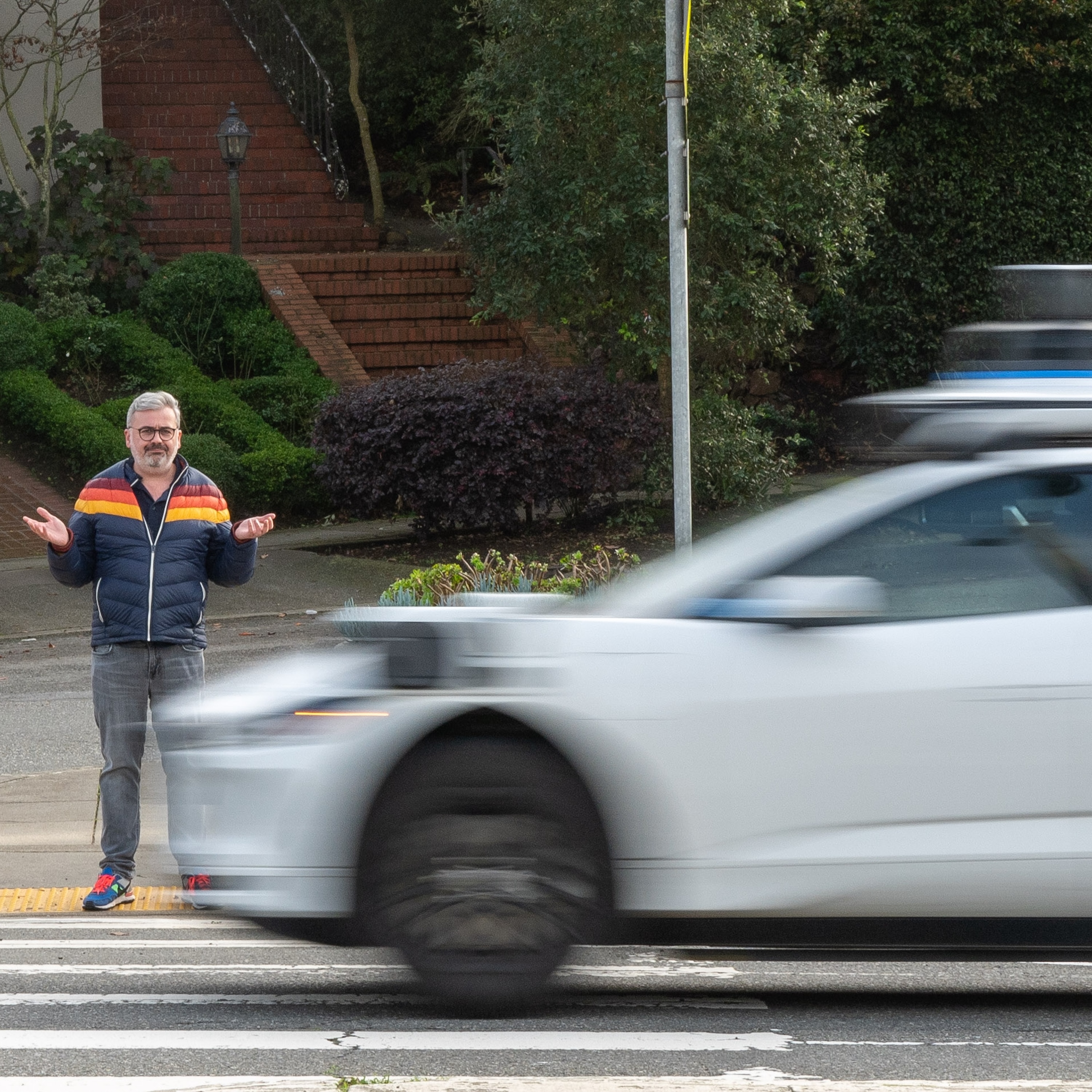
Post Reports
What to know before getting into a driverless taxi
00:26:01
As robotaxis roll out in more cities across the U.S., here’s what to know about how safe driverless vehicles actually are and what it's like to share the roads with them.
Loading summary
Transcript98 lines
- [00:02]
Martine Powers
In San Francisco earlier this year, tech columnist Jeff Fowler and tech reporter Lisa Bonos commuted to work in a pretty unusual way.
- [00:12]
Jeff Fowler
All right, so time to call our Waymo. I'm gonna pull up the Waymo app here.
- [00:17]
Lisa Bonos
What you're hearing is Jeff summoning a car to pick up him and Lisa. In this case, a driverless car.
- [00:24]
Jeff Fowler
Says it's almost at pickup here in.
- [00:26]
Unnamed Speaker
The app, and the car will wait for two minutes. Oh, here it is.
- [00:29]
Jeff Fowler
It's approaching. It's on the wrong side of the.
- [00:32]
Unnamed Speaker
And now it's parking in a to bus zone.
- [00:35]
Jeff Fowler
Yep.
- [00:37]
Lisa Bonos
Since last June, Waymo's driverless cars have been available to anyone who wants to take a ride around San Francisco. Waymo is owned by Alphabet, the same parent company as Google, and their cars have become a familiar sight in the city.
- [00:52]
Jeff Fowler
All right, let's get in.
- [00:53]
Unnamed Speaker
The handles have popped open for us.
- [00:57]
Jeff Fowler
It greeted me with a hey, Jeffrey. And then there's this, like, chill spa music. Let's just, like, listen to it for a moment. Get in the right head space to be driven around by a robot.
- [01:11]
Unnamed Speaker
All right, all right, you ready?
- [01:13]
Jeff Fowler
Okay, Lisa, press the start ride button.
- [01:17]
Unnamed Speaker
Door is just locked.
- [01:18]
Jeff Fowler
Heading to 490 Yost Avenue. This steering wheel is moving on its own. And there's a little sign on the steering wheel that says, do not touch me.
- [01:27]
Unnamed Speaker
Please keep your hands off the wheel.
- [01:34]
Martine Powers
The idea of a car that drives itself might feel futuristic, but for an increasing number of Americans, that future is already here. Waymo and other companies have announced plans to operate in more cities across the US and the Trump administration has signaled.
- [01:51]
Lisa Bonos
That it wants to pave the way.
- [01:52]
Martine Powers
For autonomous vehicle companies to expand. Last month, it loosened rules around driverless cars.
- [01:59]
Unnamed Speaker
Waymo vehicles are currently taking commercial passengers in San Francisco, Los Angeles, Phoenix, and Austin, and they're launching later this year in Atlanta. And in 2026, the plan is to start in Miami. There's also another company, Zoox, which is a subsidiary of Amazon that plans to launch in Las Vegas and San Francisco this year. I should mention that Amazon founder Jeff Bezos owns the Washington Post, and Elon.
- [02:28]
Jeff Fowler
Musk has promised that by the summer, Tesla's going to be operating robo taxis in Austin, Texas. And to be clear, we don't know how real any of these timelines are, but the takeaway from all of this is that this isn't just a weird San Francisco techy la la land kind of thing anymore. So get ready. Buckle up.
- [02:50]
Martine Powers
From the newsroom of the Washington Post, this is Post reports. It's Tuesday May 13th. I'm Martine Powers, popping back in to share this fun conversation that I had with Jeff and Lisa. Jeff and Lisa told me about what it's been like to live in a city full of driverless cars. And this turned out to be really relevant to my life because this spring Waymo announced plans to start offering driverless taxi rides next year in D.C. where I live. Lisa started by explaining the kind of sci fi promise of these vehicles.
- [03:25]
Unnamed Speaker
Waymo has been testing their self driving vehicles on San Francisco's streets for years. First with safety drivers and now with no human behind the wheel. You look around, you see them everywhere. Waymo says they have about 300 cars on the road in San Francisco and they recently started offering rides in Silicon Valley to some San Francisco residents. This is really cool. Many people take Waymo's any chance they get, and Waymo says they're on a mission to be the world's most trusted driver. They want to reduce traffic fatalities and they point out a robot isn't going to drive drunk or distracted. But when I speak to safety experts and ordinary riders, they often say that there are issues with robot taxis that could be as dangerous as a driver who's drunk or distracted.
- [04:12]
Lisa Bonos
Well, I think that speaks to a question that I'm interested in diving into, which is about the safety of these robotic taxis. What does the data say about how safe these robotic taxis actually are?
- [04:24]
Jeff Fowler
The argument is that robot drivers are going to be better than human drivers. But I think it really comes down to some nuance in what we mean by the word safe. Do we mean not killing people because robot cars have killed people. There was a very sad incident that happened a couple years ago in the Phoenix area where an Uber self driving car killed someone. Or do we mean having fewer road accidents that have to be reported to the police? Do we mean like people feeling safer to walk the streets or to like be inside one? If we look at the data, Waymo says that as of last fall, its cars have about 60% fewer police reported crashes compared to a human driving the same distance in the cities where it's available.
- [05:21]
Lisa Bonos
What does that mean?
- [05:22]
Jeff Fowler
That means that if you were comparing apples to apples, the Waymos are a little bit safer. However, it's really tough to compare apples to apples on this. In San Francisco, where we've had Waymos for a while now, operating commercially, they're still not operating for regular passengers like Lisa and I on highways. So when you enter the highway situation, you're going at a much higher speed. That changes the dynamic so the signs are good that they're going to have fewer accidents, but they are not accident free. They are not perfect. They have struck a bicyclist in San Francisco. And there are all kinds of concerns that come from sharing a road with a robot taxi. But I don't want to sort of diminish the fact that, yes, it is entirely possible and the data is suggesting that having more robot taxis on the road could decrease the number of accidents.
- [06:20]
Lisa Bonos
Yeah, because, I mean, you mentioned that there was a fatality a few years ago, and, you know, the person who was struck by a taxi on a bike. I think the argument against that would be like, a lot of people are hit by cars when they're on bikes, and a lot of people die in road accidents with cars that have drivers. But you were talking about how there are these incidents that come up in which there are questions about how these driverless taxis are navigating the roads or where problems become apparent. And I'm curious, what are some of the other unintended consequences that you all have encountered in terms of how these driverless taxis are in some ways creating safety issues?
- [06:58]
Unnamed Speaker
Yes. So, you know, similar to Jeff, you know, when I speak to people who've been Waymo passengers, they generally express that their rides have gone smoothly and that they feel safe. But there are these rare instances where passengers say that they've experienced harassment or threats to their safety from people outside their vehicles.
- [07:18]
Lisa Bonos
Wait, really? Yes, that's so, because I feel like harassment comes to mind where I'm like, oh, you know, maybe one of the benefits is that you don't have to deal with like a weird driver who's saying stuff to you or whatever, but that the harassment is still happening. It's just not happening inside the car.
- [07:32]
Unnamed Speaker
Yes. So I spoke to four Waymo passengers, three of them women, who said they experienced harassment or what felt like threats to their safety from people who followed, obstructed, or attempted to enter the driverless vehicle in which they were writing. All of these writers said that their experiences with Waymo had generally been positive, but that the company should improve on how it responds to threats to writers, personal safety.
- [07:57]
Lisa Bonos
Wait, so in those cases, when that's happening, I mean, what is your sense from those conversations of why they're being targeted? Like, is it just people who are seeing this weird looking car and saying, like, oh, let's do weird things that the people riding in this weird car.
- [08:14]
Unnamed Speaker
So one of the things about these vehicles is that people that are in a city where there are autonomous vehicles they know that the vehicles are programmed not to run them over. So you could stand in front of a Waymo and it would not, it would not run you over, it would not keep going. Which means that you have a captive audience to pester a writer for their phone number or tell them they look hot or try to enter the vehicle.
- [08:38]
Lisa Bonos
Wow. That's both fascinating and deeply depressing in terms of how even if there's an opportunity to solve one problem about harassment, it just creates another problem. What did Waymo say about that and how they're addressing that category of things that happen?
- [08:53]
Unnamed Speaker
So in response to those incidents, Waymo spokesman Ethan Teicher said that we take these events very seriously and understand how upsetting they can be. He also said that incidents of harassment or attempts to enter one of the company's vehicles during a ride are, quote, extremely rare.
- [09:12]
Lisa Bonos
I'm curious what else you guys have heard from some of these riders about what they've experienced.
- [09:17]
Jeff Fowler
Waymos sometimes just do weird things. They will drive into a construction zone where there is wet cement and park on it. They will ignore humans who are, you know, directing traffic and go through construction areas or other kind of like dangerous areas. As much as you can try to make software that can deal with any situation, there are so many situations that are on the road and there are enough of these that the National Highway Traffic Safety Administration has opened an investigation into Waymo and had, I think, a couple of dozen examples that had been documented on social media and in local news reports.
- [10:04]
Unnamed Speaker
That is a Waymo self driving car stalled out in the intersection of 3rd and Howard on Sunday around 3pm in this shot, it looks like traffic enforcement is talking to someone inside, but there's no one there.
- [10:17]
Crews on scene saw multiple Waymo autonomous vehicles driving straight through this at full speed, ignoring public works vehicles trying to block this area off. San Francisco.
- [10:29]
In 2024, according to data from San Francisco Metropolitan Transit Authority and the Los Angeles Department of Transportation, Waymos received combined over 650 parking tickets in San Francisco and Los Angeles.
- [10:45]
Lisa Bonos
Wow.
- [10:46]
Unnamed Speaker
And the most common reasons that they got these tickets were for parking in areas that were designated for street cleaning, obstructing traffic or double parking.
- [10:57]
Jeff Fowler
So when Lisa told me about this reporting of hers, it was kind of funny at first and then it got kind of a little bit unsettling for me. At the base of the promise of Waymos and of all self driving cars is that their software is programmed to always obey the law. Right. One of the basic elements of obeying the law is obeying parking and not blocking traffic. And if it's like, getting that many tickets, like, how is this software deciding to break the law that often? And, like, what controls really are in place on areas where the law is really clear? I mean, it's like you can or cannot park in this place. The law could not be clearer. And it shows that, again, this notion of, like, what is safe? There's a lot of gray zone in that question of what is safe.
- [11:44]
Martine Powers
Yeah.
- [11:45]
Jeff Fowler
And that's what we experience living in a city now filled with these vehicles.
- [11:52]
Lisa Bonos
After the break, what laws are in place to make sure driverless cars are safe to be on the roads? There might be fewer than you think.
- [12:01]
Martine Powers
We'll be right back.
- [12:09]
Cleve Wootson
My name is Cleve Wootson. I'm a White House reporter for the Washington Post. In addition to generally breaking news about whatever the president and the administration are doing, I also write about the impact of policies and politics across the country. I think a lot of Washington reporting is based on the most powerful people, but the impacts of all of that stuff happens to people that grew up very similar to the way that I grew up. We grew up lower middle class a lot of our lives, you know, whether it be free lunch or public housing or whatever was impacted by decisions that are made in Washington. So if people just have more insight into how all of this stuff is working, it's a good day for me. Subscribers support this work and the people behind it. Learn more@washingtonpost.com subscribe I'm Cleve Wootson, and I'm one of the people behind the Post.
- [13:11]
Molly Roberts
I'm Molly Roberts.
- [13:12]
Drew Goins
And I'm Drew Goins. Each Friday on Impromptu, we talk through the questions we can't stop thinking about.
- [13:18]
Molly Roberts
Do we need to rethink how much we drink?
- [13:20]
Drew Goins
Why are companies really asking workers to come back to the office?
- [13:23]
Molly Roberts
Does boycotting a business actually work?
- [13:24]
Drew Goins
Should we quit social media?
- [13:26]
Jeff Fowler
Media?
- [13:26]
Molly Roberts
We're here when the news gets personal and the headlines hit home.
- [13:30]
Drew Goins
Join Molly and me every Friday on Impromptu from Washington Post Opinions.
- [13:34]
Molly Roberts
Find impromptu wherever you get your podcasts.
- [13:41]
Lisa Bonos
What you're describing, I think really squares with my understanding, or at least my assumption around how these cars are supposed to work and why they are. The argument is ultimately safer because they, you know, yes, maybe they'll drive a little slow, maybe they'll be cautious and approaching, but that it's always gonna err on the side of safety. Or as you said, that it's programmed not to. Like, if there's someone standing in front of the car, like, there's no way that it's going to hit that person standing in front of the car. But it sounds like what you have been documenting complicates that picture quite a bit, that it's not always like, doing the safe thing in the moment.
- [14:17]
Unnamed Speaker
Well, also, you know, safety can vary based on the situation or condition you're in. Right. There's not always a rule written for everything. Like when we were riding the other day and it was raining, we were techn. Technically going the speed limit, but it was raining so hard that I thought if I was driving, I'd be going five miles an hour slower than this.
- [14:35]
Lisa Bonos
How interesting.
- [14:36]
Jeff Fowler
And let me tell you, Martin, a little story. So I live in San Francisco next to a big street that gets a lot of Waymos on it. I've counted, and I can get like one or two dozen waymos per hour going down the street during rush hour. And I happen to have to cross this street every time I want to, like, commute to work. And I started to notice when I would step into the marked crosswalk on this street that a Waymo would be coming down and it wouldn't stop for me in the crosswalk. And I tried to remember back to my, like, driver ed training when I was like, wait a minute, isn't the law that if there's a pedestrian in the crosswalk, you're supposed to stop?
- [15:16]
Lisa Bonos
Yeah. You have the right of way.
- [15:17]
Jeff Fowler
You 100% have the right of way. And the law is pretty clear about this. But I noticed that the Waymos wouldn't consistently stop for me. Sometimes they would, sometimes they wouldn't. Now, again, going back to your earlier point about safety, a lot of human drivers do not stop for me in that intersection, in that crosswalk either.
- [15:32]
Lisa Bonos
Yeah, I can imagine.
- [15:33]
Jeff Fowler
But at least I can look them in the eyes. But with the Waymo, there's no one to look at.
- [15:37]
Lisa Bonos
Yeah.
- [15:38]
Jeff Fowler
So here's what I did. I started getting my phone out and recording myself crossing the street. And I recorded probably 20 different times that a Waymo blew right past me when I was fully in the intersection. And then I took these videos to Waymo and I said, hey, wait a minute. I thought you guys were programmed to always obey the law. Pretty clear that pedestrians have the right of way here. And they looked at it, they said, thank you for the feedback. And they said, we are designed to obey the law, but we have room for improvement when it comes to the complicated interactions with humans on the street. So in other words, they didn't admit any legal liability, but, like, to Me, it was a reminder that driving is this very complicated thing. There's rules, but there's also social interaction, and there's a social intelligence that is involved in figuring out, you know, how to navigate around other cars, how to navigate around other, what they call vulnerable road users. That's pedestrians, bicyclists, and whatnot. And the robots just haven't mastered that.
- [16:43]
Lisa Bonos
You mentioned some of these other reports that have also come out about Waymo cars violating, you know, traffic rules or getting parking violations. What did they say about those incidents and about the other scenarios where Waymo cars were, in some cases, violating the law?
- [17:02]
Unnamed Speaker
So Waymo spokesman Ethan Teicher told me in an email that safety is the company's highest priority. He also added that Waymo's cars are designed to take the safest possible action during those first few minutes where they're picking up or dropping off riders, which is when many of these parking citations occurred. He said that the vehicles can detect if they're blocking traffic and recognize appropriate parking spaces, but they might briefly pull over in a loading zone to drop off a rider. He also said that Waymo is refining its ability to better avoid parking citations and specified that the company pays all the tickets it receives.
- [17:42]
Jeff Fowler
Waymo has participated in these investigations by the National Highway Traffic Safety Administration, or nhtsa, and others on the local level. And they've been partnering up with community organizations that might normally complain about the behavior of cars to make themselves seem friendly and futuristic. Which is, I. I guess a way to say that they're kind of leaning back onto this notion of, but, hey, we're better than human drivers overall, so put up with our foibles.
- [18:08]
Lisa Bonos
Interesting. So let's talk about the regulation and the oversight here. I mean, you mentioned that nhtsa, the National Highway Traffic Safety Administration, always a mouthful to say that they, in some cases, have been investigating some of these driverless taxis. But, like, what are the laws around whether or not they can operate? And, like, what system is in place to make sure that when they are operating, they're safe? I mean, what's determining whether these cars are on the road in places that we might encounter them?
- [18:39]
Jeff Fowler
Martine, can I tell you a crazy fact?
- [18:41]
Lisa Bonos
Please.
- [18:42]
Jeff Fowler
Police cannot ticket a Waymo in San Francisco.
- [18:45]
Lisa Bonos
Wait, what? But you just said that they were getting parking tickets.
- [18:49]
Unnamed Speaker
Yeah, that's the only kind of citation they can give. They can't give a moving violation.
- [18:53]
Martine Powers
Wait, seriously?
- [18:54]
Jeff Fowler
Seriously? I learned this because when I was trying to investigate why way MOS wouldn't stop for me when I was crossing the Street. I reached out to the San Francisco police. I was like, hey, I want to report, report a violation. And they didn't even respond to me. There was in fact, a bill that the California legislature passed last year. Originally, it would have given the police the right to give a ticket to autonomous vehicles for moving violations. But it got weirdly watered down in the end. So starting next summer, all they can do is issue what's called a notice of non compliance to self driving car companies. But it doesn't carry any real teeth.
- [19:28]
Lisa Bonos
Oh my gosh.
- [19:29]
Jeff Fowler
The point of all of this is to say, like, if you're a consumer or you're a pedestrian and you're worried about this sort of stuff, there's maybe not as much oversight as you would think.
- [19:39]
Unnamed Speaker
You can submit a complaint to the DMV in your state if you see something awry. And I have looked at those complaints. A lot of these regulatory decisions are made at the state or federal level. And Elon Musk has said that he wants to loosen the requirements for getting more autonomous vehicles on the road.
- [19:59]
Jeff Fowler
Yeah. So if anything, oversight's going to probably decrease in the next four years.
- [20:04]
Lisa Bonos
Well, you know, speaking of Elon Musk and his role in the federal government right now, I mean, clearly he has the ability, or at least there's an expectation that he has the ability to influence some of these policies at a larger level. But what's the eventual goal here? I mean, are these companies ultimately looking to replace every taxi or person driven Uber or Lyft or what have you in America with driverless taxis?
- [20:32]
Jeff Fowler
I think Waymo, which is owned by Google and started out as one of their experiments, is very much invested and is spending a lot of money to try to figure out can we turn this into a profitable business. And we don't have much of an indication they've really been able to do that yet. But I think they really want to see, like, can driverless cars replace Uber in the future? So, yes, replace many of those human drivers. And for Tesla, I think the ambitions are even broader. Elon Musk leans heavily into the idea that these cars are all safer when they're driven by robots. And that will make the world a safer place by taking robot vehicles where we need to go. I mean, I will say definitely in Silicon Valley, there's an almost religious belief that driving in the future will be done mostly by robots and occasionally by people who want to do it for sport because they really like driving, but it's mostly going to be robots.
- [21:31]
Lisa Bonos
And having reported on this, having had all these personal experiences of being in driverless taxis and being around driverless taxis. How has that left you feeling about what it means to share a city with these cars?
- [21:47]
Unnamed Speaker
Really torn. Hmm. I mean, it took me a long time to want to get in one. I think I was probably among the later group of my colleagues here in San Francisco who had ridden a Waymox. And I will say, honestly, the best part about it for me as a writer is not having to talk to anyone. Sometimes I have a busy day. I'm going from place to place to that man. I just want to sit in quiet for five to 15 minutes. And so I will tend to choose to ride no Waymo if it's been a long day, if it's late at night and I just don't want to talk to anyone, and if I have a long ride, that's coming up for me.
- [22:29]
Jeff Fowler
When they first opened up Waymo, I loved taking them. I would take them all over the place. I was a big fan.
- [22:36]
Lisa Bonos
You have strong early adopter energy, Jeff.
- [22:38]
Jeff Fowler
Right. Well, that's kind of part of my job, right? Like I'm the guy who's supposed to live in a future that hasn't quite arrived for everybody else yet. But here's the thing. I started to realize that like so many other artificial intelligence technologies that have become a part of our lives in the last year or two, there's this problem where when it first arrives, we're kind of wowed by it, and it really makes us ignore the shortcomings or forget that it's not as smart as a real human. And my experiment with trying to cross the street near my house really taught me in a big way that, wait a minute, these things are pretty far away from having a human level social intelligence when it comes to driving. And that gave me a lot of pause. I know that for us to get the benefit of computers that can drive more safely than humans, these things need to be tested. And they need to be tested in the real world. And they're only going to get better by being in all of these different kinds of situations and learning from them. That said, the residents of San Francisco and now LA and Phoenix and soon Atlanta did not all agree to be experimented on. And that is exactly what is happening. Right. Like it or not, we are sharing the streets with a giant Google experiment that has mostly not hurt anyone. But is that an okay thing to do to the citizens of that city? I don't know.
- [24:05]
Unnamed Speaker
You know, when I speak to people who've worked in transit in San Francisco. They point out that safety is not a binary. An individual in a car could be safe in the ride that they are taking, but that car's actions affects everybody else on the road. And so when these cars stop on busy roads to let people out or pick people up, that still has an effect on everyone driving and moving through a city. You know, when I read complaints that people have submitted to the California and Texas departments of Motor Vehicles, I hear a lot of people being upset that they have not chosen for their city streets to have these robot cars on them. And while there is some fascination, there's also a lot of concern and fear about what might happen on the road. I would say in the cities where waymos have rolled out, there is this mix of fascination and fear in equal parts and also anger at those who see these robot cars as potentially taking over jobs they might have or just taking a piece of humanity off the roads because you can't look in a driver's eye and say, hey, I'm crossing the street here. You just have to trust that the robot sees you.
- [25:29]
Lisa Bonos
Lisa and Jeff, thank you so much for sharing all this reporting.
- [25:33]
Jeff Fowler
You bet.
- [25:33]
Unnamed Speaker
Thanks for having us.
- [25:36]
Lisa Bonos
Jeff Fowler and Lisa Bonos, cover technology for the Post.
- [25:43]
Martine Powers
And one more thing before we go. We are working on an episode with our books team about summer reads. So if you're looking for a good book for the summer, record a voice memo with your name and what you're looking for and send it to us. We'll try to give you a recommendation and we might even play your voice memo on the show. Our email is postreportsohpost.com we look forward to hearing from you. That's it for Post reports. Thanks for listening. Today's show was produced by Emma Talkoff. It was edited by Lucy Perkins and mixed by Sam Baer. I'm Martine Powers. We'll be back tomorrow with more stories from the Washington Post.
- [26:33]
J
Make your Memorial Day weekend joyfully chill with a cool, creamy sensation of My Mochi ice cream. My Mochi is perfectly portioned scoops of premium ice cream wrapped in sweet soft dough. It comes in all your favorite flavors like strawberry, mango cookies and cream and amazing new flavors like lemon cheesecake. My Mochi ice cream is gluten free and only around 70 calories per piece. Look for the purple box of Mymochi at walmart or visit mymochi.com to find a store near you.