← Post Reports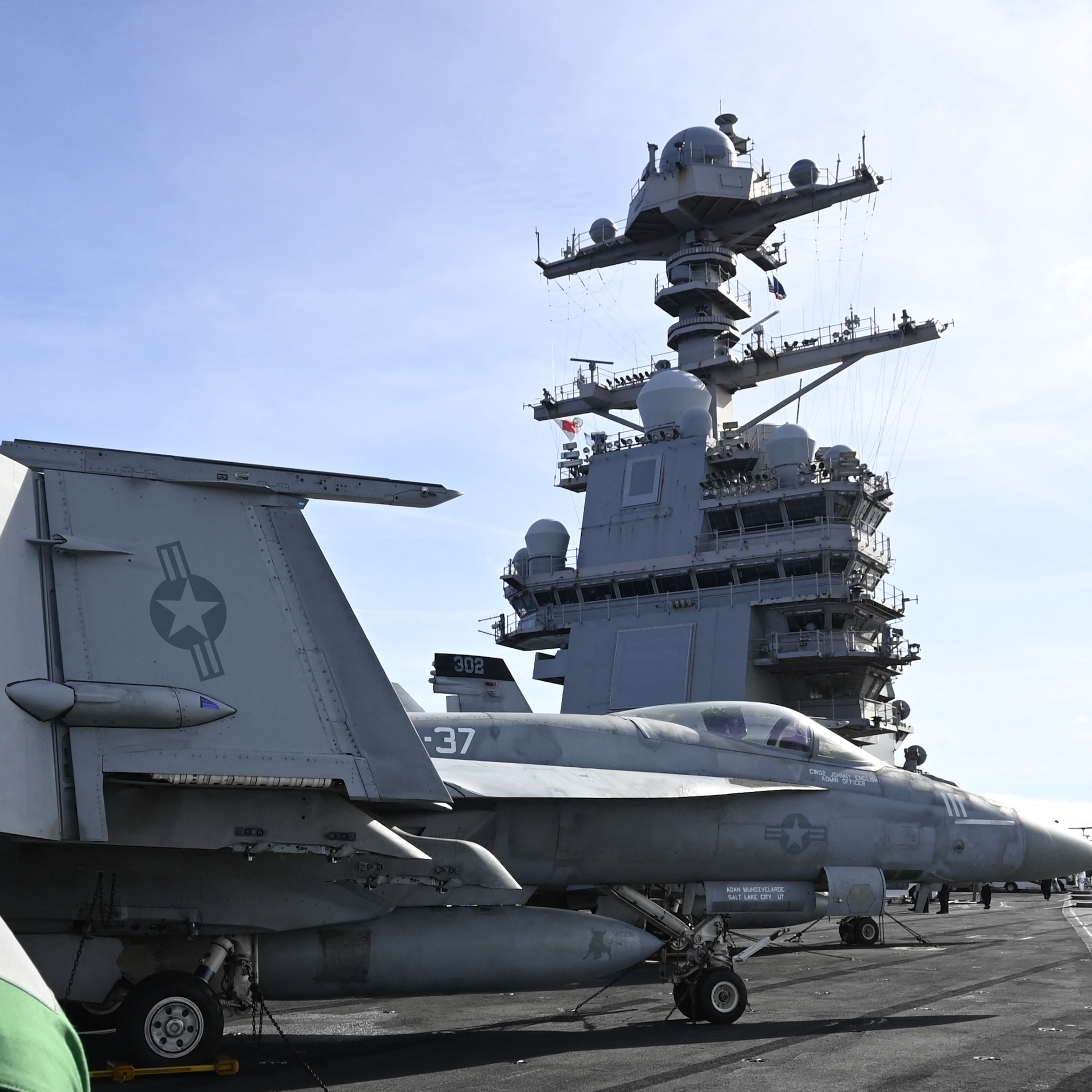
Post Reports
What's behind Trump's moves in Latin America?
00:25:38
From Argentina to Colombia to Venezuela, the Trump administration is attempting to reshape the political landscape of Latin America. Now, people are wondering: What’s next for the region?
Loading summary
Transcript59 lines
- [00:03]
A
The United States involvement in Latin America has been intensifying in ways we haven't seen in decades. From Argentina to Colombia to Venezuela, the Trump administration is attempting to reshape the political landscape of Latin America. Trump is propping up allies in the region and targeting his enemies. This has left many wondering what's next.
- [00:26]
B
We've got US Warships, we've got troops, we've got threats of invasions.
- [00:33]
A
So we brought Karen DeYoung and Samantha Schmidt, two of the Post's experts on Latin America, into the studio to explain what is going on.
- [00:40]
C
Yeah, I think we're entering an era of really aggressive intervention in the hemisphere in a way we haven't seen in a long time.
- [00:48]
A
From the newsroom of the Washington Post, this is Post Reports. I'm Cole Bjorkowitz. It's Thursday, November 13th. Today, Karen and Sam join me to unpack the latest developments in Latin America and. And how the Trump administration is pushing the boundaries of our foreign relationships with three countries in particular, Venezuela, Colombia, and Argentina. Karen, Sam, hello.
- [01:18]
B
Hello.
- [01:19]
C
Hi.
- [01:20]
A
I want to center our conversation today on the three countries that I just mentioned, but let's first start with Venezuela, because I think that's probably what's top of mind for most people. For months, we've been hearing about these US Strikes on boats off of its coast. These strikes have killed dozens of people. It's left people asking whether we should be bracing for something bigger like a war. Where are things at right now? What do we know about US Policy as it pertains to Venezuela under President Nicolas Maduro?
- [01:48]
B
I think that the Trump administration has sort of gone back and forth on starting out. We're going to negotiate with Venezuela. We want to get some American detainees out of there. We want to deal with their oil. But it's really changed sort of at the end of the summer where they said, that's it. We've had it with Maduro. He's an illegitimate president. But more importantly, in terms of policy and the administration's accusations about him, he is a major drug dealer who has sent not only his migrants here, where Trump says they've come from prisons and insane asylums and stuff, I think they've mostly been economics refugees. But he's also said, we're going to stop this flow of drugs. Trump has couched this all as the importation of fentanyl into the United States. Fentanyl doesn't come from South America, doesn't come from Venezuela. But in any case, Trump has sent dozens of warships and aircraft there, opened a base that had been closed for a long time in Puerto Rico. And they've started striking these drug boats, which are kind of really long, almost sort of like canoes with very powerful outboard engines on the back of them. And they've struck them in international waters, killing, they say, everyone aboard. Haven't presented much evidence of what they were doing, what they were carrying, who they were, but said that they were harming the national security of the United States. Trump most recently has said, no, no, no, we're not going to invade. But I think that the feeling certainly in the region and among a lot of people here, what are you going to do with all of this military hardware and people in the region? Is it just for show? And so I think that there is a lot of concern that there's going to be some kind of land attack.
- [03:43]
A
And Sam, I know that Maduro is in the crosshairs of the Trump administration, but why has the focus been on Venezuela all this time?
- [03:51]
C
So President Nicolas Maduro has been in power since 2013 after the death of Hugo Chavez, the founder of Venezuela's socialist state. During those years, Venezuela has struggled with a crumbling economy, with one of the largest refugee crises in the world as millions fled, you know, a humanitarian crisis in the country. And he is also being investigated by the International Criminal Court for crimes against humanity and has repressed and jailed dissidents and opposition leaders repeatedly over the years and has refused to allow and accept democr elections and democratic election results in this country. Since Trump took office, we know that Venezuela has become an important issue. It has been this battle between engagement, particularly from envoy Rick Grinnell, and the Marco Rubio approach, which Venezuela has been a fixation of his for many years.
- [04:54]
B
You know, Rubio is from Florida. Rubio is the child of Cuban immigrants. He made his reputation in the Senate of being really hard line Cuba on socialism. And so I think that, you know, this happened during the first Trump administration where he sent ships, not as many ships, but sent ships to the Caribbean, said Maduro has to go, would not rule out the use of force. That was when Rubio was a senator and he was kind of the leading the charge for this sort of anti Castro, anti Maduro push. And so in some ways, Trump has just sort of doubled down on what he said during his first administration. And now Rubio is the secretary of.
- [05:39]
A
State and obviously has a lot more power and influence.
- [05:42]
B
Right.
- [05:43]
C
I mean, there is a large representation of Cuban politicians and also Venezuelans in the United States who have wanted to see more pressure against Maduro, the opposition in Venezuela has tried everything to oust him through elections. The US has tried sanctions since Trump's first administration, and nothing has worked.
- [06:07]
B
The other thing you have to remember about Venezuela is that President Maduro, who the United States does not recognize as a legitimate president, is also under indictment in the United States and has been really since, I guess the indictment first came down in the early 20s with a bounty of what is now $50 million for his arrest. And so that's.
- [06:32]
A
And what's that indictment for?
- [06:33]
B
It's for drug trafficking.
- [06:34]
A
I see.
- [06:35]
C
Ok. I think there is debate about what this is really about, and the Trump administration says this is about drug trafficking. But much of the focus has been on, as Karen mentioned, on fentanyl and on deaths in the United States, when we know that really what we're talking about here is cocaine in South America, which is a small percentage of the deaths from drugs in the United States.
- [06:58]
A
Just how close to war are we? Because I think that's what a lot of people are wondering.
- [07:03]
B
Well, you know, Trump, as with many things, has been back and forth on this issue. He originally said, you know, impose sanctions. He said, we are going to strike the drug boats. Then he said, and we're going to go in on land. I mean, he said that several times more recently as Congress, certainly the Democrats, but some Republicans, particularly in the Senate, have said, wait a minute, this is a violation of the War Powers Act. And in fact, they came very, very close to passing a resolution to say, you can't do this.
- [07:34]
A
And did that resolution say you can't invade Venezuela or you have to stop killing people indiscriminately?
- [07:41]
B
It said both. I mean, it said, this is not a war. Drug smuggling, as bad as it is, is not a capital crime in the United States, and you are executing people. So they're saying it's a violation both of domestic law and of international law. And so in the past week or so, Trump has sort of stepped back and said, oh, no, no, no, we're not gonna do that. But I think the fact that you have all of this hardware and all of these people hovering off the coast of Venezuela, a lot of people are not so sure. He's not going to flip back the other way.
- [08:13]
A
I was going to ask what are the repercussions for breaking international law?
- [08:19]
B
Good question. Not many. There's a sort of international outrage. There's that Trump has shown he doesn't care too much about that someone could bring a case in the International Court of Justice, which is the UN Sort of international legal body, the United States is not a member of that and has no obligation to abide by any of its rulings. So it's more sort of international outrage. International law is kind of a guidebook that the world has agreed that there's.
- [08:55]
A
A social contract, almost.
- [08:57]
B
Yeah. But there's nothing really to force you to adhere to it.
- [09:01]
A
Nothing to stop a bad actor from.
- [09:03]
B
Correct.
- [09:04]
A
Attacking another country.
- [09:06]
B
Correct.
- [09:07]
A
Sam Moving on from Venezuela, let's talk about Venezuela's neighbor to the west, which is Colombia. And Colombia has been a longtime ally of the United States, but relations there have also taken a dive recently. What's happening between the US and Colombia?
- [09:24]
B
Yeah.
- [09:24]
C
So Colombia's president, Gustavo Petro, is its first leftist president, and he himself is a former guerrilla and has been very critical of the us' war on drugs. I remember listening to Petro's inauguration speech, and he specifically mentioned the war on drugs and the need to end it, and has called for rethinking the criminalization of coca, the base plant for cocaine. And so he has really called for a different approach to this and has been highly critical over the years and over recent months of Trump in particular, and his actions. And I interviewed him as the boat strikes had just started, and he did not hold back his criticism. He called it murder. He has then continued to sort of escalate his rhetoric, and even his visa was taken away after he was in New York for the UN General assembly and was at a Palestine protest and basically calling on the military in the US to not listen to orders. So it's clearly escalated, and Trump himself, and particularly Rubio have been very critical of Pedro over the years. And all of that has sort of come to a head in recent weeks, because basically Trump threatened to cut off all aid to Colombia, which he has not done yet. But that would be a massive shift for what is the US's most important ally in South America, historical ally, where the police and the military have extensive US training and equipment, and they share intelligence. And this is an incredibly important collaboration between security forces that is really crucial to Trump's efforts to, as he puts it, try to go after drug traffickers in South America. So on top of that, Petro is now sanctioned by the U.S. treasury and is being accused of being a drug trafficker himself, even though we don't have evidence of that. It's unclear if Trump is actually going to follow through on those threats. But things are quite tense right now between these two leaders, who are very much on opposite sides of the political spectrum.
- [11:37]
B
I think the bottom line is that the methods and the description of the situation that the Trump administration has presented to justify its actions do not really jive with the situation on the ground and what's actually happening in terms of drug trafficking and gangs and who's doing what and who's responsible for it. So that has brought to the fore all these questions about, well, what are you doing and why? Just to put this in a broader context, you know, the Trump administration has said we are going to improve, expand U.S. relations, U.S. influence in the Western Hemisphere. And so what does that mean? I think what it means is they want to kind of eliminate governments on the left in Latin America and bring them more in sync with MAGA and with the Trump administration's goals. Columbia's a democracy. They're going to have elections next year, and, you know, maybe at this point, they're just trying to influence the direction of those elections. And that's the case in a lot of South America, at least.
- [12:52]
A
So now I want to talk about a very different story that's also unfolding in Latin America. And it's kind of the inverse of this, which is that Trump is kind of wrapping his arms around Argentina and the Argentine government coming to the rescue of what is a flailing economy there. Why is he embracing Argentina in this way?
- [13:17]
C
Argentina is important to Trump because of its president, Javier Milei, who is ideologically very aligned with Trump. He came in with this image of the chainsaw that he wanted to cut government spending. He was going to basically the Argentine version of drain the swamp. This is a message that was well received in Argentina, where they were dealing with spiraling inflation and an economic crisis. And he promised to address that inflation to fix the economy. He's an economist himself. You know, this message was well received by Trump and his supporters. And, you know, from the beginning, they have been very supportive of Milei. And now, you know, Milei has struggled to deal with the devaluation of Argentina's currency and needs the US's help. And basically the US has offered to bail him out.
- [14:17]
B
I think Argentina has had economic problems for decades and decades. Politics have always been very, very volatile in Argentina. So they switch back and forth between populists who say, we're going to save the poor and populists who say, as Milei has said, we're going to cut everything. And so Milei came in and said, we're going to cut everything and. And made a lot of trips to Washington, stands by Trump's side and with Elon Musk, and as Sam said, with his chainsaw. And so the administration said, wow, this is our guy. We're going to support him because we are going to try to spread this kind of movement all over South America. But the economy didn't get much better with Milei. And so Trump then moved in with a bailout. And there were legislative elections a couple of weeks ago and said, well, we're going to give them $20 billion to stabilize their currency if he wins these legislative elections. If his party doesn't win, we're not going to give it to him. And so lo and behold, Milei's party went from really being the underdog to winning the legislative election. So now they get their money. So it's, you know, it's this very, as I was saying before, this attempt to sort of influence politics in South America.
- [15:46]
A
After the break, the complicated history of US Involvement in Latin America and how the Trump administration sees its role in the region's future. We'll be right back.
- [16:03]
D
Doesn't it seem like fall always feels like a reset? Whether it's the after school activities, busier routines, or shorter days, finding time to cook is pretty much impossible. That's why I love Factor. No matter how crazy the day gets, their chef prepared diet friendly meals make it easy to get everything done while still enjoying something comforting and delicious. There are so many great things about Factor, especially their wider selection of weekly meal options, including premium seafood choices like salmon and shrimp at no extra cost. From more choices to better nutrition. That's why 97% of customers say that Factor helped them live a healthier life. My personal favorite Factor meals have been the garlic, butter and mushroom chicken thighs, pomodoro herb salmon and chimichurri shredded pork. All amazing and all things I would never have had time to make before. Factor eat smart@factormeals.com post 50 off and use code post 50 off to get 50% off your first box plus free breakfast for one year. That's code. Post 50 off@factor meals.com for 50% off your first box plus Free breakfast for one year. Get delicious ready to eat meals delivered with Factor offer only valid for new Factor customers with code and qualifying auto renewing subscription purchase. If you're like me, when you were young, you used to dream of being anything. An athlete, the president, an astronaut. But as you get older, your dreams change, focusing less on running the world and more on how you can take your skills and ideas and turn them into something real. Instead of dreaming of going to space, maybe you start dreaming of owning your own business. And if you do you'll need a website, a payment system, a logo, and a way to advertise to new customers. It can all be overwhelming and confusing, but thankfully that's where Shopify comes in. Shopify is the commerce platform behind millions of businesses around the world, including 10% of all E commerce in the US from household names like Mattel to brands just getting started. And that's because Shopify is there for you from day one with beautiful ready to go website templates to match your brand style. So turn those dreams into sign up for your $1 per month trial and start selling today at shopify.com reports. Go to shopify.com reports shopify.com reports.
- [18:23]
A
So Karen, Sam, we've touched on this a little bit, but I think it might be helpful to kind of understand the history and obviously it's a very long history of U.S. policy in Latin America. Can you kind of walk us through what has been US Policy in Latin America, kind of building to this moment we find ourselves in?
- [18:42]
B
I think you have to go way back and you can start at the beginning of the 1800s.
- [18:48]
A
Oh wow.
- [18:48]
B
With the Monroe Doctrine. European countries had colonies in Latin America then.
- [18:55]
D
Yeah.
- [18:56]
B
And this was President Monroe saying that we are not going to tolerate intervention in our hemisphere. This is the Western hemisphere, it belongs to us. And gradually that became a reality. Trade relations with political relations with military relations. But it was always kind of a one way street. The Americans, yes, they've had military intervention certainly at the beginning and middle of the 1900s. You had US troops occup Nicaragua. They occupied Haiti, they occupied the Dominican Republic. And so you had a situation where when things got out of hand, the Americans said, we're going to settle this down. And they usually were U.S. economic interests. You know, you had the CIA intervening in Central America on behalf of the big U.S. fruit companies. That's where you got the term banana republic. Again, it was sort of a one way street. There wasn't the investment, there wasn't the really level of interest interest. It wasn't a big time thing for the United States. It was just something to keep in control. So of course, a lot of these countries, they're big countries, they have big trade relationships with the United States, but also now opportunities to trade elsewhere, certainly with Europe, but also with China. And so we're saying, wait a minute, what happened to our influence here? And various administrations have tried various ways of doing this when anti communism was the whole thing. We're going to move in and we're going to promote democracy. Trump has a Bit of a different idea. He's come in and said, wait a minute, this is our hemisphere. It belongs to us. We are going to cooperate with countries that cooperate with us. And cooperation means adopting the social policies, the political policies, and the military policies of the United States. And so a lot of people in the region are saying, why is this any different than it was 200 years ago? I think it's part of this continuum of history where, no question, I mean, the United States is the big player.
- [20:59]
C
In recent years, lots of people in South America or who follow Latin America have felt that the US has been focused elsewhere, has been a bit distracted, and hasn't been as focused on Latin America as a priority for the State Department. And I think that has sort of ebbed and flowed. You know, the Biden administration took a very different approach, trying to engage on issues and with presidents in a new way, particularly on Venezuela. After the maximum pressure approach of the first Trump administration, they tried to focus on supporting elections there. This is after years of sanctions and trying to oust Maduro. They basically made a deal with Maduro and said, we will lift sanctions to support freer and fairer elections. And in other ways, they were actually trying to get other Latin American presidents to step up and to take the lead. Colombia, Brazil and Mexico, there were a lot of hopes that these three leftist presidents could help negotiate with Maduro, bring him to the table. So I think the Biden administration was saying, you know, look, let's let Latin Americans try to sort this out. Unfortunately, it didn't work, but it was a very different approach to what we're seeing now.
- [22:15]
B
I think the other thing which we haven't really talked about is the whole migration question with President Trump, Biden sort of letting in a lot of migrants, the majority of whom were from Latin America or had come through Latin America to get there. And Trump seizing on that as an issue and that sort of focused attention. The problem is, you see a place like Venezuela where you have hundreds of thousands of Venezuelans here in this country. And so at the same time, Trump is saying, let's get rid of Maduro, let's have a democracy. The opposition should be in there. You have Trump saying, all the Venezuelans who are here are criminals and we are going to arrest them all and we're going to send them all back. And it's an interesting sort of juxtaposition that I think the Venezuelan opposition has sort of tried to ignore up until this point.
- [23:06]
A
Yeah, it's a great point, Karen, because I have wondered how Trump's immigration policies and his desire to deport a lot of migrants, to your point, many from Latin America, kind of fits into this bigger picture of what he's doing in Latin America.
- [23:22]
B
If you listen to Trump, certainly recently, when he's been asked many times, why are you doing this with Venezuela, Why this big military mansion? His first response is inevitably about migration. They sent these criminals here, and also they are trafficking these drugs and killing Americans.
- [23:41]
A
I feel like the Trump administration, for all of these policies, he's making this argument that it's about drug trafficking, that it's about protecting America. This is all in the national security interests of America. But the through line between Venezuela, Colombia and Argentina really seems like it is, is the propping up of far right regimes. That's why he's befriended Argentina. It's why he's.
- [24:05]
C
It's why he's befriended President Nayib Bukele in El Salvador. Bukele has seen his profile rise on the global stage under the Trump administration, even as he is taking on more and more power and consolidating his power in an incredibly authoritarian way. And is is accused of essentially disappearing tens of thousands of people in prisons, in some cases detaining accused gang members just for having tattoos. And, you know, he has gotten many benefits from the Trump administration in recent months, in particular through this deal that they made to send Venezuelans and Salvadorans to his prisons in March.
- [24:48]
B
You know, this is to a large extent about domestic politics in the United States. You know, Trump ran on a going to get rid of migrants who are taking your jobs and committing crimes. Oh, my gosh, you are all dying of drug overdoses. So we're going to get rid of that. And so to the extent that alliances are formed with countries in Latin America, they've been pretty clear about saying those who comport with our national security objectives are the ones that we're going to be friends with. And our politics. It's sort of like if you look at Trump's relationship with Viktor Orban in Hungary, the president of Hungary, you know, he is kind of on the outer limits of the European Union as a sort of. He's very conservative and really kind of taking over institutions in Hungary. This is the kind of Latin American equivalent of that Milei in Argentina, Bukele in El Salvador. You just had a new president in Ecuador that they think can be a friend. You just had the ousting of a longtime leftist government in Bolivia, and they've already had the president elect up here. And so they're kind of getting their ducks in a row of countries that agree with them both politically on social issues and also they feel like in the long term can be an economic advantage to the United States.
- [26:19]
A
Well, thank you. Thank you both so much for such a robust and thoughtful conversation about this. I really appreciate you coming on.
- [26:25]
C
Thank you.
- [26:26]
B
It was a pleasure. Thank you.
- [26:32]
A
Karen DeYoung is a senior national security correspondent for the Post, and Samantha Schmidt is the Post Mexico City bureau chief. Since taping this conversation, the Trump administration continued to build up its military presence near Venezuela after sending the Navy's largest aircraft carrier into the region. The Venezuelan defense minister said Venezuela is, quote, preparing to set a maximum level of alert amid rising tensions with the US and in Colombia, President Gustavo Petro ordered a suspension in intelligence sharing with the US until the Trump administration stops attacking boats in the Caribbean. That's it for Post report. Thanks for listening. If you want to show your support for the show, please subscribe to the Washington Post. Not only is it a great way to help us continue to do this work, you can now get access to Washington Post podcasts ad free in Apple Podcasts. Today's show was produced by Ilana Gordon and Ted Muldoon, who also mix the show. It was edited by Ariel Plotnick. Thanks to Ben Palker. I'm Cole Biekowitz. We'll be back tomorrow with more stories from the Washington Post.
- [27:58]
E
You listen because you know the power of good journalism and the Washington Post is there for you. You 247 when you become a Washington Post subscriber, you get exclusive reporting you can't find anywhere else. You also get sharp advice, columns, delicious recipes, TV and music reviews and so much more. Right now, you can get all of that for just $4 every four weeks. That's for an entire year. After that, it's just $12 every four weeks. And you can cancel any time. Add to your knowledge and discover all the Post has to offer. Go to washingtonpost.com subscribe that's washingtonpost.com subscribe.