Podcast
Product Fridays
Hosted by The Andrews · EN
Andrew McGill and Andrew Phelps talk creativity, emerging tech, and the art of building great products. Subscribe for weekly inspiration and insights.
productfridays.substack.com
productfridays.substack.com
12episodes
Episodes
Newest firstAll episodes
Stop Guessing, Start Listening
Jun 2900:15:30Tap to summarizeA researcher runs some interviews. They produce a report. They tell everyone what they learned.Then the product team goes back to building.The researcher Emily Goligoski doesn’t work that way.This week on Product Fridays, Emily says research is a team sport: “When I think about research design, I think the real cheat code is actually collaboration,” she says.We couldn’t agree more, and we’re thrilled to have Emily on the show to discuss the art of understanding people.Ideas we loved:* How to do research as a team of one* The N+1 rule for building products* Why “cheap and cheerful” research is often enough* Emily’s three research questions that fit on a Post-It note* How AI is (and isn’t) changing the craft* Why Emily still carries a notebook everywhere she goesMentioned in this episode:* Rev* Leuchtturm1917 notebooks* Rhodia notebooks* Portage reporter’s notebooks* Pilot G2 retractable rolling ball gel pens, fine point, 0.7mm* MUJI gel ink ballpoint pen, 0.5mm (too fine for Phelps’s taste) This is a public episode. If you would like to discuss this with other subscribers or get access to bonus episodes, visit productfridays.substack.com
Transcribe →
AI doesn't kill art. It moves the goalposts.
May 2900:25:45Tap to summarizeDid the camera kill art? Of course not, says our guest David Somerville, it pushed art to new places. Cubism. Impressionism.“What didn’t happen is art ceased to exist,” he says. “It became about, okay, but now can I paint a feeling?”David is one of the most creative people we know. He is a designer, creative consultant, game maker, and published Dungeons & Dragons author. (He’s also our first-ever non-Andrew guest. He’s filing paperwork to fix that.)David’s instinct cuts against the doom take: using AI to do more of the same, faster, is self-defeating. The interesting question is what AI can do that hasn’t been done yet.A few things from the conversation worth stealing:* Wonder vs. empathy. Wonder looks at something from the outside (what does it look like?); empathy stands inside it (what does it feel like?). Good work comes in moving between the two.* “Yes, and” is the whole job. When a client insists the logo has to be blue, David says yes — to the goal — then proposes a different way there. Most bad creative calls are just fear of being wrong.* Process is a runway, not the whole flight. You need it to take off and to land. In between, you have to actually fly.We loved every minute of David’s insights about creativity and the creative process, and we hope you do, too. Happy Friday.—The AndrewsIn this episode:* David Somerville, founder of the creative consulting firm Smrvl™️* Brand Deck This is a public episode. If you would like to discuss this with other subscribers or get access to bonus episodes, visit productfridays.substack.com
Transcribe →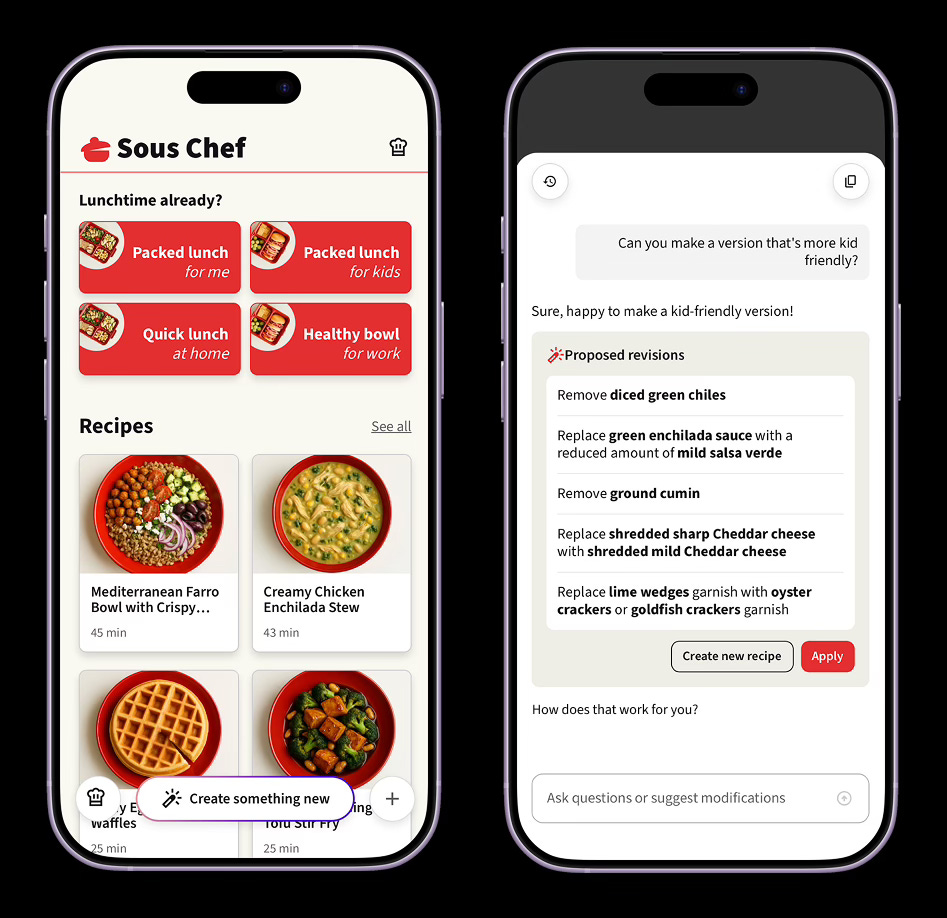
Introducing Sous Chef, our newest app
Mar 1300:25:19Tap to summarizeBig news! Sous Chef, our AI-powered app for creative cooking, is officially in open beta 🎉Now, we’re not saying we’re the next coming of Bobby Flay and Alton Brown, but we both know our way around the kitchen. And we’ve always been frustrated by the dearth of purpose-built products that match how we like to cook.So, we’re designing our own. Sous Chef makes cooking amazing meals easier, more spontaneous, and more fun. Take a look!In this episode, we break down what Sous Chef does, how McGill came up with the idea while reading recipe newsletters, and why nailing down the perfect set of features is so dang hard.Also, should we rename the app “Cooking Idiot”? That’s what Phelps wants. We’ll let you draw your own conclusions We’d love to hear your feedback on the beta. Give it a try and drop us a note at hello@productfridays.com with your thoughts. This is a public episode. If you would like to discuss this with other subscribers or get access to bonus episodes, visit productfridays.substack.com
Transcribe →
Revealed: The Product We'll Vibecode Out of Existence
Feb 2700:22:08Tap to summarizeLast week, we threw down the gauntlet: We’re joining the SaaSpocalypse and picking one of our software subscriptions to replace with a vibecoded substitute.The people spoke: It’s QuickBooks.We suspect QB has very few fans. Much like other big platforms (e.g. Jira, and increasingly Zoom), it’s tried to become everything to everyone over years — and ended up completely incomprehensible to anyone. It’s the opposite of an “opinionated product.”In this new era of frictionless personalized software, its breadth feels like bloat. We simply don’t need all of it! (And we’re not the only people thinking this. Intuit’s stock has dropped by a third since the beginning of the year.)In this episode, we dig into what actually would be the perfect bookkeeping software for two guys named Andrew (and maybe you, too). We don’t want to spoil anything, but “Partiful for expense categorization” DID come up.Next week: We unveil our creation. Stay tuned. This is a public episode. If you would like to discuss this with other subscribers or get access to bonus episodes, visit productfridays.substack.com
Transcribe →
Help us pick which SaaS platform to vibecode out of existence
Feb 600:23:39Tap to summarizeEarlier this week, the NASDAQ’s most powerful software stocks took a massive nosedive because an AI provider published a plugin.It sounds kind of silly, like the (probably apocryphal) thing where elephants are deathly afraid of mice. But the numbers don’t lie. Some of the biggest software platforms around — Intuit, Adobe, LegalZoom — did indeed lose hundreds of billions in market capitalization after Anthropic added a legal research plugin to their new Cowork product.What are they worried about? It’s not just about Anthropic competing with legal software. The real fear is that Claude and other AI tools can help anyone spin up passable alternatives to expensive SaaS products — an era of personal software. Who needs to pay QuickBooks $500 a year to balance their books when an AI can build you a custom replacement in an afternoon?Is this fear justified? We’re going to find out by stress-testing our own software stack. We went through every recurring subscription we pay for and asked: Could we build a decent substitute using Claude? These are our top picks. Vote below to help us choose which one to tackle first. This is a public episode. If you would like to discuss this with other subscribers or get access to bonus episodes, visit productfridays.substack.com
Transcribe →
Introducing The Andrew Company
Jan 1600:24:40Tap to summarizeFolks, we did the dang thing. After six years of friendship, three years of consulting together, and 10 beautiful months of Friday podcasting — The Andrews are officially joining forces to create The Andrew Company.(Here’s our official launch video — shot in Phelps's daughter’s playroom.)We have two goals:* Create delightful (and opinionated) products together. We love tools that solve specific problems extremely well — apps like Flighty and YNAB. So we’re doubling down. The Andrew Company’s primary output is joyful products (and podcast episodes). We’re already at work on Re:verb, Bandwagon, and Sous Chef.* Help companies, big and small, take ideas from a blank whiteboard to v1.0. Starting is hard! We make it easy. We help teams turn early ideas into first versions of real products or new lines of business — from places like CNN and The Washington Post to startups like Till Financial.In this episode, we walk through why we decided to join forces and how we worked through our differences as co-founders. This is a big step for us. And we have to say — we’re very grateful to all of you. Product Fridays, in some ways, is the beta version of The Andrew Company. This community, and your feedback, has been invaluable in helping us decide what matters most for our business and working lives.Thanks for being part of it. And here’s to many more Fridays to come. This is a public episode. If you would like to discuss this with other subscribers or get access to bonus episodes, visit productfridays.substack.com
Transcribe →
Getting Real About 2025 (And Our Bets For 2026)
Dec 1500:29:46Tap to summarizeHappy almost New Year! This is a year-in-review episode, but we’ll save you the usual LinkedIn end-of-year pablum. Some things about 2025 were hard. Andrew Phelps shares how he dealt with unexpected business pressure; McGill talks about his “duck months” — calm on the surface, paddling like hell underneath. Some of you might have felt the same way?But 2025 also gave us some incredible gifts. Clarity! Some really important work! And of course, this podcast and community. You are one of the best things that happened this year. Thank you for being with us.On to 2026. We’ve got predictions for the year, and we’re doing our best Polymarket impression and applying confidence intervals to each. For instance, we’re 90% sure that if you listen and leave a review on Apple Podcasts, we’ll write you a personalized limerick. But we’re only 10% sure our poetry will be any good.Mentioned in this episode:Honestly, so many things, but here are some of the more unusual suspects:* MS NOW (née MSNBC)* Parent company Versant* The Walt Disney Company* Nano Banana Pro* And ofc Gemini/ChatGPT/Claude et al* Perplexity* That time Phelps’ flight almost crashed This is a public episode. If you would like to discuss this with other subscribers or get access to bonus episodes, visit productfridays.substack.com
Transcribe →
The Terrible, Horrible, No Good, Very Bad Product Friday
Nov 2400:32:27Tap to summarizePhelps has been building something for the past month. It’s inspired him — maybe more than any side project in recent memory. And it just suffered a setback that has him wondering if he should keep going on at all.McGill has been building something for the past year. It started out promising. Then it got hard. Somewhere along the way, he set it down. Now he’s looking for the inspiration to see it through.Sometimes you just gotta wear all black and turn all the lights off and record your podcast in the dark. Because as much as we’d like everything to follow the Golden Roadmap™️, building products isn’t linear. Today, the Andrews break down what to do when things feel stuck – or just suck. And spoiler alert: BOTH of those projects are getting built, folks.Mentioned in this episode:* Bandwagon. Group chats with AI. Sign up for the private beta!* Sous Chef. Win Thanksgiving this year.And the too-expensive-to-actually-buy items topping The Andrews’ holiday wishlist this year:* reMarkable Paper Pro * Sony ZV-E10 II camera* Switch 2 (actually this feels attainable)* And will this be the year McGill buys one of the Meta VR headsets?Today’s limerick recipient: Nonita Juanita. Thanks NJ! This is a public episode. If you would like to discuss this with other subscribers or get access to bonus episodes, visit productfridays.substack.com
Transcribe →
A Topic So Big, We Needed Two More Andrews
Nov 1000:26:38Tap to summarizeOur last PF conversation left us hungry for more. Sure, it’s great to hear how two chaotic coders — er, talented thought leaders — are using AI to build products. But what about genuinely top-tier engineers? Are their lives any different?So we asked two elite developers — both named Andrew, of course — to weigh in. Please welcome:* Andrew Briz, editorial director of newsroom engineering at POLITICO* Andrew Milligan, full-stack engineer at Earth GenomeBriz and Milligan are the fellas that other engineers call when they can’t figure out why their code is crashing. (McGill definitely did when they all worked at POLITICO together). In this episode, we discuss:* The tools they’re using (and what they think is overhyped)* How AI is changing how they collaborate with other engineers* The “Google Maps” effect, or how relying on technology always comes with a costPlus, we read TWO original limericks honoring listeners who left reviews on Apple Podcasts. (If you want your own, write a review!)Mentioned in this episode:* Zed – open-source code editor* Cursor* Cursor bug bot* Codex This is a public episode. If you would like to discuss this with other subscribers or get access to bonus episodes, visit productfridays.substack.com
Transcribe →
The Best Way to Vibecode Is Hands-On. Here's How We Do It.
Oct 2700:21:07Tap to summarizeA note from The Andrews: Hey! It would help us a lot if you would review Product Fridays on Apple Podcasts (even if you don’t like us). It’s basically like giving us money. If you do, we’ll immortalize you in a limerick on the next show.AI is changing software development — duh! But while no-code platforms like Replit and Lovable have gotten a lot of attention, most of the magic is happening when developers partner with AI instead.That means instead of ditching the IDE altogether, they’re using tools like Claude Code and Cursor to make engineering plans, debug code, and bang through all the boring scaffolding no one wants to do. This week on Product Fridays, we pull back the curtain on our own coding workflows, explaining how a project goes from idea to production. And we argue this style of hands-on vibecoding is more productive than using no-code platforms — even if you don’t know much code at all.We’ll cover:* How we use ChatGPT and Claude to think through architecture* How we use Cursor and Visual Studio Code (with Claude) to write the code* How AI makes it hard to resist laziness…* … and how it’s an awesome tutor, tooDiscussed in this episode:* Replit* Lovable* Cursor* Claude Code and Visual Studio Code* Paradise on Hulu* Snickers candy bars This is a public episode. If you would like to discuss this with other subscribers or get access to bonus episodes, visit productfridays.substack.com
Transcribe →