← The Growth Podcast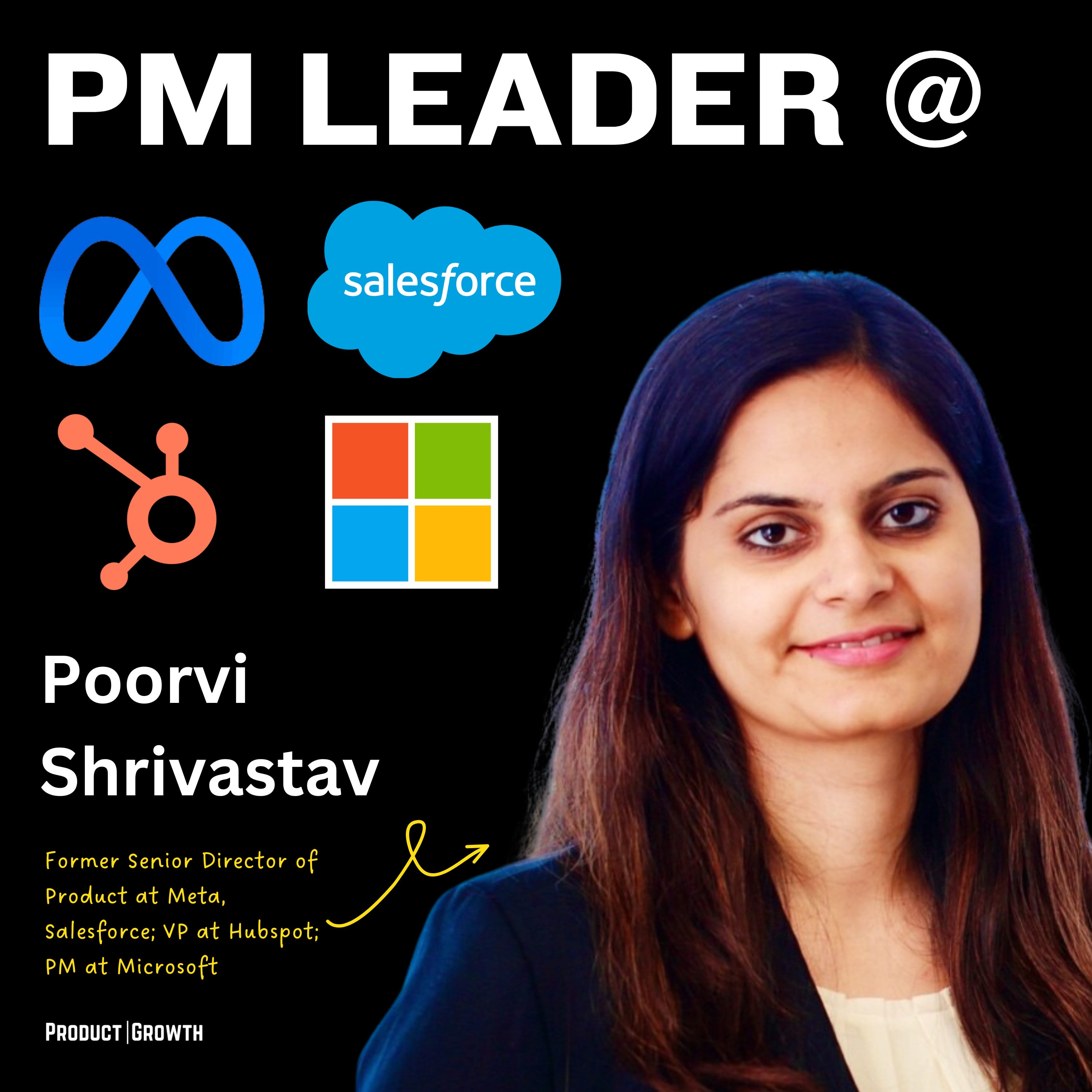
Loading summary
Transcript110 lines
- [00:02]
Akash
Is one of the most experienced product leaders in tech. Period. She's been a PM at Microsoft, she's been a Senior Director of Product at Salesforce, she's been a VP of Product at HubSpot and she's been a Senior Director of product at meta.HubSpot and meta on one end of the speed spectrum and Microsoft and Salesforce on the other. How does that manifest in daily life?
- [00:25]
Purvi Srivastava
I feel people start confusing quality with speed and that is not true. Whereas at Microsoft I obsessed over tickets closing high priority bug items role at Salesforce it was a lot more strategic from the get go. I spent less time in Jira tickets and more time in front of the customers. Meta taught this rigorous data driven decision making so I wasn't surprised. What took me by a little surprise was every role is expected to know it.
- [00:54]
Akash
What is your take on how to improve as a product writer and how much AI should be people using when they're writing?
- [01:01]
Purvi Srivastava
Your summary doesn't suck because you didn't use the right tool. Your summary sucks because you were not able to write a good document because they weren't clear.
- [01:14]
Akash
Hello everyone and welcome to today's episode of the Product Growth podcast. We have Purvi Srivastava. She is one of the most expansive, experienced product leaders in tech. Purvi, welcome.
- [01:25]
Purvi Srivastava
Thank you. I'm very delighted to be here. I've heard so many great things about the podcast and I've seen you grow so it will be amazing.
- [01:34]
Akash
Just glad to have you. I think we've been talking about this for about a half year now, so it's finally come to be. I've been reading your content, I've been following your career and if you haven't followed her career, Burvi was a Senior Director of Product Management at Salesforce. She she was a VP of Product at HubSpot and she was most recently a Senior Director of Product Management at Meta. So she has really seen it all when it comes to big tech. Today in this episode we're going to talk about what it's really like to hold these high powered leadership roles in big Tech and how you could potentially become one of those. But I really want to start Purvi at the beginning of your journey. You started as at Microsoft and the reason I want to reflect on this is because a lot of people who aren't product managers, they might see some content from Marty Kagan, they might see some content from Chamath Palhapitiya, they might see some very surface level stuff about what it's actually like to be a product manager and what the question they have is is the reality like the books. So what was it like being a PM at Microsoft? Were you truly empowered? Were you building your strategies? What was your day to day?
- [02:47]
Purvi Srivastava
Yeah, so let me give you a bit about how I got into Microsoft and then we talk about the culture and various tactics and skills that people at Microsoft learn. So I started my career back in the aftermath of the financial crisis of 08 09. That was the first year Microsoft had recruited from my university and I was fortunate to be one of the few, I think I was one of the three or four computer science engineers that were selected for the role. So pure fortune and some hard work and then all hell broke loose within first six seven months because the Lehman Bros Crash happened. There were a lot of layoffs and from engineering, which is what I was trained in, I took a 360 degree turn to work in customer support for the Office suite of applications. So I was offered the role or severance and I was new to the industry so I definitely wanted a job. So I mean picture this. I was 22, I worked 5am shifts and I managed people that had been in customer service for decades more than I was. And I feel like one night stands vividly in my memory. I was running what we call back then graveyard shifts. So they started at like 8 9pm and they ended at 4 or 5am in the morning. And we were battling a legacy application that was throwing exceptions and I made the mistake that I missed the handoff. So between shifts we had handoffs or exchanging notes on how the high priority items were going to I hope you're
- [04:32]
Akash
enjoying my conversation with Purvi. We'll be right back after this word from our sponsors.
- [04:36]
Podcast Host/Announcer
Trust isn't just earned, it's demanded. Whether you're a startup founder navigating your first audit or a seasoned professional scaling your GRC program, proving your commitment to security has never been more critical or more complex. That's where Vanta comes in. Businesses use Vanta to establish trust by automating compliance needs across over 35 frameworks like SoC2 and ISO 27001. Centralized security workflows, complete questionnaires up to five times faster and proactively manage vendor risk. Vanta can help you start or scale your security program by connecting you with auditors and experts to conduct your audit and set up your security program quickly. Plus, with automation and AI throughout the platform, Vanta gives you time back so you can focus on building your company. Join over 9,000 global companies, companies like Atlassian, Quora and Factory who use Vanta to manage risk and prove security in real time. For a limited time, my listeners get $1,000 off vanta@vanta.com Akash that's V-A-N-T-A.com A-K-A-S-H for $1,000 off. This episode is brought to you by Work OS if you're building a SaaS app, at some point your customers will start asking for enterprise features like SAML authentication and SCIM provisioning. That's where Work OS comes in, making it fast and painless to add enterprise features to your app. Their APIs are easy to understand so that you can ship quickly and get back to building other features. Today, hundreds of companies are already powered by Work os, including ones you probably know like Vercel, Webflow and Loom.
- [06:10]
Akash
Work OS.
- [06:11]
Podcast Host/Announcer
Also recently acquired Warrant, the fine grained authorization service. Warrant's product is based on a groundbreaking authorization system called Zanzibar, which was originally designed for Google to power Google Docs and YouTube. This enables fast authorization checks at enormous scale while maintaining a flexible model that can be adapted to even the most complex use cases. If you're currently looking to build role based access control or other enterprise features like Single sign on SCIM or user management, you should consider WorkOS. It's a drop in replacement for Auth0 and supports up to 1 million monthly active users for free. Check it out at workos.comakash to learn more. That's workos. Com Akash so I was grabbing dinner
- [06:54]
Purvi Srivastava
at the cafeteria and I missed it by like five minutes. We didn't have great documentations or CRM systems back then, so handoffs were very critical. I spent my entire night debugging the issue from scratch, similar to what we did with the camera issue before we recorded. We were battling several other issues so I wasn't able to get to an enough of a conclusion and the documentation was missing. As I said, I wasn't confident enough to call my manager at 3am in the morning and so that really gave me a pause because by the time I called and by the time we were able to get the team together it was already a P0 escalation and that that gave me a footing of like three things. One, I'm never late. I'm mostly never late to anything. Secondly, I obsess over documentation and then thirdly I am okay asking for help even when you're in a leadership situation. Not always, but I don't believe in the know it all culture. So after that year I switched back to engineering and I supported both product and engineering at Microsoft. Were the teams empowered? I think back then the teams were empowered, but I'd say they were more focused on program management and executional skills as opposed to strategy and go to market. I think even the role was called program manager or technical program manager, something along those lines. So they focused a lot more on how and less so on the what. It was a great launchpad and I definitely learned a lot in my six, seven years there. But I feel like go to market messaging, pr, pricing and packaging, those are the skills I learned at other companies like Salesforce.
- [08:49]
Akash
So Microsoft in the era you were there, it sounds like late 2000s, early 2010s.
- [08:56]
Purvi Srivastava
Yeah.
- [08:56]
Akash
Program managers were really more focused on some of these executional tasks which if you kind of look at the the Venn diagram of what Marty Kagan thinks a PM should be spending their time on these how tasks is a pretty small portion, but at Microsoft that was pretty much the whole job.
- [09:14]
Purvi Srivastava
It was pretty much the whole job. At least like starting levels. It probably became more strategic as you grew. I was there for like three years within the PM career path. I did do engineering leadership which became a little bit more strategic towards the end. But I would say that was the difference, at least during my time.
- [09:37]
Akash
And what is. What does lower level IC work at Microsoft feel like day to day when you are focused on the how? What are the things that are taking up the majority of your time? What are the things that you're getting the type of feedback on to do more of? What are the main. What does a day in the life feel like as a junior PM at Microsoft?
- [09:58]
Purvi Srivastava
Yeah, so a lot of us did the rotational program which was. You did six months rotation in different functions and then you selected what specific function you wanted to be a part of. So my husband did that. I only wanted to be an engineer, so I did not do that. But through this customer service path, it so happened that I got to experience a lot more functional roles than I wanted to. And when I landed up in pm, I think my day to day mostly consisted of ensuring a feature, a very small feature. For example, if it's your birthday on Bing.com, they would show a slightly different view or layout for you versus others. It was an experimental feature that we worked on back in the day. My specific role was to ensure that the requirements were clearly written and documented. They were signed off, the visual elements were there. It was less problem solving. I Felt like, but more tracking and executional. But also like I was very early in my career. If I imagine my role at Salesforce, which I believe we'll be talking about a little bit, it was a lot more strategic from the get go. So I spent less time in Jira tickets and more time in front of the customers. Whereas at Microsoft I obsessed over tickets. Closing high priority bug items, ensuring that we're closing the points.
- [11:32]
Akash
So at Microsoft there also seemed to be a little bit of element of what is often now in like a technical program manager role as you said, which is often distinguished from a product manager role which is helping with some of the engineering project management.
- [11:48]
Purvi Srivastava
Yeah. So the thing is like Microsoft have specific product marketing role which take care of the go to market side PR messaging and whatnot. So in terms of strategy, I feel like you only start doing it as much. Either you're post MBA and you've worked in the industry so much or you have like years of experience on the same product as an engineering leader and a lot of like PMs coming in early through these programs. And it's rightly so. Right. They learn the craft, the systems are at a much broader scale, the platforms are complex so you need to learn the tasks and what better way to do it than solving Jira tickets. Like I did that at HubSpot as well when I and I'm going to talk about it like they had a program called embed where the GMs embedded as PMs on the team.
- [12:42]
Akash
So let's move on to Salesforce. What level were you when you were in your Salesforce journey?
- [12:48]
Purvi Srivastava
I started as a product manager so I feel like I was there at Microsoft for a long time and then I went to MBA and sort of had a reset. So it didn't like my experience didn't automatically translate over to my first role at Salesforce if we think about levels, but it did translate to the maturity I brought to the organization and then that is what I saw in the way I rose through the ranks. Salesforce was, was very different from Microsoft and I'm happy to talk about that if that's of interest.
- [13:26]
Akash
Yes. What were the big differences? I think they were also roughly one tenth of the market cap. So you might expect that inherently a more mid cap company versus a big tech company is different. What were the big differences?
- [13:40]
Purvi Srivastava
Yeah, you know I joined Salesforce when I feel we were at the business unit I was part of was at a billion dollar, maybe roughly billion dollars of revenue and now they've grown to be like 8, 9, 10 billion. Not sure. But Salesforce was where I discovered my love for Enterprise and B2B SaaS. There is something so powerful about sitting across from your customer, watching them use your product, seeing their eyes light up when a feature saves them hours of work and debugging, and then opening your dashboard to see how that translates to usage patterns and business metrics. When I was at business school, I knew I wanted to build products for sure because that was my forte. I like building a bold vision with practical knowledge. I like sequencing work, not just prioritizing. I liked efficient execution and I also loved making money for the company while making people happier. So Salesforce fit the bill in all those four categories. I was fortunate enough to incubate and launch multiple new products, a new business, mentor venture companies, and also helped with the Associate Product Management program which then CPO Brett Taylor had started with a small group of other leaders. So it offered a lot more, I feel in terms of holistic business leadership perspective than I learned at my previous company. And to put it like what are the big differences? I feel like two stand out. One is Salesforce. Product managers distinctly blend core product with deep customer engagement. It's a standard practice for PMs at any level to participate in executive briefings, quarterly business reviews, customer meetings and whatnot. I think these skills develop PMs who excel not only at building scalable products, but also crafting compelling messaging and communications in overall life. The second thing that was different was the role also demanded strong platform thinking. So at Salesforce I learned to resist silos as my scope drew. The focus was understanding broader connections, how sales and service, for example, fit together, identifying those foundational platform capabilities like we did with the Slack integration. So the integrated mindset was very important and that provided opportunities that people don't get at other companies. You build a repetition of being seen as someone that can see end to end product thinking even when you're not running your own product. So that kind of platform thinking was very important and which was which is significantly big different from other places.
- [16:40]
Akash
Is it fair to say if you were advising young PMs generically? Based on what I'm hearing about how much faster you are learning and how much more scope you are able to get at Salesforce that it might be good early in your career to find more middle sized companies instead of just sticking in big companies in order to grow your skill set?
- [17:04]
Purvi Srivastava
I'd say like wherever you are, focus on the impact. And it might sound very cliched, but as I look Back I stopped focusing on the size of the company or like industry as much. I focus on the people and if there's an opportunity in the problem space. So don't focus on like how fast you can rise, focus on the impact. And the reason is like if you create that trust 360 degree loop, let's say you do something well, opportunities come. Whether it's a mid sized company or a large company. You might take a little bit more time to change your title, but it's okay to take more time now than not knowing your core skill sets when you are in a broader leadership role because you have no time to develop those skill sets. Once you are off the record in people management, it is very hard. So I would say just take the time right now to create impact and hone the foundational skills skills and that's what I feel like worked out for me.
- [18:18]
Akash
Salesforce in particular has this reputation of being a very sales led company. Obviously Marc Benioff, the CEO, he is one of the world's best salesmen. So you really grew in the PM ranks at Salesforce. That's when you exploded from product manager to senior director of product. What was it like growing up in the ranks at this kind of sales led culture?
- [18:41]
Purvi Srivastava
Yeah, I mean back to what we're talking about, right? My skills, my foundational skills were important. So the core axes of strategy, execution and cross functional management when I was an IC and then when I became a people leader. Add to that how you build capacity for your team and your partners. Right. I would say Salesforce was phenomenal. Like I did center stage keynote, like a small part in it. My first year out of business school at Salesforce. So they really put you in and you learn the communication, the presentation, the external skill set very well. But I also feel coming from Microsoft, I knew execution really well. So if I was able to put two and two together and when I was asked to lead a new business, I think the strategic skill sets really grew from that point. So what worked out for me was these core skills. Whether it was coming from my previous experience or whether it was something that I was put into on the job, all the three worked together and it created that magical loop. I did feel sometimes that I could have been promoted faster. Everybody feels that everybody sort of layers in their careers in two years increments. I should be here, I should be there. There's a lot of comparisons. I made it, people make it, but I feel once I wasn't there, let's say I wasn't getting promoted To a certain level, I think I had a good personal board of directors, friends through different spheres of life that were able to tell me to take a pause, which I'm able to carry forward now to others who seek advice. And that pause really helped because I stayed in roles even when I thought that promotion is not coming in and that ultimately now, if I look back, has led to better outcomes.
- [20:37]
Akash
So is the advice for people who are thinking about the long term chess game of their product career to not really rush their promotions and feel like they need to get promoted every two years?
- [20:50]
Purvi Srivastava
Yeah, I'm not saying don't ask for a promotion. So a promotion in its core terms is you have the scope, you have the readiness and there's budget for it right at the core. It boils down to three things. If you have the skills, you believe that and you see the scope 100%. Ask for a promotion. I don't think we should get fixated on that title change. I feel like that has become sort of the norm, that if you're not changing the title within two years, you are lesser than a peer. And I feel careers are long. Like you know, typically 25, 30, 35 years long career. And then like even Now I'm only 15 years in. I look back, I feel particularly proud about situations where we were able to create a great product or I was able to hire someone who's done better than me now. So those moments really shape your career forward. Don't get fixated on the promotion. Ask for it. For sure, ask for it. But if it's not coming, I would rather advise someone to stay in the same company and build a trust and career trajectory as opposed to start jumping every one year for the title. That that's what personally I believe in. Yeah,
- [22:08]
Akash
after Salesforce, now you've made it in terms of the product leadership ranks. You're a senior director. That's probably when you experience what I describe as kind of like the 360 in your job where you stop going from pure craftsmanship work, a lot of execution work, to strategy, to a lot of what and why. How was that shift liked for you? How did that impact your day to day and at the end of your time at Salesforce, what did a day in the life of Purvi look like?
- [22:39]
Purvi Srivastava
Yeah, that's a great question. So for, for me the shift was gradual, it wasn't drastic. Because my last role at Salesforce we had incubated and launched this new business. I had a multi functionary cross functional team now and the team was in Israel as well as in the us I'd learned that craft integrating an acquired company into, into the main company, establishing a little bit of that culture. So the things that I was missing was a really building like a company wide culture or at least like a organization wide culture, number one. Number two was I was very much in enterprise at Salesforce and Microsoft. Like I hadn't seen that product growth motion in SMB mid market. And I think it's important for a product leader to see the stack end to end even if you are not interested. And then the third thing was again at Salesforce I was leading product but I wasn't responsible for direct revenue. And that creates a different kind of pressure on leaders. So those three things were missing. Although I had honed in on the product craft, I was doing fairly well as a people leader. I loved my teams, I recruited great talent. So there were parts of the job that I had and then there were parts of the next level of job that I don't think I would have gotten an opportunity in my role there. And I was there for a long time so I didn't start looking at the next opportunity. But it so happened that the timing worked out and someone I knew, again, someone I'd worked in the past, was looking for a new leader at a smaller mid sized company called HubSpot.
- [24:30]
Akash
Yes. And HubSpot, although at the time you worked there it had a crazy stock price increase roughly just order of magnitude wise it's about the 10th the market cap of Salesforce. So we go from Microsoft to Salesforce to HubSpot like 1/10, 1/10. How did life change as a product leader? What are the big differences that you would generalize between those stages?
- [24:56]
Purvi Srivastava
I loved my time at HubSpot. I felt it's the most content I was, whether it was people or products or processes. I talked about the three skills I wanted to learn at Salesforce and all of those three things were presented in an opportunity for the GM role at HubSpot. So I was one of the three or four GMs there for the time I was there. I still love the products, still admire the culture, still very excited about the company. So in terms of differences, I felt HubSpot was a culture of simplicity. Whether it be prioritization strategy or company values. The company was growing and we were trying to set up just enough systems to scale that growth, but also not create overly burning processes that slowed down the speed. A good example is HubSpot's product development revolves around five primary colors, automation Content, data, reporting and messaging. Now these foundational elements span across all products, creating a unified platform experience. So rather than pursuing acquisitions, they build products internally, ensuring each addition seamlessly integrates with this core framework. This concept was new, but it was a very simple concept to apply to a multi product or platform portfolio. Let's say the team enhances the primary color, the improvement cascades down to the entire platform. For example, I think Sales Hub was one of their businesses. They strengthened reporting, but that elevated reporting capabilities in the business I was responsible for as well as the marketing business, which was the biggest one at that time. So that was the difference in terms of similarities. I feel like HubSpot was more in line with Meta and the scale is very different, but there is a bias for speed and iteration, for waiting for perfection or perceived perfection. So I feel like there are similarities in the role that I've had at Meta to HubSpot not so much with Salesforce and Microsoft.
- [27:21]
Akash
HubSpot and Meta on one end of the speed spectrum and Microsoft and Salesforce on the other. How does that manifest in daily life? What are the impacts to how you can act and what you're forced to do as a product leader?
- [27:36]
Purvi Srivastava
I think it manifests in like two ways. You know, one is your prioritization and sequencing. Like you're always in that reprioritization, always on phase. Whereas you know, if you're. No, I don't think anybody does Waterfalls now, but in very large B2B enterprise companies you can take a little bit of time to decide. Whereas I think at Meta and Hubs are both, they move at the speed of light, whether it's through experimentation or through customer insights. That's one difference. The second is I feel people start confusing quality with speed and that is not true. Like you don't have to compromise one for the sake of other. And I saw that within the PMs that operated at Meta, super high performing PMs across the board, high quality of products, rapid iteration. So that becomes your way of life. Now if it's hard to question like how long can it sustain for people, but that is the way of life and it just becomes a foundational skill, like an everyday thing that you are into data, you read metrics every day, you are into very analytical decisions, you move fast, less over analysis. So those are the kind of things that impact PMs day to day.
- [29:07]
Akash
So Meta, we've basically covered your journey. For those listening along, we went From Microsoft, Salesforce, HubSpot to MeTa. MeTa has a little bit of a mythology about its product development culture. So I'm curious what were, what was true about what you had heard about Meta when you got there and what surprised you about the product culture there?
- [29:30]
Purvi Srivastava
Yeah. So let me tell you a little bit about my role at Meta. Because it was very different from my previous roles. So my role represented a distinct evolution in scope and operational style. I was responsible for a portfolio that spanned data, infrastructure and business platforms. So huge PM teams including directors, managers across meta.com, customer service platforms, supply chain, data center infrastructure and some of our internal tooling on procurement. The key differentiator wasn't just scale, I believe it was Meta's unique culture and operating model. While Microsoft taught me technical depth, Salesforce taught customer engagement, HubSpot taught the product growth, volume and value model, Meta taught like this rigorous data driven decision making. So I wasn't surprised. I was expecting it through the interview process because you know, we've done it, we had done it so many times. But what took me by a little surprise was every role is expected to know it. Like it's not a PM's job. There's data science, there's data engineering, design engineering, PM. They all live and breathe data. So that was not a surprise. But you know, happy found knowledge path. The other thing that surprised me was how involved the leadership is in details. So typically, you know, in enterprise companies when you go up, you let go of the details to form a comprehensive view of priorities or strategy because there's only so much time. At Meta there's this T shaped leadership. Everybody is in super depth no matter what level of their area and they are super aware of everybody else's area at some level of altitude that is possible. And that T shaped leadership, it maintained that Director, senior director, VP levels and beyond. So that was again a surprise. But I feel like that is where people should be, that is where leaders should be. Like if I'm not deep into my own product, I have no right to question someone on my team, like why did they build it? What did they build? That place of questioning cannot come from a place of knowledge. Then those two were happy surprises.
- [32:08]
Akash
So you've had these three roles, senior director, VP roles. How would you kind of summarize what a day in the life is like if someone wants to know?
- [32:21]
Purvi Srivastava
So I mean one, one myth I want to clear is a CA director at Salesforce is very different from a senior director at Meta. And the reason I say it is because titles can be be very misleading. At Meta you're required to be at a very different altitude. At Salesforce, you're still a leader, but you're more functional. Product leadership, not business leadership. Right. So that's sort of the difference. But having said that, the day I would divide it into people and customers, 30%, so either like spending time with the teams or spending time with customers. 40% was execution and strategy with high amounts of time spent on data driven decision making, looking at metrics and then the rest was alignment, whether top down alignment, bottoms up alignment, sideways alignment. So that's like 30, 40, 30. That's how I spent my time. And it could go a little bit more if there's an escalation or there's a major launch coming up. Like at the time of connect. Typically get more time on testing and quality on the product side or on performance cycles. You spend more time on the people bucket. But those three are the priorities that are always on top of mind.
- [33:52]
Akash
So when I was a VP of product at Apollo, where we did have some revenue and metrics and high altitude ownership, like part of the senior leadership team, my day typically looked something like, you know, wake up well before work starts, try to process my myriad of communications, emails and slack. Probably only get to like 30, 40%. Then the day actually starts where I was pretty much triple booked from nine to five.
- [34:18]
Purvi Srivastava
Yeah.
- [34:19]
Akash
But I would still sometimes say no to all three things to get, you know, roughly one to two hours of deep work if I'm lucky. But I'm still getting pinged on slack in that deep work time that I have to respond to and throughout meetings. Actually, one thing that was really different for me as I hit director and VP was people were expecting me, like other directors and VPs to respond even when I was in other meetings. So kind of having a dual brain in all meetings that I'm in. And then finally, you know, after putting the kids to sleep, getting one or two hours more of deep work and communications. Does that resonate with how your day in the life looked?
- [34:55]
Purvi Srivastava
I think it mostly resonated till I hit a breaking point. So I had a breaking point in the sense physically I was very exhausted two years ago, like it was just not working. So I had to take a pause. But till that point, 100% agree. There's an expectation that you're always all on multiple channels, like it's a omnichannel situation. There's two things I changed because I was really getting to a point where I thought I cannot physically continue for as long as I wanted to. One was I request Whoever, like the ChatGPT admin or a real admin that I need Friday's 4 hours block and what I need Fridays for is to go through my entire week and revise like what happened? What are the priorities? What are the key action items? I needed very clean Friday evening to be able to begin my Monday better so that I started doing. And I've been fortunate that there's been really good administrative support in all the companies. That was one change. The second change is I personally don't like this meeting culture in Silicon Valley. I don't feel like I'd get any bonus points in showing to every meeting. So you know, like yourself, I've said no to meetings but I also don't show up like for the sake of showing up now. And I feel that took a while to get used to that. If all the senior directors are meeting, let's go meet because you know will be great networking. There's definitely channels I spend more time networking within, within the company or outside. But I save my time for two reasons. A, like people above me, below me, on the side, like the people I really work closely with. A and then B to try my own product because I feel like all of this time was taking away from me, spending more time on the product itself and I don't feel authentic giving someone else feedback if I hadn't used the product as deeply. Those are the two changes I made. But I 100% agree this like omnichannel always on culture showing up in every meeting is. Is taken as equivalent to your working hard. Yeah.
- [37:20]
Akash
And as far as I experienced there was pretty much never less than 50 hours a week. And on vacation you had to be responsive. Is that how you experienced it?
- [37:30]
Purvi Srivastava
Yeah. I've spent multiple ski trips and both my kids were with my husband and I was just there in the cottage. So. But I will say that we can't blame 100% this on any company or its culture. Right. Like the Silicon Valley and major executives everywhere else, they are a self selected group. They like working. So there is a component of you also present. So when I was doing these things I could walk away. But you know, sometimes it's a fear of whatever your job, sometimes there is that next promotion, sometimes your image and there are crucial situations when you can. But I also feel like there are situations where when I could and I didn't because I was liking it, I was liking the problem solving, I was liking what we are building. I wanted to take it to like completion. So I'm also responsible.
- [38:28]
Akash
What are the big differences when you have that specific title and role, general manager like you did@HubSpot versus the other product leadership roles.
- [38:39]
Purvi Srivastava
Yeah. So the GM roles typically in B2B SaaS, enterprise companies are responsible for PL and that's why you would see there's this running joke that most gms don't last beyond two years. Or it was like back in the day. It is a hard role. Right. Because most people who land into these roles come from either building great products themselves and now they're sort of transitioning over to what product and business or they come from marketing sales where they know how to sell but they've never made products themselves. So no one comes at knowing both of these skills, at least in their first GM job. So it was a hard role in the sense that it required a lot more of strategic mindset, you know, keeping ensuring the go to market motions are well lined up to the product that we are building. Because I can build the greatest product. If it doesn't sell, it doesn't sell. I don't make the numbers. But what I liked about HubSpot, which is where I experience experiences is they had this really great program called Invent back then and most executives, VP plus including GMs SVPs, they came in, they embedded on a team for three months to learn about A customers B products. And that three months, you know, I was not very comfortable coming because I hadn't done it at such senior level. But once I was there and once I embedded on the team, it was one of the teams I was eventually going to manage. That gave me a great launching pad on understanding the business and the product well enough to take critical decisions. Because after three months you do decide on a lot of things that might move the needle a lot more than things were moving before.
- [40:38]
Akash
I imagine that there's when owning P and L, at least as I've experienced it, like at Apollo where I own the self serve P and L for instance, there's a lot more work that goes on with finance. Like I would say like almost like 20% probably of my week on the whole is like how are we tracking to forecast what are the elements of the next forecast? Do we believe this assumption to be true? Do we believe there's a connection between this initiative and the metrics we're going to see or not. Is that how you experienced it as well?
- [41:08]
Purvi Srivastava
Yes, I was very tight with sales, customer success and finance. Like I didn't have a one to one line of finance counterpart till HubSpot. Like we had a shared leader at Salesforce but I was very, very close to sales. In fact, one of my best friends I can say that came from HubSpot. She was an SVP there and we just had mutual respect for the kind of sales plays and processes she was trying to launch and the kind of product I was trying to build. So I did, yeah, I did spend like 40, 50% of my time on the, on the go to market side. But I think that was possible because I knew the product and the industry and that functional area really well. If I didn't know it, I would be spending. If I go to like, okay, let's say what would be a good example, like if I go to healthcare tomorrow, I feel like I still want to spend much more time on the product side, even in a GM role than on the go to market, sales and finance side. I would do that, but after six to nine months because that, that is what my core skill set is. The other things I would leverage, the people who are more experienced combined with my insight.
- [42:24]
Akash
You started your career in India, I'm sure you're still connected to folks there. What do people in India and across the globe generally. Because if you remember we started talking about Marty Kagan hold as incorrect assumptions about what building product is like at these name brand companies like Salesforce, Microsoft and Meta.
- [42:45]
Purvi Srivastava
So good question. I only worked in India for a year and a half and as I moved a lot of my peers moved here in the US So I didn't work with India for a long time. Having said that, more recently I had teams and partners in India. So I sort of understand the culture slightly better. This is my experience. I feel two misconceptions or two things that I generally don't agree on. One is that international PMs automatically get down leveled at major US companies, particularly FAANG or MANG or whatever the new acronym is. I feel from my experience this simply isn't true. You know, companies generally value demonstrated and sustainable impact over like geographical location. So I feel like when candidates prepare, if they can showcase that experience in interviews, they can absolutely enter at the right level. So that's one thing and I'm happy to talk about, let's say people are very curious about meta leveling. How does that work? How do you prepare for interviews? The second myth that makes me chuckle is this idea that US based VMs are all strategy and not so great at execution. I've worked extensively at these big companies. I've seen firsthand that Microsoft executional excellence is just a basic skill set. But there are PMs that going forward become more strategic, you will find PMs that lean heavily on one skill or the other. But I mean the best product leaders I've worked at Meta, regardless of location, are both strategic and executional successes.
- [44:33]
Akash
Exactly what I was want the message to be out there because I recently did my India tour where I met with a bunch of PMs in India and that was consistently what I heard is like, oh, the PM that we practice here is so immature. I'm so executionally focused. But I think that's a bit of a misconception that might exist about big tech.
- [44:53]
Purvi Srivastava
Yeah, I mean let's, let's take Meta's example, right? Their process, their hiring process is very structured. If you're doing a people leadership role, you have people management product. I think project retrospective, cross functional except partnership, operating and cultural values, execution and product sense. Like those are the, those are the basic ones. The leveling is rigorous. I agree, like specifically at director plus level. But I mean all they ask us three skill sets. You have a structured framework, thinking your scaling ability can be portrayed and your cultural fit with fast moving environment. I feel like if you are nailing those three in the kind of impact you've had in your previous roles, at least you can show it through whatever questions are asked. You get in at the right level and then you're not all execution unless strategy, like a lot of this is also showcasing your work in a way that makes sense to the other person. I mean people overlook how strategic they are because they are in the middle of the thing doing it. And then it appears like, oh, everybody could do it. But once you step out and start thinking about in third person, there are moments that pop out where you were really strategic or you took a decision after much analysis, whatever framework you used, or there was like the small pricing decision. I think we have to step out from our bubble to be able to analyze our strategic mindset from a third party's perspective.
- [46:34]
Akash
Let's move on from what different product cultures are like and move on to product management and leadership skills and specifically how to do product leadership well. And before we can really dive into that, what I need to understand is what is your product leadership style?
- [46:50]
Purvi Srivastava
Right. So I operate on three core principles. They've stayed almost the same throughout my career. One is accountability. Like I am high on accountability personally and I expect the same who's part of my organization. For example, we use tools like hpms to relay information week to week. Like what am I thinking? What are the highlights? How's the team getting Impacted to maintain that weekly communication thread, we use okrs, any, any other tools. But like as long there is a goal check in, as long as people are trending towards that goal, I'm okay. If people are not, then you know, I would need to know like why not and what can we do better? So high on accountability. Second, autonomy. I believe in empowering teams. I know the culture is changing slightly in the industry right now and there's a mix of top down and bottoms up happening, but I think it's better the better because if decisions are taken with some kind of directive and guardrails, they can lead to better outcomes as opposed to full autonomy on whatever you want to build, whenever you want to build, how you want to build. So that's the second thing. Third is transparency and clarity to the point I can as team scales clear communication becomes very important. Even if the decisions are happening at a very senior level, they have to be cascaded down and implemented at every level of the organization. So if there is no clarity of communication, there's no consistency, it starts impacting things. Those three are like underlying principles. I think as the scope and scale of products have grown and the team size and locations have slightly changed, enhanced things along those axes. So let's say structured communication, for example, has become very, very important. Consistent communications through weekly updates or, or even sharing early wins when you. I'm bringing. Secondly, when I'm bringing new leaders on the team, it's very important that they succeed. The cost of a wrong hire specifically in a leadership role is very, very high for the company companies. So how do you set them up? How do you ensure their first six months can be something that could be like two to three years. At least two to three years in the company. And then finally I'm leaning into tools a little bit more like okrs or other tools where we don't have to all spend time in meetings. Like we have this culture of reviews that can happen automatically unless something is wrong. We don't get into huddle. I think those are the sort of like changes that have been made from the core philosophy over the years.
- [49:40]
Akash
You mentioned this really interesting shift that's happening culturally in the industry which is whereas probably 30, 40 years ago in the era of waterfall, we were very tops down, in the era of agile and inspired Marty KAGAN and empowered PMs we went very bottoms up and there seems to be a leveling out where we're more ending up in the middle. Why do you think that's happening and is that a good thing?
- [50:09]
Purvi Srivastava
Why is it happening? I feel like whenever technological advancements happen there is movement of budget and in order to do that movement of budget, leadership needs very clear view of where people are spending their time, how is it leading to impact? Those are the two questions they need to answer. I mean I don't disagree with any anyone's philosophy, but I do feel like someone who's been in these shoes for last few years, if I don't know like what's the ROI for where folks are spending time and my leaders don't know where my team is spending time, how would I take and allocate budget to AI advancements, infrastructure, apps, whatnot? I don't have a clear view, right? So I do feel it's good like a good mix of top down guardrails, directives at least very broad level priorities and a good mix of defining how those priorities can be accelerated through product features. Roadmaps, executional, rigorous, it's overall in the best interest. Different companies skew differently in this axis. But I do feel some directive is good for these technological shifts when they happen.
- [51:33]
Akash
Let's talk about team structure. You've said if a horizontal team exists only because it cannot fit nowhere else, it will eventually be dissolved. Explain.
- [51:45]
Purvi Srivastava
Yeah, so I've had horizontal teams twice in my career. Mostly once I had just a horizontal team and then twice I had vertical and horizontal mixed together. And the purpose of the horizontal team should be to serve all the vertical teams in a scalable way. If I'm trying to fit work structure on product strategy, I might land up with a horizontal team that doesn't have a purpose and eventually it needs to be dissolved. But if I'm going in the right sequence that I have a product strategy and I'm lining up people, not existing people, like a perfect model to it, then chances are the horizontal team will stay and it will serve its purpose. And the best thing a leader could see is when the horizontal teams and the vertical teams really jam with each other and there's not conflicts or funding that could be a best party a leader could be in. So that is what I meant by horizontal team not having a purpose.
- [52:51]
Akash
So what would be an example of a horizontal team in a jam with a vertical team?
- [52:58]
Purvi Srivastava
Let's say like going back to HubSpot. If they have, let's say there's a team on reporting that serves reporting, use cases for every business, then that's a perfect jam. Right? Sequencing can be an area of smaller conflict, but more or less, if they have everybody on the roadmap that could be great. We had a situation with one of my favorite leaders where we are wanting to launch knowledge articles on a new platform and we ended up launching it for multiple businesses. And that was a win for the horizontal team. But if the horizontal team let's go on their own path and this is fictitious and starts developing a new tableau or a new reporting product to sell as an add on in the market, then it defeats the purpose of having that team.
- [53:53]
Akash
When it comes to performance reviews, you've said remember to leave yourself out of the discussion, focus on your team members and their performance and avoid making the review about yourself. I thought this was really insightful. Why do you, why did you focus on this point?
- [54:08]
Purvi Srivastava
So there is a rigorous performance culture in most companies I've worked at and that is great because it teaches you to operate at different scales and vouch for the people in terms of the operating model of those companies. The reason I said that is at senior leadership levels the game becomes about optics and mostly you will run into situations where during performance reviews, calibrations, whatnot, leaders are trying to gain bonus points for themselves as well as their teams. So you're not only just playing for your team, you're playing for yourself. And you might be playing for your leader like someone above you. And when you're playing for these three people, it becomes harder to win. So I felt like if I, let's say for me for example, if I can keep myself out on how I look and I can only focus on candidates impact and the demonstrated skill sets that lead to a better outcome, that's number one. Number two is larger companies. Sometimes it happens, you know, you're trying to get your candidate promoted, someone else is trying to get their candidate promoted. So how do you like ensure how you act in the room? So there is synergies and people can go through the promotion and I feel like that is that that shouldn't be the bar. If a candidate has to get promoted, I should leave my sentiments outside of what would be the impact of that promotion on my team. That part should be left outside. Because teams dissolve, you get different teams, you manage different people. So in the end keep company over team over yourself. That is something I learned beautifully at HubSpot. They follow it down to the T. Whether it's performance, whether it's product or customer obsession. Always prioritize company because in the end it will pay for the leader. Also if you show that goodwill, if you are true to the company, to the product, to the team over yourself, it will show up eventually as a career gain somewhere 100%.
- [56:35]
Akash
I think it's always reminds me of Adam Grant's concept of givers versus takers, where the givers, I think in the long run they tend to do better. So you've seen so many different types of product leaders in your various roles. If you had to define different archetypes of effective product leaders, what would they be?
- [56:56]
Purvi Srivastava
I don't think about product leaders and like specific archetypes. I know there is at Meta we have different archetypes. You know, someone who's a starter versus someone who's a captain who steers the ships. More, more executional, focused. I don't think in terms of archetypes. I feel like the best product leaders I've worked with share three core strengths and they always ring true in all these three areas. No, number one, they are creative and they follow structured thinking. I think that's foundational. They combine strong vision, strong execution. They can spot patterns, they can spot different problems and build frameworks to solve them systematically. So I think structured thinking creativity is very important. The second thing is they're confident and clear communicators. They have this natural ability to articulate complex ideas in simple terms, adapting their style to the audience. And then finally I feel like curiosity and a growth mindset because we are all reinventing ourselves, going from ICs to leaders, back to ICs, operators to venture startups to larger companies. So I feel like curiosity and growth are important and the PM shouldn't let go of it. And the most great PMs I've worked with, they are true on all these three levels or skill sets. So I particularly don't follow any archetypes.
- [58:33]
Akash
Those three skill sets are universally important for sure. When you mentor icpms, what are the most common areas that tend to be improvement areas. And maybe we can even take Meta, where you said they're particularly strong. If you had to define the top two or three, what would be those top two or three improvement areas?
- [58:52]
Purvi Srivastava
I would say number one would be forgetting the fundamentals. No customer insight plus speed. As you grow higher, let go of the customer insights. Never do that. I mean most PMs sort of are so focused on managing teams. 5pm team versus 9pm team versus, you know, like having more vendors in their team, sometimes hiring interns in their team. So I feel like never let go of the fundamentals because you have to have some things that you're really great at and you have to hold them really tight and keep on improving. So for me, like Customer insights. Speed is very important. Sorry, the second thing is over. At least in the earlier years for icpm, they, they should obsess over data. Sometimes they would let go of data for intuition. But I feel like early years you should really learn how to do those like weekly metrics, right? How to find patterns on those metrics. That's a key skill and it will pay rewards towards the end. When you have like a portfolio where you can dig deep into every, every chart but you're good at like finding patterns so it comes to you easily. The second thing and finally writing, chat, GPT or Claude or whatever. I feel like writing is such an essential tool. I feel if the PMs don't learn how to express complex ideas in simple language, it would be very hard in the age of AI to communicate with cross functional partners. So those are the three things I generally give advice on. Hone the writing, hone the data and the patterns. And then don't let go of how much time you're spending with the customers.
- [60:42]
Akash
Let's do those step by step. So spending more time with customers. How can PMs carve out more space and time with customers?
- [60:51]
Purvi Srivastava
It's a conscious decision. I feel like you have to figure out your avenues where you're going to spend time. Like customer advisory boards, like some avenues are presented by the company, you know, cabs, recordings, customer recordings your salespeople are talking to and get the recording do once a week. Shadowing customers. So I worked in call center products for a large part of my time at Salesforce and we spent time shadowing customer service agents in Tennessee and Nebraska in the middle of nowhere. And those were like the highlights, right? Nobody's asking you to develop the solution that the customer is asking. Just like see the problem and then you can find the best solution. I think those like are common avenues like go see the customer, see the recording or, or tune into, you know, cab or whatever forum the company provides. I tell you like there was this one really great meeting at HubSpot where right from like the CEO to the top executives of the company sat every month and they invited customers from different segments, different products and the customer gave feedback, positive and constructive and that feedback was taken seriously because the team was there, right in motion, right from everybody. That was one of the few meetings that I hoped whenever I work in a smaller company I could carry forward because you understand the metrics, you understand the real time feedback and how both are correlated.
- [62:26]
Akash
Other areas you mentioned was writing and what is your take on how to improve As a product writer and how much AI should be people using when
- [62:35]
Purvi Srivastava
they're writing the AI is same, right? Like your summary doesn't suck because you didn't use the right tool. Your summary sucks because you were not able to write a good document because you weren't clear. It's the same with AI. Like if your input sucks, your output wouldn't be great. I feel like PMs should write as often like I'm right. I'm writing my second book. The first comes out in March. But I feel like PMs should spend time writing the first version of PRD. Sure, you can use chat PRD after that. It's pretty good. I agree. Or other tools. But write the first version. Write the customer problems that you have encountered when you were speaking, spending time with, you know, shadowing them or reviewing recordings, write them out and then you can finesse that with whatever tools you want to use. But unless you like write the problems and why that problem is occurring, it would be very hard for any tool to know the tool isn't debugging with the customer at the end of the day. So I feel like it should become a weekly habit whether and you want to write about product, that is great. But also write about like what are you reading? Highlights of the week, what products did you use? Why was the product helpful? Like, if you're only interested in writing, you'll never become a good writer. You have to be interested in product to become a good pm. So that that's what I feel.
- [64:09]
Akash
One of the topics that I often felt like I was coaching PMs on was product reviews and making sure that the product review doesn't go haywire. As a leader, how do you coach PMs to do better in product reviews?
- [64:27]
Purvi Srivastava
So I have a slightly salty take on this. I feel a product review going well is as much a responsibility of the leader and the kind of structure and expectation they set as is the responsibility of the PM who's leading the review. In terms of like basic hygiene, here is what I I as a leader want to get out of product reviews and that's what I tell the teams that come to me. There should be clear decisions, there shouldn't be any major surprises and we want to close follow ups within committed timeline. I also tell like remember it's not a platform for showcasing achievements or building program promotional cases. Unfortunately, some of the product reviews that I've been part of over the years become more of a showcase than a decision making platform. So basic hygiene four things a who establish Whatever racy DC framework you want, but know who would be sitting there and what their roles are. What I've experienced is sometimes again, people digress. The review, it goes somewhere else. You're not able to finish with the goals that you started in mind. So it is not about the visibility for anybody. It is a forum for decision making. Second, focus on what specific decisions you want to make and have pre reads and that should be read by everybody. If pre reads are not read by anybody and you're going in the meeting for the optics or for the decision, it's a wrong meeting. I mean, at Meta, we follow this pretty rigorously with pre reads. The third is norms. You know, stay tight, 30, 45 minutes, who's taking the notes, follow up and close. And finally, if things are not closed up within a time period, there should be a retro on what's not working. Because a lot of product reviews go well and then there's a ton of feedback that comes out of it and nobody closes on it. If you're not going to act on any product feedback because you know it doesn't make sense, even if an executive or a very senior person says that, just say, we are not going to act on it now. So that's closed for at least the foreseeable future.
- [66:40]
Akash
You made a point to clarify that executives also need to set up the right structure for the product review, set up the right context. So what are sort of the mistakes that people make and how can executives set them up?
- [66:53]
Purvi Srivastava
Well, yeah, so I think executives should have someone leading the product reviews. They should post about what should be discussed in the product reviews, give clarity on whether this is a decision making framework, it's a place where we will all sit and review weekly metrics, or it's a place where we will review the upcoming launches. Why is it for and what, what should be the goal? That should be clear. I think what happens is you start a new process you're very rigorous about, goes well for three months and then come an escalation and that process is disrupted because then you start widening the periphery of what that review platform should be used for. I think those are some of the things that executives can avoid. Don't let product reviews become a show and tell platform. That should be separate. I think that shouldn't be there at all. But if you need to, that should be totally separate. The second thing is I think the decision typically should happen outside the room. So when you're coming into the room, all your needs are norms. If you're trying to devise let's say you're trying to consolidate your technology platform on a single vendor or decide on the new commerce platform you would use. That decision cannot happen in the room. That decision needs to happen outside of the room. And all you need is everybody to say yes, document it down and come out. So I think that is the kind of expectations and it requires a large company, it requires a lot of hustle for the PMs to do these pre decisions before the decisions. But it is how the game runs and over time most people get better at it. It becomes like a foundational skills. So I think those two things are what I feel executives should set up.
- [68:45]
Akash
Clearly it sounded like there might have been some juicy stories or instances of executive misbehavior at product review you've experienced in your career.
- [68:55]
Purvi Srivastava
I feel if you've been around for 15 years, everybody would have had juicy stories. But it's nothing out of the ordinary. As human beings and as PM specifically, we are very curious and we are all product centric. When you see something for the first time, maybe the review is about technical platform, but we all get hung up on a UI element on the right side of the screen. So it could go in circles. But yeah, I feel again like, you know, you set up a process, it works great for three to six months, something happens. So you need a reset to make sure that these processes can last at least two, two and a half years.
- [69:43]
Akash
Let's move on to product strategy, which is the other hot topic outside of product reviews that a lot of people want to talk about. As an executive, I think it's very important to articulate and then share out and repeat your product strategy. What are your favorite methods for that and in particular how do you like to share it? Do you like docs, presentations, prototypes?
- [70:06]
Purvi Srivastava
Yeah. So in terms of two part question, right. In terms of product strategy, I adhere to HubSpot simplicity. All I want in a product strategy is what is this market for? Are we positioned to capture it and why is now the time to capture it? Now everything else, roadmap and details can come later. Like that's the basic crux of what I feel should be there. The second part is. Sorry, I forgot. Akash, what was the second question?
- [70:42]
Akash
How do you like to. So if it's so simple, it sounds like it's just a doc. There's no like, yeah, how do I do it?
- [70:48]
Purvi Srivastava
Or no prototype, I am anti slides. But that is me. I prefer writing because I think it provides clarity of thought. So my process is I would write a 70 pager strategy. Cut it down into 30, cut it down into 20, cut it down to 5. That's where I will stop because I feel like that process gives me and the people who are working on that document a lot more clarity on the decisions that we would be taking throughout the process. And then once we are crystal clear, it is easier to explain it to whoever, the C suite or the VP or our partners. So yeah, I'm more attested to docs than to slides.
- [71:29]
Akash
Walk us through this process. What does the 70 pager look like? What is all the information and how do you consolidate it down to 5?
- [71:35]
Purvi Srivastava
I mean the 70 pager could look like a lot of analysis on the data. Let's say what are the core problems? How is the business running so far? What are the customer problems that we've been hearing about? Where the company strategy should go, like it follows the same structure, right? Like your core problems, your core users, where is the business, where is the market and how all of this come together for the key pillars that we want to invest in. And then you of course have your metrics down, roadmap and everything else. I think a lot of that 70 pager is research that has been done. If it's not a new area, the research and the product innovation or the customer feedback that has come in from so many sources and that is needed to be able to form opinions that are grounded in data. Once you are there, then you start cutting it down into the pieces that are relevant through citations and whatnot. Not. And the five pager is needed because again you're going back to answering these three questions, right? Like what is this market, why I should play in it and why I should play in it now to win. And I think that is, that is good enough. It should start. Any executive readout should start with the decision and then go into a little bit of rationale of why
- [73:00]
Akash
start with the conclusion, then have it back it up.
- [73:03]
Purvi Srivastava
Yeah, exactly.
- [73:06]
Akash
Let's move on to some of the hot topics in product management. One of the biggest hot topics in product management is the new sort of idea of being more lean in the field. So after non stop growth from 2001 to 2021, we had a contraction in 2022. We were flat in 2023, we barely grew in 2024. What's your take on this new culture shift in product management?
- [73:34]
Purvi Srivastava
I feel like there's two things that are changing. One is we talked about the top down and bottoms up directive, which ultimately has an impact on how broader you can go with the product strategy and how many PMs you eventually require on your team. That's one thing. The second thing is the technological advancements that we are seeing, which is making people more productive in general.
- [74:03]
Akash
One of the interesting trends that you experienced in your own career too is that you started to be accountable for more output metrics. And I think this is one of the common trends that's happening in product management. What's your forecast for that? Do you think more PMs will have to take on output metrics and more become like gm?
- [74:22]
Purvi Srivastava
So I think there's finite GM roles in the industry, there's finite businesses to run. So I don't think more PMs will become GMs in the sense that they'll have titles because I feel that would be the wrong precedence to go after. But I do think PMs are going to be more ROI driven, which ultimately they'll be responsible for output metrics, whether it's like revenue or is it churn or adoption. So I do think that will happen because we've seen this shift on impact and ROI driven work. And back to the things that we're talking about, right, who's on my team? What are they working on? And does that line up to the ultimate ROI that the company is driving, whether it's like revenue or cost efficiency? I feel like AI can be a little bit of a outlier right now because it's in the early phases. So it's not necessarily driving the kind of revenue impact, more productivity and efficiency. But sooner or later I feel more PMs are, are being held accountable at that level.
- [75:28]
Akash
You mentioned AI. How do you feel like that is going to impact the trajectory of the role in the next five to 10 years? Are there going to be less PMs, more PMs, how is it going to impact those roles overall?
- [75:40]
Purvi Srivastava
Course I feel there'll be two things. One, AI will integrate into our daily lives with respect to toolings, you know, whatever tools you're using, whether on the agentic side or for assistance. That would become like the way of working. Which will lead to the second change that I have more time because the mundane is or easier automated tasks are being taken care of by systems. So where can I put it towards? And that would be the shift in the kind of problems PMs will work on more infrastructure PMs, I really hope they do because I come from infrastructure off lead. That's been my experience. That's a space ripe for, for critical thinking. There's only few companies that operate. So those are the kind of like critical problems the PMs would start solving as they free up more time from the core day to day that they were taken care of.
- [76:44]
Akash
Let's move into how to get a PM job at Meta. I'm sure a lot of people come to you with this question and you have some hardened advice at this point. What are the best ways PMs can get interviews at Meta?
- [76:56]
Purvi Srivastava
So I think there's two things how you can get interviews and the second is how you can clear interviews. I think in terms of getting interviews, if you've worked in either SaaS or mostly consumer, you have a good profile, you can get a referral. Interviews will come because they have a very broad hiring strategy at least I feel like it's a very fair and equitable process. Process. The second most important part is how clear the interview where I feel a lot of people struggle even from one phase to the other. And again, I think we lightly touched on this in the beginning, but it is very structured process and it is very true to what you have to do once you're inside the company. So a lot of people think you're trying to game it, but you're really not. Because if you do well of the process, chances are high that you'll do well on the in the company as well. So they do want to make sure that they bring in the right people in terms of what's tested. You know what, I see this typically those products and product execution cross functional skill interviews for leadership. There's an angle of project retrospective or people management skill set as well. But at the core, core I feel like whatever the question is, you know, whether it's a design Facebook dating app or if the question is, you know, debug that rise in metric, I, I feel the candidates who stand out sustainably show framework thinking, structured communication, showcase how they can scale that problem to something that they've done in their real life, like how to scale scale and performance. Those kind of skill sets apply and then finally they can think in high, fast moving, high pressure situations, which is, these companies are high pressure, they are fast moving and you have to really decide very fast based on data. So if you can showcase those examples, clearly that's a way of, that's a way of standing out.
- [79:17]
Akash
So in terms of getting an interview, your main advice is to try to go for a referral. There's no reason for people to spend too much time, it sounds like on work products or LinkedIn outreach or cold emails.
- [79:31]
Purvi Srivastava
I would say referral is works better in most other. Most companies, not just meta but I mean apply for the job. There's just like the application ratio I feel like for all companies right now is pretty high in terms of inbound. So if you can have a referral. Not again, not for meta, any company. It works better. Like it's worked better for me when I know people who are recruiting and they can put in a reference or a good word.
- [80:01]
Akash
And when you were conducting these interviews, you were generally interviewing really high quality experience, experienced PMs. What were the most common mistakes or reasons that you would disqualify a person?
- [80:13]
Purvi Srivastava
That's a good question. I would say this two. One is mostly in situations where you're describing a past project or a past conflict with a co worker or stories, I would see people giving answers that are very true to that particular situation without a scalable framework in mind. So the thing is, if you've done this over and over again in your career, chances are you would have some kind of framework to lean into. When you're problem solving, that is a signal that the candidate might have just done it once or twice. But if they start with something that they can lean into as a scalable way to problem solve, then gives a signal that, you know, might have done this more than once. Now this is just my experience, everybody thinks differently. So that's one thing. The second is I feel the candidates sometimes don't lead by themselves. They wait for a clue or an answer. There is no right answer. Mostly, you know, in product management you hit and miss, you trade and you decide. And that's true of the interview process as well. You know, I can design a clock in a, in five different ways or 10 different ways. So take the assumptions, state that out for the interviewer and don't wait for them to give you a clue.
- [81:41]
Akash
I think those case interviews, people just, they're often not prepared for that environment of that showing that structured thinking. So I really agree with that advice. How do the senior processes differ? You touched on it a little bit. But I believe the difference is that IC roles, you're mainly going to have three types of interviews. Analytical execution, product sense, product strategy and cross functional. And then when you get to the leadership level, I think you mentioned a whole bunch of other types of interviews. They're looking at what are those and how do you AC those?
- [82:12]
Purvi Srivastava
Yeah, I think the number of interviews, I'm not aware like what is the recent trend. But in terms of skill sets, so they look at past projects, they used to call it Project retrospective during my time. They do look at people management as a skill set and I feel operating culture at Meta, those are common in both the interviews. So those are the two things that would differ in a leadership loop. And then I believe there's different levels of leadership. There's managers, directors and then VPs. So there might be more differences in these three loops based on seniority
- [82:56]
Akash
in general. People are always asking me, you know, how do I get an M2 instead of M1, D1 instead of M2, D2 instead of M D1. What is your advice for people trying to get the maximum level for themselves?
- [83:10]
Purvi Srivastava
So this is a quirk. I know people will not like it, but I feel like if you're coming into Google or Meta and if you're coming in slightly under level than where you think yourself, it's. It's not that bad. And the reason is it's easier to grow than maintain a very senior level inside these companies, especially at the leadership level. So I feel like seven plus. If it's a seven or eight, you might come in as a seven and take that promo as opposed to coming in an eight and being really overwhelmed in the kind of response responsibilities. Having said that, I think the typical bands like, you know, M1, M2 is sort of same level Google Meta, stripe, I feel D1, D2 or Director, Senior Director or M3 at Stripe. They're kind of like a same range of interviews and then you can be pegged that decided on how we came across in the whole interview process.
- [84:10]
Akash
So Purvi, we've covered so many topics on how your product leadership journey went. You have recently left Meta. What's next for you?
- [84:22]
Purvi Srivastava
Yeah, so I am hoping to transition to a venture role full time but it's too early to talk about it so hopefully soon
- [84:35]
Akash
exciting that product management to venture shift. And if people enjoyed this episode and they want to learn more about you, where can they find you online and how can they help?
- [84:45]
Purvi Srivastava
So they can find me online on LinkedIn. I'm a lot more on Instagram by virtue of working at Meta but also because I'm launching my first book. It's a children's book and I would love help on anybody who wants to provide feedback. So it blends stem concepts with cultural elements. So if anybody's interested, I would be putting out some of the publishing media assets and early reviewers notes out. Let me know. I would love help on that on finishing that process. Definitely for product managers because book publishing is also a similar craft of identifying the problems creating the product and then taking it to market.
- [85:36]
Akash
Alrighty Purvi, thank you so much for being here.
- [85:40]
Purvi Srivastava
Awesome. Thank you for having me. This was great fun.
- [85:44]
Podcast Host/Announcer
Thank you so much for listening. If you found this valuable, you can subscribe to the show on Apple Podcasts, Spotify, or your favorite podcast app. Also, please consider giving us a rating or leaving a review as that really helps other listeners find out about about the podcast. You can find all the past episodes or learn more about the show at product-growth.com See you in the next episode.