
Podcast
The Growth Podcast
Hosted by Aakash Gupta · EN
Join 500K+ for deep dives on AI + product management. After spending a decade plus in product, I now interview PM's most insightful experts.
www.news.aakashg.com
www.news.aakashg.com
47episodes
Episodes
Newest firstAll episodes
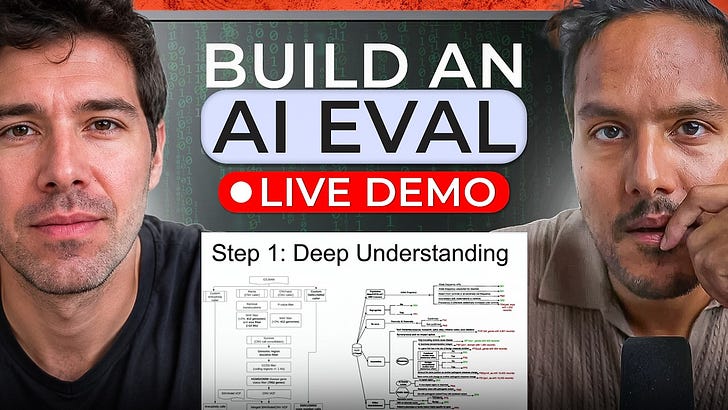
How to Build Frontier-Lab Quality Evals with Daniel McKinnon, ex-PM at Meta, Google
2w ago00:56:57Summary readyToday’s EpisodeA developer posted this workflow in March, and it is the clearest picture of where PM is heading that I’ve seen all year.Rasty Turek spent the past year building with coding agents, and he mapped how his process changed over that time. He reckons he now spends around 90% of his time on evals. His eval started as QA, and then it became the spec.Great, now everyone agrees evals are important and will become indispensable for PMs going forward. But there is very little on how to write one.That changes today.I’ve now done 6 episodes on evals, and all of them start with an agent that is running and failing. So what do you do on day 0?Daniel McKinnon was a PM on the Llama models at Meta, a boomerang who spent around 7 years there in total. He sat on Facebook’s central AI team for the entirety of its existence. He wrote enterprise evals for Gemini, Llama, and Ray-Ban Meta.His first job at Meta was on the speech recognition team. He had to figure out how to check whether the models were any good. They weren’t called evals back then. But he’s been writing them for his entire career anyway.In this episode you’ll learn:* How to build an eval set from nothing* The floor-and-ceiling method for calibrating* How to score it and make the shipping callCheck it out:Please fill out this short survey on PM salaries.🆓 I’m doing a free webinar Thursday on getting AI PM interviews. Join me:The next cohort of my LandPMJob program starts in August. If you want my 1:1 coaching, sign up.----Check out the conversation on Apple, Spotify, and YouTube.Brought to you by:* SerpApi - Get started with SerpApi using 250 free credits.* Product Faculty - Get $550 off their #1 AI PM Certification with code AAKASH550C7* Ariso - Ship AI agents and features faster, with fewer regressions* Land PM Job - 12-week experience to master getting a PM job* Pendo - The #1 software experience management platform----Key Takeaways:1. An eval is a trivia question for the model - At its core, an eval is a prompt with a correct or plausibly correct answer plus a way to score whether the output is good. It is the clearest way to communicate what your product should do in the AI era.2. Offline evals catch problems before you ship - Test the model offline against a fixed prompt set before pushing to production. If it fails, you change the model, the prompt, or the approach before real users ever see it.3. The best eval sits between too easy and too hard - An eval that scores 100% gives your engineering team nothing to optimize. An eval that scores 0% is equally useless. Aim for a 25% to 50% success rate so there is room to run.4. Old benchmarks are already saturated - MMLU, HellaSwag, ARC and the rest were built for a simpler question-and-answer world. Frontier models now score effectively 100% on them, which is why you have to keep building new evals and throwing away old ones.5. Writing an eval is mechanical once you understand the problem - Come up with roughly 100 prompts that match the real distribution of tasks. The hard part is not the writing. It is deeply understanding the domain first.6. Subject matter expertise drives everything - The cystic fibrosis and congenital heart disease evals worked because Daniel understood the genetics, not because of any template or tool. There is no eval template the way there is a PRD template.7. Modern evals are agentic, not just Q&A - The genetics eval hands the agent a file with billions of variants and asks it to find the cause of a disease. This is a task, not a lookup, and it mirrors how real AI products now work.8. Find the model ceiling on purpose - The easy cystic fibrosis case gets solved by most models. The harder digenic congenital heart disease case exposes where even strong models fail. Knowing the ceiling is the point of the exercise.9. Sample multiple times before you trust a result - Models are non-deterministic. Run the same task several times so you understand the real distribution of outcomes rather than a single lucky or unlucky pass.10. Meta and Google build products very differently - Google is seen as more engineering-led, Meta as more product-led and far more aggressive culturally. Daniel worked on both Gemini and Llama and saw everything from Llama 3 highs to Llama 4 lows.----Where to find Daniel McKinnon* LinkedIn* X* Gamow LabsRelated contentPodcasts:* AI Evals with Hamel Husain and Shreya Shankar* How to Run Evals in Claude Code with Aparna Dhinakaran* Evals are the New PRD with Ankur GoyalNewsletters:* AI Evals for PMs: Everything You Need to Know to Get Started in 2026* AI PM’s Guide to LLM Judges* AI Evals Explained Simply----PS. Please subscribe on YouTube and follow on Apple & Spotify. It helps! This is a public episode. If you'd like to discuss this with other subscribers or get access to bonus episodes, visit www.news.aakashg.com/subscribe
Summary
The PM's Guide to Governance with Eric Ries, author of The Lean Startup
3w ago01:19:43Summary readyCheck out the conversation on Apple, Spotify, and YouTube.Brought to you by* Land PM Job - 12-week experience to master getting a PM job* Jira Product Discovery - Plan with purpose, ship with confidence* Amplitude - The market-leader in product analytics* Bolt - Ship AI-powered products 10x faster* Product Faculty - Get $550 off their #1 AI PM Certification with code AAKASH550C7----Today’s episodeEvery startup founder picks up Zero to One. Reads the chapter on Delaware C-Corps. Files the paperwork. Moves on.That paperwork will outlast every product decision they ever make.I sat down with Eric Ries, the man who created Build, Measure, Learn. NYT bestselling author of The Lean Startup. Co-founder of Answer.AI with Jeremy Howard. Founder of the Long-Term Stock Exchange. Dario Amodei called him before Anthropic’s seed round.His new book Incorruptible drops May 26. It is the blueprint for building a company that the financial system cannot capture.He also demoed live how he wrote the book using Solve It, the AI platform from Answer.AI. Not prompting. Not generating. Editing the model’s responses directly.If you are building anything you want to outlast the next funding round, this is the one episode to watch.Check out the episode on Apple Podcast and Spotify.If you want access to my AI tool stack, grab Aakash’s bundle.----Key Takeaways:1. Governance has four dimensions - Compliance is table stakes. Purpose, coherence, and integrity are the three most boards ignore. Companies that nail all four outperform the market over decades.2. Financial gravity destroys good companies - The unconscious reflex to comply with the values of those who have more than you. Jim Senegal called it heroin. You compromise once and it gets baked into the forecast.3. Costco's governance fortress is the blueprint - Staggered board terms, poison pills, fiduciary hierarchy. $10K at the Costco IPO is worth $8.7M today versus $151K in the S&P 500.4. Stone does not enforce itself - Johnson & Johnson carved values into limestone. Asbestos ended up in the baby powder. $10B settlement. Structure protects ethos but does not create it.5. Mission lock vehicles create 6x survival - A separate entity holding the for-profit board accountable. Novo Nordisk, IKEA, Patagonia, Hershey, Vanguard all use this structure. 60% survival to year 50 versus 10%.6. Anthropic's LTBT took two years to defend - AI safety experts appoint board seats. The trust gains power as the company hits milestones. Structural protection is why Anthropic can afford to be courageous.7. Public Benefit Corporations write mission into the charter - Legal permission to pursue purpose over shareholder value. Not the B-Corp certification sticker. A legal structure.8. LLMs are conformity machines - They produce the center of the outcome distribution. For competitive advantage you must change how you use AI.9. Solve It enables human-in-the-loop writing - Edit the model's responses directly. 600 test readers, 10K structured comments, Python scripts organizing feedback per chapter.10. Build Measure Learn works at any timescale - Not about absolute speed. Relative velocity versus your industry convention. The AI labs that release more quickly create decisive trust advantages.----Where to find Eric Ries* LinkedIn* Incorruptible* Answer.AI / Solve It* Long-Term Stock Exchange* Lean Startup----Related contentPodcasts:* AI Product Strategy with Aman Khan* The Marty Cagan Episode on Product Management* How to Succeed as a Head of Growth with Dan OlsenNewsletters:* AI product strategy in 2026* How Cursor grows* PLG in 2026----PS. Please subscribe on YouTube and follow on Apple & Spotify. It helps!If you want to advertise, email productgrowthppp at gmail. This is a public episode. If you'd like to discuss this with other subscribers or get access to bonus episodes, visit www.news.aakashg.com/subscribe
Summary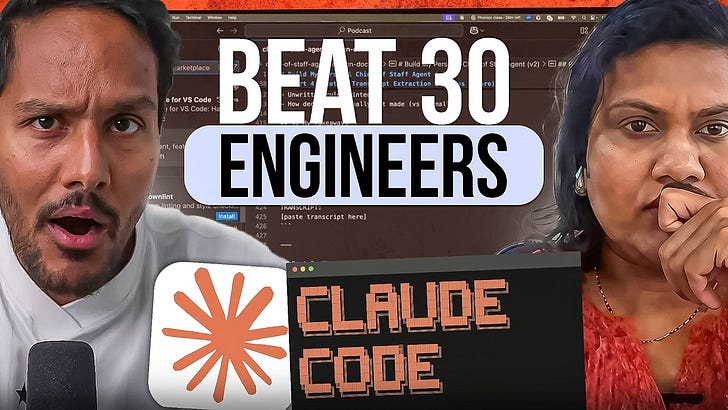
Claude PM Masterclass from Former FAANG AI PM Jyothi Nookula
4w ago01:33:20Summary readyToday’s episode“This one’s too complex. I’m still stuck on ChatGPT.”I get some version of that DM every week, usually right after I publish something on the PM OS or the Team OS. And every time, I feel it, because those guides do assume you’re already up and running.So I made this episode for the person sending the message. Jyothi Nookula has been an AI PM since before that was a title, through Netflix, Meta, and Amazon, and I asked her to take a PM from zero to eighty on the entire Claude stack in one sitting.She walks through:The five-layer Claude stack, so you finally know which surface and which model to reach for and whenA chief of staff you build in Claude Code that reads your meetings and quietly learns your org, your people, and your politicsThe self-improving agent loop she used to beat 30 engineering teams at an internal hackathon, as a PMEverything she shows is something she runs at work, which is the only reason any of it holds up.Send this to the PM in your life who keeps saying they’re behind. Two hours from now, they won’t be.----Brought to you by:Hyper Agent: Turn your recurring PM work into reusable agents----If you want access to my AI tool stack - Dovetail, Arize, Linear, Descript, Reforge Build, Relay.app, Magic Patterns, Speechify, Bolt.new and Mobbin - become an annual subscriber ($150), and grab Aakash’s bundle.If you want access to my AI PM customizations - PM OS, Job Search OS, and Prompt Library - become a founding subscriber ($250).----Key Takeaways:1. Match the model to the job - Sonnet handles ninety percent of PM work at the best cost. Save Opus for genuinely hard reasoning, and hand fast bulk jobs to Haiku. Defaulting to the smartest model for everything just burns time and money.2. Stop skipping the knowledge layer - Projects, skills, and memory are what make Claude know your actual work instead of guessing from a blank slate. Almost everyone underinvests here, and it is the difference between a chatbot and an assistant that knows you.3. A skill beats a prompt - A skill is a saved playbook Claude picks up on its own when it fits the task. It only loads when needed, so it never clogs the context window. Build one once and stop re-explaining the same task forever.4. Write your skills yourself - Human-written skill files consistently beat AI-written ones. Draft with Claude to move fast, then layer in the domain knowledge only you have. That last step is what makes it actually work.5. Automate your time based work - A morning brief, a standup summary, and an end-of-day wrap can all run on a schedule while you sleep. You walk in already knowing what needs your attention. It clears the busywork that eats your mornings.6. Give your automations guardrails - Cap the length, tell them to stick to facts, and never let them hallucinate. Left unchecked, an AI brief will pad itself and invent things. A few hard rules keep it sharp and trustworthy.7. Build a chief of staff that learns your org - Point Claude at your meeting notes and let it build a picture of your people, your priorities, and your politics over time. Feed it transcripts first, since they carry the richest signal. It compounds into something no generic chatbot can match.8. Keep that knowledge base on your own laptop - Your most personal work data does not belong in someone else's cloud. When you leave a company, it walks out with you. You keep full control of your most sensitive context.9. The PM job is changing fast - The ratio is shifting from one PM per eight engineers toward two PMs per one. Building is becoming part of the role, and the PMs who can ship are pulling ahead.10. Building is easy now, taste is scarce - When anyone can build, the edge moves to knowing what is worth building and what good actually looks like. That judgment is the one skill you cannot download.----Related contentGithub repo: https://github.com/fibbonnaci/ai-builder-skillsPodcasts:How to Become an AI PM - YouTube | Spotify | AppleHow a VP Uses Claude Without Producing Slop - YouTube | Spotify | AppleThis CPO Uses Claude Code to Run His Entire Work - YouTube | Spotify | AppleNewsletters:I Built You Memory for Claude Code, Hermes, and OpenClawI spent 100s of hours building a PM OS for youHow to build a Team OS in Claude Code----Where to find Jyothi Nookula:LinkedIn: https://www.linkedin.com/in/jyothinookula/NextGen Product Manager: https://nextgenproductmanager.com/Where to find Aakash:Twitter/X: https://x.com/aakashguptaLinkedIn: https://www.linkedin.com/in/aagupta/Newsletter: https://www.news.aakashg.com---PS. Please subscribe on YouTube and follow on Apple & Spotify. It helps!If you want to advertise, email productgrowthppp at gmail. This is a public episode. If you'd like to discuss this with other subscribers or get access to bonus episodes, visit www.news.aakashg.com/subscribe
Summary
The PM's Guide to AI Design that isn't Slop
Jul 901:14:45Summary readyToday’s episodeToday I’m showing you, advanced Codex workflows with Meng To, founder of Design+Code.He told me early on that he’s barely touched Claude. He’s been living inside Codex every day since launch, running a setup most PMs have never seen up close.Plan mode and a fleet of 20 agents running at once while he steps away from his desk entirely. Slides, charts, and full brainstorms generated inside the same chat window, reviewed, regenerated, and shipped, all without writing a line of code.We also get into something heavier than workflows.Why PMs are losing their jobs to layoffs right now? And how to future proof your career?Don’t miss....----Brought to you by:Arize: Trace, evaluate, and fix your AI agents before broken behavior ships to users----If you want access to my AI tool stack - Dovetail, Arize, Linear, Descript, Reforge Build, Relay.app, Magic Patterns, Speechify, Bolt.new and Mobbin - become an annual subscriber ($150), and grab Aakash’s bundle.If you want access to my AI PM customizations - PM OS, Job Search OS, and Prompt Library - become a founding subscriber ($250).----Key Takeaways:1. Codex is a fleet operator - Meng runs 20 agents at once while stepping away from his desk entirely. Each one works on something different, slides, charts, brainstorms, while he does something else completely.2. Plan mode isn't optional - Skipping it means paying twice, once to build the wrong thing, once to undo it. Codex returns a full breakdown, architecture, steps, and open questions, before touching anything.3. A screenshot beats a paragraph every time - It shows the AI what you mean instead of what you think you mean. A simple two-key shortcut drops any window straight into the chat as context.4. The taste skill is the real differentiator - Without it, AI design defaults to generic. With it, the output looks like something a senior designer with years of experience actually made.5. Trust is earned in tiers - Read only first, then supervised access, then full access. Skipping straight to full access before learning where the AI tends to fail is how people get burned.6. HTML beats Figma for speed - Every extra tool is a login, a subscription, and a context switch the AI can't do for you. Keep your blast radius small.7. UGC won because audiences are tired of corporate polish - A synthetic version of you, used honestly, reads as more human than a generic message. Ten old photos is all it takes to build a digital twin.8. Technical PMs aren't surviving layoffs because they write code - Meng hasn't written a single line in six months. They're surviving because they're fluent enough to direct a fleet of agents and catch a wrong output before it ships.9. Meng builds his own tools when nothing off the shelf fits - His own video editor, his own SaaS templates, his own design brainstorming app. The tool built for your exact workflow beats the popular one every time.10. The bar isn't five star anymore - Five star is just the floor everyone clears by default now. The real question is what six, seven, all the way to eleven star looks like, because that ceiling rises exactly as fast as the floor does.----Related contentPodcasts:How to Design with AI - YouTube | Spotify | AppleHow to Use Codex Like an OpenAI PM - YouTube | Spotify | AppleThe Ultimate Guide to ChatGPT Codex - YouTube | Spotify | AppleNewsletters:OpenAI’s Codex is the Best Way to Use ChatGPTI spent 100s of hours building a PM OS for youHow to build product strategy in the age of AI----👨💻 Where to find Meng To:LinkedIn: https://www.linkedin.com/in/mengtoDesign+Code: https://designcode.ioAura: https://aura.build👨💻 Where to find Aakash:Twitter/X: https://x.com/aakashguptaLinkedIn: https://www.linkedin.com/in/aagupta/Newsletter: https://www.news.aakashg.com---PS. Please subscribe on YouTube and follow on Apple & Spotify. It helps!If you want to advertise, email productgrowthppp at gmail. This is a public episode. If you'd like to discuss this with other subscribers or get access to bonus episodes, visit www.news.aakashg.com/subscribe
Summary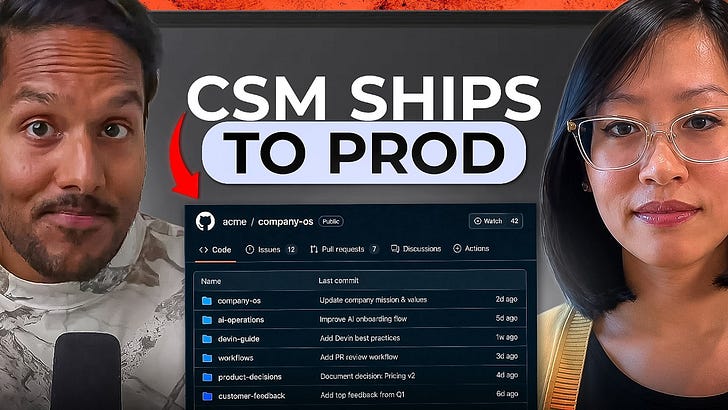
How to Build a Company OS in Claude Code with Jiaona Zhang, CPO at Laurel
Jun 2401:07:59Summary readyToday’s episodeProduct teams have figured out AI for engineering. The PMs are using Claude. The engineers are in Cursor. If you’ve been reading this newsletter from the start, you’ve seen how the top 1% are using AI to 10x their output. But there are still teams at companies like Adobe, teams in sales, customer success, finance, who don’t have access to any of these tools. You ask them what AI to use for their next task, and you get a blank stare.That gap is the real problem. And it compounds every day.Jiaona Zhang “JZ” has built the fix. She is the CPO at Laurel, which just raised $100M in Series C, and she has led product at Airbnb, Dropbox, Webflow, and WeWork. Today she runs a product team that ships frontend and backend features end to end, without any engineering handoff.In this episode, she screen-shares everything. Laurel’s full Company OS built in GitHub, with skill files for every function from CS to legal to finance. The playbook to agent pipeline that turned 50-page docs into automated workflows. The daily Slack briefing that tells every person exactly what to do and which skill to use when. And a ton more.This is one of the densest episodes I’ve ever recorded. The knowledge per minute is as high as it gets.Don’t miss.....----Brought to you by:Ariso - Ship AI agents and features faster, with fewer regressionsBolt - Ship AI-powered products 10x fasterPendo - The #1 software experience management platformProduct Faculty - Get $550 off their #1 AI PM Certification with code AAKASH550C7Customer.io - Send smarter messages using your product data----If you want access to my AI tool stack - Dovetail, Arize, Linear, Descript, Reforge Build, Relay.app, Magic Patterns, Speechify, Bolt.new and Mobbin - become an annual subscriber ($150), and grab Aakash’s bundle.If you want access to my AI PM customizations - PM OS, Job Search OS, and Prompt Library - become a founding subscriber ($250).----Key Takeaways:1. Every company has a 1% who are AI-native and a 99% who do not know what to use when. The Company OS closes that gap by encoding the 1%'s workflows into skills that anyone can use when they open Claude.2. Build the ontology before you build the OS. Map every team's work to categories and tasks first. Color-code what should get more human time vs what gets automated. The OS is built from that work map.3. Even the friction of going to a different interface kills adoption. A separate agent tool in a new tab will not get used consistently. Deliver skills and automations inside Slack and email, where people already are.4. When AI adoption is everyone's responsibility, it is no one's responsibility. Dedicate one person full-time to AI Operations. Start with one person who demonstrates value. Every other function will want their own version within months.5. The Company OS turns a 50-page playbook into a set of agents. Write the playbook first. Then audit it. What requires a human? What can be automated? Build the skill files from what remains.6. The captain model replaces the handoff chain. Every feature has one owner end-to-end. The captain is whoever has the most critical skill for that feature's hardest problem.7. PMs at Laurel ship front-end and back-end features. Not just growth experiments or copy changes. Core product features deeply integrated with billing systems and time entry logic. One PM who identifies as a designer shipped one of these end-to-end last month.8. JZ went from hundreds of reports to 5 PMs and 4 designers. They ship more than ever. Adding people adds coordination cost. In a world where one PM can take a feature from discovery to production in a day, large teams cancel out their own capacity gains.9. The new PM interview is a screen share. JZ asks every candidate to show their actual screen. In 60 seconds she knows their level of AI skills.10. The PM fundamentals never changed. Problem space first. Know why and for whom you are building before you build. The speed changed dramatically. What you are supposed to be doing at the heart of it did not.----Related contentPodcasts:How a VP Uses Claude Without Producing Slop - YouTube | Spotify | AppleHow to Build a Team OS in Claude Code - YouTube | Spotify | AppleHow to Become a Builder PM - YouTube | Spotify | AppleNewsletters:I spent the last week building an OS in Claude CodeI spent 100s of hours building a PM OS for youHow to build product strategy in the age of AI----Where to find Jiaona ZhangLinkedIn - https://www.linkedin.com/in/jiaona/Reforge - https://www.reforge.com/profiles/jiaona-zhangLaurel - https://www.laurel.ai/Where to find Aakash:X - https://x.com/aakashguptaLinkedIn - https://www.linkedin.com/in/aagupta/Newsletter - https://www.news.aakashg.com---PS. Please subscribe on YouTube and follow on Apple & Spotify. It helps!If you want to advertise, email productgrowthppp at gmail. This is a public episode. If you'd like to discuss this with other subscribers or get access to bonus episodes, visit www.news.aakashg.com/subscribe
Summary
How a VP of Product Uses Claude Without Producing Slop | Matthew Wensing, Customer.io
Jun 900:50:17Summary readyToday’s episodeThere are hundreds of guides on writing PRDs with Claude. Dozens on running user interviews. Almost nothing on how a VP of product actually uses it.Matt Wensing is VP of Product and Design at Customer.io. They crossed $100M ARR, just shipped an AI agent, and are one of the fastest growing companies in B2B SaaS right now. I asked him to show me his actual documents, his actual Slack threads, and the exact sessions where Claude helped him produce leadership grade output.What he showed me changed how I think about AI for leaders. Claude has the instincts of a brilliant new hire, it wants to deliver before it fully understands what you need, and at the VP level that gap shows up fast. Matt has spent months figuring out how to manage it, and in this episode he shows you everything.----Brought to you by:LogRocket - Find the bugs killing your conversion before your users do. I ran a head-to-head eval to see if that's true.----If you want access to my AI tool stack - Dovetail, Arize, Linear, Descript, Reforge Build, Relay.app, Magic Patterns, Speechify, Bolt.new and Mobbin - become an annual subscriber ($150), and grab Aakash’s bundle.If you want access to my AI PM customizations - PM OS, Job Search OS, and Prompt Library - become a founding subscriber ($250).----Key Takeaways:1. Take inventory before you open Claude - Before building anything, list every piece of raw material you already have. Zoom recordings, strategy docs, past presentations. The quality of what you feed Claude determines the quality of what comes out.2. Pivot content, do not write from scratch - Claude's best use case is transformation, not creation. Give it two inputs and ask it to reorganize one into the shape of the other. Matt calls this matrix multiplication.3. Build slides first - Build the visual story first. Screenshot the finished slides and feed them back into the same Claude session. Ask it to write a talk track that adds depth using all the context it already has, not one that just repeats the slide.4. Kill eager suggestions immediately - The moment Claude asks if you want it to generate the next thing, say stop. You control the pace. A 200-iteration session with a great deliverable beats saying yes to the first draft every time.5. Start sessions in the abstract - If you reveal the domain too early, Claude pattern matches to the nearest template. Keep it abstract. Build a clean mental model first. Reveal the domain only when the framework holds up on its own.6. Layer complexity in slowly - Start with the simplest version of the framework. Let Claude stabilize on the basics before you add exceptions. Dumping everything in at once produces a lost in the woods experience for both of you.7. AI alignment decks always backfire - When you one-shot an alignment deck, you flatten the problem. Senior executives have spent months living with the real complexity. They feel the thinness immediately, even when they cannot say why.8. Decompose the problem before building anything - Challenge yourself to explode a nasty problem into all its pieces before you touch Claude. Put those observations into the context window first. Then assemble the solution.9. The Slack scanner keeps leaders close to the ground - Customer.io built an AI scanner that monitors dozens of Slack channels and surfaces threads where a product person should be involved. It runs continuously without overwhelming. 10. Chiefys audits your strategy docs automatically - Chiefys is a Slack bot that holds Customer.io's ratified company documents and checks new work against all of them. It flags contradictions and stale documents so nothing goes invisible after you ship something new.----Related contentPodcastsPM’s Guide to Claude - YouTube | Spotify | AppleHow to Become a Builder PM - YouTube | Spotify | AppleWe Built an AI Product Manager in 58 mins - YouTube | Spotify | AppleNewslettersHow to Use Claude for WorkHow to Build Product Strategy with Claude CodeThe PM OS----Where to find Matthew Wensing:1:1 Video Consultation: https://intro.co/MattWensingLinkedIn: https://www.linkedin.com/in/wensing/X: https://x.com/mattwensingWhere to find Aakash:X: https://x.com/aakashguptaLinkedIn: https://www.linkedin.com/in/aagupta/Newsletter: https://www.news.aakashg.com---PS. Please subscribe on YouTube and follow on Apple & Spotify. It helps!If you want to advertise, email productgrowthppp at gmail. This is a public episode. If you'd like to discuss this with other subscribers or get access to bonus episodes, visit www.news.aakashg.com/subscribe
Summary
How to Use Codex Like an OpenAI PM | Abhi Muchhal, PM OpenAI (ex-Meta and Nubank)
Jun 301:07:07Summary readyToday’s episodeSix months ago, I told you Codex is the best way to use ChatGPT for PM work.Most of you tried it. Some of you stuck with it and very few of you are running it the way the people who built it actually run it.Today we get that inside look. Abhi Muchhal is an International Growth PM at OpenAI. Before that, Meta, Nubank, and a founder building on the OpenAI API. He is one of the people responsible for ChatGPT’s growth in India, Brazil, and Japan, markets that are now driving a meaningful share of OpenAI’s 900 million weekly active users.He opened his actual setup on camera. The harness. The automations. The prompts that actually work. And the ones that failed before he figured it out.----Brought to you by:Bolt.new - Ship AI-powered products 10x fasterProduct Faculty - Get $550 off their #1 AI PM Certification with code AAKASH550C7Customer.io - Send smarter messages using your product dataAriso - Ship AI agents and features faster, with fewer regressionsJira Product Discovery - Plan with purpose, ship with confidence----If you want access to my AI tool stack - Dovetail, Arize, Linear, Descript, Reforge Build, Relay.app, Magic Patterns, Speechify, Bolt.new and Mobbin - become an annual subscriber ($150), and grab Aakash’s bundle.If you want access to my AI PM customizations - PM OS, Job Search OS, and Prompt Library - become a founding subscriber ($250).----Key Takeaways:1. The harness is what separates Codex users from Codex runners - The connectors, the permissions model, and the skills layer are the three components that make Codex a system rather than a chat tool. Without all three, you are using an expensive autocomplete.2. Generic prompts hit the wrong data - Abhi's team had separate B2C and B2B tables that both matched "tell me about weekly active users." The generic query returned the wrong answer every time. Specificity is the skill, name the exact dashboard and the exact metric, looks simple but saves a lot of time when you scale.3. Three permission levels - Read tasks get full autonomy. Synthesis and drafts get full autonomy. Anything going to another human gets your eyes first. Treating permissions as binary, all control or all autonomy, breaks.4. The person who cares most builds the skill - One OpenAI growth team built a skill that automates their entire experiment review process. It writes the hypothesis, monitors the run, and prepares the review doc.5. Real automations run without you - Abhi runs three automations before he opens a single dashboard: a Slack triage, a 9:30AM self-refreshing growth dashboard pulling from 7-8 sources, and a weekly stakeholder update that writes its own first draft. He reviews, makes edits if needed, and sends.6. Prototype before you document - Build the working prototype first, then write the 10-question companion FAQ. Showing engineers something that runs changes the conversation from whether to build to how to build it.7. India is OpenAI's second largest market and under 10% of working adults are knowledge workers - The ChatGPT use case that drove US growth does not reach the same share of people in the markets driving the most new users. Building for the world means knowing how different the world actually is.8. The WhatsApp computer use loop ran in 68 seconds - Point Codex at the WhatsApp desktop app. It reads what you missed, identifies action items, checks your calendar, and types the draft in the composer. One tap to send. Every PM building for international markets should run this workflow at least once.9. Speaking evals is the key to breaking into a frontier lab - Name a capability you care about. Describe how you would measure it. Say how you would know if the model improved. You do not need 50 evals under your belt. You need to understand why they exist and what a good one measures.10. Building something real is non-negotiable for frontier lab applications - Abhi had a live Chrome extension running on the OpenAI API at the time of his application.----Related contentPodcasts:The Ultimate Guide to ChatGPT CodexHow PMs Ship 100K Lines of Code at OpenAIEvals are the new PRDNewsletters:OpenAI’s Claude Code KillerAI Agents Guide for PMsHow to Land a $300K+ AI PM Job----Where to find Abhi Muchhal:LinkedIn: https://www.linkedin.com/in/abhimuchhal/OpenAI:LinkedIn: https://www.linkedin.com/company/openai/Where to find Aakash:X: https://x.com/aakashguptaLinkedIn: https://www.linkedin.com/in/aagupta/Newsletter: https://www.news.aakashg.com---PS. Please subscribe on YouTube and follow on Apple & Spotify. It helps!If you want to advertise, email productgrowthppp at gmail. This is a public episode. If you'd like to discuss this with other subscribers or get access to bonus episodes, visit www.news.aakashg.com/subscribe
Summary
How PMs Ship 100K Lines of Code at OpenAI with Ryan Lopopolo, Member of Technical Staff
May 2501:14:45Summary readyToday’s episodeMost companies are still debating whether PMs should ship code.OpenAI is already debating the best ways for PMs to ship code.They’re living in the future.The builder behind a lot of that harness engineering is Ryan Lopopolo. He wrote the OpenAI post on harness engineering and runs a frontier team where PMs, designers, and engineers all ship using the same system.The wild part for me? His PMs shipped around 100K lines of production code.Did they open the IDE? Hell no! Their coding happened through PRDs, tests, docs, and harness rules. The model did the typing.As someone who spent a decade in PM growth roles, I’ve seen how long it takes to move a feature from PRD in a doc to code in prod. For most companies, that latency is weeks.In Ryan’s world, it can be days, and the PM is inside the loop instead of watching from Jira. So I wanted to get to the bottom of this:* What does the harness look like when PMs can ship like that?* How do engineering teams set PMs up so they don’t ship slop?* What changes in the EPD trio when code is cheap, and validation is the bottleneck?That’s today’s episode, and I come with receipts as Ryan goes deep.----Check out the conversation on Apple, Spotify, and YouTube.Brought to you by:* Product Faculty - Get $550 off their #1 AI PM Certification with code AAKASH550C7* Bolt - Ship AI-powered products 10x faster* Customer.io - Send smarter messages using your product data* Ariso - Ship AI agents and features faster, with fewer regressions* Pendo - The #1 software experience management platform----* If you want access to my AI tool stack - Dovetail, Arize, Linear, Descript, Reforge Build, Relay.app, Magic Patterns, Speechify, Bolt.new and Mobbin - become an annual subscriber ($150), and grab Aakash’s bundle.* If you want access to my AI PM customizations - PM OS, Job Search OS, and Prompt Library - become a founding subscriber ($250).----Key Takeaways:1. Code is a liability, not an asset - Every engineering org was built around the assumption that code is expensive to produce, validate, and deploy. Codex inverts this. Code is now the cheapest part of the stack and the constraint moves to how clearly you describe the problem.2. The new constraint is product decisions per week - With code generation effectively free and parallel, the bottleneck is no longer keystrokes. It is the quality of the brief, the clarity of the architectural boundaries, and the speed of verification.3. A billion tokens a day is the new floor - Ryan's claim is that if you are not running this volume you are negligent. The math comes out to roughly $2K to $3K per engineer per month, which is trivial against the headcount cost of human-only execution.4. A single PR can burn 350 million tokens - One refactor that would have taken Ryan three weeks ran on Codex for 60 hours straight across three days. He gave it two prompts total after the initial spec. The output matched what he would have produced himself.5. The harness is the actual product - Codex CLI is the surface. The harness is everything that gets the agent the right context at the right phase. Pre-work, messy middle, and close. Each phase needs different context, different tools, and different verification.6. agents.md is forcibly injected context - This file lives in the repository root and is always loaded into the agent's context. Use it for the operating model and the non-negotiable rules. Everything else gets pulled in dynamically because context is a hard, scarce resource.7. The painted-door technique works inside the codebase - Ryan's team enforces package boundaries so a designer can paint a fake UI on top of stubbed APIs. Real usage signal, no backend cost. This only works because the architecture refuses to permit a ball of mud.8. The PM's PRD can become a shipped PR in one week - In Ryan's setup, the PM wrote a markdown PRD, the team reviewed it in a Monday meeting, and a working feature shipped to customers by the following week with zero PM-to-engineer back-and-forth.9. The Monday morning roadmap starts with legibility - The first move is making the repository legible to the agent. Write the implicit team decisions down in a documentation tree. Use @-mention Codex to keep that tree updated whenever a Slack thread surfaces a new guardrail.10. One agent beats multi-agent handoffs - The lossy friction of agent-to-agent handoffs costs more than it saves. The right answer is one agent with full addressability over design, backend, and frontend, powered by a model good enough to hold the whole task in context.----Where to find Ryan Lapopolo* X* LinkedIn* OpenAIRelated contentPodcasts:* How to Run Evals in Claude Code with Aparna Dhinakaran* How to Build a Full AI Dev Team in Claude Code with Gabor Mayer* This CPO Uses Claude Code to Run His Entire Work Life with Dave KilleenNewsletters:* PM’s Guide to Claude with Pawel Huryn* How to Become a Builder PM with Mahesh Yadav* How to Build a Team OS in Claude Code with Hannah Stulberg----PS. Please subscribe on YouTube and follow on Apple & Spotify. It helps!If you want to advertise, email productgrowthppp at gmail. This is a public episode. If you'd like to discuss this with other subscribers or get access to bonus episodes, visit www.news.aakashg.com/subscribe
Summary
How to Run Evals in Claude Code with Aparna Dhinakaran, Founder and CPO of Arize
May 2201:19:32Summary readyToday’s episodeMany of the smartest AI teams I know are running their evals on Arize. Teams at Uber, Booking.com, Pepsi, and others.It’s become one of the most important skills for PMs. I already had on the CEO of Braintrust, Hamel Husain and Shreya Shankar, and Ankit Shukla.Today I’m adding to this knowledge base on evals with a masterclass on evals in Claude Code.Aparna Dhinakaran is the founder of Arize. She’s also their CPO. And she gives a masterclass in how to run all of your evals through Claude Code.So if you want to do AI evals like the best, like Uber, like Booking.com, check out this episode. For anyone in building in Claude Code, it’s a doozy.If a candidate did this in an interview, Aparna said she would hire them on the spot.----Check out the conversation on Apple, Spotify, and YouTube.Brought to you by:* Superhuman - The fastest email experience ever made* Sign up and get 1-month free of Superhuman Mail with my link: superhuman.com/akash (given by brand - Kartik)* Land PM Job - My 12-week AI PM + Job Search Course, first 10 enrollees get a FREE 30-min 1:1 consultation* Vanta - Automate your compliance. Close deals faster* Product Faculty - Get $550 off their #1 AI PM Certification with code AAKASH550C7* Bolt - Ship AI-powered products 10x faster----If you want access to my AI tool stack - Dovetail, Arize, Linear, Descript, Reforge Build, Relay.app, Magic Patterns, Speechify, and Mobbin - grab Aakash’s bundle.Do you want to become an AI PM? I’ve created a course for you. Starts soon.----Key Takeaways:1. Trace before you eval - A trace is the full step-by-step playback of what your agent did. Without it, you have no evidence base for evals. Every LLM call, every tool call, every intermediate output needs to be visible before you write a single eval.2. A span is your unit of evaluation - A span is one discrete step inside a trace. Evals run at the span level, not the trace level. "Did this specific scoring step get the priority right?" is a more useful question than "was the whole run good?"3. Instrumentation is now a one-command job - Claude Code's instrumentation skills can set up observability for your agent automatically. Arize Phoenix's skill looks at your codebase, identifies the LLM calls and tool calls, and wires them to the tracing layer. No engineering support required.4. The vibe eval is a draft, not a verdict - An LLM can suggest what your evals should test by looking at your traces. That suggestion will not know your bug-first policy, your comp logic, or your definition of "critical." Treat it as v0 and refine against your actual judgment.5. When evals fire, two things could be wrong - The agent produced a bad output. Or the eval is miscalibrated. Reading the flagged span yourself is the only way to know which one needs fixing. Both are normal. Both are good news.6. Evals drift and need regular realignment - Your priorities change. Your bug policy changes. Your product changes. An eval calibrated to last quarter will start misfiring this quarter. Regular alignment to human feedback is maintenance, not a failure.7. The self-improvement loop is already running at the best teams - Fetch all spans where evals fired. Group by failure category. Propose a specific prompt fix. Review and approve. Ship the new version. This loop runs on a schedule and requires a human at the approval step.8. Enterprise PMs: start with one internal agent - Not a customer-facing product. An internal tool that takes four hours off your week. Once you have it, you will naturally want to trace it. That is when observability starts to matter to you personally.9. The context graph is the enterprise unlock - Agents are only as useful as the context they have. Enterprise data lives in silos. The teams breaking through are building unified context layers that give one agent access to CRM, Gong, analytics, GitHub, and Slack.10. Product taste is still the alpha - Code is cheap now. Shipping speed is table stakes. The PMs who pull ahead are the ones with the sharpest judgment about what to build, and the loops that make their agents better every day.----Related contentPodcasts:* AI Evals with Hamel Husain and Shreya Shankar* Evals are the new PRD with Ankur Goyal* AI PM Crash Course with Aman KhanNewsletters:* AI Evals for PMs: Everything You Need to Know to Get Started in 2026* Your Complete AI PM Course & Career Roadmaps* AI PM’s Guide to LLM Judges----PS. Please subscribe on YouTube and follow on Apple & Spotify. It helps! This is a public episode. If you'd like to discuss this with other subscribers or get access to bonus episodes, visit www.news.aakashg.com/subscribe
Summary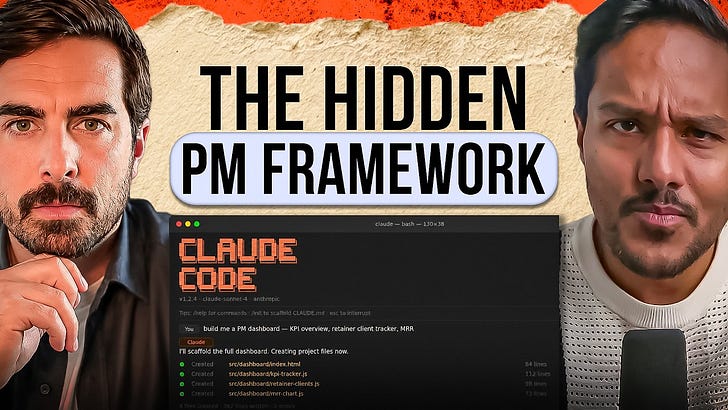
Claude Code for Non-Technical PMs, with Andre Albuquerque
May 1801:09:38Summary readyToday’s episodeThe market is looking tough for non-technical PMs.Every single week, my comments look exactly the same: brilliant product managers who have the vision, specs, and roadmap in mind, but have zero coding skills. They want to build, and while thousands of technical resources exist online, they make a flawed assumption: that you already know how to code.So when I invited Andre Albuquerque on my podcast, I had to ask him to share his setup. Andre is the founder of Builders Camp, a product school with 4,000+ students across 30 countries, who runs five businesses with Claude Code and has never been a developer.Live on the episode, he built a fully functional product from scratch to show how easily a non-technical PM can go from 0 to 1. He also walked me through CLAUDE.md architecture, custom multi-agent skills, and the bridge between Lovable and Claude Code (which, by the way, not many people are talking about).If you have been putting off Claude Code because it feels too technical or intimidating to set up, this episode is absolutely for you.----Check out the conversation on Apple, Spotify, and YouTube.Brought to you by:* Customer.io —* Amplitude — The market-leader in product analytics* Bolt — Ship AI-powered products 10x faster* Arize — Ship AI agents and features faster, with fewer regressions* Product Faculty — Get $550 off their #1 AI PM Certification with code AAKASH550C7----* If you want access to my AI tool stack - Dovetail, Arize, Linear, Descript, Reforge Build, Relay.app, Magic Patterns, Speechify, Bolt.new and Mobbin - become an annual subscriber ($150), and grab Aakash’s bundle.* If you want access to my AI PM customizations - PM OS, Job Search OS, and Prompt Library - become a founding subscriber ($250).----Key Takeaways:1. Non-technical PMs are stuck in Jira, Linear, and PowerPoints - Most European PMs are still product owners in disguise, paper-shuffling between strategy and engineering teams. The way out is to actually start building, not to lobby for more autonomy.2. Start with Lovable on a personal project - Build something for your family, your friends, yourself. The codebase does not need to be pretty. The point is the safety to make mistakes without breaking anything that matters.3. The Lovable + Claude Code bridge nobody documents - Connect both tools to the same GitHub repo. Write code in Claude Code with all its depth. QA visually in Lovable with its hosted preview. Publish from Lovable's button. The perfect transition layer.4. Lovable, Cursor, and Vercel are not competitors - Lovable bundles the IDE, the hosting, and the deployment in one product. Vercel exposes the hosting layer so you can run real branches with real preview URLs. Cursor is just an IDE with a generous free tier.5. Cursor has a free debugging agent - When Claude Code breaks, open a Cursor agent and paste the error. The free agent unsticks you instead of leaving you stuck at step zero.6. CLAUDE.md is your team's culture - Loaded automatically every session. The first rule should be "for every task, call the PM agent." When you notice yourself fixing the same issue twice, update CLAUDE.md so it never happens again.7. The PM agent never writes code - The PM orchestrator's only job is to decide which other agent should handle the work. The researcher investigates. The designer proposes. The engineer architects. The implementer writes.8. Do not copy famous people's skills wholesale - Going on LinkedIn and downloading 100 skills from product celebrities creates more confusion than value. Look at how your real team works. Write each role down as an agent.9. Fix the agent, not the feature - When something ships wrong, do not patch the output. Identify which agent in the pipeline failed, update its instructions, and run the pipeline again. The next session inherits the fix.10. The Monday morning move is exactly three steps - Get added as a collaborator on a low-risk repo. Pick the oldest ticket in the backlog. Push a branch and demo by Friday.----Related contentPodcasts:* Claude Code and agents with Gabor Meyer* n8n, Claude Code, and OpenClaw with Mahesh Yadav* Claude Code with Hannah StulbergNewsletters:* How to Build a Full AI Dev Team* How to Become a Builder PM* How to build a Team OS in Claude CodeP.S. Reply with “CLAUDE” and I’ll send you Andre’s actual CLAUDE.md template. He said we could share it.PS 2. Please subscribe on YouTube and follow on Apple & Spotify. It helps!If you want to advertise, email productgrowthppp at gmail. This is a public episode. If you'd like to discuss this with other subscribers or get access to bonus episodes, visit www.news.aakashg.com/subscribe
Summary