← ProductLed Podcast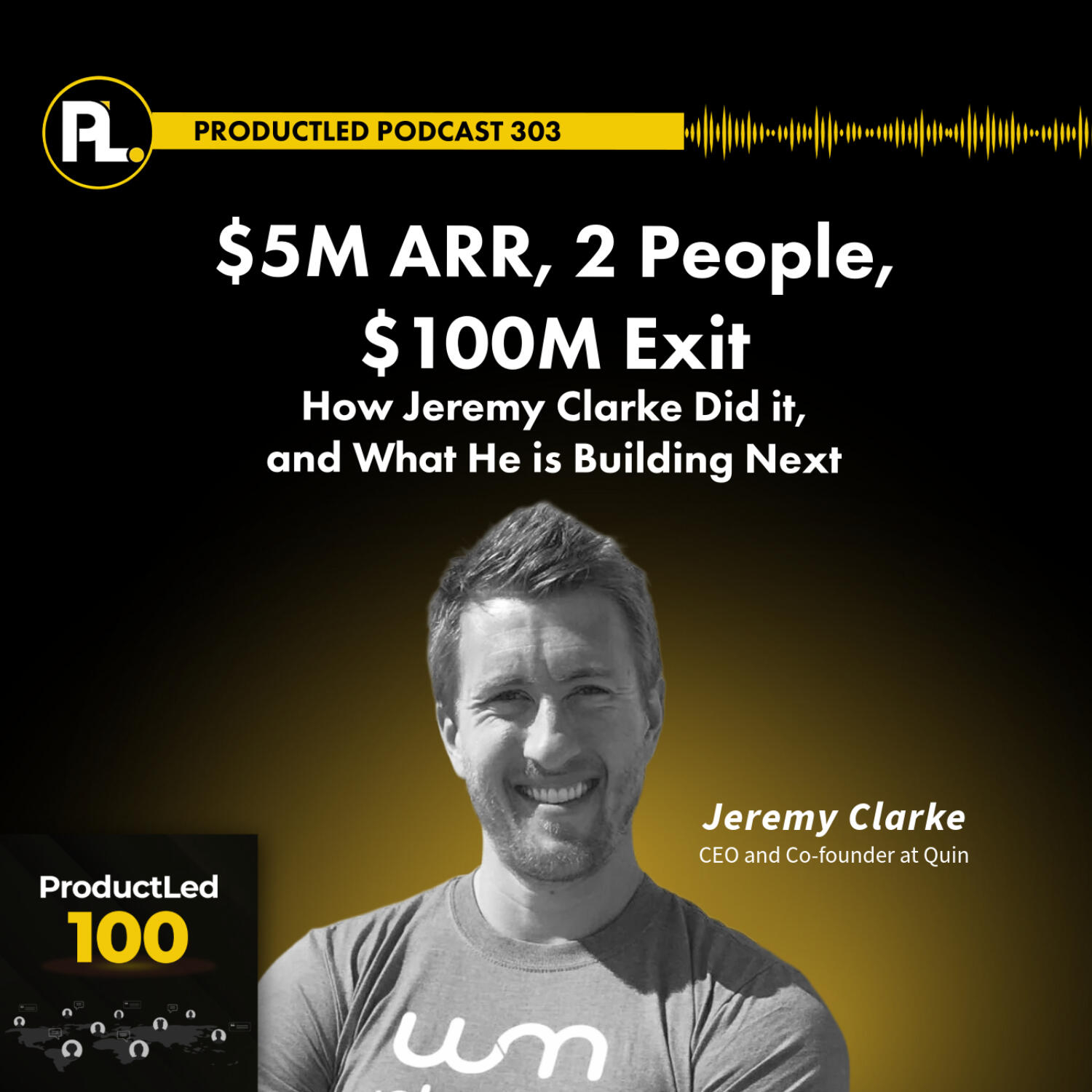
ProductLed Podcast
$5M ARR, 2 People, $100M Exit — How Jeremy Clarke Did it, and What He is Building Next
00:54:50
Loading summary
Transcript58 lines
- [00:00]
Jeremy Clark
Webmerge had a really good kind of word of mouth. Like we didn't really have a marketing team. We did blog posts, we had good SEO and we had good relationships with our partners. A lot of it just came, word of mouth and it just kind of grew. We never had to go spend a bunch of money to get customers. Like they just kind of came to us. It's hard to replicate that.
- [00:16]
Esmond
So you eventually sold the business, right? What made you reach that position?
- [00:19]
Jeremy Clark
We're coming up to the realization that, okay, we're going to have to hire somebody soon. In hindsight, it was a very profitable business. Ultimately had a really good outcome from the whole thing. It was a very good outcome come. But had I not sold, I think I'd much better off now. The company continued to grow well, everybody in that deal, like it worked out well.
- [00:44]
Podcast Host
Hello everybody. Welcome to another episode on the product led podcast. Today we have a fantastic guest. His name is Jeremy Clark, who has bootstrapped a company called web merge to 5 million ARR and then sold it for over a hundred million just a few years ago. And so it's a fantastic story of a bootstrap company. And one of the things I did leave out there is he did this with just two employees and he didn't hire anybody until about 2 million ARR. So just fantastic story going through it. And so in this podcast you're going to learn three things. One is how do you actually exit for the a hundred million dollar? And really just what are some of the things that contribute to that? What is the playbook to build a very lean company to be able to do this. And you're going to learn how important it is to really be focused on doing one problem. Solving one problem.
- [01:37]
Jeremy Clark
Very, very, very good.
- [01:39]
Podcast Host
Another thing is you're going to think about how to actually hire people. So Jeremy refers to the, what are the leverage moments at the time when you know it's actually you do need to hire somebody else. We also talk a bit about just how right now it's actually a lot harder to grow a SaaS, but it's on the other end way easier to actually build one. So you're going to learn a ton in this podcast like I did. Let's dive in. Yeah, so we were just going through like some of the research on like Web Merge, some of the other things you've done on like I know you talked to Greg from the Practical podcast as well, or Practical Founders Podcast and just give you a little context too on like our audience, most people listening to this, they're product led founders. So they, they use like a free trial freemium motion to grow their business and they do want to build a big business with a tiny team. And I think your web merch store is amazing to kind of prove that. Esmond as well, I don't know how much you know about him, but he, he grew user flow from 0 to 4,6 mil. ARR exited with it. There was three people, two founders. So yeah, also pretty similar on that story. But yeah, I know you're also working on the app Quinn. Is that like where most of your time goes today or.
- [02:51]
Jeremy Clark
Yeah, yeah, most of my time is there and then I race on the side. But that most of my work time is, is towards Quinn right now.
- [03:00]
Podcast Host
Nice. That's cool. And how's that going for you so far?
- [03:04]
Jeremy Clark
It's going, I mean it, it's a whole, you know, this, this new space is, it's difficult than it was, you know, back when I started Web Merge. The things that I've learned at Web Merge were, you know, just good product gets you a, get you a long way. And we were able to kind of find a little niche and really, you know, exploit that niche. And it worked really well. And huge margins. You know, I had, I think the biggest struggle with, you know, Quinn now is, you know, with Web Merge, my margins were, I don't know, 98%. Like every new customer I brought on was like pure profit. And now it's every new customer I bring on, I have to like scratch out a profit. Like I have to try to get profitable on them. And so it's just a completely different landscape. It's harder to reach people. And so I'm, I'm learning what I, you know, what I had with Web Merge and that's been what you probably with user flow is like you kind of had lightning in a bottle and it's hard to, it's hard to replicate that.
- [04:01]
Podcast Host
Yeah, because I was going through your website too, and it's interesting. I was just immediately thinking of like, okay, you're competing with Pfizer on the email front. Then you're competing with like Fathom and Grain.com and like all the other meeting recorders on that end. And I'm like, oh, like this is a really tough battle to duke it out because each of those has a very specialized motion of just solving that one problem. Now there is benefit. Absolutely. To like, you know, combined all these into one and eliminate busy work. I feel like it will go that way eventually. But how are you Thinking about just kind of. Yeah, solving that problem. Because there's one. Positioning is like, okay, how do we stand out? But then the second part here is really not just standing out, but like gaining that distribution advantage, especially because margins are really low when it comes to AI enabled products.
- [04:53]
Jeremy Clark
Yeah. I think the biggest thing that we're kind of focused on is trying to really lean in on delivering the, like, the thesis. Like our North Star is essentially like, yeah, we compete with all those, you know, specialized tools that in a lot of cases, to be honest, if that, like, if you really need an awesome note taker that just does note taking really well, you could save videos, you can do all this stuff. You still need to go use a fathom of Fireflies. Like that's what it's built for. Like, we're built to kind of help mimic a human assistant. And that's really what we're trying to like lean in on is, you know, you can text with Quinn, you can email Quinn Slack, just kind of, it just can go off and do things. I think with now like openclaw and Claude work and stuff like that coming out. Like, that's kind of what we've been building this whole time versus kind of like Fireflies competitors. As that starts to gain, you know, more popularity, I think a lot more people will kind of be exposed to what Quinn is doing because that's kind of ultimately what we're doing. Except we're taking the like, setup and like the learning and like, you just sign up for Quinn, you connect your tools and you go like, there's no. You don't have to spend all this time learning how to train your own agent and do all these things like that. That's the value that we've brought in is kind of being able to do that. And so from a distribution standpoint, we're really trying to lean in with our integration partners that we have. But again, it's another landscape that's just changed completely in the last 10 years. When I built Web Merge and we built integrations, we had a lot of integrations and they love. We did tons of stuff together. And now like, we can't even get people to respond to our emails. Like, hey, we want to integrate with your product and do these. Like, they don't even respond to us. It's. It's like, I don't. What's the point of a partner team if you don't do your job and like respond to emails? Like, it's. It's insane to me. It just, it's Completely different. Like people, I don't know, I don't know what it is, but the ecosystem they don't quite understand of like how integration partners are, can be a massive benefit to both distribution and stickiness to their product. Like the moment you don't allow somebody to integrate with another tool they want to use, like, they go off and they try to find a different tool that does. And so, yeah, that's a whole nother tangent, but that is a big thing that we've learned.
- [07:21]
Podcast Host
I'm curious, like, to hear your playbook for Web Merge. Was it, was, was it not like getting a lot of integrations because it was just you and then you eventually hired a strategic salesperson and that was the whole business that took you to 5 million?
- [07:36]
Jeremy Clark
Yeah, I mean the, the really, the kind of evolution of the product was, you know, I started off very small with a very specific solution. We allowed you, we gave you a WYSIWY editor and we allowed you to add like little merge tags and you could generate a PDF and email it. Like that was the initial version of Web Merge. And like that, you know, solved an immediate problem that I saw in the market. And then as time went on or as we, you know, got new customers, the feedback came in, people started requesting more things and eventually evolved into different template types, you know, word PDF, like fillable PDFs and then came, okay, now we need to send these documents different places. And that's when we got into the integration game. Outgoing integrations as well as incoming integrations to like send data to webergen. And the core, the core product of what it did, like took document or took data in, populated a document and sent it out. Like that core piece of, you know, generating the document didn't really change in the last five years of the business. And so eventually we got to a point where, yeah, it was integrations. So just integrate with as many different things as we can. I mean, luckily we were top 100 Zapier forever, but we were one of their first integrations once they kind of opened up the platform, like they built their first 50 to 100. And then once they opened that up, like we were like one of the first ones to get kind of published. And so we, we had a ton of ton of customers that were using Zapier. So that luckily helped us kind of expand that quickly. But also Internally we had 30, 40, maybe more integrations that kind of let people do direct with, you know, without zapier. And then the second part of that was distribution. So when I brought on the strategic sales, it was just like we just need go, go, go. And it was, we found a lot of ecosystem partners, like integration systems people.
- [09:37]
Podcast Host
So were they more of like a partnership person versus sales or did they do a bit of both? Whereas like, hey, enterprise wants to use this. Great, sign up the contract here and then also can you work on that integration over there to get that locked and loaded?
- [09:51]
Jeremy Clark
Yeah, I mean it was definitely both. I still did a lot of the like tech partnership side, like integrations, but Gabe is the kind of strategic hire that we did. And he, he definitely wore both paths of, you know, sales, but partnerships from. He would. A lot of his effort was on like Salesforce ecosystem partner, like the integration, the people that are going in and helping clients set up their orgs within Salesforce, like that's who we tried to get in. We demoed our product, we gave it to them for free. Another nice thing that you know, we could do back when the web merge days, like we could just, hey, use our product for free. You know, it didn't cost us anything. Now we tried that at the beginning of Quinn of like, hey, use our product and all of a sudden like our usage spiked and like we were getting like it just was costing us money. And it doesn't like, didn't make, doesn't make any sense to give people a free product anymore. Which is kind of frustrating.
- [10:45]
Podcast Host
It's kind of interesting. I know we, we talked to another podcast guest earlier this week and there's the same thing. It's like you can have like all the metrics if you want to like blow up your free plan and give away like very generous AI credits and everything. But there's that fine balance of like, yeah, I want to show you the value of the product so you can see it for yourself. But then on the other hand, it's not a charity. Like we're still running a business here and I know they had like they were paying tens of thousands of dollars for some free accounts and they're just like, what are we doing here?
- [11:19]
Jeremy Clark
Especially because it's like, you know, you, you eventually want to get that money back. So like, and if you have, you know, 30%, 40%, maybe 50% margins, like you have to sell a lot of product to even, just break even on what you gave away and then hopefully, you know, make a long term business, like the financial is just, they don't work like they used to.
- [11:40]
Podcast Host
And what were the early days of web merch like when you first launched it? I'm just kind of curious Because I know when we were chatting at the beginning, you're like finding that like almost like a needle in a haystack in an industry where you're like, hey, it's a very specific problem, a very great timing, a lot of factors that just kind of worked in your favor. And then we were also talking with the founder of Typeform. And it was interesting because, like, they had no plans on creating, you know, Typeform as it is today. But then they're like, oh, all these like, you know, agencies and other people are asking for this because they love the forms we have for our clients and so shareable. We'll throw it out there. And then they're like looking at their account the next week. They're like 8,000 signups. Like, are you kidding me? So curious. Like, was it big kind of knee jerk reaction like that when you first launched or was it like a slow trickle and then you got an integration here and then it just kept growing organically? Like, what did that look like?
- [12:31]
Jeremy Clark
Yeah, that's a funny story in type form. It's, it's the exact story of how formstack got started too. Like they had these agencies, they built these forms for their clients and people loved it. So. And they all kind of start at the same time. So they go through like these generational businesses just kind of all kind of start in the same way at the same time. It's very interesting how that happens. But with Web Merge, yeah, it was more of a slow trickle, you know, you know, the quick backstory. I, I worked with formstack, I was on their team as a contract at the beginning and then kind of brought on. But this idea kind of spurred out of kind of work I was doing with formstack. And so when, you know, I built Web Orange, launched it, built the integration, I sent out emails to forms like formstack customers who had asked about this feature, like being able to generate a PDF from, from data. And so that was kind of how I seeded the first customer base. But it wasn't anything massive. It was, you know, I mean, emailed maybe 50 people. And you know, I think out of, you know, the first year it was definitely a slow ticker. And then it just kind of just kept compounding. It never had the like, you know, exponential huge hockey stick growth. But the first couple years we had like quadruple and triple just because of small numbers. But I think, you know, over time, you know, we were still, When I hit 5 million, we were still doubling every year. And so it was just like A nice compounding every year from that, but it was a. Years. Seven. Seven years to get there. Not definitely not the 8,000 signups in a week for sure.
- [14:05]
Esmond
But one thing, and by the way, one thing I love. You keep saying we, but it was pretty much you, right, Jeremy, who did this. But I understand coming from userflow, we also said a lot of we. What kind of. When did you go all in on it then? Because you were at formstack, right, and you were seeing some early traction. When did the. Did you decide to quit your job and kind of go all in on this? And I heard that formstack allowed you to do it, even though it was almost like a formstack feature. How did that happen?
- [14:35]
Jeremy Clark
Yeah, as an interesting event. I mean, essentially, you know, as I said, I kind of came up with as a list idea while working at formstack and I was like, hey. And I took it to like, leadership the CEO, and I was like, hey, I think this, this could be another, like a separate big product. We, you know, gave him all these use cases. And I was like, what if we should build this? And like, man, how do we. You know, he didn't agree. I was like, do you mind if I go off and build it? So I went off and built it, and then once it was ready to go, I was like, okay, second chance. Here, here's what it looks like. Here's what we can do. Do you. Do you want to partner up on this? Like, you know, we can kind of make it a joint venture type thing. And again, he's like, nope. But he's like, you can run with it. So. So I ran with it nights and, you know, nights and weekends. Kind of launched a product and that was. I launched it late 2012 or late 2011. So 2012 was kind of the first. The first year I stayed on at Formstack till 2015. And the reason in, I was making more in one month with web Merge than I was making in my entire year salary at formstack when I left. And the reason I stayed was the whole reason I actually started at formstack because, like, before formstack, I was doing web development and I had clients and I just sat in my, you know, at the time, my apartment all day by myself. And I just needed, like, it was. I needed a social environment. And so I didn't want to lose that. Like, that was a. I really enjoyed working with the people at formstack and in kind of that social environment. So I definitely stretched it out farther than I probably should have. But yeah, I stayed on for a while and the, you know, eventually it was, you know, again in 2015 is when I officially kind of left Formstack. And it was just time like it was, you know, I was able to focus more time on what I was doing. I had, you know, I had moved to California. I kind of had a new life I was trying to get into out here and just kind of a culmination of events was finally what was like, okay, now, now is the time. But yeah, I definitely stayed longer than I probably should have.
- [16:36]
Esmond
And, and do you think the reason why you were bootstrapping the business was because you were actually working at formstack at the same time so you didn't need to like raise capital or anything to pay yourself or how did you. Was it very intentionally that you wanted to bootstrap? Bootstrap? Because at user flow, we were definitely very intentional about that due to past experience. I don't think you had any like prior startups or anything like that. So what, what was the reason for you deciding to, to basically bootstrap the business?
- [17:04]
Jeremy Clark
Yeah, I, I think it was probably two things. I think first was I didn't know how big the business could be, you know, and when you, when they started this off, I was like, okay, this, this could be a good business, but like, is it like VC business? You know, I never really thought of it that way and so the thought of like going out and raising money actually didn't really cross my mind that much. And the other one was I don't do well with authority. And so like the thought of having bosses and someone like, look, I don't like that feeling. So I mean, same thing. Now I run a venture studio in Quinn. It's all self funded. We could go out and probably raise a good round right now, but I, I'm not sure I want to do that. Like, I think I like, I like to control my own destiny. So I think that that's, that was a big factor is I was probably, I just, I wasn't confident in like, you know, going out and pitching these people and be like, oh, this could be this a hundred million dollar business. And then in 20, it was probably around the same time, 2014 maybe there was another, there's another player in the Salesforce ecosystem that was similar to Web Merge, but like just in the Salesforce ecosystem it turned out to be like a private equity deal. And so they made it sound much bigger than it. The headline was they raised like $80 million and I was like what? Like this business that I'm doing, basically the same thing. Like, they just raised $80 million. Okay, this actually, like, that means they actually do have some decent revenue. This actually could be something big. And that's when it kind of like, okay, I switched and started to kind of really think of it more as, like, okay, this actually could be something really big.
- [18:39]
Podcast Host
And when you started this business too, was the intention of, like, hey, I just want to design something small and keep it small for the. The whole time being, or was it more just like, nah, I don't want to hire people on the team because when I hear like, two people to 5 million, it's like, hey, that's. That's a really lean company. But what was that intentional or just like, out of, hey, this, we don't need any more people, we got it solved kind of thing? Because nowadays you could do that much easier. But back then, it's like that. That must have been a lot harder. There's a lot less AI tools to support. Like, all those other things that do suck up a lot of time.
- [19:14]
Jeremy Clark
Yeah, I would say it was intentional, but not like, at the outset. Meaning, like, I didn't go into this of like, oh, okay, I want to pick this, build this business and not hire a bunch of people. It was. I. I just kept. It just kept growing and I was like, oh, like, this is easy. Like, I, you know, I keep adding all this revenue. The nice part with Web Merge was you could add all. Most of the work was like, customer support and things like that was like the first month or two. And then after, like, they understood how web merch work. They. You never really heard from again. So you just keep getting paid and you, like, never hear from them. As, you know, more people signed up in the trial phase, that was what was making me more busy. But as long as, like, that didn't, like, just go explode, I could kind of keep up pretty good. And then the revenue just kind of compounded. So I just never really had to think about it too much. And so it wasn't intentional. And like, I don't want to hire people, but I did, I did enjoy not having, like, I don't want to manage people. Like, I Even now, like, I, you know, run this venture studio. We. It's just a team of four, but there's a lot that you have to. I'm more managing people now, and it's different. And so I think that I made the right decision back then in that stage of like, I wanted. If I hired somebody I wanted it to be like a, you know, a turning point. Meaning like, you know, if I hire them, okay, it's going to give me like 3x. Like something's going to matter. It's not just going to keep the train going, it's going to like turn it up. And I wasn't confident until I hired Gabe that like, okay, I brought Gabe in because starting to get to a point where I needed some, I needed a face to the business. I, I, I'm, I work better behind the scenes. I don't like going to conferences. I don't, you know, I will because it's, you know, I'm the founder, I have to. But if I can have someone else who really feeds off of that social energy and, and gets out there, that's who I want to be. Kind of, they're doing that and so like that's where I saw an inflection point and kind of, okay, we can have someone out there doing that. But everything else was, I was able to kind of quickly do and my hunch was correct because when we kind of sold private equity, we actually merged back with Formstack and their support team took over. I could answer 20 support tickets in the time that someone could read one support ticket. Like it just is so much faster for me to do stuff than just hire somebody, pay them a bunch of money, train them like all this stuff. It was just so much easier for me to do it.
- [21:40]
Podcast Host
So on the support, since I know Esben has an opinionated take on support. Esben, share your take on that. And then I'm curious if it resonates with Jeremy and if it's the same.
- [21:51]
Esmond
Yeah, first of all, so userflow was very similar in the sense that the load of support was very equal to the number of trials. So whenever you had new trials you would get more support and then after a while it would kind of calm down. You would always have the usual suspects who would keep coming back with questions. Not always the highest paying customers for
- [22:13]
Jeremy Clark
some reason, but it's always the lowest.
- [22:15]
Esmond
Yes, unfortunate. But yeah, I mean my take on support, and I assume Jeremy says the same, is that it's really good to be close to support because you are then in the feedback loop with the customer. So if you are also the ones building the product, that feedback loop becomes really, really tight knit and you end up building a better product and you end up solving support issues in the product instead of solving them by just keep on answering the same question. If you've had the Same question for 10 times just say let's just fix this in the product and not hear about this again. So you feel the pain a lot more when you're close to support. So that's my take on it. But I would say the user flow was also acquired and we did hire some supporters while I was there. I would actually say it, it was, it was nice to have somebody else there to help and support as long as it's the right people. Because it would take some load of me being available 24 7. So, so I think there, there is a balance there. But I definitely feel it's, it's very powerful to be close to support and as the people building the product.
- [23:24]
Jeremy Clark
Yeah, absolutely. I, I couldn't agree more. I. Being close to support, obviously I had to be because it was just me. But I think that as you said like you have the close feedback loop with customers, you see what they're going through, you see what's happening and you can fix stuff, you can build things quickly. Like couple big things that happened for us was I could just wow people of like, hey can I do this? And like give me a day. And I would go off and build a new integration or build a new feature like, you know, just iterating quickly and it like blew their minds and like they were just like fans forever. The other thing we did was a lot of professional. In the early days I did a lot of professional services helping you know, people that didn't want to learn how to set up a, you know, a template, merge fields, they felt it's too technical. So I was like oh, problem, I'll you know, pay me thousand to that, whatever it was, depending on how big the project was, like pay me some money, I'll set it up for you and we're good to go. But I actually used that as like, what can I build product? Like improve the product essentially, like to deliver this project I need to improve the product. So I'm getting paid to develop new features as well as kind of locking these people into long term contract. So that worked out really well. The. Yeah, handing off to support is, is hard when it was just you for a while, you have to just kind of let go. I think I, I talked to Wade at Zapier about this years ago, but he kind of went through the same thing of like when they started hiring people he had to just like stop checking support because when he would go in and see, you know, too many open support tickets or look at the responses that people were doing, it just like drove him nuts. And so he just kind of had to like, shut it off completely. And I. You do kind of. It is this weird balance of, like, when you do eventually kind of move away to support so you can focus on, you know, ultimately more important things, you just kind of have to shut it off. Because if you kind of sit there and you get in the weeds too much, it. They're never going to answer it. Answer the questions like you do. And so you, you have to be really, like, diligent in just kind of letting them do their thing. They'll eventually learn and catch up and do a good job, but you just kind of have to let them. Let them do it.
- [25:28]
Esmond
So you eventually sold the business, right, Jeremy? What made you reach that decision? You were generating a lot of revenue. You were just two people at the time. You were, you sold, right? Thing was 5 million. ARR. So you were doing great, probably paying yourself a nice salary. Why did you sell?
- [25:43]
Jeremy Clark
Yeah, it's a good question. I think in the, at the time we were going, you know, growth is good. We're coming up to the realization that, okay, we're going to have to hire somebody soon. Like, it's, it's doable. We're. We're doing fine, but like, eventually we, we got to bring on that support person. We got to bring on somebody to kind of help do this. And so that was kind of weighing on me, like, do I want to go through this, hire people, start to manage, have to like, set all that stuff up, like, whatever it takes to do all those things. Meanwhile, we've had a, you know, decent amount of inbound interest two year, a year before, kind of I sold maybe a little bit more. Like, kind of got our first actual offer. It was really low, but like, like, the interest was starting to go. And so I had, you know, this PE firm reach out and we had some discussions. Ultimately, I was just like, now it's, you know, they kind of threw out some soft, soft offers of like, what the. What they were thinking. And I was like, oh, no, it's too low, too profitable, too. Too many things. And so we, that we played that dance for, I don't know, six months. They would like, reach out every couple months and kind of re. Engage. And eventually, you know, they came up with something that was interesting. And you know, the, the thing that I liked about what the, the PE deal was was I could, you know, kind of take some chips off the table because right now, you know, it's. It's me, one other person business that in all hindsight you know, is a feature of a lot of other companies. Like, anybody could build this feature and kind of like cut us off at the knees to a certain degree. Like, we still have a good. The nice part about Web Merge was it worked with everything and so the companies don't have to do a lot. But if one of our big customers was like, hey, we're going to offer PDF generation, it could siphon off a lot and who knows what that could do the business. So it gave us the opportunity to take some chips off the table, but also combine into a much larger story that I can roll over a lot of that equity into a new business and take a second chance at it. And so I really like the economics of it. The two big factors were I might have to hire somebody soon, and I'm not sure I actually want to do that. I'd rather hand it off to a team that's already kind of established and then just kind of, you know, playing the odds. Like, do I want to keep all my eggs in one basket for. For a while? I don't know. But yeah, in hindsight, it was a very profitable business, ultimately had a really good outcome from, you know, kind of the whole thing. It was a very good outcome. But had I not sold, I. I think I'd be much better off now. I think the company continued to grow. Well, it continued to be super profitable. I think everybody in that deal, like, it worked out well for. For absolutely everybody. That was cool.
- [28:30]
Podcast Host
But do you think going back to your unique ability, is it you would say, just building the initial tech, getting out to the market and seeing, hey, this is what works? Or like you mentioned also, like, there's scalers like Wave, that Zephyr had to go through the same thing of like, okay, if I'm going to jump on the train of, like, learning the new skill set of scaling a company with a lot more people, do I really want to do that? So where are you now in that decision? Like, you have a venture studio, you have Quinn as well. And so it is going to eventually get to that point too, where there is maybe a bit more people to manage. So I'm curious, are you still wrestling with that part of, like, okay, do I jump on that scalar train or just stay as more of a builder? And there's nothing wrong with staying as a builder too. I totally look up to a lot of builders.
- [29:20]
Jeremy Clark
Yeah, I struggle with it. It's hard. I mean, I think, you know, with even just again with the venture studio we've got, I've got three other people, partners basically, you know, they're partners and so we've had this discussion many times. Like that's been our thesis of you know, the products that we've built. Like we, you know, build kind of, we try to build kind of niche. Even though Quinn is a broad solution. We've, we've tried to really niche into like a specific, you know, problem that we're solving but kind of going after niches without having to. It doesn't need to, we don't need to raise a bunch of money, we don't need to hire a bunch of people. Like how can we run this as lean as possible? Like that's been our kind of goal from the start. Eventually yes, we will have to hire and you know, we've got one of our partners is going on maternity leave here soon. So we're going to be a man down and we're trying to figure out how to best. It'll be interesting to see whether how we do like all three or if we kind of are strained and we need to hire somebody to kind of come in. We've talked about just kind of lower level hires just to kind of get, get stuff done for us. You know, we kind of handle the high level strategic things but we just need someone in there to just like grind out the day to day stuff and, and kind of help us kind of keep up. But as far as scaling up a large team, yeah, I don't know if that's for me. I, I think that you know, as much as I, I enjoy building, you know, when I sold the business I kind of exited it completely after the next turn. So I stayed on at Formstack or the new kind of venture for two, three years and then I kind of completely kind of got out, took some time off, took about a year, year and a half off and really what I came back to is I just enjoy tinkering and building. I'm definitely a builder. I like kind of trying to solve problems, trying to do these things and managing people, managing a big team is. I'm not sure that it's a hundred percent what I want to be. I think it's doable if for the right opportunity. But I think I lean back to my instincts which is the builder side.
- [31:18]
Esmond
Awesome. By the way, you're very David Okunev who was the co founder of Typeform, he's also doing a venture studio building small businesses. So very similar. But one thing I'm thinking because I'm hearing you like to build and so on but it also sounds like something changed, right? You are no longer maybe that energized anymore to do the all the operational stuff that comes with building a startup, right. So how has the motivation maybe changed? Because now you are, I assume you, you got a good exit from. And by the way, it's funny, that was Omstack that eventually became the Acquirer which was full circle but you got a good exit. So what's the motivation now? Right? Like I know it from myself. Like motivation definitely, you know, gets impacted when you already succeeded. We're not all Elon Musk who keep building one $1 billion or trillion dollar company after another. So how do you think about that and the whole motivation for building the next startup?
- [32:18]
Jeremy Clark
Yeah, it's funny. So as I said I in 2021 is kind of when I fully exited Web Merge and Formstack and you know, as I said I, I took some time off, I started racing cars, I started doing all these different things just like, oh, I surfed every day just trying to like do something completely different, figure out what I want to do next and ultimately came back to building. But what happened was I don't want to, I didn't at the time want to go through the grind of like, oh, I got to go the startup grind and do all that stuff again. So that's when I kind of brought together Gabe who I worked with at you know, Web Merge, who was there and then two other partners kind of brought them in because I wanted a team to kind of okay, I'll, I'll build it, you guys go take it to market, you, you kind of figure out how to make this a business. And that was kind of the original thesis of the venture studio. And my plan was, you know, I build, you know, it's kind of a part time thing for me. They work full time and are just out there trying to do it. And now that I'm in from almost day one I was working full time like it was, it's hard not to. And especially now with Quinn where you know, things are going so well and it, it the opportunity cost of me not, you know, being in it 100% is just too high. And so you know, what started off as me trying to do something just like scratch an itch and you know, have a, you know, a good thing because as you said, it's been like the motivation we'd have to build something really meaningful for it to actually be meaningful. And so other than just like spinning your wheels the other side of why kind of I'm doing, you know, the venture studio is, it's kind of my way of giving back to you know, most of the partners on the team, like they helped in some way with kind of the web merge formstack journey. So it's kind of my way of giving back to them and hopefully giving them kind of the same outcome that I had with, with web merge. And so that's also kind of driving motivation. Not just kind of a good exit for me but also kind of like okay, how can I. It's my way of you know, giving back and kind of helping someone else's story come true as well.
- [34:22]
Esmond
And then, then I guess another big thing that happened is AI, right? AI has, is this new shining object that, that everybody want to learn about get into. Did that have a impact on your decision to go back as well?
- [34:39]
Jeremy Clark
You know, funny enough I out of the everybody on the team, I am the least in the original I was the least impressed by AI and as a builder I'm still. The technology still isn't where it needs to be. Luckily it's still giving us the ability to deliver a good product. And what I've had to learn is I'm a very, especially with computers and everything, like I'm so systematized and I can just do things so fast because I'm doing the same things over and over again. I'm doing whatever. And so to me the, you know, drafting an email, doing these things, it's really simple for me. I'm also not a, you know, my emails are a sentence or two. I don't actually ever write like long emails. So it's, it's not hard for me. But the majority of people out there who are doing some other job, whether it be, you know, a lot of people that were kind of talking to our financial advisors or other kind of like people to people relationship kind of business. And so like they spend most of their time wanting to talk to people, wanting to do these things. And so like the computer work, the note taking, the record keeping, like all that is just super time consuming for them with no benefit in. It's hard for them to do that. And so like where AI can come in and just kind of help get those things done for them. They see it as this like game change, absolute game changing technology. Like they're, you'll watch a demo of us showing and obviously they've had experience with a lot of AI at this point but even like once they kind of see what Quinn can do it just like the light bulb in Their head just like explodes. Like, it's just so many cool things. And it's taken me a while to warm up to that of like, because I'm just like, for me, I want the technology to be where it hopefully will be at in like three to five years. Like, I want that now because, like, that's what's going to really impress me. But I think the technology of where it's at now, luckily, is still good enough for us and everybody to be able to deliver a really interesting product and help a lot of people. For sure.
- [36:43]
Podcast Host
That's interesting. I mean, we had Winston, who is building a portfolio of one person, portfolio companies as well. And one of the things we chatted with him on the podcast was the importance of picking an industry where there's not a lot of like, hey, we gotta update you on the product. We gotta do a lot of services to get you up, to really get the value. And so I'm curious how you decided this is the industry, this is the problem we want to solve. Because I think for people listening, it's important to think about this because you could end up solving a problem where you're like, actually to solve that, it's quite intensive. You need people. It's not just a product problem. And so that's not to say like, you can't create a great business if you, you still need people. I mean, like, look at Salesforce. I'm like, they're pretty big, but it's not necessarily the easiest to scale. A company where you have to rely on like a lot of professional services to get them up to value.
- [37:39]
Jeremy Clark
Yeah, I mean, you know, the, the kind of arc evolution of Quinn is actually like, we didn't start off in, in this area. Similar, but not really. Like, the original thesis for Quinn was we, we had this kind of relationships through our first kind of venture studio product that we had was a, an end of life planning tool that I built. Actually before I started the venture studio, this was kind of my first kind of tinkering I did. So it was a tool that allowed you to kind of keep track of your will and bank accounts and all the things like in case something happened to you, like your family would have access to those details. That way they, they just knew it didn't have any like sensitive information, but just like knew exactly where things were. It was kind of the same thing when I had Web merge, I had a little thumb drive that I hit that I had hidden in my house that like in case I got hit by a bus, it had all the like server details, who to contact, like all the passwords that were needed. So it was just like this in case of emergency thing. And so kind of digitized that. And our original kind of go to market with that product was financial advisors. They work with like their little like free thing that they do for new clients is help them get a will, a lot of relationships with financial advisors. And that product ended up, you know, we kind of shelved it. But anyways, through those relationships we kind of thought of an idea of like, okay, these people want to maintain relationships with people. And the tool that we can provide is one that helps keep track of personal details, whether it be, you know, kids names, vacations are going on, like whatever it may be. And then period. It can help you send periodic just like check ins like hey, you know, how was you know, Susie's dance recital last month? Or you know, hey, I, I know you're a big Lakers fan. What'd you think of the trade, you know, or the game last night, like whatever it may be. And we used, we kind of kept track of that information and then used kind of a bit of AI as well as just kind of just search APIs and different things to kind of surface this information. We did a lot of research before we built this product. People like really wanted it. They're like, yes, absolutely, want to use it, Took it to market. What we found out is the people want to use it, but it was actually adding things to their day so they, they weren't doing these things. And now they had a tool that was telling them to do this. And so they didn't do it because the, you know, they already had a full plate. So like you're telling me to do more things like it, it didn't work. But what they really loved was we had built the ability for them to text Quinn. So like after a meeting they could just like text Gwen like, hey, you know, John's kids names are Tim and Susie. And it would go and like kind of squirrel that away, save it to that person's profile so you have the information. They really love that. So we were kind of thinking about, okay, how, what can we do with this technology? How can we pivot this a little bit to kind of help them get things done. And so we kind of took that core piece of the technology of like, okay, Quinn is like this, you know, a, again this human assistant that you can kind of communicate in however, whatever way you need to, whether it's text, email, Slack, obviously we have our own app and help Them get things done. And that. That's where it was kind of. Okay, we can integrate with their email. We can integrate with, you know, their calendar and their CRM. People hate data entry. Like, we could, you know, after a meeting, they could just do a voice note and send it to Quinn. And Quinn can automatically, like, save that note into Salesforce or whatever. It may be just, like, helping them get things done. Basically, the product just kind of evolved to where it is today out of necessity and kind of talking with our customers, but it wasn't actually what we started off doing.
- [41:11]
Podcast Host
Cool. And one of my favorite questions has been came up with highlighted here, but let's go through is what is one thing building Web merge that you never want to repeat and one thing you're hoping to replicate with Quinn?
- [41:27]
Jeremy Clark
Oh, man, I don't know. Web merge was pretty fantastic. Again, it was lightning in a bottle. People are always so impressed by the story, and they're like, oh, it's so awesome. But to me, I was. I lived it. And so I was like, oh, this is, like, it wasn't, you know, it obviously, I worked very hard and ate up many sleepless nights and do all those things, but you kind of forget about all that as, you know, as time goes on. And I was like, oh, it's not that big a deal. But now that I'm trying to do it again, it's like, oh, this is actually really hard. What I would love to replicate is the natural snow. Like, Web Merge had a really good kind of word of mouth. Like, we didn't really have a marketing team. We didn't have a good. Like, we did blog posts. We had good SEO and we had good relationships with our partners. And so a lot of it just came, word of mouth, and it just kind of grew. We never had to go spend a bunch of money to get customers. Like, they just kind of came to us. So ultimately, I'd like to figure out how to redo that in that sense. And we are working on kind of focusing on word of mouth because, I mean, most marketing channels right now are extremely expensive and very ineffective. And so we are trying to figure out how to kind of help grow through our users, essentially through that word of mouth. But as far as billing, I wouldn't want to do with Web Merge.
- [42:36]
Esmond
It's okay if there's nothing. I. I would. I would have the same answer with userflow, to be honest.
- [42:41]
Jeremy Clark
Yeah. I mean, again, like, it. Yeah, I. I want to have something. But, like, you know, it was. It actually worked out. It actually Worked out really well. So it's hard to say, hard to say anything.
- [42:54]
Esmond
One thing I always think about. So we did interview Vincent, as Wes said, and there's this, a lot of talk about building this one person, $1 billion company or building these highly effective companies. And I think we both you with web merch and us with use, but we did it at not at that $1 billion scale but at a 5 million AR, which is still pretty good. And I think the one thing that always comes to my mind is it's not only about the technology, it's also about the mindset. Right? So now that you're building a new company, it's also about replicating that mindset of how do you actually build a highly effective company. One can argue that even before AI, it was possible to build these kind of one person or two person highly successful companies. Right. But nobody did it and everybody raised VC money and now suddenly everybody's saying now it's possible, but they're still raising VC money and building I. There's definitely a mindset there that's important to replicate when you build these highly effective companies.
- [44:01]
Jeremy Clark
Yeah, for sure. And I think, you know, even with, you know, what we're doing with Quinn now, like I, you know, I still believe support is extremely important. So like I, I push everybody on the team to help with support and like everybody gets assigned tickets and you know, they're just close to the customer. So I, I do try to like in like response times, like I harp on everybody, like respond as fast as you can. Like it, it helps crazy if people, if you get a response back to somebody in 10 minutes, it'll blow their mind. Like they're, they're used to like sending an email and then getting a response couple hours, maybe the next day. And if you can just do those little things of like, it just goes a long way. So like trying to replicate those little things and I think that's what adds up is kind of the little things that you kind of do on a daily basis that I, you know, me just came naturally. But I think that's what really helped and it is that mindset of both the like from like what you want to do, but also just like what you're willing to do to get, you know, job done. Like if I have something I need to get done, I'm going to stay up till 3am to get that done. Whereas, you know, other people might be like, no, I'll do it tomorrow, I'll do it tomorrow. Like no, I'm like I need to get this done now. And I think that's also a big difference between, you know, founders and companies that kind of can, can get things done and grow quickly or, you know, they're like, oh, well, I don't really want to do that. I'll just hire somebody to do that. And then, well, to hire somebody. Now where am I going to get the money? Now I need to go raise money. And so, like, it just becomes this vicious circle. And now you got to raise money. Well, I've got the money. I have to spend it. So then I'm going to hire a bunch of people. And it doesn't actually make a huge difference on the business because a lot of it is. You just need time for natural things to happen in the business, for things to snowball. It doesn't matter whether you have, you know, two salespeople or 200. Obviously it's going to make a, you know, an incremental impact if you have 200 versus 2. But like, are you going to have 100x the output? Probably not. Maybe, maybe 10x. Like, everybody's going to be way less efficient. And so it's about hiring at the right time. And like, again, that's why I talked about earlier is like, I hired somebody, I wanted it to actually make an impact, not like, just take some things off my plate and it not really make a difference. Like, if I'm not able to go take that extra time and turn that into, you know, doubling our revenue, the hire is not worth it.
- [46:22]
Podcast Host
Definitely. And now with webinars, you have like a really good playbook. You know, stay lean, focus on integrations. Then eventually, when you have that inflection point, okay, let's hire somebody to get more integrations. Sign up those enterprise clients as well. But for your next company. Quinn, what are some of the things you're adapting when it comes to your playbook? So we were talking a little bit at the beginning with AI, you know, it's like eating into your margins, insane amount, so you can't necessarily give away the same amount for free. And there's a lot of other things that, that do change. It's a lot more competitive that people could have looked at your product, be like, okay, I'm going to try and copy this pretty quickly. And like, now it might not be as good, but it's like the barrier to copy is, is quickly eroding and it's, it's getting faster and faster where people can do that. So curious, like, what has changed when it comes to your playbook how you're thinking about winning when it comes to your, your space first.
- [47:18]
Jeremy Clark
What hasn't changed is I think the focus on the customer is massive. I think you're going to have a lot of companies out there are again just trying to copy and build things quickly but like they don't know how they can deliver a product that works that looks like it, but it's so much more of the team that's behind it, like in the support that you give somebody. The, you might be able to get a bunch of people to try their product, but will they be a long term customer? I don't know. And so for me it's focusing on the customer like that's going to be in kind of delighting them in that sense. Obviously the product has to be good and the product has to work, but secondary, like it's the team behind it that I think is actually going to make the big difference. You know, we saw that with the, in the web merge days, like there were copycats that popped up. We just never, I mean we never really heard. They never really went anywhere because they were just, you know, it just, they tried to pop up and it was either a first mover advantage, like we already had such a head start, you know, we had that going for us or it was just, you know, a tech product that when things went wrong, they, they didn't respond for days or whatever it may be. We never really lost a lot of business to them. And so, you know, I think we're seeing the same thing with Quinn now is once we can get people kind of in the door, we do a decent amount of handholding on purpose just because A, we want to learn from these people so we're staying very close to them. But B, we're like giving them a face to the, to the business and to the software. It's not just like this tool like they have somebody they can reach out to. It's just kind of building that trust. And so I think that that is something that is extremely important in this day and age when you have, I think it's. Personally, I think it's harder to kind of build a business now because there is so much noise like in people's lives. There's a bunch more noise as well as options. Like there's again it's, it's easy to go out and build some product that you can take to market. And so like just the distractions and you know, the options are just crazy. So I think it just comes down to, it almost comes down to marketing, which what you can take to market. And I think that's why word of mouth I think is the most important thing to kind of focus on right now is like how do you get other people talking and recommending your product? Because like that's, that's what's going to move the needle is like that trusted
- [49:37]
Esmond
referral one ways to think about it is it's become a lot easier to build but it's still very hard to find product market fit. I think that's still going to be the challenge for many people even though they have cloud code or whatever to build rapidly. They're just going to end up in a build trap where they keep building and they never find that product marketplace.
- [49:56]
Podcast Host
We're going to see that on massive scale too. Like $100 million companies where it's like hope we're still finding PMF. You're like, what? But it's true. And one thing I just curious about too, since you're building Quinn and it's, you know, enabling people to eliminate a lot of busy work too. I'm curious how do you use AI in your own life? Like what are some of the best things that you found to save time, really show up, prepare? Like what are some of those, those crazy things you're doing? Because I imagine there's what you see in Quinn and then there's like the whole nother world of Jeremy's life of AI, everything.
- [50:33]
Jeremy Clark
Yeah, I mean as I said I, I think I've got a lot of stuff kind of on autopilot already. But one, one thing I've really leaned into was just the coding side and I, I wouldn't say I still don't trust the AI to kind of go off and like build everything for me, but what I do use it for, so I use cursor and I use black box as well and kind of mix between the two depending on what I'm trying to do. But the one thing I like about the coding tools is the autocomplete. They all do a really good job of like kind of understanding the context of what I'm trying to do and they kind of quickly auto complete what's going on and I can easily be able to just helps me code faster it and so, and the other side of what I'll do is if I have like we have a lot of integrations and so what comes along with that integration when I need to build a new like we just built one last night for the insightly CRM and what I'll have it do is like, hey, here's. I need to build a new integration for Insightly. Here's the API documentation. Follow the same format that we used for Salesforce and Microsoft Dynamics, whatever it is, and it can go off and like stub it out really good and. And follow what I've already done, essentially with the other integrations. It can go off and kind of implement that new integration rather than me having. Basically what I would do is copy paste and then go through and change what I need to change. But I'm still not leaning on it. Like, I know a lot of people are in the sense of like, they're just literally having it do everything. With exception to the iPhone app we just did. I did build an iPhone app for Quinn and I didn't really want to learn it, so I had, you know, kind of coding tool go out and do that for me. And that was. That's the one exception to that, to that rule where when I needed something fixed or changed, I unfortunately, I could look through the code and figure it out, but I really didn't know, so I would just have AI do it. That's like, everything else is still me.
- [52:39]
Podcast Host
Nice. No, that's awesome. And last question here about. So you're based in Manhattan beach and you are a professional race car driver too, as well, which is amazing. And so how much does lifestyle design play into, like, your overall business decisions?
- [52:57]
Jeremy Clark
You know, it a lot. I've been very fortunate to, you know, kind of have the outcomes that I've had and try not to take that for granted. And what I found though, is like, you get, you know, I, you know, have this time off and do these different things like racing. I really enjoy racing and doing these things, but it's also an expensive sport. And so it kind of drives you to like, be able to continue to do these types of things and keep up your life lifestyle. It actually continues to motivate me to do more and more, like kind of keep that drive forward. And so, yeah, it's. That's what I've noticed is like, it just kind of helps me keep that drive alive. Cool.
- [53:32]
Podcast Host
Awesome. And where can people find out more about what you're up to? There's obviously Quinn. We can link to it in the show notes, but if people want to reach out to you, is like LinkedIn the best place or where?
- [53:42]
Jeremy Clark
Find me on LinkedIn. That's probably the easiest way. I'm pretty active there. If you're interested in following racing, you can follow my Instagram as well.
- [53:51]
Podcast Host
Nice. Awesome. Well, thanks so much for coming on. This has been a blast.
- [53:54]
Jeremy Clark
Jeremy, no, awesome. Thanks for having me guys. I appreciate it.
- [54:00]
Podcast Host
And to wrap things up, thank you everybody for listening to this version of the product podcast. Make sure to rate review this on wherever you listen to podcasts, whether it's Apple, Google, you name it, Spotify. I'm going to read every single one of those reviews and that's how I know how to improve this. Also, if you want to stay in contact with being and learn what is going on in the world of PLG and every single week get the best actionable deep dives on product led growth. Make sure to head on over to product led.com forward slash newsletter. I am personally writing each of these deep dives every single week and you're going to get a ton out of it. So make sure to head on over there to product led.com forward slash newsletter.