← ProductLed Podcast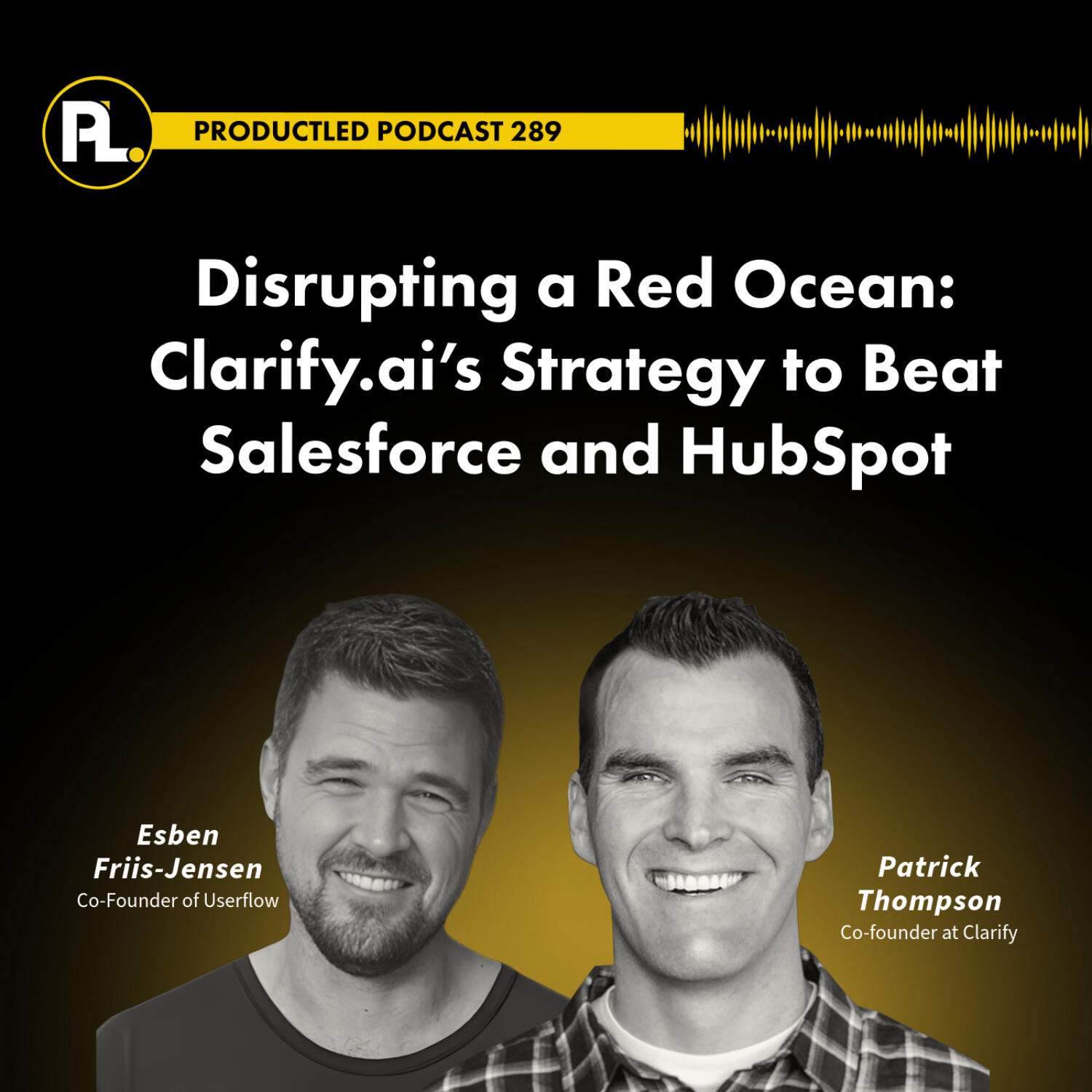
ProductLed Podcast
Disrupting a Red Ocean: Clarify.ai’s Strategy to Beat Salesforce and HubSpot
00:39:23
Loading summary
Transcript50 lines
- [00:00]
Patrick
As we spent the six months at the beginning actually doing the hard work. Writing code these days is not the hard work. It's actually talking to customers, making sure you have good product intuition and product sense to build the right thing.
- [00:11]
Espen
You don't need to bring something super amazing to become a competitor and become a successful business. It's more about how you execute, how you make a great UX and it's really a product led mindset.
- [00:23]
Host
So for this episode, the main focus is definitely going to be on how to, how to create something people actually want, they need. They will be willing to pay for that with a lot of money and they highly value what you do. Because I think the, the worst thing and the hardest piece of like being an entrepreneur is like the opposite of that, which is, you know, you spend all your time doing the stuff that you think you should be doing and you have something that people don't really want, they don't value. And that is a hard pill to swallow. If you stay in that lane as an entrepreneur, you're just not going to be that successful. So I think this is a perfect way to start the Product 100 podcast series because at the end of the day it's like this is the core foundation stuff that you got to get right. So here we have Patrick, who is the CEO of Clarify, and they're building an autonomous CRM. So that's going to help you obviously sell more, but it just makes it super simple to automate a lot of the stuff you do in a CRM that nobody actually does is accurate now because AI is doing it, but solving a meaningful problem. Absolutely. So, Patrick, welcome and excited to dig into this topic with you.
- [01:37]
Patrick
Aspen, appreciate you having me, I guess.
- [01:39]
Host
To kind of kick things off on this end. How did you decide, like, this is the core problem we want to solve for Clarify? Because I think that is a lot more real recent. Like you, you've helped a lot of other companies get started as well. But what was kind of the, the foundation there for you to decide, hey, this is the, the core problem we want to solve, this is the market, all that.
- [01:58]
Patrick
Yeah, that's a great question. I think for those that don't know, I actually started another company back in 2019 that was acquired by Amplitude in 2021. So clarify to me feels just like an extension of that company. Previously we were solving a lot of the data quality customer challenges. We built a customer data platform. That company got acquired by Amplitude, but we were solving effectively the symptom of the problems that plague kind of the go to market tech stack. Now this time around we're actually trying to solve the root cause which is rebuilding the go to market tech stack from the ground up, Starting with the customer platform or your core CRM and then moving to adjacent categories on top of that. So for me, I feel like I've been working in this problem space now for almost seven years and even having spent some time at Atlassian building some of our internal tooling for fairly similar and related to what we're doing now. So for me it's like just the subject matter expertise and like finally being able to feel like, hey, how do we actually make a swing for the fences and actually solve this once and for all. But it's funny, the conviction for me on this is more having spent seven years just interviewing thousands and thousands of companies and seeing the Franken stacks that they end up building with really Salesforce kind of at the center of it and being like, okay, there has to be a time to go after this, you know, 8,000 pound gorilla. It feels like now with LLMs and kind of this post AI world, like there's a huge opportunity to automate a lot of the mundane work that teams have to do in the context of CRM. But yeah, if it wasn't for the, you know, seven years of having talked to so many different companies and having done like reference architecture work with these companies to actually help set up their go to market platforms, I probably would not be in the seat that I am now because this is a daunting and ambitious problem that we're trying to tackle at clarify.
- [03:43]
Host
Okay, well, sounds like a ton of interviews and stuff like that too. But if somebody was kind of listening and they don't quite have that like solid product market fit, they don't have that clarity on like, okay, this is the core problem you should solve. How do you kind of go about that process and suddenly you got some awesome thoughts there.
- [04:00]
Patrick
Yeah. So for us, like a big believer in customer discovery for iteratively we kind of jumped off the cliff and we're trying to figure out how to build the plan on the way down. Didn't really know what we're going to be working on. Had spent six months just interviewing teams, not writing any code. Had a ton of interviews, got about a dozen, Lois, before we decided to actually write a line of code. And for us that was a very kind of transformative moment for us. My co founder and I had been working together for almost a decade ahead of that and did a bunch of TechCrunch Disrupt hackathons and we could build software. But what we really wanted to avoid doing is spending years of our life building the wrong software that didn't find product market fit. So for us, it was really a scientific process similar to growth, of actually going out, talking to people, validating our assumptions before actually ever writing a line of code. And once we did that, everything else kind of was much, much quicker.
- [04:50]
Host
Right.
- [04:50]
Patrick
We went from six months of discovery, three months to build our first, you know, effectively mvp. It was the shittiest thing we've ever built in our life to get our first enterprise contract to then raise venture funding to a year later get acquired by Amplitude for tens of millions of dollars. Right. Like, it was a very quick process, but only because we spent the six months at the beginning actually doing the hard work. Writing code these days is not the hard work. It's actually talking to customers, making sure you have good product intuition and product sense to build the right thing. And so that's the advice I give everybody, is actually go do the hard work upfront, validate what you're building. It's not just the problem validation. It's like solution validation and business model validation. There's just a ton of risk across all three of those things. Yeah, and there's. We had a really good advisor named Justin Wilcox back in the days where we learned a lot of this from. And he would just beat the shit out of us every time we jumped on a call with them. Be like, how many interviews have you done? What are you learning?
- [05:40]
Host
Right.
- [05:40]
Patrick
Versus, you know, it was my, my co founder's birthday and finally that was the, the first time he was actually able to write code for that, for at least for that company.
- [05:48]
Host
Yeah, I think there's this definitely a fun conversation here, especially with you, esfind, because there's two different paths here. If you want to build something that people really want. You could look at existing solutions like in the product adoption space and be like, you know, I think there's still room for another and we could do it better, which I think you definitely did with user flow. And then we. With what you're doing, Patrick, with like, especially like iteratively, you're like, hey, there's this net new problem. You have to kind of create some new potential solution here because it's being completely underserved. So maybe Esmen, if you want to jump on this bandwagon too, of like how to design something that people actually want. So there's existing solutions like product option, which is a complete red ocean like when you started, there's a lot of them, there's appendos, the app queues, a lot of different options that people could choose, but you still went in there. So what was the, the approach you took for designing something that like people actually want?
- [06:41]
Espen
First of all, I think going into Red Ocean is actually everything I recommend any founder should do. Blue Ocean is so much harder because in a Blue Ocean you have to educate the market. They don't know about your solution or they don't know how your solution fit in their budget and so on. And it's 10x if not 100x harder to then get that budget, get that buy in for them to buy the product. And especially if you want to do things like product LED growth and a more self service approach, educating the buyers is super hard. If I was to do another startup, I would definitely go into a red Ocean. So I think that's a good starting point because then you don't have to reinvent the wheel on everything. So it's the same with Patrick. Right. They're building an autonomous CRM and of course they're reinventing a lot of stuff, but they're also, there's a lot of baseline stuff they're not reinventing.
- [07:34]
Patrick
Right.
- [07:35]
Espen
And that helps them. Even the word CRM is something they don't have to invent. Right. Because it's already there. It's something people will search for. And it was the same with us at userflow.
- [07:46]
Patrick
Yeah, it's funny, I mean having been a customer of UserFlow both at Intervalay and amplitude and having evaluated a lot of the competitors in the space when we were doing customer discovery back in the intervally, we actually had an LOI from HackerRank for 60 grand for a user adoption platform. That was a problem that we were also validating at the time. So yeah, it was very. When you guys came out, you're like, I think you did great job at product execution. But I think too right that nobody in the market was happy with appcues or Pendo or the other tools that they were using. And this was actually something that was when we had our list of problems to go prioritize. This was on the list of problems for prioritization because we had interviewed so many different companies that it didn't beat out the data quality customer data platform one. That one we had way more Lois, even though it was a lower dollar amount. But yeah, definitely, I feel like the problem space that you're tackling was right for disruption. I'd say the same thing for CRM today we're going into probably the most established category that exists, SaaS. And yeah, like we, you know, we had an opportunity to be like, oh, we're going to call this something else, like the go to market, you know, go to market platform or something else. We could have reinvented a new category, a new name for it. There's a, there's a competitor that's calling it xrm and I'm like, I don't understand, like there's an existing category. Just build a better solution that customers actually love and want to use. It's not hard to do it in context of CRM. Like, nobody loves their CRM today. No.
- [09:05]
Host
But I think for both of you too, this might be the, the hardest part to kind of teach because it's like, what is that underserved need or that angle or that point of view? So like, maybe Esmen, if you could share more about like on your ends at userflow, what was that, like, core thing? Whereas like, hey, like, you know, all these other solutions are out there, but we could probably do this one thing better. And there's conviction and staying power. And then of course you got to execute like hell to make it work really well. And then also, Patrick, it sounds pretty obvious with the CRM space, like everybody doesn't like it. Can we create something that's like more automated? And it's really, I think if I understand correctly, it's like a lot of that manual entry, the data entry of like everybody just either doesn't do it or they hate the process of doing it. So how can we make that easy? That was kind of like the hypothesis you're, you're building off of, right?
- [09:56]
Espen
Yeah. First of all, being a user yourself of these products helps a lot. If you've experienced the pain yourself, you exactly know what that pain is. And it becomes a lot easier to build a foundation with userflow. My co founder Sebastian had tried a couple of these different tools and found it even for him, who's a super, super developer and so on, didn't really know how to use these tools in a good way and found them not very robust and so on. And that triggered something in him to build a product that had a different builder style. So for us it was a lot about changing the UX completely away to something different. So if you look at userflow compared to its 20 plus competitors, the way of building is just significantly different. Basically changing the UX paradigm. You can say, what was the big change we did with user flow? That's not Like a mind blowing kind of innovation or anything like that. That's the beauty of it, I think, is when you enter these red oceans, you don't need to bring something super amazing to become a competitor and become a successful business. You just need to bring something that kind of makes you unique and attracts the market. And I think Patrick can speak more to that, but I think they're doing something similar with Clarify. It's not like of course AI is a huge change for sure, but again, it's not like something that nobody could like think of doing. It's more about how you then execute it, how you make a great ux and it's really a product LED mindset. You build a product that's easier to use and built for the user, not the buyer.
- [11:37]
Patrick
Yeah. I think the other thing Aspen, you're probably, you did a great job of is like just business model disruption, right. If you look at like Pendo or appcus or the other tools out there, they all had a high sticker price, they were all sales LED motions, right. Like you're trying to have it start at like 30 to 50k for a lot of these solutions in market, right. Whereas you, anybody can come sign up for user flow, throw a credit card down and just start using it. That's literally what we did iteratively as well. And you guys built a better product, right? So once you're actually starting to using this solution, it's like, why would I actually want to switch? Like this is actually a better solution. It's cheaper and it's easier to adopt and easier to, to get started. And so I actually think that's something that was one of the reasons I feel like you guys won early on quite, quite well and the reason that we chose you all over actually the competitors in the space that we're, you know, more established. I'd say that's kind of similar to what we're doing at Clarify. We're not just trying to build a better product that uses AI that's more intuitive and more modern. Those are all true. The other thing that we think quite a lot about is just business level disruption, right. Like if you look at tools like Salesforce or HubSpot, like they get really expensive even early on for a startup. It really the most expensive piece of software that we paid for was HubSpot and we were a seed stage company paying 15k here, which just feels like, you know, it was a tool that was manual that I never updated and it was painful for me because we ended up hiring Francisca who actually, you know, she beat some discipline into me. I'm like, okay, hey, this thing's to be updated. We need to use this for both sales and marketing. And, you know, it, it did work at the end of the day, but it wasn't a great experience and it wasn't something that I fell in love with and, and wanted to use. And now with AI, right. The plan is to automate all of the work that you typically do within your CRM. That's what we're doing at Clarify. So, yeah, there's product differentiation. The other thing is just the business model differentiation, which is how do you price for it? How do you be more value or consumption or price at the end of the day instead of charging per se, which is something that I feel like we believe strongly in as a PLG company, is that like, we should be the easiest, the fastest and the, the cheapest solution in market when it comes to making it easy for folks to adopt and grow with their business.
- [13:41]
Host
I think that also goes back to when you add all this together. There's like, if you have the better product, the better pricing, what you're really creating there is just true moats in your business that are a lot harder to copy. We had Marie, who's the SEO founder of Kali, and like they're going up against Pipeborn. But I think that the most interesting thing is like they give unlimited forms away for free and like, sure, there's like branding and stuff like that on them, but they have this massive awareness, like over like 500,000 active users every month. And so right now they're at about, I think like 4 million in a recurring revenue, but they're growing fast. And like, I just look at Typeform, I'm like, if you want to go to the entry level plant, like that's their maximum at tally. And so you're just like. But it's the same thing really. It's like just as easy to use for the most part. And so there's some things where it's just like, well, is that going to stay true? Like, what is Typeform going to do? And I don't see them ever reducing their price by four times. They're going to always try and always outsmaise for protecting the revenue they have and then trying to do expansion. But, um, for the lot of those users, there's like, yeah, why, why would I keep paying this if I could just find a much cheaper alternative on that end? So I definitely think you're onto something there.
- [14:58]
Patrick
I, I love counter Positioning for that's for it. Especially when it's like the incumbent can't change the pricing because it's going to erode all of their existing value that they have in market, especially if it's a publicly traded company. There's other companies like Agreed have done the same thing with Docu. DocuSign is like, hey, like we're just making this product a commodity and we're going to give this away for free and we're going to monetize other stuff around it. That's extremely smart notion.
- [15:22]
Espen
I do want to add though that what we saw in the market with user flow was because you're right, we created the first generation of more product led approaches with free trial and so on, which led the other companies to also start doing free trial. But what we saw was also then a bunch of newer startups coming in, especially from Europe with a way too low price. I think that is also bad. And so always remember Patrick is coming from the US so when he says a low price it's probably not the same as how many Europeans think about a low price. We have a tendency, and I'm European so I can say that, but we have a tendency to price ourselves way too low and that just makes your product look low quality. There's this balance that you need to keep where you have a good product at price but it shouldn't be too expensive but it should also not be too cheap because that just makes it look like a low quality solution.
- [16:16]
Patrick
Yeah, and I think this is where for us in particular because we're basically trying to say that the CRM should be free. Right. Like CRED applications should be free at this point. Right. The, the buried entry on building software specifically when it comes to CRED type experiences is super low. So what we're trying to do is monetize the AI like the things that like it would be hard for somebody to vibe code really good agents for doing some of the stuff that we do today where we are really trying to actually monetize and add value to customers is not in the core, you know, CRM use cases, but more in the agents that we're building. I think this is, it's interesting because even since we started there's been a dozen new entrances into the market. Right. I think things always happen in waves and you know, we're you know, slightly less than a two year old company. But yeah, even since we've launched there's been a lot of, I would say like yeah, I don't know if they're copycat. But companies, but a lot of companies that are following a very similar emotion now. And you know, for us it's always that's exciting, right? Because we actually, we want this change to happen in market and we actually want competition. I think this is something that a lot of people don't think about. It's like if you have no competition, to your point earlier, you have to educate the market. And now what we're refining is that the market is actually being educated and if we can build the best product that gives us legs to stand on, at least when we have a conversation with a customer. And so that's really where we're focusing a lot of our energy and effort. Yes.
- [17:38]
Host
Which I think parallels really nicely to the second half this interview too of like, how do you stand up that early stage go to market motion so that great like you, you build fantastic products, early stage products. But it maybe it's better than what's out there in the competition for autonomous CRMs. And then it's planners always make that better and better, of course, but on the go to market side, that's really also where it's like, how do you become that early market leader and really have a substantial position in the market? What is your kind of take on how to actually approach that? I want to hear from both of you too, because definitely in Red Oceans this is the like where you go to war, essentially.
- [18:17]
Patrick
Well, Espad, I'm happy to jump in and then I'm curious to get your take as well. But I think the biggest thing for us is just like figuring out one, who do we love? Like who do we want to solve problems for? Right. So a lot of this is like ICP definition. So for clarify, like we're building great software for other founders right now, right? Our ICPs, like seed series A, Series B venture funded businesses, a lot of other businesses that use us as well. But those are the people that we're spending a lot of our time interviewing and making sure that like we're building a solution that really meets their needs and will grow and help them scale their businesses. And so like ICP definition is step number one. Step number two is like where do these people hang out? What are the channels for you to actually reach your customer? Right. Like Is this private WhatsApp community Slack communities? Because I guarantee you, if you're solving a problem for whoever it is, lawyers, accountants, tradies, they have some way that they all hang out and gather right at the end of the day, it's, it's Human psychology. And so if you can actually reach these communities, if you can start providing value and showing that you actually care about them, then it's one great way to build brand. But then two can actually fit into your product discovery loop as well. So you can spend more time interviewing, make sure that you actually understand their pain points intimately so that you can build a better product experience. And then three is then the sales side. But like for me, like the difference between product discovery or customer discovery and sales is a very thin line, right? Like if I actually care deeply about somebody and I am asking all the right discovery questions, like I'm gonna know relatively quickly, I can actually help solve their problems. And if I have a product that can do that, great. If I don't have a product, let me help them with just advice and feedback. And this is like more for me, like give more than you take, right? When it comes to providing or building anything, it's like I actually wanna give more value than I'm taking from folks. So even if I don't have the right product, like my job is to actually help them, right? My goal at the end of a call, if I'm doing a discovery call, is actually like make sure that they have more out this call than I do. That's like the number third. And like yes, there's some value extraction at the end of day, if I'm actually solving a problem, then hopefully I'm able to actually capture that value. And for us that really comes into like things like pricing model. But first and foremost, like you have to solve the first two before I think you can solve the third. I think a lot of people just jumped into number three without really intimately understanding the first two. And so if you think about building your business model, whether or not it's product led, marketing, led sales led, like you still have to do the first two steps regardless of what motion you have at the end of the day. I think that's the hardest part is people might think, okay, I can just build a product like business. I never have talked to anybody, but then it's like how do you know how to write your marketing copy? How do you know what pain points Resonate, what your USPs are that actually are going to like the trigger effectively to get people to engage? Whether or not some signing up for your website or jumping on call with you, it doesn't really matter. And so like that really has to be, you know, I'd say customer first approach to, to doing that. Everything else after that feels a lot easier. Right. Like if you built software for any length of time, like it's a fairly well understood process of, you know, be able to go build and execute. But everything else that we just described, most people haven't done. Right. If you've worked at a bigger company, this is typically a responsibility of your go to market team or a product organization. But if you're an engineer, like you've not done these things. So these are the things I tend to push people to do because it doesn't come naturally for a lot of folks.
- [21:25]
Host
So to just clarify real quick, the first, second, third problem, what were those again?
- [21:29]
Patrick
First is understanding your icp, right. Like who do you love? Second is like what channels? Like how are you going to distribute your software? Like what channels? And then third is really around like the overall go to market motion, like business model. Right. Like how are you going to monetize? But a lot of this is like value oriented. Right. You're creating value and then you're capturing value. The goal is to create more value than you capture and like the long time as you optimize the business, those will get closer and closer.
- [21:51]
Host
I love it.
- [21:52]
Patrick
How are you?
- [21:52]
Espen
Ezra, definitely with Patrick on all those three points. I think ICP and positioning is another word you could use for the marketing copy are super important. As an example, user flow. We positioned ourselves as user onboarding. No code user onboarding for software as a service businesses. So of course our product only worked for software as a service businesses. Our positioning was user onboarding. And it could have been in app content or in app engagement or whatever. But what people were actually looking to solve was to fix their user onboarding. And by having that positioning and that messaging we were able to attract a lot of prospects and customers in, in that way. And that we learned from speaking with our customers and early customers. So that that matters a lot. And especially in a product led business where you are trying to get people to sign up for a trial without them having to speak with someone. The messaging is insanely important. It also allows you to do things like search engine marketing. So you can do like Google Ads which are highly targeted to that group of ICPs. And with that positioning, which is a tool we used a lot at userflow.
- [23:08]
Patrick
Yeah. And it's funny, like Espinoleum. I'm curious, what were the channels that worked the best for you early on?
- [23:13]
Espen
Yeah. So I think like everybody else, we started on product hunt, which was actually not a good. It was a good channel and not a good channel. To this day I would still Actually recommend people to launch their product on product hunt if they have a product product. Because you will get a lot of customers who will maybe become paying customers but they will not be good long term customers. But you will might also end up with with with one good customer in Kogel's case or user flow. Sorry, I have too many companies in user of lower case. It was actually make we got as a customer back then they were called Integromat but they became early customer through product hunt and they helped define a lot of the ICP that we were looking for. Right. Because they were the perfect ICP for us. So sometimes you're lucky that you just hit 1 out of 10 maybe on a channel that's maybe not the best in the long run but it can at least give you some initial traction. And then when we went further it became lot about founder led marketing on LinkedIn which is a channel that many SaaS companies are using today. And then we used search engine marketing, Google Ads. So I would say those are were our two primary channels that we could control. The other, the last one was word of mouth which I think is important for any product led business with a great UX and so on that you create a product that's delightful to use. So delightful that people will speak about it.
- [24:44]
Patrick
Yeah, I love Jay Simons at a loss. He needs to talk about building a remarkable product. A product that people remark upon and building that flywheel at Elastin was so good because like it's free. It's literally free customer acquisition. Right. Like you're not paying for ads, you're not having to pay for marketers to write content. Like your customers are the biggest champions. And so yeah, 100% that's like my favorite channel. And something that we're spending a lot of time thinking about even at clarify is word of mouth and building some virality into the product as well. But effectively building a product that customers want to tell their friends about. But I do like your your point earlier right. Like for us at iteratively like our marquee customer, like our reference customer was was Box. Right. We were building with box.com which is a publicly traded company. Once we ended up getting them as a customer it made all the other deals that we actually had so much easier behind that because when we ended up building a product that was actually servicing the needs of the mid market because they pulled us in that direction and then two it it provided us a kind of a reference lighthouse customer that we can point to and we're able to go close companies like Canal plus and Freshly in Thrive Market all within a very short time period after just closing that one big customer. One of the things that's actually funny is we started out iteratively as a pure PLG business, had thought that people would come, they would actually buy the software and like it was great. What I ended up having to figure out the hard way is that because we're of a more complex sale, right, the person actually buying the software is different than the person actually implementing the software. And the price point was at a point where you couldn't throw it on a credit card anymore. We ended up actually having to have more of a sales motion at that point. You know, we still pushed people into the product to one be able to qualify them, but to be able to make sure that there was enough interest in actually the solution that we built. And they didn't think that we were like selling them something else. But yeah, it was, it was a funny realization for that business where you know, I'd come from Alassian being like PLG all the way and only figuring out that most of our revenue came from kind of the sales motion at the end of the day. And so now doing this business where we're getting the PLG all the way, but we have a sales assist motion for companies actually really need more handholding and support.
- [26:53]
Espen
I actually have a follow up question to that because you're very good at going into spaces where the setup for a user is quite hard. Actually with userflow we also did a smart decision. Actually not many of our competitors did that with the Chrome plugin, right? That instead of you having to install a JavaScript snippet which many of our competitors required, you only had to install a Chrome plugin and then you could do build something and preview it in your own application. And in that way we were able to create a really good aha moment by having them build flows without involving developers in the trial. But in all your companies, let's take iteratively you joining Amplitude which has a similar issue actually. And now maybe it's a bit easier in a CRM world, I don't know. But it's definitely not the easiest products to create aha moments. Right. So how are you going about that?
- [27:52]
Host
Businesses with a CRM that's fully set up, ripping it out, installing the new one is actually quite complicated. Whereas if you're just starting from scratch, not necessarily your best ICP customers, but it's easy to kind of get started.
- [28:05]
Patrick
That's correct. I think what I mean like going to CRM, like definitely understood, well, better understood some of the things here as far as the complexity of the sale and like complexity of like implementation. Right. And the CDP land, you know, ignorance was bliss. I didn't know how hard it was honestly going into. It's like, oh yeah, this is easy, you just need an engineer. You need to like go add some analytics tracking, you can capture some data and like run it to someplace. And you know, I was like, oh, that's not that hard. And like, you know, I can tell you from working with a thousand companies that it is hard. Right? So I think part of the challenge there is like how do you reduce that? And like one of the reasons that amplitude acquired it earlier at the end of the day was reducing the time to value or time to go live on the implementation side because we actually spent a lot of time thinking about the collaboration model, how to get these teams to work together and actually deploy tracking and it wasn't easy. And with CRM, yeah, there's a migration cost like I say, I still say the vast majority of companies who are coming to clarify, starting from scratch, right, they don't have something, they might have a spreadsheet or an airtable or to track this in notion today, but those that are actually coming from HubSpot. So the number one migration right now to Clarify is from HubSpot. There is some, you know, some level of complexity. The nice thing is that we built software to actually help solve that, right. So we ended up building a, a one click integration with HubSpot that actually can import all of your data. We're building the same thing for Salesforce now as well, right. Because we have more and more people wanting to migrate from Salesforce. So moving the data is one part, but then there's also the workflow on top of that data and the integrations that you have and then there's the change management of getting people to use new software. The. It's funny, if you think about complexity, I'd say it's, it's actually exponential. It's not even linear. It's like the bigger the organization, the more exponential the complexity gets. At least in the category that we're in right now. I'm hoping at some point it kind of flatlines. But yeah, what we're finding is that, you know, if we go talk to a series B series C startup, it's probably 10 times more complex than just us talking to a C stage startup. So we're trying to build software to help alleviate that burden. We're also hiring, you know, what we call like these product specialists or what we call product advocates at people who know our products so damn well and understand the landscape that can actually go help the customer do the migration. You know, we don't charge for this. It's not professional services. It's literally like our job to help customers get successful and we have to earn their business by doing that.
- [30:19]
Host
Yeah, when we were working with keep.com they had very similar, they call them like onboarding coaches. And so they had like a free audit essentially that they would offer every new person on their trial. So they'd be like, great, like we're gonna set up a 60 minute call, go through, audit your business, understand like what are your key processes. And then they would help them automate a few of them. So they're like, oh great. Like when a lead comes in here, they go through all this flow and then they're like oh my goodness, I get it. And their net revenue attention on like everybody that they did on that one, it was close to like 150%. So they're just like, this is amazing, let's keep doing it and let's just like, like power through it. So they just kind of bolt that onto every customer engagement that they thought was worthwhile to get it started on the right foot. Because yeah, the analogy I always go through is there's like think of like a cake, there's like three layers that are really important to get customer success. There's the product layer which is like everybody thinks about and then there's the knowledge layer of like what knowledge should they not know that they need to know to get successful here? And then there's usually a skill layer of like what skills do they not have that they, they need to have to make this work. And sometimes like for one of our other clients, pow box, like they were targeting like mental health specialists and to give them like HIPAA compliant email for like their Gmail or Microsoft Outlook. But the setup was really complicated. You had to go to your domain registrar and like change the all the SMTP and like all this other crazy stuff. And once it's set up you just use your email like normal. So it's like brilliant once it's set up. But that's why even for like a $29 per month product per month, they were able to afford like a full time support person and team to just like go ahead and onboard all these people and actually do it with them. And that's all the hardest problem that people struggled with. So I think anytime you have that, like, big, hairy, audacious problem that, like, most people struggle with, it's like, yeah, that's. That's really where I think adding a human in the loop is super valuable, for sure.
- [32:25]
Patrick
Yeah. The only other thing I'd add is, like, our product's only gonna get better every single day from here on out, right? So, like, right now is the actually hardest part or hardest point in time for a customer to actually adopt our offers today. So, like, if we can use humans to actually help alleviate some of that pain, at least near term, the pro, the plan is to help then automate everything from there on out. Right? And that's to, like, codify the knowledge base that you're describing. Right. Like, it's funny, we use agents a lot, and we have, like, an intern agent inside of our product that people can ask questions to. And it's like, it's very valuable in the sense that, like, it helps to support deflection. But, like, right now, we actually want to know the issues that our customers are facing so that we can build the right product so that the next thousand customers who own partner with us don't actually face that issue. So it's like, I think a lot of folks specifically in, like, in the context of plg, try to. Then they try to prematurely apply automation or, like, tech touch. Whereas, like, you know, you definitely want to have that relationship early on. So you know that, like, hey, I'm actually building something here that can scale without having to. To have all these, like, potholes and bear traps that customers are going to run into.
- [33:30]
Host
And as we wrap up here, too, is there anything else you'd recommend as, like, whether it's a tip recommendation or something like that, when it comes to, hey, like, here's how to really, like, double down, find the customers that actually value what you do and solve meaningful problems. Because I think that's the most underrated thing that core foundation got to get it right. And it's something that I think a lot of people don't know that is ever evolving. It doesn't change.
- [33:55]
Patrick
I mean, I'd be remiss to not talk about data, having spent so much time doing experimentation and analytics. But I'd say the hardest part is when to look at quant data versus qualitative data and when to be able to actually apply your kind of gut and intuition to what you actually need to go do. Right. I tend to see a lot of people, especially at the early stages, they tend to link too much into analytics. Trying to understand things. I think if you're a B2C company or if you have like large swaths of customers, like you might be able to actually get some insights from that. But like what we, you know, at the earliest stages rely on is things like just session replay, just being able to watch our customers use our product, being able to talk to our customers, be able to observe patterns and behaviors through like in depth analysis and research was the most valuable part for us. And then as you start to scale out your business, you have like different hypotheses around certain areas of your application. Like you can go a little bit more targeted. Definitely think tools like amplitude and experimentation tools do help. Right. Like we use this ourselves as well. But yeah, I just don't avoid talking to your customers. That's the one thing I hope people take away from this is that you want that relationship. And I can tell you for you know, I bend over backwards to help our customers be successful in the earliest days because like I learn from every single interaction I have with them. Right. And at some point, you know, maybe that will, won't be the case. But like right now I definitely want to make sure I but I'm super close to them as we continue to iterate on the, on the product side. And then lastly like, you know, for me with this company it's like I'm, you know, I'm here to have fun. Like this is, you know, doing startups are stressful, they're a lot of work. How do you make work fun? And that's something we spend a lot of time thinking about now that I don't think I thought about the, the first company. Nice.
- [35:38]
Host
I love that. And is, do you have any other like habits or things that you found have been very helpful for like staying in the loop, talking with more customers every single week week.
- [35:48]
Patrick
So I mean we have a bunch of. So when we use clarify and clarify right. So like every new product sign up gets pumped into clarified. I think it's pumped into the slack channel. So like I can passively look at like who's signing up for our product and I reach out to different people who you know, I find interesting and just like hey thanks so much for signing up. Let me know if you ever want to jump on a call. So there's more passive things there and then same thing or go to marketing does the, the the same. But it's all managed via kind of this like you know, chat Onix kind of style experience. Additionally like we have a ton of word of mouth so anytime a customer actually refers us, like, I'll try to jump on a call if I have a relationship with that customer. Right. One, to show that like, hey, I care. And then two, I value value that introduction that they're making. So like I'm still, you know, in over 10 customer calls a week at this point. Yeah, like I'm in neck and neck right now with our, our salesperson for the most calls for the last like three months. I still, I still hope I beat them. You know, the, the hard part about that is then how do you communicate the learnings and insights? Right. So every customer call you have, I think the hardest part and the thing that people don't do a good job of is actually, actually communicating and distilling research insights. So one of the things that we've done recently with Clarify is we launched our MCP integration. We also have like all of our customer call recordings inside of Clarify. Right. So we actually do a really good job of analyzing all of our insights and research and go to market and we publish that one on a, you know, weekly basis at all hands. We talk about a customer that we've interviewed and then on a monthly basis we look at all the interviews that we've done to publish. Like, what is the product feedback that we're hearing? What are the blockers? That's. This is an exercise that I really like because, you know, not your engineers may or may not want to join calls with you, but how do you actually build that context? Overused word these days. How do you build that context for your engineering team, for your engineering team to make sure that they're building the right thing as well? Right. You want to push that down as much as you can. I love it.
- [37:32]
Host
Awesome. Well, thanks so much for coming on, Patrick. This has been great. On the next episode, we'll definitely be interviewing another Product Lab 100 member as well. Just dissecting what actually goes on when it comes to building and scaling a world class product or business. But any other places where people can find out more about what you're up to? Clarify AI, of course. Since it's autonomous, CRM makes sense to have the AI domain. And you're on LinkedIn as well. But any other places?
- [38:01]
Patrick
Yeah, I mean, I have a newsletter, Founder Therapy, effectively on Substack, so I talk a lot about the founder journey there, mostly the high highs, low lows. So if you're a founder interested in just content, we also interview a bunch of guest folks that come there. But yeah, that'll be one place to find me and then LinkedIn. I publish a lot of content. I try to build and open as much as we can here. Just trying to share as much knowledge for other folks so they hopefully can avoid some of the mistakes that we're making.
- [38:26]
Host
Awesome.
- [38:26]
Patrick
Love it.
- [38:27]
Host
Well, thanks so much for coming on.
- [38:28]
Patrick
Thanks boss for having me. Thanks husband.
- [38:33]
Host
And to wrap things up, thank you everybody for listening to this version of the productbed podcast. Make sure to rate review this on wherever you listen to podcasts, whether it's Apple, Google, you name it, Spotify. I'm going to read every single one of those reviews and that's how I know how to improve this. Also, if you want to stay in contact with Bean and learn what is going on in the world of PLG and every single week get the best actionable deep dives on product led growth. Make sure to head on over to productled.com forward/newsletter I am personally writing each of these deep dives every single week and you're going to get a ton out of it. So make sure to head on over there to productled.com forward slash newsletter.