Loading summary
Transcript69 lines
- [00:00]
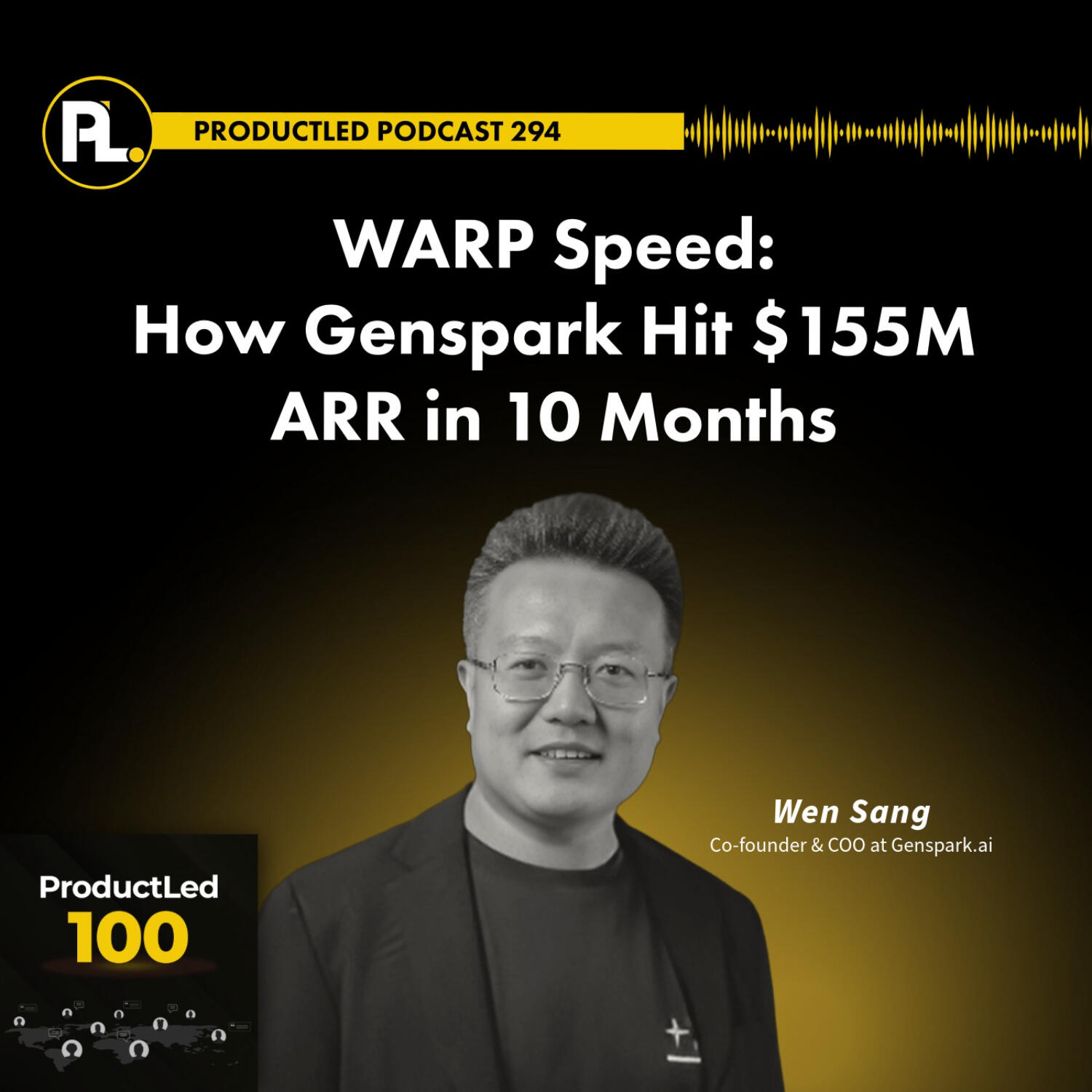
Wen Sang
People really need information to get the job done. So we're like, can we push it steps further and actually get the job done? 90 plus percent of code in our company at Genspark is written by AI. After we hit $100 million AR, we're like, this must be real. It's time.
- [00:23]
Ashman
Amazing story. Product led growth at its finest.
- [00:26]
Wen Sang
I would say the cost of building new things is like 90% lower. Right? I mean, you don't have to choose anymore. You can have it all and you can have it faster. We see an opportunity to actually be part of this fundamental transformation of how work is going to get done. This is actually our secret sauce.
- [00:48]
Wes
So welcome to the product led podcast with me. I have my co host Esben, who is our entrepreneur in residence at productled, who's the co founder of User Flow as well, which bootstrapped to almost 5mil ARR with just 3 people and product led growth. And today's guest is Wen Sang, who is the COO and co founder of Genspark, which is an all in one AI workspace I've used myself. It's amazing. If you use ChatGPT, it's like, okay, that's good for like general stuff, but if you want to make slides, you want to use it for Excel or development and everything else, it just has AI agents for everything you can do for a knowledge worker. So genspark, by the way, is just, there's hypergrowth, which used to be like, okay, going from zero to a hundred million in five years, and now genspark is what I would say going on a new trajectory, which is warp Speed, which is 0 to 100 million in less than 12 months. And actually by the time we schedule this podcast interview, you guys were were just at 100 million in nine months. And now at 10 months, you guys are already at 155 million RR. And you just had your super bowl commercial, which you said you 10x your traffic, which is absolutely bonkers. And I'm just excited to hear. Okay, maybe you doubled your ar. We'll get into that soon. But thank you so much for coming on, but this is a blast.
- [02:12]
Wen Sang
Absolutely. Thank you Wes, and nice to meet you, Espen, and super excited to be here, learn from you guys. And also, yeah, share about genspark.
- [02:20]
Wes
I know where most people kind of start and just want to learn is like, what kind of gave you the idea of starting genspark? Because there's a lot of different AI tools out there, but I know there's a lot of different language models 70 plus you mentioned already. And so what kind of gave you the idea of like, okay, let's take a unique take on this market for sure.
- [02:39]
Wen Sang
So basically our founding team has quite deep experience in the world of algorithm and Internet. Basically I'm the only guy who doesn't code. I was an automotive engineer by training. My other co founders, they, they've always been long term Microsoft veteran. Eric was the founding member of BingSearch, Michael Vaughter, KZ, Ray, they all spent tons of time in Google building the early search ranking technologies. Justin was a founding member of pytorch, spent over 12 years at Facebook before they even were Facebook. So building technologies, Facebook messenger from zero to billions of users and so on, so forth. So in my Komodo Landro I build departments and Pinterest, YouTube and so on and so forth. So this group has true understanding of how the Internet works, how the algorithms work and then when ChatGPT happened or like okay, the way how information is going to be served to individuals, that's going to change, right? It's no longer going to be like putting a keyword. Everybody sees the same thing so everybody's going to get their own customized information. So we worked on that a little bit, but then very quickly we came to the revelation that, you know what, we got asked the question, why do people need information? Right? Well, out of, outside of curiosity, people really need information to get the job done. So we're like, can we push it steps further and actually get the job done for human beings beyond just serving the information? Because it's pretty clear information is going to be abundant for everyone. So this was beginning of 2025, the reasoning capability of these models really just, you know, became great. You know, yeah, it became real. So we're like, okay, let, let's try something here. So April 2025, we launched our first version of the Genspark Super Agent and within 45 days we got to about 2 million users. We're like, okay, there's definitely something here. Let's, let's keep going. So that is when we basically began this streak of releasing a new AI agent on a weekly or bi weekly basis. And by the time it came to July, August, a lot of corporations started reaching out to us through our support email saying that hey, our employees used your solution. And it's amazing. These are PE firms in Japan, investment banks from London, oil gas companies from Bogota, Colombia, government agencies from Dubai uae, consumer electronics companies from South Korea. They were like, we need a business solution because so many people are signing up on your platform. Right. Like we, we need control. So essentially is what they're saying. And we're like, well we don't have a business solution, so. But so many of them, you know, pushed us hard. So we're like, okay, maybe, maybe we should build one. That's when we got into the yo yo phone work to you know, get certified, you know, by SOC2, type 2 and ISO 2701, all the good stuff there. So. And eventually November 20th we released our Genspark for Business officially. Team plan, Enterprise plan, Team plan for you know, smaller teams with less than, you know, 150 people kind of seats needs and then enterprise, enterprise plan for bigger organizations. As of today, I'm revealing this number for first time here. We have over 1500 organizations onboarded in the last 10 weeks onto J4 for business. And I mean yes, we have conversations with enterprise clients, but a lot of them just signed up that was like, yeah, pretty self serving. So yeah, I mean that's kind of how it all happened. And to your earlier description, yeah, it's been a whirlwind. It's like things are happening fast.
- [06:29]
Wes
Yeah, no kidding. And how do you stay on top of it all? Because with a company growing that fast, it's I imagine like, okay, when you're at warp speed, it's just, there's, there's a lot going on, no doubt. And it's hard to stay on top of everything even if you think of just fulfilling on demand. Like I always kind of talk about, okay, what do you need to enable warp speed? I'm like, well you got to have like zero friction to get people to value. But then also as much of as you can is your friction to scale, which you have a product LED motion which allows you to handle a lot of that. But I'm sure there's still a lot of support requests, a lot of people reaching out and that volume of stuff must be overwhelming. So how do you stay on top of all of it?
- [07:14]
Wen Sang
Well look, it comes down to, I mean first off, we don't know everything. We're just learning by doing and building the airplane while we're flying it. That's all just the honest truth. But we have one focus as a company and that is product. Because we've learned very early on that when it comes to, you know, this, this, you know, human beings, reactions, AI products, we're all very smart. Okay, Human beings are smart. It's like pretty easy for us to tell if we're spending time burning tokens and teaching AI how to do things or we give the AI a command, a prompt and then boom, job is done. I'm happy, I'm ready to go. It's pretty easy to tell. So we, we focused 99% of all of our energy and time on just making sure the product gives high quality output so that our users could take, take on, you know, the result and then just run with it versus like, you know, people getting frustrated and hey, I just, yeah, you know, so that's, that, that, that's been the key. And on top of that, when it comes to yo being able to operate in a AI native fashion, so 90 plus percent of code in our company at Jess Bark is written by AI. That's the, that's the only way to release new product features, new agents on a weekly, by weekly basis. And when we do that, people love it. They were like, I paid 25 bucks, now I'm getting a lot more. Not only I can get all the GPT models, Gemini models, anthropic models, instead of paying, you know, for you know, know, 30, 40 bucks for each of them, you know, things could add up quickly. Right. We also have open source models. Everything's in one place. And not only you can pick and choose for certain applications, but for the major stuff like, you know, if you're building a presentation, building a financial model, building a podcast and so on and so forth, our model orchestration layer would just, you know, do the work to pick the perfect model at the right time to do the right task for you. When it comes to value like that, users are smart. They instantly decide, this is what I want. So being able to focus on product, that output quality and then pushing on new values has been the very thing that helped us to stay focused and then just keep coming, keep going.
- [09:31]
Wes
What would you say is your biggest challenge? What is the thing that keeps you up at night where you're like, I don't know how we solve this problem. And what is that for you and genspark right now?
- [09:45]
Wen Sang
So it's interesting, it's twofolds on the one hand, exact to your point, naturally, for any application. When we grow the user base from day one, we're a global company. We have users from all over the world. Our top markets are like us, France, Japan, India and South Korea. They're all over the place. And now in the GCC region, Middle east region, people are, wow, a lot of demand. So, so I mean the, the support requests are from everywhere at all times. And it's right now, I don't know If I. Yeah, it's hard to keep up as one thing. But at the same time, we also know that the amount of people who can benefit from our product is way more than people who know that we even exist. That's also the case. We've had great growth. But we know that we're catering to the 1 billion plus global knowledge workers. Many of them are, you know, bankers, analysts, consultants. They may work solo, they may be in a big corporation. Many of them don't, don't know that, you know, there is a company called JamesBar who can help them. So we're also trying to just, you know, get more people to know about us because you can build something that is awesome. And we benefited tremendously for more than month, you still gotta kind of let people know. So that's why we purchased the super bowl commercial. We're like, okay, two, 300 million people are watching this at the same time, so this should be able to, you know, help us to get the words out. So, yeah, those are two things that, you know, keep. Because I'm the commercial guy on the team, right. All my other commanders, they're like, we're coding. You go, do you know the other
- [11:21]
Wes
stuff you get as customers? We'll handle it.
- [11:24]
Wen Sang
Yeah. So how to make sure our customer experience is, y' all great at all times. And how to make sure that there are constantly more people, you know, getting to know about us. Those are the things. Top of my mind.
- [11:35]
Wes
No, that, that absolutely makes sense. And so maybe on that note too, when it comes to how did you get so many people to find out about what you do? So the very first 45 days, you got to 36 mil. ARR. And that's just bonkers already. So there's some great stuff going on there. And then it just seems like you're on this crazy, crazy growth trajectory. So of course, like, there's a billion plus people that could absolutely use this. Hopefully even more than a billion plus in the coming years as more people, you know, get onto the AI wave and Internet and everything else too. Everybody should be able to use a platform like this. So on your end, what has worked exceptionally well because I think at the beginning, if I read my research right, the first 36 mil error, you didn't do much marketing spends.
- [12:27]
Wen Sang
Yeah. So we intentionally kept it. I mean, even up until the end of last year. So I'll give you the full scope. So basically in the beginning, we're not sure. So we wanted to make sure, you know, we're all, we're not overly kind of marketing it so that we can't tell if this is real signal or this is just, you know, out of, you know, advertisement. So we intentionally, you know, stayed away from advertisement. We basically just kept on, you know, releasing new agents from the beginning April 2025, all the way to August, September time frame. We just wanted to see if this actually works, if we do really have product market fit. That was kind of the thinking there. We wanted the product to work for us, wanted a product to sell for us. We didn't want to kind of just prematurely put fuel on the fly. By the time it came to August, September, time frame, not only individual users are continuously just picking us up, but also, like, you know, enterprise companies are reaching out. Like, these are household names. They were like, yeah, we're ready. Let us buy you buy your solution. Like, we're like, okay, this is. This must be real. So that's when we got started, you know, testing certain channels to, you know, market it out and to let more people know about us. But up until the end of the 25, we didn't spend much on, you know, just marketing or whatever. Only, you know, after we hit $100 million ar, we're like, this must be real. It's time. So we're like, okay, we're ready. Let's go. So we did some promotions in the beginning of the year, which helped, right? We did a new year kind of promotion. And then I were like, okay, we. We had. So. So basically what happened with super bowl was we always had great contact in that world. And then because some of our clients are some of the largest advertisement agencies, you know, in the world, and they were like, oh, someone backed out. Do you guys want in? Like, but yeah, it's. It's a crazy thing to think about. But then we quickly made the decision, you know what? It's time. We gotta let more people know. So, yeah, our head of marketing was like, let's do this. So we actually generated the story or creative the script from giantspark. We had multiple options, and then we picked the story you saw on the. And then we're like, okay, let's do this. We bid the deal. We got halftime, we got the fourth quarter, and then we did the shooting, like in, can't remember, 10 days or 11 days in new York. It was crazy. So everything was just, you know, going like, very quickly. But, yeah, I mean, that is when we really got started. And now coming to this year, we do have plans to spend more on SEO, on YouTube, on influencers, on all channels, conferences, LinkedIn, whatever, that could potentially help us to get in front of our target audience. We'll likely do a lot more this year.
- [15:39]
Wes
Awesome. And just for people that are, like, just trying to gauge the super bowl investment, because most people hear, like, oh, man, like, this company spent, you know, a lot of money on that. They didn't get much return. Are you open to kind of sharing just like, okay, what does that deal look like for 30 seconds? And then also just the results of traffic are. Although it's like. It's like, have you recouped it yet? That's. That's part of the hard part of like, okay, how do you track all that, too? But curious to hear your take on that, too.
- [16:10]
Wen Sang
I mean, look, so before we went in, we talked to someone who did tuber bow ads before. Different kind of companies, technology companies and so on. And basically, the simplest way to think about it is you got to look at, you know, who are the successful companies who did this and did they come back? And the answer is pretty clear, right? Like, people who are, you know, companies who are successful and then did it, and they. They constantly come back and we talk to someone, the other like, you can't measure it. There's no way you can just measure it. But we decided to. After looking at kind of the before, after whatnot, we decided to come back. So that was kind of a important framework that we also adopted. At all times, we always want to look at the data, but when it comes to those moments that you have to pull the trigger, you have to kind of make decision. You got to read the bigger signals. We do that as well. So, yeah, so far, I mean, we went in with the expectation this is just about brand awareness. We didn't expect, like, instant. We thought, there's gonna be a delay between the advertisement being aired and, you know, some. Some, you know, traction gets picked up, but clearly, like, instantly these days, everybody's on their phone. So it's. It's pretty quick. We're like, okay, we didn't expect this. This is great. So, yeah, it's telling that we'll be able to capitalize on this. And I think we've been talking about, okay, what's next? We're only going to go bigger, so.
- [17:35]
Wes
And I also think there's a window right now where AI products are. Everybody's excited about this. They want to try new stuff. Like, I love paralleling this to the App Store. So, like, when it first came out, everybody's like, do you have an app for that? How cool like, it was kind of a little exciting. And then. And then now you go to a restaurant, they're like, download our app to get the menu. You're like, no, please, no. Like, kill me.
- [18:05]
Wen Sang
I totally hear you. Yeah, but from kind of perspective of, you know, if, if, if people are, if there are a lot more people now kind of aware of us. Two interesting things happened right after this. One is like all of a sudden all the folks from, you know, different sports teams on NFL, MLB, NBA, they all reached out. Even FIFA World Cup 2026, like F1, Formula One. They were like, hey, you guys ready? Let's. Let's do something. So that, that was pretty interesting to see. That's kind of from that industry, but more, more important, like, you know, friends who I. You haven't talked in 10 years. They were texting me, hey, when look at your ads, I'm like, okay. People saw it. Okay, that's good. So, yeah, it's. I think, yeah, people do see it.
- [18:58]
Wes
Oh, for sure. And it was really well done as well. So good on you for using genspark for creating that as well for the draft.
- [19:06]
Ashman
No, I just want to add, I hope you do FIFA World cup. As a European, I like that kind of football a lot better. So you should definitely do that.
- [19:14]
Wen Sang
Are you coming to la?
- [19:16]
Ashman
But I used to live in San Francisco. It would have been a lot easier, but I recently moved to Europe, so it will be a lot harder. But maybe we'll see.
- [19:26]
Wen Sang
I heard final games in New York. Yeah, maybe New York is closer.
- [19:29]
Ashman
So, yeah, that would be really awesome. Just to add a question, by the way, amazing story. Product led. Growth at its finest. I would say focusing on building a product that just has a great ux, it delivers value very fast and all these things. So even though people say a product cannot sell itself, it can if you do it in the right way. But one thing you definitely notice about your approach is you try to do everything right. And that's part of your value proposition is kind of like, we want to alleviate busy work and that means we go all in. We do all sorts of products like docs, PowerPoints, you know, you name it. But that also adds a lot of complexity. And the common advice in the software world is you should focus. In order to grow, you need to focus. But you can kind of say you're doing a bit the opposite or you're focusing on building a lot of things. So what's your thoughts around that and this level of complexity you're building by having this many products for sure.
- [20:41]
Wen Sang
Esmen, that's amazing question. So this is where we believe the commissional Silicon Valley wisdom fails. Okay, so two things are fundamentally happening right now. One is that in the past the world has been a tool centric one, meaning that each of us would have to learn 20, 30, 40 tools to do specific tasks eventually to accomplish business goals. So that's just the process. Right now with agentic AI capabilities like what genspark super agent could offer, our view is the boundaries among different tools are disappearing. It no longer matters like what specific tool you use to do what specific tasks. Those are means, those are all means to an end. The end is business objective. It's the same set of business context. I could ask Jensburg super agent to do research on Nvidia stock in the past 12 months. Build me a full financial model on its stock price trajectory next 3, 6, 9, 12 months and give me full discounted cash flow analysis and then put that into a five page slide deck and give me a three minute podcast on the topic and provide me a full investment memo on consideration of $10 million. And they all use the same set of contacts, but they give me different formats of output in order for me to accomplish the goal to talk to for example an investor to, you know, have this consideration. So the focus now is human. Our view is this wave of AI y' all breakthroughs is going to give us finally the human kind of centric world that we no longer have to, we no longer have to do the busy work to accomplish the real work. Everybody could work like a Jamie Dimon JP Morgan, right? Like you don't see Jamie typing hard to trying to build a model or he just makes a few calls and analysts would get it done for him. We want that for everybody. We want to put Goldman Sachs analysts in everybody's pocket. A fleet hoven is kind of the fundamental change we see beforehand. Now second thing is the reason a lot of the kind of consideration Whitecaps, okay? If something works, just focus on that, don't worry about anything else. Is also from the reality in the past that building something is costly.
- [22:59]
Wes
Right?
- [22:59]
Wen Sang
Building software, it used to be like whenever we wanted to build something new, it's like next quarter, next year. But with this wave of AI breakthroughs, the cost of building new things is like 90% lower. Right? I mean you don't have to choose anymore. You can have it all and you can have it faster. And also to that I can let you guys in on a little bit of secret how we work internally here. So we don't have like a front end team, back end team, DevOps team, design team and so on so forth like team and the different teams like you know, just going back and forth. That is a lot of overhead with you know, being a kind of AI native company. What we did is we built a three layer technology architecture, you know, model orchestration sitting on top of 70 plus soda models. We built 150 plus in house tools to allow the LLMs to leverage their intelligence and bridge that gap between them and the real world tasks. And then we build a data layer, you know, with access to premium databases. We pay for you know, all of those services to grant the output. So on top of that, each one or one or two engineers at our company lead a complete product end to end. Our AI slide agent was built by our product manager Alan. He was not a developer before, but hey, our tech architecture is there, it's scalable. Let's go. So he the first version he built in two weeks. So this new era of how to build with just a lot more empowerment and speed, a lot less overhead, it's not just about the work by itself but also about how we coordinate with each other, how we communicate with each other. The overhead is way less that help us, that helps us to kind of have a lot more freedom, a space or we can accomplish a lot more with the same amount of people. We are globally a 50 people team. That's it. Yeah,
- [24:52]
Ashman
I think one one thing about that. So, so you are saying all these things and it's beautiful, I love it. I love lean organizations. I mean at Userflow we were only three people, right? But we couldn't like the scale you're at is just another level. You are 50 people but you also raise capital. And often what happens when you raise capital is the evil investors come in and say you should hire some more people. And that's where you end up with a huge organization. But you didn't do that. So you have a different mindset. But maybe a twofold question is how did you avoid that? And secondly, how are you then spending the VCs money? Because they are expecting to see that capital deployed somehow, right?
- [25:38]
Wen Sang
100%. So one to that as when I'd say the cost structure of the AI era of the companies are different from let's just say SaaS companies. So one is clearly there is cost from an inference standpoint that's a big one. But beyond that then there is the go to market and then headcount is actually not necessarily the biggest. So for us, I'D say really? I mean the investor's desire is always going to be the same. I gave you a dollar, you turn that into 10. Right. As quickly as possible. So that's just it, how you do that, don't care. But in the past it's always about scaling human heads. Like the more people you have, the more developers you have. That means the faster you can ship and the more sales folks you have. That means you can get more clients. That was kind of the simple math in the past. Now so to get more built, not necessarily you need more human heads. To your point, lean organizations, you'll have the very advantage that you have less communication overhead, you have less inefficiency. So if you could get it done like with less people. Absolutely. Because it's not just about AI doesn't work. It's about you no longer have to kind of orchestrate these human communications. That's just. But beyond that, when it comes to go to market the same thing for PLG companies, we naturally benefit from the product motion and it's about enhanced that enhancing the kind of the bottom stop motion through your marketing, through kind of growth engineering, through a lot of these things. Not necessarily just how do you help more people to sign up? By hiring more. What kind of people? However, I would say from enterprise standpoint clearly there are still accounts that is worth millions of dollars that require human touch. From pre sales we hear about all of these Palantir like companies having forward deployment engineers before you even have a contract. That is also a thing. I just saw this piece of news article saying that OpenAI is hiring hundreds of thousands of consultants, AI consultants to help enterprise to adopt AI solutions. That is also real people got to look at what, what is my business, do I have this sort of needs and does the money spent on this help me to you know achieve that is kind of. Yeah. So for us we actually see you know, growth avenues out of all of all of these opportunities. So yeah, but it's not like linearly kind of the one on one kind of just gotta manage up the investors a little bit.
- [28:24]
Ashman
There's a lot of similarities I think with your model to another successful company from the past, Slack, which also grew very organically, you know with people signing up for it and then recommending it and then it became a B2B company more and more. But I think you're doing it at an even bigger scale than they were. So that's amazing.
- [28:45]
Wen Sang
Thank you Ashman. I mean you're very kind. But yeah. So to that what we're also hearing and seeing, we've been talking to some of those folks and they basically said, look, when what happened for us, like over the time span of about 5 or so 5 to 7 years is happening to you guys within 1 to 2 years is kind of. Yeah, that's the difference. So before it was like yeah, kind of freemium individuals, SMB and you know, enterprise and then platform. Now it's all, it's all happening at the same time.
- [29:12]
Wes
Why do you think that is? So like, it's clear that that's the Trend. It's like 0 to 100 million less than 12 months. I call it warp speed. And I'm like, it's, it's happening again and again and again. But why is it happening so quick?
- [29:26]
Wen Sang
That's a great, great question, Wes. I mean I don't think we have figured it all out, but what we're hearing is on the one hand, if you quite kind of, if you filter out all the noise like AI is the very theme of our time, right? So it's not only in the individual's kind of mind, but it's being talked about at pretty much every boardroom. So that kind of both kind of bottoms up and then top down motion happening at the same time. I have to think like it helps to kind of accelerate a lot of these conversations, explorations as one. And it's clear like that's before. When it comes to these different software tools, there are different use cases, they're for different use. There's never a time it's one thing and that's changing everything, right? In such a short. So it's just so concentrated in a way. Second thing is initially when ChatGPT just came out, people were just shocked, like, whoa, this thing talks like a human. But now three years later, four years later, people are like, we're used to that, right? Like many of us take that for granted. Like, hey chatgpt, what should I get for lunch? The reality is when you see real value, like GPT chats, right clock codes JSpark. When you see like real work can be done by jenspark, you're like, holy cow, there's real value. Of course we wanted more. We want it now. We want it for all of our folks. So comes down to, you know, if there's clearly, you know, felt a measured value right away. And that value is not just, you know, I save you time. Not just that. I'll give you a couple examples. One of our power user, I talked to Scott, he's a sixth generation texan based in Dallas, Texas. He's a consultant to help, you know, local restaurants secure bank loans. In the past, he would hire someone to count the foot traffic to do the market analysis, and then hire some analysting, a CPA firm to build a financial model. Essentially say, hey, a bank. We're going to pay your money back timely and properly. And he would build a presentation. He would walk into the bank meeting together with his clients to secure a million dollars, two million dollars, a patio project or something. And then he gets paid 20, $40,000, whatever. Now, and for that he has to spend weeks, if not months of time to recruit those folks, to manage the contract, to give them the scope to let them get the work done and then put it all together manually, right? And he would have to spend thousands of dollars out of his pocket, if not, you know, tens of thousands. So his kind of operating margin is probably 50, 60%. Now he pays JBark $25. And he said, jan, Spark, do the marketing research. Here's the zip code, here's the restaurant, here's the city. Put it together, JBar. Build me the financial model. Here are the historical, you know, P and L balance sheet of this restaurant. And then make it happen. And here's the project we're thinking about. Give me three scenarios. Best, worst, most problem, okay? And then, hey, Jasbark, don't be a presentation. He will still polish off the work, but you know, the groundwork is done through Jazzbark super agent. And the math. At the end, he would still go into the bank meeting together with his client, and then the bank would grant the loan. And that happens like in order magnitude of 2, 3 days. No one is hired beyond himself. He pockets all the margins. He pays US$25. So when that happens, he gets to serve five, six more times of clients at the same time as well. That's real money made. Imagine like before, out of 40,000 project, he makes, you know, 30,000. Now he makes all pretty much 40,000. And it happens in like, you know, a fraction of time. He used to have, have to spend the same goes with, you know, solo, you know, developer shops building, you know, shopify websites for the local businesses. This is young man Matthew in Michigan. Before, he would hire developers on upwork, spending thousands of dollars. He would charge his clients 6 to $7,000 a pop. Now you know, it's all his and it's done like right there. And he has this. It's important to have taste so he knows what's good, what's what's not. Good. So you can go a few rounds with the AI, but still, it's like, easy, quick, cheap. You make all the money. So it goes with, you know, big household consulting firms that we're working with, catering to mega companies with hundreds of billions of dollars in market cap. Used to be like, they have to spend hundreds of thousands of dollars for one prototype project, you know, going back and forth with their developers offshore for weeks. Now it's just a few analysts and consultants sitting in their Chicago office. Two days, bam, done, three prototypes, client, are you happy? And they charge a lot less money saved, time saved. But more importantly, they get a lot more business. The client loves them.
- [34:09]
Wes
Right?
- [34:09]
Wen Sang
They were like, wow, all the other folks are still just charging us a quarter million dollars. You guys are just 50k. That's still. I mean, they paid 25. So, yeah,
- [34:20]
Wes
everybody's happy.
- [34:22]
Wen Sang
Exactly. Everybody's happy. So that's why, y', all, it's happening so fast, because there's real money being made. Is, is, is. Is our observation. Yeah.
- [34:34]
Wes
And. Absolutely. And everybody that is at the forefront is like that contractor or anybody else. It's like you can have a insane advantage in the meantime with just like, cost efficiency, time saved, everything else, versus at the very beginning. I think one of the best things you mentioned as well is just what is the future of knowledge workers? It's not doing the busy work. It is actually taking that all out so you can do the work, like the taste side of things where it's like, hey, they are going to really value this, or this is the actual useful insight. So I'm going to focus on, like, honing that in and the deck is taken care of and all that stuff, and it looks good.
- [35:15]
Wen Sang
Exactly 100. I mean, so. So at the end of the day, human beings compete with human beings. If you jump on board and then just. It becomes real good. That's a. That's a. You have a complete different life than the other folks who are just, you know, I'm living my life without knowing what's happening. So I talked a little bit about how we interacted with a lot of advertisement agencies. Now then, the latest kind of, you know, projects we've seen is basically these folks, you know, in the past, they would pitch a creative with a storyboard. It's pictures and texts, right? And now it's on, like, full production videos out of, you know, basically some of ad agencies. They came to us with a story, basically told us straight up, I built this with J Spark. Okay? But it's better the full production Video, basically it goes that if we like the video, how it's going to look like, then they're going to do the real shooting with a movie star or something. But before, that's just impossible for you to put together a production level kind of video story. You have to spend, if not millions, at least hundreds of thousands of dollars and it takes so much time. Now, basically, in that industry, if you pitch creative ideas with an old storyboard, you're for sure gonna lose business. No one is interested. People don't even understand it. That's just how things are changing. Right. You have to have a full kind of almost production level kind of a thing for the clients to see. Ah, this is going to be how it's look like. We just need to change the face to Brad Pitt or whatever. So that's. Yeah, that's how.
- [36:45]
Wes
That's the easy part.
- [36:46]
Wen Sang
Yeah, that's just.
- [36:48]
Wes
So.
- [36:49]
Wen Sang
So basically I talked to some of the, you know, executives of these companies. They were like, yeah, when we have to do this, otherwise six months later our company spawn. That's just how much of urgency people have. Yeah.
- [37:02]
Ashman
So the problem is definitely there in the market or the need is there. Right. People are looking for these kind of AI solutions. But I think another big component of the fast growth of these companies, and yours included, is that you show value really quickly. And maybe you can speak a bit to that because one thing I think is really you took it one step further than all the rest of the AI companies. When I go to your website, there's no website. It's basically just the application. And then I have to sign up, I can see kind of what it does, but then I have to sign up and get started. Right. So you're not even trying to explain the value proposition on a website like normal SaaS businesses do. You're really jumping right into the app. So can you maybe speak a bit to that decision? And also how do you ensure that people see the value? And how quickly do they see the value?
- [37:54]
Wen Sang
Look, Aspen, honestly, I don't know if that was just how things were done or it's actually a decision. So, I mean, the product still has a lot of rough edges. We're constantly improving it. I know that the version that you're using today is going to be the worst version you ever use out of Jasmar. One thing that does work is if people have an opportunity to try it out and within 5, 10 minutes they can get value. That's like the easiest way to just know.
- [38:20]
Wes
Right.
- [38:20]
Wen Sang
But I would say I Personally think we should and we could do a better job on at least crafting, craft some content so people know what this is all about. Yeah, I think we actually should do something around that. But I would say to your observation, like if you look at all the leading AI companies, may it be OpenAI, may it be anthropic, maybe even, even Microsoft, like, you know, the first thing they always want to give you is an entry point for you to just try it out. For that I think it makes sense people, human beings are, you know, smart and, and if the product is not, you know, there so for people to figure out how to use it in seconds and then being able to get value out of in minutes, it's not working. Right. So that's just it. You have to, you have to lower the barrier for people to at least set to have an opportunity to kind of find out and then just see it in the action. That's absolutely important. Now beyond that, I do think we should do more work to build the content and share more stories of how human beings are benefiting from it. We're working on that.
- [39:31]
Ashman
I mean it's working so maybe you don't need to change anything. It was interesting to see. I love when being random or not, but it's definitely a bold choice, right, to do something.
- [39:45]
Wen Sang
Thank you. Thank you. Asmin.
- [39:46]
Wes
Yeah, yeah, I think it just goes back to zero friction to value. Like you said, get people to value in seconds. I think the new bar for any AI native company is 60 seconds to value or less. And how can you get people to that outcome and as fast as humanly possible. And that is actually, I think what goes back to the previous question I asked you about like what is driving this fast growth? I think it is, it's when you use some of these products, it is 4 out of 10 better than anything you've ever used before. Like you go from Google Slides to like this or something like that, you're like, it's much better, much faster. You're like, why was I editing slides like a dummy? It's not a good use of time.
- [40:29]
Wen Sang
Yeah, open up four tabs. You know, ChatGPT, you know, Gemini, Claude and DeskPark, just put in the same prompt, ask the agent to do real work for you and see what happens. That's the easiest way to tell. Back in the summer we did a one million dollar showdown, basically saying that hey, same props you give us. If anyone does better than us, we give you money. We gave out a million dollars to just get product feedback. That's like yeah, how we. Yeah, I mean look, the Frontier Labs, they're great with amazing technologies. We work with all of them very closely. We get, you know, early access to the models before the release. We got premium rates and all that. It's great, great partnership. But their focus is on intelligence. They're pushing the frontier of how smart can this model be, right? Like they're trying to just make it so smart that it exceeds all human beings. It's AGI for us. We're more grounded with the goal. We focus on getting the output quality so good that human beings could skip the email drafting the slide building all the real world stuff. Personally for me, like I'm a knowledge worker and I don't remember doing any Olympia level math problem once in my last 10 years lifetime, so. And that. But I'm a, I think I'm a fairly intelligent guy. It's about the optimization kind of focus. So we focus on output quality, how usable, how useful the output is for day to day knowledge, work, use.
- [41:58]
Wes
How do you measure that though? Because other than asking people at the end of everything like okay, great, how good was that? Because I'm the same like as you kind of mentioned, whenever I'm you know, creating a prototype something I'm like, okay, let's pull up like lovable cursor, Claude everything. And then I just kind of take the best from each and pick the one I want to work on based on what's the best job.
- [42:22]
Wen Sang
So we, this is actually our secret sauce. We build a recursive learning fully automated because we're learning eval benchmark system. So what it does is it constantly learns from the metadata of how users are interacting with our product and it helps the agent to get constantly better and better at orchestrating the right model for the right tasks, leveraging the right tool in the right context and eventually get you great results. So that kind of minimum amount of prompting or back and forth, maximum amount of downloading and using the product, the results. So that's kind of the system we put in place to just help our agent get better and better continuously. Now one thing I would point out is because it's still a wild west in terms of new models, you're getting released every day and each different model is good at different things. So it's extremely important. Stay nimble, stay kind of adaptive. That's also how our system works. That eval benchmark system is kind of the key to keep scores on everything.
- [43:35]
Wes
I like it. No. Thanks for sharing your secret sauce. What else is in There because I'm sure you got some other good stuff.
- [43:43]
Wen Sang
That's all I know.
- [43:47]
Wes
That's awesome. And one question I had for you, just as you're doing the all in one play, which is fantastic, I definitely think there's a massive market for that because as there's subscription and AI fatigue as that sets in, in the next like 18 months, people are going to look to centralize and be like, hey, like which one can do? Even if you're not the best in class for each of the AI agent tools, they'll be like, hey, but it's, it's got everything, it's really solid and over time you can get the best in class of each of those. I totally believe that. But what is your, your take against Some, let's say AI native single point solutions? So like if you're going head to head, let's say with like gamma for the slides versus what you do, and so there's like a, if you think of like typical going to war in a way, it's like, of course you got the all in one mode. That's a really healthy way to like, hey, we don't just do slides, we do all these other things. You're going to win on that battleground for people that are looking for something all in one. But if they just consistently do like point to point solutions, it is hard to fight a battle against a company that's just focused on that or a company that's just focused on, let's say Excel or something like that. So I'm curious, how do you decide of like, okay, we're going to really win with this AI agent, we're going to make this one the best. Because I do see there is a lot of specialization also going on in the AI space right now, especially like Claude for, you know, development and stuff like that too. And so the all in one kind of moat is fantastic when you can get to like good enough level for everything. Where people are like, this is definitely great enough, but it is hard to kind of keep ahead of the single point solution.
- [45:29]
Wen Sang
So to that I'd say the two fundamental bets we're making. Wes, here is one, when it comes to value for users, we just deeply believe in the future where tasks no longer, you know, specific tasks no longer matter. It's all means to an end. What matters is with the same set of context, all of these different applications, scenarios are all connected. And what, what matters is the end result from a business objective standpoint. So because of that, it's not going to Be enough for users to just have a single thread kind of thing. Because think about this. If I'm a salesperson, I have this inbound lead. I need to build out not only a sales proposal, but also a pitch deck, but also kind of a one pager, but also writing this email. All of these share the same set of contacts. If I have to switch between, let's say I use Gamma for slides, I use ChatGPT for a research report. I use something else to build that sales proposal. I use Gemini to do my email. That's a lot of copying and pasting. Why do I want to spend time on that? Right? That's just like, oh, and I got to remember all the logins and I gotta kind of, okay, you know, try getting discounts and promotions for each of the applications. It's just way too much. And now I need to operate Salesforce, I need to operate Slack. I need to copy that meeting notes to that message. God, my head explodes. So today's world, we benefit from all of these tools. We also are, I'd say victims. If I put it into the extreme of all of these different. We just, you know, we're, we're busy for the sake of being busy a lot of times. So the fundamental bet we make is that worked for a while now with this AI breakthrough, this, this wave, the world will start converging onto, you know, a more human centric world. And then that's just it. Now, second thing is also important, which is from a building standpoint. So we talked about this a bit earlier. Our view is because the way we built our agents, although they were optimized for different scenarios, AI sheets, AI slides, AI docs and so on, podcasts and so on, they may feel like different products underneath, it's the same set of tech. It's the mod orchestration, it's a tool using. It's the data kind of aligning the same set of tech beneath the results, rendering. It's all just code writing. It feels different, but it's all the same. So the product actually gets better and better when there are different entryways for people to use it and interact with and get agent a lot better at everything. So if you just go single thread on one thing, in our view, that's dangerous, that's risk. But at the end of the day, I mean, look, even in the old world, do you know that like we talk about slack, Slack made $1.8 billion last year or whatever. Microsoft Teams, which has a lot more, you know, people have different views on the Product experience, whatnot. That's four times bigger. More than four. That's 8.7 billion, $8.6 billion or something. You know, fact check on the numbers. But that's like it. Yeah. People don't talk about it. Most people are not aware of it, but that's the value of a bundle. So I'm not saying like, you know, again, different people have different views on the product. We work with all of them, but that's the reality.
- [49:01]
Ashman
You rather want to be Microsoft than you want to be Slack. I think that's a good way to put it.
- [49:08]
Wen Sang
Yeah, yeah, yeah, yeah, yeah.
- [49:11]
Wes
No, that's great. And what is your end game for genspark? Like, is it to one day have Microsoft buy you because they clearly need help on the AI from all their products. We can add that to the Microsoft subscription and then it would be useful. What would be like your big end game that your own sports? Of course. There's like 1 billion plus people empowering knowledge workers and really helping people do less busy work. And I am so excited about that because I think it's time people start using their heads more than just doing busy work at the end of the day. So what's that endgame look like for you and your team?
- [49:48]
Wen Sang
Look, Wes, everybody has a price tag. Okay, so we're all human beings. But. But I would say the opportunity we see is one that is just so rare, it's so lifetime that we believe there is actually enough. You built a real, A real generational company with, with real impact. Because our team is a rather. I say I personally have a lot of battle scars building my last company. So goes with my other co founders. We're not here for quick in and up. Not like that. We really see this because, you know, there are so many options in the world. You can do so many different things. We chose to do this not because we have to or we wanted to. Quick kind of. There are so many other ways to make money. Right? Like, but we see an opportunity to actually be part of this fundamental transformation of how work is going to get done. I mean, this is almost like, you know, the kind of. We talk about the industry revolution when engines just came out, when Internet just came out. We see that opportunity. We want to be the new, I don't know, Ford for this age or, you know, we see that opportunity. So when it comes to that, our view is if we do a good enough job to really help the world, to capitalize on this technology breakthrough, the money will follow, we'll be fine. We're good right now. But more importantly, it's legacy for us. If we put it simple and plain. That's what we really wanted. But we wanted to be able to, you know, tell our kids our grandkids one day. Hey, you remember, like you probably don't remember how the world looked like before we all had to work like, you know, slaves really hard on PowerPoints and slide decks and you know, all the spreadsheets. No, you don't do that. You just focus on being creative and being strategic. That's your grandpa. We wanted to be able to say that. So now that, yeah, it's such a
- [51:47]
Wes
good analogy to the difference between like the horse drawn buggy versus the car. We think about that a lot. But now it's like AI is totally that for the knowledge worker because you can do 10x the like go at 10x speed without working 10x harder because AI is there. So last question on this. To wrap everything up, what would be your advice to any founder out there today based on your experience and what would be like, the single piece of advice you'd be like, if you're going to thrive in the AI era, this is what you got to think about or do differently. What would be your kind of advice for those people?
- [52:24]
Wen Sang
I don't know if I'm qualified to give advice because everybody's just kind of learning by doing and all that. But one thing I observed that really worked well for us is what we talked about in the very beginning. Being obsessed with the product and its output is what worked really well for us and will continue to be our obsession. That's just it. That's the most fundamental thing. If you have a good product, people will notice, people will come to you and they would want it to give you money. That's just what we're seeing. And yeah, we hope that as our kind of holy Bible, product has to be the best.
- [53:04]
Wes
Yeah, that's super simple. Hard to pull off though because I think a lot of founders sometimes want to take that quick shot.
- [53:13]
Wen Sang
So the first product we launched was about search. There is a process, there is no guarantee. Right. So of course, I mean we grew the first product to about 5 million users. We decided to sunset that and focus on this and then we're very fortunate it worked out. So we just, you know, keep, keep going. I, I, I would imagine y', all, it's, it's going to be similar for everybody. Everybody's trying. But the beautiful thing is, I mean look at the big companies, they try all kinds of things as well, not necessarily. Success is not guaranteed. And I mean, here's also another scary thing. Disruptors are getting disrupted constantly in this AI era, like in a much faster kind of a pace. Back in 22, everybody was talking about Microsoft Copilot for code generation and then it's Windsurf and Cursor and then it's clock code. Who knows what's coming out next? We're on the edge all the time. We're paranoid, but sure, you never know. So yeah, keep pushing. That's the only way to survive.
- [54:13]
Wes
Solid advice. Well, thank you so much for coming on, Bun. This has been super insightful and I'm definitely going to be cheering you on from the sidelines here and just hoping to see you guys continue to grow and help. That's 1 billion plus knowledge workers. Really. Stop doing all that busy work. Get some time back and do the actual hard work. At the end of the day, that is going to remove the needle, but not the busy work. No more busy work.
- [54:36]
Wen Sang
100%. That's a dream. Yeah. Awesome. Thank you, Wes.
- [54:42]
Wes
And to wrap things up, thank you everybody for listening to this version of the product podcast. Make sure to rate review this on wherever you listen to podcasts, whether it's Apple, Google, you name it, Spotify. I'm going to read every single one of those reviews and that's how I know how to improve this. Also, if you want to stay in contact with Bean and learn what is going on in the world of plg and every single week get the best actionable deep dives on product led growth. Make sure to head on over to productled.com forward slash newsletter. I am personally writing each of these deep dives every single week and you're going to get a ton of it, so make sure to head on over there to productled.com forward slash newsletter.