Podcast
Professional Speaking: Known. Booked. Paid.
Hosted by John Ball | Speaker Coach for Paid Keynotes & Professional Positioning · EN
Professional Speaking: Known, Booked & Paid is the definitive business podcast for keynote speakers, subject matter experts, and corporate consultants who are serious about building a commercially viable business, not just getting better at public speaking.
Each week, host and speaker coach John A Ball cuts through the noise on what actually drives client bookings, inbound referrals, and premium fees.
Solo episodes tackle high-ticket positioning, pricing strategy, and the critical business mistakes keeping good speakers underpaid.
Guest episodes bring in working speakers, event planners, bureau insiders, and industry experts with the kind of candid insight you won't find in generic public speaking advice.
If you're ready to move from inconsistent gigs and underpriced keynotes to a scalable speaking business that commands market attention—this is the show.
13episodes
Episodes
Newest firstAll episodes
Why Speakers Give Up Too Soon: The Results Lag
May 2700:25:11Tap to summarizeThere comes a point for almost every speaker and coach where the doubt becomes hard to ignore. You are doing the work, following good advice, showing up consistently — and nothing seems to be moving. The bookings are not coming. The calendar is open. Other people seem to be on calls constantly, and yours is, well, available.Or maybe some things are trickling through, but not enough for it to feel real or sustainable. There is a ceiling somewhere above you that you cannot quite identify, let alone push against.In this episode, John Ball addresses that place directly. Not with motivation. With a more useful question: what is actually going on?What you will take away:Why slow results are almost never a reflection of you as a person, and what they are more likely to reflectThe results lag principle: why the work you are doing now rarely pays off now, and why that is not failureWhy expert advice that works for established speakers often does not translate for those still building foundations, and how to recognise the differenceWhy measuring vanity metrics instead of leading indicators distorts your read of the situation entirelyHow to go back to your why as a diagnostic tool rather than a motivational oneWhat quitting actually means versus pausing a pursuit, and the difference between running out of resources and running out of reasonsWhen it genuinely is time to explore other options, and how to recognise that honestlyJohn shares from direct experience: the periods of doing live streams for 60 days with no traction, building a coaching business alongside a job taken out of financial necessity, and repeatedly asking himself whether the podcast was worth continuing. The answer in each case came back to the same place: the why.If you are at a point where the question is forming in the back of your mind, this episode is worth your time.If you are not getting results and cannot see why, get in touch. John works with professional speakers to diagnose exactly what is and is not working, and where the effort needs to go. Reach out on LinkedIn or at john@presentinfluence.com for a no-commitment conversation.FAQ SectionWhy are professional speakers not getting bookings even when they are doing everything right?John Ball argues that a lack of bookings is almost never a reflection of a speaker's ability on stage, but a problem on the business side: specifically, positioning and visibility. Most speakers who are not getting results are following advice calibrated for people further ahead in their business, without the foundational elements in place to make that advice work. Ball describes this as a context mismatch rather than a failure of effort or talent. The fix, he contends, is almost always in the business mechanics rather than the performance.What is the results lag and why does it matter for speakers building their business?The results lag is the delay between the work a speaker puts in now and when that work converts into bookings, income or visibility. John Ball uses his own podcast as an example: a slow-burn asset that does not immediately generate leads but builds trust, relationships and positioning over time. Ball argues that this lag is long enough to feel like failure when it is not, and that speakers who quit during this window are often stopping just before the pipeline they have built begins to pay out.How do you know if it is time to quit your speaking business or keep going?John Ball contends that most speakers who are asking this question are asking it too early. He draws a distinction between running out of resources, which is a practical reality and not a verdict, and running out of reasons, which is a more meaningful signal. Ball suggests going back to the original why as a diagnostic tool: if the why is still solid, the question shifts from whether to continue to what needs to change. People who have genuinely reached the end, he argues, usually know it without needing external confirmation.Why does expert advice on speaking and coaching sometimes not work?According to John Ball, much of the advice circulating in the speaking and coaching industry is designed for people who already have an established platform, a warm audience or a different market context. Following that advice faithfully without those foundations in place will not produce the expected results, and that is a calibration problem rather than a personal failure. Ball gives the example of being advised to live stream on LinkedIn daily for 60 days with no meaningful traction, attributing the failure to unclear positioning rather than the format itself.What is the difference between vanity metrics and leading indicators for speakers?John Ball argues that many speakers track the wrong things: follower counts, post impressions and downloads rather than enquiries, fee conversations and genuine relationship signals. Measuring vanity metrics creates a distorted picture of progress, making things look worse than they are or masking the fact that real indicators are not being tracked at all. Ball notes that some speakers do not track any metrics at all, and that without this visibility, it is impossible to run a business effectively rather than simply deliver a product.How does John Ball's Professional Speaking podcast approach the question of giving up?In this episode of Professional Speaking: Known. Booked. Paid., John Ball draws on personal experience across coaching, speaking and podcasting to address the question of whether to quit when results are not coming. He argues that the gap between invisible and known is often shorter than it appears from inside the fog of slow results, and that reconnecting with the original purpose behind the work is a more reliable guide than any external metric. Ball also shares that stopping for practical reasons, such as running out of financial runway, is not the end of the pursuit.CHAPTERS:00:00 When Effort Stalls03:06 Motivation Or Visibility03:33 Business Beats Performance05:06 Results Lag Reality08:17 Bad Fit Guru Advice12:19 Track Real Metrics15:07 Reconnect With Your Why17:31 Runway And Pausing20:12 Quit Or Honest Pivot21:51 Adjust The Right Levers23:53 Get Help And Next StepsVisit https://strategic-speaker.scoreapp.com to take the 2-minute Strategic Speaking Business Audit and find out what's blocking you from getting more bookings, re-bookings, referrals and bigger fees. There's a special surprise gift for everyone who completes the quiz.Want to get coached for free on the show? Fill in the form https://forms.gle/mo4xYkEiCjqtz9yP6, and if we think your challenge could help others, we'll invite you on.For speaking enquiries or to connect with me, you can email john@presentinfluence.com or find me on LinkedInYou can find all our clips, episodes and more on the Present Influence YouTube channel: https://www.youtube.com/@PresentInfluenceThanks for listening. Rating the show 5* on Spotify helps their algo recommend the show, so please take a moment to follow the show and leave a rating.Mentioned in this episode:Do you want to join the Known, Booked & Paid Blueprint September Case Study group?This September I'll be working with a group of 5 speakers who are already speaking but not getting the level of bookings and speaker fees that they really want. We'll work on the 3 key areas that will allow your speaking business to flourish. Since it's the founding group, there's an extra special deal on the price for joining that will never be repeated. Go to https://presentinfluence.com/kbpb for full details.
Transcribe →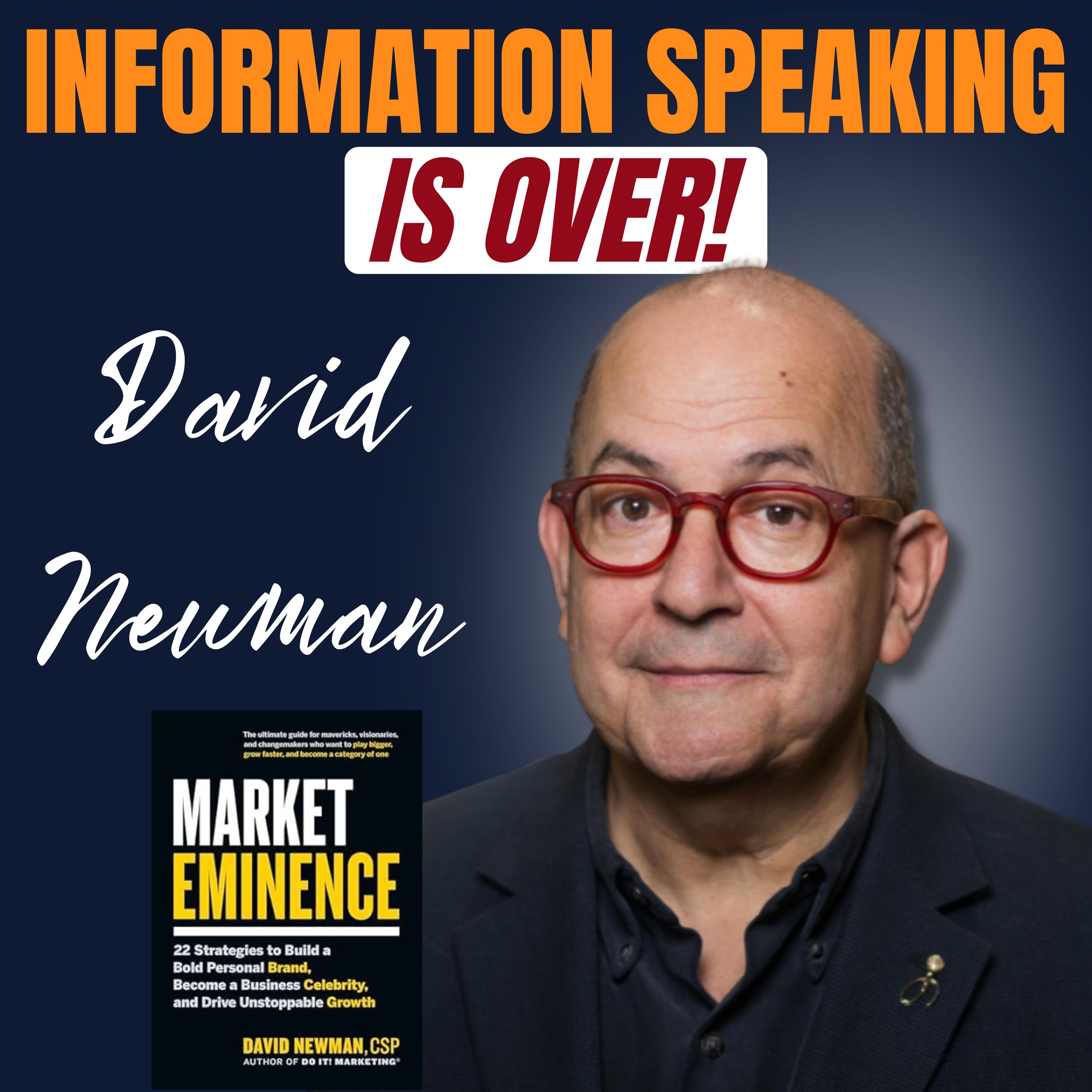
Maximize Your Speaking Career: Avoid the 'How-To' Trap with David Newman
May 1300:53:56Tap to summarizeUnlock the secrets to establishing a thriving speaking career with David Newman, a renowned speaker, consultant, and author known for his work in building market eminence. Join us as David reveals why over-reliance on 'How-To' content could be hindering your professional growth. Learn how to cultivate a balance of visibility, credibility, and brand preference that truly sets you apart.Discover actionable strategies and insights from David's decades of experience helping experts, consultants, and professional speakers elevate their careers. Find out how standing out in the crowded market can be achieved without defaulting to prescriptive content.Episode Highlights:- Understanding market eminence and its critical role in professional speaking.- The pitfalls of being overly dependent on 'How-To' content.- Developing a unique personal brand that resonates with audiences.- Real-world examples and case studies illustrating successful career transformations.If you're an aspiring or established speaker, don’t miss this episode filled with practical tips and expert advice that can steer your career in the right direction.Keywords: speaking career, David Newman, market eminence, personal branding, professional speakers, visibility, credibility, how-to content, speaker consultant, brand preference.#SpeakingCareer #DavidNewman #PersonalBranding #MarketEminence #PublicSpeakingWhat you'll take away:Why branding agencies are often the wrong first move for speakers -- and what to do insteadThe fire hose problem: why giving audiences too much content kills your follow-up businessThe mule vs magician distinction: what high-value clients actually want to buyWhy how-to content is finished as of November 2022 -- and the three content types that still workHow to think, what to believe, and where to focus next: the framework for content that AI can't produceThe market eminence model: visibility, respect, and brand preference as the three pillars of getting bookedCategory of one: what it actually means and why being divisive is the strategy, not the riskWhy your website navigation might be quietly sabotaging your speaking enquiriesThe "disturbing your enemy" exercise: how to find your position by identifying who you'd rather repelConnect with David Newman: Website: doitmarketing.com | Market Eminence resources: marketeminence.comJoin me for the Speaker positioning event on May 27th, A Position of Authority: Why Most Speakers Are Invisible (And What To Do About It)https://present-influence.kit.com/products/a-position-of-authority-eventCHAPTERS00:00 AI Changed Speaker Content01:49 Branding Is BS04:57 Stop The Firehose10:23 Mule Versus Magician15:26 Front Load Airport Value17:52 Market Eminence Framework20:05 Category Of One26:06 Finding Contrarian Differentiation28:03 Spotting Anti-Clients30:51 Disturb Your Audience32:29 Why Speakers Dont Book33:40 Three Content Upgrades35:04 Future Casting Advantage38:22 Is Speaking Doomed40:27 No Footnotes Needed43:15 Marketing Show Your Work45:38 Make Speaking Obvious49:07 Where To Find David50:31 Host Wrap And Workshop52:28 Follow Review And FarewellFAQ SECTIONWhy is how-to content no longer effective for professional speakers?According to author and speaker strategist David Newman, how-to content became obsolete in November 2022 when ChatGPT became publicly available. AI systems can now produce more comprehensive, accurate, and faster how-to content than any human speaker. John Ball and David Newman argue that speakers who continue to rely on how-to content are competing directly with AI on AI's strongest ground. The only content that remains uniquely human is content based on personal experience, hard-won expertise, and a genuine point of view.What are the three types of content that AI cannot replace for professional speakers?David Newman identifies three categories of Professional Speaking: Known. Booked. Paid. The first is how-to-think content -- strategic, insight-driven content grounded in the speaker's experience and expertise that helps audiences approach problems differently. The second is belief-shifting content that separates myths from truths and challenges conventional wisdom based on the speaker's direct observations. The third is future-casting or trend-spotting content that helps audiences understand what is coming next and how to prepare. Newman argues that focusing exclusively on these three areas can transform a speaking business within 90 days.What does it mean for a speaker to become a "category of one"?David Newman defines a category of one as a speaker whose specific combination of topic, perspective, philosophy, and personal experience cannot be replicated by any other speaker. It does not mean being the only speaker on a topic -- it means being the only speaker who approaches that topic from your particular angle, with your particular beliefs and your particular biases. Newman argues on the show with John Ball that divisive, opinionated positioning is not a risk but a strategy: the people who resonate deeply will book you; those who do not were never going to book you anyway.How can professional speakers find and develop a contrarian positioning?David Newman and John Ball discuss on the podcast that the first step is identifying who you would actively not want to hire you -- your "enemy" -- and then creating content that would deliberately alienate them. Newman shares a story of a client whose contrarian positioning around corporate intrapreneurship was validated when a hostile executive told her exactly what he did not want -- which confirmed she had found her position. The homework Newman recommends is to write, post, or share something that would genuinely upset the audience you do not want, because doing so more strongly attracts the audience you do.What is the "mule vs magician" distinction, and why does it matter for speakers and coaches?The mule vs magician framework, developed by David Newman, describes two different orientations to value in speaking and coaching programmes. A mule mentality is focused on volume -- more content, more bonuses, more videos, more binders. A magician mentality is focused on outcome -- the shortest possible path to the result the client already knows they want. Newman argues that high-value buyers and executives are no longer impressed by quantity and that the correct question when designing a programme is not what to add but what to remove.Visit https://strategic-speaker.scoreapp.com to take the 2-minute Strategic Speaking Business Audit and find out what's blocking you from getting more bookings, re-bookings, referrals and bigger fees. There's a special surprise gift for everyone who completes the quiz.Want to get coached for free on the show? Fill in the form https://forms.gle/mo4xYkEiCjqtz9yP6, and if we think your challenge could help others, we'll invite you on.For speaking enquiries or to connect with me, you can email john@presentinfluence.com or find me on LinkedInYou can find all our clips, episodes and more on the Present Influence YouTube channel: https://www.youtube.com/@PresentInfluenceThanks for listening. Rating the show 5* on Spotify helps their algo recommend the show, so please take a moment to follow the show and leave a rating.Mentioned in this episode:Do you want to join the Known, Booked & Paid Blueprint September Case Study group?This September I'll be working with a group of 5 speakers who are already speaking but not getting the level of bookings and speaker fees that they really want. We'll work on the 3 key areas that will allow your speaking business to flourish. Since it's the founding group, there's an extra special deal on the price for joining that will never be repeated. Go to https://presentinfluence.com/kbpb for full details.
Transcribe →Your Speaker Positioning Is Not Your Topic: Why Good Speakers Stay Invisible
May 500:22:12Tap to summarizeIf you're a good speaker who isn't getting booked at the rate or fee you think you deserve, this episode is going to be uncomfortable in the right way.The problem, in most cases, isn't your speaking. It's your positioning. And more specifically, it's the fact that most speakers build their positioning around what they want to say rather than what the market actually needs to hear.In this episode, John works through six positioning mistakes that keep credible, capable speakers invisible -- with real client stories and examples that make each one land where it needs to.Join us for the live speaker positioning event: https://present-influence.kit.com/products/a-position-of-authority-event It's a 'pay what you want' event, so pay a little, pay a lot, whatever you think good positioning guidance is worth.What's covered:The topic trap—why building your talk around your own expertise and interests, rather than your buyer's specific problem, is the fastest route to an empty pipeline. Including a story about a speaker whose health and productivity topic created a liability rather than a solution.Information vs transformation -- why packing your keynote with everything you know is the reason you're not getting rebookings or workshop enquiries. The talk that impresses is not always the talk that converts.The speak-on-anything problem -- both the unfocused speaker who hasn't chosen a lane, and the ego-driven speaker who believes intelligence alone equals credibility. With a real example from John's time at The Speaker Lab, and a look at what happened when Courtney Harding (episode 254) chased a hot topic without a clear problem to solve.The corporate bottom-line test—particularly for speakers building a career in the UK and Europe, where the association circuit doesn't exist in the same way it does in the US. If you want to be well-paid, corporate is where you need to be -- and your topic must connect directly to making or saving money. Cross-references the episode with Jackson Ogunyemi on education speaking, and a forthcoming episode with Claire Young on the UK education speaker market.Nice-to-have vs must-book -- why some topics will always sit in the soft column no matter how well you frame them, and what creates genuine urgency in a booking decision.The person is positioning—ethos, logos, and pathos applied to the speaker's positioning. Why two speakers can deliver identical content and create entirely different results, why your ethos cannot be copied even when your content is, and what Maria Franzoni revealed about content theft on episode 256 of this show.Referenced episodes:Episode 254 -- Hot Market, Cold Inbox: Why Your Speaking Calendar Isn't Matching Your Credibility (Courtny Harding)Episode 256 -- How Professional Speakers Get Hired: The Bookability Formula (Maria Franzoni)Jackson Ogunyemi episode -- education speaking and why it rarely pays enough to build a career onComing soon -- Claire Young on the UK education speaker booking market==============FAQs==============What is speaker positioning, and why does it matter for getting booked?Speaker positioning is how you define and communicate the specific value you deliver to a specific buyer with a specific problem. It goes beyond having a topic—it determines whether a buyer sees you as a must-book speaker or a nice-to-have. Most speakers who struggle to get booked consistently, or who aren't commanding the fees they want, have a positioning problem rather than a speaking problem. In this episode, speaking coach John Ball explains why positioning built around what a speaker wants to say, rather than what the market needs to hear, is the most common reason credible speakers stay invisible.What is the difference between a topic and a positioning for a speaker?A topic is a subject area —such as leadership, communication, resilience, or AI. A positioning is a specific claim about who you serve, what problem you solve, and why you are the credible choice to solve it. John Ball describes the topic as raw material and positioning as what you build from it that makes a buyer say yes. Speakers who position themselves around a topic category rather than a specific buyer problem are easy to overlook and difficult to justify to stakeholders.What mistakes do speakers make when trying to break into the corporate market?The most common mistakes speakers make when breaking into corporate include: building their talk around their own interests rather than a problem the business already knows it has, delivering information-heavy keynotes rather than creating genuine transformation, speaking on too many topics without a clear specialisation, and failing to connect their subject to the company's bottom line. Corporate buyers need to justify every fee to stakeholders, which means a speaker's topic must connect directly to making money, saving money, or reducing risk. John Ball covers all of these mistakes with real client examples in this episode.Why do some speakers get lots of enquiries while others with equal talent don't?Speakers who attract consistent enquiries are typically positioned at the intersection of a specific, urgent problem, a credible, differentiated solution, and demonstrable evidence that their work delivers results. John Ball describes this as the difference between a nice-to-have speaker and a must-book speaker. Topics that address immediate, high-stakes business pain points -- such as AI adoption, organisational communication failures, or leadership under pressure -- create urgency in the buyer that drives action. Softer topics, however well framed, tend to be deferred or cut when budgets tighten.What are ethos, logos and pathos, and how do they apply to speaker positioning?Ethos, logos, and pathos are the three modes of persuasion identified by Aristotle. In the context of speaker positioning, logos refers to the intellectual substance of a speaker's content—their frameworks, research, and arguments. Pathos refers to the emotional resonance they create—their delivery, humour, and ability to move an audience. Ethos refers to their credibility and earned authority to speak on a subject—their track record, lived experience, and body of work. John Ball argues that ethos is the most powerful and least copyable element of a speaker's positioning, and that speakers who rely solely on logos—listing credentials and frameworks—leave the most important part of their positioning invisible.Can other speakers copy your talk and damage your positioning?Content theft is more common in the speaking industry than most people acknowledge. Talks get transcribed, frameworks get lifted, and stories get repurposed by other speakers. However, John Ball argues that what makes a talk genuinely powerful -- the speaker's ethos, their lived experience, and their earned authority -- cannot be copied. Two speakers can deliver identical content and create entirely different results because audiences respond to the person carrying the ideas, not just the ideas themselves. Speaker agent Maria Franzoni addressed this directly on episode 256 of Professional Speaking: Known. Booked. Paid.Is corporate speaking the only viable route for well-paid speakers in the UK and Europe?For speakers building a career in the UK and Europe, corporate speaking is the most reliable route to sustainable, well-paid work. The association speaking circuit that sustains many American speakers does not exist in the same form in the UK and Europe, and associations that do exist largely do not pay competitive fees. Education speaking can be rewarding but rarely pays enough to build a primary income on -- explored in depth in the episode with Jackson Ogunyemi. Faith speaking does not pay at meaningful levels except for established public figures. After-dinner speaking, conference speaking, and stand-up comedy can be lucrative but require distinct skill sets. A forthcoming episode with Claire Young, who runs a UK education speaker booking agency, will explore the education market in more detail.Ready to do the actual work on your positioning? John is running a live event -- A Position of Authority: Why Most Speakers Are Invisible (And What To Do About It) -- where we go beyond the theory and build a position that is specific, credible, and unmistakably yours.Registration link: https://present-influence.kit.com/products/a-position-of-authority-why-most-speakVisit https://strategic-speaker.scoreapp.com to take the 2-minute Strategic Speaking Business Audit and find out what's blocking you from getting more bookings, re-bookings, referrals and bigger fees. There's a special surprise gift for everyone who completes the quiz.Want to get coached for free on the show? Fill in the form https://forms.gle/mo4xYkEiCjqtz9yP6, and if we think your challenge could help others, we'll invite you on.For speaking enquiries or to connect with me, you can email john@presentinfluence.com or find me on LinkedInYou can find all our clips, episodes and more on the Present Influenc...
Transcribe →