← Real Cool History for Kids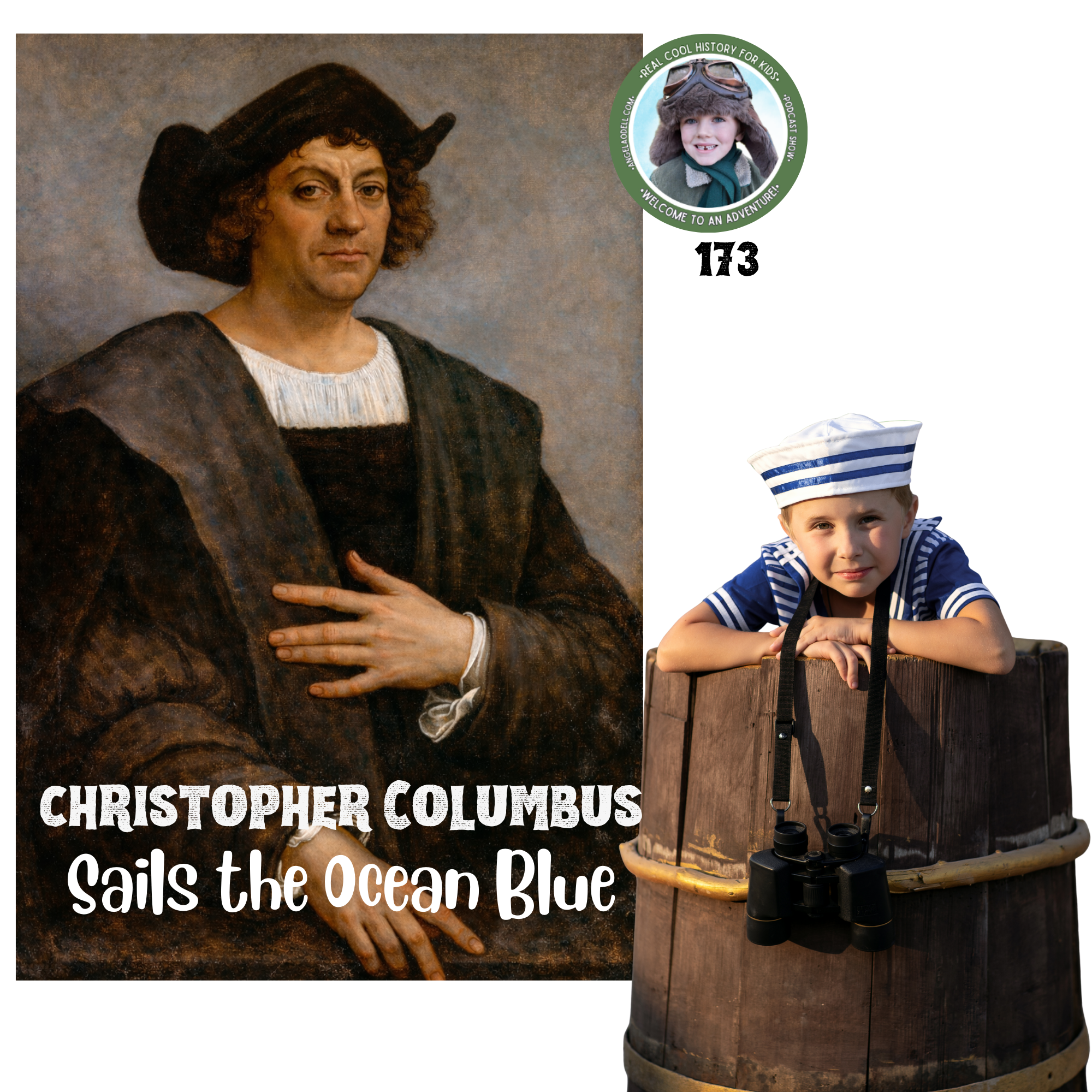
Real Cool History for Kids
Christopher Columbus Sails the Ocean Blue (a special episode for Eliza Lipps)
00:16:28
Loading summary
Transcript1 lines
- [00:00]
A
Foreign. This is Angela Odell and you are listening to Real Cool History for Kids, a podcast show featuring history told from a distinctly biblical worldview perspective. Welcome to an adventure. Welcome to episode 173 of Real Cool History for Kids. This episode is for Eliza Lips, who wanted to hear the story about Christopher Columbus. Okay, you guys, I am going to be really honest. I have been asked several times to create an episode like this about this man and I've put it off because I honestly, I just didn't want to deal with the issues. I know that will probably come after the release of this episode. So let's start here. Any telling of Columbus's story has to start right now in our current world. You see, Christopher Columbus used to be considered a straight up hero by pretty much everyone. Someone who had accomplished amazing feats of bravery and courage. Someone who sailed across the massive Atlantic Ocean when nobody thought that was possible and stumbled across islands in what we now call the Caribbean, thus opening the doors for exploration of the Americas and eventual European settling of these continents. But in the last 25 years or so, Christopher Columbus reputation has taken a real beating. People have argued that he's responsible for opening the door for all kinds of bad things to happen and they blame him for all kinds of stuff and pretty much completely disregard all of the amazing things that he did. This popular opinion condemning him makes it hard to to tell his story without making someone mad. So in light of that, I want to remind all of my listeners that God often works through ordinary imperfect people to accomplish things much bigger than they could ever imagine. In fact, this is the true reality of all of history, isn't it? God doing his thing the way only he can. So in this episode you aren't going to hear me detailing all of Columbus faults, which like any human, there were many. There is enough of that kind of storytelling, you guys, that it's available anywhere else. So I'm not going to go into that. The Bible tells us that all people have fallen short of God's glory. That means when we learn history, we are not looking for perfect human heroes. The true hero of history is God himself, who works through real people, living in real times and making real choices, affected, informed by their culture. And when we expect perfection from people in the past or the present, we are expecting something that God has never required of any human being. And that my friend, is a fact that we all need to remember. So with that in mind, let's hear the story of Christopher Columbus. Christopher Columbus was born around the year 1451. In the seaport city of Genoa, Italy. He grew up surrounded by ships and sailors and stories of the sea. From a young age, Christopher learned how to sail and how to read the winds and how to study maps and the stars. He loved the ocean. He loved to sail. Christopher also studied religion. You know, he lived in a world deeply influenced by the Church. And his Catholic faith shaped how he understood both his life and the world around him. As a young man, Columbus became convinced that he had a divine calling. He believed God had placed it on his heart to sail west across the Atlantic Ocean. Christopher also had a family who mattered deeply to him. His wife, Philippa, came from a respected Portuguese family connected to early explorers and sailors. Through Philippa, Christopher learned even more about navigating and life at sea. Together, Christopher and Philippa had a son named Diego. Sadly, Philippa died when Diego was a young boy, leaving Christopher brokenhearted. Later on in his life, he had another son, Ferdinand, whom he cared for deeply and helped educate. Columbus spent long stretches of time away from his family because of his voyages. But his letters show that he thought often about his sons and their futures. Ferdinand later grew up to become a scholar and a writer who carefully preserved his father's papers and helped historians understand Columbus life and journeys more clearly. Columbus goal was to find a new route to Asia. But he also believed that exploration could open doors for the spread of Christianity. And this belief guided him for many years. Christopher spent a long time preparing for his dream voyage. He studied geography, astronomy, and he read books written by earlier explorers. And he prayed. And then he asked again and again and again for help. Most of the people he asked to help him said no. They had no interest in funding such a harebrained idea. Some thought his plan was just downright dangerous, just crazy. And others thought it would cost way too much money. And many simply didn't believe it could be done. But Christopher Columbus was persistent. Finally, in 1492, Queen Isabella and King Ferdinand of Spain agreed to support his voyage. Hey guys, I'm going to take a quick break right here in the middle of our story about Christopher Columbus to give a shout out to a recent podcast reviewer who said this about Real Cool History for Kids. This is Eliana Shirk. I love Real Cool History for Kids. I'm seven years old. I listened to your podcast while I folded the laundry today. I like the episode about the locomotive chase. You're the best ever. Thanks, Heliana. I'm so happy you're enjoying the show. Thank you for your wonderful feedback. This episode is made possible in Part by the America Story series, written by me and published by Master Books, a leader in homeschool curriculum. Written from a distinction distinctly biblical worldview perspective and designed for everyday life. Okay, let's get back to our story about Christopher Columbus. So King Ferdinand and Queen Isabella of Spain decided to help Christopher Columbus. And they gave him three ships. The Nina, the Pinta, and the Santa Maria. These ships were small and they were wooden, and they were powered mostly by the wind. Before leaving, Christopher and his crew prayed for safety and blessings. He knew he was facing unknown odds. Most people thought he was absolutely crazy to even try this voyage. But Christopher believed the old Norse legends about the land on the other side of the vast water. He believed it to be the coast of the Indies, the rich Orient lands of Asia. He had no idea that there were two massive continents in the way. Well, on August 3, 1492, the ships sailed west into the Atlantic Ocean. Days turned into weeks. The sailors watched familiar landmarks disappear behind them. The ocean felt endless, and the sailors suffered through one storm after another. Food supplies slowly dwindled. Many of the sailors became extremely afraid and discouraged. They thought for sure they were going to be lost at sea. Columbus kept a journal throughout this journey. In it, he often wrote prayers and thanked God for protection. He also recorded signs of land, birds flying overhead, floating plants, and changes in the water. All of these small details gave him hope that land was somewhere nearby. As fear grew among the crew, Columbus remained steady. He encouraged them and reminded them why they had come. He believed God had not brought them this far, just to be abandoned in the middle of the ocean. Then, late on the night of October 11, a lookout spotted land. In the early hours of October 12, 1492, the ships reached the shore. The ships had landed on a small island in the Caribbean that the native people called guianahanni. Columbus named it San Salvador. Most historians believe that this island is part of the Bahamas today. Although the exact modern island is still debated. What is for sure is that it was not part of mainland North America. It was an island in the Caribbean Sea. When Christopher stepped ashore, he thanked God and claimed the land in the name of Spain. To him, this moment was an achievement and the fulfillment of years of praying and preparations and perseverance. Christopher thought that he had reached the Indies in Asia. So he called the native people he saw Indios, which means people of the Indies. This is where the name Indians came from and why the native American tribes of North America became known by that name. He had no idea that he was actually in a place Europeans had never even known about before. Christopher made four voyages across the Atlantic Ocean in his lifetime. He never did find the riches he and his sponsors were looking for. They had imagined they were going to find gold and precious stones, but they found very little of obvious value. However, his journeys did open the way for continued exploration and lasting contact between Europe and the Americas. The world became more connected and history began moving in a completely new direction. Because of what Columbus did, the exploration period would bring massive changes to the Americas and to the world. Christopher believed his life was part of a larger story, one written by God. That belief gave him courage when others doubted, patience when doors closed in his face, and strength when the journey felt overwhelming. Christopher Columbus did not live to see all of the long term results of his voyages. He could not have imagined everything that would follow. We can always learn lessons from history, can't we? First, history teaches us humility. It reminds us that we do not know everything but God does. Isaiah 55 tells us that God's ways are higher than our ways and his thoughts are higher than our thoughts. Thank goodness, right? When we study history, we remember that God is never surprised by human events. History also reminds us to persevere, to trust God in uncertain moments and to step forward when we believe he's calling us to go, even when the path ahead of us is unclear. Most importantly, you guys, when we learn history, we learn how God has been at work all along. We are reminded how he is the true hero of history. And now it's time for this episode's birthday shout outs. Happy birthday to Jordan Johnson who is turning 9 on February 11th. Happy birthday to Jael Johnson who is turning 8 on February 27th. Happy birthday to Evelyn who turned 9 on January 21st. Happy birthday to Samuel Rhodes who turned 4 on February 2nd. Happy birthday to Bennet Wilkinson who turned 9 on February 2nd. Happy birthday, Hope who turned 7 on February 4th. Happy birthday to Gemma Hansley who turned 10 on February 7th. Happy birthday to Shiloh Clues, who is turning 3 today on February 9th. And happy birthday to David Lara who is turning 11 today on February 9th. Happy birthday to Hope who turned 5 on February 7th. Happy birthday To Otis Young who is turning 11 on February 11th. Happy birthday To Koa O' Connor who is turning 7 on February 19th. And happy birthday to Gibson Brown who is turning 4 on February 22nd. Happy birthday to all of you from the Real Cool History for Kids family. I hope you all have enjoyed this adventure in history today. Remember to keep exploring and to keep asking questions. And always remember that God is the real hero of history. I'll meet you here soon for our next episode of Real Cool History for kids. Until then, with the help and grace of Jesus, our Savior, be the best you ever.