← Real Cool History for Kids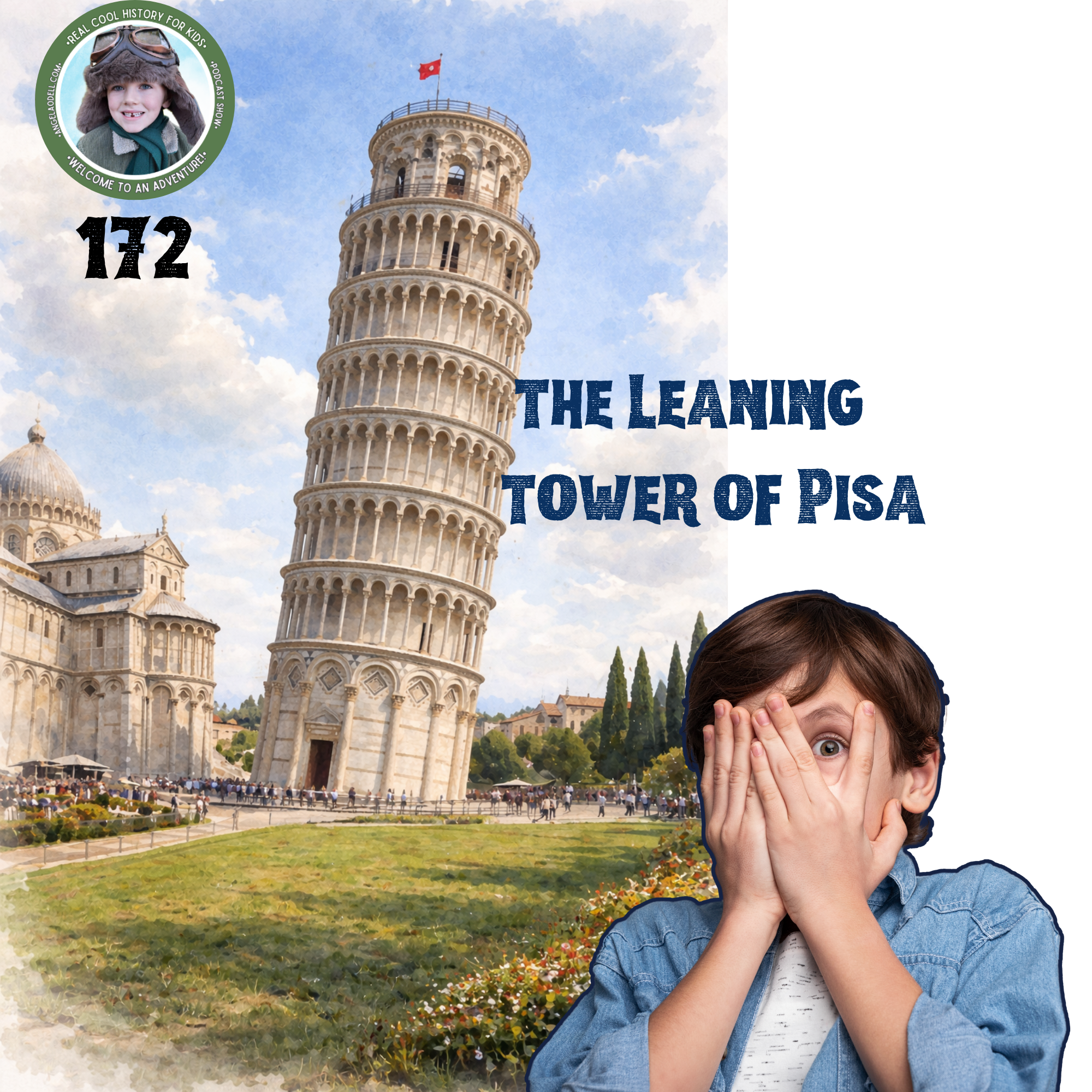
Real Cool History for Kids
The Leeeeeaaaning Tower of Pisa (a special episode for Monty Goeller)
00:13:40
Loading summary
Transcript3 lines
- [00:00]
A
Foreign. This is Angela Odell, and you are listening to Real Cool History for Kids, a podcast show featuring history told from a distinctly biblical worldview perspective. Welcome to an adventure. Foreign. Welcome to episode 172 of Real Cool History for Kids. This episode is for Monty Goler, who wanted to hear the story of one of the most famous and most puzzling buildings in the entire world. The Leaning Tower of Pisa. When people hear the name Leaning Tower of Pisa, they usually picture a tall white tower tipping sideways, as if it might fall over at any moment. Some people even joke that it looks like it was frozen halfway through a mistake. But the real story of this tower isn't silly at all. It's actually really interesting. It's a story about patience and problem solving in a building that became famous not because it was perfect, but because it wasn't. To understand how the Leaning Tower of Pisa came to be, we have to travel back more than 800 years to the Middle Ages. Back then, Pisa was a powerful city with ships sailing across the Mediterranean Sea. Pisa traded goods, built strong fleets, and competed with other important Italian cities like Genoa and Venice. The people of Pisa were proud of their city and wanted to be admired across Europe. So they began to build something magnificent. They chose a wide grassy area and began planning a grand cathedral complex. This space would later be known as the Piazza del Duomo. In this one place, they planned four important buildings. A cathedral, a baptistery, a cemetery, and a tall bell tower. That bell tower is the building we know today as the Leaning Tower of Pisa. Construction on the tower began in 1173. Builders carefully stacked heavy white stone blocks, shaping each one by hand. The plan was simple. Build a tall, straight tower that would rise high above the city. That's all they wanted to do, because that's what a bell tower was. Bell towers were important in medieval times. Bells marked the hours of the day. They called people to church and rang out for celebrations and warnings. The taller the tower, the further the sound could travel. At first, everything seemed to be going very well with the new bell tower. The tower rose level by level. But after only a few stories were built, the workers noticed something interesting and rather troubling. One side of the tower was sinking slightly into the ground, and the tower wasn't straight anymore. It was beginning to lean. The problem wasn't the stone or the craftsmanship. The problem was the ground. Beneath the tower itself, the soil was made of soft clay, sand and silt. It looked firm on the surface, but it couldn't properly support the enormous weight of a Stone tower. Imagine standing on a solid pavement versus standing on a. A muddy river bank, for instance. On solid ground, you feel steady. On soft ground, one foot might sink lower than the other. And that's exactly what was happening beneath the tower. The builders didn't understand soil science the way engineers do today, but they knew something was wrong. And they also knew that a leaning tower was probably going to be dangerous. So construction slowed, and then it stopped altogether. Years passed, and then decades. A decade is 10 years, by the way. So decades passed. Part of the delay was fear about the leaning tower. But there were other reasons, too. Pisa became involved in wars with neighboring cities, and money and attention were pulled away from the building projects. The unfinished tower just stood there in the square, leaning a little more. As time went on. When construction finally resumed, new builders faced a difficult choice. Should they just tear the tower down and start over, or should they just try to finish it? Anyway, they chose to keep building it. As they added new levels, they tried to correct the lean by making one side of the tower slightly taller than the other. And if you look at it carefully, even today, you can actually see. See where they did this? There's a subtle curve to its shape. Even with these adjustments, though, the tower never became straight. Still, generation after generation kept working on the tower. Some people who helped build the tower never lived to see it finished. Parents worked on it, and then their children, and then even their grandchildren. The Leaning Tower of Pisa was built in sections, so not all at once. Finally, in the 1300s, nearly 200 years after construction had begun on the tower, it was finally completed, and it was still leaning. Over time, the tower became famous for that very reason. Travelers came from far away just to see it. Some were amazed, and others were nervous. And people wondered just how long it could possibly stand like that. Centuries passed. A century is a hundred years. So hundreds of years passed. The tower survived storms, earthquakes, and even wars. And slowly, the lean grew worse. By the 20th century, that's the 1900s, experts were becoming deeply concerned. The tower had tilted further than ever before, and the scientists feared that it might collapse altogether. What should they do? Hey, guys, I'm going to take a quick break right here in the middle of our story about the Leaning Tower of Pisa to give a shout out to a recent podcast reviewer viewer who said this about Real cool history for kids. My name is Kaylin, and I'm seven years old. I love Real Cool history for kids. I listen with my dad and my brother while we go to American Heritage Girls and Trail Life and Long Road trips. My favorite part is everything. I can't pick one thing. Thank you, Kaylyn. I'm so happy to hear that you're enjoying the podcast podcast show. Everyone make sure you check out this year's Liberty Lives Here series on my website. You can follow the link in the information this episode is made possible in part by the World Stories series, written by me and published through Master Books, a leader in homeschool curriculum, written from a distinctly biblical worldview perspective and designed for everyday life. Now, let's get back to the story. By the late 1900s, the Leaning Tower of Pisa was in real danger. Engineers warned that if nothing was done, the tower would fall within decades, or even Sooner. So in 1990, a big decision was made. The tower would be closed to visitors so it could be saved. A team of engineers from around the world studied the tower carefully. Their goal was not to make it perfectly straight. By then, the lean was part of the tower's identity. They just wanted to make sure it would stand safely for hundreds of years to come. At first, engineers used steel cables and heavy lead counterweights to keep the tower from tipping further. Then they began the most delicate part of the rescue. They slowly removed small amounts of soil from beneath the higher side of the tower's foundation. This method is called under excavation. It allowed the tower to gently settle back toward a safe position. The work had to be done incredibly slow, sometimes just a few millimeters at a time. The entire process took more than 10 years. In 2001, the Leaning Tower of Pisa reopened to the public. The lean had been reduced by about 17 inches, and the tower was far more stable than before. Scientists continued to monitor it closely, and by 2008, sensors showed that the tower had finally stopped moving and shifting. Today, the Leaning Tower of Pisa still leans, but it is considerably safer. You know, it's interesting. The Leaning Tower of Pisa has always reminded me of the story Jesus told in Matthew 7 about building our lives on solid ground. If you think about the fact that the Leaning Tower of Pisa was built on sand instead of rock, it's no wonder that it's leaning right. Think about that. This is what Jesus said. Anyone who listens to my teaching and follows it is wise. Like a person who builds a house on solid rock. Though the rain comes in torrents and the floodwaters rise and the wind beats against that house, it won't collapse because it's built on bedrock. But anyone who hears my teaching and doesn't obey it is foolish, like a person who builds a house on sand. When the rains and the floods come and the winds beat against the house, it will collapse with a mighty crash. You know, the Tower of Pisa has remained upright, although it has been crooked and leaning almost since the beginning. Its entire lifespan has been spent either causing worry for those around it or being worked on to keep it from tumbling down. It's never been a completely functional, sound structure because of the sandy ground it was built on. That tower, you guys, is kind of like our lives. If we want a strong, straight, functional and worthy life, we need to obey the word of God and build our lives on the rock of Jesus Christ. Anything else is like building our lives on sand that can be washed away or at least end up looking like the Leaning Tower of Pisa. And now it's time for this episode's birthday shout outs.
- [12:16]
B
Happy birthday to Ezekiel Jude, who turned 8 on January 20th. Happy birthday to Alex Joyce, who turned 9 on January 22nd. Happy birthday to Liam McElroy, who is turning 7 today on January 26th. Happy birthday to Natalie Bozanos, who is turning 11 on January 30th. Happy birthday to Avram Moore, who is turning 14 on January 30th. And happy birthday to Nora Weaver, who is turning 7 on January 3rd.
- [13:04]
A
Happy birthday to all of you from the Real Cool History for Kids family. I hope you have enjoyed this adventure in history today. Remember to keep exploring and to keep asking questions. And always remember, history is full of real adventures and really cool stories. I'll meet you here soon for our next episode of Real Cool History for Kids. Until then, build your life on the rock of Jesus Christ and be the best you ever.