← Real Cool History for Kids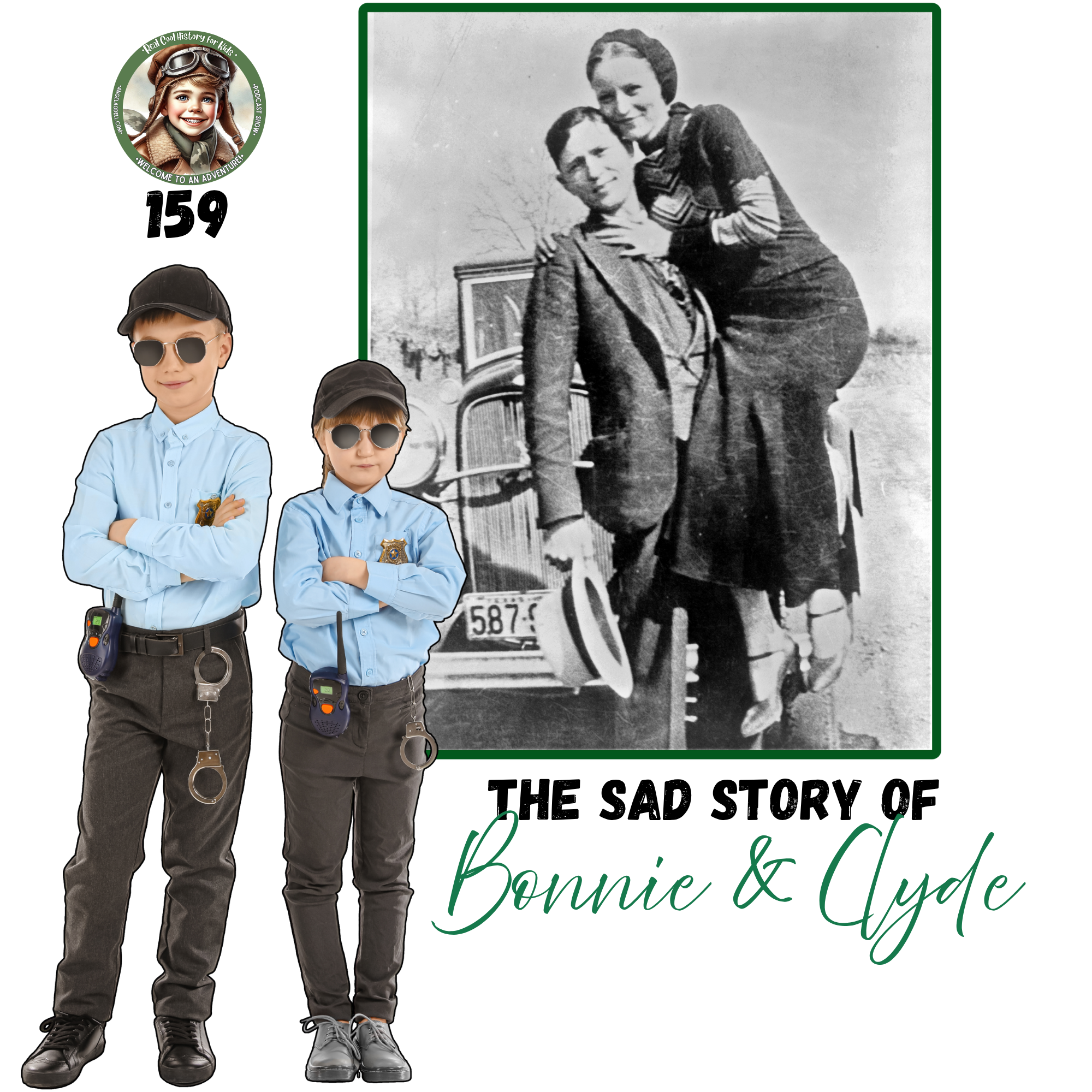
Real Cool History for Kids
The Sad Story of Bonnie and Clyde (a special episode for Judah Leffers)
00:13:41
Episode 159: The Sad Story of Bonnie and Clyde (a special episode for Judah Leffers) Get all kinds of cool member content AND help keep Real Cool History for Kids on the air! Visit Angela's website: https://angelaodell.com/
Loading summary
Transcript1 lines
- [00:00]
A
Foreign. This is Angela Odell, and you are listening to Real Cool History for Kids, a podcast show featuring history told from a distinctly biblical worldview perspective. Welcome to an adventure. Welcome to episode 159 of Real Cool History for Kids. This episode is for Judah Leffers, who wanted to hear the story of Bonnie and Clyde. Hey, Judah, this one's for you. The story of Bonnie and Clyde is one of violence and murder. And quite honestly, I just wasn't 100% sure I could actually create an episode about it. My goals for this podcast is to tell the stories of history in a way that will tell the truth, but also shepherd my listeners hearts. As I worked through my research about Bonnie and Clyde, I realized their story is an important one because it can be used as an example for what happens. We make bad decisions and choose to live life for ourselves. So this is the reason I'm telling you their story. I want you to think of it as a case study of how bad decisions lead us in the wrong direction. Okay. To meet up with Bonnie and Clyde in their own time period, we need to jump back in time almost 100 years, right into the middle of the Great Depression. I told you guys about the Great depression in episode 138, so if you haven't listened to that episode yet, you might want to. It'll give this story a better context. Okay. The Great Depression was a time when money was super tight. People were really, really struggling, and banks were closing down everywhere. In the middle of all of this trouble, two young people. A decision that would change their lives and the lives of many others. Their names were Bonnie Parker and Clyde Barrow. Instead of helping people or working to make things better for everyone, Bonnie and Clyde chose a very different path. They became outlaws. They robbed banks and stole cars and even committed crimes that hurt people very badly. And they committed murder and they didn't stop. They were always running, always hiding, driving from state to state to stay ahead of the police. What kind of people would do this? And what life circumstances led them to this path, this place of choosing such a horrible, violent lifestyle? Well, Clyde Barrow was born in Texas in 1909. He came from a big family and they were very poor, and he had a hard time finding work. He got into trouble with the law at a very young age, first by stealing cars and then later committing even more serious crimes. Bonnie Parker was also from Texas. She was born in 1910, and she loved to write poetry and to read books. When she was a teenager, she dreamed of being famous, maybe an actress or a Writer Bonnie was tiny, not even five feet tall, and at one point during their time on the run, she was seriously hurt in a car accident. Battery acid spilled onto her legs and gave her very, very deep burns on her legs. Even when she walked, she often had to lean on Clyde for help, and her legs were scarred and the pain never really went away. But even after her injury, Bonnie stayed by Clyde's side. When they first met in 1930, they quickly became very close. Soon after Clyde was arrested and sent to prison, Bonnie still stayed loyal to him and even helped him to escape. But he quickly was caught and sent back to prison. When Clyde was finally released from prison in 1932, he didn't leave his life of crime behind. He didn't learn his lesson. Instead, he and Bonnie teamed up and they started robbing gas stations and grocery stores and then banks. Sometimes Clyde's brother Buck and his wife Blanche and other gang members helped them commit these robberies and run from the police. They drove all over central United States in fast, stolen cars, and they never stayed in one place for very long. If they thought the police were nearby, they'd be gone before sunrise. The newspaper called them the Barrow Gang, and people all over the country followed their story as if it was some exciting range unfolding saga. Hey guys, I'm going to take a break right here in the middle of our story about Bonnie and Clyde to give a shout out to a recent podcast reviewer who says this about real cool history for kids. Mrs. O', Dell, I love your podcast so much. It makes history really interesting and I love how you make it from a biblical view. Love Shiloh. Thank you, Shiloh, for your kind words. I'm so happy that you're enjoying the podcast show. Hey everyone, I want to invite you to join our Patreon platform. For just $8 a month, you get all kinds of great resources added throughout the month. By joining our platform, you are helping to keep real cool history for kids on the air. And of course, make sure you stick around to hear this episode's birthday shout outs. This episode is made possible in part by the America's Story series written by me, Angela o', Dell, and published through Master Books, creators of home school curriculum designed for everyday life and written from a distinctly biblical worldview perspective. At Master Books, our purpose is ink on paper to impact eternity because education is never neutral. Okay, let's get back to our story about Bonnie and Clyde. Now here's something very interesting. Some people thought Bonnie and Clyde were like Robin Hood. They believed that these two outlaws were Stealing from the banks and standing up to the system that was making so many people poor. But that really wasn't true. Bonnie and Clyde weren't helping people. They were stealing stuff for themselves. They were stealing other people's things for themselves. And along the way, they hurt and killed several people, including police officers. The FBI and local law enforcement had been trying to catch the Barrow Gang for years. But every time they got close, Bonnie and Clyde slipped away. Finally, in 1934, the law caught up with them. A group of law officers led by a former Texas Ranger set up a trap on a country road in Louisiana. On the morning of May 23rd, Bonnie and Clyde were barreling down the road at high speeds. They were late to a meeting with one of their friends because Bonnie had insisted on stopping to grab a sandwich for lunch. They quickly approached what they thought was their friend next to his truck on the side of the road. Realizing too late that they had driven into an ambush, the lawmen opened fire on the two. And both Bonnie and Clyde were killed. Just like that, their crime spree was over. Pictures of their stolen car full of bullet holes were published in newspapers across the nation. These photographs became a symb of Bonnie and Clyde's violent life. Some people were shocked, and others said it was the only way to stop them. Many talked about how sad it was that they had wasted their lives and died at such a young age. Clyde was only 25 and Bonnie was 23 years old when they died. Let's take a moment to think about this story. Bonnie and Clyde were real people. They made real choices. Choices that hurt others. And even though newspapers made them famous, their story isn't one to copy or admire. It's a warning. The Bible tells us in Exodus 20, verse 13 and 15 that we must not kill and must not steal. That's part of the ten Commandments. And these are serious commands from God. You see, when we break them, people get hurt. When we break the Ten Commandments, people get hurt. Lives are destroyed. Bonnie and Clyde chose the wrong path. They could have used their talents and their energy to do something good. Instead, they let their anger and desperation lead them into a life of crime. And that's something important for us all to remember. We will probably never be faced with a choice of whether or not we're going to murder and steal. But we do face choices, big and small. And all choices have consequences, good or bad. Will we choose what is right, even when it's hard? Or will we take the easy way, even if it hurts others? God's word helps guide us. His ways are always best, even when the world tries to make wrong choices look exciting or cool. So next time you hear the names of Bonnie and Clyde, remember this. Their story is a clear reminder that what we choose matters and those choices always have consequences. I want to leave you with a verse from Deuteronomy 30, verse 19. These are the words of God spoken through Moses to his people. And this is what he said today. I've given you the choice between life and death, between blessing and curses. Choose life. And now it's time for this episode's birthday shout outs. Happy Birthday to Graham Fossheim, who turned 4 on July 16. Happy birthday to Joey Logan, who turned 6 on July 18. Happy birthday to Grace Fossheim, who turned 6 on July 20. Happy birthday to Luthien Ishizu, who turned 9 on July 20. And happy birthday to Zachary Clark, who turned 7 on July 21. Happy birthday to Joshua James, who turned 5 on July 21. Happy birthday to Chatham Phelps, who turned 12 on July 23. Happy birthday to Corbin Fought, who turned 6 on July 26. Happy birthday to Wesley Stillwell who turned 9 on July 28. And happy birthday to Sarah Kate Fridley who is turning 8 on July 31st. And a special happy birthday in memory of Alexander Levy who was born on July 17, 2021, but passed away at a week old. He would have been four on July 17th. Happy birthday to each of you from the Real Cool History for Kids family. Remember to keep exploring, keep asking questions and never forget. History is full of real people, real adventures and real cool stories. I'll meet you here soon for our next episode of Real Cool History for Kids. Until then, with the help and grace of Jesus our Savior, be the best you ever.