
Podcast
ReConsider
Hosted by Erik Fogg · EN
A podcast to examine your life, because the unexamined life is not worth living.
Hosted on Acast. See acast.com/privacy for more information.
18episodes
Episodes
Newest firstAll episodes

[2.6] The One Wisdom
3d ago00:52:00Tap to summarizeToday we explore wisdom. Not the "don't put tomatoes in a fruit salad" kind. Serious business wisdom.It turns out, the wise tend to converge on understanding the world in a similar way.In the 20th century, philosophical titans saw this convergence. They look back to the original seers of wisdom and see in them parallels that run so deep, that upon deep contemplation of these philosophies, they found a "highest common factor," including among:Epicteus, Marcus Aurelius, and the StoicsPlato, and various Neoplatonists such as PlotinusSpinoza, SchopenhauerPossibly Hegel, Wittgenstein, though they are famously difficult to interpretJiddu KrishnamurtiLao Tzu, who authored the Tao Te ChingALso Chuang Tzu and Lieh TzuJewish philosophers such as Philo of AlexandriaSufi mystics of Islam, most famously Jalal al-Din RumiJesus of NazarethSt. PaulMeister Eckhart, the mystic Christian St. Jon of the CrossHinduism:The Sages of the UpanishadsAdi Shankara’s The Crest-Jewel of WisdomThe Bhagavad GitaThe BuddhaParticularly Zen masters who followedVarious SutrasThe Bardo ThodolIt is the Perennial Philosophy. I call it the One Wisdom. Huxley called it the “Highest Common Factor” of universal truth.SOURCESCamus, Albert. The Myth of Sisyphus. 1942.Huxley, Aldous. The Perennial Philosophy. Harper & Row, 1945.John of the Cross, St. Dark Night of the Soul (La noche oscura del alma).Jung, C. G. Letters, Volume 1: 1906–1950. Princeton University Press.Kahan, Dan. Identity-protective cognition research (cross-referenced, this project).Platform Sutra of the Sixth Patriarch (Liuzu Tan Jing).Polanyi, Michael. Personal Knowledge: Towards a Post-Critical Philosophy. University of Chicago Press, 1958.Polanyi, Michael. The Tacit Dimension. Doubleday, 1966.Tolle, Eckhart. A New Earth: Awakening to Your Life's Purpose. Dutton, 2005.Tao Te Ching (Laozi).Watts, Alan. Become What You Are. Shambhala, 1995 (essays, 1930s–1950s).Watts, Alan. Out of Your Mind: Tricksters, Interdependence, and the Cosmic Game of Hide-and-Seek. Sounds True, 2017.Watts, Alan. The Wisdom of Insecurity. Pantheon, 1951.Wittgenstein, Ludwig. Tractatus Logico-Philosophicus. 1921.Wright, Robert. Why Buddhism Is True. Simon & Schuster, 2017.Xiangyan Zhixian — traditional Chan/Zen biographical account (Tang dynasty, c. 820–898).Zhuangzi (Chuang Tzu), "On the Equality of Things" ("Discussion on Making All Things Equal").Bible. Job 42:5–6; Luke 15:11–32 (KJV).Bhagavad Gita, 2.47.Ovid. Metamorphoses.McGilchrist, Iain. The Master and His Emissary: The Divided Brain and the Making of the Western World. Yale University Press, 2009.Miles Kington. Quoted in The Independent (UK), Mar 28, 2003. Joseph Campbell. The Hero with a Thousand Faces. Pantheon, 1949 — "Freedom to Live," Stage 17. Eckhart Tolle. The Power of Now: A Guide to Spiritual Enlightenment. New World Library, 1997 Ramana Maharshi, quoted in Ram Dass, "Dying Is Absolutely Safe"Alan Watts, Become Who You Are. Sam Harris, Waking Up: A Guide to Spirituality Without Religion. Dalai Lama & Paul Ekman, Emotional Awareness: Overcoming the Obstacles to Psychological Balance and Compassion. Times Books, 2008Emmet Fox, The Sermon on the MountErnest Kurtz & Katherine Ketcham, The Spirituality of Imperfection. BantamByron Katie, Loving What Is. Harmony, 2002. Diana Chapman & Jim Dethmer (with Kaley Klemp), The 15 Commitments of Conscious Leadership. 2014.Epictetus, Discourses / Enchiridion.Marcus Aurelius, Meditations.Plato, RepublicPlotinus, The Enneads.Spinoza, EthicsSchopenhauer, The World as Will and Representation.Hegel, Phenomenology of Spirit. Jiddu Krishnamurti, Freedom from the Known Philo of Alexandria, On the Creation of the World. 1 Corinthians 1:20, 1:25, 3:19 — "the wisdom of the world is foolishness"John 14:6 — "I am the way, the truth, and the life." John 8:12 — "I am the light of the world."Galatians 2:20 or 2 Corinthians 5:17 -- "in Christ" Hosted on Acast. See acast.com/privacy for more information.
Transcribe →
[2.5] The End of Education
1w ago00:54:06Tap to summarizeWe explore the state of education just before the rise of AI, compare it to today, and extrapolate into the future. SourcesTyler Jagt, "My Students Can't Read," Chronicle of Higher Education, 2026. NAEP Long-Term Trend AssessmentPew Research, "Reading for fun has become less common," 2021.James S. Coleman et al., Equality of Educational Opportunity ("The Coleman Report"), US Dept. of Health, Education, and Welfare, 1966Kathryn Borman & Monique Dowling, Teachers College Record, 2010.Dan Goldhaber, "The Mystery of Good Teaching," Education Next, 2002 Steven Rivkin, Eric Hanushek & John Kain, teacher-effects study, Econometrica, 2005. Xitao Fan & Michael Chen, parental-involvement meta-analysis, Educational Psychology Review, 2001 World Bank, "Vietnam's Human Capital: Education Success and Future Challenges," 2020 (PISA science outperformance on low per-pupil spend). OECD, "Does Money Buy Strong Performance in PISA?", PISA in Focus No. 13, 2012 (no score/spending relationship above ~$35k cumulative per-student spend). NCES, Digest of Education Statistics 2023, Table 236.55 (US per-pupil spending, $6,873 → $17,495 real dollars, 1970-71 to 2020-21)Boston Globe, 2001 coverage of Harvard grading ("laughing stock of the Ivy League"; 91% of seniors graduating with honors). Harvard Crimson, Oct. 5, 2023 (~79-80% of 2020-21 grades in the A range)Anemona Hartocollis, "Harvard Students Skip Class and Still Get High Grades, Faculty Say," New York Times, Oct. 6, 2025. Gallup, confidence-in-higher-education tracking, July 2023 and July 2024 releases (57% in 2015 → 36% in 2023/24; Republican confidence ~56%→~19-20%, Democratic decline much smaller)Pew Research, Aug. 2019 (share saying colleges have a negative effect on the country, 26%→38%, 2012-2019, driven almost entirely by Republicans/leaners)Challenge Success (Stanford, Denise Pope), Fall 2018 surveyMark Galloway, cheating in advantaged-community schools, Ethics & Behavior, 2012Stacy Dale & Alan Krueger, "Estimating the Payoff to Attending a More Selective College," NBER WP 7322, Aug. 1999; Quarterly Journal of Economics, 2002. Follow-up: NBER WP 17159, Jun. 2011; Journal of Human Resources, 2014.ProPublica & The Chronicle of Higher Education, "The Newest College Admissions Ploy: Paying to Make Your Teen a 'Peer-Reviewed' Author," May 2023.Nataliya Kosmyna et al., "Your Brain on ChatGPT," MIT Media Lab, arXiv:2506.08872, 2025. Hao-Ping (Hank) Lee et al., "The Impact of Generative AI on Critical Thinking," CHI 2025, peer-reviewed, n=319. Turnitin AI-detection data, 2023-2026 (>80% AI-written flags: ~3% early 2023 → ~15% early 2026).Inside Higher Ed / Generation Lab Student Voice survey, Aug. 2025Rose Horowitch, "The Elite College Students Who Can't Read Books," The Atlantic, Oct. 2024. "Hilarius Bookbinder," "The Average College Student Is Illiterate," Persuasion, Mar. 2025. Tyler Jagt, "My Students Can't Read," Chronicle of Higher Education, 2026. NAEP 2024 12th-grade reading assessment, released Sept. 2025 (lowest since assessment began). Erik Brynjolfsson, Bharat Chandar & Ruyu Chen (Stanford Digital Economy Lab), "Canaries in the Coal Mine?," Nov. 2025, ADP payroll dataIndeed Hiring Lab, entry-level software postings2U, coding-bootcamp partnership shutdown, Dec. 2024.Southern New Hampshire University, bootcamp closure, 2023, citing AI adoption.World Economic Forum, Future of Jobs Report, 2023 & 2025 McKinsey Global Institute, "Skill Shift," 2018 Stefan Bauschard, "Education is a Wicked Problem in AI" Brian Miller, "Farewell, Peak Literacy, We Hardly Knew You," Front Porch Republic, Nov. 2023. James Marriott, The New Dark Ages: The Death of Reading and the Dawn of the Post-Literate Society Hosted on Acast. See acast.com/privacy for more information.
Transcribe →
[2.4] You Sit Upon a Throne of Lies
2w ago01:06:57Tap to summarizeIt's amazing how useful illusion is for surviving in a cave, and staggering how destructive it is to our lives. The Buddha saw this 2500 years ago. Modern science sees it more clearly than ever.In this episode I did not even get into the Fundamental Attribution Error or the vast suite of cognitive biases and logical fallacies to which we are prone.But we are not doomed to live like this!SOURCESYes, I read these!Brickman, Coates & Janoff-Bulman (1978), J. Personality & Social Psychology 36.Gilbert, Stumbling on Happiness (2006) Gazzaniga & LeDoux, The Integrated Mind (1978).Kurzban, Why Everyone (Else) Is a Hypocrite: Evolution and the Modular Mind (2010)Wright, Why Buddhism Is True (2017) Fadiman & Gruber, Your Symphony of Selves (2020) Hunt, Marx, Lipson & Young (2018), J. Social & Clinical Psychology 37.Allcott, Braghieri, Eichmeyer & Gentzkow (2020), American Economic Review 110(3).Scitovsky, The Joyless Economy (1976).Wrigley & Schofield, The Population History of England 1541–1871 (1981)Killingsworth & Gilbert (2010), Science 330.Kasser, The High Price of Materialism (2002).Einstein–Born correspondence (1926); Bohr–Einstein debate.McGilchrist, The Master and His Emissary (2009); McGilchrist Substack, Apr 2026 (Kastner 2024 paper).Mercier & Sperber, "Why Do Humans Reason?" (2011), Behavioral and Brain Sciences.Haidt, The Righteous Mind (2012) Trivers, The Folly of Fools (2011)Kahan, "Ideology, Motivated Reasoning, and Cognitive Reflection" (2012)Dunbar, Grooming, Gossip, and the Evolution of Language (1996); Dunbar, Duncan & Marriott (1997).Hardin & Higgins (1996); Higgins & Rholes (1978); Echterhoff, Higgins & Levine (2009), Perspectives on Psychological ScienceKopietz et al. (2010), Social CognitionFestinger, When Prophecy Fails (1956).Plato, Apology 38a5–6; Republic Book VII (514a–520a) Hosted on Acast. See acast.com/privacy for more information.
Transcribe →
[2.3] Harder, Better, Faster, Stronger
3w ago00:40:57Tap to summarizeAs AI's capability grows, what once-human tasks will it be able to do, by when? What will those displaced humans do? We look to the automation revolutions of the past to see what the historical pattern has been, and explore in what ways AI is different that could change the pattern. The pattern will change. The implications are immense. SourcesLeontief's horse. Wassily Leontief, 1983, National Academy of Engineering symposium The Long-Term Impact of Technology on Employment and Unemployment. Quote and horse-population figures via Brynjolfsson & McAfee, "Will Humans Go the Way of Horses?", Foreign Affairs (2015): https://www.foreignaffairs.com/world/will-humans-go-way-horsesSoftware developer pay. U.S. Bureau of Labor Statistics, Occupational Employment and Wage Statistics, Software Developers (SOC 15-1252): https://www.bls.gov/oes/2021/may/oes151252.htm · https://www.bls.gov/oes/2022/may/oes151252.htm · https://www.bls.gov/oes/2023/may/oes151252.htm · Occupational Outlook Handbook: https://www.bls.gov/ooh/computer-and-information-technology/software-developers.htm · Total-comp figure: Levels.fyi (2026).AI timelines (experts). Katja Grace et al., "Thousands of AI Authors on the Future of AI" (2023 survey, 2,778 researchers): https://arxiv.org/abs/2401.02843 · https://aiimpacts.org/wp-content/uploads/2023/04/Thousands_of_AI_authors_on_the_future_of_AI.pdfAI timelines (forecasters). Metaculus (community forecasts; live figures): "first general AI system" https://www.metaculus.com/questions/5121/ · "weakly general AI" https://www.metaculus.com/questions/3479/Goldman Sachs. "An AI Job Apocalypse?", Goldman Sachs Research, June 25, 2026: https://www.goldmansachs.com/insights/top-of-mind/an-ai-job-apocalypse (Goldman's own view is that the disruption is temporary.)Occupational exposure. Tyna Eloundou, Sam Manning, Pamela Mishkin, Daniel Rock, "GPTs are GPTs," Science 384 (2024): https://www.science.org/doi/10.1126/science.adj0998 · working paper: https://arxiv.org/abs/2303.10130Entry-level cracks. Stanford Digital Economy Lab, "Canaries in the Coal Mine? Six Facts about the Recent Employment Effects of AI" (Nov 2025): https://digitaleconomy.stanford.edu/app/uploads/2025/11/CanariesintheCoalMine_Nov25.pdfCurrent labor data. Maxim Massenkoff & Peter McCrory, "Labor Market Impacts of AI: A New Measure and Early Evidence," Anthropic (Mar 5, 2026): https://www.anthropic.com/research/labor-market-impacts (Note: Anthropic funds both the models and this research.)Depression unemployment anchor. U.S. unemployment peaked near 25% in 1933 (verify exact figure before citing on air). Hosted on Acast. See acast.com/privacy for more information.
Transcribe →
[2.2] Obliviscere Mori
Jul 1300:46:06Tap to summarizeHow much of your life -- and everyone's -- is a compulsive, futile effort to deny your own death? What happens when you see what's really happening?SourcesLeontief’s horse. Wassily Leontief, 1983, National Academy of Engineering symposiumHumans and Horses. Brynjolfsson & McAfee, “Will Humans Go the Way of Horses?”, Foreign Affairs (2015): https://www.foreignaffairs.com/world/will-humans-go-way-horsesSoftware developer pay. U.S. Bureau of Labor Statistics, Occupational Employment and Wage Statistics, Software Developers (SOC 15-1252): https://www.bls.gov/oes/2021/may/oes151252.htm · https://www.bls.gov/oes/2022/may/oes151252.htm · https://www.bls.gov/oes/2023/may/oes151252.htm · Occupational Outlook Handbook: https://www.bls.gov/ooh/computer-and-information-technology/software-developers.htm Total-comp figure: Levels.fyi (2026).AI timelines (experts). Katja Grace et al., “Thousands of AI Authors on the Future of AI” (2023 survey, 2,778 researchers): https://arxiv.org/abs/2401.02843 · https://aiimpacts.org/wp-content/uploads/2023/04/Thousands_of_AI_authors_on_the_future_of_AI.pdfGoldman Sachs. “An AI Job Apocalypse?”, Goldman Sachs Research, June 25, 2026: https://www.goldmansachs.com/insights/top-of-mind/an-ai-job-apocalypse (Goldman’s own view is that the disruption is temporary.)Occupational exposure. Tyna Eloundou, Sam Manning, Pamela Mishkin, Daniel Rock, “GPTs are GPTs,” *Science* 384 (2024): https://www.science.org/doi/10.1126/science.adj0998 · working paper: https://arxiv.org/abs/2303.10130Stanford Digital Economy Lab, “Canaries in the Coal Mine? Six Facts about the Recent Employment Effects of AI” (Nov 2025): https://digitaleconomy.stanford.edu/app/uploads/2025/11/CanariesintheCoalMine_Nov25.pdfCurrent labor data. Maxim Massenkoff & Peter McCrory, “Labor Market Impacts of AI: A New Measure and Early Evidence,” Anthropic (Mar 5, 2026): https://www.anthropic.com/research/labor-market-impacts Hosted on Acast. See acast.com/privacy for more information.
Transcribe →
[2.1] Exponential Growth is a SOB
Jul 600:41:16Tap to summarizeLook over the growth if AI's capability in the past 3 years, and the past year. What is it going to look like in 3 years, and what are the implications for all of us?Some visions of the future of AI by some researchers on the cutting edge:https://ai-2027.com/Dario Amodei, Machines of Loving Grace (October 2024)Leopold Aschenbrenner, Situational Awareness: The Decade Ahead (June 2024)Eliezer Yudkowsky and Nate Soares, If Anyone Builds It, Everyone Dies (2025)Nick Bostrom, Deep Utopia (2024)The skeptics:Arvind Narayanan and Sayash Kapoor, AI as Normal Technology (2025) Hosted on Acast. See acast.com/privacy for more information.
Transcribe →[2.0] An Introduction to ReConsider 2.0
Jun 100:08:43Tap to summarizeA brief guide on how to get the most out of the new ReConsider Hosted on Acast. See acast.com/privacy for more information.
Transcribe →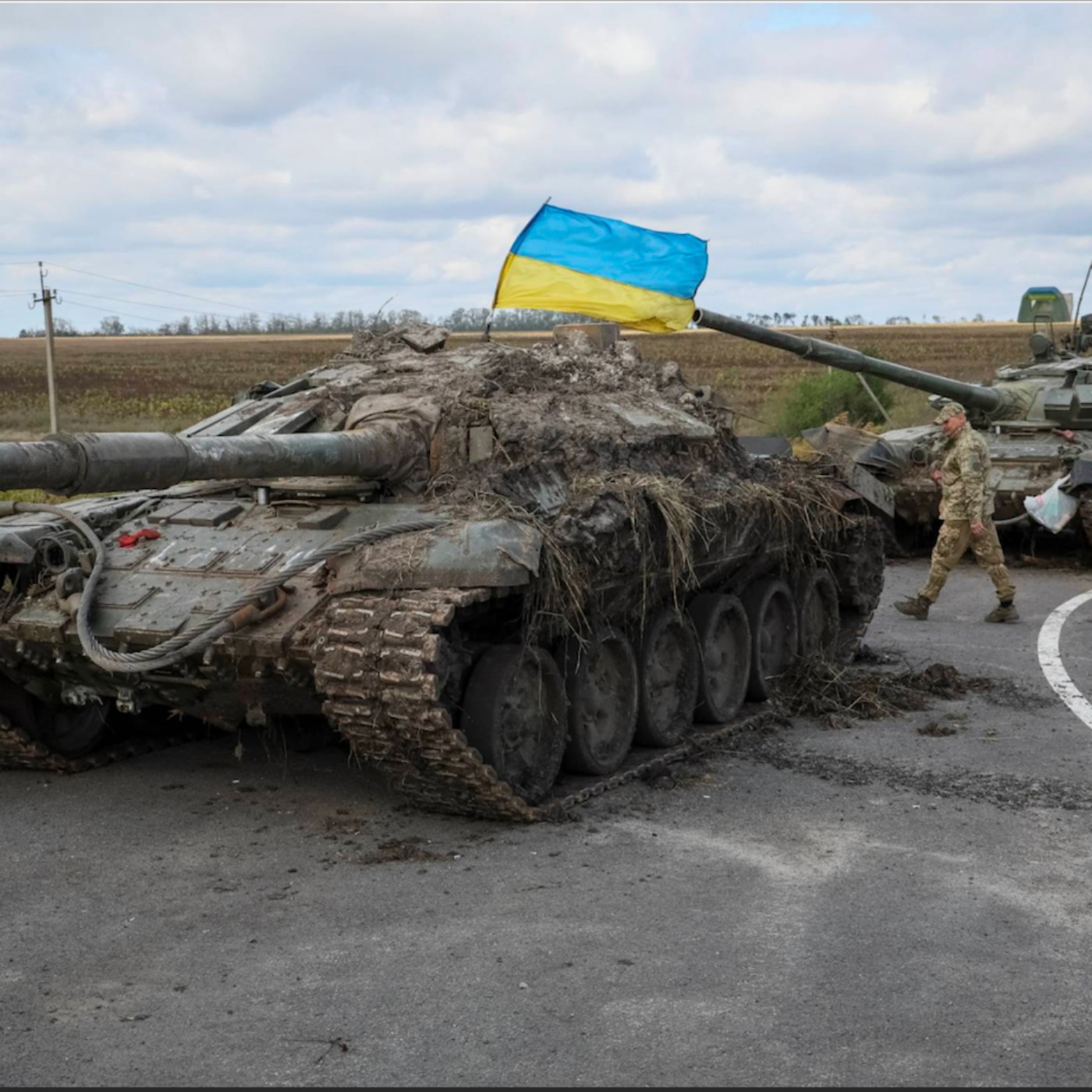
Ukraine XI: Asymmetric Momentum
Oct 18, 202200:37:11Tap to summarizeThere’s something really interesting happening in Ukraine. The few and far between Russian victories seem to be making them weaker. Yes, you read that right. Russian victories are draining the life out of their soldiers, making it harder to win the battles that come next. On the other hand, Ukrainian victories have been swift, dramatic, and devastating - with each win seemingly making them stronger.The big question is, why is it that Ukrainians gain momentum with every win, but Russia can’t seem to build on their victories? Well, it all comes down to asymmetric momentum. And there are 6 major reasons for this. Tune in to hear what these 6 reasons are and how the recent Ukrainian victories mark a critical juncture that will determine the course of the war.Topics Covered Include:00:00 Introduction02:40 What is asymmetric momentum?04:49 Ukrain’s positional warfare06:55 Understanding Ukraine’s offensive and defensive strategies08:16 Russia’s unintelligent retreat10:37 How Russian political interests are affecting their progress14:54 The poor discipline and lack of drive in Russian forces16:42 Is the Russian army competent enough to win this war?18:00 How Russia’s desire for a quick war is slowing their progress20:40 Ukrainian motivation and their willingness to die for the right reasons24:58 The impatient side of Russians uncovered28:30 Many Russian conscripts will die due to lack of training and morale29:36 The psychology behind Putin’s destructive Soviet-style leadership32:04 Ukraine is playing the patient game34:07 Summary35:36 Parting thoughts Ukrainian victories on the ground have been swift, dramatic, and devastating. And each win seems to make them stronger.Russian victories (back when they happened), seemed to be slow and grinding, and wear the Rusisans down, making them weaker.Why is it that Russians lose momentum with each victory, but Ukrainians gain it? Why such asymmetric momentum?I see 6 (or 7, depending) major reasons:1. Russian Politics (“quick war”): impatience -> meat grinder, not admitting defeat, vs Ukraine’s patience2. Russian Politics (show territorial progress): territory vs. Ukraine’s “defeat the enemy” -> meat grinder3. Russian Politics (don’t let Ukraine show territorial progress): no retreat allowed -> break and rout4. Morale, espirit de corps, discipline, "why are we here" vs fighting for home and life -> Ukrainians will die for the right reasons, Russians are drunk, will break and refuse to fight5. Russian atrocities: hardens Ukrainian morale and turns them into 24/7 machines of war who get smarter and become veterans6. Soviet vs. NATO style: NATO style allows for initiative and invests in training; Soviet style mass forces of limited training and centralized command means they are very predictable7. Putin: total centralized control by someone who has clearly lost touch with realityLinks and Resources:Reconsidermedia.comReconsider Media on Twitter - https://twitter.com/reconsidermediaReconsider Media on Facebook - https://www.facebook.com/ReConsiderMedia/ Hosted on Acast. See acast.com/privacy for more information.
Transcribe →
Reconsidering Russia 2: Russia's Interest & What to Expect with Prof. Mitchell Orenstein
Oct 17, 202201:09:17Tap to summarizeMitchell Orenstein is a professor of Central and East European Politics in the Slavic department at the University of Pennsylvania and an associate of the Davis Center for Russian and Eurasian studies at Harvard. His research focuses on the political economy and international affairs of Central and Eastern Europe.This episode is the latest installment to the four-part series on Reconsidering Russia, where we try to dig into Russia's historical and geopolitical context to help you better understand some of their moves today and what's going on in their country today.Tune in to hear Eric, Xander, and Professor Orenstein dive deep into Russia's real objective in Ukraine, Eastern Vs. Western-leaning periods of Russian leadership, why Russia really needs to diversify its economy, and so much more.00:00 Introduction01:35 Why Geopolitics is not about reforms or democracy03:49 What does Russia really want?05:49 Understanding Russia's national interests and foreign policy preferences12:59 Eastern Vs. Western-leaning periods of Russian leadership16:33 Comparing Russian perceptions to the American interpretation20:10 What does the 'Near Abroad' mean?20:54 The democratization of Russia's 'Near Abroad'24:12 Consequences of the collapse of the Soviet Union28:10 The strategic and fundamental importance of Ukraine32:14 Russian interests in Finland34:57 The Nature of Germany's relationship with Russia39:01 Caucasus as a region of strategic importance to Russia44:15 Chinese and Russian interests in South-East Asia47:15 China-Russia relations: Eternal rivals or emerging alliance 50:41 Russia's views on China's growth in power and influence 52:38 Russia-Japan dispute over Kuril Islands 54:50 Thoughts on Russia's domestic politics and foreign policy58:35 Why Russia really needs to diversify its economy01:01:58 What to expect from Russia in the next 5 to 10 years01:05:18 Russia - a gas station with nuclear weapons01:08:03 Parting thoughts Links and Resources:Reconsidermedia.comMitchel's website - https://www.mitchellorenstein.com/Mitchel's profile on the Foreign Affairs Magazine - https://www.foreignaffairs.com/authors/mitchell-orensteinReconsider Media on Twitter - https://twitter.com/reconsidermediaReconsider Media on Facebook - https://www.facebook.com/ReConsiderMedia/ Hosted on Acast. See acast.com/privacy for more information.
Transcribe →
Ukraine X: The Absolutely Dazzling Counter-Blitzkrieg
Sep 19, 202200:36:05Tap to summarizeTime in Kyiv: 9am, Tues, Sep 13th.Kharkiv Oblast is free.Zelenksy announced about 6 weeks ago that a major counter-offensive in the South would take place. After a month of attacking bridges, rail depots, ammunition depots, C&C, bases, etc etc etc, the offensive started in earnest. 2 weeks in, they haven’t gotten a ton of territory back.But, as all of us paying attention know, the Southern offensive may have been the greatest diversion in warfare since WWII itself. Over the last week, Ukraine launched the most dazzling counter-blitzkrieg I can think of. We’re going to go over all of that in its glorious detail here. There’s so, so, so much we don’t know. Lots of opsec, lots intentionally hidden from the public. What I can say with certainty is there will be many a movie made about this in Hollywood -- this is one of the great moments in military and geopolitical history, period. It is very, very likely the tide of the war has turned, and for good. David is now on top of Goliath, pummeling him.Please excuse the sound. I wasn’t planning to record while on break here but I just couldn't help it. I don’t have my mic!Connect with Mark Russian History on Facebook Hosted on Acast. See acast.com/privacy for more information.
Transcribe →