Podcast
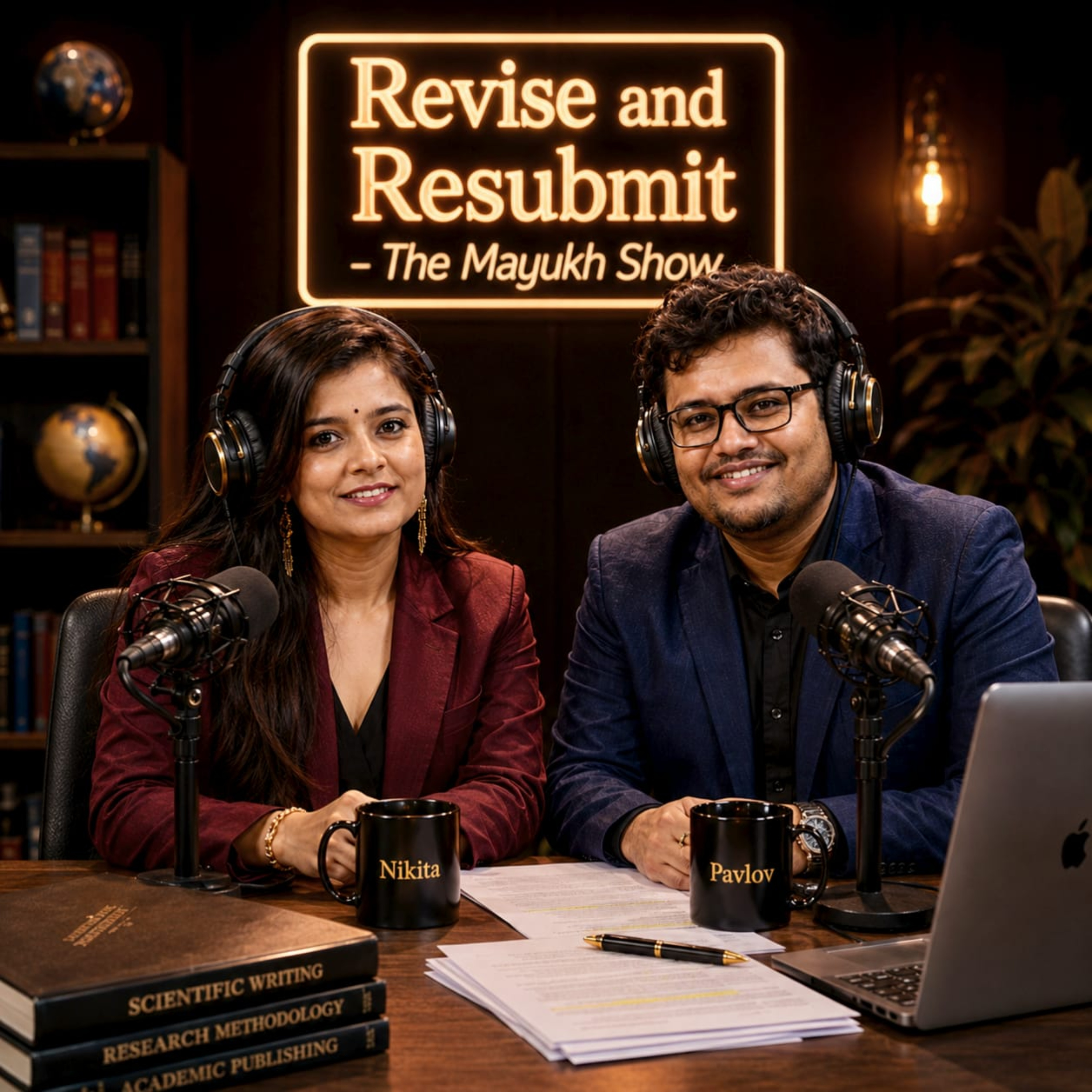
Revise and Resubmit - The Mayukh Show
Hosted by Mayukh Mukhopadhyay · EN
In Revise and Resubmit, a dynamic AI duo— Nikita and Pavlov — guides you through the fascinating world of academic research. Whether they’re debating emerging trends, revisiting theories, or exploring the latest innovations, their conversational style makes scholarly insights accessible and engaging for academics. Papers chosen by Mayukh. Powered by Google NotebookLM.
46episodes
Episodes
Newest firstAll episodes
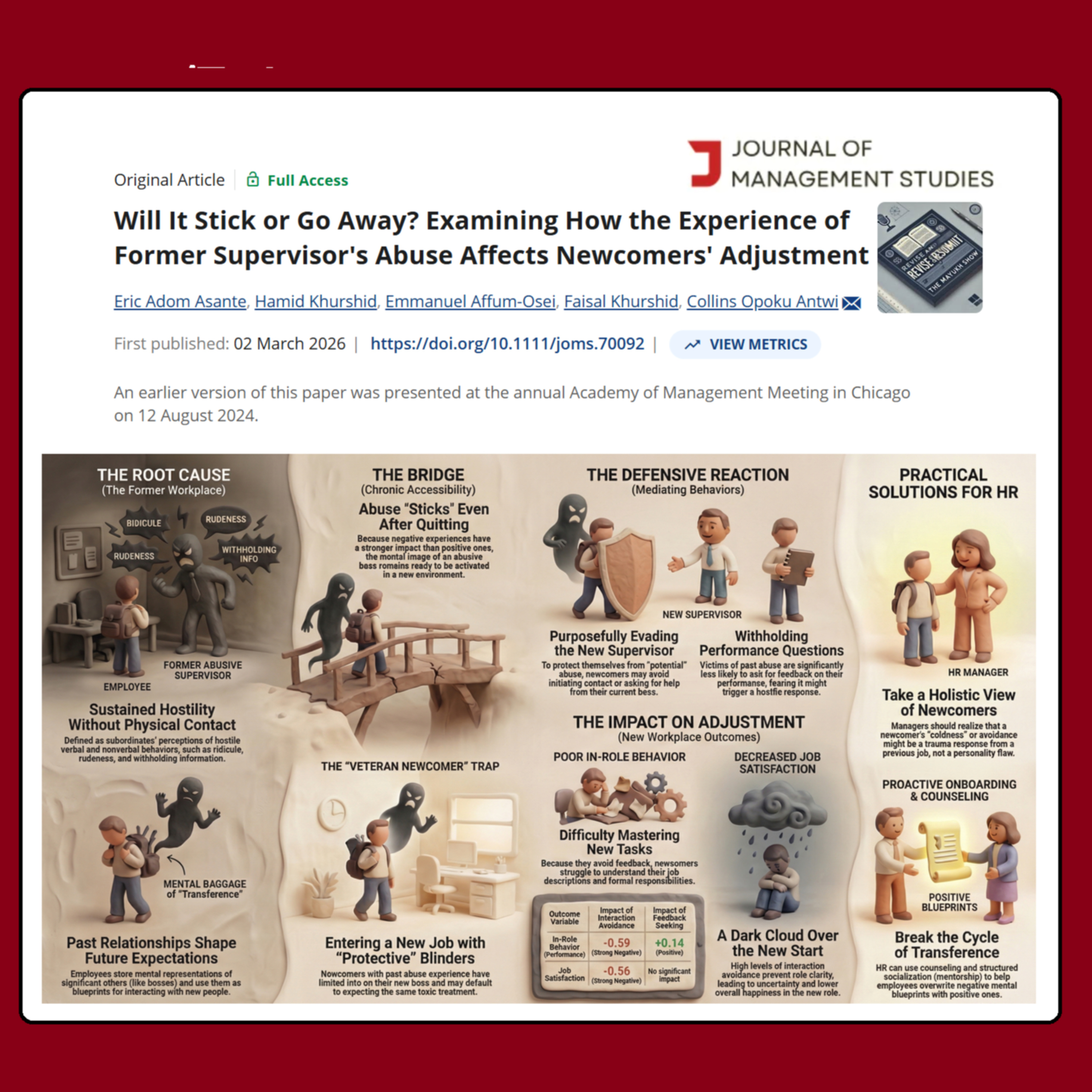
Will It Stick or Go Away? (Asante 2026) | FT50 JMS
Mar 1501:03:38Tap to summarizeEnglish Podcast Starts at 00:00:00Bengali Podcast Starts at 00:19:03Hindi Podcast Starts at 00:38:10Danish Podcast Starts at 00:51:38ReferenceAsante, E.A., Khurshid, H., Affum-Osei, E., Khurshid, F. and Antwi, C.O. (2026), Will It Stick or Go Away? Examining How the Experience of Former Supervisor's Abuse Affects Newcomers' Adjustment. J. Manage. Stud.. https://doi.org/10.1111/joms.70092Youtube Channelhttps://www.youtube.com/@weekendresearcherConnect over linkedinhttps://www.linkedin.com/in/mayukhpsm/Welcome to Revise and Resubmit. 🎙️🧠There is a particular kind of bruise that does not show up in a mirror. You carry it into the next room, the next job, the next bright beginning. You tell yourself, this time will be different. And maybe it will. But your body still remembers the old rules. Your mind still listens for the footstep that once meant danger.Today, I am bringing you a new piece of research with a deceptively simple question baked into its title: Will It Stick or Go Away? Examining How the Experience of Former Supervisor's Abuse Affects Newcomers' Adjustment. It is by Eric Adom Asante, Hamid Khurshid, Emmanuel Affum-Osei, Faisal Khurshid, and Collins Opoku Antwi, published online on 02 March 2026 in the Journal of Management Studies, one of the truly prestigious journals on the FT50 list. 🏛️📌What I love about this paper is that it refuses the comforting fantasy that you can just quit a bad boss and be instantly free. Most abusive supervision research stays inside the original workplace, like the story ends when you hand in your resignation. But these authors ask what happens after the exit. What follows you into the new office, the new onboarding, the new supervisor who has not yet done anything wrong.Using the social cognitive model of transference, they show something painfully human: when you have been burned before, you start protecting yourself early. You avoid interacting with your current supervisor, and you seek less feedback, even though feedback is often the oxygen of a good start. That self-protection then quietly taxes your in-role performance and your job satisfaction. One field study plus two experiments later, the message lands with weight: a toxic manager can cast a shadow that crosses organizational borders. 🌒📉And the practical heartbeat is this: if you are a leader welcoming a newcomer, you are not meeting a blank slate. You are meeting a person with a work history, and sometimes that history includes harm. Trust is not a vibe. It is a deliberate practice. 🤝🛠️Thank you to Eric Adom Asante, Hamid Khurshid, Emmanuel Affum-Osei, Faisal Khurshid, and Collins Opoku Antwi, and to the Journal of Management Studies, published by the Society for the Advancement of Management Studies and John Wiley & Sons Ltd., for research that names what so many people feel but struggle to explain. 🙏📄If you want more research stories that stay close to real lives, subscribe to Revise and Resubmit on Spotify, and join the YouTube channel Weekend Researcher. 🎧✅📺 You can also find this podcast on Amazon Prime and Apple Podcast.Now here is what I cannot stop wondering: when a newcomer seems distant, quiet, or allergic to feedback, how often are we witnessing “lack of motivation” and how often are we witnessing an old wound trying not to reopen? 🤔🩹
Transcribe →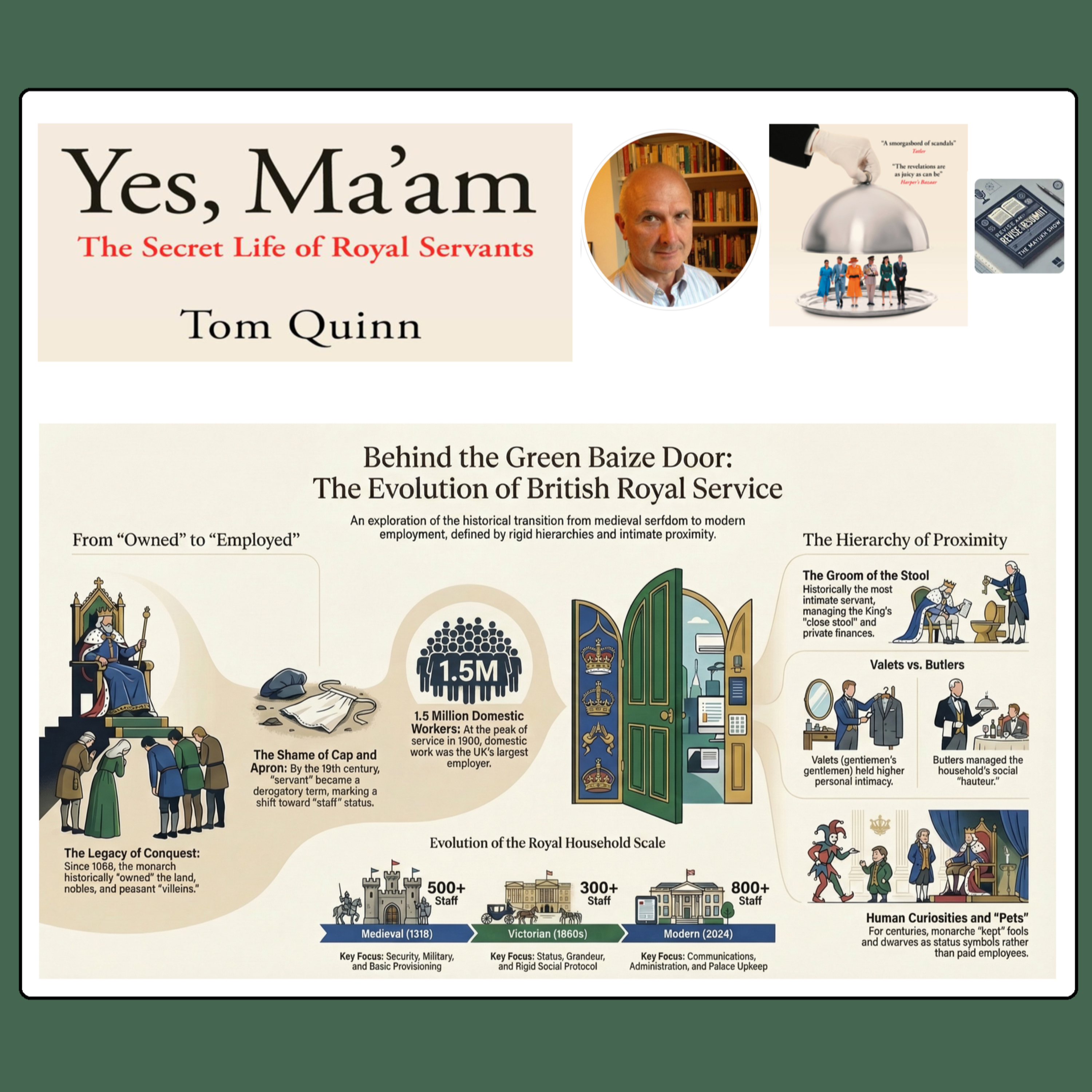
Yes, Ma’am: The Secret Life of Royal Servants (Quinn 2025) - Weekend Book Reviews
Mar 1401:14:06Tap to summarizeEnglish Podcast starts at 00:00:00Bengali Podcast Starts at 00:21:50Hindi Podcast Starts at 00:42:51Danish Podcast Starts at 01:00:37ReferenceTom Quinn (2025). Yes, Ma’am: The Secret Life of Royal Servants. Biteback Publishing. https://www.bitebackpublishing.com/books/yes-ma-amYoutube channel link https://www.youtube.com/@weekendresearcherConnect on linkedinhttps://www.linkedin.com/in/mayukhpsm/🎙️✨ Welcome to Revise and Resubmit, and to this episode of Weekend Book Review. I’m so glad you’re here.There are some books that do not merely open a door. They seem to slip quietly past it, down the corridor, and into the rooms where history is still breathing. 📚👑 And that is very much the feeling I had as I entered Yes, Ma’am: The Secret Life of Royal Servants by Tom Quinn, published by Biteback Publishing, out in hardback and ebook on 20 March 2025, with the paperback scheduled for 31 March 2026.This is, on its face, a book about royal servants. But as I read it, I kept feeling that it is also a book about intimacy, power, routine, dependency, silence, class, and the peculiar ways human beings arrange themselves around prestige. Tom Quinn, who has written widely on the royal family, country houses, London history, servants, and the great eccentricities of British life, is uniquely suited to tell this story. He brings to the page the patience of a social historian and the ear of a storyteller. 🕯️🏰Quinn has spent years writing about the people who stand just outside the official portrait, the ones who button the cuffs, carry the messages, manage the moods, polish the silver, and keep the machinery of grandeur from falling apart. In that sense, Yes, Ma’am is not just about royalty. It is about the hidden labor that makes majesty possible. It is about those who see everything and are expected to say nothing. 🤫👞🐎And what makes this book so compelling is that it understands something deeply human. The monarchy may seem distant, theatrical, even mythic. But the life around it is full of ordinary absurdities and extraordinary loyalties. Here are footmen and valets, ladies-in-waiting and equerries, people who live close enough to power to smell its perfume and its panic. Through them, Quinn shows us that the royal household is not just an institution. It is a world, old and strange, tender and brittle, disciplined and emotional all at once. 👀📖So in today’s episode, I want to sit with this book, listen to what it reveals, and think a little about what happens when history is told not from the throne, but from the staircase behind it. 🏛️✨Thank you to Tom Quinn, and thanks as well to Biteback Publishing for this fascinating book.If you enjoy conversations like this, please subscribe to Revise and Resubmit on Spotify, and also subscribe to the YouTube channel Weekend Researcher 🎧📺. You can also find the podcast on Amazon Prime Music and Apple Podcast 🍎🎙️So let me begin here: if the people who serve power are the ones who know it best, what do they finally teach us about the people the rest of the world calls royal?
Transcribe →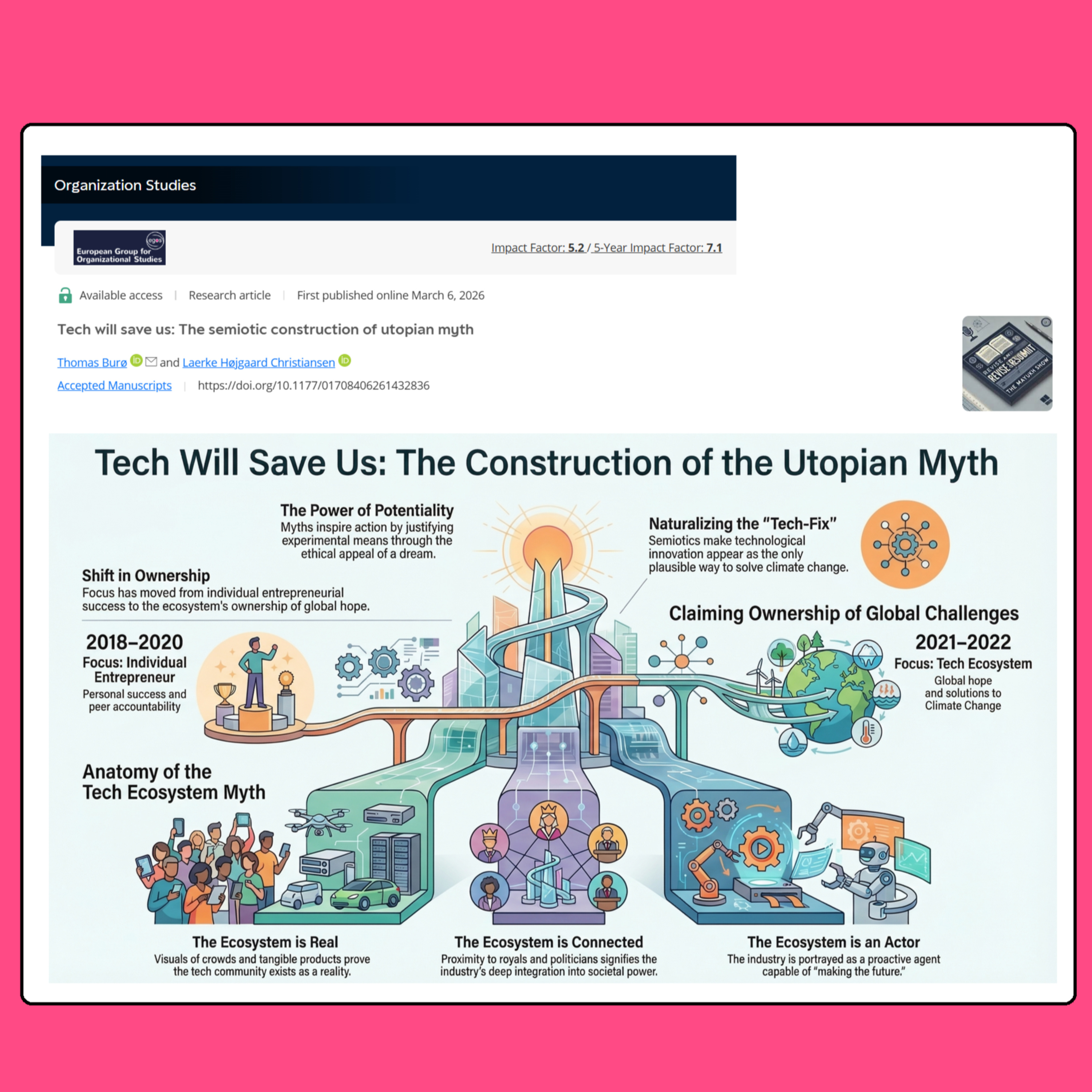
Tech will save us (Burø & Christiansen, 2026) | FT50 OS
Mar 801:04:51Tap to summarizeEnglish Podcast Starts at 00:00:00Bengali Podcast Starts at 00:21:13Hindi Podcast Starts at 00:36:47Danish Podcast Starts at 00:52:14ReferenceBurø, T., & Christiansen, L. H. (2026). Tech will save us: The semiotic construction of utopian myth. Organization Studies. https://doi.org/10.1177/01708406261432836Youtube Channelhttps://www.youtube.com/@weekendresearcherConnect over linkedinhttps://www.linkedin.com/in/mayukhpsm/🎙️✨ Welcome to Revise and Resubmit, the podcast where we sit with ideas long enough to hear what they are really trying to say.Some papers do not merely explain the world. They reveal the stories that have already explained it for us. This one begins in the glowing promise of technology, in the bright music of innovation, in the polished theater of entrepreneurial hope, and asks a question that feels almost impolite in its honesty: what if the future we are being sold is less a plan than a myth? 🌍⚡Today, we turn to a remarkable new article, Tech will save us: The semiotic construction of utopian myth, by Thomas Burø and Laerke Højgaard Christiansen, published online on 06 March 2026 in Organization Studies 📘, one of the most prestigious journals in management and organization scholarship, and proudly part of the FT50 journal list. Published by SAGE Publications, this paper invites us into a world where technology does not simply innovate, but signifies, performs, and persuades.Drawing on Roland Barthes and using multimodal semiotic analysis, the authors examine the promotional videos of TechBBQ, the largest tech event in the Nordics. And what they uncover is not just branding. It is something far more powerful. It is the careful construction of a utopian myth 🚀🌱, a story in which the tech ecosystem appears not only creative and dynamic, but morally destined to solve the grand challenges of our time, including climate change.But myths do important work. They inspire hope. They create belonging. They elevate fields into agents of history. And, as this paper shows with striking clarity, they can also naturalize power, grant legitimacy, and allow organizations to claim ownership over society’s deepest problems without ever having to promise concrete action. That is what makes this study so compelling. It is not cynical, and it is not naïve. It is attentive to the seduction of possibility, and to the politics hidden inside that seduction. 🔍✨So in this episode, we ask what happens when tech becomes not just an industry, but a salvation story. What kind of future is being imagined, who gets to author it, and what disappears when hope itself becomes a form of organization? 🤔Before we begin, do subscribe to Revise and Resubmit on Spotify 🎧 and follow the YouTube channel Weekend Researcher ▶️. You can also find the show on Amazon Prime and Apple Podcast 🍎📺, so wherever you listen, stay with us and stay curious.Our thanks to the authors, Thomas Burø and Laerke Højgaard Christiansen, and to SAGE Publications for bringing this important work into the world.And now the question that lingers, quietly but insistently: when someone says tech will save us, are we hearing a solution, or are we hearing a myth? ✨
Transcribe →
The Oedipus Complex (Rohleder 2025) - Weekend Book Review
Mar 701:27:02Tap to summarizeEnglish Podcast starts at 00:00:00Bengali Podcast Starts at 00:19:58Hindi Podcast Starts at 00:43:19Danish Podcast Starts at 01:02:00ReferenceRohleder, P. (2025). The Oedipus Complex: A Contemporary Introduction (1st ed.). Routledge. https://doi.org/10.4324/9781003394471Youtube channel link https://www.youtube.com/@weekendresearcherConnect on linkedinhttps://www.linkedin.com/in/mayukhpsm/Welcome to Revise and Resubmit, and to this episode of Weekend Book Review. 🎙️📚I have always loved the moment when a serious idea stops being a museum piece and starts breathing again, right there in the room with you. This weekend, I am holding a book that tries to do exactly that for one of psychoanalysis’ most famous, most misunderstood, and most argued over notions: The Oedipus Complex: A Contemporary Introduction by Poul Rohleder (Routledge, published September 10, 2025). 🧠✨Rohleder is not writing from a distance. He is a clinical psychologist and psychoanalytic psychotherapist in private practice in central London, a Senior Member of the British Psychotherapy Foundation, and an Honorary Senior Lecturer at the University of Essex. So when he walks us back to Freud, he is not doing it to genuflect. He is doing it the way a working clinician returns to an old map, not to admire the ink, but to see what still helps when the weather turns. 🗺️🩺What I appreciate here is the book’s steady, humane ambition. It starts with Freud’s original formulations, then moves through later transformations with Melanie Klein and the UK Independents, and then keeps going, pulling in French psychoanalysis and contemporary relational thought. Along the way, Rohleder does not dodge the criticisms. He steps into them: feminist critiques, queer perspectives, cross-cultural questions, and the complicated modern realities of gender and desire. 🌈⚖️🌍And yet, the heart of the book is not scandal, not shock, not Freud as a punchline. It is something quieter and, honestly, more useful. Rohleder keeps returning to triangular dynamics, the child and caregivers, the ache of rivalry, the longing to matter, the fear of exclusion, the first rehearsals of relationship itself. He shows how those early configurations can shape intersubjectivity, the way we learn to be with another person without collapsing or conquering. 💬🧩In this Weekend Book Review, I will ask a simple question with a stubborn afterlife: when we strip away the caricature, what is left of the Oedipus complex that still helps a contemporary practitioner listen, and helps the rest of us recognize the old dramas hiding inside new stories? 🔍📖Before we begin, thank you to Poul Rohleder and Routledge for this book. 🙏🏽🏛️If you enjoy these reviews, please subscribe to the podcast on Spotify and follow the YouTube channel Weekend Researcher. ✅🎧📺 You can also find the show on Amazon Prime Music and Apple Podcast.Now tell me, as you think about your own life and the lives you study, where do you still see that triangle quietly reappearing, asking to be understood again? 🤔🔺
Transcribe →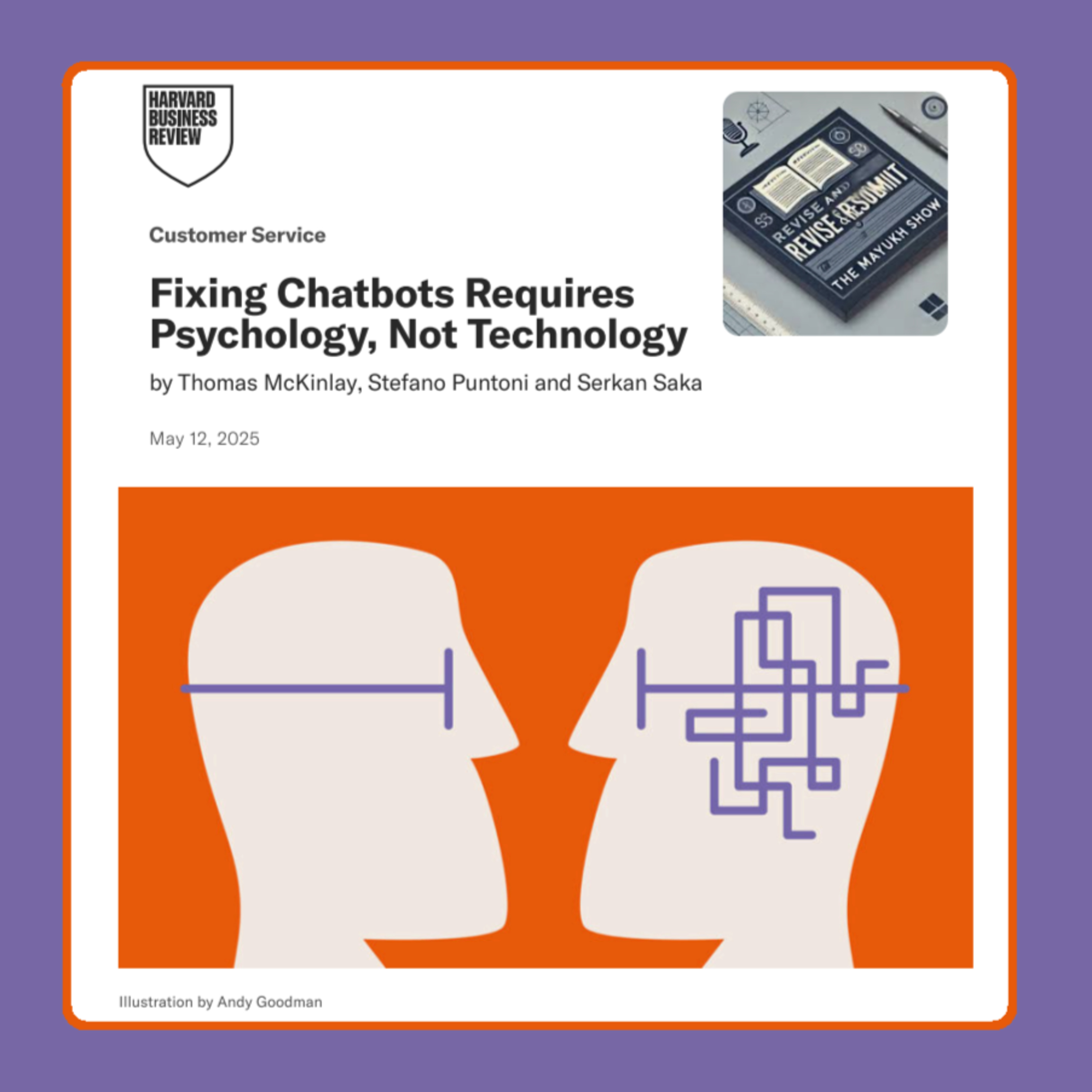
Fixing Chatbots Requires Psychology, Not Technology (McKinlay et al 2025) | FT50 HBR
May 13, 2025Tap to summarizeEnglish Podcast starts at 00:00:12Bengali Podcast starts at 00:20:01🎙️ Welcome to another episode of Revise and Resubmit! 🎙️The podcast where academic brilliance meets real-world impact—and we dig deep into the research that’s shaping tomorrow’s headlines.💡 Today’s paper? It’s not just smart—it’s paradigm-shifting. And it’s coming straight out of the Harvard Business Review, one of the most prestigious journals on the planet and proudly part of the elite FT50 list. That means when these scholars talk, the business world listens. 👂📈So, what’s on the docket? A game-changing article titled:👉 “Fixing Chatbots Requires Psychology, Not Technology” 👈Now, wait. Psychology? Not tech? You heard that right. While everyone else is busy fine-tuning their AI algorithms and upgrading their chatbots like they’re assembling the next Iron Man suit 🤖🛠️, this paper dares to ask:What if the real problem with chatbots… is how we think about them?🧠 Enter our authors:Thomas McKinlay, founder of Science Says, the go-to source for translating cutting-edge marketing research into real-world action.Stefano Puntoni, marketing professor at Wharton and co-director of Wharton Human-AI Research—a thought leader at the intersection of behavioral science and AI.Serkan Saka, assistant professor at San José State University and a master at turning consumer behavior research into executive-ready insights.Together, they unpack why your chatbot might be leaving customers cold—and how simple psychological cues can warm things up fast 🔥.From transparency to tone, from trust to timing, this episode will give you six research-backed moves to make your AI assistant less like a robot… and more like a brand ambassador. 🧍♂️✨So here’s the question:If better AI isn’t the answer to better customer service… what is?Stick around, get curious, and take notes. This is not just a paper—it’s a new playbook.📢 Huge thanks to the authors—Thomas McKinlay, Stefano Puntoni, and Serkan Saka—and to Harvard Business School Publishing for bringing this vital research to life. 🙌And hey! Before you go fix your chatbot—or your customer experience—don’t forget to subscribe to Revise and Resubmit 🎧 on Spotify, Apple Podcast, and even Amazon Prime! And for more engaging takes on academic research, hit up our YouTube channel 👉 Weekend Researcher. 🎥✨Because the best ideas shouldn’t stay locked in journals. They should start conversations. 🗣️💥Let’s revise. Let’s resubmit. Let’s rethink everything.ReferenceMcKinlay, T., Stefano Puntoni, & Saka, S. (2025, May 12). Fixing Chatbots Requires Psychology, Not Technology. Harvard Business Review. https://hbr.org/2025/05/fixing-chatbots-requires-psychology-not-technologyYoutube Channelhttps://www.youtube.com/@weekendresearcherSupport us on Patreonhttps://patreon.com/weekendresearcher
Transcribe →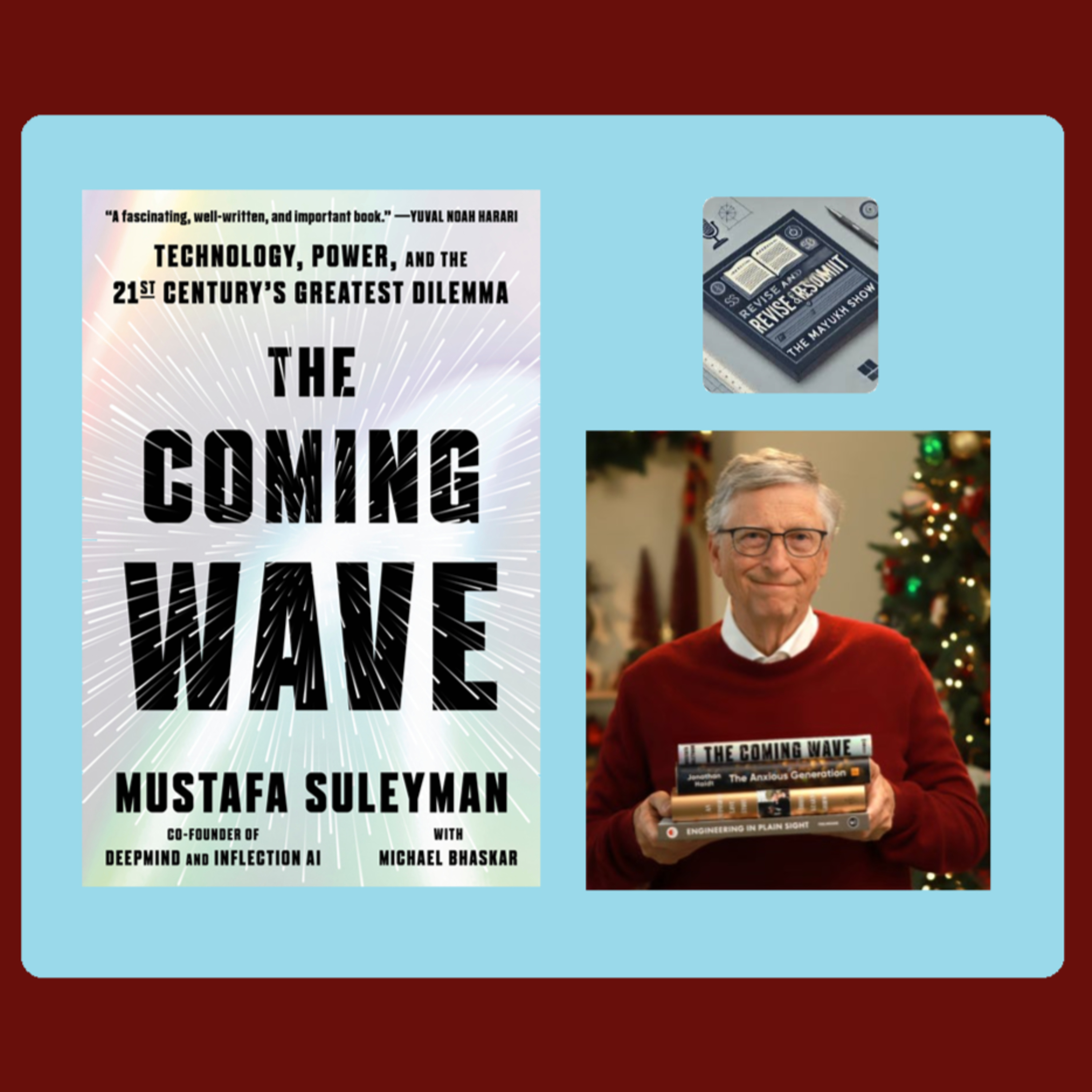
The Coming Wave (Suleyman, 2023) - Weekend Book Review
Dec 13, 2024Tap to summarizeWelcome to Revise and Resubmit, your one-stop destination for insightful book reviews and academic explorations. This episode of Weekend Book Review takes a deep dive into a book that promises to reshape how we think about the future: The Coming Wave by Mustafa Suleyman, co-written with Michael Bhaskar. Let’s start with Mustafa Suleyman, a name synonymous with innovation in artificial intelligence. As the co-founder of DeepMind, the trailblazing AI company acquired by Google, Suleyman has been at the forefront of technological revolutions for over a decade. Today, he leads Inflection AI, further cementing his role as a visionary in this field. And then there’s Michael Bhaskar, a UK-based author and publisher, known for thought-provoking works like The Content Machine. Together, they bring a potent mix of insider knowledge and literary finesse. The Coming Wave isn’t just a book—it’s a wake-up call. Suleyman takes us on a gripping journey into a future dominated by AI and synthetic biology. He paints a world where DNA printers, quantum computers, and autonomous systems are not science fiction but our daily reality. But here’s the twist: with great innovation comes great peril. This book is about navigating the narrow path between catastrophe and dystopia, and forging a future where technology works for humanity—not against it. As I read, one thought kept lingering: How do we, as individuals, prepare for a world that seems both exhilarating and terrifying? A big thank you to Mustafa Suleyman and Michael Bhaskar for this groundbreaking work, and to Crown for bringing this book to the world. If you found this review insightful, subscribe to Revise and Resubmit on Spotify and check out our YouTube channel, Weekend Researcher. You can also find us on Amazon Prime Music and Apple Podcast. Here’s the question we leave you with today: Can we, as a society, contain the very technologies we’ve unleashed? Reference Suleyman, M. (2023). The coming wave: technology, power, and the twenty-first century's greatest dilemma. Crown. https://www.the-coming-wave.com/ Youtube channel link https://www.youtube.com/@weekendresearcher Support us on Patreon https://patreon.com/weekendresearcher
Transcribe →