← Rex Factor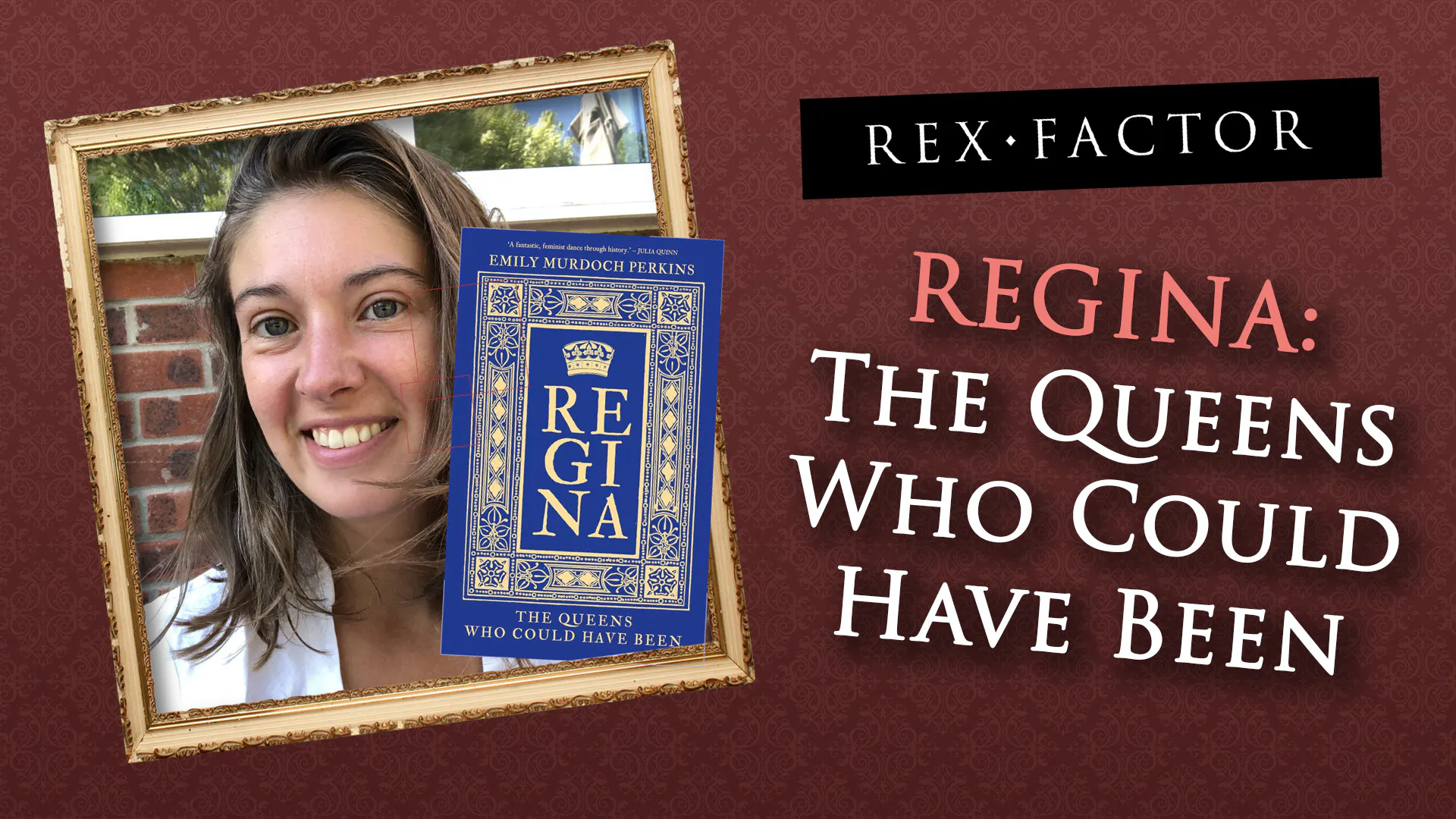
Rex Factor
Emily Murdoch Perkins - The Queens Who Could Have Been
01:09:18
Looking at whole would have ruled if daughters were prioritised in the succession
Loading summary
Transcript84 lines
- [00:00]
Emily Murdoch Perkins
K Pop demon hunters, Saja Boy's breakfast meal and Hunt Trick's meal have just dropped at McDonald's. They're calling this a battle for the fans. What do you say to that, Rumi? It's not a battle. So glad the Saja Boys could take breakfast and give our meal the rest of the day.
- [00:14]
Graham Duke
It is an honor to share.
- [00:16]
Emily Murdoch Perkins
No, it's our honor.
- [00:18]
Graham Duke
It is our larger honor.
- [00:20]
Emily Murdoch Perkins
No, really stop. You can really feel the respect in this battle. Pick a meal to pick a side.
- [00:27]
Graham Duke
Ba da ba ba ba and participate in McDonald's while supplies last.
- [00:31]
Emily Murdoch Perkins
It's crunch time at work and you need to bring wings to your workday. Visit redbull.com gettingitdone and answer a couple questions about your work style to get a Spotify customized playlist tuned to your productivity. Plus score a can of Red Bull on us while you go from to do to done. And remember, Red Bull gives you wings. Supplies are limited. Terms apply. Visit the website for more information.
- [00:59]
Graham Duke
Not sure how to tackle your taxes? Are you sweating the small print? You may be experiencing FOMO, the fear of messing up the answer using TurboTax on Intuit credit Karma. They help you get your biggest refund and then we help you do more with it with a personalized plan designed to help you hit your money goals. It's time to take your taxes to the max. Start filing today in the Credit Karma. Apply. Welcome to Rex Factor. This week, Emily Murdoch Perkins, Regina, the queens who could have been with your hosts Graham Duke and Ali Hood. Hello. Hello and welcome to Rex Factor where we are reviewing all the nearly monarchs of England from Aethelwold to Albert Victor, the men who could or should have become king but for the intervention of fate. Now this point in the podcast last time we released our introduction episode to series four, what I'm having to give this rally because this is all a little bit out of sequence in the recording. The last episode we've released was the Series 4 introduction where we talked about what we're going to do in the series. And before we get on to Aethelwold next time time we are speaking to Emily Murdoch Perkins about her book Regina the Queens who could have Been, which as we'll see when we talk to, has got a very rexy outlook in its theme and it feels quite pertinent to this series because it's all about daughters who, but for the successional focusing on sons and kings, would have been the monarch. So I thought it's a kind of introduction to series four in the way that we spoke to Dr. Emma for the start of series three, we're going to speak to Emily about daughters who could have been Queen. The counterfactual element, looking at the people who could have been there but weren't. How you assess them, what we make of them, a little bit of crossover in terms of some of the individuals we'll be doing. But yes, basically it's just a little, little entree before we actually get into our individual nearly monarchs. Who is Aethelwold? Aethelwold we have recorded but we've not released. So you can plausibly is whatever you're maintain that you don't know who he is because of course we don't know who he is. We haven't done it yet, but of course we have done. Really? So of course you do know. Really. Oh, I mean, Alfred the Great's nephew fights with Edward the Elder. I, I. Are you sure that's not Athelstan? Yeah. Isn't he Alfred the Great's nephew though? No, Athelstan is Alfred the Great's grandson. Okay. And he does get mentioned in the episode spoiler. So associations there. Okay, well, anyway, what's this? So put Ethelwald completely to one side for today. You don't have to know who Ethelwald is today. Today we're speaking to Emily about the daughters who could have been Queen. So the ones who but for the succession law, focusing on the oldest sons, they would have been the rulers. Okay. How many of them are there? Well, we get a chance to speak to Emily about that now. So we are very excited to be joined on the podcast today by the author Emily Murdoch Perkins. Emily, thanks so much for joining us.
- [04:20]
Emily Murdoch Perkins
Thank you so much for having me. It's an absolute joy.
- [04:23]
Graham Duke
Could you just first of all introduce yourself to the listener in terms of who you are and what you do?
- [04:28]
Emily Murdoch Perkins
Well, as you can probably tell by the delightful accent, I am British. I'm a novelist and historian and I have been writing and telling stories pretty much as long as I can remember. My first ever school report at 4 was Emily tells us she's going to be an author. And I've pretty much done that ever since. I have almost 100 novels published and one non fiction with a second one coming out next year.
- [04:56]
Graham Duke
Nice. And it's the, the non fiction one that we're interested in talking to you about today. It's Regina, the Queen she could have been. And it's really right up our straza in lots of sense. One in terms of the concept because we like a concept of going from this one to this one, and they're all connected in some way also. The people who are in it will see as well. So could you just give us like an intro to the book, actually? Like, what is, what is the book about? What's the, what's the theme?
- [05:20]
Emily Murdoch Perkins
Well, I am one of those Brits who finds the British monarchy fascinating because it feels like the biggest fantasy story ever told, but it's still happening. And I find it as a medievalist, someone who really dedicated a lot of my academic rigor to over a thousand years ago, the idea that that is still happening in pretty much exactly the same way that it happened for over a thousand years to me is bonkers. And when Queen Elizabeth II died, if you lived here in the uk, and I presume a lot of places around the world, our TV was absolutely blasted with images of the royals, live action of the royals, the funeral preparations of the royals. And I remember thinking, gosh, you know, if you're Prince Charles, Charles III now, you've spent your life preparing for a role that you must have at some point wondered if you would ever actually get, whether in the end actually your mother would outlive you. But there is a sense of purpose to that, a sense of your life being mapped out for you as the heir to the throne. And of course, on our screens, the four children of Elizabeth, you had three sons, and then Anne, the sister of the monarch. And I thought, well, this woman has not had her life mapped out for her. She doesn't have a blueprint, she doesn't have a sense of purpose or direction. But she's had all the same restrictions and difficulties of being a royal. And I started to wonder, well, what sort of royal women would have had if they had that blueprint ahead of him, if they, as eldest daughters knew that they would always become one day the heir to the throne. You know, if we didn't have Richard the Lionheart or Henry viii, what other women would we have had? And they started doing some reading and it turns out really fascinating characters out there. And I realized that I had to absolutely tell their stories.
- [07:01]
Graham Duke
It's such a great idea for it because like we. So people ask us what we're going to do and we're doing, say the nearly monarchs at the moment. We did the consorts of England, the UK last time, but. So this is. It's not something that would ever have occurred to me, but it's one of those. As soon as you see the book, I was like, oh, that's such the sort of thing that we.
- [07:17]
Emily Murdoch Perkins
Well, I'll be honest, I kind of assumed someone had written the book already, so I very much went online and thought, right, I'd love to read that story. Tell me. And I thought, you know, there was a few kind of almost misses where they focus on one or two people. So often Tudor historians will be like, oh, Lady Jane Grey. Ooh, and that's great. And that's amazing. And those are definitely stories that are worth telling. But this particular story of actually, if we had more, More of a matriarchy rather than a patriarchy in terms of the Royal Family, who are these people? You know, I realized, you know, I'm a historian and I'm not sure before this book was researched whether I could have named more than four eldest daughters of monarchs of Britain or England ever. And I thought, well, hang on, they were still living, they still had things to do. What did they fill their times with? What decisions did they make? What support did they give some? And what arguably terrible mistakes did they make? And thank goodness they were interesting, otherwise it would be a very short and dull book.
- [08:16]
Graham Duke
And you've also got. Which is again, sort of similar thing that we're going to be experiencing in this series, kind of that, that what if bit, the counterfactual bit, where you can kind of imagine what might this person have done? And of course we don't actually know, but that's where you get to imagine. So sort of it like you've put in the book, actually. And I think it's right that it sometimes feels like some historians don't like the what if? It's almost looked down on, but we always find it really fascinating. So why do you think that is? Why do you think they don't like it? And why do you think it actually can be quite a useful thing?
- [08:45]
Emily Murdoch Perkins
Such a good question. I think we have this view of historians as revealers of truth. And of course, as soon as you say that, you say, well, who's truth and how true does something have to be? And how much evidence do you need for something to be considered true? And I think what it comes down to is that human nature is also always craving simultaneously two completely different things, undeniable, irrefutable fact and stories, myths, legends, fairy tales, folklore. And I think history is actually where those two things kind of merge. You know, if we say, you know, Robin Hood, what is true about Robin Hood? There's not a huge amount of evidence that anyone called Robin Hood existed, but most children could tell you that the truths that Robin Hood embodies are about justice and honour and respect and equality and access to food and taking from the rich to give to the poor. Those are all true things. But I'm not sure I'd find much in the law codes about it. If you think about it, most of people's understandings of Richard the Lionheart is informed more by the Disney film Robin Hood than any sort of historical fact that we actually have. And so I think what the what if allows us to do is historical storytellers like myself can write into the gaps. You know, in the absence of evidence, in the absence of absolute, undeniable truth, we're not claiming that it is true, but we are informed by evidence rather than just pure storytelling. And I think it's kind of bashed out of us. For those of us who go to university to study history, you know, it's very, you know, how do you evidence this? How did you evidence this? How can you refer to this? What's your reference? But most of the most interesting conversations that you have in seminars or lectures or just with your friends in the pub are the what ifs. And so I did want to bring an element of that into the book while trying desperately to really signpost. This is what we know. And this is where I'm wildly speculating.
- [10:42]
Graham Duke
Were you tempted? Because it was said, you know, you write a lot of fiction as well. Is there any point where you got into any of the stories and thought, you know, actually, I kind of like to flesh out this. What if, Maybe just roll with this 100%.
- [10:52]
Emily Murdoch Perkins
What are the things that I found in the ED? And my editors were so encouraging. I was very open to them. That I came from a fiction background, was, you know, I could be writing away and go. And she was absolutely furious at her father when he forbade her from. And then I stop and go, do I know she's furious? Or would I be furious if my father did? X, Y, Z? Was she scared or would I be scared if that invasion had occurred? Was she? And it's very, very difficult to prevent yourself from slipping into that emotionality. And because you want to tell a good story and I don't want. I didn't want the book to be dry and dull. It is not that type of book. But every now and again I had to kind of rein myself in and go. One could argue, or it's easy to believe that because you don't know 100% or even 50%. And that's when you really have to go, well, to Err, on the side of caution.
- [11:43]
Graham Duke
We're not sure, I guess, particularly the early ones, because another thing I like about it is the fact that you start with the Saxons, which we always do as well in our series, that so many people, 1066 as his beginning. So I love the fact that you do that, but I guess that also it's because there's not a lot of information. I guess that brings a challenge as well.
- [12:01]
Emily Murdoch Perkins
Some of these women were almost impossible to write about. As people read the book, you will notice that the chapters get significantly larger once we get to kind of the Tudors onwards, just because there's so much more material evidence. And I say material because it's not just dear Diary, today I received this proposal. It's, you know, ledgers and law codes, but fabrics as well, evidence of food. It's tempting to look back at the older, more medieval women and go, well, because we don't know anything. Nothing really happened. But the trouble is, most of the trouble is just time. There would have been a huge amount of evidence about these women that because it was 1200 years ago, not 200 years ago, it just hasn't survived. Things don't survive that long most of the time. The trouble is, a lot of the things that survive, especially bizarrely for the Norman queens, was actually more difficult than the Anglo Saxons. You know, I know a lot of our listeners will know the Anglo Saxons documented a lot more than we think, and they were far more egalitarian in their approach. When it came to women, the Normans weren't in any way. One of the things that almost frustrated me that we have about three different lessons, lists of William the Conqueror's children from contemporary sources. So people who lived at the time of William the Conqueror. None of those lists had the same birth order and most of them don't even include the daughters. And when they do, they don't have the same names. So I had to very much in the book say, look, I'm pretty sure this is the eldest daughter. I could be wrong. Like, this is one where we are having to go with the evidence we've got, and there's not a lot of it.
- [13:40]
Graham Duke
Now, you started one that we did in our last series, but maybe actually should have done in this series. We can never quite find a place to put her, but we wanted to cover, which is Aethelflaed lady the Mercian. So why was she your starting point?
- [13:52]
Emily Murdoch Perkins
Well, I'll be honest and I'll say I tried to start with William the Conqueror. I thought you Know, this is a big undertaking. I'm. I include every single eldest daughter of an English or British monarch until modern day. So I was, I already knew I was covering about 12,000 years and I even include the eldest daughter of Oliver Cromwell, which was a very exciting debate with my editor. But I'm a medievalist by training, as I said, and you can't really understand the Normans without understanding the Saxons. And so I kept going further and further back that there was a draft and it will never hit the light of day where we start as the Romans leave. But I will be honest, the heptarchy is too fractured, it's too confusing. It's almost its own book. And maybe that'll be one I write one day. But I got to Aethelflaed and I thought, well beyond the fact that this is kind of where England as a concept begins, which is rather convenient just for drawing a line in the sand somewhere. Her life and her determination to try and make sure that her daughter inherited is a real tipping point in English history. And there's very few of them that I think are as dramatic as this one. Because if she had been successful, it would have been female monarchs that would have been the standard for over two millennia, not male. And, you know, the book would have been Rex, the Kings who would have been. It would have been a very different book. And so to not start with her really, I think would have undermined a lot of what I'm trying to explore in the book. Because her, you know, she was bold, she was educated, she was militarily powerful, she was highly respected and even she couldn't manage to have a mother to daughter succession. And so that really sets the stage for why it was so impossible and yet so intriguing to have all these eldest daughters completely passed by the succession.
- [15:32]
Graham Duke
Yeah, it feels like we probably because we did her in our Consort series, because she was sort of a consort. Well, she was a consort immersive, but you're more interested in her as a ruler. So I do wonder whether we should have done her in this series. But because it was controversial to have a last time, we thought, well, we can't kind of just, you know, parachute during this time.
- [15:47]
Emily Murdoch Perkins
But I really, I love the idea that she, I think she'd find it fascinating that she was a controversial figure and even she was remembered, you know, so many millennia later. Because I get the impression from, again, the limited sources, we have all the caveats, all the caveats that she just got on with it. She sounds like a really practical minded person. Who was far more interested in building cities and making sure that military alliances were happening than, you know, pretty dresses or anything we might think of as medieval women, you know, with the big, tall, pointy hats with veils flowing out of them. I think the idea that she would be debated as consort versus regnant, to use a generic term, I think she'd find it hilarious. I like to. I like to think that she's one of my dinner participants. If I could have five people from history, she would be one of them.
- [16:36]
Graham Duke
So of all of the. All of these women that you've looked at, which would you most like to base your next fiction book on? Which of them has the biggest gaps that you'd most like to fill in?
- [16:48]
Emily Murdoch Perkins
Biggest gaps? I think Gunnhild. So she's the daughter of Harold ii, or Harold Godwinson as most people know him. So he's one of those 1066 kings. I think after the Battle of Hastings, 1066, there's this sense that William the Conqueror just rocked up, entered England, and that was that the transition of power was completely seamless. But, of course, it was so much more complicated than that. And I think we often forget that Howard had children. He had quite a few children who all survived the battles of 1066. The sons got into military difficulties later, but not focused on them. His eldest daughter was fascinating. Gunhild makes a tactical decision, which I think was the right one to join a nunnery at this point. You know, she is the surviving daughter of a previous royal line, and I think she's probably expecting to either be disposed of or married off to some. Someone that she's not going to like. So she enters the abbey at Wilton and she's, you know, praised by her contemporaries for this. You know, this is a very logical decision. She then does elope with a man about 30 years older than her, who is a Norman called Alan the Red. And it's a little bit murky. We don't think it was an abduction. We definitely think she went willingly. But Alan the Red had actually been given her mother's lands at his. His kind of gift from within the conqueror as part of his participation. So there's a big question mark for a lot of historians about whether she wanted kind of to return to her home, and that was an easy way to access that community that she had left, whether he wanted to cement ownership of that land through marrying her. The trouble is she. She is technically a nun. So Anselm, who's Archbishop of Canterbury at this point, he writes to her and orders her back to the nunnery. She writes, writes back and is like, absolutely not. And you're setting yourself up for this incredible showdown between, you know, essentially a princess and the head of the Church in England. Not Church of England. And then Alan the Red dies, which is very awkward and uncomfortable because Gunhild is now totally unprotected again. But she doesn't return to the nunnery with her tail between her legs, which again, is very much what I do. She becomes the mistress of Alan the Red's brother, who is also called Alan. He is Alan the Black. And then that's it. We know absolutely nothing of her from 1093 onwards. We have no idea what happened. And I would love to know and maybe one day write that story and just see where I can take her.
- [19:15]
Graham Duke
Weird that they chose to have the same first name and changed the surname. Normally works the other way around.
- [19:21]
Emily Murdoch Perkins
Well, no, this is one of the things that I have. Slight tangent of the book every now and again to give context of things. It's actually really relatively common for a number of reasons, right until kind of the 1480s, 1500s, partly because families often wanted to pass down names. And infant mortality was 1 in 3 before the age of 5. So if you re. If you were called William and you really wanted your heir to be called William, you might call the first two or three sons William on the expectation that only one would make it to adulthood. Naming of a child William, not made by the parents always. It was often made by the godparents. And so if the godparents of one child was called William and the godparents of the second child was another guy called William, they might both decide to call their godsons William. There was a big tradition of naming based on saints days. So if there's. I think there's four St. Thomas's in the Catholic calendar, so you could be born on four different days and all still be called Thomas. So we actually see this turn up again and again and again. And so you have these kind of acronyms, you know, the Red, the Bold, the Angry, the Beautiful. Because often you have. I mean, the Paston letters is something I could again talk about for years. Very, very quickly. During the War of the Roses, there was a family called the Pastons who wrote to each other a lot. And all of a great, vast amount of their correspondence survived from the War of the Roses. So we have a hugely intricate snapshot of what was happening for the middle classes at their time. They've got their son William Paston, and then their Two sons, John and John, and they both survived to adulthood. And so we're continuously trying to work out is this the older John or the younger John. And most inconveniently, they are both knighted. So they're both Sir John Paston their whole adult lives. And that's in the 1460s. I think
- [21:11]
Graham Duke
you struggle enough with the family trees when they don't all have the same name as. Well, I know you'd have to just use National Insurance numbers.
- [21:17]
Emily Murdoch Perkins
You really would.
- [21:21]
Graham Duke
So I sort of got. Because it's. It's a really fascinating book and there's so many interesting figures in it, so obviously we can't talk about all of them. And also, obviously you want people to get the book so they get the full story. But. So I sort of picked out. I tried to pick out a few that I sort of found really interesting, that kind of. Across some different time periods. So we might sort of go off the tangents during the discussion, but one of the first ones I picked out was Mary of Bois, Stephen's daughter.
- [21:46]
Emily Murdoch Perkins
Yes.
- [21:47]
Graham Duke
And, yeah, I'd love to hear you talk about her a little bit more. She really jumped out to me.
- [21:51]
Emily Murdoch Perkins
Poor Marie. Spoiler alert. It's not going to be cheerful. So if, you know, if you're having a down day, maybe come back to this one. So Marie was the daughter of Stephen, and Stephen had fought a civil war with his cousin, Empress Matilda, for the throne of England for over a decade. There was a lot of arguments between these two royal cousins and eventually the decision was made that Stephen would. Would remain king, but it wouldn't be his son and he had two that would become the next king. It would be Empress Matilda's son who becomes Henry ii. So that's just to give you a context of Marie's born into a warring royal family that's arguing about whether daughters or sons should sit on thrones, and her brothers are disinherited during her lifetime. So it's a very tumultuous time where the definitions of what power are and who gets to decide what power is, is constantly changing. But Marie's slightly unusual for this time, and we're talking kind of the 1130s to 1150s. So this is only a generation, a generation and a half after William the Conqueror. She has a mother who is the Countess of Boulogne in her own right. So different parts of France are all kind of fragmented and each different area has different rules. And unlike most, most of medieval Europe, at this point, the county of Boulogne is happy for daughters to Inherit, basically, if there's not a son, a daughter is fine. So it's still not the firstborn, regardless of gender. But if there are no sons, don't worry about it. We'll go through a daughter. So Marie's kind of born into this family where her father's only got power because of her mother's power, but then he becomes king through military might, then he fights a civil war, and then her brothers are disinherited. So it's all very complicated. And I don't blame Marie. She decides to become a nun. And to be honest, this seems like a good idea to just to get out of the complication. When her parents die, her brother, the eldest brother, becomes Count of Boulogne, and then her second brother becomes the Count of Boulogne because her eldest brother dies. But when the second brother dies and neither of them have children, she becomes the Countess of Bologna. This is. Well, you think so. You would think so. Unfortunately, Marie's not going to have children because she's a nun, so. Oh, so she's still alive at this point. She's in her, we think, kind of early 20s. So there's now this power vacuum in potentia, because while she's alive, there is a ruler of Bologne, but she's in an English nunnery and doesn't want anything to do with it. And when she dies, who becomes the next leader of Boulogne? Now, Boulogne is a very, very important part of France, economically and militarily. Who controls Boulogne really matters to the King of England, the King of France, the kingdoms in Spain, the kingdoms around the Germanic areas. So this big question is opened, and poor Marie doesn't have a good time of it. Her opinion is not sought. And a man comes to the nunnery where she lives, he kidnaps her and he rapes her. Marie is then considered married by the Church laws of the time, because consent, unfortunately, this point is not crucial. Consummation is. She has a child less than a year later, and you'd kind of expect in a very patriarchal world, someone to step in for Marie, someone to advocate for her, someone to challenge what has happened. But all of Marie's family has died. Her close family, her cousin is now the King of England. But he and most of Europe are arguing about two things. Number one, who is the Pope? There are currently three popes, A pope, an anti Pope and a anti. Anti Pope. It is unclear. There's also arguments about who exactly is the Holy Roman Emperor, because it's kind of by Inheritance, but it's also kind of by election, so every. Everyone else is debating the really important things and Marie's kind of forgotten. She's trapped in Boulogne, a place that she'd never really been and never really cared about. Almost a decade later, she has a second child. She has two daughters, which is fine, which is fine because a daughter can inherit, so daughters are fine. Almost as soon as she has the second child, she leaves her husband and gets an annoyance annulment, making this the first divorce in English royal history. So Henry VIII gets all the credit for it, but it was a woman about 400, 500 years earlier who does this. This is very bold. You know, we think of annulments now when we think of them at all as, well, we'll just pretend it didn't happen. But Marie couldn't pretend it didn't happen because she had two children and it couldn't really be annulled because that would invalidate them to become heirs and heiresses for the county of Boulogne. Somehow she essentially gets round this. And part of this is, I think, speculation alert, because she's royal and she's a countess and therefore some sort of allowance is made. She goes straight back to a nunnery where, bless her, she probably wanted to be the whole time. And again, she fades from history at that point. We think we know when she died, but not really sure. But for someone who clearly just wanted to spend most of her life being left alone, she had to endure horrendous things, but then made a really bold and quite dangerous, arguably, decision to leave her husband, leave her children, leave the wealth and splendor and pomp that being the Countess of Boulogne would give her and turn her back on it all.
- [27:18]
Graham Duke
Wow. Yeah, Good move, though. She'd get away with it.
- [27:23]
Emily Murdoch Perkins
It's as well. It's astonishing that she did. And it's kind of forgotten by a lot of historians. You know, we do make this huge deal about Henry VIII about, you know, oh, gosh, wasn't it shocking for an English royal to demand a marriage to end? And you go back to medieval era, it was happening left, right and centre. It was just people made less of a fuss of it because they just
- [27:42]
Graham Duke
could sort of feel weirdly. I mean, he's got a lot of things to criticize him for Henry viii, but it's sort of. You almost feel a bit sorry for when you think how easy everyone else gets it and he just sort of thinks, why me?
- [27:55]
Emily Murdoch Perkins
Yeah. And it builds into this persecution complex that are known for, but really, you know, is solidified within Henry viii. He really believes that the Pope is out to get him, that the Catholic Church has decided that he's not special enough like all the other monarchs to so sitting aside wise and so becomes this really intrinsic anger that you see come out in the creation of the Church of England.
- [28:22]
Graham Duke
It's really fun when you hear bullies being told no, they just can't cope. Yeah.
- [28:28]
Emily Murdoch Perkins
And, you know, in with full respect, the Chuda family, his children don't do much better, to be honest. They don't learn from his mistakes in any way.
- [28:38]
Graham Duke
Now, speaking of Henry viii, actually, that might be quite a nice segue into another person in the book who. It was interesting when we did, we did a vote amongst our sort of a privy council, as we call them, people on Patreon that back us as to whether we did the Nearly monarchs or the Scottish consorts. The Nearly monarchs won by only one vote, so we had quite a strong following for the Scottish consorts. And some of the Scottish consults, obviously here is for you as well, because they end up going off from England to Scotland, one of whom is Henry's older sister, Margaret Tudor.
- [29:11]
Emily Murdoch Perkins
Yes. So at this point, family tradition for the English monarch is very much sending their daughters up to Scotland mostly to try and appease them. The idea being that, well, if it's your brother in law, you're less likely to fight them. It does make me laugh as a historian that we get to the Tudors and this has happened at least four times by my count, and it has made absolutely no difference in reducing the amount of wars between a England and Scotland. But there we go. So, yeah, Margaret Tudor, she's the daughter, the eldest daughter of Henry vii. So, end of the war the Roses, he comes in and it's very important for Henry VII to connect his children with other royal houses, because at this point we think of the Tudors as this, you know, great dynasty that lasts over a hundred years with these famous names like Henry VIII and Elizabeth I. When Henry the seventh, sorry, takes the throne, he is an upstart from an illegitimate line out of Wales who's never lived in London and has never been part of a royal court. And he's desperate to make marital connections through his children to other royal houses. And James IV of Scotland is at first very hesitant to marry someone from such a inferior royal line. But, you know, when you're neighbours, you eventually have to get on. And as a side note, I find James IV fascinating. He was the most bizarre king you know, he spoke eight languages, he loved golf, he practiced dentistry on his subjects. He was really bizarre. Real big fan of him. So when Margaret marries him, it was by proxy. So she stays in England and he stays in Scotland, and they do this kind of ceremonial marriage with someone kind of standing in. And at this point, she's still considered the Queen of Scotland. Now, this puts her on a precedence above her little brother Henry, the future Henry viii. And he cries that she now has precedence over him, which, again, I think suggests the direction of his life at a very, very. I think he's about five at this point. Margaret eventually goes up to Scotland when she's a little bit older, about a year later, and she and James IV do struggle to conceive. It takes him over a decade to have a son that lives past the age of. Of one. And she's pregnant with what will end up being the second son who will survive when James IV is killed in battle and very awkwardly against the English, which is her brother at this point, Henry viii. Now, this leaves Margaret in a slightly precarious position. She's not crazily popular in Scotland because she is English and because she's very proud to be a Tudor and she's very proud to be popular, a part of her family. But she is considered the regent of her two sons until she remarries. And I can't find any evidence of whether Margaret knew about this rule before she remarried or not. But there is a rule in the Scottish law that if a queen regent remarries, she loses custody of her sons. So Margaret marries a much younger and a much more junior man, the Earl of Angus. Not sure whether it's love or practicality. She was very isolated, and having a husband in a very militaristic society would have been helpful. The Earl of Angus proceeds to spend a lot of her money and openly moves his mistress into Margaret's castle. She is not happy. And so she writes to her brother, Henry VIII and says, hello, dear brother, I would like you to help me get a divorce. And Henry VIII is scandalized. The very idea of a member of his family getting a divorce, absolutely not. To the point where he actually sends back, instead of a loving message saying, of course, Margaret, my sister, I will help you. He sends a priest back to openly chastise her in the royal court, and she flees the room in tears. And this goes on for years. Margaret continuously writing to her brother Henry viii, saying, please help me get a divorce. And Henry VIII continues continuously writing back, saying, absolutely outrageous, Catherine. And I think this is a terrible idea. We think you should obey your marriage vows. Eventually, Henry VIII asks his minister, Thomas Wolsey to reply because he's too busy writing to Anne Boleyn. So there is an element of hypocrisy slipping in here. Margaret, because she's a Tudor, because all she loves is drama, decides to leave Scotland and she turns up at Henry Dates court, which is a little bit embarrassing. She's essentially abandoned her husband. She's also abandoned the country where she was meant to go and basically be a liaison between the two nations. Eventually she goes back. There's a slight interlude where she orders cannons to fire on her husband when she's defending a castle. Don't worry about it. She's finally given a divorce. So the first, not Henry viii, wasn't even the first Tudor to get a divorce. He was just the first male Tudor to get a divorce. Margaret is now free of the horrible Earl of Angus. She immediately remarries a younger, much more junior man who immediately starts spending her money and moves his mistress into Margaret's castle. So poor old Margaret, not a brilliant judge of character.
- [34:14]
Graham Duke
Right now at the Home Depot. Shop spring Black Friday savings and get up to 40% off plus up to $500 off select appliances from top brands like Samsung. Get a fridge with zero clearance hinges so the doors open fully even in tighter spaces in your kitchen and laundry that saves you time. Like an all in one washer dryer that can run a full load in just 68 minutes. Shop Spring Black Friday Savings plus get free delivery on appliance purchases of $998 or more at the Home Depot offer valid April 9 through April 29. US only C store online for details. And she doesn't have a great reputation, but it's only reading her again, your book, how she really does feel like a Tudor. Like it's not a surprise reading what she's like and her upbringing character that she's Henry's sister. It's like, yeah, these two have grown up together.
- [34:59]
Emily Murdoch Perkins
I think the only reason they didn't come to more blows was because they lived in different countries. I mean, it's astonishing. The, I mean, you know, nature, nurture, very unclear. But there's definitely strong ties between the two of them because they are absolutely determined to get their own way all the time and they are both genuinely shocked when they don't get given everything they want immediately, which is very endearing as a historian 500 years later, but must have been an absolute nightmare to deal with on a day to day basis.
- [35:29]
Graham Duke
Yeah, Henry just. I. The more you find out about him, the less I like him. We're being like an amateur to this. You see him on the front cover of the books and everything, and he's just the baddie. He's chief baddie.
- [35:48]
Emily Murdoch Perkins
What Henry VIII is, and I'm not sure this is directly him, I think it's mostly the people around him, probably Thomas Cromwell. He's brilliant at his own branding. He really knows the image he wants to portray. He's really clear on how he wants other people to think of him at the time, but also remember him. You know, the amount of art that was created on his orders to make him look impressive, the amount of military works, the amount of castles and palaces, you, portraits we have, the tapestries, all the writings, they are all designed very much on a particular ideal, an idea of who he is. Now, every monarch tries to do this, but I don't think there are many monarchs that do such a good job of it as Henry viii. And I think that's partly because. And again, slightly controversial. Other historians will disagree. For the first 10, maybe 15 years of his reign, he was the perfect monarch. He was really generous with his friends. He was very successful militarily. He was very kind, he was very merciful. He was devoted to his wife Catherine. They had a number of children. Obviously, as we know, no sons survived. He was doing everything that a monarch was expected to be. He was, you know, charitable. He traveled all over England and made himself very visible to his people. And I think it's the one of the what ifs of history. History. If Catherine of Aragon and Henry together had three sons as well as Mary, I think he would have been considered very much on the same lines as Richard the Lionheart, who, by the way, was a terrible monarch. He spent less than nine months in England in his whole reign. It was far too having too much fun on the continent. But I think, you know, Henry VIII is scuppered. His reputation is scuppered by his own obsession with a son.
- [37:38]
Graham Duke
And he's a great irony as well, obviously, that his is the first. His daughter is the first of those firstborn daughters that actually does get to become the monarch. Obviously, she does have to wait for Edward when he comes along, but actually it's his daughter that is the first one to become a reigning monarch. It's this amazing.
- [37:57]
Emily Murdoch Perkins
You're so right. And I love Mary Tudor and I didn't love her before I wrote this book. I very much bought into kind of Bloody Mary. You know, I was born and raised in Kent. And almost everyone that she had killed judiciously was from Kent. And so where I grew up, she was Bloody Mary. And, you know, she was terrible. But actually, the more I read about her, the more I realized that, you know, she was a Tudor princess with brilliant red hair and a fiery temper. She loved dancing, she loved languages, she adored fine clothes and jewels. You know, we had this vision of her as very austere and very unique, smiling and very depressing. But, you know, she believed passionately in the right to read the Bible in English, not Latin, which we don't think of as a Queen Mary attribute. You know, she once gambled a third of her annual income just over Christmas because she loved playing cards. And again, we think of that as being a very Elizabeth Tudor that, you know, Elizabeth the first sort of merry making. But, you know, it was Mary who put the law in, you know, put in law, put in writing that a woman could inherit the throne. She put in place a lot of the poor laws and charitable laws that still exist in London today. She put in place a lot of the beginnings of the economic reforms that Elizabeth would claim a lot of the credit for, because it turns out economic reforms take a while to really bed in and start to see fruit from. So the more I read about her, the more I realized that actually she's an absolutely fascinating character and we've really done her a disservice.
- [39:18]
Graham Duke
Yeah, it's like it's impossible not to feel a lot of sympathy for Mary sort of right up until kind of the matches come out that you're thinking we're all kind of following her all the way. Like, oh, if you hadn't just done that.
- [39:30]
Emily Murdoch Perkins
Well, it's difficult, isn't it? Because a lot of the, you know, executions that she was queen for, their local executions, she's probably not even aware they're happening. You know, capital punishment was a fact and it would remain a fact in England for Britain for another 300 plus years. But a lot of them were also political. I mean, you know, again, Kent being the hotbed of medieval and Tudor rebellion, you know, most of the rebellions, other than maybe the pilgrimage of the north, comes out of Kent. And so actually if you detract or subtract, I suppose all of the political executions, there's very, very few religious executions that she ever administers, which again, I didn't know until I started diving deeper.
- [40:12]
Graham Duke
I think one of the reasons I'd like, I'm always drawn to Tudors and Henry viii. I think some of it is Just because it's such a vibrant period and we've got, obviously, so much more evidence than previously. But it does feel like that whole family, these kind of brilliant, vivid characters. And so going back to Margaret, she feels the same as, well, you know, talk about, like, her education and her interests and all this sort of stuff. There's a great story about when she is pregnant for the first time successfully. And I think you say how, like, James goes off on a pilgrimage, and she doesn't take very kindly to the fact that he's doing that.
- [40:42]
Emily Murdoch Perkins
No, she throws a straw and, you know, bless her, you know, she's. She's not well, and she wants a husband by her, and she calls out for him, and the message eventually comes that he's not there. He's gone on pilgrimage. He's walking to a pilgrimage site, which will take seven days to get there, I think, and seven days to get back. And she basically has this moment where she's, how could he possibly leave me when I need him? This is outrageous. It's a very human instinct, you know, when our loved ones aren't there and they're choosing not to be there. When you feel unwell and feel fun. Of course, when you're the queen of Scotland, the tantrum you throw is a little bigger than most people's. And then people write it down and we read about it hundreds of years later, and it. It is a real challenge, you know, especially, again, for those early medieval queens. Most of the stuff written about them is written by men. And so you've got to look at it through the lens of, okay, well, this is someone who is a clergyman. This is a priest. This is, you know, someone who doesn't live with women, who has never lived with women, who actually has been in a monastery and rarely encounters women. And they are bringing their own biases in a way that the woman at the center of that story isn't particularly aware of. You know, we take a different Margaret, for example. She's the eldest daughter of Henry iii. She is, shocker sent to Scotland to marry the king to try and build peace. And, you know, she has a very overprotective father. Henry III's own sister was also sent to Scotland. That marriage ended terribly. And so he was very anxious and nervous about his daughter Margaret going up to Scotland. She got married when she was young, around 11. Fear not. I know everyone's clenching, but probably not consummated for four or five years. But the problem is, is that we see in the record that she starts writing home at about the age of 15. And she's very angry because she is being forbidden from sleeping with her husband. She has not contributed the marriage. She'd been married four years and she's furious. And she's absolutely laying into her dad, saying, you're the King of England, you set me up here, you've got to do something about this. And for generations, historians read this and thought, oh, my goodness, this petulant, over sexed girl who, you know, she's desperate to get her knickers off. And actually, if you think about it as a military or political manoeuvre, she's not being permitted to do the one job that she was sent to do, which is to become a queen in all senses of the word, and become the mother of the next Scottish king. Women at this time are not getting any power to their own household, their own purse or their own economic spending, or even the ability to decide when to eat, what to eat, which castle to live in, all the power, her ability to intervene on behalf of her home country, England, the ability to liaise between the French court and the Scottish court. Again, the role that a queen would do, she's not allowed to do that because she's not a mother and she's never going to be a mother unless she's allowed to consummate that marriage. And so what can be read as this very petulant, irritable teenage girl throwing her toys out the pram is actually quite a coherent political argument of, I'm not going to be able to have any power to do what England wants in the Scottish court unless you make this happen. Henry iii, classic overprotective dad, decides to march to Scotland with an army. So there does have to be a very awkward peace negotiations where Margaret and her husband Alexander and her dad sit down and go, so when is sex going to happen? Which is not a peace treaty that I ever want to. But she gets her own way. Her dad goes back down to England with his army, thank goodness. Margaret goes back to Scotland with her husband Alexander, and children follow.
- [44:31]
Graham Duke
We don't see that in the films.
- [44:34]
Emily Murdoch Perkins
And this is one of the things that I absolutely loved about researching for this book. There are so many stories of, quite frankly, bonkers things that are going on and we don't know about them because they're not part of the line of succession, they've never sat on a throne, and yet they are completely unraveling many of our expectations of what a princess is. Whether it's medieval or Tudor or Stuart or Georgian, they are not taking the decisions that we expect. And that's because they are still royal. They expect to have more control than most people. They expect to have their voice heard. And when they don't get their own way, they do have power and leverage to try and make it happen. So again, speculation alert. What would many other women at the same time be doing if they had that sort of power and leverage? We don't know. And it's very, very annoying as a historian to not know. But you know, we have to assume that there would be other women who would equally want to take charge of their own lives, but just don't have the ability to do so.
- [45:34]
Graham Duke
And I have these decent encounters as well in that because it's sort of, I don't know, you almost don't imagine getting that much of a person's personality from this period. Particularly when it's not the king or the. Yeah, the future king. Like the daughter writing and complaining to the father, Margaret as well, obviously to Henry and then I think also Edward III and like one of his daughters that you.
- [45:56]
Emily Murdoch Perkins
Was it Isabella or is it Isabella's ever the second. She's my absolute favorite. Like if I had to pick one and there's over 40 in this book, she's my favorite. So Edward II is not a popular king. He is usurped, murdered, crossed your mark by his wife. And so Eleanor grew up in a very contentious family. She is married off to Reginald, Count of Gelders, which is part of continental Europe, part of France. Now he's not, Reginald's not the nicest man. This is his second marriage. He already has four daughters. But you guess what, he doesn't have, have a son. So I mean, Reginald also imprisoned his own dad for six years and then the dad died in mysterious circumstances. Don't worry about it. So he could become Count of Gelders. So he's a, he's a suspicious guy. And on the face of it, Isabella does a great job. She has two sons, but then her husband declares that she has leprosy and sends her away. And this is always a bit of a curveball moment because people tend to look at me go, leprosy, leprosy. I said, well, essentially any skin disease at this point could be described as leprosy. But what is really useful about the diagnosis of leprosy is that you don't have to be staying married to them anymore. It's kind of the non divorce, divorce situation is like, well, I can't touch her, so I can't have more children. So she's useless to me as a wife and therefore the Church won't get angry if I essentially set her aside. So she sent off into a castle. She's not impressed by this. She breaks out. She turns up again at Reginald's court and strips naked to prove that she doesn't have leprosy. Her husband is then forced to take her back and dies a few years later. Mysterious circumstances. Don't worry about it. And she becomes pregnant and rules for her son.
- [47:43]
Graham Duke
Brilliant.
- [47:45]
Emily Murdoch Perkins
She's just incredible. Yeah.
- [47:49]
Graham Duke
Golly. Ultimate power move. Yeah.
- [47:52]
Emily Murdoch Perkins
And again, not something that you tend to learn about at school, but would
- [47:56]
Graham Duke
make a great film.
- [47:58]
Emily Murdoch Perkins
Again, where's the. Where's the biopic?
- [48:00]
Graham Duke
Yeah. Carefully shot, but nevertheless, I have to
- [48:04]
Emily Murdoch Perkins
think about the scripting of the Angles a little bit. But it's incredible to think that, you know, these are women taking back control. When men try to. The men in their lives try to exert their power, A lot of these women pushed back and in very creative ways, it has to be said.
- [48:20]
Graham Duke
And I guess the fact that, like you're saying, the fact that these are, you know, could have been monarchs if the succession laws are different, and the fact they've grown up in these royal households with as being daughters of kings, that they obviously carry an element of that, even if they don't expect to rule, they obviously have something in them that is that same sense of right.
- [48:39]
Emily Murdoch Perkins
And until very, very recently, and I'm not sure I could give an exact kind of line in the sand, but for the vast majority of the English and British monarchy, it was God who put your father on the throne. God had decided it was providence and fate and his plan for England, Britain, that your father was the most important man in the whole country. And you have to assume that that breeds a sort of power expectation within those children. Whether you're the heir or not, it'll be your brother on the throne next. You will always have a biological connection to the most important man in the country. And for, you know, once empire starts to come at the end of the Tudors and to the Stuarts and the Georges, one of the most important men in the planet is someone that you can turn up at his door and go, I have a problem, I need you to fix it it for me. So there's a sense of entitlement that does come through many of these women. But I wrestled with that a little bit because is it entitlement if it's true? If you do have that power, you're not feeling smug. You are actually one of the Most powerful people in the land.
- [49:54]
Graham Duke
You see that with the kings as well, right? Yeah, it sounds arrogant, but equally it's like, well, I mean, it is sort of true as well.
- [50:00]
Emily Murdoch Perkins
So, yeah, if you have the biggest army, you are able to turn up to a country and say, actually we're going to have you, because there's not much that the other opponents can do about it. And so it does. We do see these patterns of eldest daughters not just making demands of their father, but also then making. Making demands of their brothers once they are the king, and then their nephews once their brothers die if they live long enough. And so there is this expectation, I think is probably the best word rather than entitlement, that they will always have their voices heard in one way or the other.
- [50:36]
Graham Duke
Now, I want to get to Vicki, Albert and Victoria's daughter, before we finish, but just before we get to her one. Some of that I not really heard of and known anything about at all before, but I found really interesting was George II's daughter Anne, who seemed to be almost the first one we've got documented where it was the explicit, like, no, I really would rather be king. I'd quite like it if my brothers died and I got to be king. The actual, just naked ambition of. No, yeah, yeah.
- [51:03]
Emily Murdoch Perkins
I will admit because I'm a medievalist by training and by being a medievalist you have to come now at the Tudors, the Stuarts and the Georgians were a little less detailed for me. And so I had to do a lot more kind of contextual reading to kind of place myself. Anne is precociously bright and incredibly self centered and it was one of the things I really wanted to be clear about in the book is that, you know, I'm not going to paint all these women as paragons of virtue. Some of them are mean, some of them are cruel, some of them are nasty, some of them are not nice people. And unfortunately, I think Anne probably isn't that nice a person. She was very arrogant. She had a great sense of her own importance. And you're right, you know, we have in the record that she very calmly one day said to her mother that she wished her brother would be, quote, out of the way, end quote. So she could be the heir and inherit the throne. And I quote, I would die tomorrow to be queen today. But the trouble is, is that Anne was not pleasant to be around. She really struggled to make friends. She was very awkward, she was very aloof. You know, she was married off to someone who was not considered A catch. She adored him, which I think is adorable in itself. But even then, her adoration of her husband didn't restrict her doing exactly what she wanted. When she became pregnant, she decided to leave William of Orange over on the continent and turned up in Britain, much to everyone's surprise, because she was not expected to be there, because she wanted to give birth on English soil and she thought that this would give her expected son a stronger claim to the throne. There is nothing to back that theory up. I don't know where Anne got it from, but she had this sense of, well, if my son's going to be the King of Great Britain, he's got to be born here. Very sadly, we're not sure if she lost the pregnancy, if it was a phantom pregnancy. Eventually she does have to end up going back to. To Holland. It takes her nine years to have a daughter, another five to have a son, and she becomes regent of Orange when her husband dies. We have it in the record of people writing about her saying that she's working really hard, but she's alienating people everywhere she goes. She never meets a person that she manages to make her own friend. Even her ladies in waiting aren't that big fans of her. And so this kind of bad manners prevents her from making political change. She's a big reformist, she wants to bring literacy, she wants to. To bring liberalism, but she's kind of ignored because no one likes her. And it's kind of sad. She kind of dies and everyone's kind of relieved that she's gone, which is kind of sad. But you do look at her and think, well, I'm not sure you helped yourself, love, which is. Sounds so dismissive. And it's very easy to become dismissive of these characters who aren't actually that nice. But she is also, again, she's a product of her own world. And women who were nice in the 17th and 1800s did not get very far.
- [53:55]
Graham Duke
Now, I said I wanted to get to Vicky before we finish because it feels like obviously she's kind of one of the last ones. Obviously she's the daughter Victoria and Albert, and one of the last ones that you can have, but it almost feels like she was potentially the best example of a someone that would have been a really good monarch if she'd had the opportunity to get herself.
- [54:15]
Emily Murdoch Perkins
Absolutely. Very similarly to Anne, Vicky has an older brother who very openly says that Vicki would be a much better Queen of England than he would be. That was Edward vii. Eventually, Vicki was the firstborn of Victoria and Albert, she was absolutely adored. And she was raised very specifically to be a queen of Prussia. So at this point, we don't have. When she's born, we don't have Germany as one nation, but it's definitely moving that direction. There's lots of people advocating for that at this point in Germany. And one of the people, two of the people who really believe in that are Victoria and Albert. Victoria is half German and Albert is fully German. So Vicki is this kind of very Germanic. She speaks German fluently as a native tongue. And she is raised specifically to marry one of the heirs of Prussia, which is one of the Germanic states that will be considered to be the leading role of unifying Germany. And when I say raised for this, I literally mean she was given lessons from about the age of six on Prussian politics, on Prussian economic, on all the German states of how to manipulate the different German political agenda. Unfortunately for Vicky. Well, let's start off with the good things. Fortunately for Vicky, she marries the grandson of the King of Prussia because she genuinely falls in love with him. So this is one of those rare situations where it's a dynastic match and they're very clearly, literally pushing in this direction, but they do genuinely fall in love. So she adores him. Fritz. Friedrich. Fritz. And so that's good. The bad news is, is that everything her parents have taught her about Prussia is wrong. So she marries at 17 and moves to Prussia and is horrified to find that everything she thought about Prussia was wrong. I don't just mean in kind of. Well, the weather's slightly different or they speak a slightly different dialect of German. All the rules of precedence are different, so she's continuously offending people. All the rules of etiquette are different, so she's continuously offending people. But more than that, Victoria and Albert are, you know, lowercase liberal. Liberals, you know, they believe in a free press, for example. They believe in charity. They believe in donations to hospitals. This is not the standard in Prussia. In fact, it's quite the opposite. So whenever Vicky suggests something on these lines, she is absolutely castigated, both by the royal family, who ostracized her completely, but also the Prussian country. She's seen as this interloper and this spy and someone who is trying to manipulate the royal family or on English orders, she's really, really hated. And poor Vicky, you know, her parents do her another disservice, especially her mother. Victoria is known for being a prude when it comes to her body, and she's very prudish in the way that she raises her daughters, which means that when Vicki first becomes pregnant, she's not seen by a doctor her entire pregnancy. Unfortunately, this is even more catastrophic because when labour starts, the birth goes terribly wrong, baby gets stuck, and by the time a doctor is sent for, Vicki is unconscious. Even worse, there's a huge misunderstanding, which means a letter was sent to the doctor just popped in the post and a messenger wasn't sent. So by the time this mistake has been realised, it's likely that she's going to die. And in fact her obituary is sent to newspapers in Prussia because everyone is confident at this point that her life is over. Miraculously, when the doctor does arrive, he is able to save both mother and baby. But baby Wilhelm, or Wilhelm, has a lifelong disability due to damage on his shoulder because of getting stuck in a birth canal. And Vicki is absolutely determined that this will never happen again. All of her pregnancies after that go relatively well. And when one of her daughters marries a Greek prince and becomes pregnant, Vicky is essentially having a panic attack. That's what it sounds like in her letters, that this is going to happen to her daughter. And she tries to convince her daughter to have a midwife move into the royal household and just be on permanent staff so that there's someone there if things go wrong. I don't want to cast aspersions, but like most daughters, when they get married, they don't want their mother's interference in their lives and her daughter absolutely refuses this interference. Vicki then plants a midwife in the Greek royal household. She masquerades as a housemaid, but when Vicky's daughter goes into labour, there are complications and the midwife does save both the life of Vicki's daughter and the grandchild. So you do feel like Vicky's kind of going, well, I told you so.
- [59:01]
Graham Duke
That's brilliant.
- [59:03]
Emily Murdoch Perkins
I really love. I have a lot of time for Vicki. She's, you know, she's very liberal, lowercase l in a very conservative lowercase C society. You know, she openly reads Mein Kampf, she openly breastfeeds, including her sister's children when her sister doesn't have enough milk. She sponsors Jewish orphanages at a time of rampant anti Semitism. She opens a women's college for education when women are being barred from secondary and further education. So she's really trying desperately to make a difference in the country that she is very convinced she has been raised to support. And very sadly for Vicky and her husband Fritz, when he eventually comes to the throne, he doesn't live more than a Few months, he's very unwell, he has cancer, and he dies. And so, after 40 years of preparing for a role of power and influence and being able to modernize and liberalize a country that she has lived in for the vast majority of her life, she's very quickly sidelined. Her son Wilhelm becomes the king or the emperor, the Kaiser. At this point, he is not a fan of his mother. He blames her for the disability that he has, and she's very quickly, essentially shoved to live in a very small kind of backwater within Prussia. But Vicky being Vicky, she builds a big castle. First step of widowhood, build a big castle. But then she starts patronizing the local town. She builds roads, she plants a load of trees because she believes in shade for children. She supports a hospital. And she's utterly beloved. And in a very small way, I hope she does find a little of that joy that she was so desperately hoping that she could bring kind of, you know, the land that she gave her whole life to
- [60:44]
Graham Duke
say, it feels like Albert trained her to be like, the perfect British monarch, intended that to be what he was doing, but that feels like what ultimately yours do.
- [60:53]
Emily Murdoch Perkins
And she would have made a much better monarch than her brother, you know, Edward the Caresser, as he was known. Absolute. You know, what, not suitable for this podcast. But she was politically astute, she was clever, she was bright, she was intellectually curious. On the last day of her life, she insisted, despite being incredibly un. Well, on continuing on with her Greek lessons because she wanted to speak to her Greek grandchildren in their native tongue. You know, she was incredibly passionate about the arts, but also medicine. You know, she volunteered as a nurse in one of the wars that Prussia managed to get themselves involved in. She would have been absolutely astonishing as a Victoria ii, but unfortunately, we never get her.
- [61:42]
Graham Duke
Well, that's that. That's the book, isn't. That's the fascinating what ifs or all of them. Yeah, she's jumped out as me, as the one you thought could most clearly see how she would have. How she'd have worked. Well.
- [61:53]
Emily Murdoch Perkins
Well, I'll just add really, really quickly. I think it's right monarch, right time, because Anne, daughter of George ii, who we talked about, you know, she would have been a brilliant, imperious medieval monarch, but by the 1700s, people wanted a really warm royal and so, you know, liberal Vicki was sent to conservative Prussia. Not ideal. You know, Margaret Tudor would have made an excellent war leader, but she was never trusted with military matters. And so I think she kind of ended up fighting everyone around her because of this pent up aggression that the Tudors seemed to build. So it's fascinating not just to see the queens who could have been, but actually how many of them just weren't suited to the time that they lived in.
- [62:30]
Graham Duke
Yeah, see the King sometime as well. Like Henry VI is a very peaceful man trying to be religious and quiet. I think wars of the Roses wasn't the best time for you, but maybe the type of country you'd have a bit more. Well, thank you so much for talking to today. I mean, it's been absolutely fascinating learning about. Obviously some of those women say that there's loads more stories and women in the book that is well worth checking out. So, yeah, definitely, if people have enjoyed this talk, then definitely get the book. So they're all interesting stories.
- [63:00]
Emily Murdoch Perkins
Thank you so much for having me. I've had so much fun chatting about all these women. And yes, please do read the book because there's a lot more packed in there.
- [63:08]
Graham Duke
Thanks so much for chatting to us. Cheerio.
- [63:13]
Emily Murdoch Perkins
Bye.
- [63:17]
Graham Duke
So that was Emily Murdoch Perkins on Regina and the Daughters, the queens who could have been. It felt. Do you know what, halfway through I was thinking, we've done this, she nicked our idea. But now it's the queens that could have been. Exactly. That's why as soon as I saw the book come out, I thought, oh, that's so on. That's such of an ilk of what we're doing. So it's not the same thing, obviously, because we're the monarchs who should have been in the sense that they were in line or could have been in line. Yeah. But it's such a similar complementary idea. It's taking the idea and just tweaking it to make it that little bit even more interesting, dare I say. So, yeah, I was attracted to that. I was like, I would never have thought of that as a series for us. But it's absolutely the kind of thing that we could have done as a series. So, yeah, a great idea and it's really interesting book as well. There's lots of others that we didn't get to talk about that I enjoyed reading about and why don't we do this series on them next time? There's a gap. Yeah, we'll just go back. Oh, we've got to do the Scottish consults. Oh, well, we've got a book on it and of course we've got a few Scottish consorts in there as well. For people that were disappointed that we didn't do the Scottish consorts, it's like Margaret Tudor. Yes. English princess, but also Scottish princess. Anyway, so that was. That was our chat with Emily. Now we sort of had to. Well, we didn't have to stop in a rush, but you had to. I had to stop. Depart in a rush as soon as we stopped. So we didn't do some of our usual endy bits, including actually giving her an opportunity to say where we might go to find out. Oh, yeah. About her. So I did just check with her afterwards. So if you would like to get the book or get more info on Emily, then the book is Regina the Queens who could have been available in all good bookshops. Though if you want the gold foil shiny hardback edition, then that's a limited edition until June. So this episode will come out before then. So if you want to get that one, it will have lovely goldy leafy bits on the blue. Do that before June, otherwise there will be then a paperback version coming out or see the ebook. So find out more at Emily Murdoch Birkins. She's really engaging, isn't she? And I. Now, Graham, I'm gonna shock you. I haven't read the book, but I imagine if I had, it would be an entertaining read. Yeah, it is and it's, yeah, very accessible as well. So sort of obviously start, like she said, it starts of small little entries, a nice little bite size and then it goes on. You get more info. So chapters be ever accessible. We also had a nice little chat after you went off and she was saying it was nice speaking to someone who, like, who has obviously read the book. And I was like. Which I assume is probably meant me, but maybe you gave off that one. I don't think I did. I did a lot of sitting like this going, she's right, you know. Yeah, she's right. This is interesting. Yeah, yeah. So great chat with Emily. So hopefully that sets us up nicely for the nearly monarchs because it's very much that sort of similar process of these people who you can't talk about their reign because it didn't happen, but equally they're very interesting people. And you can see that's why you're putting this out first. That's why this one's coming out first. Yeah, that's a good idea. Oh, yeah, thank you. Yeah, it's good because you tried to explain it at the start and I was not understanding what was going on. There was a little bit of not listening a little bit. I told you everything that was sort of logical about it. And then you're like, yeah, I don't. Who is this Aethelwold? That was the first name I heard and then the rest of it just sort of. That was right, yeah. Yeah, that's exactly what happened. Yeah. Well, the good news is that the next episode that we are going to be doing is the first proper episode of series four where we will be reviewing Aethelwold and finding out exactly who he is. Unfortunately for Ali, we have actually already recorded that he's already forgotten that he's got no more opportunity to remember it. But nevertheless, the rest of you, give me one fact, nuns. The og. We'll see. Anyway, that's all from us today. As I say, next time it will be Aethelwold, who is the nephew of Alfred the Great and a rival to his cousin Edward the Elder for the throne. So we will start series four proper with Aethelwold next time. Brilliant. Otherwise, thanks for listening. Bye.