Podcast
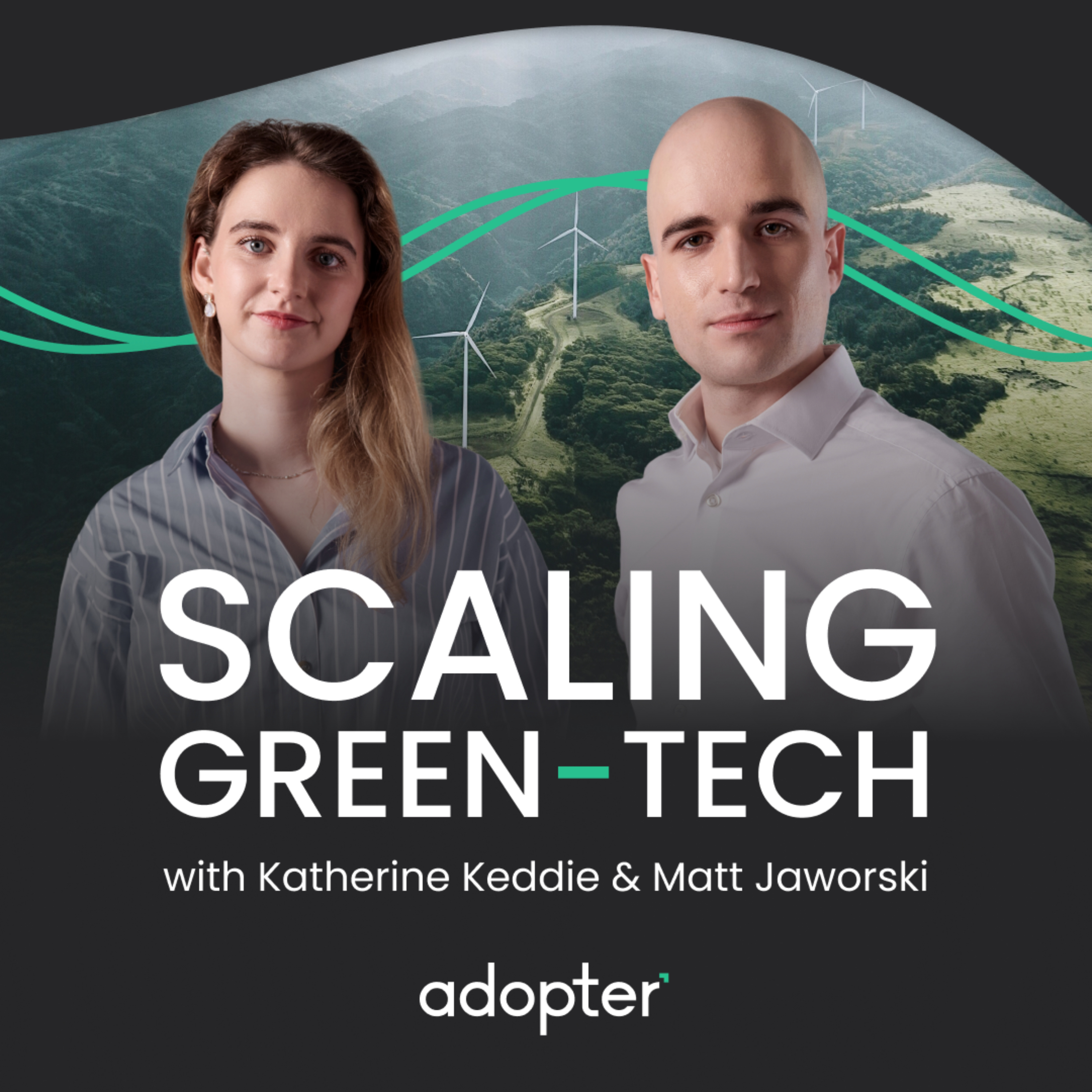
Scaling Green-Tech
Hosted by Matt Jaworski and Katherine Keddie · EN
Scaling Green-Tech by Adopter is a podcast for people shaping the future of climate technology - founders, investors, and ecosystem leaders at the forefront of adaptation and resilience solutions. As part of Adopter’s mission to accelerate the adoption of high-impact climate innovation, the podcast aims to amplify real voices and practical insights that can help others navigate the startup journey. Our conversations go beyond the hype to bring real, unfiltered stories - the wins, the roadblocks and everything you need to know in between.
20episodes
Episodes
Newest firstAll episodes
Martin SFP Bryant (PreSeed Now) - How To Win Attention From Investors and Journalists at Pre-Seed
Mar 400:55:33Tap to summarizeMartin SFP Bryant, Founder of PreSeed Now, discusses what investors and journalists look for from early-stage startups on Episode 20 of Scaling Green Tech, a podcast by Adopter.Bryant draws on nearly 17 years as a technology journalist - including covering ElevenLabs before the launch of ChatGPT - to explain what separates pre-seed startups that attract backing from those that stall. He argues that the strongest founders compress their value proposition into a one-to-two sentence "micro-pitch," citing Stripe's early line ("take payments on your website with a single line of code") as an example of a pitch that immediately communicates both the product and its scale potential. The conversation covers why climate tech companies lose traction when they lead with environmental impact rather than economic value, how the contraction of the tech media landscape has changed founder media strategy, and what Bryant looks for when selecting startups to profile on PreSeed Now from a pipeline of hundreds.This episode is relevant for pre-seed and seed-stage founders preparing to raise investment. It is also useful for climate technology companies refining how they communicate value to investors, customers, and the media. Matt Jaworski hosts.Find out more about Adopter here: https://www.adopter.net/Explore PreSeed Now here: https://preseednow.com/
Transcribe →Paul Domjan (ENODA) - Resolving the Energy Trilemma
Feb 1800:50:38Tap to summarizePaul Domjan, Founder and Chief Policy and Global Affairs Officer at ENODA, discusses grid infrastructure modernisation and the energy trilemma on Episode 19 of Scaling Green Tech, a podcast by Adopter.Paul argues that the electricity grid designed by Nikola Tesla, George Westinghouse, and William Stanley 138 years ago was built for one-directional power flow from large centralised generators to passive consumers - a model fundamentally incompatible with distributed renewable energy that flows in both directions. He traces how this infrastructure gap manifests as renewable curtailment, harmonic distortion, and voltage instability, particularly at the distribution level where the grid meets homes and businesses. In Poland, more than 90% of renewable curtailment results from system balancing limitations rather than grid capacity constraints. ENODA's response is the Prime Exchanger, a device that replaces the distribution transformer serving 60 to 120 homes with digitally controlled infrastructure capable of managing voltage, correcting harmonics, and enabling reverse power flow in real time.This episode is relevant for energy technology founders, grid infrastructure innovators and policymakers looking for the inside scoop on what the energy transition looks like today and in the future. Find out more about Adopter here: https://www.adopter.net/ Explore ENODA here: https://www.enoda.com/
Transcribe →Cam Ross (Green Angel Ventures) - What Makes Climate Tech Investable
Feb 401:01:43Tap to summarizeIn Episode 18 of Scaling Green-Tech, Katherine Keddie and Matt Jaworski are joined by Cam Ross, CEO of Green Angel Ventures, one of the UK’s leading early-stage climate tech investors.Cam breaks down how Green Angel evaluates over a thousand companies each year to find those with the potential to deliver both strong financial returns and meaningful climate impact. They explore what makes a great pitch, why founders matter so much at the earliest stages, and how angel networks can help startups navigate the rigours of growth.The conversation also dives into the realities of scaling climate solutions in capital-intensive and highly regulated industries, and why truly investable climate tech must stand on its own two feet - even if regulation changes. Cam shares top insights on the current funding environment and what founders should focus on when raising capital in 2026.If you’re looking for the inside scoop on raising capital, straight from the investors themselves, this episode’s for you.Find out more about Adopter here.Discover Green Angel Ventures here.Explore the EIS Climate Change Fund here - currently open to investment.
Transcribe →Amandeep Kalra (GreenFlip) - Unlocking the ROI in Decarbonising Homes
Jan 2101:07:03Tap to summarizeIn this episode of Scaling Green-Tech, Katherine Keddie and Matt Jaworski speak with Amandeep Kalra, Co-Founder and CEO of GreenFlip, about what it really takes to decarbonise homes at scale - and why leading with sustainability alone often misses the mark.Amandeep discusses his journey founding GreenFlip, which helps investors identify the homes that deliver the highest ROI from energy upgrades. They explore why comfort, cost, and value are far more powerful drivers of change than carbon targets, and how reframing retrofit as an infrastructure investment can unlock capital, improve tenant outcomes, and future-proof housing stock.The conversation also dives into building a company in public, learning through deep customer discovery, and selling before the product is fully built. Along the way, Amandeep offers candid advice for founders in climate tech, property, and retrofit on messaging, hiring, and scaling in a tougher market environment.If you’re building in housing, retrofit, or climate tech - or grappling with how to turn impact into real-world adoption - this episode is for you.Find out more about Adopter here.Find out more about GreenFlip here.Follow Amandeep on LinkedIn here.
Transcribe →Federico Cristoforoni (Net Zero Insights) - The State of Climate Tech in 2025
Jan 700:51:37Tap to summarizeIn this episode of the Scaling Green-Tech podcast, Katherine Keddie and Matt Jaworski speak with Federico Cristoforoni, Co-Founder and Managing Partner of Net Zero Insights, to unpack the findings from his newly released ‘The State of Climate Tech 2025’ report.Federico shares what the data reveals about the climate tech ecosystem today - including the shift from hype to fundamentals and growing investor selectivity. Together, they explore which technologies are closest to scale, how AI is being applied across climate solutions, why adaptation is quietly gaining momentum, and what’s really happening across key geographies, from the US to India and beyond.They also dig into the hard truths facing founders right now: longer fundraising cycles, fewer grants, tougher commercial expectations, and the growing importance of positioning climate solutions around cost, performance, and resilience - not just impact.If you’re a climate tech founder, investor, or operator trying to understand where the market is headed next, this one’s for you.Find out more about Adopter here.Read The State of Climate Tech 2025 report here.
Transcribe →Simon Zadek (Morphosis) - Introducing the Adaptation Economy
Nov 2601:16:58Tap to summarizeIn this special episode of Scaling Green-Tech, Katherine Keddie sits down with Simon Zadek, Co-Founder and Managing Partner of Morphosis, a Swiss-based adaptation solutions investment business. Morphosis exists to bridge the gap between public ambition and private action, catalysing scalable, inclusive, and market-based solutions that help societies adapt in a climate-impacted world. A globally recognised leader in sustainability economics, Simon unpacks the thinking behind Morphosis and the launch of its landmark report ‘The Rise of the Adaptation Economy: Investing in Adaptation and Resilience in a World Beyond 1.5C’. Developed in partnership with FGV EASP, Itaúsa Institute, The Paulson Institute and Basilinna, the report and associated technical papers provide a first-of-a-kind integrated policy framework to unlock private capital and scale transformative adaptation solutions.Drawing on insights from the report, Simon dissects the multi-trillion dollar opportunity in the adaptation economy, and discusses how innovative frameworks, private capital, and technology can ensure inclusive delivery of goods and services in a climate-impacted world. He details how governments, investors, and innovators can collaborate to engineer new markets for essentials such as food, water, and health that serve low and middle-income households in climate-vulnerable areas. From water desalination to decentralised infrastructure, Simon illustrates how emerging adaptation solutions can become the backbone of thriving, resilient economies.If you’re interested in where the next wave of climate innovation and investment will emerge - and what it takes to turn adaptation into opportunity - this episode is for you.Find out more about Adopter here: https://www.adopter.net. Learn about Morphosis’ work here: https://www.morphosis.solutions/. Read the report and suite of associated technical papers here: https://www.morphosis.solutions/adaptation-economy.
Transcribe →Katherine Foster - Principles for Impactful Systems Innovation
Nov 1701:08:53Tap to summarizeIn this episode of Scaling Green-Tech, Katherine Keddie speaks with Katherine Foster, Innovative Finance Lead at EIT Food and World Economic Forum Fellow, about what it really takes to build systems-level innovation.A pioneering Swiss-Canadian leader in digital sustainable finance and systems change, Katherine brings over 35 years of experience spanning diplomacy, technology, and climate innovation. She shares her personal theory of change - including how to design for complexity rather than control it.Together, they explore the evolution of blended finance, the integration of KPI-linked instruments and layered data frameworks, and why “value” must expand beyond profit to include nature and people in decision making.Katherine also reflects on her work advancing digital and finance innovation for integrated innovation from resilient agri-food systems to water. She addresses her work on data and AI - as tools for innovation, but also on issues of governance and embedded risks. She also highlights the importance of embedding local and contextual expertise at every level and stage of innovation. If you’re working on systems innovation at the intersection of climate finance, water and food systems, this conversation offers a grounded, big-picture perspective on how to move from pilots to integrated approaches for scalable impact.Find out more about Adopter here: https://www.adopter.net.
Transcribe →Juliette Devillard (Climate Connection) - Connecting the Climate Tech Community
Oct 2901:06:11Tap to summarizeIn this episode of Scaling Green-Tech, Katherine Keddie speaks with Juliette Devillard, Founder and CEO of Climate Connection - the UK’s largest community and events platform for climate tech founders, investors, and innovators.Juliette shares how Climate Connection grew from a small post-COVID meetup into a thriving ecosystem where partnerships are formed, investments begin, and teams are built. They explore what makes a truly engaging event, the lessons Juliette brought from the US climate startup scene, and how the UK can nurture a stronger culture of risk-taking and deep-tech investment.They also dive into the human side of scaling - from founder well-being and avoiding burnout, to building purposeful communities and communicating complex ideas in ways that inspire action.If you’re interested in community-led innovation, the culture behind scaling climate tech, or the power of connection in accelerating change, this one’s for you.Find out more about Adopter here: https://www.adopter.net/ Explore Climate Connection here: https://climateconnection.co.uk/
Transcribe →How to Win on LinkedIn in 2025 - A Founder’s Guide to Real Engagement
Oct 1500:30:36Tap to summarizeIn this episode of Scaling Green-Tech, Adopter’s Matt Jaworski and Katherine Keddie unpack what’s new on LinkedIn in 2025 - and how founders can use it to drive real growth.They explore the rise of TikTok-style video feeds, the value of authentic storytelling, and why founder voices consistently outperform brand posts. In 2025, the most effective content isn’t polished or AI-generated, but human, timely, and genuinely useful. Expect practical insights on turning expertise into engagement, creating content that sparks discussion, and reframing your message from sustainability to resilience.If you’re a climate-tech founder ready to make LinkedIn work harder for your mission, this one’s for you.Adopter is Europe’s first marketing company specialised in climate tech and adaptation solutions. Find out more about how we support scaling innovation through strategic digital marketing here.
Transcribe →Anne Snelson and Becky Lane (Furbnow) - Accelerating the Home Energy Transition
Oct 101:32:23Tap to summarizeIn episode 11 of the Scaling Green-Tech podcast, Katherine Keddie sits down with Anne Snelson and Becky Lane to explore how we can accelerate decarbonisation in the domestic built environment. Anne Snelson is a carbon literacy training specialist who works with major corporates to embed climate awareness and drive organisational change. With a background spanning transport, telecoms, and construction, she now focuses on equipping leaders and teams with the knowledge and urgency needed to transition towards net zero. Becky Lane is the CEO and co-founder of Furbnow, a fast-growing startup helping homeowners navigate the complexity of energy efficiency upgrades. Furbnow leverages data, technology, and supply chain expertise to deliver tailored home energy plans, with ambitions to scale across the UK and beyond.Together, they unpack the barriers slowing down progress in housing and construction, the consumer behaviours driving adoption, and why success depends on meeting people where they are. From policymaking gaps to “boiler funerals” and renovation trigger points, this conversation sheds light on the real-world complexities and opportunities in decarbonising our homes. If you’re interested in making retrofit mainstream, the consumer transition to net zero, or how startups can help transform one of the hardest-to-decarbonise sectors, this one’s for you.Find out more about Adopter here. Explore Anne’s work here: Leadwithsustainability.co.uk.Discover Furbnow here: https://furbnow.com/
Transcribe →