
Podcast
SCI Care: What Really Matters
Hosted by International Spinal Cord Society (ISCoS) · EN
A podcast series brought to you by the International Spinal Cord Society (ISCoS). With each episode, we will speak with experts from all over the world to discuss various aspects of spinal cord injury including etiology, prevention and care, providing valuable insights regarding the most up to date information for those providing care for the spinal cord injured. Collaboration is the key and at the heart of what ISCoS does. The podcast series will be an extension of ISCoS, philosophy to make “Life after a spinal cord injury happy, meaningful and worth living..”
10episodes
Episodes
Newest firstAll episodes

A discussion with Dr. Sasha Rabchevsky on current advances in spinal cord injury research
Jun 200:19:36Tap to summarizeSend us Fan MailDr. Alexander (Sasha) Rabchevsky joins Dr. Michael Fehlings to discuss autonomic and cardiovascular control after spinal cord injury, promising neuromodulation results, and the future of SCI research Learning goals:Cover the importance of autonomic function and cardiovascular control after SCIDiscuss the impact of neuromodulation in SCIProvide an overview of future research directions in SCI The opinions of our host and guests are their own; ISCoS does not endorse any individual viewpoints, given products or companies. You can follow us on Twitter and LinkedInContact us directly with any questions or comments at iscos@associationsltd.co.uk
Transcribe →
Evaluating the role of structured rehabilitation in mild degenerative cervical myelopathy- the ReMiDY trial
Apr 100:15:01Tap to summarizeSend us Fan MailCaroline Treanor chats with Dr. Michael Fehlings about degenerative cervical myelopathy (DCM) structured rehabilitation approaches as well as the highly anticipated upcoming ReMiDY trial. Learning objectives:What is degenerative cervical myelopathy (DCM) and why is it important?Discussed the ReMiDY trial and the importance of evaluating structured rehabilitation for DCMCovered enhanced recovery after surgery (ERAS) protocols for DCM and the role of structured rehabilitation The opinions of our host and guests are their own; ISCoS does not endorse any individual viewpoints, given products or companies. You can follow us on Twitter and LinkedInContact us directly with any questions or comments at iscos@associationsltd.co.uk
Transcribe →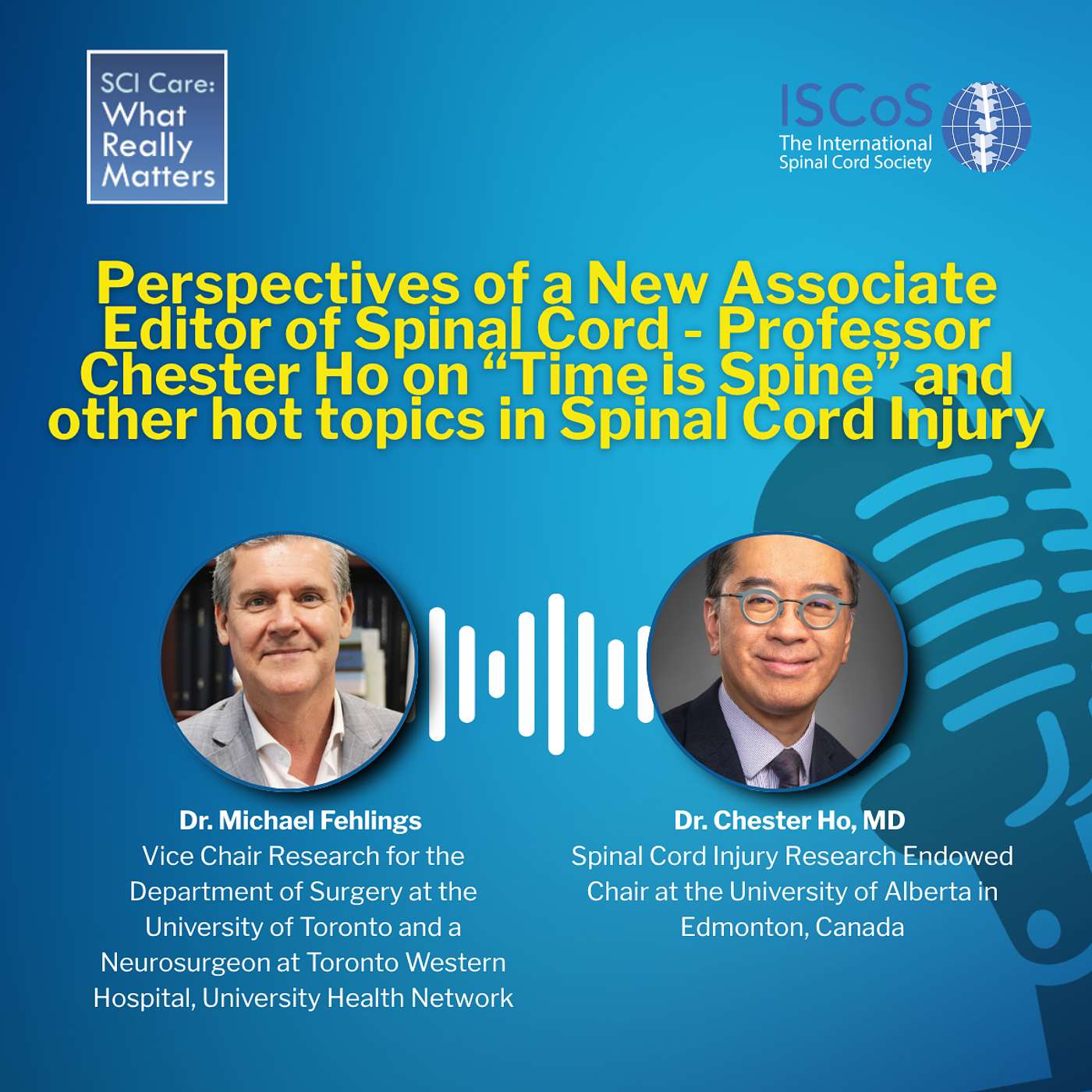
Perspectives of a New Associate Editor of Spinal Cord - Professor Chester Ho on “Time is Spine” and other hot topics in Spinal Cord Injury
Mar 3100:16:59Tap to summarizeSend us Fan MailDr. Michael Fehlings is joined by Dr. Chester Ho – one of the new Associate Editors at Spinal Cord. The conversation covers Dr. Ho’s perspectives on the current state of spinal cord injury research and opportunities for implementing evidence-based approaches in the clinic. Learning goals:The concept of early surgical intervention for acute spinal cord injury was discussedThe Canadian knowledge translation efforts to implement Time is Spine were reviewedOther key areas in spinal cord injury treatment were discussed The opinions of our host and guests are their own; ISCoS does not endorse any individual viewpoints, given products or companies. You can follow us on Twitter and LinkedInContact us directly with any questions or comments at iscos@associationsltd.co.uk
Transcribe →
Evidence-based recommendations for health professionals to improve care of people with spinal cord injury and cognitive impairment: An update to the psychosocial clinical practice guide
Mar 300:11:53Tap to summarizeSend us Fan MailDr. Michael Fehlings is joined by Dr. Mohit Arora to discuss his recent publication in Spinal Cord “Evidence-based recommendations for health professionals to improve care of people with spinal cord injury and cognitive impairment: An update to the psychosocial clinical practice guide”. This episode covers the factors contributing cognitive impairment after SCI, cognitive screening approaches, and future directions for the field. Learning goals:Cognitive impairment after spinal cord injury is common, frequently overlooked, can occur immediately after injury, and arises from multiple contributing factors. If not proactively addressed, it can significantly compromise rehabilitation and long-term outcomes.Routine, validated cognitive screening should occur early and continue across the lifespan, supported by tailored communication strategies and person-centred care.We now have clear, evidence- and consensus-informed recommendations, but meaningful impact depends on system level implementation, including workforce training and supportive clinical environments.What questions will be raised in this webinar/podcast?Introductory remarks from Michael FehlingsMichael Fehlings will ask guest(s) to summarize key points from the manuscriptMichael Fehlings will discuss points with guest(s)Michael Fehlings will ask guest(s) about anticipated future directions for this work as well as clinical impactThe opinions of our host and guests are their own; ISCoS does not endorse any individual viewpoints, given products or companies. You can follow us on Twitter and LinkedInContact us directly with any questions or comments at iscos@associationsltd.co.uk
Transcribe →
SCI Peer Support: The what, the how, and the why?
Dec 1900:54:49Tap to summarizeSend us Fan MailThe Engagement and Peer Support SIG would like to bring the audience through the story of peer support from a historical perspective to its research implications. Teri, Erik, Shane, and Gill will provide how peer support came to be, what it looks like and how different it is, the magic behind it, and how to transform that magic to measurable outcomes and impacts.SpeakersShane Sweet, Associate Professor, McGill University, CanadaGill Hilton, Austin Health, AustraliaErik Berndtsson, Outreach Development Manager, RG Active Rehabilitation, SwedenTeri Thorson, Manager, Peer Coaching and Outreach, SCI British Columbia, CanadaThe opinions of our host and guests are their own; ISCoS does not endorse any individual viewpoints, given products or companies. You can follow us on Twitter and LinkedInContact us directly with any questions or comments at iscos@associationsltd.co.uk
Transcribe →
Opportunities for Data Standardization to Enhance Spinal Cord Injury Research
Dec 500:09:03Tap to summarizeSend us Fan MailKey points:International collaboration is required to produce research that can be interpreted and applied across different regionsAs outcome measures and collection methods continue to evolve a methodical approach to updating research best practices is requiredA larger focus should be on including the thoughts of persons with lived SCI experience when defining research questionsSpeakersDr. Fin Biering-SørensenDr Michael FehlingsThe opinions of our host and guests are their own; ISCoS does not endorse any individual viewpoints, given products or companies. You can follow us on Twitter and LinkedInContact us directly with any questions or comments at iscos@associationsltd.co.uk
Transcribe →
SCI and the Climate Crisis: From Impact to Action
Nov 2701:40:15Tap to summarizeSend us Fan MailPeople with the lived experience of SCIs are one of the most vulnerable groups of in the world-both to the extreme heat and weather events which have increased in frequency because of climate change. Although health care professionals have an opportunity to educate their patients about actions they can use to protect themselves during these extreme weather events, many feel unprepared to discuss the topic. Moreover, health care professionals are beginning to experience moral distress about their inability to take action regarding this existential concern. The webinar will include participants from three continents and multiple disciplines. We will use the interactive platform mentimeter to facilitate the interaction of participants, expressing their feelings about climate change and about sharing their actions.The opinions of our host and guests are their own; ISCoS does not endorse any individual viewpoints, given products or companies. You can follow us on Twitter and LinkedInContact us directly with any questions or comments at iscos@associationsltd.co.uk
Transcribe →
Australia/New Zealand Guidelines for the Physiotherapy Management of Spinal Cord Injury
Nov 2100:15:05Tap to summarizeSend us Fan MailKey points:This podcast summarizes the results of a rigorous evaluation of the evidence for physiotherapy interventions in spinal cord injury using the GRADE methodologyMuscle strengthening exercises are effective for partially paralyzed muscles with MRC Grade 3 and 4 strengthFurther evidence is required in the optimal management of severely paretic musclesSpeaker: Dr. Joanne Glinsky is an Associate Professor of Allied Health (Sydney Local Health District/University of Sydney) and a Senior Research fellow at the John Walsh Centre for Rehabilitation (Kolling Institute/University of Sydney). She has a strong interest in physiotherapy management of people with Spinal Cord Injury and has worked for over 25 years as a clinician, educator and researcher in this field.The opinions of our host and guests are their own; ISCoS does not endorse any individual viewpoints, given products or companies. You can follow us on Twitter and LinkedInContact us directly with any questions or comments at iscos@associationsltd.co.uk
Transcribe →Finding meaning and purpose after spinal cord injury: Reflecting on 5 years of the Engage Program
Nov 1201:29:43Tap to summarizeSend us Fan MailRebuilding a sense of meaning and purpose following trauma is a vital contributor to post-traumatic growth and adapting well to a spinal cord injury (SCI). This webinar shared the co-design process undertaken to develop a course that uses the concept of post-traumatic growth to foster a stronger sense of meaning and purpose after SCI. It presented the course facilitators' reflections on running the program for the last five years, its successes and challenges. Case studies were also used to demonstrate the impact of the course on participants.The opinions of our host and guests are their own; ISCoS does not endorse any individual viewpoints, given products or companies. You can follow us on Twitter and LinkedInContact us directly with any questions or comments at iscos@associationsltd.co.uk
Transcribe →
Experiencing cauda equina syndrome and its aftercare in the UK
Oct 2700:14:49Tap to summarizeSend us Fan MailPoints:Cauda equina syndrome (CES) is a common emergency condition that neurosurgeons and spine surgeons deal with.The long term consequences and the impact on the person dealing with CES are poorly defined.This podcast explores the impact of CES on the person, including pain and autonomic dysfunction, and management strategies which can be implemented by health care professionals.Nish's Affiliation: Nisaharan Srikandarajah is a Consultant Neurosurgeon specialising in complex spine at The Walton Centre and an Honorary Senior Clinical Lecturer at The University of LiverpoolThe opinions of our host and guests are their own; ISCoS does not endorse any individual viewpoints, given products or companies. You can follow us on Twitter and LinkedInContact us directly with any questions or comments at iscos@associationsltd.co.uk
Transcribe →